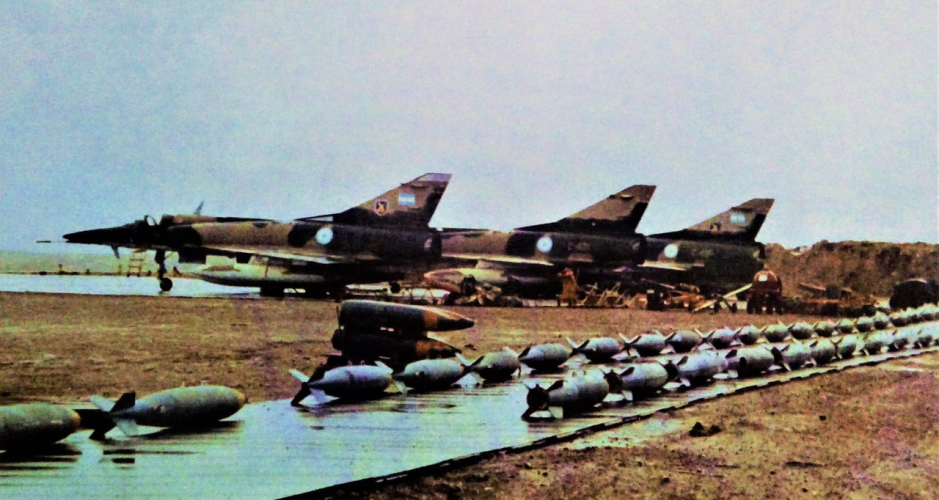
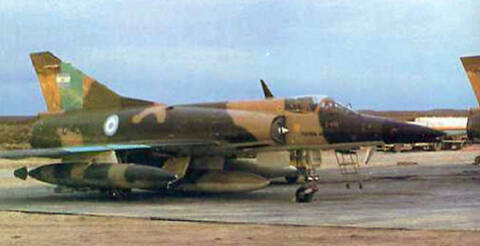
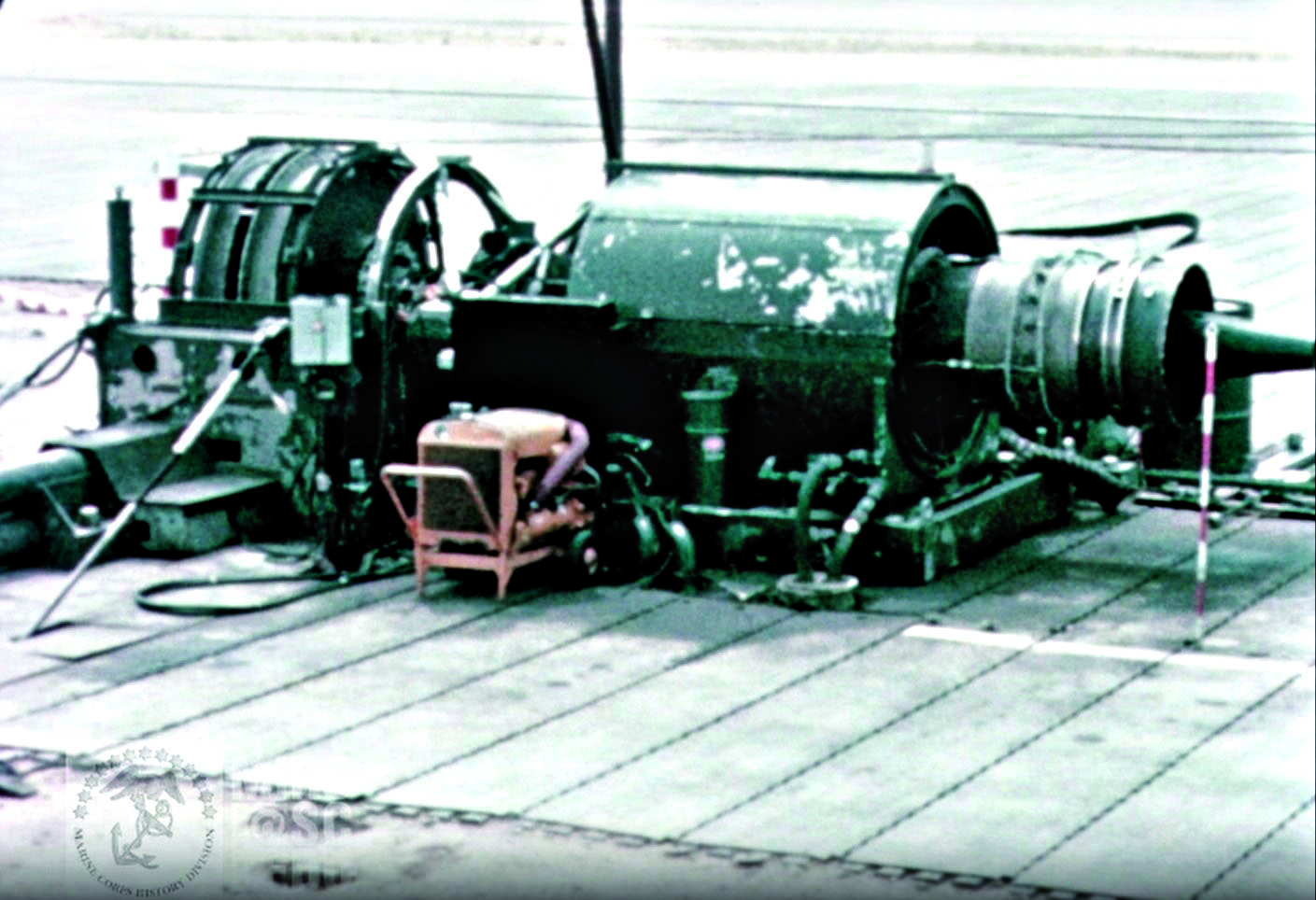
How would an all out attack on the RNs Sea Harriers and GR3s take place, its not as if they were all in the air at once for most of the war? After the initial May 1 strikes on Port Stanley and Goose Green airfields the RN settled into proving a CAP or 2 for the daylight hours. This is a big ask for 10 pairs of aircraft, declining to 8.5 pairs, with a 75 minute flight endurance.
Well first you'd send a flight of 4 fighters from Mt Pleasant to challenge a Sea Harrier CAP. 4 vs 2 means the outcome would likely favor Argentina. Do that a couple of times and soon enough the Sea Harrier CAPs will have to double up. So now shuttle in a few more fighters from the mainland and send 6 or 8 fighters to challenge the Sea Harrier CAP (6-8 vs 4).
Within a couple of days the RN would have to choose between pulling back its CAP aircraft or finding a way to neutralize Mt Pleasant. Pulling back the CAP would significantly reduce their ability to continue with the landings. Historically they were not very successful at neutralizing Mt Pleasant. On top of that any increased attrition to the Sea Harrier force would significantly impede preparations for the landing, and lack of air dominance would make it a lot harder to intercept strikers once the landings did happen.
But all this hinges on fighters being able to operate from Mt Pleasant (i.e. low take-off & landing speeds, brake chute, no complex electronics), with a missile better than AIM-9B (e.g. Magic 1) and a climb rate similar or better to Harrier. They didn't have that but it wasn't unachievable.
If you could get Israel or Argentina to copy/pirate [maybe with the cooperation of South Africa] the Atar 9K50 to power an Argentinian Kfir derivative, then I think you'd have something.
In doing so, retire the existing Mirage III fleet or zero-life them after the Kfir's are delivered, incorporating Kfir components in them during the process.
What does Kfir bring to the table? It still wouldn't be able to operate from Mt Pleasant and not sure the refueling probe had been developed back in 1982. So basically you have a Mirage with slightly more lift.
More internal fuel than the Nesher, which had more fuel than the Mirage IIIE, which had more fuel than the second-hand Israeli Mirage IIIC (that only came after the war) ?
Ok, time for a recap about all those Argentinian Mirages
Total number of aircraft delivered:
-19 IIICJ + 17 IIIEA
-3 IIIBJ + 4 IIIDA -------------------------- 43
-35 IAI Dagger A + 4 Dagger T ---------- 39
-10 Mirage 5P ---------------------------- 10
IIICJs & IIIBJs were ex-Israeli, 5Ps were ex-Peruvian. All were retired in December 2015.
Well first you'd send a flight of 4 fighters from Mt Pleasant to challenge a Sea Harrier CAP. 4 vs 2 means the outcome would likely favor Argentina. Do that a couple of times and soon enough the Sea Harrier CAPs will have to double up. So now shuttle in a few more fighters from the mainland and send 6 or 8 fighters to challenge the Sea Harrier CAP (6-8 vs 4).
Within a couple of days the RN would have to choose between pulling back its CAP aircraft or finding a way to neutralize Mt Pleasant. Pulling back the CAP would significantly reduce their ability to continue with the landings. Historically they were not very successful at neutralizing Mt Pleasant. On top of that any increased attrition to the Sea Harrier force would significantly impede preparations for the landing, and lack of air dominance would make it a lot harder to intercept strikers once the landings did happen.
But all this hinges on fighters being able to operate from Mt Pleasant (i.e. low take-off & landing speeds, brake chute, no complex electronics), with a missile better than AIM-9B (e.g. Magic 1) and a climb rate similar or better to Harrier. They didn't have that but it wasn't unachievable.
Presumably you mean Port Stanley not Mt Pleasant that was built postwar.
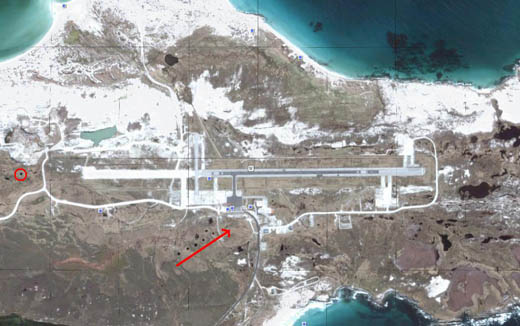
In the picture below the dark grey part of the runway and hardstand was available to the Argentines in April 1982 and the white parts are what the British built postwar with great effort,after delivering 2 big rock crushers and all sorts of gear and closing the runway for some time.
This shows what it takes to allow Stanley to operate modern (in 1982) combat aircraft to the extent where it could sustain an air campaign. I'm afraid you can't really wing it with much less.
More internal fuel than the Nesher, which had more fuel than the Mirage IIIE, which had more fuel than the second-hand Israeli Mirage IIIC (that only came after the war) ?
Ok, time for a recap about all those Argentinian Mirages
Ok so, among all those breeds of Mirage, which one had the better range ? must be a draw between 5P and Daggers I presume ?
Hi
But you need the Ok of the USS for the engine. at that time we have un embargo from USA.
I ll prefer equal number of Mirage F-1AZ, like the SAAF
From Wiki: "Mirage F1A. Single-seat ground-attack fighter aircraft, with limited daylight-only air-to-air capability. Fitted with lightweight EMD AIDA 2 ranging radar instead of Cyrano IV of other variants, with laser rangefinder under nose, retractible refuelling probe and more fuel.
Mirage F1AD : Mirage F1A for Libya. 16 delivered 1978–1979.
Mirage F1AZ : F1A for South Africa. 32 delivered 1975–1976
If i have before war I ll need to test AAR with the C130.
What does Kfir bring to the table? It still wouldn't be able to operate from Mt Pleasant and not sure the refueling probe had been developed back in 1982. So basically you have a Mirage with slightly more lift.
H_K, I would think importantly, the Argentinian Kfir would bring the following to the table:
1/ a consolidation of types - better overall operability;
2/ more modern avionics;
3/ more powerful engine - deriving better performance [including your "lift"]
4/ improved manoeuvrability and control effectiveness thanks to improvements in aerodynamics;
5/ range and time on station, thanks to its air refuelling capability.
As for "operating from Mt Pleasant", I was personally thinking of the Argentinian Air Force as a whole. By focussing on Mt Pleasant is a limiting strategy which has to be recognised by Argentina from the get-go in the overall strategic context of such a war. If you're strategy hinged on having to rely on Mt Pleasant's capture and its continued operability, I'd be seriously questioning the validity of the whole invasion - period. But there lays the strategic blunder of the whole Argentinian initiated war - the Falklands was a populist action by a desperate and unpopular military regime, which was looking for a nationalist distraction vs. a strategically important national interest......
Presumably you mean Port Stanley not Mt Pleasant that was built postwar.
In the picture below the dark grey part of the runway and hardstand was available to the Argentines in April 1982 and the white parts are what the British built postwar with great effort,after delivering 2 big rock crushers and all sorts of gear and closing the runway for some time.
This shows what it takes to allow Stanley to operate modern (in 1982) combat aircraft to the extent where it could sustain an air campaign. I'm afraid you can't really wing it with much less.
We've discussed this before... what you're showing is how to transform Port Stanley into a well equipped airbase for peacetime operations, with full on-site facilities including maintenance aprons, munitions and fuel storage, runway extensions for aborted take offs etc. Obviously that's a massive engineering effort. But the Argentinians would be operating in wartime mode and could make do with fewer facilities, more limited capability and more risk... just as Harriers did from the San Carlos forward operating base.
If Port Stanley were only a forward operating base for shuttle operations, you could reduce maintenance, fuel and munitions resupply capability to the bare minimum. This should be much easier than the real-world San Carlos FOB... you'd install similar loops at the end of each runway (using matting) to allow aircraft to be quickly turned around and/or wait on alert, but a lot of infrastructure would already be there.
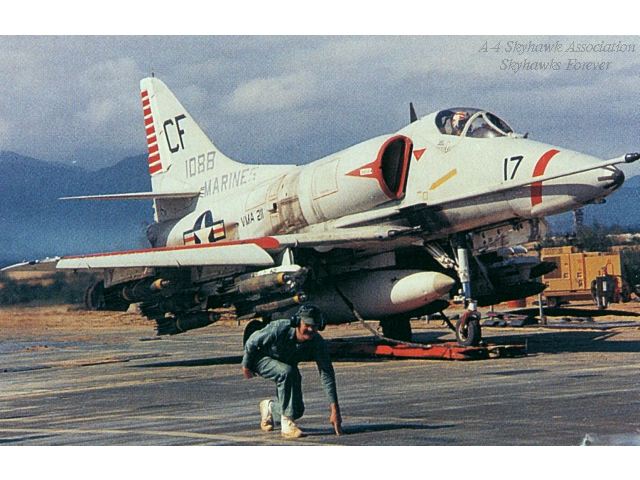
The concern about runway length may be overblown, as it depends largely on the aircraft type. A lightly loaded A-4F or A-4M (for example) has better short field performance than an F-4, even without the extra reheat thrust for TO (largely thanks to its subsonic design and low stall speed). There would be some risk of runway overruns that would have to be accepted on take-off & landing, but again... wartime ops. I'm not convinced however that the A-4B/C had enough thrust. So Argentina needed later-model A-4s. Or perhaps Etendards IVMs.
P.S. Added pic of San Carlos FOB to illustrate the very small amount of ground matting required to receive a small number of fighters with quick turnarounds.
So, turning loops on each end, a couple of fueling/rearming revetments to keep a CAP on, and lots of C130 missions moving fuel and AAMs to the islands.
@H_K on the contrary, as it was the Port Stanley airfield supported 213 flights by Air Force and civilian C130, F28, B737 and BAC 1-11 in 10 days, in addition Navy Electra and F28s flew 100 missions during the war plus whatever else the air force flew that isn't counted in those 10 days. This sort of aircraft movement, with single aircraft on the runway and only a couple of aircraft on the hardstand at any one time is doable without turning loops, taxiways and all the other stuff.
When you get multiple combat aircraft having the land at the same time things get tricky. In Black Buck 1 the first 6 Victors had to land at Ascension one after the other and wait at the end of the runway, so the last tanker was coming in to a 'short' runway with 5 aircraft at the end hoping his brakes worked in order to avoid destroying all 6 aircraft in a collision.
This is why turning loops, multiple access to the hardstand and the longer runway aren't frills, they're essential to get the first fighter out of the way of the ones following less than a minute behind. You're Sids Strip picture shows the same in reverse, the loop being used to allow Harriers to take off in combat 'flights' of multiple aircraft in rapid succession.
When loops, hardstand etc becomes the minimum for even semi-regular combat aircraft operations like shuttle bombing/CAPs then the magnitude of the task in front of the Argentines becomes apparent. They have to get the heavy equipment, PSP and all the other stuff over to the Falklands before the SSN blockade is announced and get the airfield up to minimum fighting standard by the time of Black Buck 1 and the Sea Harrier strikes the following morning. Its a big ask, even if they had plans ready to go, which they didn't.
That's the issue. The Argentine government didn't plan or have their follow-on forces set up with separate transportation.
There was plenty of information and AARs about building/repairing/upgrading runways more or less as the second wave onto the beach from the US operations in the Pacific. Including doing that construction work while the enemy was still within rifle range of the runway.
There should have been a plan for the Argentine combat engineers to arrive before the shooting stopped to fix the airport to a "minimally-viable combat airfield" standard. Turning loops at least at one end if there's a plan to lengthen the runway, refueling stations, revetments for any fighters being stationed on the islands, etc.
There should have been a plan for the Argentine combat engineers to arrive before the shooting stopped to fix the airport to a "minimally-viable combat airfield" standard. Turning loops at least at one end if there's a plan to lengthen the runway, refueling stations, revetments for any fighters being stationed on the islands, etc.
There doesn't even need to be fighters stationed at a minimally viable combat airfield, they just need to be able to use it as needed. Daggers and Mirages in particular were very marginal on fuel for the round trip, but if they could land at Port Stanley after expending ordnance, refuel and head back to the mainland that would allow them to use their afterburners, take evasive routing (crucial for Daggers IIUC) and/or carry a greater payload.
That said Port Stanley is hideously vulnerable to enemy action, being stuck on a peninsula that juts right out into the RN's playground. Revetments would be a must, although they're likely not too difficult to arrange with a bulldozer, front-end loader and dump truck.
I agree with you, but
keep in mind this facts:
1- Dagger have tu use same route to attack due to the lack of endurance over the islands
2- before war, as a doctrine, only the naval aviation have the task and trainign to attack ships. Air force, was to support and attack in land.
So no training the pilots before the war.
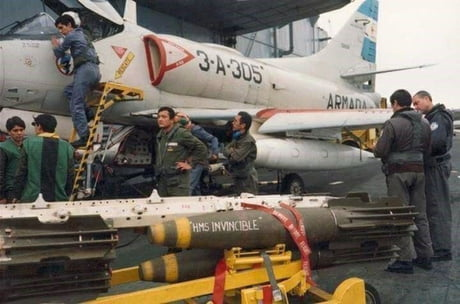
The Mk 82 Snake eye, was the mostly the main bomb of the naval aviation.
Air force use a GP bomb with parachutes
A-4Q on CV furing war
You see Snake
A-4B and C
GP bombs
Bombs for Dagger
Attack configuration of a Dagger for the attcak
In and out using the same route, for the lack of fuel
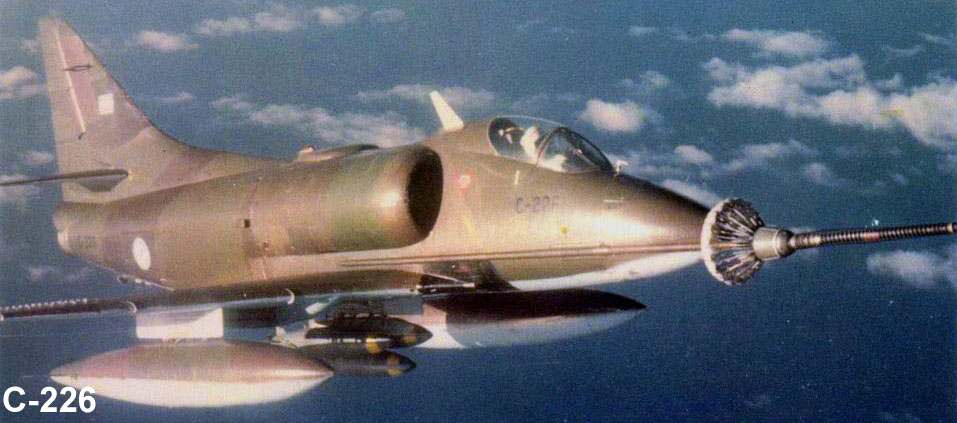
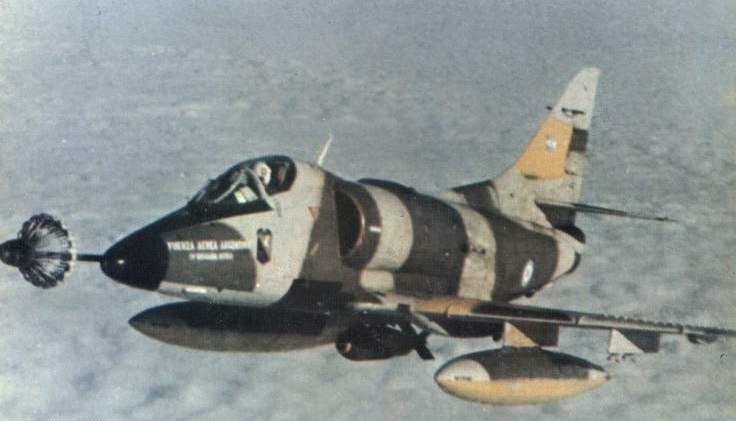
No M-III or M-5 / Dagger with IRF. After war some proyects come to light in France to give IFR to M-III
Is in spanish, but explain why IAI Dagger can have IFR
This is why turning loops, multiple access to the hardstand and the longer runway aren't frills, they're essential to get the first fighter out of the way of the ones following less than a minute behind. You're Sids Strip picture shows the same in reverse, the loop being used to allow Harriers to take off in combat 'flights' of multiple aircraft in rapid succession.
The San Carlos FOB picture shows 2 very simple loops using PSP matting. These double up as both taxi and servicing areas. One pair of aircraft could be accommodated on each loop, up to 4 if necessary.
Install these loops on each runway end and you have a functional solution to accommodate and turnaround flights of fighters with minimal engineering.
The San Carlos FOB picture shows 2 very simple loops using PSP matting. These double up as both taxi and servicing areas. One pair of aircraft could be accommodated on each loop, up to 4 if necessary.
Install these loops on each runway end and you have a functional solution to accommodate and turnaround flights of fighters with minimal engineering.
You'd have to extend the runway and install arrestor gear as well, 4,100' is just too short in the wet weather. IIUC the Argentines did consider and perhaps attempt to lengthen the runway by ~500', which is better but still very short.
You'd have to extend the runway and install arrestor gear as well, 4,100' is just too short in the wet weather. IIUC the Argentines did consider and perhaps attempt to lengthen the runway by ~500', which is better but still very short.
Want would obviously be a whole parallel runway with parallel taxiways 10,000ft long, but that's expensive in time and materials. Not that Seabees etc don't have constructions like that planned out in great detail, including the exotic concrete mixes needed to fully cure in less than a week. But you're still talking 2 weeks or more from start to first flight.
The RAF thought it needed 6,100' and 5 RHAG sets for Phantoms, which are of the same vintage as the Argentine jets although much heavier. The USMC SATS base at Chu Lai started A4 operations with 3,545' using arrested landing and rocket assisted take-offs, going to catapults launches later while an 8,000' runway was built. We know that 4,100' was considered by the Argentines to be too short for regular safe landings and I've seen 500' bandied about as an extension.
My guess, and it's only a guess, is that 4,600' and an arrestor wire would be the bare minimum for anything other than dire emergency use. 5,000-5,500' and maybe a 2nd arrestor wire set would allow semi-regular use, at which point the other stuff like hardstand, loops etc starts to rear it's ugly head.
Not even Mt Pleasant has that. It has an 8,300' main runway with a turning loop at either end although one doubles as a huge hardstand for big aircraft. It is intersected by a 4,800' runway with large fillets (not loops) at either end that goes into an area with 17 fighter dispersal revetments. There's also a short taxiway linking these 2 runways, but the whole thing isn't heaving with extra taxiways etc.
The RAF thought it needed 6,100' and 5 RHAG sets for Phantoms, which are of the same vintage as the Argentine jets although much heavier. The USMC SATS base at Chu Lai started A4 operations with 3,545' using arrested landing and rocket assisted take-offs, going to catapults launches later while an 8,000' runway was built. We know that 4,100' was considered by the Argentines to be too short for regular safe landings and I've seen 500' bandied about as an extension.
With brake chutes the 4,100’ runway at Port Stanley was long enough for A-4s. The brake chute reduced landing rolls in wet conditions (RCR=15) by 38%, from ~4,500ft to ~2,750ft [A-4M NATOPS]. This is at a landing weight of ~13klbs ie. with ~2klbs of bringback (fuel and weapons).
You’d have to compare to F-4K performance but the A-4 had the advantage of a low landing speed, ~120 knots.
The problem for Argentina of course was that their A-4s didn’t have brake chutes installed. This meant that only the Super Etendards, which *did* have brake chutes, could land at Port Stanley. But in wet conditions that was considered marginal. The SuE landed a little faster than the Skyhawk (125 knots) and the asymmetric carriage of a (rather precious) Exocet underwing wouldn’t have helped. An A-4 landing with just a pair of AAMs and an empty belly tank wouldn’t have faced the same constraints.
The real clincher for me is that the FAA and COAN never tried it, they decided it wasn't feasible without bothering to test it even though they had time. Surely the leadup to wartime is the time to try the difficult things, if they could pay off.
Would a thread on 'fighting airfields' get any traction, if it was in the right place?
Article here about the creation of the San Carlos FOB and the difficulties faced in doing so.
[ https://www.thinkdefence.co.uk/docs/the-san-carlos-fob-forward-operating-base/
The unfortunate thing was that the Atlantic Conveyor had received orders on the morning of 25th May to enter San Carlos Water that evening to begin unloading. Before that could happen she was hit by two Exocets and lost with much of the equipment she had been carrying lost with her.
Argentine aircraft for air combat against the Harrier, or one that could destroy Harrier operations by destroying its embarked naval air base?
Regarding the air base runway, much has already been said...it was a problem of not having planned or tried before, during, or after...
For air-to-air combat, the answer becomes simplistic, as the question would be on equal terms? Refueling and flight time? There are many variables...the Dagger or Mi-III itself was superior, but they couldn't fight on equal terms because they came very heavy from the continent, heavy and limited in weapons and time...the A-4 likewise...the MiG-21 on equal terms could be a good adversary, but it's well known that its range invalidated it as a candidate....
So, everything comes back to being able to use a light aircraft, with short takeoff, but with a flight envelope used from the islands, that could replicate the successful missions of the Argentine fighters operated and that came from the continent...
Okay...okay....let's not waste time discussing the top speed in an open oceanic attack...but anyway, at least against an amphibious invasion, the small speed difference is irrelevant for attacking ships in the channels....the distance was very short, the planes came around the terrain of the islands and descended in the last seconds along the slopes attacking the ships....remember that most of the time the ships were only 2 km from the shore...that is...the lower speed was irrelevant because the reaction time of the ships, as well as the blindness of the radars due to the terrain behind the planes, were very detrimental....even lighter planes would be very efficient and, if operated from the islands, would be equivalent to any attack carried out by Daggers and A4s coming from the mainland.
...In the picture below the dark grey part of the runway and hardstand was available to the Argentines in April 1982 and the white parts are what the British built postwar with great effort, after delivering 2 big rock crushers and all sorts of gear and closing the runway for some time. This shows what it takes to allow Stanley to operate modern (in 1982) combat aircraft to the extent where it could sustain an air campaign. I'm afraid you can't really wing it with much less.
...We've discussed this before... what you're showing is how to transform Port Stanley into a well equipped airbase for peacetime operations, with full on-site facilities including maintenance aprons, munitions and fuel storage, runway extensions for aborted take offs etc. Obviously that's a massive engineering effort. But the Argentinians would be operating in wartime mode and could make do with fewer facilities, more limited capability and more risk... just as Harriers did from the San Carlos forward operating base. If Port Stanley were only a forward operating base for shuttle operations, you could reduce maintenance, fuel and munitions resupply capability to the bare minimum. This should be much easier than the real-world San Carlos FOB... you'd install similar loops at the end of each runway (using matting) to allow aircraft to be quickly turned around and/or wait on alert, but a lot of infrastructure would already be there. The concern about runway length may be overblown, as it depends largely on the aircraft type. A lightly loaded A-4F or A-4M (for example) has better short field performance than an F-4, even without the extra reheat thrust for TO (largely thanks to its subsonic design and low stall speed). There would be some risk of runway overruns that would have to be accepted on take-off & landing, but again... wartime ops. I'm not convinced however that the A-4B/C had enough thrust. So Argentina needed later-model A-4s. Or perhaps Etendards IVMs. P.S. Added pic of San Carlos FOB to illustrate the very small amount of ground matting required to receive a small number of fighters with quick turnarounds.
...When loops, hardstand etc becomes the minimum for even semi-regular combat aircraft operations like shuttle bombing/CAPs then the magnitude of the task in front of the Argentines becomes apparent. They have to get the heavy equipment, PSP and all the other stuff over to the Falklands before the SSN blockade is announced and get the airfield up to minimum fighting standard by the time of Black Buck 1 and the Sea Harrier strikes the following morning. Its a big ask, even if they had plans ready to go, which they didn't.
That's the issue. The Argentine government didn't plan or have their follow-on forces set up with separate transportation. There was plenty of information and AARs about building/repairing/upgrading runways more or less as the second wave onto the beach from the US operations in the Pacific. Including doing that construction work while the enemy was still within rifle range of the runway. There should have been a plan for the Argentine combat engineers to arrive before the shooting stopped to fix the airport to a "minimally-viable combat airfield" standard. Turning loops at least at one end if there's a plan to lengthen the runway, refueling stations, revetments for any fighters being stationed on the islands, etc.
You'd have to extend the runway and install arrestor gear as well, 4,100' is just too short in the wet weather. IIUC the Argentines did consider and perhaps attempt to lengthen the runway by ~500', which is better but still very short.
In his 2006 book Razor's Edge: The Unofficial History of the Falklands War, Hugh Bicheno noted that local ham radio enthusiast Reginald Silvey covertly informed the UK that there were no civilians on the peninsula of Stanley airfield, allowing bombardment to proceed. Page 126: "By Argentine count the airfield peninsula was hit by 218 bombs, 1200 naval shells and was strafed twenty-two times: an enormous investment to no permanent effect [because the runway remained in use till the end of the war]. The battle for the airfield was only saved from being a serious British defeat by the unconscionable Argentine failure to include materials and engineers for the extension of the Stanley runway in their invasion plan, or to give it top priority once the British Task Force sailed."
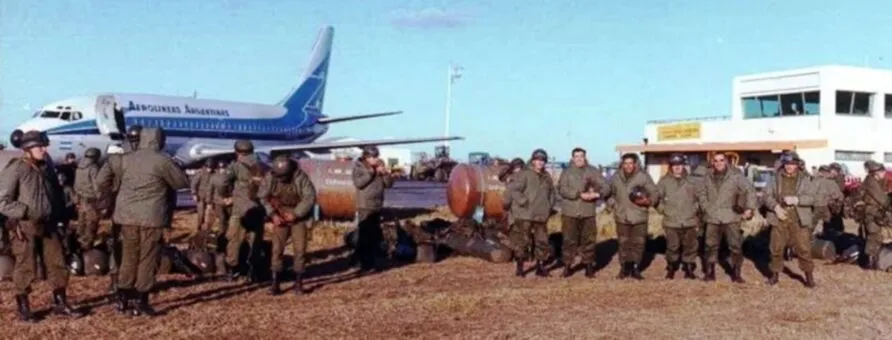
On the other hand, the Argentines did land a laden 707 airliner on the existing runway at Stanley. In his book The Fight for the 'Malvinas': The Argentine Forces in the Falklands War (Penguin, 1990), Martin Middlebrook wrote (p52) "The first unit of X Brigade—an advance party of the 3rd Regiment—left El Palomar Airport [near Buenos Aires] in the early hours of 11 April [1982] in a Boeing 707 of the national airline, Aerolineas Argentinas; the airliner had all its seats removed to enable a maximum load to be carried. After a refuelling stop in the south of the country, Stanley was reached in the first light of dawn, the aircraft captain not liking the appearance of the short runway but managing to land safely." The book doesn't mention it, but that airliner must have taken off from the short runway and successfully returned home. So it seems there was more margin at Stanley to 'wing it' (in extremis) than any peacetime regulation would have allowed.
(The Boeing 707 that spotted the oncoming British Task Force at sea on 21 April was an Argentine Air Force transport flying from the mainland.)
In his 2006 book Razor's Edge: The Unofficial History of the Falklands War, Hugh Bicheno noted that local ham radio enthusiast Reginald Silvey covertly informed the UK that there were no civilians on the peninsula of Stanley airfield, allowing bombardment to proceed. Page 126: "By Argentine count the airfield peninsula was hit by 218 bombs, 1200 naval shells and was strafed twenty-two times: an enormous investment to no permanent effect [because the runway remained in use till the end of the war]. The battle for the airfield was only saved from being a serious British defeat by the unconscionable Argentine failure to include materials and engineers for the extension of the Stanley runway in their invasion plan, or to give it top priority once the British Task Force sailed."
On the other hand, the Argentines did land a laden 707 airliner on the existing runway at Stanley. In his book The Fight for the 'Malvinas': The Argentine Forces in the Falklands War (Penguin, 1990), Martin Middlebrook wrote (p52) "The first unit of X Brigade—an advance party of the 3rd Regiment—left El Palomar Airport [near Buenos Aires] in the early hours of 11 April [1982] in a Boeing 707 of the national airline, Aerolineas Argentinas; the airliner had all its seats removed to enable a maximum load to be carried. After a refuelling stop in the south of the country, Stanley was reached in the first light of dawn, the aircraft captain not liking the appearance of the short runway but managing to land safely." The book doesn't mention it, but that airliner must have taken off from the short runway and successfully returned home. So it seems there was more margin at Stanley to 'wing it' (in extremis) than any peacetime regulation would have allowed.
(The Boeing 707 that spotted the oncoming British Task Force at sea on 21 April was an Argentine Air Force transport flying from the mainland.)
I've seen pictures of 737s and BAC 111s at Port Stanley but never even heard about a 707 landing and taking off from that 4,100' runway until just then.
I can't imagine that such an event wouldn't be widely known and constantly debated on this site.
...So, everything comes back to being able to use a light aircraft, with short takeoff, but with a flight envelope used from the islands, that could replicate the successful missions of the Argentine fighters operated and that came from the continent.
Okay...okay....let's not waste time discussing the top speed in an open oceanic attack...but anyway, at least against an amphibious invasion, the small speed difference is irrelevant for attacking ships in the channels....the distance was very short, the planes came around the terrain of the islands and descended in the last seconds along the slopes attacking the ships....remember that most of the time the ships were only 2 km from the shore...that is...the lower speed was irrelevant because the reaction time of the ships, as well as the blindness of the radars due to the terrain behind the planes, were very detrimental....even lighter planes would be very efficient and, if operated from the islands, would be equivalent to any attack carried out by Daggers and A4s coming from the mainland.
Maybe, Carvalho2008. But in fact this was tried. The Argentine Navy stationed four armed Beechcraft T-34C-1 Turbo-Mentors and six Aermacchi MB-339 jets in the Falklands, and the Air Force put twenty-four IA58 Pucarás there. During the war these shot down one British Army Westland Scout helicopter and put a Zuni rocket and some cannon shells into frigate HMS Argonaut, but otherwise they accomplished little despite motivated pilots, and all were lost (some ended up in UK museums).
See for example the article "Pucara's Wrong War" by Argentine author Salvador Mafé Huertas in the April 1996 issue of Air International.
You would have to explain how those 34 planes could have been more effective, or how similar light aircraft could get results in a future Falklands war.
When I say a combat aircraft capable of replicating the same attack envelope as the A4s from the mainland, I'm talking about aircraft similar to the MB339. It's extremely easy and frequent to confuse the importance of the MB339 or similar aircraft with their operational record in the Falklands. In reality, we can almost say that they didn't operate there, given that they only accumulated about 6 hours of missions... This was precisely because it was never the true option and mainstay of the Argentine Air Force. At the beginning of the war, they had only about 12 units and were practically out of operation due to lack of maintenance. With the start of the war, some were put into operation and 6 were moved to the islands. In other words, they were already in poor condition and visibly without an operational maintenance structure similar to that which was set up for the Pucaras. This changes absolutely everything!!!! There were a good number of extra landing craft that could have been replaced with each loss... but obviously, this didn't happen because, being totally inadequate for anti-ship attacks, it wasn't worth it. Thus, British ships could stay 2 km away in the island channels or less than 70 km away in the ocean... the MB339 had only one anti-ship mission and it was effective, even with light armament. Look at their operational chart and you'll see they didn't have any flight hours... But if Port Stanley had a ballast of 14 to 20 of them, with a maintenance team proportional to its operational needs, much could have been done. Seriously... they simply didn't fly... allocating landing craft was the materialization of yet another strategic error... they focused on land support... but obviously... if you focus on land support, it's because the invasion has already occurred and naval gunfire support is already 15 km away...
Maybe, Carvalho2008. But in fact this was tried. The Argentine Navy stationed four armed Beechcraft T-34C-1 Turbo-Mentors and six Aermacchi MB-339 jets in the Falklands, and the Air Force put twenty-four IA58 Pucarás there. During the war these shot down one British Army Westland Scout helicopter and put a Zuni rocket and some cannon shells into frigate HMS Argonaut, but otherwise they accomplished little despite motivated pilots, and all were lost (some ended up in UK museums).
See for example the article "Pucara's Wrong War" by Argentine author Salvador Mafé Huertas in the April 1996 issue of Air International.
You would have to explain how those 34 planes could have been more effective, or how similar light aircraft could get results in a future Falklands war.
The following text was originally published in April 2010. Due to the 38th anniversary of the conflict, it is worthwhile to revisit it so that new generations can better understand the history of the conflict.
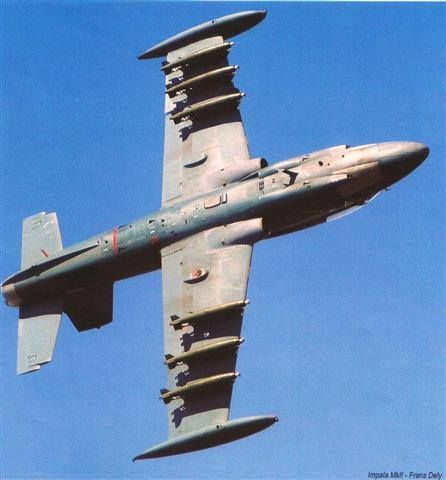
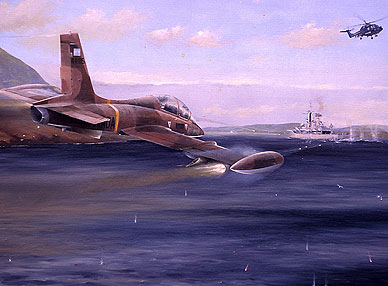
The “1st Naval Attack Squadron”, based in Punta Índio, Buenos Aires province, was one of the Argentine Naval Aviation units that had its baptism of fire during the Falklands War. In 1982, the unit was equipped with Italian-made MB.326 and MB.339 jets. The MB.339 is the “younger brother” of the well-known EMB.326 Xavante jet.
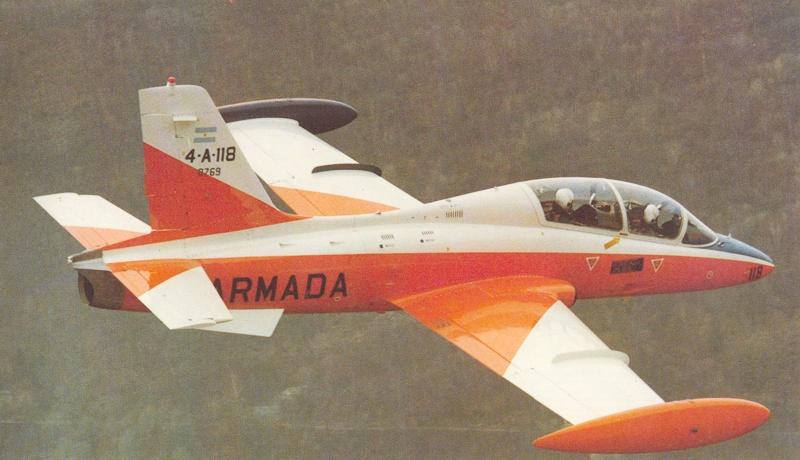
The Argentine Navy, the first customer of the 339, had acquired ten units at the end of 1980 and transferred them the following year. For the role of armed trainer, the 339 was capable of carrying just under two tons of armament on six pylons under the wings. The aircraft arrived painted in orange and white, just like the aircraft sold to Peru.
In March 1982, the 1st Squadron had low availability, around 40%. After the conclusion of "Operation Rosario," the name given to the action to recapture the islands, the 1st Squadron received orders to send a division of four Aermacchi MB.339 aircraft to Rio Grande. The squadron quickly worked to solve the aircraft problems, and in the first half of April, 16 (10 of which were MB.339s) of the unit's 17 aircraft were airworthy.
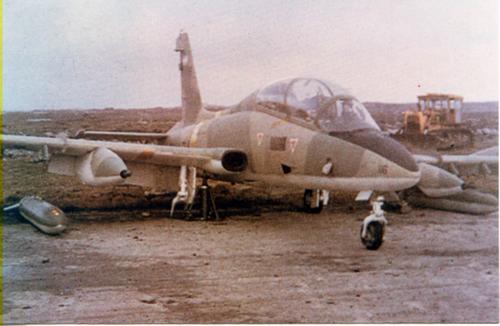
On April 24th, two MB.339s (4-A-113 and 4-A-116), accompanied by a BE-200, took off from Rio Grande at 9:45 am, arriving at 11:15 am in Puerto Argentino, as the location and airfield of Port Stanley in the Falkland Islands was renamed. The aircraft were parked off the runway on aluminum planks, near runway 26. Between April 25th and 30th, three reconnaissance and familiarization flights were conducted over the island.
In the Falklands, the 339s were intended to operate not only in armed reconnaissance but also in maritime attack and close air support. For this latter role, a configuration was chosen with two 30mm DEFA 553 cannons on internal pylons (each pod with a capacity of 120 projectiles) and two Zuni LAU-10/A rocket pods (four 127mm rockets per pod) on intermediate pylons.
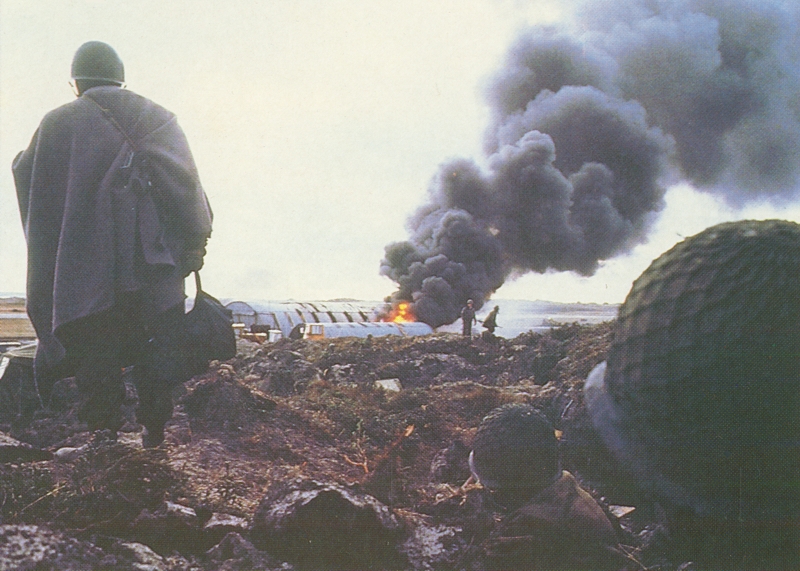
The tranquility of the end of April was replaced by intense action on May 1st. In the morning, the Puerto Argentino airfield was attacked by Royal Navy Sea Harriers, and luckily, none of the 339s were hit. However, one of the bombs destroyed 30 JP-1 fuel drums belonging to the fighters.
Later that same day, the division's aircraft were scrambled to investigate two contacts detected by the radar installed on the island. They appeared to be helicopters, but nothing was found. The two MB-339s were again scrambled on the 3rd to investigate a "surface echo" detected 60 miles away on a heading of 160º.
Flying close to the sea and in completely adverse weather conditions, the two aircraft reached the location indicated by the radar, but found nothing. Returning in combat formation and at low altitude, the leader ("Capitan de Corbeta" Molteni) landed on runway 26. Right behind him came "Teniente de Frigata" (First Lieutenant) Carlos Alberto Benitez, who, flying so low, ended up touching the wingtip of his aircraft on a small elevation in the ground. Benitez lost control of the aircraft, but still had time to eject. Unfortunately, because he was close to the ground and the aircraft was tilted, the parachute did not open and the Argentine pilot died in the crash. The war had barely begun for the 1st Squadron, and it had just lost its first aircraft and its first pilot.
Given the situation, new aircraft were requested. On the same day as the tragic accident (May 3rd), two more MB.339s were transferred from Espora to Rio Grande. The following day, in the afternoon, two planes departed for Puerto Argentino. After 12 minutes of flight, the pilots were alerted that the Puerto Argentino airfield was under attack and returned to the mainland. In the following days, enemy air activity and radar picket ships, combined with unfavorable weather, prevented reinforcements from reaching the island. Only on May 15th were the two aircraft (4-A-112 and 4-A-115) able to land in Puerto Argentino.
A historic mission
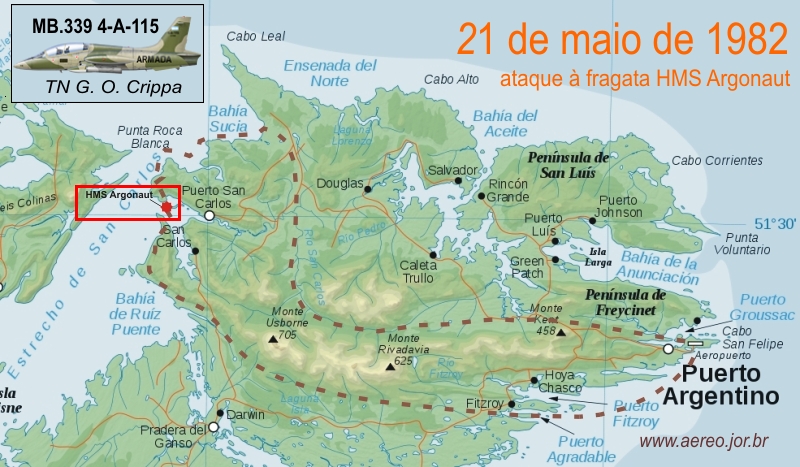
At the Puerto Argentino airfield, Argentine naval aviation officers met on the afternoon of the 20th to plan the following day's mission. "Capitán de Frigata" Oscar Manuel Arce, commander of the naval air station, informed "Tenientes de Navío" (Lieutenant Commander, equivalent to Captain in the Air Force) Guillermo Owen Crippa and Horacio Talarico, MB.339 pilots, that on the morning of the following day (May 21st) two aircraft should fly over the San Carlos Strait region. There were indications that an enemy landing might occur in that area. However, the scale of such a maneuver was unknown, as was whether it would simply be a diversionary landing.
The mission was to be carried out at very low altitude, skirting the higher slopes and using the island's terrain as a defense. From Puerto Argentino, the two aircraft would head west, following the Rivadavia mountain range, which crossed Soledad Island from east to west. Near Mount Usborne (the island's highest point), the jets would follow a valley that would take them directly to San Carlos.
On the morning of the 21st, the weather was overcast over the islands. The cloud ceiling was low, and there was fog and localized drizzle. It wasn't the best day for flying, but conditions were satisfactory for completing the mission. From very early on, the mechanics worked exhaustively on both aircraft, but technical problems requiring more time-consuming solutions appeared on Talarico's plane.
Around 8:30 am, Argentine Army patrols reported the presence of ships in the San Carlos Strait. As completing the mission was crucial, every effort was made to ensure that at least one of the aircraft was airworthy. Shortly before ten o'clock in the morning, Lieutenant Crippa's plane was ready. In a way, the delay allowed for an improvement in the weather, although it was still cloudy (with low clouds) and foggy in some places.
It was 10:04 AM when Crippa lined up his MB.339 with runway 08 and received clearance from the tower to take off. After takeoff, Crippa turned gently to the left and headed west. After passing through the Argentine defense lines and Mount Kent, the naval officer had complete freedom to attack any helicopter he encountered along the way.
Not far from Mount Kent, Crippa observed two columns of gray smoke rising from the ground. They were Army helicopters (a Chinook and a Puma) that had been attacked by RAF Harrier GR.3s earlier that morning. If Crippa's aircraft had taken off two hours earlier, his fate might have been different. But this was his day.
Flying within the San Carlos River valley, Crippa encountered a thick layer of fog near the ground that caused a series of reflections with the sun's rays, impairing visibility. The Argentine officer then decided to change course and enter the San Carlos Strait from its northern side. This way, he would also have the sun at his back as much as possible.
Upon reaching North Bay, he found no ships and turned left into the strait. Near Punta Roca Blanca Bay, flying at an altitude of 500 feet and approximately 300 knots, Crippa identified a ship which, according to him, was a Type 21 frigate. At first, the ship did not notice the aircraft, which was following the coast at low altitude. A few seconds later, he spotted other ships near the location of the Type 21. As he passed one of the hills bordering the San Carlos Strait, he came face to face with a Royal Navy Lynx helicopter hovering about 1,000 feet above the sea surface.
Since Crippa had orders to attack any helicopter he encountered, he maneuvered the aircraft (he was lower than the helicopter) to carry out the attack. Moments before pulling the trigger, the Argentine officer identified another ship. It was the frigate HMS Argonaut (Leander class). As it was a higher-value target, Crippa maneuvered the MB.339 to the left and charged towards the ship. At the moment of firing the cannon, no projectile left the barrel. He tried with the Zuni rockets and again, nothing. He then realized that he had not selected the armament's "master switch," which he did immediately.
It was approximately 10:30 am when Crippa was almost over the ship. He aimed at the bridge and the surrounding electronic systems. He knew he couldn't sink the frigate, but at least he would try to disable it.
He fired everything he could (cannons and rockets) before raising the nose of the aircraft, turning back towards the sea and passing by the stern while already executing evasive maneuvers. Three crew members were injured and the Type 965 air surveillance radar was put out of action.
At this point his presence was no longer a surprise and every gunship that existed there began firing at his plane. It was a fight of one against all.
Crippa observed that a Fearless-class amphibious assault ship (HMS Fearless or HMS Intrepid) to his left had fired a missile (most likely a Seacat), which missed him. The further the MB.339 advanced through that stretch of sea, the more ships it encountered. It flew even lower and at full power weaved between the ships of the British fleet. Momentarily the fire ceased, with the possibility of one ship hitting another. But this was short-lived. As a way to get rid of the ships once and for all, the Argentine pilot sought refuge behind the hills. After clearing the first hill, Crippa came face to face with more ships to his right, anchored in Ruiz Puente Bay. Again, the firing against his plane began. Quickly, Crippa turned left towards the town of Puerto Sussex.
Before returning to Puerto Argentino, he gained altitude and made a smooth left turn to carry out a final reconnaissance. In his assessment, there were fourteen medium and large ships in San Carlos. It was a very high concentration in such restricted waters. There was no longer any doubt, the "invasion" had begun.
Crippa's task was to return and provide all possible information about the flight. The report was not made via radio, as the low flight, practically "glued to the terrain," greatly reduced the VHF range. There was also the fear of encountering a Sea Harrier CAP if their return route was revealed by the transmission.
And their return route became the biggest concern at that moment. As the outward navigation had been altered due to weather conditions, geographical references had been lost.
Being further south than he should have been, Crippa would pass close to Puerto Darwin, where there was an Argentine garrison unaware of his whereabouts and mission. Friendly anti-aircraft artillery could even hit him, as had already happened to Captain García Cuerva of the FAA, shot down near Puerto Argentino by friendly fire.
Crippa then decided to fly "close to the ground" and skirting the hills of Rivadavia, as these would lead him to the eastern side of the island. A few minutes later, the MB.339 was already flying over Agradable Bay. Certain that he was close to "home," the Argentine pilot climbed and communicated with the airfield. After receiving instructions, he headed for landing. Before aligning with the runway, he made one last contact.
It was approximately 10:45 am when Crippa landed. Upon leaving the cockpit, he headed to the Operations Center, where he reported in detail on the attack and the situation of the British fleet in the strait. It was the first detailed account of the landing. His information was crucial for subsequent attacks from the continent. Crippa was awarded the "medalla al heroico valor en combate" (medal for heroic valor in combat).
The operational readiness of the MB-339s was severely affected by local conditions. The lack of infrastructure to maintain and store the aircraft on the tarmac, coupled with the harsh winter (which affected the aircraft's electrical systems), greatly reduced aircraft availability. In addition to the loss of 4-A-113, 4-A-116 had engine damage from shrapnel and 4-A-115 had electrical failures. Only 4-A-112 was airworthy. More MB-339s were needed.
On May 26th, accompanied by a Fokker F-28, three MB-339s (4-A-110, 4-A-114, and 4-A-117) departed Rio Grande bound for Puerto Argentino, where they arrived at 2:32 PM. On the same day, a maintenance effort was made to put the 4-A-115 back into service using parts salvaged from the 4-A-112 and 4-A-116. This measure was urgent, as British troops were advancing on Darwin and the MB.339s needed to be employed in close air support missions.
Despite the adversities, two aircraft (4-A-114 and 4-A-117) were launched on the morning of the 28th to support the army in Darwin. With worsening weather and near-zero visibility, the mission was aborted. In the afternoon, the weather improved and the same aircraft took off westward. The attack was carried out using cannons and Zuni rockets. “Capitan de Corbeta” Molteni, pilot of 4-A-117, observed the firing of a missile and initiated diversionary maneuvers. The other MB.339 (4-A-114) was not so lucky, and its pilot, “Teniente de Corbeta” Daniel Enrique Miguel, was shot down by a Royal Marines Blowpipe MANPAD. The following day the British captured Darwin.
To make matters worse, an air raid on the Puerto Argentino airfield on May 30th, carried out by RAF Harriers, put 4-A-110 out of action, which had arrived on the island four days earlier. Shrapnel pierced a wingtip fuel tank. The only good news of the day for the 1st Squadron was the return of 4-A-115 to the flight line. The following three days saw extremely low temperatures, and the aircraft parked outdoors suffered greatly as a result. The armament system was affected, and problems with the engine starting electrical system worsened (when the battery temperature dropped too low, it was unable to supply 19V). With three aircraft out of action, two lost, and only two airworthy, it was decided to end the squadron's activities in the conflict.
Total aircraft used: 7
Number of missions flown: 4
Total combat flight hours: 21:20h
Aircraft lost: 2
Aircraft captured: 3
Pilots killed during combat: 2
@carvalho2008 the pictures in your post provide a good indication of what was wrong with Port Stanley Airfield. The most capable aircraft on the islands is pushed backward onto some hastily laid PSP that doesn't appear to have anything like gravel under it, rather than on the existing hardstand or better prepared airfield extension works. It sits out in the open, there are no revetments, earth berms, railway sleepers (these left with a hastily departing ship after Black Buck 1) to give it even the minimum protection from shelling and air attack.
I'm not surprised these MB339s flew 6 hours, the airfield wasn't conducive to flying more.
@carvalho2008 the pictures in your post provide a good indication of what was wrong with Port Stanley Airfield. The most capable aircraft on the islands is pushed backward onto some hastily laid PSP that doesn't appear to have anything like gravel under it, rather than on the existing hardstand or better prepared airfield extension works. It sits out in the open, there are no revetments, earth berms, railway sleepers (these left with a hastily departing ship after Black Buck 1) to give it even the minimum protection from shelling and air attack.
I wonder what the Argentines would have done if they had more or less completed their full ~12 month planning cycle? Early on the tiny planning cell was directed not to plan for the defense of the islands, but this may have changed as the cell progressed with their planning. Does making the airstrip more useful and useable count as defensive preparation?
I dunno. I mean, that airstrip was absolutely marginal for flying even 737s into, and fast jets are even more voracious runway eaters.
I cannot imagine planning to take an island from another country without planning to place or enlarge an airfield to handle whatever cargo planes and fast jets my country operates.
I dunno. I mean, that airstrip was absolutely marginal for flying even 737s into, and fast jets are even more voracious runway eaters.
I cannot imagine planning to take an island from another country without planning to place or enlarge an airfield to handle whatever cargo planes and fast jets my country operates.
For me it's whether the airport expansion is a medium-long term vs short term project for the Argentines.
While they may have a medium-long term plan to expand the airport the question is does the military plan including landing airport expansion gear in the first day? Or does their directive mean they wait and see if the invasion is accepted as fiat accompli?
If they do have to wait, and then are forced to react to the British sending a task force what can they accomplish in a short time if they are prepared for this scenario. IIUC the Maritime Exclusion Zone was declared in 12 days and the Total Exclusion Zone declared in 30 days, despite there were Argentine ships in Port Stanley when the Vulcan bombed the airport. So ship have free reign for about 2 weeks and can still risk it for a month, and the bombing started in a month. What can be achieved in that time period?
Continuing, well... we talked about the use of fighters similar to the MB-339, light aircraft capable of replicating the exact attack profile within the channels and bay of São Carlos, and still providing some oceanic naval attack capability to create a greater distance from the British aircraft carriers. In short, the fact that Argentina employed MB-339s is always mentioned as a counter-argument, but I demonstrated that they, in fact, did not operate them.
Total aircraft used: 7
Number of missions flown: 4
Total combat flight hours: 21:20h
Aircraft lost: 2
Aircraft captured: 3
Pilots killed during combat: 2
This site uses cookies to help personalise content, tailor your experience and to keep you logged in if you register.
By continuing to use this site, you are consenting to our use of cookies.