
MiG-21MF/bis vs Sea Harriers ?

  • Sea Harriers would have complete air superiority.

  • Sea Harriers would have had some losses.

  • Sea Harriers would have been blasted out of the sky.

  • None of the two aircraft would have gained air superiority.


Results are only viewable after voting.
How would an all out attack on the RNs Sea Harriers and GR3s take place, its not as if they were all in the air at once for most of the war? After the initial May 1 strikes on Port Stanley and Goose Green airfields the RN settled into proving a CAP or 2 for the daylight hours. This is a big ask for 10 pairs of aircraft, declining to 8.5 pairs, with a 75 minute flight endurance.
Well first you'd send a flight of 4 fighters from Mt Pleasant to challenge a Sea Harrier CAP. 4 vs 2 means the outcome would likely favor Argentina. Do that a couple of times and soon enough the Sea Harrier CAPs will have to double up. So now shuttle in a few more fighters from the mainland and send 6 or 8 fighters to challenge the Sea Harrier CAP (6-8 vs 4).

Within a couple of days the RN would have to choose between pulling back its CAP aircraft or finding a way to neutralize Mt Pleasant. Pulling back the CAP would significantly reduce their ability to continue with the landings. Historically they were not very successful at neutralizing Mt Pleasant. On top of that any increased attrition to the Sea Harrier force would significantly impede preparations for the landing, and lack of air dominance would make it a lot harder to intercept strikers once the landings did happen.

But all this hinges on fighters being able to operate from Mt Pleasant (i.e. low take-off & landing speeds, brake chute, no complex electronics), with a missile better than AIM-9B (e.g. Magic 1) and a climb rate similar or better to Harrier. They didn't have that but it wasn't unachievable.
 
If you could get Israel or Argentina to copy/pirate [maybe with the cooperation of South Africa] the Atar 9K50 to power an Argentinian Kfir derivative, then I think you'd have something.
In doing so, retire the existing Mirage III fleet or zero-life them after the Kfir's are delivered, incorporating Kfir components in them during the process.
What does Kfir bring to the table? It still wouldn't be able to operate from Mt Pleasant and not sure the refueling probe had been developed back in 1982. So basically you have a Mirage with slightly more lift.
 
More internal fuel than the Nesher, which had more fuel than the Mirage IIIE, which had more fuel than the second-hand Israeli Mirage IIIC (that only came after the war) ?
Ok, time for a recap about all those Argentinian Mirages
Total number of aircraft delivered:
-19 IIICJ + 17 IIIEA
-3 IIIBJ + 4 IIIDA -------------------------- 43
-35 IAI Dagger A + 4 Dagger T ---------- 39
-10 Mirage 5P ---------------------------- 10

IIICJs & IIIBJs were ex-Israeli, 5Ps were ex-Peruvian. All were retired in December 2015.
Ok so, among all those breeds of Mirage, which one had the better range ? must be a draw between 5P and Daggers I presume ?
 
Last edited:
Well first you'd send a flight of 4 fighters from Mt Pleasant to challenge a Sea Harrier CAP. 4 vs 2 means the outcome would likely favor Argentina. Do that a couple of times and soon enough the Sea Harrier CAPs will have to double up. So now shuttle in a few more fighters from the mainland and send 6 or 8 fighters to challenge the Sea Harrier CAP (6-8 vs 4).

Within a couple of days the RN would have to choose between pulling back its CAP aircraft or finding a way to neutralize Mt Pleasant. Pulling back the CAP would significantly reduce their ability to continue with the landings. Historically they were not very successful at neutralizing Mt Pleasant. On top of that any increased attrition to the Sea Harrier force would significantly impede preparations for the landing, and lack of air dominance would make it a lot harder to intercept strikers once the landings did happen.

But all this hinges on fighters being able to operate from Mt Pleasant (i.e. low take-off & landing speeds, brake chute, no complex electronics), with a missile better than AIM-9B (e.g. Magic 1) and a climb rate similar or better to Harrier. They didn't have that but it wasn't unachievable.

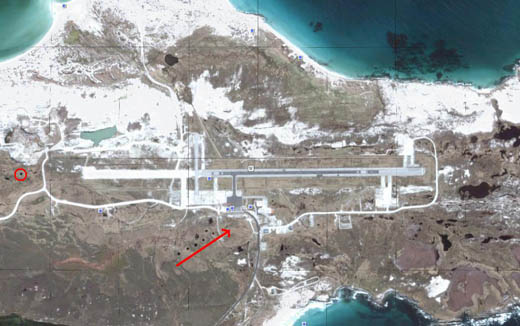
Presumably you mean Port Stanley not Mt Pleasant that was built postwar.

In the picture below the dark grey part of the runway and hardstand was available to the Argentines in April 1982 and the white parts are what the British built postwar with great effort,after delivering 2 big rock crushers and all sorts of gear and closing the runway for some time.

This shows what it takes to allow Stanley to operate modern (in 1982) combat aircraft to the extent where it could sustain an air campaign. I'm afraid you can't really wing it with much less.


1776543592388.png
 
More internal fuel than the Nesher, which had more fuel than the Mirage IIIE, which had more fuel than the second-hand Israeli Mirage IIIC (that only came after the war) ?
Ok, time for a recap about all those Argentinian Mirages

Ok so, among all those breeds of Mirage, which one had the better range ? must be a draw between 5P and Daggers I presume ?
Hi
But you need the Ok of the USS for the engine. at that time we have un embargo from USA.
I ll prefer equal number of Mirage F-1AZ, like the SAAF
From Wiki: "Mirage F1A. Single-seat ground-attack fighter aircraft, with limited daylight-only air-to-air capability. Fitted with lightweight EMD AIDA 2 ranging radar instead of Cyrano IV of other variants, with laser rangefinder under nose, retractible refuelling probe and more fuel.
Mirage F1AD : Mirage F1A for Libya. 16 delivered 1978–1979.
Mirage F1AZ : F1A for South Africa. 32 delivered 1975–1976

If i have before war I ll need to test AAR with the C130.
 
What does Kfir bring to the table? It still wouldn't be able to operate from Mt Pleasant and not sure the refueling probe had been developed back in 1982. So basically you have a Mirage with slightly more lift.
H_K, I would think importantly, the Argentinian Kfir would bring the following to the table:

1/ a consolidation of types - better overall operability;
2/ more modern avionics;
3/ more powerful engine - deriving better performance [including your "lift"]
4/ improved manoeuvrability and control effectiveness thanks to improvements in aerodynamics;
5/ range and time on station, thanks to its air refuelling capability.

As for "operating from Mt Pleasant", I was personally thinking of the Argentinian Air Force as a whole. By focussing on Mt Pleasant is a limiting strategy which has to be recognised by Argentina from the get-go in the overall strategic context of such a war. If you're strategy hinged on having to rely on Mt Pleasant's capture and its continued operability, I'd be seriously questioning the validity of the whole invasion - period. But there lays the strategic blunder of the whole Argentinian initiated war - the Falklands was a populist action by a desperate and unpopular military regime, which was looking for a nationalist distraction vs. a strategically important national interest......

Regards
Pioneer
 
Last edited:
Back
Top Bottom