I don’t have any math chops either. Seems like gravity is closer to the strong nuclear force than anything. If “electrogravitics” were a thing, you’d see cows floating in thunderstorms, and some fop in a powdered wig would have done experiments in it long ago, flipping over his pantaloons as he tried to row his little floating box.

You are using an out of date browser. It may not display this or other websites correctly.
You should upgrade or use an alternative browser.
You should upgrade or use an alternative browser.
Alcubierre Warp Drive starship IXS Enterprise
- Thread starter Triton
- Start date
-
- Tags
- 2010s nasa united states
royabulgaf
ACCESS: Top Secret
- Joined
- 29 December 2008
- Messages
- 684
- Reaction score
- 390
Justo, I don't want to see UranusSometimes scientists get stuck in a problem and have no choice but to use their creativity to imagine concepts that justify their theories, although they call it theoretical physics that sounds better.
In 1869 Dmitri Mendeleev had the 'inspiration' of creating a farsighted version of the periodic table of elements leaving gaps for some elements still unknown but of predictable properties. He was lucky and when they were discovered, between 1874 and 1886, he became a hero.
In 1930 Wolfgang Pauli 'invented' a particle called Neutrino as a desperate remedy to explain an incomprehensible phenomenon named Beta disintegration, knowing that perhaps its existence could never be experimentally proven. But he got lucky and the Neutrino was officially discovered in 1956.
In 1984 a physicist of the Berkeley University named Richard Mueller imagined the existence of Nemesis, a dark star orbiting at 16,000,000,000 kilometers around the Sun, to explain certain orbital alterations experienced by Uranus and Neptune. But so far, he has not had any luck.
At the beginning of the twentieth century, science became stuck again because the established paradigm of the Standard Model of Particle Physics was unable to explain the Dark Matter, the Dark Energy, the Gravitational Quantum State, and the Cosmological Constant phenomena. The theoretical physicists have been formulating models on the String Theory that are impossible to demonstrate because this would require amounts of energy that exceed the available technology.
Science or faith?
In 2018 Sabine Hossenfelder of the Frankfurt Institute for Advanced Studies, published the book ‘Lost in Math: How Beauty Leads Physics Astray’. Sabine argues that the theoretical physicists have lost the North. We have not seen a major breakthrough in the foundations of physics for more than four decades. Paucity of major advances in fundamental physics is partly due to an overemphasis on aesthetic criteria such as symmetry and mathematical beauty, in the face of their inability to overcome the new challenges posed to science.
In 1453, while the Turks shelled the walls of Constantinople with 1,054 mm heavy artillery, Byzantine theologians were debating the sex of angels instead of defending the fortress. They ended badly.
Science Fiction writers have 'solved' the issue by imagining a subspace driver using Faster Than Light (FTL) technology, something that violates Einstein's established paradigm. Everyone knows this is impossible, but my neural network by defect tells me it will finally be built by someone who did not know it... or we will stay here until the Sun freezes!
The FTL hypothesis starts out from the assumption that technological progress has no upper limit. But we must consider the possibility that the human mind be incapable of solving the problem. Nor can we lift a ton of weight, fly, run at 100 mph, breath underwater, or see Uranus, the heat, or the bacteria... but we have found a way to build machines that do it for us.
Maybe Artificial Intelligence will uncover the secrets of the FTL.
Interstellar travel will only stop being a utopia when the theoretical physicists became desperate to consider all the time lost in the face of a barrier that had been existing only in their own minds.
If they are unable to develop a new Physics, they will end up being replaced by an Artificial Intelligence that does not respect the established paradigm.
 . Here's a thought. Maybe these problems are solvable, but we simply are not intelligent enough to solve them. We may build computers capable of solving this, but perjhaps we are not intelligent enough to even ask the right question? Take an analogy. You could spend a thousand lifetimes trying to teach dogs long division, but you never will be able to.
In that case, Artificial Intelligence could be used as a translation interface, many people drive vehicles without knowing anything about mechanics and use levers of all kinds without knowing who Archimedes was.Justo, I don't want to see UranusSometimes scientists get stuck in a problem and have no choice but to use their creativity to imagine concepts that justify their theories, although they call it theoretical physics that sounds better.
In 1869 Dmitri Mendeleev had the 'inspiration' of creating a farsighted version of the periodic table of elements leaving gaps for some elements still unknown but of predictable properties. He was lucky and when they were discovered, between 1874 and 1886, he became a hero.
In 1930 Wolfgang Pauli 'invented' a particle called Neutrino as a desperate remedy to explain an incomprehensible phenomenon named Beta disintegration, knowing that perhaps its existence could never be experimentally proven. But he got lucky and the Neutrino was officially discovered in 1956.
In 1984 a physicist of the Berkeley University named Richard Mueller imagined the existence of Nemesis, a dark star orbiting at 16,000,000,000 kilometers around the Sun, to explain certain orbital alterations experienced by Uranus and Neptune. But so far, he has not had any luck.
At the beginning of the twentieth century, science became stuck again because the established paradigm of the Standard Model of Particle Physics was unable to explain the Dark Matter, the Dark Energy, the Gravitational Quantum State, and the Cosmological Constant phenomena. The theoretical physicists have been formulating models on the String Theory that are impossible to demonstrate because this would require amounts of energy that exceed the available technology.
Science or faith?
In 2018 Sabine Hossenfelder of the Frankfurt Institute for Advanced Studies, published the book ‘Lost in Math: How Beauty Leads Physics Astray’. Sabine argues that the theoretical physicists have lost the North. We have not seen a major breakthrough in the foundations of physics for more than four decades. Paucity of major advances in fundamental physics is partly due to an overemphasis on aesthetic criteria such as symmetry and mathematical beauty, in the face of their inability to overcome the new challenges posed to science.
In 1453, while the Turks shelled the walls of Constantinople with 1,054 mm heavy artillery, Byzantine theologians were debating the sex of angels instead of defending the fortress. They ended badly.
Science Fiction writers have 'solved' the issue by imagining a subspace driver using Faster Than Light (FTL) technology, something that violates Einstein's established paradigm. Everyone knows this is impossible, but my neural network by defect tells me it will finally be built by someone who did not know it... or we will stay here until the Sun freezes!
The FTL hypothesis starts out from the assumption that technological progress has no upper limit. But we must consider the possibility that the human mind be incapable of solving the problem. Nor can we lift a ton of weight, fly, run at 100 mph, breath underwater, or see Uranus, the heat, or the bacteria... but we have found a way to build machines that do it for us.
Maybe Artificial Intelligence will uncover the secrets of the FTL.
Interstellar travel will only stop being a utopia when the theoretical physicists became desperate to consider all the time lost in the face of a barrier that had been existing only in their own minds.
If they are unable to develop a new Physics, they will end up being replaced by an Artificial Intelligence that does not respect the established paradigm.

archipeppe
ACCESS: Top Secret
- Joined
- 18 October 2007
- Messages
- 2,556
- Reaction score
- 3,892
A friend showed me in his technical training book where the Air Force said in the mid-80s that frequent static bursts on certain frequencies of a radio channel were caused by Starships using their Warp Drives in the outer Solar System... Then on the next page it states this is actually caused by sun spots
Randy
Randy

- Joined
- 1 May 2007
- Messages
- 2,815
- Reaction score
- 2,657
As I understand it you don't have to go beyond C to get somewhere fast...time slows so much neat the speed of light.
But only for the people travelling. This is the 'Time Dilation' effect. A rough example, 'cos I'm not an expert in this, if you climb in your starship and travel at 0.9c ( nine tenths of the speed of light ) for a year, when you return you will find that many more years will have passed, than the one you spent onboard your ship . . . also while you have aged by a year, everyone else will have aged by many more years, and will now be much older than you are . . .
cheers,
Robin.

Nik
ACCESS: Top Secret
- Joined
- 15 July 2009
- Messages
- 1,374
- Reaction score
- 1,208
The 'Hubble Tension', where space 'old & far' seems to expand at too-many sigmas different rate to 'near & new', may have been solved. Cosmologist has noticed that may only take a whisker of oblateness in the expansion to square them...
https://phys.org/news/2022-01-superhorizon-modes-hubble-tension.htmlOr Cosmic rotation, perhaps ??
I've been watching for 'Tele-Parallel' news, but nothing non-woo has shown up that doesn't need scary-serious math to even begin to grok...
IIRC, with several competing takes, though better than trad String Theory's zilliions, there's the issue that no-one has yet thought of a way to robustly challenge / falsify any of them with current or near-term tech. Bit like the early Solar Neutrino and Gravitational Wave hunts. Or, um, exo-planets...
FWIW, they're hunting magnetic monopoles again !!
https://phys.org/news/2022-02-harnessing-strongest-magnetic-fields-universe.html"With no signs of the signal, the researchers were able to exclude the existence of monopoles lighter than 75 GeV/c2, where c is the speed of light, for magnetic charges ranging from 1 to 3 base units of magnetic charge."
Per hunt for 'Dark Matter', finding any will blow the lid off our best current models, extend them like Einstein did for Newton...
Likewise, there's something weird about the Muon, the electron's short-lived heavier cousin, whose electric and magnetic dipole moments sneer at attempts to predict them. Another case of 'too-many sigmas difference'. Either there's a subtle 'gotcha' in the math, or potentially new physics. Or both ??
https://phys.org/news/2022-01-superhorizon-modes-hubble-tension.htmlOr Cosmic rotation, perhaps ??
I've been watching for 'Tele-Parallel' news, but nothing non-woo has shown up that doesn't need scary-serious math to even begin to grok...
IIRC, with several competing takes, though better than trad String Theory's zilliions, there's the issue that no-one has yet thought of a way to robustly challenge / falsify any of them with current or near-term tech. Bit like the early Solar Neutrino and Gravitational Wave hunts. Or, um, exo-planets...
FWIW, they're hunting magnetic monopoles again !!
https://phys.org/news/2022-02-harnessing-strongest-magnetic-fields-universe.html"With no signs of the signal, the researchers were able to exclude the existence of monopoles lighter than 75 GeV/c2, where c is the speed of light, for magnetic charges ranging from 1 to 3 base units of magnetic charge."
Per hunt for 'Dark Matter', finding any will blow the lid off our best current models, extend them like Einstein did for Newton...
Likewise, there's something weird about the Muon, the electron's short-lived heavier cousin, whose electric and magnetic dipole moments sneer at attempts to predict them. Another case of 'too-many sigmas difference'. Either there's a subtle 'gotcha' in the math, or potentially new physics. Or both ??

Deltafan
ACCESS: Top Secret
- Joined
- 8 May 2006
- Messages
- 1,784
- Reaction score
- 2,767
Chance Glenn, Maybe a name that the future will remember, or not...
https://www.msn.com/en-us/news/tech...e-with-ethylene-glycol/ar-AA172zh2?li=BBnb7Kz
https://www.msn.com/en-us/news/tech...e-with-ethylene-glycol/ar-AA172zh2?li=BBnb7Kz

Brett Davidson
ACCESS: Top Secret
- Joined
- 26 September 2006
- Messages
- 4,441
- Reaction score
- 12,826
I get pretty warped on ethanol.

- Joined
- 21 January 2015
- Messages
- 14,995
- Reaction score
- 24,210
New video from Cool Worlds -What’s Stopping Us From Building A Warp Drive:
View: https://youtu.be/SBBWJ_c8piM
Scott Kenny
ACCESS: USAP
- Joined
- 15 May 2023
- Messages
- 19,533
- Reaction score
- 27,979
At 0.707cee, the subjective time to the travelers equals the lightyear distance. A 13ly trip at 0.707cee only takes 13 years by crew subjective time.As I understand it you don't have to go beyond C to get somewhere fast...time slows so much near the speed of light.
Of course, getting up to 0.707cee is a different story.
Maybe wormholes are real after all
https://phys.org/news/2024-01-astrophysicists-theoretical-proof-traversable-wormholes.html
https://phys.org/news/2024-01-astrophysicists-theoretical-proof-traversable-wormholes.html
Brett Davidson
ACCESS: Top Secret
- Joined
- 26 September 2006
- Messages
- 4,441
- Reaction score
- 12,826
On overview.
https://www.goincrediblyfast.com/
https://www.limitlessspace.org/
And a nice animation.
View: https://www.youtube.com/watch?v=RiJFo-kaJBQ&t=5s
Doesn't refute https://www.secretprojects.co.uk/th...ive-starship-ixs-enterprise.22236/post-613473 of course but it looks pretty.
https://www.goincrediblyfast.com/
https://www.limitlessspace.org/
And a nice animation.
Doesn't refute https://www.secretprojects.co.uk/th...ive-starship-ixs-enterprise.22236/post-613473 of course but it looks pretty.

topspeed3
ACCESS: Secret
- Joined
- 31 January 2011
- Messages
- 496
- Reaction score
- 276
That is the next step.At 0.707cee, the subjective time to the travelers equals the lightyear distance. A 13ly trip at 0.707cee only takes 13 years by crew subjective time.
Of course, getting up to 0.707cee is a different story.
Scott Kenny
ACCESS: USAP
- Joined
- 15 May 2023
- Messages
- 19,533
- Reaction score
- 27,979
Still means the people back on earth see however long the actual trip time is. It's just the passengers on the lighthugger that get the advantage of shortened subjective time.That is the next step.
Nik
ACCESS: Top Secret
- Joined
- 15 July 2009
- Messages
- 1,374
- Reaction score
- 1,208
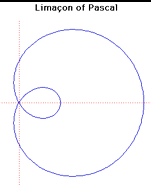
Somewhat Off-Topic, but, exasperated by the problems with 'practicable' Alcubierre Drives --Their outrageous energy budget plus assembly using oodles of 'Unobtanium'-- that I, perforce, cheated.
In my 'Convention' tales, their FTL uses a 'Double Bubble', such that ship efficiently rides along within a 'Limaçon of Pascal'...

In my 'Convention' tales, their FTL uses a 'Double Bubble', such that ship efficiently rides along within a 'Limaçon of Pascal'...
- Joined
- 21 January 2015
- Messages
- 14,995
- Reaction score
- 24,210
New paper on Warp Drive’s along with a related video:
https://arxiv.org/abs/2404.03095
View: https://youtu.be/rZC65Q3F_Mk
https://arxiv.org/abs/2404.03095
Here is the paper she is talking about:
https://arxiv.org/pdf/2404.03095
The subluminal version:
https://iopscience.iop.org/article/10.1088/1361-6382/ad26aahttps://phys.org/news/2024-05-subluminal-warp.htmlIn this new study, the team has built a model that draws similar conclusions, but without the need for negative, or any other types of exotic energy.
The team blends both new and traditional physics techniques based on gravity to describe the creation of a warp bubble around an object, allowing it to travel at speeds that are far beyond those that have been proposed to date—though, not at or above the speed of light.
The engine behind the technology, the researchers suggest, would involve combining a shell made of stable matter with a "shift vector distribution" similar in design to that described by Alcubierre.
They further suggest such an engine could allow for speeds near the speed of light.
https://arxiv.org/pdf/2404.03095
The subluminal version:
https://iopscience.iop.org/article/10.1088/1361-6382/ad26aahttps://phys.org/news/2024-05-subluminal-warp.htmlIn this new study, the team has built a model that draws similar conclusions, but without the need for negative, or any other types of exotic energy.
The team blends both new and traditional physics techniques based on gravity to describe the creation of a warp bubble around an object, allowing it to travel at speeds that are far beyond those that have been proposed to date—though, not at or above the speed of light.
The engine behind the technology, the researchers suggest, would involve combining a shell made of stable matter with a "shift vector distribution" similar in design to that described by Alcubierre.
They further suggest such an engine could allow for speeds near the speed of light.
topspeed3
ACCESS: Secret
- Joined
- 31 January 2011
- Messages
- 496
- Reaction score
- 276
Well even if the time remained same after 26 years everything would be pretty fricken different.Still means the people back on earth see however long the actual trip time is. It's just the passengers on the lighthugger that get the advantage of shortened subjective time.
Scott Kenny
ACCESS: USAP
- Joined
- 15 May 2023
- Messages
- 19,533
- Reaction score
- 27,979
All it really does is help prevent Generation Ship issues.Well even if the time remained same after 26 years everything would be pretty fricken different.

Dilandu
I'm dissatisfied, which means, I exist.
Still a MAJOR improvement over low STL drives. Could reach Centauri system & return within 10 years.Well even if the time remained same after 26 years everything would be pretty fricken different.

- Joined
- 19 July 2016
- Messages
- 4,814
- Reaction score
- 4,274
OK, something in simples please, if warped light velocity comes with time dilation issues, this projected propulsion method gets around that, how? Sorry extra crispy this week and I would like to get my head around this rather than the reverse please. How does the percentage of warped light velocity obviate the effect?
I know but a head full of snot can be REALLY irritating, no joke.
I know but a head full of snot can be REALLY irritating, no joke.
It doesn't.OK, something in simples please, if warped light velocity comes with time dilation issues, this projected propulsion method gets around that, how? Sorry extra crispy this week and I would like to get my head around this rather than the reverse please. How does the percentage of warped light velocity obviate the effect?
I know but a head full of snot can be REALLY irritating, no joke.
The case where distance in lightyears is equal to subjective time (in years) is a special case to case.
For this to work the following condition must be met:
Ly_distance / ship_velocity_c =~ time_dilation_factor * subjective_time
maybe more obvious with the actual equation:
Code:
d*c / v = t_v / sqrt(1- v²/ c²)d * c / v = t_v * c / v
d = t_v
Scott Kenny
ACCESS: USAP
- Joined
- 15 May 2023
- Messages
- 19,533
- Reaction score
- 27,979
At .707cee, time dilation effects are in strong enough effect that subjective time equals lightyear distance. That is, passengers appear to be traveling at the speed of light. Exceeding .707cee results in the passengers subjective time being less than the lightyear distance, ergo traveling "faster" than light.OK, something in simples please, if warped light velocity comes with time dilation issues, this projected propulsion method gets around that, how? Sorry extra crispy this week and I would like to get my head around this rather than the reverse please. How does the percentage of warped light velocity obviate the effect?
I know but a head full of snot can be REALLY irritating, no joke.
For modern humans, this would only be of value for relatively short missions, ~10-20 lightyears in distance if we're willing to accept one-way missions. 5-10ly for round trips.
If we genetically and cybernetically/nanotechnically engineered humans for longer lifespans, then this would be of value for longer missions.
Not that we have any way to power any relativistic missions at all at the present. The only known way short of Alcubierre is an antimatter pion rocket. Which of course requires industrial manufacturing of antimatter.
- Joined
- 19 July 2016
- Messages
- 4,814
- Reaction score
- 4,274
Thanks mate, all sorts buzzing around between the ears like the effect of hitting small rocks or even ice crystals at near light speed and the possibility of a plasma 'shield' etc.
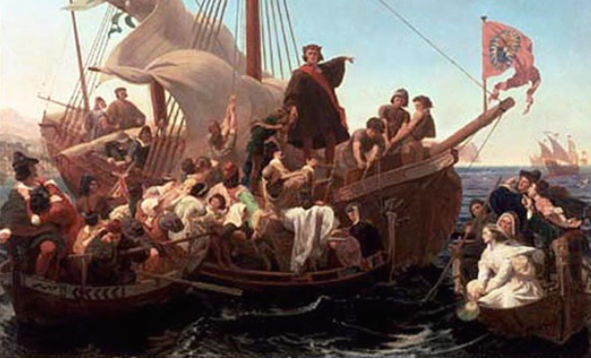
A caravel averages between twenty and thirty meters in length; a modern container ship measures 400 meters.
You don't need to compare weights, much less power, navigation and safety systems.
We are now in the age of space navigation under sail, we are five hundred years away from starting to talk about FTL propulsion, we don't even have effective protection against radiation.
You don't need to compare weights, much less power, navigation and safety systems.
We are now in the age of space navigation under sail, we are five hundred years away from starting to talk about FTL propulsion, we don't even have effective protection against radiation.
Attachments
-
 16315612136051.png362.9 KB · Views: 10
 -
 Los tripulantes de la Niña II izando el aparejo del trinquete. Foto Herederos de Roberto Ménde...jpg125.8 KB · Views: 5
 -
 José Ferrer, a la izquierda de la foto, tomada en Las Bahamas. Foto Familia de Ferrer.jpg555.6 KB · Views: 5
 -
 uiyt.jpg76.9 KB · Views: 19
 -
 78542228-captain-s-cabin-on-the-ship.jpg166.9 KB · Views: 9
 -
 215.jpg163.9 KB · Views: 8
 -
 Puente-de-mando-800x533.jpg112.3 KB · Views: 8
707!At .707c, time dilation effects are in strong enough effect that...
L. Ron Hubbard was right!
..put the axe down...no...I was just kidding...
Scott Kenny
ACCESS: USAP
- Joined
- 15 May 2023
- Messages
- 19,533
- Reaction score
- 27,979
That math has been known for years, I'm sure Ron or one of his friends could have done it.707!
L. Ron Hubbard was right!
..put the axe down...no...I was just kidding...
Ron is a terrible author. I don't know if it was losing the bet around Dianetics or what. (Herbert, Hubbard, and IIRC Heinlein had a bet about creating a viable religion in a book. Herbert's entry was Dune.)
martinbayer
ACCESS: Above Top Secret
- Joined
- 6 January 2009
- Messages
- 5,062
- Reaction score
- 6,969
*Any* cult founder/leader is a horrific person, but *truly* thank you for connecting the dots with the info on Heinlein's, Herbert's, and Hubbard's *intellectual* race to the bottom! I was vaguely aware of the religion bet, but I only was cognizant of two of the three cynical participants to date.That math has been known for years, I'm sure Ron or one of his friends could have done it.
Ron is a terrible author. I don't know if it was losing the bet around Dianetics or what. (Herbert, Hubbard, and IIRC Heinlein had a bet about creating a viable religion in a book. Herbert's entry was Dune.)
Last edited:
Scott Kenny
ACCESS: USAP
- Joined
- 15 May 2023
- Messages
- 19,533
- Reaction score
- 27,979
Note that Herbert wrote a decent book (series) and Heinlein's entry was Stranger in a Strange Land, which is more or less a decent rip of Christianity in terms of ethics. Hell, the MC of SiaSL turns out to be the archangel Michael.*Any* cult founder/leader is a horrific person, but *truly* thank you for connecting the dots with the info on Heinlein's, Herbert's, and Hubbard's *intellectual* race to the bottom! I was vaguely aware of the religion bet, but I only was cognizant of two of the three cynical participants to date.
J.O.B. was nice...early on spaceflight and spirituality merged--even with CONTACT. 1980s Flash Gordon, Space 1999 had a bit of that. Perelandra is such a lovely name. C.S. Lewis was much better at names than Dunsany...if in no other wise.
GRAVITY was the only movie where there were no angels to save you--aside from a vision.
I just thought it was odd that Hubbard thought ETs were in space-going 707s, with .707c an evening-out of time dilation.
Spirolaterals also spooked me a bit, with the Star of David and a swastika having similar steps, but I digress.
If I were an actual ET with supreme control of gravity, inertia and re-entry heating ...a 707 design spacecraft actually wouldn't be a bad choice.
The last thing I would arrive in is some lit-up ball/saucer that only looked at home in Studio 54.
GRAVITY was the only movie where there were no angels to save you--aside from a vision.
I just thought it was odd that Hubbard thought ETs were in space-going 707s, with .707c an evening-out of time dilation.
Spirolaterals also spooked me a bit, with the Star of David and a swastika having similar steps, but I digress.
If I were an actual ET with supreme control of gravity, inertia and re-entry heating ...a 707 design spacecraft actually wouldn't be a bad choice.
The last thing I would arrive in is some lit-up ball/saucer that only looked at home in Studio 54.
Last edited:
Heinlein was able to sell sand to a camel; he even sold his first story to a publisher.Note that Herbert wrote a decent book (series) and Heinlein's entry was Stranger in a Strange Land, which is more or less a decent rip of Christianity in terms of ethics. Hell, the MC of SiaSL turns out to be the archangel Michael.
But the SF writer I can't stand is Aldiss, his novel
https://en.wikipedia.org/wiki/Greybeard
it is the only book that I have not been able to finish reading in my entire life, it seems to be written to encourage the use of Prozac.
https://en.wikipedia.org/wiki/Greybeard
it is the only book that I have not been able to finish reading in my entire life, it seems to be written to encourage the use of Prozac.

- Joined
- 13 August 2007
- Messages
- 10,405
- Reaction score
- 18,054
we driving away from Warp Drive to Sci-Fi Literature critic...
back to Topic
back to Topic
Well, what I think about Alcubierre's idea is that scientific theories can only be seriously considered by the community if they can be confirmed experimentally on several occasions and by different research teams, or falsified by the same scientific procedure, which is the only thing that separates science from religion. And despite all these precautions, most of what we know as science is naively proven wrong every fifty years.we driving away from Warp Drive to Sci-Fi Literature critic...
back to Topic
Everything else is science fiction.
Brett Davidson
ACCESS: Top Secret
- Joined
- 26 September 2006
- Messages
- 4,441
- Reaction score
- 12,826
Hmph. Call be Debbie Downer, but I regard all talk of FTL and stable macroscopic wormholes no more than thought experiments at best and magical thinking at worst - theoretically productive in aiding our understanding of physics but practically impossible as engineering projects. Einstein learned a lot that was scientifically valid by thinking about what it might be like to ride a beam of light, but that didn't mean that it was physically possible to do so.
martinbayer
ACCESS: Above Top Secret
- Joined
- 6 January 2009
- Messages
- 5,062
- Reaction score
- 6,969
I haven't read it either, but just the title might already be a dead giveaway (one of the reasons why I shave every single day, because I do not want to turn into one of those)...But the SF writer I can't stand is Aldiss, his novel
https://en.wikipedia.org/wiki/Greybeard
it is the only book that I have not been able to finish reading in my entire life, it seems to be written to encourage the use of Prozac.
Last edited:
Similar threads
-

-
Nasa's and DARPA's Hundred Year Starship
- Started by bobbymike
- Replies: 8
-
Pre Enterprise and Long Beach Nuclear Surface Combatants?
- Started by Delta Force
- Replies: 48
-

-
