AIM-174 Very Long Range AAM (SM-6)

Fighters currently all have X-band radars not the required S-band. So none of them willl be able to do ABM on their own. A datalink hand off to an Aegis radar is needed. The E-2D might be able to but doubtful atm. Though, it can guide against lesser targets.
The 6th generation will have multiband radar and probably the range needed.
Why would it need S-band for AIM-174? They don't need to provide signal for the AIM-174, it's got an active radar seeker. They just need to send it updates until its active radar can take over.
 
Stated Sm2 weight might be refering to early blocks. Later blocks got various changes so its possible their weight is closer to 1800. Who knows.

This. SM-2 has steadily gained weight over various blocks and modifications. Block IIICU especially looks very different from the early Block IIIs. But there has not been a lot of updated info about the weights of the most recent versions. It also seems likely that there have been some quiet improvements in rocket motors; possibly the AIM-174 uses a highly-loaded grain motor, which is the latest hotness. That would push the weight up significantly.

Plus the very visible reinforcing ribs along the mid-body of the missile (between the strakes) that others have noted.
 
IIRC wasn't ALHTK focused on intercepting SRBMs during the boost phase, following the Desert Storm experience of seeing Scuds launching near aircraft.
It was BPI and TPI both as highlighted in the video. For most COCOMs. I don't think you can get a purely BPI interceptor that works across all regions and contingencies but with the ALHTK you still had TBM defeat for homeland defense and across all COCOMs. That's where the value lives. In some scenarios against some advesaries it may also give you limited boost / assent phase capability but obviously the physics and time sensitivity may not make them practical for a lot of scenarios where the enemy has strategic depth.
 
But there has not been a lot of updated info about the weights of the most recent versions. It also seems likely that there have been some quiet improvements in rocket motors; possibly the AIM-174 uses a highly-loaded grain motor, which is the latest hotness. That would push the weight up significantly.
We have new entrants getting qualified for the MK 104 DTRM so the idea that some better performance can be expected isn't without merit.

https://www.prnewswire.com/news-rel...mk-72-and-mk-104-rocket-motors-302658560.html

Why would it need S-band for AIM-174? They don't need to provide signal for the AIM-174, it's got an active radar seeker. They just need to send it updates until its active radar can take over.
You still need to update the missile in flight. But I would assume the Navy would have figured that part out on the AIM-174 given the SH lacks an S band transmitter. I believe there was also efforts to integrate the SM-6 on the Zumwalt. While it will need to be qualified for TBM but I don't think that's going to be crazy hard or expensive. Lockheed largely self funded a tri-band (S/C/X) missile communication solution for the PAC-3 MSE to Naval MSE transition so if Raytheon sense it can sell this to the AF or meet this joint force need I'm sure it can be accomodated.
 
Last edited:
Why would it need S-band for AIM-174? They don't need to provide signal for the AIM-174, it's got an active radar seeker. They just need to send it updates until its active radar can take over.
It's not for the missile. It's for detecting the ballistic missile at longer ranges. The AIM174 just gets data from the data link.
Since the Partriot happens to have a similar intercept profile range to SM6:
* intercept range up to 150 km but only 20 km for ballistic missiles
* the system has a radar range of 170 km which is similar to current aircraft radar range

This means the intercept range won't differ by much (acceleration time to launch speed being the difference):
~6 nm so roughly 30 km/17 nm
To be able to intercept at all the aircraft needs to move into position and preferable accelerate the hell out for maximum range.
This means either the aircraft has significant radar range or needs to slave to an external radar.
 
It's not for the missile. It's for detecting the ballistic missile at longer ranges. The AIM174 just gets data from the data link.
Since the Partriot happens to have a similar intercept profile range to SM6:
* intercept range up to 150 km but only 20 km for ballistic missiles
* the system has a radar range of 170 km which is similar to current aircraft radar range

This means the intercept range won't differ by much (acceleration time to launch speed being the difference):
~6 nm so roughly 30 km/17 nm
To be able to intercept at all the aircraft needs to move into position and preferable accelerate the hell out for maximum range.
This means either the aircraft has significant radar range or needs to slave to an external radar.
There was video years back where an F-35 was tracking a TBM from significant distance.

 
We are well past the stage of the fighter aircraft AESA radar requiring to built a fire control solution for a TBM intercept. It could play a supporting role but for this concept to work the primary work will be done by space and terrestrial Navy and Army sensors. Even the ALHTK was to leverage the IRST from airborne and longer ranged ground and ship borne radars for long range detection and tracking. Space layers which are receiving an incredible level of investment and being rapidly built up mean that this capability can proliferate beyond the traditional AEGIS ships, strategic upper tier systems and their C2 etc.
Hypersonic and Ballistic Tracking SpaceSensor (HBTSS) satellites will providecontinuous tracking and enable handofffor targeting of enemy missiles, includinghypersonic threats launched from land,sea or air. HBTSS is a critical part of themulti-layered OPIR constellation ofsatellites. It provides: • Continuous tracking and handoff for targeting hypersonic threats. • Near-global reach when prompted by other OPIR systems. • Fire control solution required for HGV intercept.
https://cdn.northropgrumman.com/-/media/wp-content/uploads/HBTSS-Data-Sheet.pdf?v=1.0.0
https://spacenews.com/l3harris-gains-edge-in-race-to-build-golden-dome-missile-sensors/
 
Yeah, but perhabs the more important detail is the actual intercept range vs. ballistic missile (SRBM).
It doesn't look like AIM174 has that much range even if air launched. Also it goes up to Mach3.5 less than AIM120/260 that are more like Mach4.7. This means the maximum target speed is around Mach~2.3 without any maneuvering.
This was the reason I was talking about mounting future 1000 km ranged missiles in the F47 art thread and possibly using them for ABM rather than with any current missiles.
 
Yeah, but perhabs the more important detail is the actual intercept range vs. ballistic missile (SRBM).
It doesn't look like AIM174 has that much range even if air launched. Also it goes up to Mach3.5 less than AIM120/260 that are more like Mach4.7. This means the maximum target speed is around Mach~2.3 without any maneuvering.
This was the reason I was talking about mounting future 1000 km ranged missiles in the F47 art thread and possibly using them for ABM rather than with any current missiles.
Dumb question here but why would it be any less than an SM-6? Surely a Super Hornet could give it as much speed/altitude as a Mk72 booster from sea-level.
 
Dumb question here but why would it be any less than an SM-6? Surely a Super Hornet could give it as much speed/altitude as a Mk72 booster from sea-level.
Depends on how the math works out between "above mach 1 and 10kft" and "below Mach 1 and 30kft"

I suspect it's roughly a wash.
 
Fighters currently all have X-band radars not the required S-band. So none of them willl be able to do ABM on their own. A datalink hand off to an Aegis radar is needed. The E-2D might be able to but doubtful atm. Though, it can guide against lesser targets.
The 6th generation will have multiband radar and probably the range needed.
why would they need S band for ABM though?
 
There was video years back where an F-35 was tracking a TBM from significant distance.
I'd say Falcon 9 is not a TBM. It's a bloody orbital rocket on it's way up, not down.
Also, IR doesn't provide range to target outside of LRF range...
 
Dumb question here but why would it be any less than an SM-6? Surely a Super Hornet could give it as much speed/altitude as a Mk72 booster from sea-level.
SM6 boosts to altitude and about Mach2+.
A fighter doing CAP flies around 20 kft at M~0.7; on-route at 36kft & M~0.85. So there is a minor loss in speed.
But the main reason for range regression depends on target speed vs interceptor speed. This is mainly due to maneuver requirement/kinetic bleed. Range also includes speed loss down range after burnout. For the same reason the SM6 range against surface target is almost 2x of air targets. Today's modern motor and control logic do improve SM6 vs SM2 in this regard but the process is still the same.
If you read cosely the E2D and F35 only transmit target data to the ship. The ship however is the one that is connected to the missile.
It's a roundabout link rather than the assets on site doing direct "guidance".
 
SM6 boosts to altitude and about Mach2+.
A fighter doing CAP flies around 20 kft at M~0.7; on-route at 36kft & M~0.85. So there is a minor loss in speed.
But the main reason for range regression depends on target speed vs interceptor speed. This is mainly due to maneuver requirement/kinetic bleed. Range also includes speed loss down range after burnout. For the same reason the SM6 range against surface target is almost 2x of air targets. Today's modern motor and control logic do improve SM6 vs SM2 in this regard but the process is still the same.
Right, but SM-6 has shot down MRBMs.
 
The SM-6 provides the US Navy a Sea based terminal defense capability against short and medium range ballistic missiles. This is one of the key missions for the weapon and a source of investment in capability growth and iterative development under the Sm-6 RDT&E funding stream (Block 1, 1A, Dual II etc etc). As Sferrin correctly notes, MRBM defeat has been demonstrated by the Navy working with the MDA. Same for SRBM defeat. The SM-6 is also the Navy's and nations initial capability against hypersonic gliders until the dedicated glide phase interceptor is readied in the early to mid 2030s. The Navy and MDA plan to demonstrate this Sm-6 vs HGV interim capability in the coming years, including under Project Maverick next year. Furthermore, even after the GPI is fielded, upgraded Sm-6 will continue to offer terminal defense capability against maneuvering hypersonic threats.

View: https://www.youtube.com/watch?v=-q-ieXZgrhY&t=2s


All of this development is directly translatable to the air launched SM-6 or AIM-174, should such a capability be needed to be fielded. The missile is capable of it. Has proven it. Will prove out additional things in the coming years. A high subsonic or low supersonic launch at 8-9 km altitude more than compensates for the initial MK72 provided capability. The kill chain is not going to be organic and that will increasingly be the case for AEGIS destroyers as well. HBTSS and cross-platform (multi-domain) integration is what gets you the detection, tracking and ultimately aid in developing a fire solution. That's the future (PWSA), and it will be no different for a potential air-launched application of the weapon for the terminal missile defense mission.

https://www.surfpac.navy.mil/Media/...ept-with-sm-6-advances-collaboration-with-au/

Tranche 1, which is the initial warfighting capability, will consist of 154 operational space vehicles, including 126 transport layer satellites and 28 tracking layer systems, as well as four missile defense demonstration platforms, according to a Space Force release.

Tranche 2, which will be made up of 270 operational transport and tracking layer satellites, is scheduled to begin launching in late 2026 and is in the post-critical design review stage, preparing for assembly, integration and testing, Sandhoo said. https://www.nationaldefensemagazine...will be,integration and testing, Sandhoo said.

 
Last edited:
Right, but SM-6 has shot down MRBMs.
That was never in doubt the question was whether a fighter can do that. That's why I went into the fighter's ability first follwed by possible range issue for sensing and intercept.
 
That was never in doubt the question was whether a fighter can do that. That's why I went into the fighter's ability first follwed by possible range issue for sensing and intercept.
Kinetically there shouldn't be much difference, but yeah, if it needs the S-band to pass along the info that would be an issue.
 
didn't it have a small X band link too?

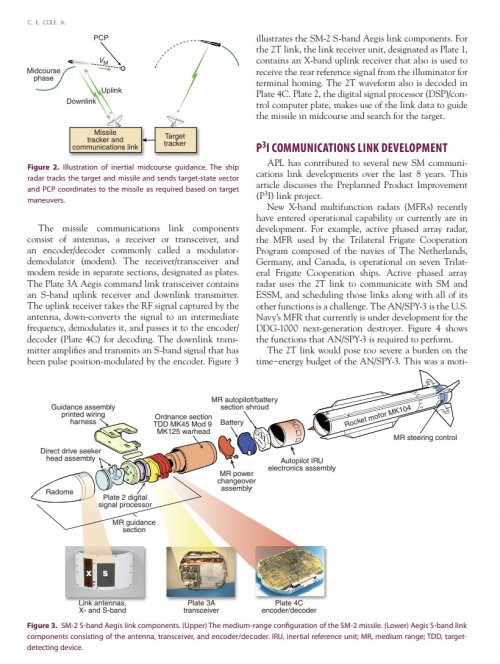
Read the rest of the article. That's the 2T (Tartar/Terrier) mode link, a receive-only link to receive the reference signal from continuous X-band illumination. Basically, a ship using AEGIS disables that link before launch, and it can't support two-way position reporting anyway.
 
We don't know what and how the data-link integration has occurred on the AIM-174. Given that both the block II AIM-9X and the AIM-120D feature a two-way data link, it would be very strange for the AIM-174 to not have a functional data-link capability to the launch platform and/or other airborne platforms. Given the Navy doesn't even list out AIM-174 in its procurement or RDT&E J-books there's not a very easy direct way of understanding what those things might be.

Also, whether its company funded IR&D, demonstrations, or actual government funding work under GDS etc. there is some integration work happening at integrating the SM-6 into the Army's IAMD at least for the 1-2 composite systems the service is fielding in Guam and ROK. Given its now a multi-domain weapon with multi-domain capability there's probably some sort of advanced networking solution in the works that is in-band with the various airborne and land based platforms of interest.

https://www.rtx.com/news/news-cente...strates-sm-6-integration-with-ltamds-and-ibcs

Worth noting that the US Army has adopted and standardized around an X-Band missile communication uplinker solution that is independent of any fire-control radar provided missile communication. It will eventually have both HIMAD and SHORAD (IFPC) comply with that solution. If Raytheon wanted to sell a lot of SM-6s for airborne, and land-based air and missile defense applications then developing a next gen X band or dual S/X band solution might not be the worst investment it could make at advancing that forward.
 
Last edited:
We don't know what and how the data-link integration has occurred on the AIM-174.
It was a quick adoption not a full scale deveopement. The fact it had AIM120 sensor head & control eased integration nothing ese.
Also, whether its company funded IR&D, demonstrations, or actual government funding work under GDS etc. there is some integration work happening at integrating the SM-6 into the Army's IAMD at least for the 1-2 composite systems the service is fielding in Guam and ROK.
Small incremental progress & customer based requests is how the industry keeps getting contracts. Why otherwise did it took ~60 years until Standard-2 weapons across the board are finally cheaper for mass production/consumption?
 
It was a quick adoption not a full scale deveopement. The fact it had AIM120 sensor head & control eased integration nothing ese.
Can you share specifics on the AIM-174 development effort. With sourcing.
 
A summary:
https://www.globaldefensecorp.com/2...ched-configuration-is-operationally-deployed/

The program being called "air-launched configuration" and being adapted in a short time rather than a typical development plan with documents going around for years and typically asking congress for funds.
I meant a primary source. Not news articles. To understand what the Navy funded you would need to look at the budget docs, any solicitations the Navy laid out to industry, and other development and/or test documentation. When you provide those, I can reliable establish what the Navy did or did not do as part of its investment into the SM-6 ALC. As I laid out, even the Navy's WVR weapon is now fully networked with a two way data link. It would be strange for the service to buy an extended range missile that the service's fighters cannot even talk to via DL without using an AEGIS vessel or E-2 as an intermediary.
 
SM6 boosts to altitude and about Mach2+.
A fighter doing CAP flies around 20 kft at M~0.7; on-route at 36kft & M~0.85. So there is a minor loss in speed.
But the main reason for range regression depends on target speed vs interceptor speed. This is mainly due to maneuver requirement/kinetic bleed. Range also includes speed loss down range after burnout. For the same reason the SM6 range against surface target is almost 2x of air targets. Today's modern motor and control logic do improve SM6 vs SM2 in this regard but the process is still the same.
IIRC from SM3 docs, the first stage gets the missile to just over Mach 1 and right around 10,000ft.
 
Fighters currently all have X-band radars not the required S-band. So none of them willl be able to do ABM on their own. A datalink hand off to an Aegis radar is needed. The E-2D might be able to but doubtful atm. Though, it can guide against lesser targets.
The 6th generation will have multiband radar and probably the range needed.

SM-6 is integrated with NIFCCA, so in principle I do not see any reason why an aircraft could not fire the weapon and let it be controlled by a platform with an appropriate SBM track. But as a practical matter, having aircraft in the right place at the right time in any meaningful numbers seems like a bigger challenge. The only advantage would be increasing the magazine depth of the task force by putting part of the ABM interceptor load on the CVN. Seems of rather dubious value to me, especially as anything more than two missiles is going to make for very limited F/18 endurance.
 
Seems of rather dubious value to me, especially as anything more than two missiles is going to make for very limited F/18 endurance.
I wasn't thinking of the Navy or the carrier air wing. I was thinking of the Air Force and it building capability. The MDA and USAF ALHTK looked at a range of TBI and BPI scenarios across PACOM, CENTCOM and Homeland defense scenarios. My broader point about the Navy having a shooter to weapon DL capability on the AIM-174 is however valid. For other missions. The Navy won't go out and pay a premium for a 2-way data link for its sub 20 mile WVR weapon while lacking one for something 5-10 x longer ranged. Unless there's a claim explicitly stating that no such capability was developed, integrated and tested by the Navy, I would assume that it was likely part of the changes made to the SM-6 ALC to get it into the carrier air wing.
 
Concur with you on datalinks; there is no way they would commission a new AAM and then not have it able to accept aircraft updates in some way.
 
I wasn't thinking of the Navy or the carrier air wing. I was thinking of the Air Force and it building capability.

NGAD, with its projected range, has enough gas that if you hung a couple on non-LO stations and used it in uncontested airspace as a BM defense tool, the loiter time and available energy might be an interesting value proposition.
 
NGAD, with its projected range, has enough gas that if you hung a couple on non-LO stations and used it in uncontested airspace as a BM defense tool, the loiter time and available energy might be an interesting value proposition.
Tbh you can do exactly the same with F-15EX.
 

Similar threads

Back
Top Bottom