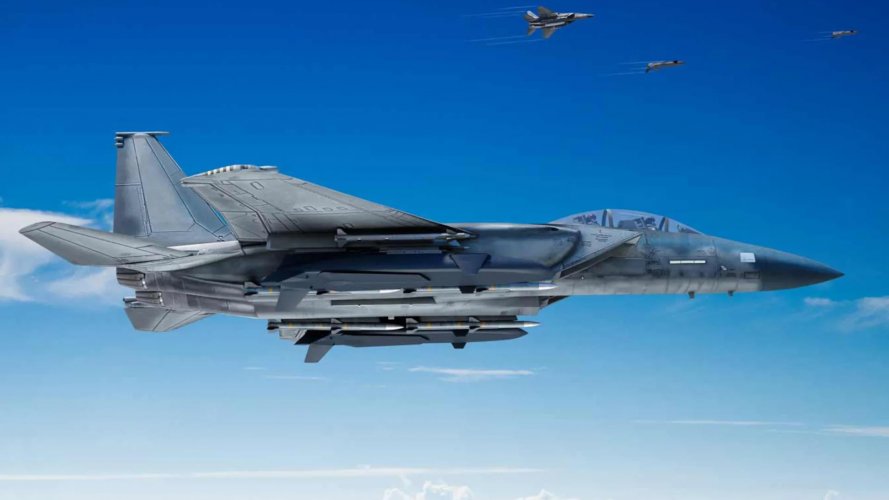
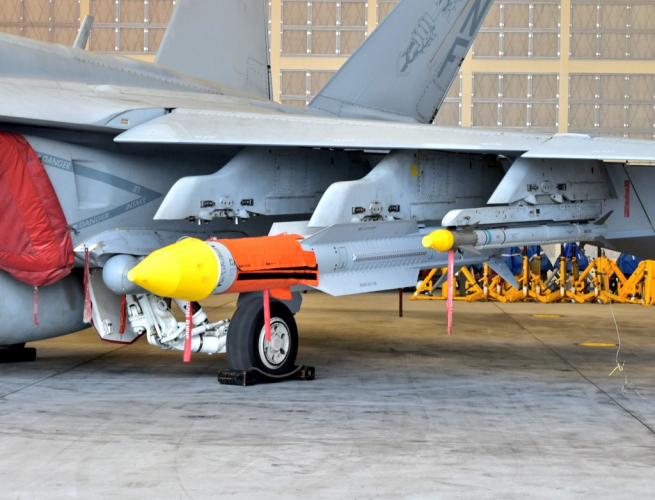
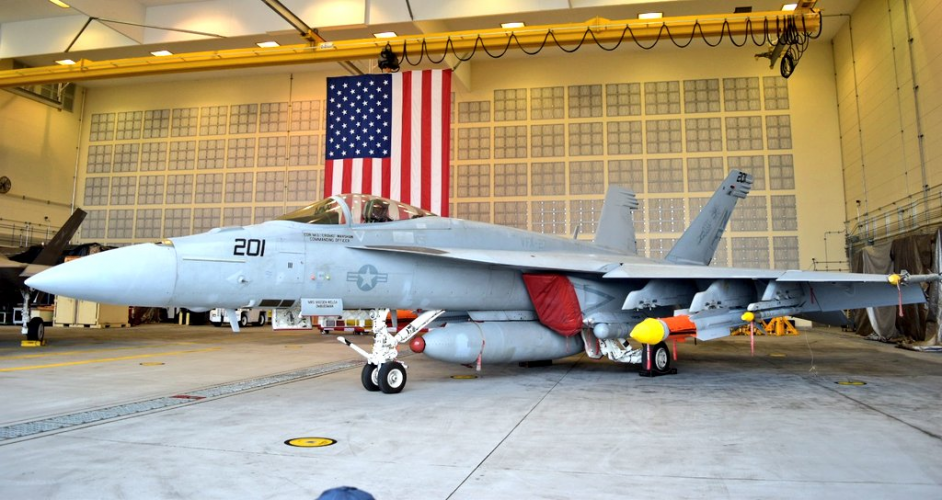
AIM-174 Very Long Range AAM (SM-6)

That makes an antenna roughly 3.7x larger in area, which IIRC my radar stuffs correctly means a roughly 3.7x greater radar range.

Do I have that right, @Dilandu ?
Yes, power and gain on the top row are proportional to area (which is proportional to diamater^2) for ESA radars assuming equal modules and that is divided by R^4 on the bottom row. All assuming equal wavelength.

The Radar Range Equation​

https://www.radartutorial.eu/01.basics/The Radar Range Equation.en.html
 
Actually, something quite strange is that modern ARH generally use the Ku-band. This is actually advantageous; for example, PAC3 or 9M317M have extremely small beamwidth, Maybe only 2-3°. And AAM with smaller radar antenna apertures, such as the AAM-4B or MICA-EM, can also achieve a main lobe width of around 7° using the Ku band, which can significantly improve the target SNR.
However, the AIM-120 has always used the X-band since its inception. Perhaps the band used by RIM-174 remains unchanged. Even using the upper limit of 12 GHz for calculations using the IEEE X-band, the beamwidth of RIM-174 might still be as high as 6°.
 
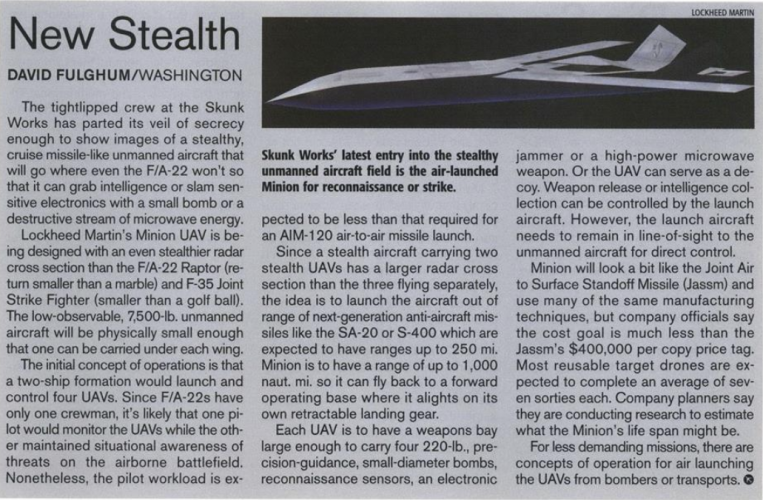
Everything old is new again. Personally, I preferred the F-22 carrying Minion.
At ~$53/ lb, the combination of 7,500lbs at $400,000 seems really out of the norm by 1-2 order of magnitude. I wonder if it’s a typo and they left out a 0 and meant $4M. At $530/lb it is still really aggressive but somewhat more believable when some are guessing CCAs can be built at $1200/lb and inflation making up some of the difference. Then again maybe that’s why the minion never made it to the light of day…
 
It is quite strange that there are still no photos of the RIM/AIM-174's seeker radar antenna. The officials even displayed the seeker structure of the PAC-3 MSE,and the antenna for the SM-6 remains unknown. It may utilize the same planar slotted array antenna as the SM-2. [9_NSKL6BQW~_SH(WOHBBAW.png
 
It is quite strange that there are still no photos of the RIM/AIM-174's seeker radar antenna. The officials even displayed the seeker structure of the PAC-3 MSE,and the antenna for the SM-6 remains unknown. It may utilize the same planar slotted array antenna as the SM-2.View attachment 810224
That picture is a pretty big mess so I don't know how reliable it is.
 
It is quite strange that there are still no photos of the RIM/AIM-174's seeker radar antenna. The officials even displayed the seeker structure of the PAC-3 MSE,and the antenna for the SM-6 remains unknown. It may utilize the same planar slotted array antenna as the SM-2.View attachment 810224

Nope. New antenna specifically for SM-6. It looks like AMRAAM only bigger diameter.

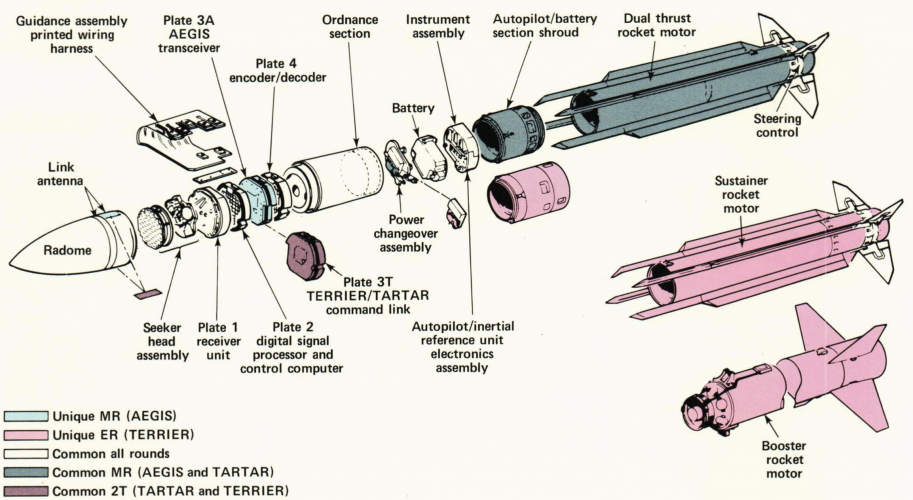
The slide at this link details what part sof the SM-6 seeker come from AMRAAM, what from SM-2, and what is all new.

https://www.secretprojects.co.uk/th...o-improve-pacific-firepower.21258/post-267344
 
At ~$53/ lb, the combination of 7,500lbs at $400,000 seems really out of the norm by 1-2 order of magnitude. I wonder if it’s a typo and they left out a 0 and meant $4M. At $530/lb it is still really aggressive but somewhat more believable when some are guessing CCAs can be built at $1200/lb and inflation making up some of the difference. Then again maybe that’s why the minion never made it to the light of day…

They were probably just lying.
 
Ok, that's maddening. I used the "SM-6" tag in the DCSA system, but of course this announcement isn't tagged "SM-6", but "DEFENSE SERVICES RELATED TO FUTURE STANDARD MISSILE PRODUCTION".

What's the point in using metadata tags if you don't use them consistently? :mad:
So that spies cannot just look things up.


This was an old post, talking about how much more antenna there is in the SM6 over the AMRAAM seeker.
They already went from a 7" antenna to a 13.5" antenna when they stuck the AIM120 seeker into the Standard, more than tripling the antenna area compared to baseline AMRAAM. If the seeker could handle going up to 21" I'd be surprised, that's 8.25x the antenna area. But if it can handle that many TRMs...
So the SM6 (and SM2 Active that is coming) should have about 3x the tracking range of the AMRAAM. And obviously, a 21" antenna in a hypothetical SM6Blk1b or Block 2 is bordering on being a fighter-sized antenna.
 
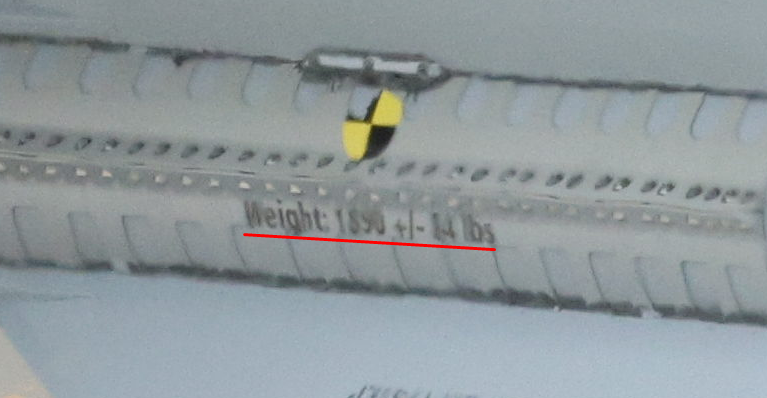
Hey something that perplexes me is that the AIM-174 states its weight being 1890+/-84 lbs
While the SM-2 BLK3 is stated to be View attachment 811149

What's with the added ~300 Lb's
Could the AIM-174 use the upgraded 21 inch DTRM motor ?
View attachment 811148
most likely from adding a strongback to mount the missile to the aircraft pylon instead of the Mk41 launch cell.


I think it would gain a lot more weight if diameter changed from 13.5 inches to 21 inches
At a rough guess, the weight will about double, maybe more. it's 2.4x more by strict math, but that would only apply to the rocket motors. Any suggestions of 21" SM6 have been using the same warhead as the 13.5" version, and only the antenna of the seeker would be larger.
 
That picture is a pretty big mess so I don't know how reliable it is.

It's from an early 80s article in a journal from John Hopkins IIRC, I can't recall the name of the journal but there was another issue which went into great technical detail about the RIM-8 Talos.
 
Stated Sm2 weight might be refering to early blocks. Later blocks got various changes so its possible their weight is closer to 1800. Who knows.
 
I can't recall the name of the journal
Johns Hopkins APL Technical Digest is the name
It's from Volume 2, an article titled, "STANDARD MISSILE: THE COMMON DENOMINATOR": https://secwww.jhuapl.edu/techdigest/Content/techdigest/pdf/V02-N04/02-04-Oliver_Common.pdf

Here's the rest of Volume 2: https://secwww.jhuapl.edu/techdigest/Home/Detail?Journal=J&VolumeID=2&IssueID=4

It's also shown in this article: https://secwww.jhuapl.edu/techdigest/content/techdigest/pdf/V34-N02/34-02-Palumbo.pdf

Articles on Talos: https://secwww.jhuapl.edu/techdigest/Home/Detail?Journal=J&VolumeID=3&IssueID=2
 
Last edited:
The AIM designation implies this is a secondary role. Assuming F-18s have been updated to use it that way.
 
Weight wise I think it mostly is strong back/lugs for being horizontally carried and launched, but the electronics of -6 varies significantly from SM-2 and there maybe other differences as well.
 
Probably needed also to tackle Navy SH pilots growing ego that can now stare back in the eyes of their elders, particularly Tomcat pilots, knowing that their* is bigger.

*NEZ
 
Last edited:
Has anyone come across any article discussing the potential of the AIM-174 as a terminal phase intercept weapon against TBM raids? This was one of the missions for the ALHTK along with boost phase interceptor with that particular one probably out of scope for the much slower AIM-174. But given the baseline SM-6 has defeated short and medium ranged TBMs when surface launched, the AIM-174 with a high subsonic to supersonic launch from 8-10 km altitude should allow at least the same level of performance. The Air Force and MDA, not the Navy, have usually been the drivers of the relatively modest S&T funding in this domain via NCADE, ALTHK, ERWn etc but it appears this could be one of the things a large F-15EX buy, if it materializes, delivers given that program and platform is less constrained by missile size and dimensions than the 5th and sixth gen platforms.

View: https://www.youtube.com/watch?v=OnVHEmROaMM
 
Has anyone come across any article discussing the potential of the AIM-174 as a terminal phase intercept weapon against TBM raids? This was one of the missions for the ALHTK along with boost phase interceptor with that particular one probably out of scope for the much slower AIM-174. But given the baseline SM-6 has defeated short and medium ranged TBMs when surface launched, the AIM-174 with a high subsonic to supersonic launch from 8-10 km altitude should allow at least the same level of performance. The Air Force and MDA, not the Navy, have usually been the drivers of the relatively modest S&T funding in this domain via NCADE, ALTHK, ERWn etc but it appears this could be one of the things a large F-15EX buy, if it materializes, delivers given that program and platform is less constrained by missile size and dimensions than the 5th and sixth gen platforms.
Fighters currently all have X-band radars not the required S-band. So none of them willl be able to do ABM on their own. A datalink hand off to an Aegis radar is needed. The E-2D might be able to but doubtful atm. Though, it can guide against lesser targets.
The 6th generation will have multiband radar and probably the range needed.
 
Has anyone come across any article discussing the potential of the AIM-174 as a terminal phase intercept weapon against TBM raids? This was one of the missions for the ALHTK along with boost phase interceptor with that particular one probably out of scope for the much slower AIM-174. But given the baseline SM-6 has defeated short and medium ranged TBMs when surface launched, the AIM-174 with a high subsonic to supersonic launch from 8-10 km altitude should allow at least the same level of performance. The Air Force and MDA, not the Navy, have usually been the drivers of the relatively modest S&T funding in this domain via NCADE, ALTHK, ERWn etc but it appears this could be one of the things a large F-15EX buy, if it materializes, delivers given that program and platform is less constrained by missile size and dimensions than the 5th and sixth gen platforms.

View: https://www.youtube.com/watch?v=OnVHEmROaMM
IIRC wasn't ALHTK focused on intercepting SRBMs during the boost phase, following the Desert Storm experience of seeing Scuds launching near aircraft.
 

Similar threads

Back
Top Bottom