AIM-174 Very Long Range AAM (SM-6)

Google at its peak, when the internet was more focused on the fire than the shadows, provided a profoundly important low level processing feature that was an incredibly additive to some people.

Back then Google was largely a citation algorithm. If a web page was cited (linked to) by other pages it was ranked as authoritative. People of course figured this out and how to game it, pollute the web, etc and now the citation aspect of Googles ranking is not as strong.

Still today if someone writes an article or forum post full of lies, bad information, etc if enough people link to it (especially on authoritative sites like SPF) Google will rank it higher.

Case in point, all of the links to TWZ on SPF .
 
Back then Google was largely a citation algorithm. If a web page was cited (linked to) by other pages it was ranked as authoritative. People of course figured this out and how to game it, pollute the web, etc and now the citation aspect of Googles ranking is not as strong.

Still today if someone writes an article or forum post full of lies, bad information, etc if enough people link to it (especially on authoritative sites like SPF) Google will rank it higher.

Case in point, all of the links to TWZ on SPF .
Yup, im specifically talking about the conceptual altavista -> google/pagerank time period. It literally presented another pre retinal processing layer that was genuinely useful that transformed general search. On the other hand, with the right knowledge, there were many more open USG data sources.

25 years later neither are true
 
Howdy; I'm the author of the Wikipedia page for the AIM-174B. A couple of... shall we say, "concerned parties" reached-out to me and advised me that the name is not "Gunslinger." That it is the program name, which a Navy PAO mistook for the missile name, and we have Naval Aviation 2025 as a result (if you'll note, NA2025 states "Gunslinger AIM-174B," not "AIM-174B Gunslinger;" not definitive proof but definitely mildly odd). Then, we have some secondary sources picking-up the name, and the rest is history (Wikipedia only cares what the secondary sources say, for better or for worse). Given that it has been six months and the USN has not issued any sort of retraction nor correction, said sources may have very well have named themselves a missile.

Personally, I think it's a cool name, though I would have preferred "Phoenix II" or perhaps another mythological bird.

This is interesting. When I reached out to both COMNAVAIRFOR and PACFLEET offices, they did not deny GUNSLINGER as the name. Of course, they could not and would not confirm (even when pressed with alternate means to confirm).

When I asked about publishing the missile's name as GUNSLINGER, they did not steer me away, even treating the publication of the name perhaps as an accident (a PAO sternly asked me to not use the name in publication, telling me she would "strongly prefer use of SM-6 ALC" in any writing while asking where I heard the name).

This situation of a backwards name could be true too. My only question is that LRASM is also in the same order as GUNSLINGER AIM-174B: "LRASM AGM-158B". We know LRASM is the missile name, not the program name. And the name comes first before the missile designation AGM-158B.

Logically, this would mean AGM-158B LRASM and AIM-174B GUNSLINGER are in the correct order.

Nevertheless, I'd be interested to know what the real case is. Once The Aviationist grabbed our story information and ran with it... the cat was out of the bag.
 
This is interesting. When I reached out to both COMNAVAIRFOR and PACFLEET offices, they did not deny GUNSLINGER as the name. Of course, they could not and would not confirm (even when pressed with alternate means to confirm).

When I asked about publishing the missile's name as GUNSLINGER, they did not steer me away, even treating the publication of the name perhaps as an accident (a PAO sternly asked me to not use the name in publication, telling me she would "strongly prefer use of SM-6 ALC" in any writing while asking where I heard the name).

This situation of a backwards name could be true too. My only question is that LRASM is also in the same order as GUNSLINGER AIM-174B: "LRASM AGM-158B". We know LRASM is the missile name, not the program name. And the name comes first before the missile designation AGM-158B.

Logically, this would mean AGM-158B LRASM and AIM-174B GUNSLINGER are in the correct order.

Nevertheless, I'd be interested to know what the real case is. Once The Aviationist grabbed our story information and ran with it... the cat was out of the bag.
^ Hi, thanks for responding. I didn't know you were first, I thought The Aviationist got their article out first. If it makes you feel any better, I cited you extensively in the Wikipedia article. Thank you for letting me know what the USN told you. Definitely goes to the idea that it's not the name. All that being said, it's been six months, and the sources have taken to it. You may very well have named a missile. It would be hard to backtrack from this, at the point.

The "where did you hear that name" thing is odd, given Naval Aviation 2025. Though that was published by PACFLEET, so perhaps other commands wouldn't be aware of it.


Gunslinger would be a nonsensical name. At best, it could work for a plane, carrying missiles (guns). It's about as fitting as naming the missile "missileer".

^ I don't like the name, but I think "nonsensical" is a bit of a stretch, with all respect. Is "Phoenix" nonsensical because it doesn't revive dead beings? Is "Sparrow" nonsensical because it isn't a small bird? The name isn't supposed to imply "the namesake is this thing," it is supposed to imply "this thing is a namesake." It is named after "Old West" gunslingers, a unique aspect of American culture and history. Would it be nonsensical to name a missile "Longbow," given that it isn't firing anything, it's the one being fired? In that case, it's happened not once, not twice, but three times (WS-121B Longbow, Longbow ALBM, and the Hellfire L[ongbow]). Two things can be true, of course; Two names can both be nonsensical. However, I would contend that one can't (or at least shouldn't) read too much into these names, is my point.

And just to be clear, I say all this while acknowledging that it's not a great name (though it does, admittedly, grow on me) and that it may not even be the correct name, as I stated.

 
^ Hi, thanks for responding. I didn't know you were first, I thought The Aviationist got their article out first. If it makes you feel any better, I cited you extensively in the Wikipedia article. Thank you for letting me know what the USN told you. Definitely goes to the idea that it's not the name. All that being said, it's been six months, and the sources have taken to it. You may very well have named a missile. It would be hard to backtrack from this, at the point.

The "where did you hear that name" thing is odd, given Naval Aviation 2025. Though that was published by PACFLEET, so perhaps other commands wouldn't be aware of it.

No worries about who you cite. I don't mind (the ensuing Twitter drama when I called out The Aviationist for practically mirroring our story 1:1 was worth everything no matter what)

Jokes aside, I was just as confused when they asked "where". I don't think "GUNSLINGER" was supposed to be in the Playbook at all. "Air Launched Capability" was the widely released "real" name from CHINFO, COMNAVARFOR, and PACFLEET, and it was seemingly the distributed name for all public affairs releases related to the missile. It was a curveball to include a new name and I personally don't think it was intentional to have it in the Playbook.

I'm going to do some rounds with some people I talk to frequently about AIM-174B to see if I can get someone to confirm the actual name. It's not going to be quick at the moment, thanks to the shutdown, but I'll keep you posted.
 
Why not take a note from the original Bumblebee programme and give it name beginning with a "T" (Just like the Standard's predecessors Terrier and Tartar), something like, say, Tantalus or Tartarus?
 
Supposedly someone, probably from the upper Midwest, started calling them honyockers (spoken in a thick draw) during the testing phase and the name stuck among the small community of people who actually had access to them. Problem is, no-one outside of very specific areas of the country knows what the fuck that word means or has even heard it before. Somewhere along the line this got misheard and now we have a missile called the "gunslinger", which makes no sense.
 
No worries about who you cite. I don't mind (the ensuing Twitter drama when I called out The Aviationist for practically mirroring our story 1:1 was worth everything no matter what)

Jokes aside, I was just as confused when they asked "where". I don't think "GUNSLINGER" was supposed to be in the Playbook at all. "Air Launched Capability" was the widely released "real" name from CHINFO, COMNAVARFOR, and PACFLEET, and it was seemingly the distributed name for all public affairs releases related to the missile. It was a curveball to include a new name and I personally don't think it was intentional to have it in the Playbook.

I'm going to do some rounds with some people I talk to frequently about AIM-174B to see if I can get someone to confirm the actual name. It's not going to be quick at the moment, thanks to the shutdown, but I'll keep you posted.
I didn't follow that closely, but I have to admit, from what little I did see, I tended to lean towards agreement with The Aviationist. However, I would appreciate hearing your side of things (for several reasons). You can PM me if you don't want to explain everything, here.

Regarding the -174, I have spoken with a naval aviator involved in tests and someone involved with the program itself. They both assert that "Gunslinger" is not the name, full-stop. That, at most, they refer to it as the "ALC" and that it's name is akin to "AMRAAM" or "JATM." I only verified the credentials of one of them, the other didn't want to share, but I believed them.
 
So that is that the AIM-174 is now officially operationally deployed on carriers as the longest ranged air to air missile in US Navy history.
 
But the design of AIM-174 is still too bad,The SM-6's aerodynamic design dates back to the 1980s-1990s or earlier. The Navy's missiles are still too conservative,perhaps developing an air-launched variant of the PAC-3 would be a better option,At least PAC-3 has a production advantage, while the annual production of SM-6 is not even enough 1 for each Aegis ship.
 
But the design of AIM-174 is still too bad,The SM-6's aerodynamic design dates back to the 1980s-1990s or earlier. The Navy's missiles are still too conservative,perhaps developing an air-launched variant of the PAC-3 would be a better option,At least PAC-3 has a production advantage, while the annual production of SM-6 is not even enough 1 for each Aegis ship.
AIM-174 is probably a stop gap solution that still heavily benefits from how integrated the SM-6 is with US fire control and datalink systems. It probably required very minimal development time and funds. Long term I would expect a purpose built solution.
 
AIM-174 is probably a stop gap solution that still heavily benefits from how integrated the SM-6 is with US fire control and datalink systems. It probably required very minimal development time and funds. Long term I would expect a purpose built solution.
I.e. the kind of stopgap solution that most likely would stay in service for a long time, and likely outlive "purpose build solution")
 
I.e. the kind of stopgap solution that most likely would stay in service for a long time, and likely outlive "purpose build solution")
The only major driver I could see is FAXX bays not being made long enough to handle SM6.

And when you're likely talking a 30cm stretch per bay to accomplish that, I'd honestly expect the bays to explicitly be sized to hold SM6 with tail fins folded. Because that's absolutely the longest possible weapon the carrier weapons elevators can handle.
 
The only major driver I could see is FAXX bays not being made long enough to handle SM6.

And when you're likely talking a 30cm stretch per bay to accomplish that, I'd honestly expect the bays to explicitly be sized to hold SM6 with tail fins folded. Because that's absolutely the longest possible weapon the carrier weapons elevators can handle.
No one is building FA_XX bays around that missile. That aircraft will not enter service for a decade and SM-6 is, relatively speaking, a short term hack job, just lake LRASM.
 
No one is building FA_XX bays around that missile. That aircraft will not enter service for a decade and SM-6 is, relatively speaking, a short term hack job, just lake LRASM.
Not sure I agree. It is representative of the longest possible weapon that will still fit on the ordnance elevators. And I think that a strike fighter should be designed around that. Because the not-HACM and/or the new bunker buster bombs are likely to be as long as can fit onto the weapons elevators.

Though I do agree that it should be a short term hack job, I've also seen how often the gooberment turns a temporary solution into the permanent solution.
 
I've also seen how often the gooberment turns a temporary solution into the permanent solution.

A bit like the AIM-9 Sidewinder, Dr. William McLean (The leader of the team that created the AIM-9 at NOTS, he died in 1976) would be flabbergasted if he knew that the Sidewinder would still be in service in 2025.
 
And when you're likely talking a 30cm stretch per bay to accomplish that, I'd honestly expect the bays to explicitly be sized to hold SM6 with tail fins folded. Because that's absolutely the longest possible weapon the carrier weapons elevators can handle.
I think the solution might be some external stealthy collars, that would cover the missile hanging on external hardpoint - either dropping away or folding before launch.
 
A bit like the AIM-9 Sidewinder, Dr. William McLean (The leader of the team that created the AIM-9 at NOTS, he died in 1976) would be flabbergasted if he knew that the Sidewinder would still be in service in 2025.
I tend to agree with this line of thinking. I think it's silly to be counting the AIM-174's days just yet. How many "stop-gap" weapons have been dragged-out for decades? More specifically, can anyone name a single (operationally-fielded) U.S. "air intercept missile" that was only fielded for a few years (excluding individual variants)? I can't think of any. Perhaps the AIR-2 (not an AIM, but whatever)?

Regardless, just to play Devil's advocate; comparing the AIM-174B to a Sidewinder may not be the best analogy. The -174 is significantly heavier, larger, and more expensive. This may limit its utility and efficiency.

Further, if the official ranges are to be believed (they're not; the -174 can likely fly much further than 130nm — 130nm is likely the low-end NEZ — but I digress), then it won't offer much benefit over the AIM-260 JATM. A smaller, presumably more agile missile, with an ostensibly more advanced seeker head. I would imagine cheaper, as well, though that may not be correct.

Quite frankly, I'm surprised the "missile truck" concept isn't being looked-at more seriously, again. If we had B-1s or B-52s or even Eagle IIs carrying large batches of AIM-174s, I could see their utility being extended many years, particularly vis a vis China. Of course, the AIM-174 is the Navy's pet.
 
Quite frankly, I'm surprised the "missile truck" concept isn't being looked-at more seriously, again. If we had B-1s or B-52s or even Eagle IIs carrying large batches of AIM-174s, I could see their utility being extended many years, particularly vis a vis China. Of course, the AIM-174 is the Navy's pet.
It's an inevitable "service dogmatism" that affects the holders of first place in some particular area. They became reluctant to test any radical innovations, fearing that it would diminish their current advantage.
 
hat, at most, they refer to it as the "ALC" and that it's name is akin to "AMRAAM" or "JATM." I only verified the credentials of one of them, the other didn't want to share, but I believed them.
AMRAAM and JATM at least make standalone sense. "Air Launched Capability" on its own is senseless; it could be a drone, a 20mm chaff round or a way of evacuating the toilet of an E-2 in-flight.

"SM-6 ALC" is unfortunately currently the full name and should not / cannot be further abbreviated.
 
A bit like the AIM-9 Sidewinder, Dr. William McLean (The leader of the team that created the AIM-9 at NOTS, he died in 1976) would be flabbergasted if he knew that the Sidewinder would still be in service in 2025.
AIM-9X has looks in common with AIM-9A, and that's basically it. The sidewinder has seen continuous development and refinement, it is very much NOT the definition of "turns a temporary solution into the permanent solution"
 
AIM-9X has looks in common with AIM-9A, and that's basically it. The sidewinder has seen continuous development and refinement, it is very much NOT the definition of "turns a temporary solution into the permanent solution"

The AIM-9 was supposed to have been replaced with by the AIM-95 at the end of the 1970s.
 
The AIM-9 was supposed to have been replaced with by the AIM-95 at the end of the 1970s.
Which would have gave the Sidewinder an Twenty year life span.

Which is many people entire careers or a shorter end of a Generation.

No way near what you can tell short or temporary.

The thing enter service in 1956.


The AIM95 been a standard replacement like the Century series were undergoing with the Teens, not a Temp being replace with the permanent deal.


As is at this point the one thing the AIM9 needs is a new motor to be fully up to modern spec. Otherwise it's basically has all the bells, performance and whistles a new build will. As is that new motor will basically only add a few more miles to the range and as is the X is pushing 20 plus miles.
 
The same can be said about standard missile family to be honest.
There is not much commonality between SM-6 (RIM-174) and RIM-2A/B
View attachment 790051
That's why I said the Standard Missile series design is too old and conservative. While the SM-6 is the most advanced, its maximum range, maneuverability, and maximum overload are still no different from the Standard Missile series. Yet, it's assigned to the Navy as "terminal ballistic missile defense." That's overly optimistic.
 
That's why I said the Standard Missile series design is too old and conservative. While the SM-6 is the most advanced, its maximum range, maneuverability, and maximum overload are still no different from the Standard Missile series. Yet, it's assigned to the Navy as "terminal ballistic missile defense." That's overly optimistic.
No, SM6 has significantly more range (~25%) and ceiling (~35%) than SM2ER. Per the open sources.
 
No, SM6 has significantly more range (~25%) and ceiling (~35%) than SM2ER. Per the open sources.
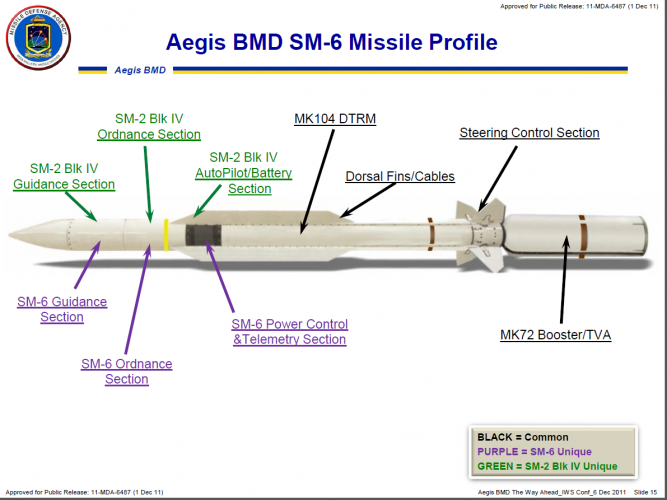
Inaccurate, you see, the RIM-156A uses the same missile body as the RIM-174, and the same MK104 DTRM and MK72 booster, the basic range is exactly the same. The range improvement of the RIM-174 may be similar to the range improvement of the AIM-120D relative to the AIM-120C7, which is achieved by optimizing the flight trajectory to increase the range. 00000001.png
 
Inaccurate, you see, the RIM-156A uses the same missile body as the RIM-174, and the same MK104 DTRM and MK72 booster, the basic range is exactly the same.
Yes, but no. RIM-156 was semi-active / IR. RIM-174 has an active terminal seeker. RIM-156 couldn't use all of its potential.
 
Inaccurate, you see, the RIM-156A uses the same missile body as the RIM-174, and the same MK104 DTRM and MK72 booster, the basic range is exactly the same. The range improvement of the RIM-174 may be similar to the range improvement of the AIM-120D relative to the AIM-120C7, which is achieved by optimizing the flight trajectory to increase the range.
Well, the whole RIM-174 project was initiated basically as "mating AIM-120 seeker with RIM-156 body".
 

Similar threads

Back
Top Bottom