Aeromarine Projects and Prototypes

There are only a couple of twin boom designs that I am aware of from Aeromarine. Paul G. Zimmermann worked at Curtiss Aeroplane before working for Aeromarine and took some of his ideas with him, which can be seen in his patent of the design of the Aeromarine Shipborne Hydroaeroplane Fighter, in which he applied for a patent in 1921, but did not receive the patent award until 1926. The aircraft was designed to land on land, water, or on the deck of a ship. The design preceded the first carrier landing, which was accomplished a year later by Lt. Commander Chevailer on the USS Langley on Oct. 26, 1922 using an Aeromarine 39B. The Shipborne Hydroaeroplane was never built.

Aeromarine Shipborne Hydroaeroplane patent
https://patents.google.com/patent/US1603304A/en?inventor=Paul+G+Zimmermann
The other twin boom design was by Uppercu himself. The owner of the company had a number of patents in his name, which were mostly automobile related patents. The design of his twin boom aircraft is in the post below.

https://www.secretprojects.co.uk/threads/aeromarine-projects-and-prototypes.18424/page-4#post-321817
The other boom designs were the Uppercu-Burnelli lifting body transports. However, as you know is a different story.
 
Thank you my dear Dynoman,and what was this designation ?,

The other boom designs were the Uppercu-Burnelli lifting body transports. However, as you know is a different story.
 
I am very late in addressing an old thread.

Here is a factory photo of a "model" of the Model XII, the photograph dates from 24 February 1923. I have additional factory photos.
 

Attachments

  • Aeromarine XII.JPG
    Aeromarine XII.JPG
    5.4 MB · Views: 56
I am very late in addressing an old thread.

Here is a factory photo of a "model" of the Model XII, the photograph dates from 24 February 1923. I have additional factory photos.

Many thanks, and please we want to see more.
 
Here is a factory photo of a "model" of the Model XII
Beth61, this is a beautiful photo of Aeromarine's proposal to the US Army for a Type XII competition.

We would love to see more photos!
 
Here is a factory photo of a "model" of the Model XII, the photograph dates from 24 February 1923. I have additional factory photos.
It is the company's entry in the USAAS/USAAC's fifth Type XII competition under contract #637.

The history of the Night-Bomber, Short-Distance multi-seater bomber (later Type XII) tenders is interesting:
  • In 1919, Martin submitted a twin-engine night bombardment biplane designated MB-2 (then GMB-2) as per Specification 1502-A.
  • Martin won Air Service contract #277 and built 20 of those, powered by 420 hp Liberty 12 engines.
  • In 1920, a slightly improved production version as per modified Specification 1502-E. Now designated the NBS-1 (for Night Bomber, Short-Range), it was built under contract #402 by Curtiss (50), L-W-F (35) and Aeromarine (25).
  • On Nov. 15, 1920, Aeromarine, Boeing, Curtiss, Gallaudet and L-W-F submitted three-engined proposals (still 420 hp Liberties); the first three received contracts #338 to 340 respectively, for design info and purchase, but none resulted in an order.
  • On May 4, 1921, the Air Service issued a new tender, to which Martin, Wittemann-Lewis and Gallaudet responded on July 18; the first two companies received contracts #518 and 519 for design info and purchase, but again, no order ensued.
  • On Jan. 24, 1922, the Air Service issued yet a new twin-engine night-bomber tender (Circular 22105), to which Cox-Klemin, Elias, L-W-F and Martin responded; the first three companies received contracts #542 to 544 for design info and purchase; this time around, all three resulted in further contracts (#554 to 556) for detailed design and construction, using the slightly modified 425 hp Liberty 12A engine type; however, Cox-Klemin's two aircraft were canceled before even receiving a designation; L-W-F's Model H-1 Owl, designated XNBS-2, was also canceled because of the company's financial difficulties; only Elias's XNBS-3 reached the construction stage, although the second example was canceled. Interestingly Martin, who apparently had not participated in that particular tender, received contract #560 for eventual construction of the new NBS- type. Also worthy of note is the fact that, with regard to this particular tender, Curtiss had also received a contract for an experimental thick wing suitable for a bombardment airplane of internally braced monoplane type, though none was built.
  • Finally, in early 1923, the redesignated Army Air Corps issued Circular 2238 and Specification 1543 for a newly-improved aircraft of the Type XII (Night Bombardment, Short-Distance - Multi-Seater) type. Aeromarine, Boeing, Dayton-Wright, Huff-Daland, Elias and Air Ships responded; the latter three received contracts #637 to 639 for their designs, but eventually it was Curtiss who obtained a construction contract for its Condor (Model 36), a refined NBS-1 with welded steel-tube fuselage designated NBS-4 (then XNBS-4) that eventually led to the improved B-2 Condor (Model 52) bomber.
 

Attachments

  • model12-1.jpg
    model12-1.jpg
    70.8 KB · Views: 38
  • model12-2.jpg
    model12-2.jpg
    72.6 KB · Views: 37
Thank you for that data rich historical overview.

You mentioned: "Curtiss had also received a contract for an experimental thick wing suitable for a bombardment airplane of internally braced monoplane type, though none were built." Date and technology proposal wise, this sounds quite interesting.
 
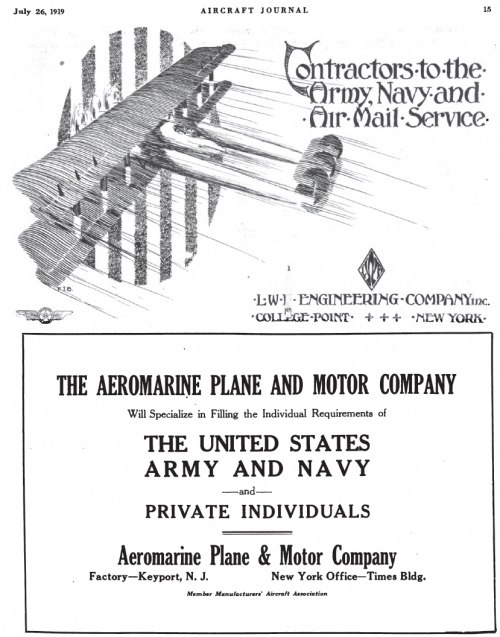
From Aircraft Journal 1919.
 

Attachments

  • 5.png
    5.png
    394.1 KB · Views: 17
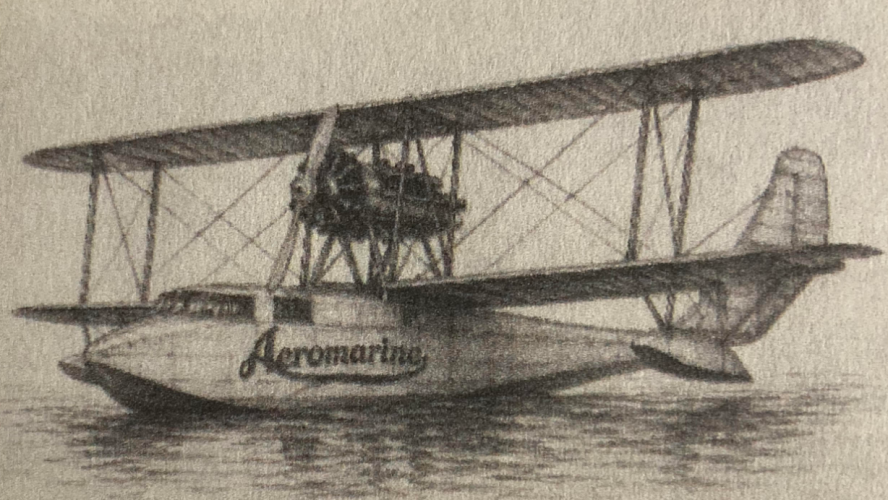
Found this drawing in the book History of Aeromarine: A Flying Boat Company in Keyport by John Schneider (2026), pg. 70. The work is not attributed to any source in the book. I don't know if this is a conceptual drawing or simply artwork. Schneider suggests that the sources of the materials used in his book are from the Keyport Historical Society. Any thoughts on this drawing?

1786368247088.png
 
Back
Top Bottom