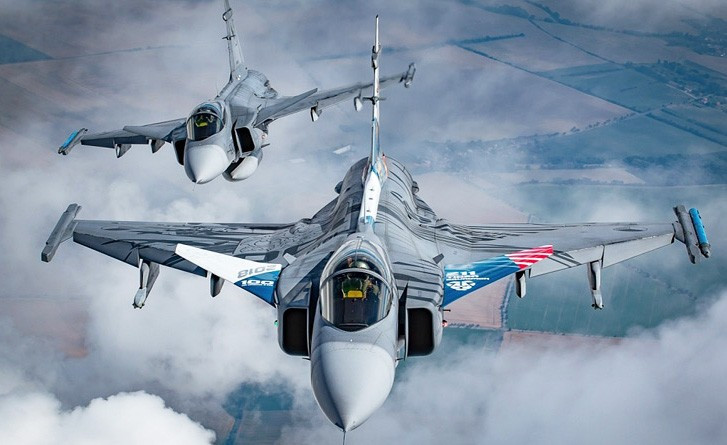
Since the last Canadian evaluation their criteria may have changed somewhat due to developments.

Villman out with a new (well, for the general public anyway) video. According to him, during Canada's last evaluation of their fighter options from 2021 a (substantial?) "risk coefficient" was applied to Gripen E/F because it wasn't yet in production. This is of course the very same evaluation that was recently leaked to the media as Canada is weighing options about whether to go forward with its F-35 buy. Gripen's scores without this coefficient are supposed to be very close to F-35's across all categories. He doesn't give his exact source for this information but implies it's a knowledgeable one. Intrigue notwithstanding, whatever the case, both options' technological and operational merits should be well known quantities for Ottawa by now.
View: https://youtu.be/3yI4r1bslA8
 
Villman out with a new (well, for the general public anyway) video. According to him, during Canada's last evaluation of their fighter options from 2021 a (substantial?) "risk coefficient" was applied to Gripen E/F because it wasn't yet in production. This is of course the very same evaluation that was recently leaked to the media as Canada is weighing options about whether to go forward with its F-35 buy. Gripen's scores without this coefficient are supposed to be very close to F-35's across all categories. He doesn't give his exact source for this information but implies it's a knowledgeable one. Intrigue notwithstanding, whatever the case, both options' technological and operational merits should be well known quantities for Ottawa by now.
Again that is a highly doubtful claim. Were this claim correct why didn't the Canadian Govt come out and state as such given the current relations with the US. They wouldn't have to give numbers but could easily issue a statement discussing a risk modifier applied to Gripen because it had yet to enter service. It wouldn't hurt them at this point and only increase their justification in moving to the Gripen. Instead we continually have statements from a guy who in his last written article showed he didn't understand the F-35 or modern air warfare, irrespective of his previous employment.

To add to the above the Finnish evaluation with Saab adding two Globaleye to their bid still didn't approach F-35 capability, the F-35 won every category over both the SH and Gripen even with the SH bidding and using Growler support. I'm not sure why the F-35 being a superior airframe should be controversial or contested anywhere. The technology between the two airframes is significantly different as well as the money invested in both programs. Quite simply you get what you pay for when it comes to fighter jets and no amount of claims to the contrary can deny that.
 
The opinion of an expert.
Who just happens to be paid by Saab to say the right thing...

Don't get me wrong. I like the Gripen and that it will be a useful addition to Ukraine. I also acknowledge that Jussi Halmetoja is highly experienced with the Gripen, but please don't try to imply that he is objective in this case.
 
I just stumbled across this short video about the roll out of the first foreign produced JAS-39E in the world:


Brazil experienced a historic moment for its defense industry and military aviation this Wednesday (25th) in Gavião Peixoto (SP), with the rollout of the first F-39E Gripen produced on Brazilian soil. The ceremony, held at the Embraer plant, brought together Brazilian and Swedish authorities, as well as representatives from Saab, AEL Sistemas, AKAER, and the Brazilian Air Force, symbolizing one of the country's greatest technological advancements in the aeronautical sector.​
 
Who just happens to be paid by Saab to say the right thing...

Don't get me wrong. I like the Gripen and that it will be a useful addition to Ukraine. I also acknowledge that Jussi Halmetoja is highly experienced with the Gripen, but please don't try to imply that he is objective in this case.
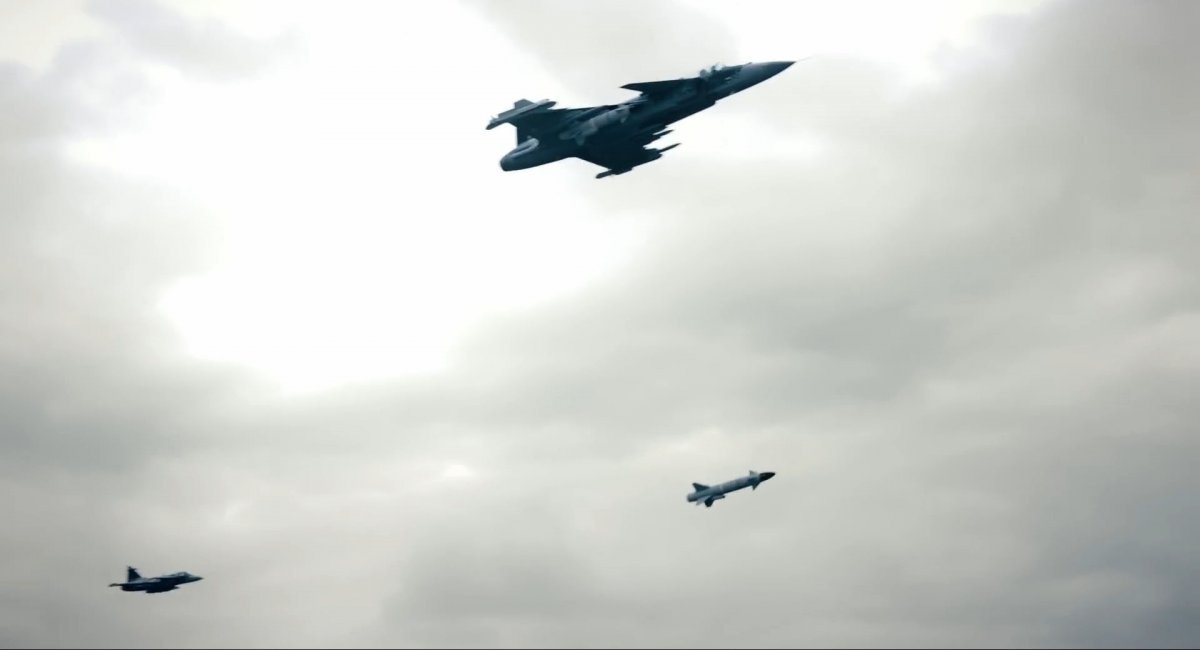
The Gripens can do this:
View: https://www.youtube.com/watch?v=UDX7zYTgz7Y


Which is very useful when the opponent knows where your airbases are and has the means to attack them.
 
Which is very useful when the opponent knows where your airbases are and has the means to attack them.
Tbh, without Russian manned fixed wing ops over Ukraine, up for debate how much it's worth right now. As the Russian reach into Ukraine is limited to stand off air breathers and/or very limited numbers of long-range ballistics, it places aircraft within the range of numerous ballistics.
A smaller footprint doesn't decrease vulnerability as effectively as range does.

In this situation, the main advantage of Gripen shifts towards prices .... and Gripen E isn't all that cheap.
FA-50 is (3 times cheaper!), but it isn't available for Ukraine.
Currently, the best (possible) aircraft for Ukraine would be Typhoon...which is not procured.

Granted, Gripen capabilities would be supremely valuable again in case of either a second Russian attempt to gain air superiority, or return of maneuver warfare(which means the same). Neither appears likely anytime soon. I honestly wonder if VKS is directly prohibited from even trying.
 
It does not matter much what aircraft it would be. What is essential in the next dozen years for them is to build mass with a large procurement of anything that is available on the market in that bracket of performances.
 
Tbh, without Russian manned fixed wing ops over Ukraine, up for debate how much it's worth right now. As the Russian reach into Ukraine is limited to stand off air breathers and/or very limited numbers of long-range ballistics, it places aircraft within the range of numerous ballistics.
A smaller footprint doesn't decrease vulnerability as effectively as range does.

In this situation, the main advantage of Gripen shifts towards prices .... and Gripen E isn't all that cheap.
FA-50 is (3 times cheaper!), but it isn't available for Ukraine.
Currently, the best (possible) aircraft for Ukraine would be Typhoon...which is not procured.

Granted, Gripen capabilities would be supremely valuable again in case of either a second Russian attempt to gain air superiority, or return of maneuver warfare(which means the same). Neither appears likely anytime soon. I honestly wonder if VKS is directly prohibited from even trying.

All the talk of Ukraine operating new fighters en masse is just wishfull thinking , Ukraine can't afford to operate more than a dozen fighters , Foreign funding will not continue indefinitely even if EU funds are used to buy the aircraft ,maintenance and operations cost are beyond Ukrainian means , same goes for their insistence on 800k+ soldier military , who will pay for it.
 
All the talk of Ukraine operating new fighters en masse is just wishfull thinking , Ukraine can't afford to operate more than a dozen fighters , Foreign funding will not continue indefinitely even if EU funds are used to buy the aircraft ,maintenance and operations cost are beyond Ukrainian means , same goes for their insistence on 800k+ soldier military , who will pay for it.
But for now, Ukraine operates more, and foreign funding is likely there for the foreseeable future.
So we work with current inputs.
 
What is the basis for that assertion?
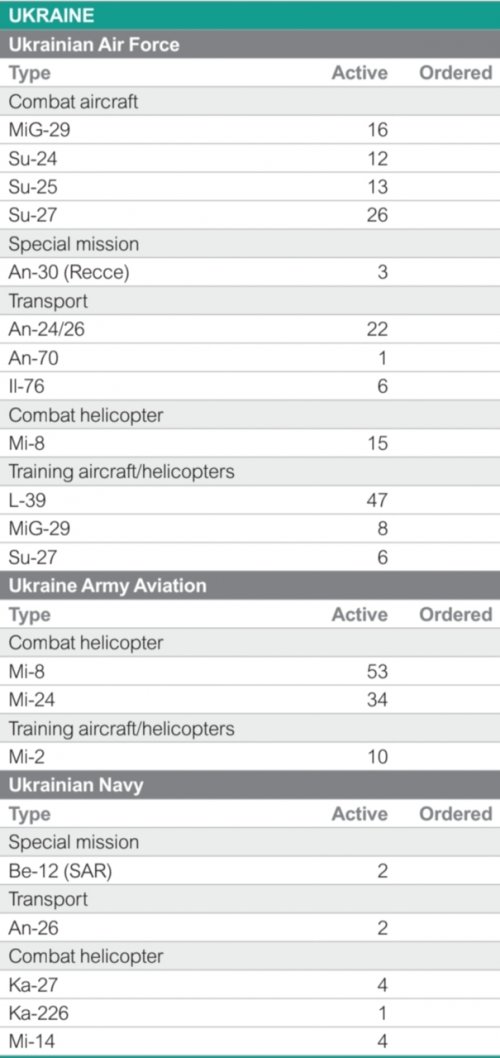
I'll do it for him, according to Flight Internationals 2021 edition of their World Air Forces Directory this was the Ukrainian Air Force throughout 2020:
IMG_20260329_125628.jpg

Now, that was a time where Ukrainian infrastructure was intact, Ukrainian industry was intact, Ukrainian workforce was much larger as not around 7 Million people left the country (most of which, according to polling don't plan to return) and Ukraine had the ability to draw from their stockpile and foreign stockpiles of Soviet legacy equipment to keep their air force going. These stockpiles outside of Russia and allied countries have been essentially exhausted by now.

What does this mean for the UAF? They have to build their force completely new from the ground up. They have to train new personelle, have to establish new logistics, have to adopt systems they're largely unfamiliar with when it comes to operation and maintenance. Systems that are more expensive to procure and maintain despite their industrial capability having been crippled compared to what it was pre-2022.

So while they were able to maintain around 67 soviet era fighters, attack aircraft and fighterbombers back then, due to all the factors above it's unlikely that a future fleet of modern western multirole fighters will approach these numbers, let alone exceed them. In 2020/21 the only reason they had these aircraft in operation to begin with was because Ukraine used to be at the heart of the USSR and subsequently inherited a lot of stockpiles of equipment, spares and industrial facilities. Most of which simply doesn't exist anymore and wouldn't be compatible with models like the Gripen.

Note: I believe posts like these and the ones to which this serves as a reply should belong in their own thread. Something like 'Hypothetical Future of the Ukrainian Air Force and potential acquistions'. Because threads like this Gripen thread, F-16 thread, Rafale and many others suffer greatly from people filling endless pages with thoughts and 'reports' on what-if's and maybe's. It would be better to pool them in a dedicated thread and leave the dedicated aircraft threads to mostly technical and historical/developmental types of posts. @overscan (PaulMM) @Antonio or @Jemiba could chime in if that's appropriate or not.
 
Again that is a highly doubtful claim. Were this claim correct why didn't the Canadian Govt come out and state as such given the current relations with the US.

It is worth noting that the American government retaliated against our civil aviation sector for even discussing cancelling the F-35 order... our government has strong reasons to avoid drawing attention (even after the Davos speech).

Also, if it looks like the competition metrics were somewhat rigged... I wonder if senior officials who persist from that era would really want attention drawn to it... better to wait until after the mid-terms if we're ordering the Gripens and just go ahead and do it (or not).
 
Let´s remember reading those shiny charts that there are... Only 11 or so Gripen E/F in service*... Not a serious basis to evaluate and compare with any CPFH.

*10 in Brazil- 1 in Sweden.
 
What is the basis for that assertion?
Appetites based on EU financing Ukraine for forseable future !Which is unlikely particulary if war comes to a halt,near all EU member states are in the red and can't really afford to finance Ukraine . Current financing is being sold as Loan when its really not.

Ukraine Revenue $68.7 billion and expenditure of approximately $113.8 billion


Comparable budget expenditure with minimal deficits , but twice the GDP of Ukraine - Czech republic -> Fighter fleet 14 second hand Gripens

Poland 3x the GDP of Ukraine , gets cca 46billion a year in EU funds (as much as Ukraine) Present fleet 46 F16 ,2 F35 ,12 FA50 aims for 46 F16,32 F35 and 35 FA-50

Austria near 3x the GDP of Ukraine , 15 Eurofighters ,aspires for 36 modern replacments.

Switzerland cca 5x the GDP of Ukraine , 25 F18 , aspiring for 30x F35

All listed combined do not aspire to Ukraine dream fleet size despite having cca 13x the GDP of Ukraine and more or less balanced budgets.

Ukrainian 'aspirational orders'
150 Gripen
100 Rafale
X number of other second hand airframes

Same goes for 800k man standing army Zelenski is demanding at 'peace talks' , they could not pay for one ever

I think Ukraine could operate maybe 30+/-6 fighters but would still need foreign financing for that.

Ukraine previously operated similar numbers with pilots barely making any flying hours and barely operational fleet.
 
Last edited:
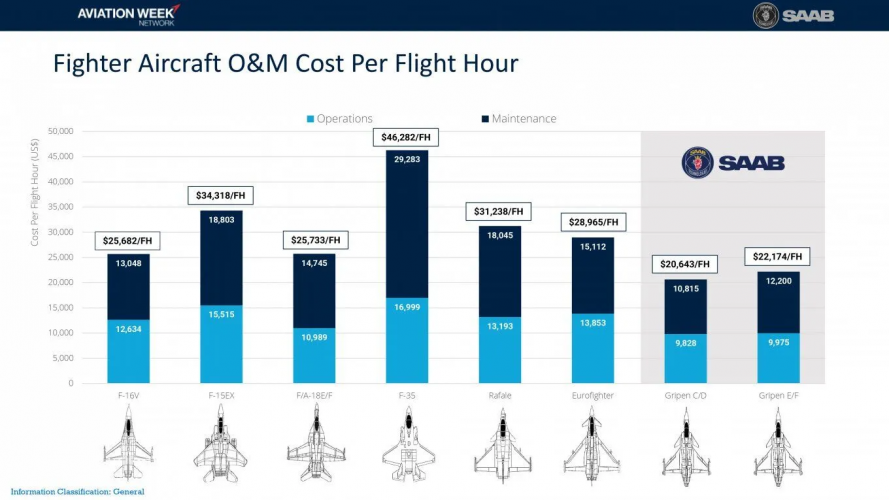
If you want to build a fleet with big numbers the Gripen is just ideal for this. Both the aquisition cost and the cost of flying the fleet is small compared with the alternatives.
View attachment 807211
Be cautious with information supplied by a biased party as part of their marketing... :rolleyes:
 
Let´s remember reading those shiny charts that there are... Only 11 or so Gripen E/F in service*... Not a serious basis to evaluate and compare with any CPFH.

*10 in Brazil- 1 in Sweden.
We can evaluate costs based on existing Gripen fleets.

"about 60 people are needed to secure 12 Gripen fighters while in case of the same number of aircrafts of the 3rd generation Panavia Tornado the number is around 200 people. Maintenance has not been performed according to a predetermined number of hours flown, but based on the actual condition of the machine. The state is being constantly monitored and any deviation from the standard is alerted by a complex on-board control device. Therefore, one flight hour requires 10 hours of maintenance on average.

The Gripen fighter is not only a reliable machine, but its operation is also economically advantageous. It is said that an hour of the Gripen fighter costs 4,500 dollars. In contrast, the American multipurpose jet fighters of the 4th generation General Dynamics F-16 Fighting Falcon cost 7,000 dollars, 16,500 dollars in case of the French multipurpose jet fighters Dassault Rafale and 18,000 dollars for the Eurofighter."

Also, the Gripen is on the small size regarding weight. A Gripen E has an empty weight at 8 tones, max takeoff weight is 16,500 kg. For comparisson, the lightest similar modern aircraft, the F-16V, has an empty weight of 9,200 kg and the MTW is over 21,000 kg. The fuel consumption is a significant part of the operating costs.

It may surprise you but so can many other platforms.
Maybe, but in the Gripen case this was considered from beginning around this capability.
View: https://www.youtube.com/watch?v=MNak9lB_q00
 
Last edited:
Mirage 2000 does the same (some trainings were made in France, on motorways).
Why a Rafale can't ?
Why a F16 can't ?
Practically every fighter jet can use the highways, highway size and length required varies

But without whole support system in place this is just a party trick.

In cold war many countries had some stretches of highway made specifically so they could host fighters , often with concrete pavement

If an F4 can so can every other fighter
 
Last edited:
A new interview with Micael Johansson. SAAB seems to stand ready, entirely up to Ottawa then. GlobalEye and Gripen different issues, according to the CEO.

Some general background provided in this new TLDR News overview about the "informal" Nordic alliance. I'm not familiar with this channel but at least this video is well sourced, as evidenced by the extensive list in their video description.

View: https://youtu.be/GxWtq2ZLfgs


TLDR News EU said:
 
Can you drive a nail with a shovel? Yes, absolutely. Can you do it with a bottle of milk? We'll, in the right conditions, probably. But neither will be as optimized as a hammer.

The Gripen (as all the Swedish fighters before him) is optimized for dispersed airfield. Small footprint (physically and ground crew), accessible maintenance panels (no access ladder, heavy tooling or platform required), ability to refuel from regular fuel trucks, even HUD symbology and approach profile are closer to an aircraft carrier fighter than a land-based one.

Can you do it with other fighters? Only to some extent. You'll need longer/larger/cleaner stretches of road (less dispersion possibilities), heavier logistic (ground crew and vehicles, more noticeable from enemy recon assets) and so on... And you will not be able to do it for long periods of time.

Maybe not a game changer (what an overused term), but still an advantage.

Practically every fighter jet can use the highways, highway size and length required varies

But without whole support system in place this is just a party trick.

In cold war many countries had some stretches of highway made specifically so they could host fighters , often with concrete pavement

If an F4 can so can every other fighter

 
600 hundred meters of straight road inside a forrest. One truck. One specialist and 5 conscripts. This is all what is needed in order to have the aircraft flying again in 10 minutes.
View: https://www.youtube.com/watch?v=HbkScZFCgro


You can land with other aircrafts on highway strips but you will not maintain them in operation with this minimal equipment.
 
I've been watching these two videos:

View: https://www.youtube.com/watch?v=dzWRL7459CA


View: https://www.youtube.com/watch?v=xy4EqhlCunc


From a purely technical persepctive. How capable are Gripen-E's in EW and SEAD against modern IADS?

Saab's marketing is very convincing, but how much of that would translate into real combat? Could Gripen Es do anything close to what Israeli F15/16s have done against Iranian air defences, or is that a wrong comparison because Israel's results depend heavily on a wider ecosystem of ISR, networking, support assets, training and stealth?

Likewise in a Ukrainian scenario without F35 support, could Gripen-E realistiically use EW suite and Meteor to survive against Russian GBADs, challenge Russian aircraft, and create at least localized air superiority over occupied Ukraine? Or are people like Justin Bronk overstating how far it could go? Basically: even if the F35 is in another league, is the Gripen E still good enough to operate effectively against Russian style air defences without taking heavy losses?
 
I've been watching these two videos:

View: https://www.youtube.com/watch?v=dzWRL7459CA


View: https://www.youtube.com/watch?v=xy4EqhlCunc


From a purely technical persepctive. How capable are Gripen-E's in EW and SEAD against modern IADS?

Saab's marketing is very convincing, but how much of that would translate into real combat? Could Gripen Es do anything close to what Israeli F15/16s have done against Iranian air defences, or is that a wrong comparison because Israel's results depend heavily on a wider ecosystem of ISR, networking, support assets, training and stealth?

Likewise in a Ukrainian scenario without F35 support, could Gripen-E realistiically use EW suite and Meteor to survive against Russian GBADs, challenge Russian aircraft, and create at least localized air superiority over occupied Ukraine? Or are people like Justin Bronk overstating how far it could go? Basically: even if the F35 is in another league, is the Gripen E still good enough to operate effectively against Russian style air defences without taking heavy losses?
It's the Swedish version of "Muh Spectra"
 
Likewise in a Ukrainian scenario without F35 support, could Gripen-E realistiically use EW suite and Meteor to survive against Russian GBADs, challenge Russian aircraft, and create at least localized air superiority over occupied Ukraine? Or are people like Justin Bronk overstating how far it could go? Basically: even if the F35 is in another league, is the Gripen E still good enough to operate effectively against Russian style air defences without taking heavy losses?
An explanation
View: https://www.youtube.com/watch?v=k6pVOG33B2E


Yes, the Gripen E’s strength is not its flight performance but its electronics: Radar, sensor fusion, ECM & EW, data links, and the separation of flight critical and non-flight critical SW allowing extremely fast SW upgrades of radar and EW in a time of war. And Gripen E’s “code in the morning, fly in the afternoon” SW architecture will allow it to stay one step ahead of its adversaries, especially those who rely on FPGAs harvested out of washing machines. This is what will decide future conflicts. Not that you can do Cobra manouvres at Farnborough or Le Bourget. ;)
 
Last edited:
Or are people like Justin Bronk overstating how far it could go? Basically: even if the F35 is in another league, is the Gripen E still good enough to operate effectively against Russian style air defences without taking heavy losses?
No and that's not even a difficult question to answer. When you see last generations fighters operate over hostile air space, for example US or Israeli aircraft over Iran, then that's because their way has been paved by the likes of the F-35, B-2 and B-1/B-52 using stand off weapons. And even then, you rarely see them operate directly over the heartland and more so at the border regions just because the thread of IADS can't be fully eliminated.

And unlike the US jets the Gripen E is overweight, underpowered and it's ECM suite is most likely not better than what the Americans and Israelis field. So trying to cross the line of contact would be suicide.

The only advantage the Gripen has over the F-16s Ukraine currently fields is that the Meteor gives it more credible means of defending itself. But ultimately it would just be used to launch stand off munitions and engage drones and slow flying cruise missiles. And for that role the horrendously high acquistion cost is not really justifiable. Not to mention that there is only like a dozen Gripen E/F right now.

I.e. this line of thinking belongs firmly in the realm of fantasy or Saab PR, to which of these Mr. Bronk subscribes, I'll let you decide for yourself. Let's just say that Saab has always been good at creating plenty of hype but delivering very little, quite literally so because the Gripen fleet across all variants isn't huge and export orders for the E/F are abysmal.
 
If you want to know how good the Gripen E is, then there are IMHO two reliable indicators of this:

The first is Gripen's performance record in Red Flag exercises. The second is the level of noise semi-professional forum posters who love Eastern kit are making about it.

After all, if it really is as bad as they say it is, why do they feel the need to pound the podium Khrushchev style to insist just how bad it is? Are they perhaps afraid of something? ;)
 
Last edited:
Seeing another forum poster brought up current conflicts like Iran and Ukraine, and without getting political in any way, what seems to work there and what does not?

Well it seems that everything that is fixed in place is taken off the playing field pretty quickly: Hardended shelters get a lazed bomb through the roof no matter how thick the concrete is. Mobile SCUD launchers were a problem in Iraq. The Yugoslav's professional shot and scoot SAM tactics caused NATO massive headaches in 1991 even knowing about the pre-prepared positions. But they (NATO) never knew which ones they were at. And when the Yugoslavs did emit, they then packed their gear up quickly and were gone in no time. And this is also how the turn-around of a Gripen works: You are gone when the missile or ground attack hits the site.

So the one common denominator for what works in all these conflicts seems to be not being there when the strike package arrives. And this is what makes the Archer artillery system so good: Even if artillery location radar fixes you as the shells leave the barrel, you are simply not there when the counterbattery fire arrives. And this is also why the road basing system we had (and are now rolling out again) in Sweden was so good: You are simply not there long enough to get zapped by any missile or strike package. And both the Viggen and Gripen are designed around this concept.

And all of this is transferable. So if you buy the Gripen E, you can operate it like the SwAF intended from austere road bases with a minimal crew, both in terms of numbers and training. It was built to be serviced by conscripts, not AF professionals.

So yeah, I do think the Gripen would make a difference for anyone who buys it: Not only is it a good aircraft when airborne, but it would also be very difficult to take out on the ground.
 
If you want to know how good the Gripen E is, then there are IMHO two reliable indicators of this:

The first is Gripen's performance record in Red Flag exercises. The second is the level of noise semi-professional forum posters who love Eastern kit are making about it.

After all, if it really is as bad as they say it is, why do they feel the need to pound the podium Khrushchev style to insist just how bad it is? Are they perhaps afraid of something? ;)
I find the logic of some individuals here fascinating. “If a Russian aircraft can’t accomplish a mission, than a western one couldn’t”

With that being said Ukraine doesn’t have the necessary electronic attack or cyber capability to effectively carry out a conventional SEAD campaign. Nor does Russia.
 
Last edited:
I find the logic of some individuals here fascinating. “If a Russian aircraft can’t accomplish a mission, than a western one couldn’t”

With that being said Ukraine doesn’t have the necessary electronic attack or cyber capability to effectively carry out a conventional SEAD campaign. Nor does Russia.

True, and which is all the more reason for Ukraine to operate the Gripen E. Or any other nation (like Sweden during the Cold War) that can't guarantee air superiority over the whole country:

Because if you are quick on your feet and always one step ahead through quick turn around times on numerous and dispersed road bases, your chances or survival are greater than if you are limited to a few well known airbases with hardened shelters and kilometers of runways in fixed spots ripe for the picking.
 
And unlike the US jets the Gripen E is overweight, underpowered and it's ECM suite is most likely not better than what the Americans and Israelis field. So trying to cross the line of contact would be suicide.

The only advantage the Gripen has over the F-16s Ukraine currently fields is that the Meteor gives it more credible means of defending itself. But ultimately it would just be used to launch stand off munitions and engage drones and slow flying cruise missiles. And for that role the horrendously high acquistion cost is not really justifiable. Not to mention that there is only like a dozen Gripen E/F right now.

Well, the israelis and the americans seem to field pretty effective ECM Suites. At the moment they are bombing unpunished a regional power armed with latest eastern weapons, like the russian S-400 and the chinese HQ-9 SAM, which are marketed to have anti-stealth capabilities. If the Gripen has the same capabilities then it will do it„s job just fine...

The Gripen has the great advantage to be able to constantly operate from different locations at each flight, in a guerilla warfare style. This does not matter if you can operate in a condition of air superiority, but it is crucial against an opponent who has superior numbers and long range strike capability. From the point of view of the cost, well, it costs less than other modern fighters on the market, like the Su-35 or Rafale. And because of it`s small weight and single engine, the cost of operating it is also significantly smaller.


A direct comparison of availability rates​

Fighter aircraftAverage availability rateCost per flight hour (€)
F-22 Raptor50–60%70,000
Rafale75–90%16,000
Su-3540–60%20,000
Gripen E85–95%8,000
 
Last edited:
600 hundred meters of straight road inside a forrest. One truck. One specialist and 5 conscripts. This is all what is needed in order to have the aircraft flying again in 10 minutes.
And if you believe that's all that is needed to operate for anything more than a couple of days (at most - it may even fall apart after one day) then you will believe anything. People need to rest, they need resources. Aircraft need fuel, spare parts, weapons etc.

The Gripen has the great advantage to be able to constantly operate from different locations at each flight, in a guerilla warfare style.
This scenario only works if there are either pre-positioned fuel, weapons, parts, support personnel at said location or a means to get them there. Otherwise all that happens will be that a jet lands somewhere and then sits...useless.

Stop being so ignorant and believing the marketing spin being put out.
 
Even with "fast" turn around, the aircraft are still on the ground for the vast majority of the time. It's not like 2-4hr sortie, 10min on ground, 2-4hr sortie, 10min on ground, etc

Dispersal only really works with limited numbers of aircraft and large areas (e.g. Sweden). Otherwise you're better off trying to defend and harden areas.

Dispersal also increases your vulnerability to other threats - e.g. Special Forces
 

Similar threads

Back
Top Bottom