Harken back to that old ESAV ppt slide from NG describing parametric aircraft design with a certain planform.

Software has most certainly come leaps and bounds since then. If it were related, it wouldnt be surprsing, but I still dont think its F4 or F35 kind of closeness.

I dont see how its physically possible to make a mulitrole strike fighter into an air superiority fighter let alone a strike leaning fighter.

I can see things going from an air superiority fighter to a strike fighter maybe, but if it is the case at all, then it most likely looks like:

AII-X demonstrator -> key technologies -> generic planform and systems modeling/validation, -> tweak to fulfill navy and airforce requirements -> two related designs sharing the same ancestry

Rather than F-47 -> F/A-XX or vice versa.

Something something digital engineering.
 
Last edited:
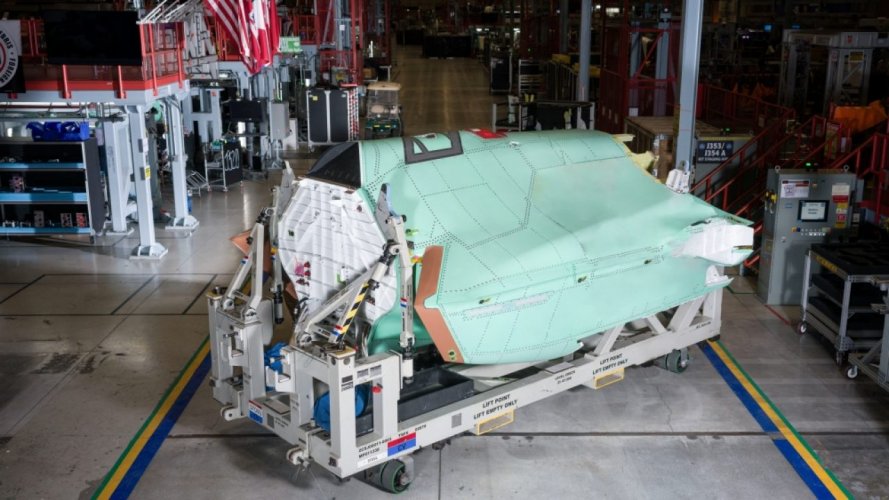
I memory serves starting about 5-6 years ago, as posted at SPF, there were a lot of stories of Boeing’s investment in and technological advances in aerospace aircraft manufacturing. Maybe along with the designs Boeing showed DoW what this manufacturing tech could do with advanced aircraft production.

Maybe this is an obvious observation but TBH I’m very surprised they won both competitions without something that really stood out and added to the proposal other than the design
 
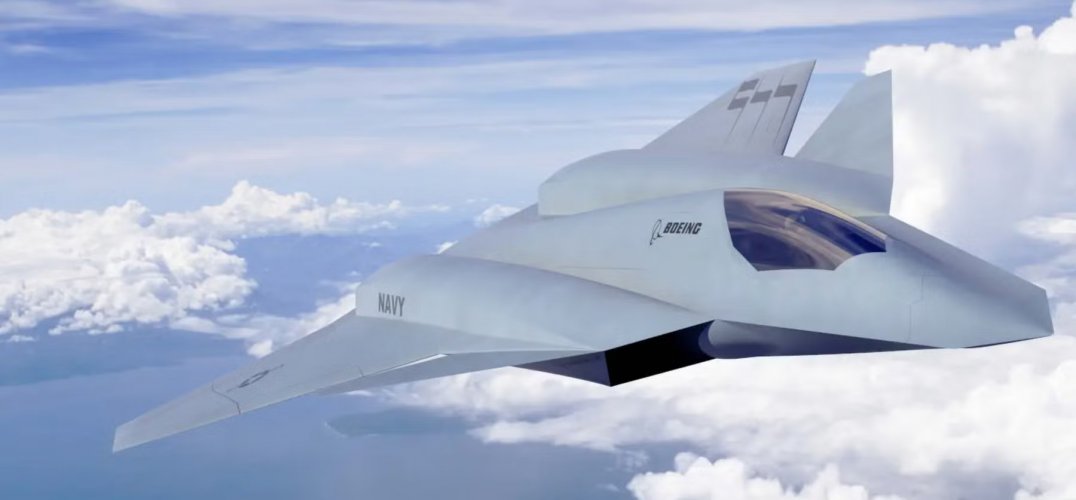
Of course it's all gut feeling at the moment, but we have been led to believe that the F-47 is a relatively small plane, and that FA-XX rendering looks huge.
The theories I've seen about the Lockheed and Boeing NGAD proposals is that the Lockheed plane was giant for a fighter - possibly similar in size and weight to the F-111 - while the Boeing plane was only about the size of the F-22. That was part of the origin of the speculation that the Boeing F-47 and F/A-XX proposals were related.
 
He said F-4 not F-14. F-4 being a USN aircraft adopted by the USAF.

I believe he was referring to the F-4 and the F-110A (Redesigned the F-4C).

Sandboxx has put out a short video concerning this announcement:


It’s finally happened: The US Navy just awarded the contract for its next stealth fighter to Boeing, and that means the Navy’s 6th generation carrier fighter is all but certain to be a carrier-capable variant of the F-47 that’s already in development for the U.S. Air Force as a replacement for the F-22 Raptor.
 
I'm not convinced yet that F/A-XX and F-47 are the same design. Could see them sharing a lot of systems but the planform, to me, is probably different and mission sets are different enough that they are two aircraft that share a design heritage but won't be the same ALA F-4 and F-35A & C.

If the F/A-XX is a clear variant in the F-4/F-35 mold then
- Will the USN continue with a derivative of a current in service engine to power the aircraft or would they go for an XA as the USAF eventually will with F-47?
- Will the weapons bays on F/A-XX and F-47 be essentially the same?
- Will the USN follow the USAF in the digital century concept of making production available open to other vendors?
- If the aircraft are the same then I would suggest Boeing should not require 20 billion to modify it for naval operations.
- Same core centre fuselage but different wings?
- Will the F/A-XX have a range increase beyond the suggested approx 750nm and be closer to the USAF F-47 range.
- Did Boeing's F-47 give them an advantage in that they could reduce EMD costs as they already had portions of the aircraft in development?


So many questions...
My dispassionate view is that considering USN was left out of the 5th gen when USAF got F-22, and they had to get the F-35 because it was the only thing available (ill-suite for carriers, single-engine), now they'd have to do with a navalized F-47 regardless if it meets their requirements or not, the alternative being remaining stuck with F-35 until the 7th(?) generation, or at best wait a decade or more (if ever) for a bespoke 6th gen design to be made for USN.

It's not hard to imagine a navalized F-47, larger folding wings/flight controls, beefed up fuselage, gear structure, maybe modified bays, maybe different engines, tailhook obviously etc.
 
I’m very surprised they won both competitions without something that really stood out
How do you know that they won both "without something really standing out"?

Seems more like assumption rather than fact. Because for them to win both competitions, their design definitely had to be quite...outstanding. Be it measured by performance within it's intended mission requirements, manufacturing methods and scaling or simply providing the best blend of qualities at the most acceptable cost and timeframe.

For something to be outstanding, it doesn't have to be exotic or borderline esoteric. It just has to do something really well, what that something is, we can't tell yet. But the Navy and AF respectively must have been satisfied.
 
How do you know that they won both "without something really standing out"?

Seems more like assumption rather than fact. Because for them to win both competitions, their design definitely had to be quite...outstanding. Be it measured by performance within it's intended mission requirements, manufacturing methods and scaling or simply providing the best blend of qualities at the most acceptable cost and timeframe.

For something to be outstanding, it doesn't have to be exotic or borderline esoteric. It just has to do something really well, what that something is, we can't tell yet. But the Navy and AF respectively must have been satisfied.
You’re misreading my post I’m saying that (and of course speculating like everyone else on this thread) that something OTHER THAN JUST THE DESIGN did stand out like advanced manufacturing technology.

There were numerous stories we all read about delaying F/A-XX because of possible production capacity issues so therefore MAYBE Boeing overcame this concern saying “not only do we have a good design for each aircraft but we can produce both efficiently and cost effectively”
 
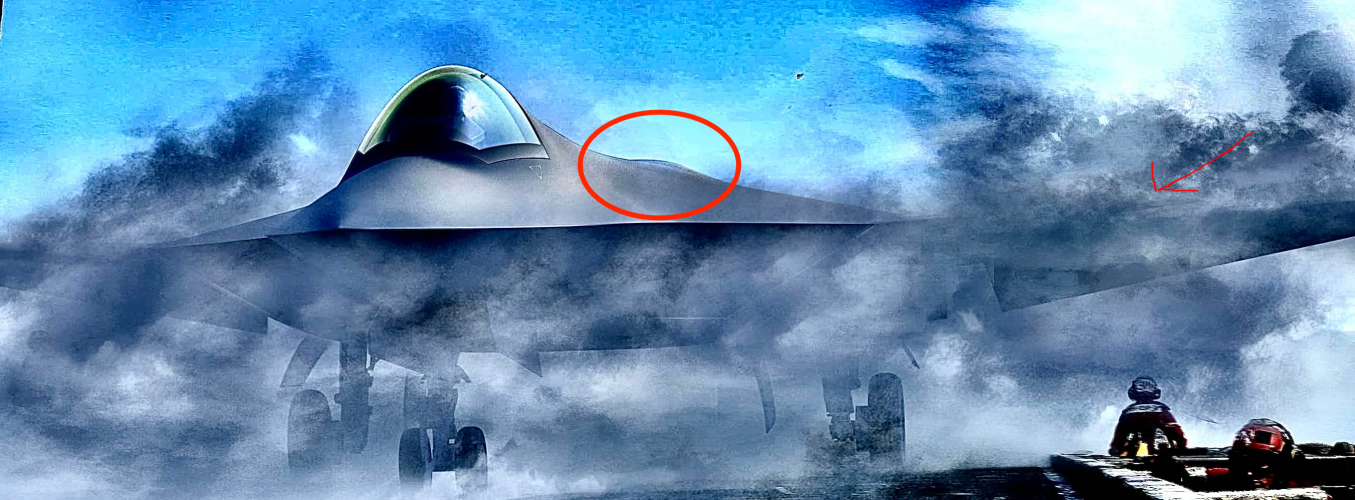
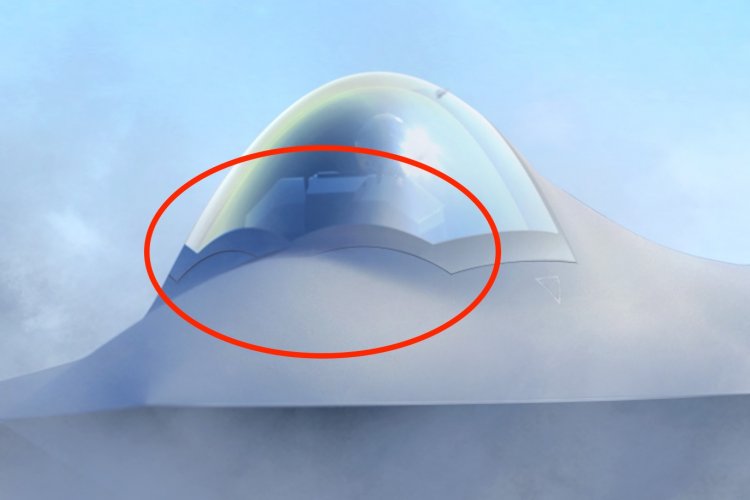
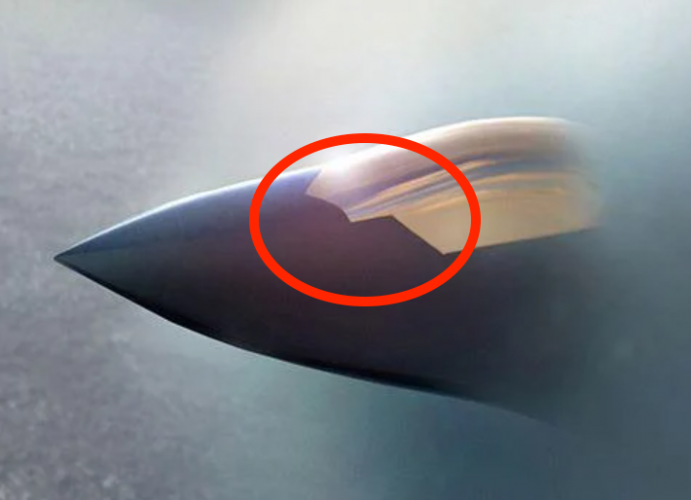
No canards, but the cockpit / nose looks exactly like the F-47 render. And ofcourse the 3d render has to be positioned at exactly the perfect angle so that those chine lines mean absolute nothing.

Still - if the fuselage is sufficiently different, insidersource can stay banned. We'll see in a few years.
I've seen the thread where insidersource was banned (The F-47 CGI one), but what do you exactly mean by that?

That being said, as what Ozair said, artistic renderings aren't made to be 100% accurate to what the whole thing will look like. It would have aspects of the real thing, especially the stuff that's visible, but everything else is guesswork and I think that there would be canards on the F/A-XX, especially given who's making them now
Steam clouds sealed the deal!
Yeah, I can see that. However, that would be detrimental to the crews working on the deck in real life, as that F/A-XX covered in steam clouds is just an accident waiting to happen
Of course it's all gut feeling at the moment, but we have been led to believe that the F-47 is a relatively small plane, and that FA-XX rendering looks huge.
Pretty sure the F-47 would be a much bigger plane, given its intended 1,000 nautical mile minimum range requirement (And that's even with the planned NGAP engines, though recent discussion in the F-47 thread suggests that there might be an interim engine planned while the NGAP is still being matured). It just looks small because the artistic renderings make it look small. Now if the F/A-XX would be just a carrier-compatible F-47, then it would be just as big, and even if it won't be one (I think it would be a wholly different aircraft with most, if not all of the same technologies and design features), it would probably still be quite large, potentially the largest fighter docked on an Aircraft Carrier in recent memory (Might be wrong on that though, so feel free to correct me).
You’re misreading my post I’m saying that (and of course speculating like everyone else on this thread) that something OTHER THAN JUST THE DESIGN did stand out like advanced manufacturing technology.

There were numerous stories we all read about delaying F/A-XX because of possible production capacity issues so therefore MAYBE Boeing overcame this concern saying “not only do we have a good design for each aircraft but we can produce both efficiently and cost effectively”
Not to mention, Boeing having won the F-47 contract and having about several years to have the technologies and requirements handled (That is including their prior Phantom Works projects like the Bird of Prey and the X-36, among others), and a facility under construction with the express purpose of building the F-47 would probably shorten the times considerably
 
You’re misreading my post I’m saying that (and of course speculating like everyone else on this thread) that something OTHER THAN JUST THE DESIGN did stand out like advanced manufacturing technology.
Then I did misread it, my apologies
 
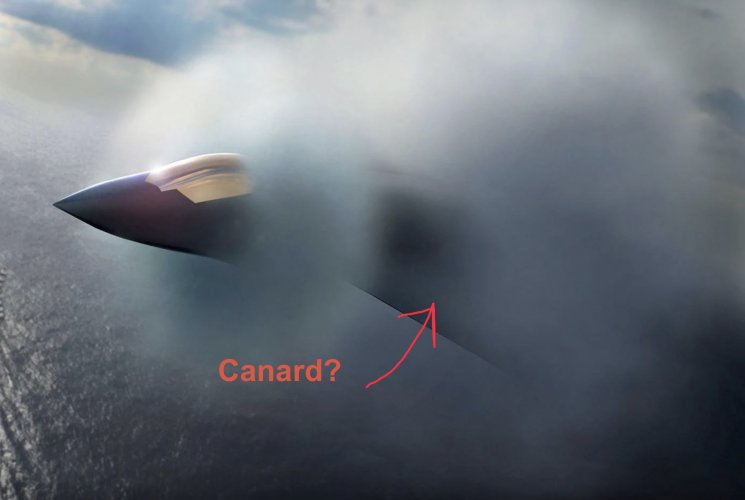
That render definitely has canards, big ones too. The whole thing looks really wide.
This might suggest though that at the other end, the engines are close together. Since Boeing is also doing the F-47, perhaps that plane is similar in that respect?

Guessing : a huge, broad weapons bay(s) (considering the impression of a pregnant flounder given by this view), but no provision for a rotary launcher, since that would restrict the diameter and therefore variety of individual weapons carried (or equipment if there is an EW/Recon variant).

Considering the wideness and length restrictions imposed by carriers, it may have a less extreme wing sweep than the F-47. Wider span, optimised for lower top speed, it's more a fast medium bomber than optimum fighter, since destroyers are meant to provide air superiority for naval groups/fleets.
 

Attachments

  • 1790733546880 copy.png
    1790733546880 copy.png
    3.5 MB · Views: 134
Last edited:
I'm just hoping Boeing can execute on both programs. Their performance on KC-46, MQ-25, and the T-7 certainly doesn't instill confidence, giving how far behind all those programs are and they aren't nearly as complex as the F-47 or F/A-XX. I honestly thought NG would win it, due to their performance on the B-21, but I guess that didn't really count for much.
And then there's Starliner that is getting thrown in the spotlight with SpaceX wanting to retire Dragon. . .
 
So logically, given the constant statements from the american MIC about not being able to support two 6th gen programs at once, FA-XX must be a variant of F-47? Just like F-4 and F-111 back in the day.
F-14 & F-111.
 
Wait a min, F-14 isn't even a variant of F-111. F-111B was the initial contender for what the navy wanted but it was pretty crap so they canned it and started the F-14 project (VFX).
I think that might be a typo.
 
My dispassionate view is that considering USN was left out of the 5th gen when USAF got F-22, and they had to get the F-35 because it was the only thing available (ill-suite for carriers, single-engine), now they'd have to do with a navalized F-47 regardless if it meets their requirements or not, the alternative being remaining stuck with F-35 until the 7th(?) generation, or at best wait a decade or more (if ever) for a bespoke 6th gen design to be made for USN.

It's not hard to imagine a navalized F-47, larger folding wings/flight controls, beefed up fuselage, gear structure, maybe modified bays, maybe different engines, tailhook obviously etc.
Some of the most successful USN aircraft have been single-engined (Skyhawk, Corsair II, Crusader) while one of its biggest (if not THE biggest) failures was a twin- the Cutlass.
 
Not sure what you guys misunderstood from my post, the likes of F-4, A-7, F-111 and later F-35 were ordered from the top to be used by both USN and USAF. Imo the same case seems to be applied to F-47 too (as the F/A-XX for USN), unless you think Boeing can design two entirely different 6th gen fighters from scratch more or less simultaneously.
 
Given how wide the cannard are on the latest image on the deck, could the 1st artist rendering have been showing us the actual cannard and not the wing all along?
View attachment 824985
Yes it could be more logical , if it was the wing the plane will be very little in size. The Boeing rendering show a big Aircraft in the F-14 size.
 
Broadly speaking, I feel a bit like it's 1992 and the news is showing neato A/F-X art.

I think my big picture takeaway (other than relief at an award) so far is that while F/A-XX has been widely described as a strike fighter, and no doubt accurately, statements over the last day or two have also been talking air superiority and FAD, while the art also looks to show an aircraft with intakes I associate with supersonic aircraft, and indeed Mach 2+ ones. To me that makes F/A-XX seem like the latter day realization of A/F-X, moreso than ATA.
 
Same here books, I even called it the A/F-X Mk.2 in the very early days of the F/A-XX.
I admire that optimism!

While it was pretty obviously going to be supersonic, I'll admit to having expected F-35ish kinematics when loaded with a similar fuel fraction, and worse when fully loaded with its higher fuel fraction and beefier payload. I thought it would be AX, or between AX and ATA. But this seems to pass the eye test as a viable BVR fighter when called upon to be that, imo anyway.
 
Let's see what happens when the first official images of the Boeing F/A-XX get revealed. I generally agree that it could be between the AX and ATA size wise.
 
I've seen the thread where insidersource was banned (The F-47 CGI one), but what do you exactly mean by that?
A strike fighter is going to have a beefier fuselage just to accomodate larger diameter strike weapons. And typically carrying a strike weapons in meaningful quantities would warrant wider bays as well. Strike weapons also require some stronger cross sectionals and a certain arrangement of supoorts for structural integrity (forgot the term for it).

Then add to that making it a naval fighter. That means beefier landing gears, a front gear bay in tandem with the support bar bay. Youd need a reinforced undercarriage too. Then add to that your strike depth/size weapon bays. These things arent rrivial to add or remove for an air superirority fighter at least traditionally.

To have an airframe capable of doing both means your air superiority fighter is going to be too draggy and your strike fighter may not have enough space to carry a meaningful payload.

Add to that the two having different engines and its unlikely that a single fuselage design can fit these without making significant compromises.

So whats more likely is two airframes sharing common ancestry. Something like ATF and NATF rather than F4.

@lancer21 no one knows if this was forced upon any particular party, but above is generally why F4 and even F35 kinda scheme seems unlikely. You arent looking at two similar roles or similar opwration settings. Its two pretty different set of requirements and operational settings.

How much digital engineering changes things isnt clear but Im not sure these changes are reconcilable even with digital engineering. Were it possible, these differences arent trivial.
 
Last edited:
A strike fighter is going to have a beefier fuselage just to accomodate larger diameter strike weapons. And typically carrying a strike weapons in meaningful quantities would warrant wider bays as well. Strike weapons also require some stronger cross sectionals and a certain arrangement of supoorts for structural integrity (forgot the term for it).

Then add to that making it a naval fighter. That means beefier landing gears, a front gear bay in tandem with the support bar bay. Youd need a reinforced undercarriage too. Then add to that your strike depth/size weapon bays. These things arent rrivial to add or remove for an air superirority fighter at least traditionally.

To have an airframe capable of doing both means your air superiority fighter is going to be too draggy and your strike fighter may not have enough space to carry a meaningful payload.

Add to that the two having different engines and its unlikely that a single fuselage design can fit these without making significant compromises.

So whats more likely is two airframes sharing common ancestry. Something like ATF and NATF rather than F4.

@lancer21 no one knows if this was forced upon any particular party, but above is generally why F4 and even F35 kinda scheme seems unlikely. You arent looking at two similar roles or similar opwration settings. Its two pretty different set of requirements and operational settings.

How much digital engineering changes things isnt clear but Im not sure these changes are reconcilable even with digital engineering. Were it possible, these differences arent trivial.
I agree with that. The USAF and US Navy have different requirements for their respective programs, however the technologies they would field are similar enough that as you mentioned, they would share common ancestry. Helps that both aircraft planned to be Open Architecture designs with both modularity and digital twins to help with both maintenance, upgrades, and eventually, newer versions as the future sees fit.
 
Not wildly dissimilar to this 2013 Boeing F/A-XX concept View attachment 824992
They were probably just waiting for their moment to prove that they can make what they have conceptualized decades ago. Still, like much of the artistic designs, that one seemed a bit too small, while the actual F/A-XX's requirements ensuring that said aircraft has to be big enough to carry the needed fuel, weapons and systems that it promises to have.
 
Now after Boeing has won we can go to the important part. Will the use the McDonnell Douglas name for this fighter, i sure hope so.
 
+1 to @Reddington777

The USAF program is air superiority focused with a massive range requirement, and as such I expect its payload is a half dozen AIM-120 sized weapons or at most a pair of SiAWs. High performance across all flight regimes is likely a requirement as well.

The USN program is primarily a strike fighter with much greater payload requirements in terms of both weight and volume, and I suspect somewhat relaxed range requirements because of organic tanking (if you blow up USN tankers on their airfield, you have blown up the whole airfield). A2A performance probably is low priority because at this point air attacks against a task force are primarily going to be aeroballistic missiles fired from high hundreds to low thousands of km away. FA-XX is not going to dog fighting J-20s over the task force. As previously noted adaptive engines have already been ruled out.

I would expect F-47 to be something in the F-22 size and weight range, but significantly longer with a fuel fraction of at least 0.4 (similar to J-20) that dispenses with needless weight (side bays, gun, TVC). That along with a less thirsty engine than F-119 (F110?) could probably get you to a thousand miles combat radius, and then adaptive engines are gravy on top.

I would expect FA-XX to be a larger and heavier aircraft, with a lot IWB volume, a much heavier internal structure for all reasons @Reddington777 stated. I think it would be something approaching F-14 in size and weight, though perhaps with significantly lower spot value.

If that is the case, these are two very different aircraft that simply share the same basic layout of tailless canard.
 

Similar threads

Back
Top Bottom