Aeria Gloria
ACCESS: Secret
- Joined
- 8 February 2024
- Messages
- 419
- Reaction score
- 482
Idk how that’s related to look up/notch/4/4 but okay


I was talking about the radial speed limit you mentioned in RNPIdk how that’s related to look up/notch/4/4 but okay
What would be a computer too weak to do this? How do you quantify or know the needed computations for N-019?
The information I talked about is from the MiG-29B, and also I prefixed this entire conversation with the fact that these are all educational guesses. There might as well be no constraints in lock mode. Also I love how we were able to change your mind about the radial speed limit, you used to be so hard set on the idea that it did now you defend it so muchreading MiG-29B it makes perfect sense
 , nice to see people can change their minds...
Look at the topic related to soviet vs western computer comparison. There was some block diagrams from hardware point of view. I doubt there are some documents showing programming architecture.If anyone here has documentation on the Ts100 in detail, and the firmware, I'd really appreciate it! Thank you!
I doubt if speed limits have source with limited resolution of digital words in C100.BZPP-4D allows for radial closures of 1200kmh
BZPP-4 allows CC Radar locks of beyond 10km
Again, this is still WIP research, but a contrary theory to a no radial limit is:
The target speed range of −2200 to +1100 km/h in “Tail-on” (Догон) mode was may be limited by the radar’s digital processing system, rather than by what the radar could physically measure. The radar’s analogue tracking system is capable of detecting higher speeds, but the digital system used a 15-bit fixed-point format that imposed limits.
There are three possible reasons why the software may have these imposed limits:
- Resolution vs. speed range: The digital system represented values between −1.0 and +1.0. Increasing the maximum speed would require a larger scaling factor, meaning each digital step would represent a larger change in speed and reduce accuracy. Limiting the target speed to +1100 km/h allowed the system to use a smaller scale, giving a resolution of roughly 0.067 km/h per step. This would help with accurately tracking and filtering small changes caused by noise.
- Preventing overflow: If a value exceeded the limits of the 15-bit format, the binary value could overflow and wrap around, potentially turning a large positive number into a negative one. The software likely kept the speed within a safe range to prevent this kind of sign error, which could cause serious problems in later calculations.
.
Yes this likely means that there is no radial limit in lock,Su-27 uses C100
Possible limits +1100 / -2200 may be from spectrum wrapping (aliasing) in MPRF or some way of processing ( as you know there are needed multiple PRF to find real value of distance and closure speed)
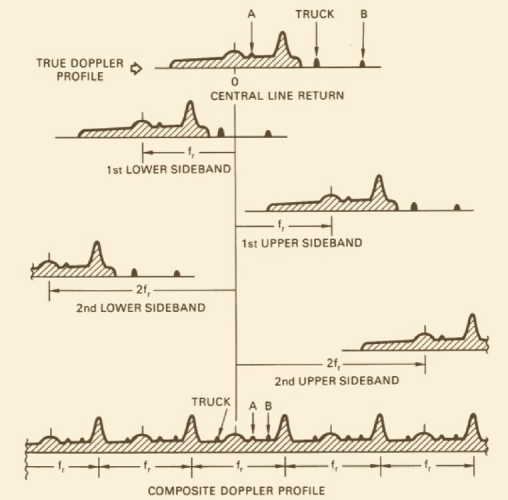
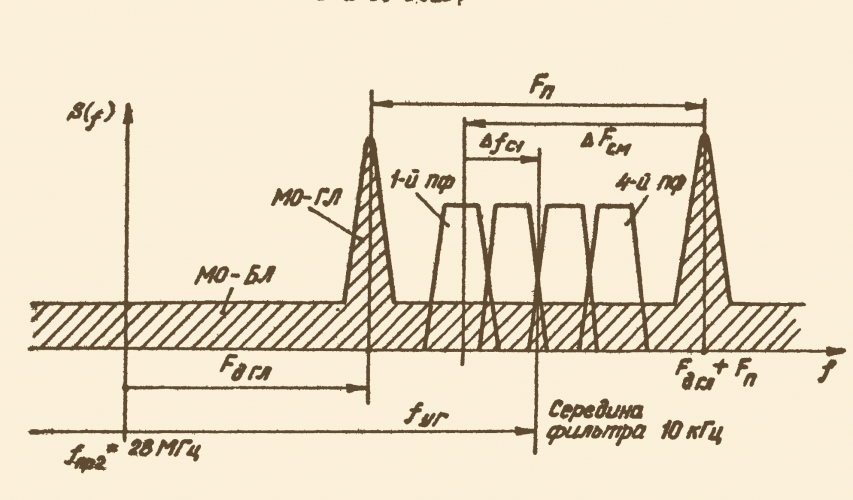
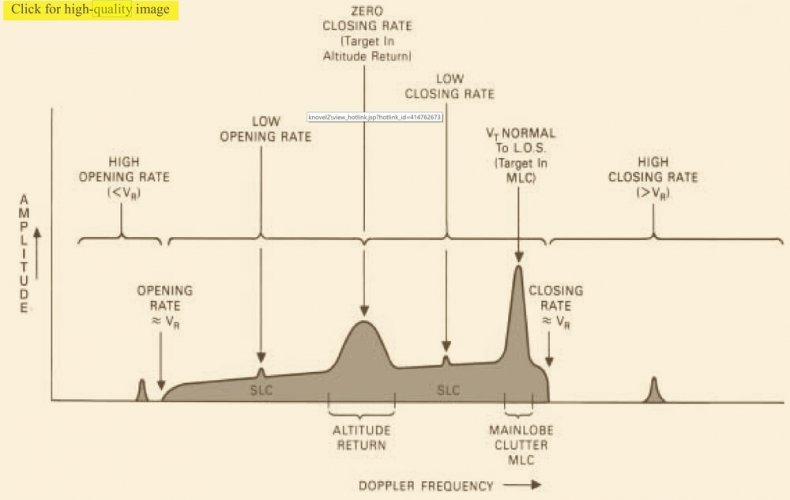
Idk what passage you are referencing for it to transition from 4/4 to ground track, as I answered you on ED forums this is only for look down situation in modes D/AUTO in ZPS, which would be angles of 3/4-0/4.which causes its doppler frequency to fold exactly into the next MLC peak, which again causes the radar to start tracking the ground
This isn't the ED forums, I'm talking about the Persuit radial speed limit in general right now, not specifically the lookdown 4/4 track.Idk what passage you are referencing for it to transition from 4/4 to ground track, as I answered you on ED forums this is only for look down situation in modes D/AUTO in ZPS, which would be angles of 3/4-0/4.
And I don’t think MLC ever truly disappears. Only becomes small enough for high enough SNR to track in it.
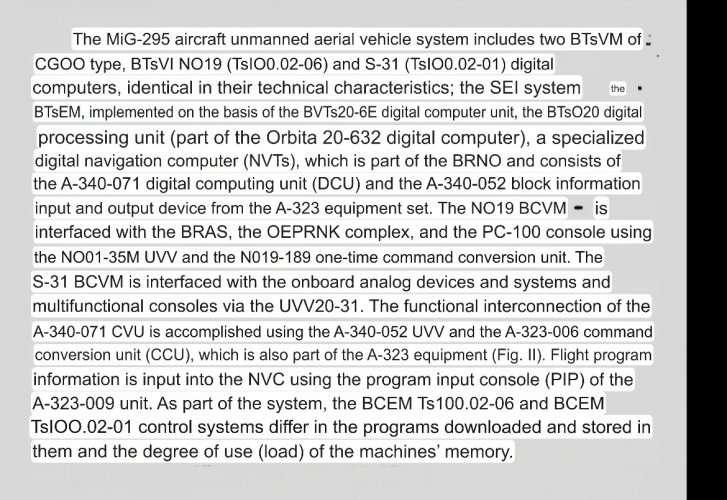
Su-27 has 2 C100 compute blocks, that's double the compute power.Su-27 uses C100
Ts100.02 determines the required operating modes and parameters of the radar blocks every radar cycle and sends them over a 16-bit digital bus such as selecting the PRF and in РНП its responsible for the Filter. The Radar doesn't have an internal computer per say except for the primary signal processing is done by the N019-03 receiver by taking radar input and turning it into information that the Ts100 computer can use,The C100 is merely an “executive” device sending out “flags”
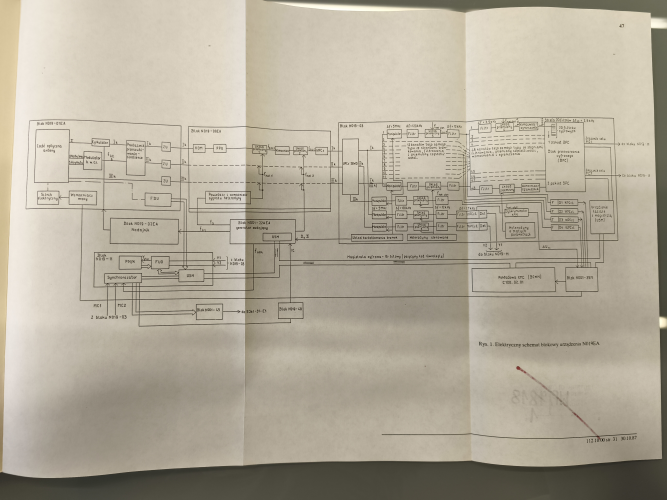
What makes you think MiG-29 only has one? Or that both are for radar?Su-27 has 2 C100 compute blocks, that's double the compute power.
A few more additions, and more raw look at what everything means:Regarding tracking in 4/4 aspect (notch/0 radial velocity):
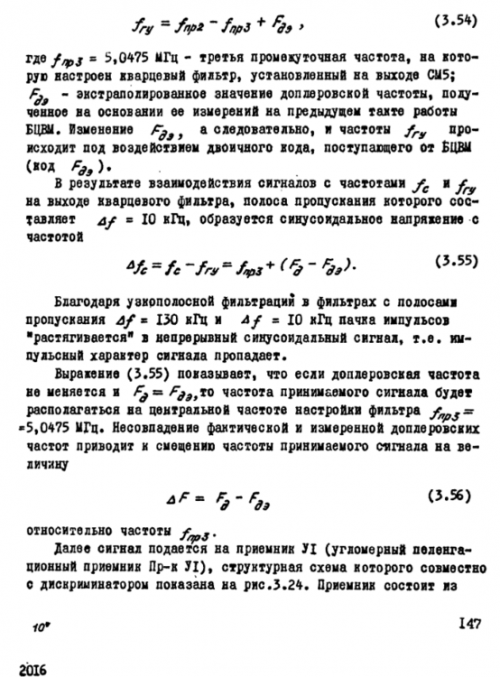
The RNP/STT Doppler processing is not simply a fixed "notch filter" that rejects everything below a certain radial velocity. The received target signal is first selected by range and passed through the Doppler-processing channel. The system then uses an extrapolated Doppler frequency (F_de), calculated from Doppler measurements from the previous tracking cycle, to control a local oscillator. After mixing, the resulting frequency is essentially determined by the difference between the actual target Doppler (F_d) and the predicted Doppler (F_de).
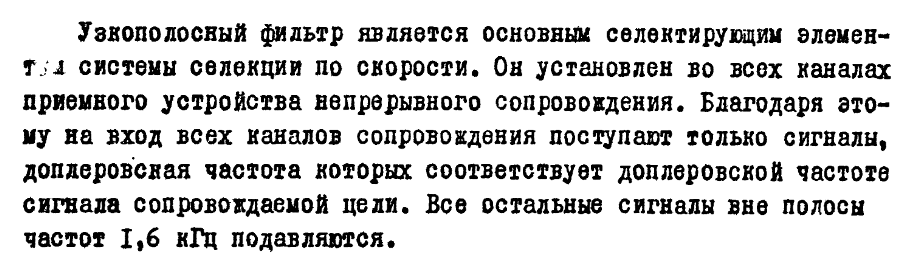
The signal is then passed through a narrow 10 kHz filter centred on the reference frequency. When the actual Doppler matches the predicted Doppler, F_d = F_de, the signal falls directly in the centre of this filter. Therefore, the filter effectively follows the predicted Doppler of the tracked target rather than remaining at one fixed velocity. If the target's Doppler changes, the signal moves away from the filter centre until the system updates its prediction during the next tracking cycle.
This is particularly important for look-down/notch situations. If the target performs a notch manoeuvre and its radial velocity decreases, its Doppler frequency also decreases. Since the tracking channel follows the predicted target Doppler, the filter will follow this decreasing Doppler as well. If the predicted target Doppler enters the same Doppler region occupied by MLC or SLC, the 10 kHz tracking filter can overlap the ground clutter. The issue is therefore not necessarily that the radar has a fixed "same-speed filter" that rejects the target; rather, the target's predicted Doppler can move into the clutter region, allowing the much stronger ground return to compete with or overwhelm the target return.
View attachment 823885
My mistake, the 130kHz one is a pre-selection filter, and, its +/- 65kHz not MHz. Honest mistakeYes, just Those search mode filters only apply to High PRF mode and it’s 130 kHz, your not gonna subtract -65 MHz from 28 MHz and look at negative hz. Medium PRF does it a bit differently.
130 kHz filter: very wide pre-selection filter centred at 28.055 MHz. It passes the entire possible Doppler-frequency range.Medium PRF does it a bit differently