
MBDA Official Port, under HYDIS. And there are many more pages.
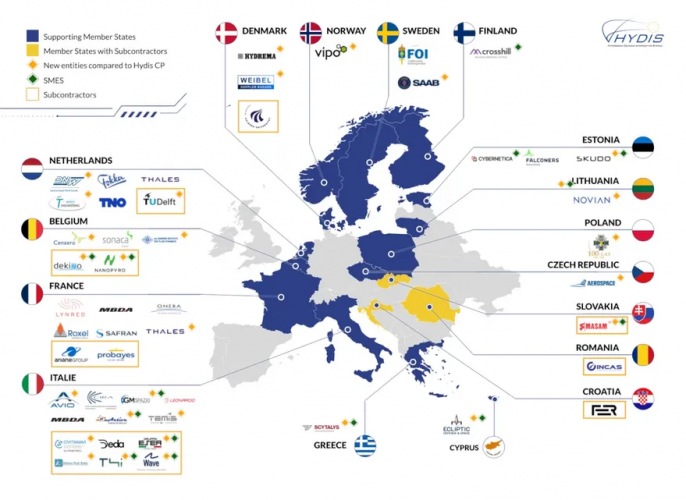
View attachment 822912

Ok so it appears that Hydis/Aquila will use a meteor type cruiser stage ?

https://www.mbda-systems.com/hydis

Avio, Main contributions to the project:
  • External booster
  • Cruiser propulsion (rocket)
  • High-temperature materials
Avio Aero, Main contributions to the project:
  • High temperature valve actuation for air-breathing motor
  • Plasma coating
Bayern-Chemie, Main contributions to the project:
  • Controllable Ramjet Cruiser Motor
  • Solid Rocket Motor with TVC (End of Cruise)
  • Dual Pulse Solid Rocket Cruiser Motor
  • High Temperature Materials
MBDA, Main contributions to the project:

MBDA France
Programme Coordination, Engagement Planning and Trajectory optimization, Aerodynamics, Terminal Vehicle Physical Architecture, EO sensor
MBDA Germany
Ramjet, Aerodynamics, Aero-propulsion & airframe, Controllability and Mid-Course Guidance, Cruiser Physical design (ramjet concepts)
MBDA Italy
Platform Separation, Lethality, Controllability and Mid-Course Guidance, All-up interceptor physical architecture, RF seeker, Contribution to EO seeker subparts design, Datalink
MBDA Spain
Operational Battle-lab modelling and operations
 
Ok so it appears that Hydis/Aquila will use a meteor type cruiser stage ?

https://www.mbda-systems.com/hydis

Avio, Main contributions to the project:
  • External booster
  • Cruiser propulsion (rocket)
  • High-temperature materials
Avio Aero, Main contributions to the project:
  • High temperature valve actuation for air-breathing motor
  • Plasma coating
Bayern-Chemie, Main contributions to the project:
  • Controllable Ramjet Cruiser Motor
  • Solid Rocket Motor with TVC (End of Cruise)
  • Dual Pulse Solid Rocket Cruiser Motor
  • High Temperature Materials
MBDA, Main contributions to the project:

MBDA France
Programme Coordination, Engagement Planning and Trajectory optimization, Aerodynamics, Terminal Vehicle Physical Architecture, EO sensor
MBDA Germany
Ramjet, Aerodynamics, Aero-propulsion & airframe, Controllability and Mid-Course Guidance, Cruiser Physical design (ramjet concepts)
MBDA Italy
Platform Separation, Lethality, Controllability and Mid-Course Guidance, All-up interceptor physical architecture, RF seeker, Contribution to EO seeker subparts design, Datalink
MBDA Spain
Operational Battle-lab modelling and operations
No, according to the latest project organizational chart, Germany is out, so goes Bayern-Chemie and its ramjet technology. Thus, I believed that 3 stage SRM is the winning solution just as show in the rendering for the Aquila Intercepter.
1788430520157.png
 
https://forcesoperations.com/derniere-ligne-droite-pour-le-duel-hydef-hydis/

Winner of HYDEF/HYDIS is expected to be announced much quicker than expected —> in November 2026

The goal of this second tranche is to bring the selected project to TRL 5 and a Preliminary Design Review before 2029 and then fly a representative demonstrator around 2030.
The idea would then be to move into development and industrialisation, with the selected system reaching TRL 9 by around 2035.
 
View: https://x.com/outerspacetoday/status/2102021526828802165?s=20

BREAKING: The Pentagon has laid out its clearest Golden Dome timeline yet, targeting an initial U.S. missile shield in 2028 before transitioning to a purpose-built architecture by 2035.
Gen. Michael Guetlein, who leads the program, said the Pentagon will first stitch together existing military systems to deliver an initial defensive capability, according to SpaceNews.That means the 2028 version will not be the finished Golden Dome. It will rely heavily on integrating sensors, interceptors, command networks and other capabilities already fielded or under development.
The second stage would replace that patchwork with a more affordable architecture designed specifically for homeland defense by 2035, including new missile-tracking satellites, data networks and potentially space-based interceptors.The Space Force is already working with 12 companies toward an initial space-based interceptor capability in 2028.
 
Last edited:
The goal of this second tranche is to bring the selected project to TRL 5 and a Preliminary Design Review before 2029 and then fly a representative demonstrator around 2030.

This is a bit OT but is there a thread on the site that talks about the TRL system that NASA pioneered?
 

Similar threads

Back
Top Bottom