P&W similarly also shuttered the engine production line in 2018 I think it was and sold the plant after completing their order of crate engines for the US. Boeing has indicated if production was restarted it would be with a different engine with ~15% more thrust, which would require design changes to the aircraft and a flight certification program beyond recertifying reinstated component production lines and assembly procedures.
Not Renton or Everett. (Pretty sure everyone here knows that those are functionally suburbs of Seattle, and usually get lumped into "Seattle" for where are you from questions)
P&W similarly also shuttered the engine production line in 2018 I think it was and sold the plant after completing their order of crate engines for the US. Boeing has indicated if production was restarted it would be with a different engine with ~15% more thrust, which would require design changes to the aircraft and a flight certification program beyond recertifying reinstated component production lines and assembly procedures.
I still contend that the probability of a restart is very low given the huge cost to get all of the required equipment. As someone pointed out, it seems Boeing does not seem to have excess space so it might be a lot of cost for new infrastructure as well.
However for all of my doubt, there is no other western contenders for the mission profile. They are flying the wings off of the current fleet and given normal timelines to compete a new design effort, there might be a lesser cost in time and money to rebuild the C-17 production line.
I have to wonder if getting the civil air transport companies to take on more government airlift efforts might be as cost effective as trying to rebuild the production lines. While they cannot do many of the tactical missions, the day to day from airport to airport could alleviate much of the pressure on the C-17 fleet.
The good quality commercial heavy lift providers are at, or near, capacity at the moment. Taking on a bunch of strategic DoD missions would require significant expansion, which may not be possible given the availability of aircraft and even if it is would mean undercutting the cost advantage, or walking away from their existing customers.
Were the original C-17 jigs and tooling preserved? If not, then add years to any production timeline, to recreate those. And having worked for Boeing for many years, I suspect that even if the old tooling still exists, they won't be able to resist the temptation to "modernize" the production processes, they've invested a lot of time and $$$ into that general area, and so you can tack on another few years and a whole lot of debugging and troubleshooting...
Didn't Douglas produce C-17 components at the former NAA plant in Columbus, OH? ISTR that when they closed that, the equipment was sold to the PRC for manufacturing civil aircraft but was diverted to military use and McDD got a large fine for violating export regs.
I'm sure a new line can be set up, but there would need to be a very solid business case for it given Boeing's overall slate of problems. I know Boeing has a mod center at the Lelly Field complex in San Antonio, I wonder if C-17 production restart could happen there.
I can appreciate Boeing wanting to move a much as possible out of Southern California, that area is just getting crazy, I'm glad I left there in early 2000.
Although I have no doubt the cost will be exorbitant, the more I read about this, the more it seems like a no-brainer regardless, for the following reasons:
1. There are simply no current production aircraft that can do close to what the C-17 can do with regards to payload, internal volume, STOL, etc.
2. AMC is beating the absolute piss out of their C-17s and if @Moose's anecdote about some examples reaching flight hour milestones 15 years earlier than anticipated is even remotely representative of the overall fleet, that would be extremely detrimental to the US' SAC.
3. The USAF hasn't even defined the requirements for NGAL yet and those seem to be dependent on experimental results from JetZero's BWB Demonstrator, which is a very high-risk program in and of itself.
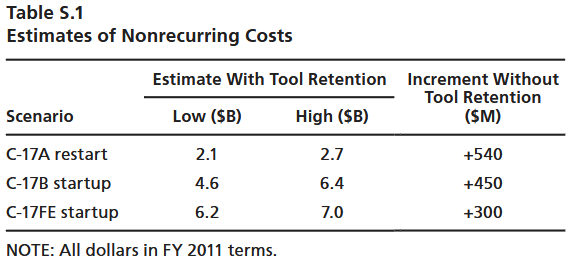
4. Assuming the 2012 RAND Report is remotely accurate, even the "worst-case" scenario to restart C-17 production (excl. all the cost of purchasing airframes) i.e. the high C-17FE estimate added to the highest increment without any tool retention ($7.54 billion) adjusted for inflation and with a generous safety factor of 1.5 ($16.8 billion) seems like a great value for maintaining the US' SAC, the resulting industrial benefits, and alliances with other C-17 operators.
I could seriously go on about this forever and want to write a follow-up comment with an analysis of alternatives to demonstrate how restarting C-17 production is by far the "least-bad" i.e. best option but should probably sleep soon lol
In any case, if there is anyone here with experience in industry or AMC that disagrees with restarting C-17 production, even at $16.8 billion, please share your reasoning for disagreeing so that the rest of us can ensure that we aren't overlooking any major factors.
No, but a C-17 Restart would not be significantly cheaper than a new design.
Tooling is all gone, factory is all gone, designs might even still be on paper (I would sure hope not), and the whole subcomponent manufacturer ecosystem would have to be recertified.
So the biggest reasons to "just build more C-17s" aren't really all there.
Trying to restart the C-17 production line would be pointless, the only thing that would work is a brand new transport program and that is coming from someone who actually likes the C-17.
Not just recertified; half or more of the components would have to be redesigned because either the original supplier is gone and didn't pass along the tech data, or the old components rely on parts you can't get anymore.
Restarting production isn't "just" flipping the lights back on in the factory and dragging The Tooling!!! out of a warehouse.
They are already upgrading the B-52 to the B-52J giving it new engines and avionics so that it will be in service with the USAF until it hits it's hundredth birthday, which will be a milestone I do not think that there will be another bomber with that pedigree like the B-52 In_A_Dream.
2. AMC is beating the absolute piss out of their C-17s and if @Moose's anecdote about some examples reaching flight hour milestones 15 years earlier than anticipated is even remotely representative of the overall fleet, that would be extremely detrimental to the US' SAC.
Largely because Congress stuffed so many C-17s into the service that they're abused on a daily basis for linehauls between major airbases. They're not designed for that, they're over-designed and over-expensive to be used as U-Hauls.
A 767 freighter could have done most of the C-17's daily takings for the past three decades at half the cost. Instead of spending dozens of billions on reopening the line, start building cheap C-46Bs and keep the C-17s for when you need to move bulk or AFVs.
.
A couple things that killed Douglas/Boeing in Long Beach; 1. No new designs (commercial or military) after MD-95/B717: 2. Very, very greedy union, probably the primary reason the site died. Also, the Douglas/Boeing way of incorporating TQM, just remove two layers of management, I'm sure everyone remembers the aircraft sabotage (and arrests) which took place during that time period. No C-17 restart, just do a new cargo jet.
I honestly doubt that there is any realistic possibility of a C-5/An-124 replacement. That would be tens of billions of dollars for a global market of less than a hundred airframes. The only way I see it happening is someone with a very specific use case that happens to overlap with the 100+ ton airlifter requirement, kind of like Windrunner designing a plane specifically to carry wind turbine blades.
I honestly doubt that there is any realistic possibility of a C-5/An-124 replacement. That would be tens of billions of dollars for a global market of less than a hundred airframes. The only way I see it happening is someone with a very specific use case that happens to overlap with the 100+ ton airlifter requirement, kind of like Windrunner designing a plane specifically to carry wind turbine blades.
I honestly doubt that there is any realistic possibility of a C-5/An-124 replacement. That would be tens of billions of dollars for a global market of less than a hundred airframes. The only way I see it happening is someone with a very specific use case that happens to overlap with the 100+ ton airlifter requirement, kind of like Windrunner designing a plane specifically to carry wind turbine blades.
It might be doable. The US did buy and build 131 C-5s, and there's another 60 An-124s (though IIRC only 30 are in civilian use). That's a run of ~175-200 units combined.
Plus, the whole petroleum industry is designed around An124-sized cargo units. It'd be reasonable to inform the petroleum industry that when the An124s age out, they will need to put up the development funds for a replacement. Petrochem as an industry can afford to throw 25 billion at a development program to cover roughly half the cost of developing a plane (based on A380 development with inflation from 2007 to 2026). The various companies can get together and decide how much each company pays up to get that total.
Largely because Congress stuffed so many C-17s into the service that they're abused on a daily basis for linehauls between major airbases. They're not designed for that, they're over-designed and over-expensive to be used as U-Hauls.
A 767 freighter could have done most of the C-17's daily takings for the past three decades at half the cost. Instead of spending dozens of billions on reopening the line, start building cheap C-46Bs and keep the C-17s for when you need to move bulk or AFVs.
Id go one step further. Let the 767 line be used for KC-46s, and instead buy every 747-8F you can get your hands on, Im sure with gas prices rising they can be had for cheap. Then see if Boeing can do a 747 wing-engine based C-5 replacement.
Restarting C-17 production would cost a lot of money and time since a) new production jigs and tooling would have to be built, b) new assembly workers trained and c) a new supply chain set up with likely new suppliers having to be qualified for the production of components, sub-assemblies and assemblies.
It might be doable. The US did buy and build 131 C-5s, and there's another 60 An-124s (though IIRC only 30 are in civilian use). That's a run of ~175-200 units combined.
My thinking was a one-to-one replacement of the current fleet of 52 C-5Ms, the 7 Antonov-operated An-124s, and a hypothetical European military fleet. In that context, I think 100 airframes is a stretch. That being said, I would like to see a US fleet closer to 100 - 150 frames.
Id go one step further. Let the 767 line be used for KC-46s, and instead buy every 747-8F you can get your hands on, Im sure with gas prices rising they can be had for cheap.
The 747-8Fs are very sought after on the civilian market and will probably be in use for at least the next 50 years, even if somebody does build a new freighter that big. Older 747-400F are getting cheaper, but their capability can be nearly matched by 777Fs.
Reusing the wing structure is very unlikely. Outsized airlifters are usually designed for better short-field performance and lower cruise speeds (Mach 0.75 vs Mach 0.85) compared to airliners, even if they don't have real rough-field capability. Dropping required runway length from 10,000 ft to 8,000 ft can give you a lot more options. They would still need a lot more wheels than a 747 to reduce ground pressure for smaller airports.
Restarting C-17 production would cost a lot of money and time since a) new production jigs and tooling would have to be built, b) new assembly workers trained and c) a new supply chain set up with likely new suppliers having to be qualified for the production of components, sub-assemblies and assemblies.
It would be as difficult as starting production of a new aircraft. Because it would be like starting from scratch, it might be possible to make big structural changes like lengthening the fuselage, adding wing segments to the root or tip, and switching to larger engines (for example, PW4062s from the KC-46 vs the PW2000/F117s) to push maximum capacity towards 100 tons at the cost of some rough-field performance. Unless you absolutely have a single piece of cargo that fits in a C-5 or An-124 (like an Atlas V first stage) and not a C-17, the C-17 restart gives you 90% of the capability for probably 25% of the cost (I would guess $20 billion vs $5 billion). The C-17 has a lot of capability as a tactical airlifter that the C-5 never had. For example, C-17s were regularly used to land at 6,000 ft dirt strips at FOBs in Afghanistan.
This site uses cookies to help personalise content, tailor your experience and to keep you logged in if you register.
By continuing to use this site, you are consenting to our use of cookies.