It is easier for a weaker space power to make LEO unavailable to a greater power-thus my push for ever larger HLLVs -no depots-and push Orbital Antenna Farms out of reach..The "Skip LEO" approach puts the First World nation back ahead leaving LEO safer. Mike Griffin was right.
 
Last edited:
We are living through the beginning of the movie Gravity.

That field of debris is threatening the ISS, the Chinese space station, and the Starlink satellite fleet below.
:eek:

:eek::eek::eek:
 
View: https://twitter.com/joroulette/status/1475565161784221706


Some new bits in this story. In an interview, Dmitry Rogozin indicates he's unhappy with all the "debris scattered across the orbit" from Russia's ASAT test and says its unlikely the Russian military will test-launch another one in the future.


Also - the State Department is considering calling for an antisatellite test moratorium, possibly during the Conference on Disarmament in Geneva next year, per two US officials.


A day before the ASAT test, senior NASA officials flew to Moscow to negotiate two key ISS agreements, meeting with Rogozin for dinner at one point. They echoed Nelson's condemnation of the test, and "it was a very productive discussion,” Cabana says.


Nelson strongly condemned the RU military's ASAT test, but speculated that his counterpart Rogozin didn't see it coming. Indeed, in the interview, Rogozin said Roscosmos wasn't consulted prior. But he added: “I’m not going to tell you everything I know.”


View: https://twitter.com/jeff_foust/status/1550161115979579395


ASAP’s Mark Sirangelo says the ISS received 681 conjunction notifications through June 1 of this year; 505 linked to Russian ASAT test. Number of conjunctions has increased “by multiples” in recent years.
#SpaceDebris update from Russia's 15 Nov 2021 DA-ASAT test. As of 25 July 2022, 1774 objects have been cataloged w 1086 having already decayed. 419 objects pose a potential risk to human space flight (i.e., geometric intersection possible) and 37 of the fragments are "lost".

View: https://twitter.com/shell_jim/status/1551743824862388225
 
I asked the experts on NSF regarding the above and this is the reply I received.

This is not Nudol. The desert-like terrain seen in the video suggests this is an anti-missile test launch from Kapustin Yar or Sary Shagan. It's definitely not Plesetsk, which is the home base of Nudol. Many websites confuse Nudol with the A-235 anti-ballistic missile system to be installed around Moscow and incorrectly link test flights under A-235 to Nudol. This also seems to have happened here. We do know what Nudol looks like (see Reply 122), but so far the Russians have released no video of it.
 
Didn't think to check whether the terrain matched Plesetsk or not. It most certainly does not. Plesetsk is surrounded by forests!

Sorry for the confusion.
 
For comparison the ASM-135, launched by an F-15, hit it's target at 555km altitude. I wouldn't take any of these as maximums or minimums. That's just where the targets happened to be.
The SM3 shot was said to be right at the ragged edge of the performance envelope, but that was also an old SM3 and not the new 21" diameter or coming 27" diameter versions.

Supposedly so tight at the edge that the ship had to be perfectly vertical when the firing command was passed.
 
Put this together for NUDOL:

==============
Nudol Complex
==============

14Ts033 (14Ц033) — the complex/firing system as a whole.

14A042 — the missile itself, by OKB Novator «Новатор».

14P222 — the TEL, on an MZKT 12×12 chassis.

14P078 — mobile command-and-computing station.

14Ts031 (Object 0746-M) Radar - Chekhov-7, Moscow oblast on the same site as the old Dunay-3U radar site. Built around 2016.

[EDITOR: If Nudol is an ASAT weapon, why is there a fancy radar? Shouldn't the radar tracks from the DON-2N and SKKP surveillance network be enough to get satellite tracks to the quality necessary to hit satellites?]

14Sh129 — the multispectral electro-optical seeker for the kill vehicle, from KBTM Nudelman.

PL-19 — US designation. "PL" is the US index series for missile systems first tested from Plesetsk.

========================================================
This is the big recent development
========================================================

The Ukrainians stole a lot of data from Russian enterprises and released it in July 2026

[https://united24media.com/investiga...ram-secret-documents-reveal-new-details-20982]

Turns out that there is another missile (102А6) being developed for the 103T6 («Святогор» Svyatogor) Complex; and that:

"Documentation shows that the two systems are closely related and share numerous identical components, allowing parts from the same production batches to be installed in both the 14A042 and the 102A6 missiles."

[...]

"Documentation describes the 102A6 missile as having a “high degree of commonality” with the 14A042 Nudol missile. Both systems incorporate identical fiberglass casings, rocket motors, gas generators, pipelines, steering actuators, sensors, and multilayer woven composite components. They also use a range of coded explosive elements, including propellant charges and pyrotechnic tablets (9Kh564M and 14Kh716), solid-fuel charges, pyrotechnic blocks and initiators (9Kh836M, 14Kh608, 14Kh610, 14Kh611, 14Kh612, 14Kh613, and 14Kh712), along with their associated casings (14D807 and 14D808)."

[...]

"Work on both the Svyatogor and Nudol projects is carried out in parallel at the Perm Powder Plant. Investment proposals, production reports, and correspondence with Almaz-Antey consistently mention the two programs together. Within these documents, Nudol is classified as a mobile anti-satellite strike system, while Svyatogor is described as either a multifunctional missile system or an air defense system."

[...]

"Another notable finding is that the Perm Powder Plant’s 2025 government procurement records include two contracts with Novator under the codename Samolet-M—the original Soviet designation for the A-135 modernization effort. This suggests that the Samolet-M project still exists and has not been replaced by the Nudol program, contrary to claims previously made in some Russian sources."

[https://zn.ua/war/zvezdnye-vojny-kr...ov-nudol-poka-zapadnye-sanktsii-buksujut.html]

[https://uazmi.org/news/post/a46bf2fff3b7a4247717a988e7e5d250]

========================================================
TIMELINE
========================================================

July 1979 - First launch of 53T6.

1985-1986 - Initial A-235 system proposed; 51Т6 long-range system, 58Р6|58R6 mid-range system, and 45Т6 (modernized 53T6) close-range system. This died in the chaos of the post-cold war period; and instead it was decided to only modernize 53T6.

1989: 5Н20|5N20 (Дон-2Н|Don-2N) radar/command post accepted into service.

1990: Serial production of 53T6 begins at Plant No. 8 of the Kalinin Plant, Yekaterinburg.

31 Jan 1991 - Contract No. 406/1591 signed to modernize A-135 via increasing 53T6 engagement zone area, missile manuverability and a new warhead as part of the (Самолет-М | Samolet-M) project.

1996 - 5Н20|5N20 (Дон-2Н|Don-2N) placed onto Combat Duty for A-135 system.

2006-2007? Don-2N modernized with completely new computers replacing the Soviet-era computers.

30 October 2007 - 53T6 missile launch to confirm that the Don-2N modernization works. [https://web.archive.org/web/20140807105210/http://armstass.su/?page=article&aid=49743&cid=25]

2008 - Almaz Antey defends PDR/CDR for 53T6 Samolet-M modernization.

29 Oct 2009 - 53T6 launched at Sary-Shagan as part of Samolet-M project.

2010 - Work underway at Almaz Antey for 53T6 production restart.

May 2009 - KEI stop-work order issued.

10 August 2009 - Initial 14Ts033 Complex "Nudol" Contract (15718710881010128000191) issued to Almaz-Antey, three months after KEI cancelation.

2011 - PDR/CDR by Almaz-Antey on 14Ts033 Complex "Nudol" Design.

20 Dec 2011 -- First launch of 53T6M missile; this version has a brand-new motor from production restart.

2012 - Almaz-Antey begins preliminary testing of 14Ts033 Complex "Nudol" Components.

Around this time, the program begins to break cover:

First, Almaz-Antey annual reports and corporate calendars feature renderings of Nudol-like systems presented as part of the "future A-235 architecture" as FUD.

Second, US analysts start to see the 14P222 (TEL) and 14A042 (Missile), or components with their basic shapes show up on National Technical Means, and this is where it gets interesting:

================
BASIC DIMENSIONS
================

US KEI Boost/Mid-Course ABM: 1.01m diam, 11.83m length, 10,432 kg
PRC HQ-29 Mid-Course ABM: 1.2m~ diam, 10.5m length
RU 14P222 Launcher Tube: 1.3m diam, 12.87m length (scaled off 1.5m tire diam assumption)
US Midgetman SICBM: 1.17m diam, 14m length, 13,600 kg

Around this time; the US is putting together documentation of INF Treaty violations by Russia -- to a satellite, a missile launch cannister/tube for the 14A042 missile has the following three options open for analysts to argue over:

Boost-Phase ABM
Mid-Course ABM
Direct Ascent ASAT
Small ICBM

But until actual flight tests are conducted; it could be any of the above.

12 July 2013 - Contracts assigned to Almaz Antey for:

--Integrated BMD test range similar to Kwajalein (Ukazchik-KV / Object 2142) near Severo-Yeniseiskiy, Krasnoyarsk, Siberia; later publicly stated as being for flight testing of Sarmat ICBM.

--Integrated C3I network for BMD (Selektsiya).

12 Aug 2014 - Nudol #1 Launch (Plesetsk)

2015 - Contract 15718710881010128000191 with Almaz Antey for 14A042 missile development updated.

22 Apr 2015 - Nudol #2 Launch (Plesetsk) - FAILED -- publicly attributed as a failed test for the Almaz-Antey Antey-2500 air defense system.

18 Nov 2015 - Nudol #3 Launch (Plesetsk) - First launch in ASAT mode against point in space.

December 2015 - Bill Gertz leaks the fact that the US knows of Nudol and that it is ostensibly a direct-ascent ASAT.

[https://web.archive.org/web/2016011...essful-flight-test-of-anti-satellite-missile/]

June 2016 - Construction detected at Dunay-3U radar site near Moscow for 14Ts031 (Object 0746-M) radar associted with Nudol.

[55.231571591716985, 37.296793052853026] (Receiver Site)
[55.206917, 37.29463433863426] (Transmitter Site)

25 May 2016 - Nudol #4 Launch (Plesetsk)

16 Dec 2016 - Nudol #5 Launch

26 Dec 2017 - RSVN launch of Topol from Kasputin Yar towards Sary-Shagan for ABM development.

26 Mar 2018 - Nudol #6 Launch (Plesetsk), first launch from standard mobile launcher.

2 April 2018 - Ankit Panda at THE DIPLOMAT leaks the fact that it was fired from a TEL for the first time, so it is road mobile. [https://thediplomat.com/2018/04/russia-conducts-new-test-of-nudol-anti-satellite-system/]

23 Dec 2018 - Nudol #7 Launch (Plesetsk), second launch from standard mobile launcher.

15 Apr 2020 - Nudol #8 Launch (Plesetsk)

16 Dec 2020 - Nudol #9 Launch (Plesetsk)

29 May 2021 - Nudol #10 Launch (Plesetsk)

15 Nov 2021 - Nudol #11 Launch (Plesetsk) - KOSMOS-1408 ASAT shootdown.

1 Dec 2021 - Contract (#2124187310461452208003311) issued for 102A6 missile / 103T6 Complex, one month after Kosmos-1408 intercept. Documentation shows that the two systems are closely related and share numerous identical components, allowing parts from the same production batches to be installed in both the 14A042 and the 102A6 missiles.

1 May 2022 - Immediately after the start of a full-scale invasion [of Ukraine], the Deputy General Designer of the Novator Design Bureau sends an urgent request to the Perm Powder Plant demanding that production facilities be immediately prepared for the simultaneous manufacture of components for the 14A042 anti-satellite missile and the advanced 102A6 missile system [the (Святогор|Svyatogor) (103T6) complex].

2 July 2022 - The Russian Ministry of Defense and the developers jointly decided to fully standardize the two systems. To save money and time, all engines, pyrocartridges, gas generators, control actuator units, and sensors were made common for both missiles.

2 Dec 2022 - Nudol #12 Launch

21 Sep 2023 - Contract (#2325187909111412246200410) designes Novator as lead developer and manufacturer for 14A042 Missile.

3 Dec 2023 - The anti-satellite missile undergoes preliminary testing. The military department's decisions indicate that by 2023, 15 prototype missiles will have been manufactured, 13 test launches will have been conducted, and the first two missiles will have been transferred to the Russian Aerospace Forces for trial operation. Furthermore, due to the rush, the customer cancels the initial batch production stage altogether, immediately launching the missile into production under the designation "O1."

4 Mar 2024 -- March 4, 2024. In Yekaterinburg, representatives from the Ministry of Defense, Almaz-Antey, and related plants are finalizing the delivery schedule : the first batch of eight combat missiles is to be assembled by July 2025, with another 12 units to be delivered by November 2026. To address the shortage of parts, the installation of components manufactured for a parallel research complex is officially authorized for serial production.

16 Mar 2024 - Nudol #13 Launch

5 Jul 2024 - The Russian military command approves an unprecedented decision : to count the hot-fire rig tests of the engines of a related system as full qualification checks for the 14A042 anti-satellite missile. The reason is simple: a lack of materials, resources, and time.

 
The SM3 shot was said to be right at the ragged edge of the performance envelope, but that was also an old SM3 and not the new 21" diameter or coming 27" diameter versions.
SM-3 Block IIB was cancelled years ago. (Even before your post, that is.)
 
Important thing I just noted.

14Ts031 (Object 0746-M) is actually a deep refurbishment of 1/2 of the old Dunay-3U.

In 2012, the RuMoD tendered a contract for the demolition of Sector 62 of the Dunay-3U site; and there's heavy demo work, followed up by reconstruction from 2014-2019 ish on both the Receiver/Transmitter sites:

[55.231571591716985, 37.296793052853026]
[55.206917, 37.29463433863426]

Visible on Google Earth Pro turn back time feature -- They effectively gutted the east facing buildings / antenna arrays; and built all new radars on the footprint/location of the old east facing Dunay-3U radars.

The best explanation for this odd facing is that 14Ts031 (Object 0746-M) are actually part of a larger BMD/Discrimination development effort; as east facing at those locations get you views on Kasputin Yar and Sary Shagan.
 
Last edited:
Nudol was fired around 02:45 UTC on 15 Nov 2021 from Plesetsk Cosmodrome from the following coordinates [62.90669845276331, 40.787542449228496].

The intercept occurred around 02:50 UTC at 486 km altitude over the Laptev Sea in the rough coordinates of 75N 60E.

Kosmos 1408 was in a 465x490km @ 82.6 deg orbit; and the major fragmentation spray from the intercept spread out over the Laptev Sea @ about [81.46921933662689, 112.93229820388733]

Intercept was about 1,500 km downrange from the launcher; at a slightly hot 300 second trajectory (minimum energy TOF is 495 seconds).

This yields a vBO of around 6.16 km/sec (40s Nudol burn) to 6.28 km/sec (60s Nudol burn).

By comparison:

GBI: 7.2 km/s vBO
KEI: 6 km/s vBO
SM-3 Block IIA: 4.5~ km/s vBO

[based off figures in https://planet4589.org/space/asat/nudol.html]

If Nudol can achieve 6~ km/sec burnout velocity in 60 seconds... well uh.

Chinese paper from 2024 where they reverse engineered KEI said:

经本文反设计的 KEI导弹能够在 63 s内加速至 6.746 km/s,具备在距离目标 200~400 km位置对弹道导弹的助推段/上升段进行拦截的能力。

or in English:

The KEI missile, designed based on the reverse engineering analysis in this paper, is capable of accelerating to 6.746 km/s within 63 seconds and intercepting ballistic missiles during their boost or ascent phases at a range of 200–400 km from the target.

You don't need to cross 1500 km in 300 seconds, requiring a velocity of 6 km/sec in 60 seconds or less if you're doing ASAT missions, as you know the trajectory well in advance.

Conclusion: Russians ignored the arms controllers and built a very close analogue of KEI, disguising it as an ASAT weapon for public consumption.
 
Last edited:
Conclusion: Russians ignored the arms controllers and built a very close analogue of KEI, disguising it as an ASAT weapon for public consumption.
ABMT didn't prohibit ABMs per se, as it specifically allowed single such areas(art.iii), rather, it prohibited nation-wide efforts.
Furthermore, testing was specifically allowed(art.iv).

A35/135(Moscow strategic ABM, compliant with the treaty) is here for decades, and the treaty is void for over 2 decades, too. Existence of SM-3 is a testimony to that.
 
ABMT didn't prohibit ABMs per se, as it specifically allowed single such areas(art.iii), rather, it prohibited nation-wide efforts.
Furthermore, testing was specifically allowed(art.iv).

A35/135(Moscow strategic ABM, compliant with the treaty) is here for decades, and the treaty is void for over 2 decades, too. Existence of SM-3 is a testimony to that.

The ABM Treaty was long defunct by 2009; when KEI was canceled as part of a large "adjustment" of the US NMD program by the then-Obama Administration -- the ostensible rationale for KEI's cancelation was "technical issues" during development -- the program had blown it's budget and was about eight months delayed; due to motor case issues during earlier component qualification campaigns in 2006; as well as some pressure from MDA earlier in the dev cycle about slower than expected acceleration but it was about three months from a full up test of a fully integrated booster when it was canceled.

Nudol's development campaign timeline

2009 - Contract issued.
2014 - First test launch at Plesetsk (5 years into program)
2021 - "ASAT" Capability demonstrated (12 years into program)
2023 - Production Missile Contract to Novator (14 years into program)

Is strongly suggestive of an extremely demanding technical program; rather than something on high TRL proven tech (i.e. earlier Soviet 1973+ co-planar ASAT programs) but adjusted for modern conditions.
 
ABMT didn't prohibit ABMs per se, as it specifically allowed single such areas(art.iii), rather, it prohibited nation-wide efforts.
Furthermore, testing was specifically allowed(art.iv).

A35/135(Moscow strategic ABM, compliant with the treaty) is here for decades, and the treaty is void for over 2 decades, too. Existence of SM-3 is a testimony to that.
SM-3 had no ABM capability.
 
"I think the ABM Treaty was reinterpreted to apply to only mid-course ABMs and nuclear-tipped ABMs."

Where did you get that idea? I remember THAAD being speed limited so as to not breach the ABM Treaty.

"A35/135(Moscow strategic ABM, compliant with the treaty) is here for decades, and the treaty is void for over 2 decades, too. Existence of SM-3 is a testimony to that."

The implication was that SM-3, Block I was the missile that broke the treaty. Block IIA is relatively new.
 
Last edited by a moderator:
Not then. Point is, it's wrong to blame Nudol with full design cycle after 2002, when there's an operational naval system.
ABMT is long gone.
To this day, SM-3 Block I does not have ABM capability. So no, it didn't back then either.
 
SM-3 had no ABM capability.
Huh? It always was an exo-atmospheric ballistic-missile KV.

With enough extra range and performance to be viable against IRBMs.


GBI: 7.2 km/s vBO
KEI: 6 km/s vBO
SM-3 Block IIA: 4.5~ km/s vBO
I don't think that's correct for the the VBO of the 21" SM3.

I know there was a Powerpoint that showed the gain from 13.5 to 21", I'm struggling to find it now.
 
Huh? It always was an exo-atmospheric ballistic-missile KV.

With enough extra range and performance to be viable against IRBMs.
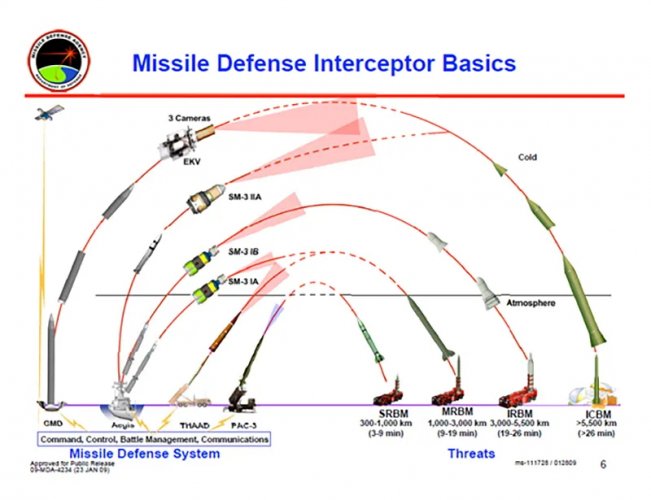
"ABM" has generally meant ICBMs. SM-3, THAAD, etc. don't have that. SM-3, THAAD, PAC-3, were designed (to varying degrees) for missiles below that.
 

Attachments

  • 1484005288581-600px-missile_defense_interceptor_basics.jpg
    1484005288581-600px-missile_defense_interceptor_basics.jpg
    193.1 KB · Views: 7
Last edited:
I think the ABM Treaty was reinterpreted to apply to only mid-course ABMs and nuclear-tipped ABMs, although how exactly nuclear-tipped S-300/400 missiles figured into that is questionable.

By the closing years of the ABM Treaty, it was becoming very bodged together as technology outpaced it:

September 26, 1997
Standing Consultative Commission

First Agreed Statement Relating To The Treaty Between The United States Of America And The Union Of Soviet Socialist Republics On The Limitation Of Anti-Ballistic Missile Systems Of May 26, 1972


In connection with the provisions of the Treaty Between the United States of America and the Union of Soviet Socialist Republics on the Limitation of Anti-Ballistic Missile Systems of May 26, 1972, hereinafter referred to as the Treaty, the Parties to the Treaty have, within the framework of the Standing Consultative Commission, reached agreement on the following:

1. Land-based, sea-based, and air-based interceptor missiles, interceptor missile launchers, and radars, other than anti-ballistic missile (ABM) interceptor missiles, ABM launchers, or ABM radars, respectively, shall be deemed, within the meaning of paragraph (a) of Article VI of the Treaty, not to have been given capabilities to counter strategic ballistic missiles or their elements in flight trajectory and not to have been tested in an ABM mode, if, in the course of testing them separately or in a system:

(a) the velocity of the interceptor missile does not exceed 3 km/sec over any part of its flight trajectory;

(b) the velocity of the ballistic target-missile does not exceed 5 km/sec over any part of its flight trajectory; and

(c) the range of the ballistic target-missile does not exceed 3,500 kilometers.
2. The Parties have additionally agreed on reciprocal implementation of the confidence-building measures set forth in the Agreement on Confidence-Building Measures Related to Systems to Counter Ballistic Missiles Other Than Strategic Ballistic Missiles of September 26, 1997.

3. This Agreed Statement shall enter into force simultaneously with entry into force of the Memorandum of Understanding of September 26, 1997, Relating to the Treaty Between the United States of America and the Union of Soviet Socialist Republics on the Limitation of Anti-Ballistic Missile Systems of May 26, 1972.

DONE at New York City on September 26, 1997, in five copies, each in the English and Russian languages, both texts being equally authentic.

FOR THE UNITED STATES OF AMERICA:
Stanley Riveles

FOR THE REPUBLIC OF BELARUS:
S. Agurtsou

FOR THE REPUBLIC OF KAZAKHSTAN:
K. Zhanbatyrov

FOR THE RUSSIAN FEDERATION:
V. Koltunov

FOR UKRAINE:
O. Rybak

September 26, 1997

Agreement On Confidence-Building Measures Related To Systems To Counter Ballistic Missiles Other Than Strategic Ballistic Missiles

The States that have signed this Agreement, hereinafter referred to as the Parties,

Desiring to promote reciprocal openness, greater trust between the Parties, and the preservation of strategic stability,

Declaring their intention to implement, on a reciprocal basis, confidence-building measures with respect to systems to counter ballistic missiles other than strategic ballistic missiles,

Have agreed as follows:

I. General Provisions

1. Systems subject to this Agreement shall be: for the United States of America -- the Theater High-Altitude Area Defense (THAAD) System and the Navy Theater-Wide Theater Ballistic Missile Defense Program, known to the other Parties by the same names; for the Russian Federation -- the S-300V system, known to the United States of America as the SA-12 system; for the Republic of Belarus -- the S-300V system, known to the United States of America as the SA-12 system; for Ukraine -- the S-300V system, known to the United States of America as the SA-12 system; and other systems as agreed upon by the Parties in the future.

2. The Parties shall conduct an initial exchange of information and notifications, as provided for in this Agreement, no later than 90 days after entry into force of this Agreement, reflecting the status as of the date of its entry into force, and update this information annually, unless otherwise agreed. Information shall be updated reflecting the status as of January 1 of each year and provided no later than April 1 of each year.

[...]
 

Similar threads

Back
Top Bottom