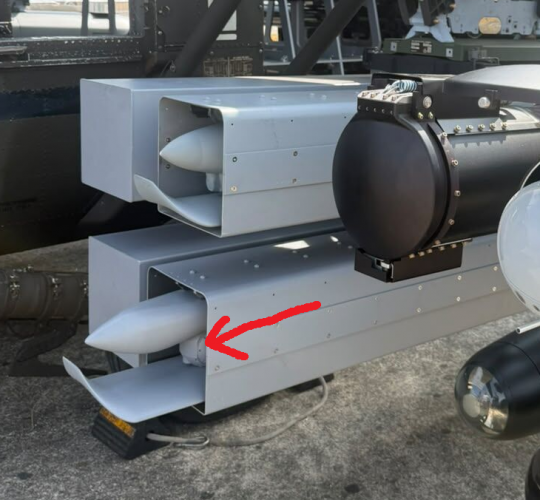
think 4x LRASM.

Yeah, and that’s a heavy load. Actually a believe AGM-158B is 2600, though I have never seen an exact number for C. Mk84 with fuses and fins probably also get close to that and they may want wing kits to be an option on top.
 
Yeah, and that’s a heavy load. Actually a believe AGM-158B is 2600, though I have never seen an exact number for C. Mk84 with fuses and fins probably also get close to that and they may want wing kits to be an option on top.
It is a heavy load. But it's a strike UCAV that is not particularly attritable because a carrier doesn't have space to store many unused airframes.

What's the Spot Factor difference between a UAV packing 2x AGM158s and one packing 4x? An A-7 could physically carry 4x AGM-158s externally and has a spot factor of 0.87 (F-18C=1.0). The MQ-25 is estimated at about 1.1 on that same standard.
 
Sure, but if you add in a 1000nm combat radius, you are definitely close to a full sized aircraft. I question how that gets down to $30 million, which is also part of the requirement.

It seems like a rather ambitious RFI.
 
Sure, but if you add in a 1000nm combat radius, you are definitely close to a full sized aircraft.
The A-7 had a 775nmi combat radius for a Hi-Lo-Lo-Hi mission that was kinda draggy. (3x300gal bags and 6x Mk82)

A sleeker airframe would likely take that to 1000nmi with 4xLRASM.


I question how that gets down to $30 million, which is also part of the requirement.
By dropping a few of the sensors out of a full sized airframe, probably the entire radar suite and the DAS.

I think it could be do-able, however. A pair of F414s would be ~7.5mil, and IIRC the cost split for an F35 was 40% systems/40% airframe/20% engine. Unfortunately, a pair of F130s/BR725s is more like 20mil.


It seems like a rather ambitious RFI.
Flyaway cost of MQ25 is in the 160mil/airframe range, so yes.
 
The F-47 is so powerful that it outclass the nonexistent J-20C.
I think the difference between Chinese and American designs will be not that dramatic. The F-47 will certainly be more technologically advanced, but they both use so much advanced technology that they can't be replenished even at the USAF's most optimistic wartime attrition rates. This is what makes the UCAV/CCA so important. Only the nations that can make the optimal combination of production rate, platform capability, armaments, and autonomy will be able to maintain persistent air superiority and credible deterrence. We're seeing that manifesting over Ukrainian and Russian territory, and the conflict in Iran looks like it's trending that way as well.
 
What's your evidence for this
Statements from everyone involved imply they are under that impression, including a lot of Chinese sources. I wouldn't count it as evidence but given the emphasis on edge compute, mesh networks, and AI systems in the 'sixth generation' CCA/MUMT CONOPS it looks like the US probably has the lead in at least a few key systems. I also personally believe the US is better at designing for maintenance, modifiability, and airframe longevity, but that's just intuition and may be misguided.
 
Whoever wrote that article is out of there damn mind lmao.

I dont think this writer understands that for a CCA, theres simply no point in a HVA protection specific airframe. 4 to 6 air to air missiles is already achievable with halfraams and 4 to 6 full sized AAMs is looking at at least half the cost of an F35.

I should also add that autonomy is nowhere near the point yet where we can and need to diversify into such specific roles. Where the technology sits today (at least what is operational anyway), while flight control itself is handled well by autonomy now, autonomy software simply hasnt yet been able to handle the scale and complexity of modern air combat yet. Its gonna take a few years for autonomy to start making useful impact on the battlefield. Up until then, CCAs as we know them are, for all intents and purposes semi-autonomous as it pertains to mission capability. This is also probably why many air forces around the world are developing and purchasing twin seat versions of their fighters - if autonomy was there, you simply dont need a second pilot

This - and not specialized airframes - should be the priority. once you have the mission planning and battle management ecosystem able to function adaquately in the field, slapping the software on just about anything will work. Until then, CCAs ought to be as they are now : one class of semi autonomous fighters and one class of basically air launched effects. Thats about what current the current state of affairs can handle.

Emphasis on edge compute, mesh networks, and AI systems in the 'sixth generation' CCA/MUMT CONOPS
This has basically been par for course for every 6th gen program in (and out of) existence.
 
Last edited:
Statements from everyone involved imply they are under that impression, including a lot of Chinese sources. I wouldn't count it as evidence but given the emphasis on edge compute, mesh networks, and AI systems in the 'sixth generation' CCA/MUMT CONOPS it looks like the US probably has the lead in at least a few key systems. I also personally believe the US is better at designing for maintenance, modifiability, and airframe longevity, but that's just intuition and may be misguided.
who is "everyone"? and does this "everyone" personally briefed with classified details from both USAF and the chinese military?

And also who are the chinese sources that believe this?
 
View: https://x.com/TheAviationist/status/2096711430070223047?s=20

Mysterious Black Jet That Emerged At Long Beach Airport Identified​

https://www.twz.com/space/mysterious-black-jet-that-emerged-at-long-beach-airport-identified
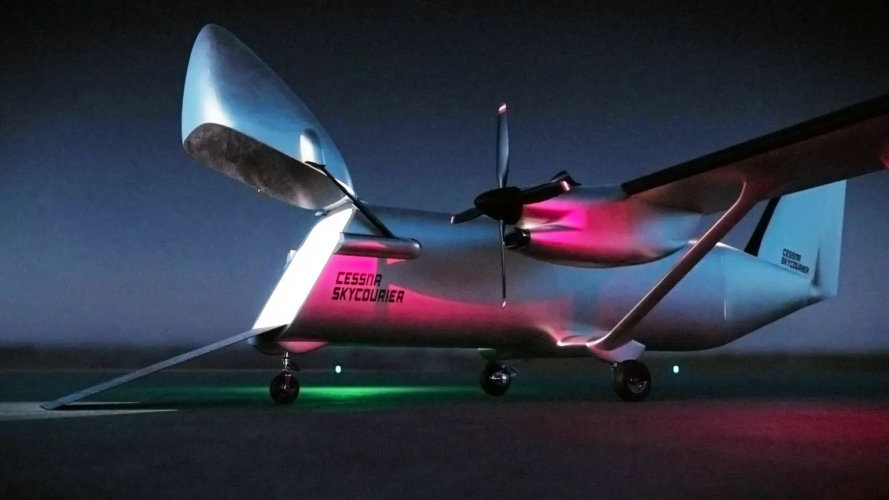
A mockup of the drone was introduced online with great fanfare in 2021 and described at the time by company CEO Jay Skylus as the “mothership” for a two-stage rocket able to carry a payload of just over 1,000 pounds.

From our story when the RAVN X was unveiled: “The twin-engine Ravn X drone — described by the company as the first stage of the system — reportedly weighs 55,000 pounds, is 80 feet long, and has a wingspan of 60 feet — roughly the size of an A-5 Vigilante. The sleek drone… has seemingly been tailored for speed.”

 
Last edited:
Some of these "money changers" ie allegedly "mid sized" competitors are still presenting products that are over engineered, less capable, & too expensive. They claim they r low cost, agile providers. Sometime, someone is going to enter the temple & flip over their table.
 
Last edited by a moderator:
Am I the only person who automatically ignores anything with "insane" or "breaks the laws of physics" in the title?
After hearing that NAVAIR appears to not have made up their mind whether they want tanker or tanker/strike plus the Center for Strategic and Budgetary Assessments' Greg Malandrino commentary on UCAV requirements needing to "creep", it was too tempting to post the INSANE.
 
After hearing that NAVAIR appears to not have made up their mind whether they want tanker or tanker/strike plus the Center for Strategic and Budgetary Assessments' Greg Malandrino commentary on UCAV requirements needing to "creep", it was too tempting to post the INSANE.
It wasn't meant as a criticism of you. Just get tired of seeing youtube get worse every day.
 
It's TWZ - but still neat article on General Atomics' MQ-9 successor called "Wildfire"

https://www.twz.com/air/first-look-at-general-atomics-wildfire-its-successor-to-the-mq-9-reaper

Wildfire does notably lack the Reaper’s distinctive hump on top of the forward fuselage. On the MQ-9A, this feature contains the drone’s satellite communications (SATCOM) antenna. What this might mean about how Wildfire is controlled and otherwise communicates is not immediately clear, but it points to the use of a smaller, lower-cost SATCOM terminal. That, in turn, would most likely be tied to a network like Starshield, the government-focused cousin of SpaceX’s Starlink. We could also see greater semi-autonomous control here, or at least a greater reliance on it.

The rendering of Wildfire also depicts the drone armed with four Joint Strike Missile (JSM) cruise missiles, with two loaded on what appears to be a single pylon under each wing. The stealthy JSM can be employed as an anti-ship or land-attack weapon. GA-ASI has released renderings of MQ-9s in the past with similar loadouts. The Air Force is already acquiring stocks of JSMs, primarily to arm its F-35A Joint Strike Fighters. Stand-off munitions like the JSM have long been seen as an increasingly important, if not critical, addition to the non-stealth Reaper’s arsenal, helping to keep the drones further away from potential threats.
 
Ignoring the CGI'd cover picture, this is actually a fairly good analysis.

View: https://www.youtube.com/watch?v=DB17ffRVg7A


View: https://x.com/CUAS_NEWS/status/2098083401626476999?s=20

SandboxAQ Completes Successful Flight Test of AQNav’s Quantum Navigation Technology on Northrop Grumman’s Lumberjack® Attritable Unmanned Aircraft System (UAS)

https://www.sandboxaq.com/press/san...ack-r-attritable-unmanned-aircraft-system-uas

Next-Gen Defense, Ready to Launch — Meet Lumberjack
https://www.northropgrumman.com/who-we-are/the-facts/autonomy/lumberjack
 
Last edited by a moderator:
500 seems pretty easy with at least two vendors, likely more for Incr2. I feel like Anduril or GA could get there by themselves if you gave them enough money.
 

Attachments

  • 1789734057023.png
    1789734057023.png
    1.3 MB · Views: 14

Similar threads

Back
Top Bottom