The ramjet ends so early too. I would have thought its two staged if not for the lack of fins on the small ramjet forebody.

My thoughts as well…it looks kind like a booster/ramjet combination where the white section is the cruiser. But I cannot imagine how it would be stabilized. But maybe find are not fitted or this is a body that is only testing captive carry.
 
Thinking about the ramjet looking thing again and trying to think of what role this would fill.

We know ramjets were ruled out for AIM-260, and this appears to be AIM-120/260 form factor-ish. And it seems any weapon this size is not a truly long ranged one by the standard of the day - I suspect AIM-260 has similar reach and probably superior kinematics at any range it can get to by virtue of a second thrust pulse. Is this perhaps some kind of low cost longer ranged BVR weapon for UAVs? Maybe a 3D printed cruiser with commercial grade guidance components strapped onto an AIM-120 rocket section? Perhaps even a rocket salvaged off an old model AIM-120 rather than a new build? The target set would probably be non maneuvering targets, or perhaps even just a long ranged weapon to pressure/suppress opposition fighters. The alpha dog AI would fire individual missiles at targets while it was evading just to force opponent maneuvers so it could quickly retake the initiative if it survived. So a cheap system that did not have very optimal end game sensors or KE might still have a big role to play, along with pot shots at large or unmaneuvering targets.
 
Last edited:
Third thought: scramjet? That would also explain the separate booster/cruiser sections as opposed to using an integral rocket-ramjet like meteor. In that case it would be liquid instead of solid fuel and there probably would be a very significant range increase over any solid rocket motor solution, though the end game would still be relatively underwhelming compared to a second solid rocket impulse. Application same as above just with increased range and different fuel type.
 

Attachments

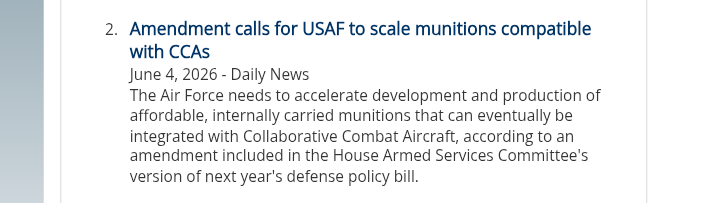
  • Screenshot_2026_0621_133554_com.android.chrome.png
    Screenshot_2026_0621_133554_com.android.chrome.png
    44.9 KB · Views: 32
I found this so interesting. On the other hand the questions asked were so poor. This technology must certainly be scaleable and although part size I'm sure has it's limits, it looks like we are not to far away from real automated airplane manufacturing at automotive industry rates. Tesla has those large scale aluminum casting machines that are designed to do this for their recent models. This is the future for aviation too. Exciting!
 
https://www.defensenews.com/news/yo...twitter&utm_medium=social&utm_campaign=tw_dfn

主要针对福特级和尼米兹级核动力航空母舰的舰载无人机(UAV)系统。

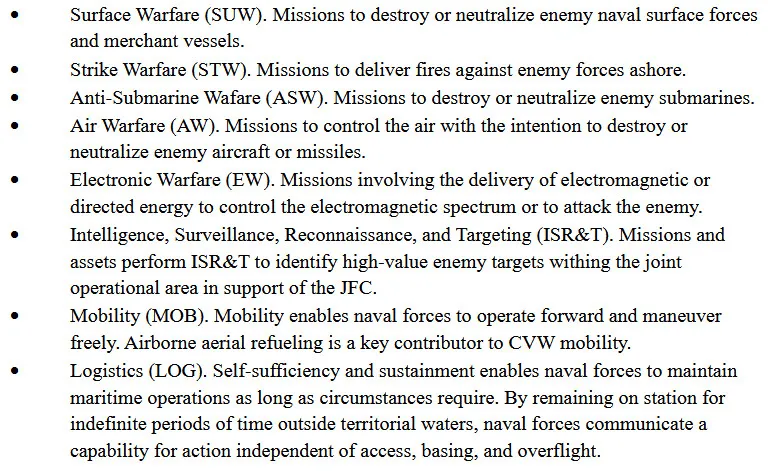
海军信息征询书(RFI):计划开发一种可扩展的无人机能力,涵盖八个任务类别,其范围至少为 1,000 海里,具有高度自主性和空中加油能力;该系统必须与现有的航母基础设施兼容,并支持跨平台垂直起降(VTOL)操作,从而能够组建由第五代和第六代资产组成的未来有人-无人协同(MUM-T)航空联队。
 

Attachments

  • Screenshot_2026_0715_132738_com.android.chrome.png
    Screenshot_2026_0715_132738_com.android.chrome.png
    39.7 KB · Views: 11

Navy seeking additional unmanned capability for Air Wing of the Future​

https://insidedefense.com/daily-news/navy-seeking-additional-unmanned-capability-air-wing-future
The Navy plans to expand its unmanned aircraft capabilities for aircraft carriers, and is seeking industry sources capable of designing, developing and fielding a new unmanned, carrier-based aircraft for its future carrier air wing. The Portfolio Acquisition Executive for Aviation plans to conduct market research to determine potential sources for this next-generation capability, according to a new government notice . Specifically, the Navy is looking for autonomous platforms that could pair with Ford-class and Nimitz-class aircraft carriers.

https://www.defensenews.com/news/yo...twitter&utm_medium=social&utm_campaign=tw_dfn

主要针对福特级和尼米兹级核动力航空母舰的舰载无人机(UAV)系统。

海军信息征询书(RFI):计划开发一种可扩展的无人机能力,涵盖八个任务类别,其范围至少为 1,000 海里,具有高度自主性和空中加油能力;该系统必须与现有的航母基础设施兼容,并支持跨平台垂直起降(VTOL)操作,从而能够组建由第五代和第六代资产组成的未来有人-无人协同(MUM-T)航空联队。
The RFI lists a few specific requirements, including a minimum 1,000-nautical mile range for strike missions.
Drones must also possess “flight autonomy (e.g., carrier pattern, taxiing) and mission autonomy (e.g., dynamic tasking/retasking, threat evasion, automated aerial refueling) maturity.”

Additionally, they must be compatible with existing Unmanned Carrier Aircraft control systems, according to the RFI.

Significantly, while the RFI mostly focuses on carrier-based drones, the Navy also wants vertical-takeoff UAVs that can operate from other types of vessels, such as destroyers and mobile sea bases.

Navy Wants 1,000 Mile Combat Radius For Carrier Based Tactical Drone Fleets​

https://www.twz.com/air/navy-wants-1000-mile-combat-radius-for-carrier-based-tactical-drone-fleets
1784291116122.png

So is it 1,000nm combat radius or range?
 
Last edited:
Read this article from aviation week that discusses the purchasing model for CCA software. For those not familiar with autonomy software, it gives a good idea of how autonomy software is separated from flight software in CCAs.
Bryan Clark, a senior fellow at the Hudson Institute who specializes in defense technologies and autonomous systems, agreed this strategy could make it easier for the Air Force to buy the best mission autonomy system and drive vendors to perform better. At this point, he said, the approach is largely untested.

“We haven’t really had any major acquisition programs where they’ve decoupled the software from the hardware to this degree,” Clark said.
Similarly to how an iPhone or Android phone have an own operating system running the device, each CCA will come with its own native flight control software to manage things like its engine, fuel system, and other “inherent functions of an airplane to be an airplane, and fly successfully without a pilot,” Kendall said in an interview with Air & Space Forces Magazine.

But beyond that, he said, the CCA will require mission autonomy software to control tactical behaviors, such as how it fights and follows the human pilot’s instructions. This programming, under the “software sold separately” approach, will be akin to the apps an iPhone or Android runs—programs that provide additional capabilities but could be updated or replaced, like swapping Google Maps for Waze, Kendall said.
A software-sold-separately approach also avoids a prime contractor locking in multiple key aspects of a new system, which can limit the government’s choices for future improvements, he said.
It also comments on the software to be associated with the F-47:
“For any program that you’re going to have for quite a long period of time—and F-47 certainly should be one of those—you want the capability to upgrade it,” Kendall said. “We should have learned from the F-35 that you don’t want to just hand that over to the prime. You want to make sure that on the government side, the opportunities to modularly add new capability, switch out subsystems or software modules, is designed into the platform. You’re going to constantly be upgrading software.”

When asked whether a similar strategy could be used for the F-47, the Air Force spokesperson said that government reference architectures like the one being used for CCAs “give the USAF and industry the flexibility to pursue similar strategies if it is in the best interest of the warfighter.”
But interestingly... Bryan Clark doesn't seem to believe F-47's software is a good candidate for this model (which I find to be questionable)
Clark said one potential drawback to the software-sold-separately approach is that vendors’ programming will need to be designed to work with multiple systems, and, as a result, could lose some of the performance that more tailor-made software might provide.

“When you’re writing the software for a radar, if you knew what the vehicle was going to be on every time, then you would write the software in a way that is tailored to the vehicle design, and also leverages what the vehicle’s other capabilities,” Clark said. “If it’s a highly modular system where you’re mixing and matching different sensors, or different electronic warfare jammers or different weapons payloads, that mixing and matching means you’ve got to genericize the software to a degree. That means you’re not going to be able to leverage all the functionality of the payloads every time.”

For that reason, Clark said, a software-sold-separately approach may not be right for the F-47, which is focused on delivering high performance. But other systems that wouldn’t require such high performance, such as next-generation mobility or refueling aircraft, may benefit from this strategy, Clark said.

I find Clarks conclusion to be utterly stupid.

The cost of modularity in software doesnt (or shouldnt) cost you meaningful performance penalties particularly with regards to a single platform like the F-47. If it does, youve got shitty software. The only time you'd be using generic software for the F-47 is if youve got multiple different sensors for the same role i.e 5 different radars from 5 different vendors or something dumb like that. This is a farcry from what CCA autonomy software faces - a single software adapatable to any number of CCAs of a particular mission type.

Its been ages since we've created interfaces to enable interchangeable software / hardware. As long as the new version / winning vendor is writing software utilizing the same interfaces, theres absolutely no reason an F-47's software cant be competed under the same model.
 
I remember seeing that wing on another forum post about a particular study done by NASA during the cold war, but its really interesting that the slanted wing had skipped manned aircraft and now finds itself in drones and cheap missiles.
 
Oblique wing planform always gave me a sense of being better for an unmanned design from the moment I ever heard of the idea being tried when I was a kid.
 
Oblique wing planform always gave me a sense of being better for an unmanned design from the moment I ever heard of the idea being tried when I was a kid.

I'm surprised we don't see it more on folding wing munitions, seems like a simpler solution than two separate pivoting wings.
 

Attachments

  • LRCSW 01.jpg
    LRCSW 01.jpg
    111.7 KB · Views: 111
Last edited by a moderator:
Many years ago when 3D printing was still voodoo by lab coated brainiacs, Boeing built a small engine as an IRAD effort. They expected it to run for less than one minute. It lasted until they turned off the fuel.

No one was interested.
 
Last edited:

Attachments

  • IMG_5736.jpeg
    IMG_5736.jpeg
    841.2 KB · Views: 21

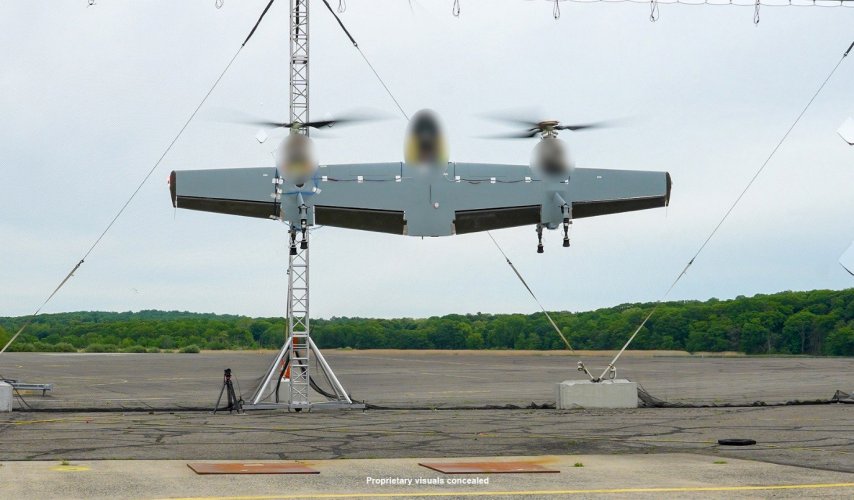
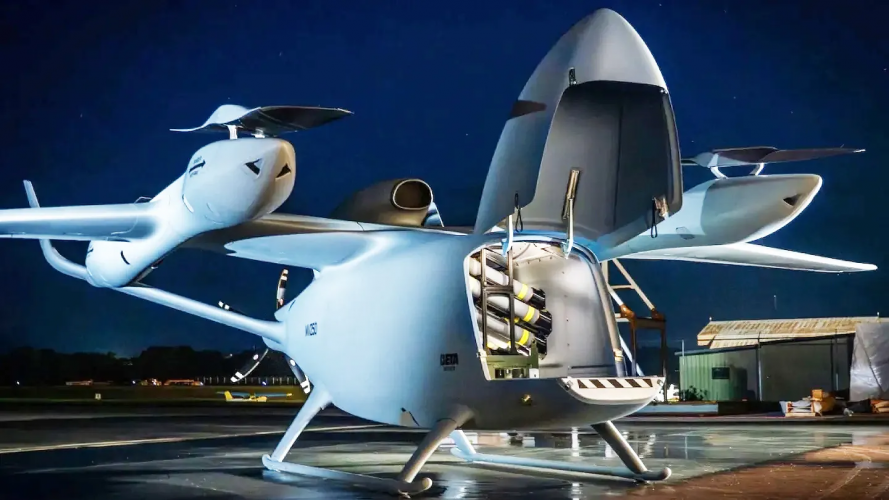
MV250 Hybrid-Electric VTOL Combat Cargo Drone Unveiled​

The new uncrewed platform is designed to move cargo, deploy air-launched effects, and support dispersed military operations.
https://www.twz.com/air/mv250-hybrid-electric-vtol-combat-cargo-drone-unveiled
1784725650761.png

General Atomics Plans New Drone Design for Low-Cost Reaper Replacement​

https://www.airandspaceforces.com/general-atomics-new-drone-design-low-cost-reaper-replacement/
The Air Force and DIU want MMA drones to have a fully loaded combat radius of at least 2,300 nautical miles and be able to launch weapons, collect intelligence, perform electronic warfare operations, or relay communications in flight to exhaust the enemy. They said MMAs should also be modular and able to carry payloads of at least 2,800 pounds, including full-motion video sensors, to fill the MQ-9’s current roles.


DOD launches Drone Dominance competition for reusable bomber drones​

https://insidedefense.com/daily-news/dod-launches-drone-dominance-competition-reusable-bomber-drones
The Defense Department is launching a search for small, reusable, one-way attack bomber drones under its overall $1.1 billion initiative to field more than 300,000 small OWA drones by 2027, the Pentagon announced yesterday . The bomber-focused competition -- to be nested under the second of four phases in the program -- will award approximately $32 million in initial prototype orders with additional orders planned in following phases of the Drone Dominance Program.
 
Last edited:

Similar threads

Back
Top Bottom