U.S. Air Force Reveals Plans For VTOL Rocket Bomber Prototype

The U.S. Air Force has released plans to experiment with a prototype reusable, rocket-powered aircraft for high-speed, long-range strike missions.

Although limited to a prototype program, the interest from Air Force Global Strike Command points toward a future bomber alternative that differs markedly from the stealthy, subsonic Northrop Grumman B-21 Raider, which is now in the early stages of production.

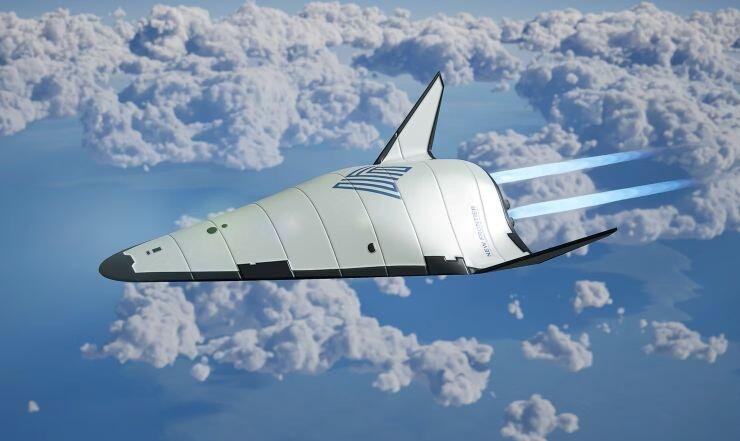
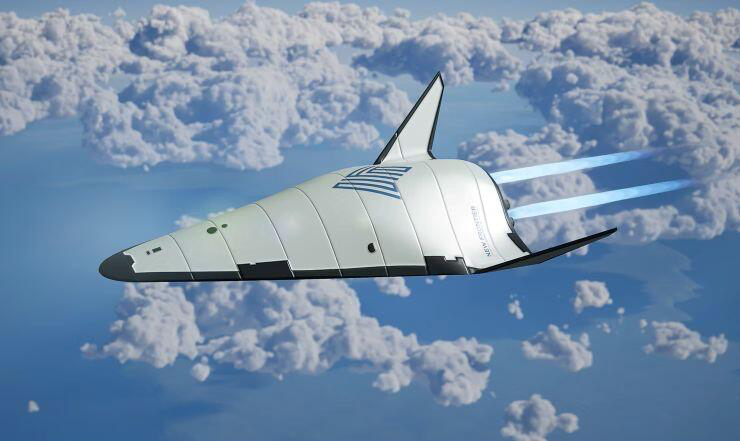
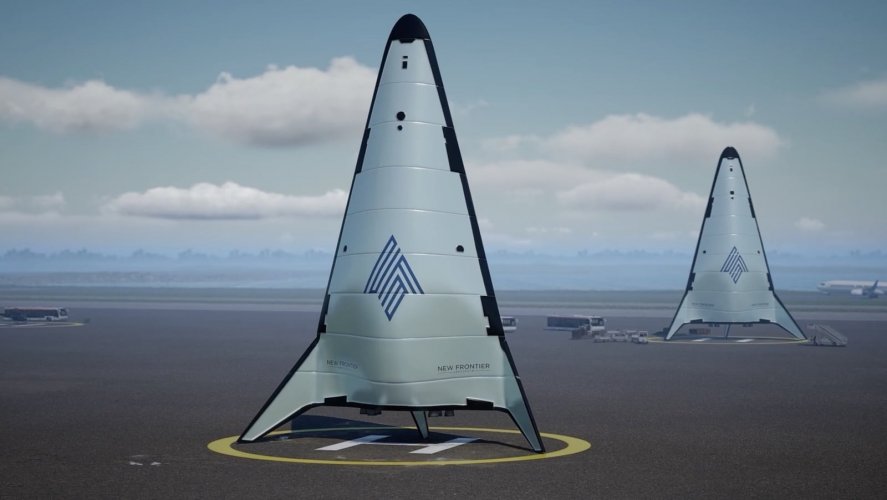
The prototype described in solicitation documents released in mid-July calls for a liquid-fueled, rocket-powered, vertical-takeoff-and-landing (VTOL) aircraft. After launching vertically, or potentially on a steep diagonal trajectory, the aircraft would transition to horizontal flight and accelerate to high—likely supersonic or hypersonic—speed, perform a strike mission and then return to its launch base for a vertical landing.

The concept requires the maturation of several technologies. The Air Force solicitation documents list advanced liquid rocket propulsion, autonomous flight control, thrust-vector control, aerodynamic control surfaces, cryogenic propellant management and high-temperature structural materials to demonstrate stable flight, controlled transition between flight regimes and reliable system performance.

The Air Force plans to make a selection quickly. A contract could be awarded within 30-45 days of the Aug. 4 submission deadline.

https://aviationweek.com/defense/ai...air-force-reveals-plans-vtol-bomber-prototype
 
"Runway independence." Perhaps a not so surprising pivot given the effects of Iranian counterattacks on ME airbases.
 
Looking at the company that the request seems to be tailored to, more like someone dusted off the plans to the Silbervogel.
The return of X-33 Venture star, it seem that the Hypersonic air breathing for ISR or Strike don't work well, come back to the Rocket Engine.
 
Last edited:

Attachments

  • NFAs-Mjolnir-Engine-Redefines-Hypersonic-Drone-Propulsion-with-Clean-3D-Printed-Power-0002.jpg
    NFAs-Mjolnir-Engine-Redefines-Hypersonic-Drone-Propulsion-with-Clean-3D-Printed-Power-0002.jpg
    21.1 KB · Views: 157
  • NFAs-Mjolnir-Engine-Redefines-Hypersonic-Drone-Propulsion-with-Clean-3D-Printed-Power-0001.jpg
    NFAs-Mjolnir-Engine-Redefines-Hypersonic-Drone-Propulsion-with-Clean-3D-Printed-Power-0001.jpg
    89.8 KB · Views: 146
Is this concept another attempt at a "space bomber" capable of suborbital flight? I don't see why else purely rocket propulsion would be preferred.

Vertical take-off makes sense for that flight profile, but vertical landing? I'm a bit skeptical about how feasible or valuable that would be here.
 
So… A VentureStar with a bunch of JASSM-ERs in its belly?

Okay. I’ll allow it. And the 30-45 day deadline to selection is interesting. If they’re not careful, people might start to believe they’re serious about the idea.
 
So… A VentureStar with a bunch of JASSM-ERs in its belly?

Okay. I’ll allow it. And the 30-45 day deadline to selection is interesting. If they’re not careful, people might start to believe they’re serious about the idea.
They are serious since a long time about this concept. New rocket tech are mature , Vertical landing is mature , Scramjet seem to be still away for a supersonic/Hypersonic Bomber or to difficult to make this tech mature..
 
I still have my doubts as to whether Xbat can do VTOL ops effectively let alone whatever the hell this is.

I get the use case but man what a wild time to be alive. One must wonder that with this period of rearming just how many of these products are going to be the next F15/F16 level of success and whats going to crash and burn.
 
Vertical landing with rockets (in 1g with atmosphere) does seem tricky—SpaceX’s stuff still falls over half the time. Shield AI seems to be getting the hang of it with their drones, but it’s a lot easier to precisely throttle a ducted fan or even turbofan than a rocket (not to mention how much easier it is to not set yourself on fire with your own exhaust), and this proposed aircraft is going to be an order of magnitude (or two, or three) heavier.

Also I feel like half the reason to do a spaceplane is so that you can glide it into a conventional landing, otherwise you could just shape your reusable delivery vehicle like a ballistic missile and probably be more efficient in absolute terms, but I guess efficiency is taking a backseat to cool factor anyway when the primary concern is trying to close the wunderwaffe gap with Russia and China.
 
So… A VentureStar with a bunch of JASSM-ERs in its belly?
More like a VentureStar with a belly full of instrumented Mk4A or Mk5 RBAs, since those are the dimensionally smallest in the arsenal. Optionally, a rack full of M829A4 darts, possibly with sabots. And the rack has enough force to deorbit the items.

At least if it's out of the atmosphere when it drops.

If it's in atmosphere when it drops you could get away with whatever can survive release at supersonic speeds. JDAMs without wing kits, mostly.
 
If only I had a $ for every conceptual design floated on these newfangled internet tubes...
 
Maintenance and arming of a tail-stander is going to be a pain in the ass. I'm not convinced the advantages necessarily outweigh the issues.

And that includes survivability. At least with an F-35B you can tow it off-base and hide it in a garage, industrial unit or superstore anywhere linked to the roadnet, this thing is going to be stuck where it lands or in the very near vicinity, and good luck getting it into a HAS.....
 
Putting my tinfoil hat on...

According to rumours, Lockheed has been seriously over budget and behind schedule with a hypersonic aircraft (the 'SR-72'). Probably it's recon but strike would be a possible mission too. Now, would this announcement be a Plan B in case it fails completely or a rival to frighten/spur them on?

Another possibility is that the USAF and USSF are dusting of the Trans-Atmospheric Vehicle requirement, perhaps emboldened by SpaceX's progress.

It has been said that (air-breathing) hypersonics isn't rocket science - it's harder. You have to keep a match lit in a hurricane and the airframe is soaked in heat much longer than a re-entering spacecraft. A semi-ballistic vehicle that has a flight path mostly in space might, depending on requirements, do most of whatever the 'SR-72' was meant to do, and some other things too.

A quick search of other threads:

https://www.secretprojects.co.uk/threads/boeing-tav-was-this-speculation-or-a-serious-concept.8293/

https://www.secretprojects.co.uk/threads/1986-afrl-trans-atmospheric-vehicle-tav.48619/

https://www.secretprojects.co.uk/th...-past-amsci-science-dawn-have-region-etc.315/
 
Last edited:
"Plans" is a misnomer. It is should be something on the lines of the "U.S. Air Force Reveals XXX For VTOL Rocket Bomber", where is X= concepts or ideas. Or "U.S. Air Force Reveals Studies For VTOL Rocket Bomber"

To me, "plans" means something more like actual drawings or a procurement in work.
 
The design is credible but vertical landing is not. This appears to be a design for a purpose unrelated to air combat. At least against air-breathing aircraft. I propose it is designed to bring down other sub-orbital threats.
 
Maintenance and arming of a tail-stander is going to be a pain in the ass. I'm not convinced the advantages necessarily outweigh the issues.
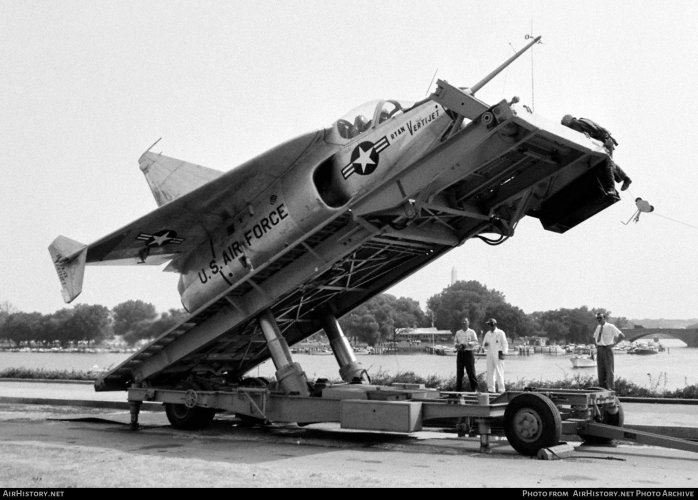
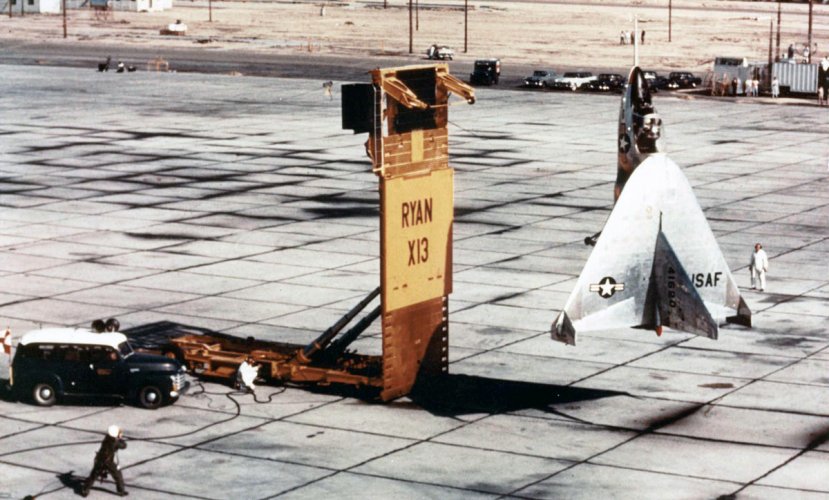
Ignoring problems with landing first, they cant just... catch it and then lay it on its belly? Put it on a rack? Hang it off the roof? Design it so it can be stored like a normal plane with structure bearing frames for laying on the spine or belly and then tilt it upright for a launch?

(Sorry. Am village idiot)

Ballistic missile launchers dont carry their missiles while they stand upright either.
 
I see something similar to the SNECMA Coleoptere being the only reasonable method. A trolley for movement, and which tilts it into a vertical launch position.
OIP.K-7mCULm3sX8nnyS9GVFDQHaKB
 
Ignoring problems with landing first, they cant just... catch it and then lay it on its belly? Put it on a rack? Hang it off the roof? Design it so it can be stored like a normal plane with structure bearing frames for laying on the spine or belly and then tilt it upright for a launch?
All of which increases the necessary infrastructure that the unit has to trail around with it, decreasing any advantage of being semi-runway* free.

* I'd still expect it to need a runway grade launch area for any kind of sustained take-off and landing operations.

What we don't really have a grasp of yet is the size and range of this thing. Are we talking B-2 size and able to hit anywhere in the world, F-15E size and able to intervene across a region, or small fighter/drone size and restricted to tactical operations?
 
All of which increases the necessary infrastructure that the unit has to trail around with it, decreasing any advantage of being semi-runway* free.

* I'd still expect it to need a runway grade launch area for any kind of sustained take-off and landing operations.
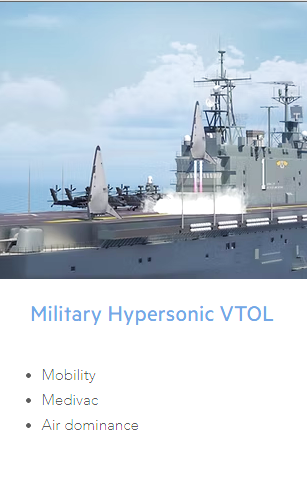
Really, the more one thinks about it, the wilder it gets. The presentation image shows it on the deck of a ship--imagine a fully fueled one of these tipping over on a rolling deck, and the deck crew trying to secure it with dozens of load straps in between launches to prevent it.

And think of all those flat tops that had to reinforce their decks because F-35Bs have hot exhaust and melt the decks (and they have to bring in metal plates when they operate off roads to keep them from melting the pavement)--how much hotter would the exhaust be from 6 liquid fueled rockets? They'll need to bring in ceramic tiles to keep from melting a hole to the hangar deck.

And speaking of those rockets, how are deck crews and airbase personnel gonna feel about storing and handling large quantities of hydrazine or whatever this thing runs on? What's the damage control drill for that look like?
 
Certainly, the handling of rocket fuels is something the Royal Navy was happy to deal with when the Saunders Roe P177 was very much planned to enter service. But what the differences are between HTP and Hydrazine procedures I don't know.

Similarly, when Avro Canada pitched for TS140 they proposed an area at the port edge of the forward deck which had a grated surface for the takeoff of VTOL aircraft. Regardless, it's going to need some serious rethinking and infrastructure investment if it were to come to fruition.
 
I see something similar to the SNECMA Coleoptere being the only reasonable method. A trolley for movement, and which tilts it into a vertical launch position.
All of which increases the necessary infrastructure that the unit has to trail around with it, decreasing any advantage of being semi-runway* free.
You may need a cleared area, but would a full runway be needed? Even if your staging area remains the same area, you may not need a couple thousand feet runway. Instead youd just need a flat clearing to launch right?

And with the tow vehicles shown above, you could probably mount that system on a large wheeled transport vehicle that can traverse some rougher terrain to said open and flat - ish clearing to launch.

Storage is also somewhat less demanding for good terrain as you could hide some fuel and weaponry inside some less dense forest areas or a prepared but not completely deforested area to hide from reconnaissance. Only the plan itself would have some difficulty being stored unless it was smaller.

I dont think this thing is going to be bomber sized either. It would maybe carry three or four ARRW sized munitions max.

-village idiot
 
Last edited:
And speaking of those rockets, how are deck crews and airbase personnel gonna feel about storing and handling large quantities of hydrazine or whatever this thing runs on? What's the damage control drill for that look like?

https://dronexl.co/2025/06/26/nfa-mjolnir-hypersonic-drone-propulsion/

"Unlike conventional engines burning RP-1 or liquid hydrogen, Mjölnir uses LNG, which burns cleaner* and can be sourced from bio-waste to achieve net carbon-negative operation**. "

LNG = Liquefied Natural Gas, so it's methane + some ethane and heavier hydrocarbons (CH4 + C2H6 etc), which burns with oxygen to CO2 + H2O. The NFA website says they use liquid oxygen as the oxidiser. So you're not dealing with chemically noxious fuel or oxidizers, but you are dealing with cryogenics, which brings its own range of operational challenges.

* 2 H2+O2 = 2 H2O, it's difficult to burn cleaner than hydrogen.

** LNG is predominantly used for shipping of natural gas from oilfields in LNG tankers. And wherever you get it from you have to expend energy to liquefy it. Getting the full process to be carbon neutral across the complete cycle seems extremely unlikely. And realistically the US is likely to source fuel from the existing supply chain, not bio-waste. IMO the woo factor in this claim is off the scale.

(The article isn't quoting NFA directly, but their website says "Powered by clean liquid natural gas (LNG), Mjölnir is net carbon negative when sourced from bio-waste".).
 
You may need a cleared area, but would a full runway be needed? Even if your staging area remains the same area, you may not need a couple thousand feet runway. Instead youd just need a flat clearing to launch right?

The problem is the launch surface, not the size. Fragging yourself on take-off with eroded launch pad is not a good idea. That's doubly a problem if you need multiple take-offs from the same pad. And if you need multi-aircraft missions, you'll need multiple launch pads. I think VTOL is largely a gimmick here, it's an inherent feature of the design, rather than operationally necessary.

Storage is also somewhat less demanding for good terrain as you could hide some fuel and weaponry inside some less dense forest areas or a prepared but not completely deforested area to hide from reconnaissance.
The problem here is LNG and liquid oxygen are cryogenics, you need tankage that can keep them cool, and there may well be an associated MASINT signature, either from temperature, or from boil-off. And that problem is doubled if you're generating them onsite.

I dont think this thing is going to be bomber sized either. It would maybe carry three or four ARRW sized munitions max.
Even a B-52 can only carry six, AGM-183 is not small.
 
LNG = Liquefied Natural Gas, so it's methane + some ethane and heavier hydrocarbons (CH4 + C2H6 etc), which burns with oxygen to CO2 + H2O. The NFA website says they use liquid oxygen as the oxidiser. So you're not dealing with chemically noxious fuel or oxidizers, but you are dealing with cryogenics, which brings its own range of operational challenges.
IIRC, the Navy is used to handling LOX in breathing quantities. So it's not bad. It's not hydrazine or hypergolics.
 
IMO the woo factor in this claim is off the scale.
Yeah, the greenwashing here is something else. I'm not sure what's weirder, touting the eco-friendliness of your intercontinental strategic strike bomber, or trying to sell concentrated methane as climate-friendly. It's roughly 80 times stronger of a greenhouse gas than CO2, which is why burning it to expel tons of CO2 instead is considered more eco-friendly than releasing it into the atmosphere directly, which is definitely not going to happen due to mishaps or even as a result of routine handling.

Also, it's odd marketing to still include in the current environment--you'd think it'd put them at risk of being automatically cancelled due to keyword search purges of "woke" projects.
 
When I first saw this news item I had to check the calendar that I hadn't accidently overslept to April 1 2027.
That's never a good sign...
 
IIRC, the Navy is used to handling LOX in breathing quantities. So it's not bad. It's not hydrazine or hypergolics.
OTOH the relative quantities involved make that like comparing stowage of small arms ammunition to stowage of mass amounts of aircraft ordnance.
 
Back
Top Bottom