NSSN Virginia-class - current status and future

L3Harris have won contracts for the TB-29C long-range thin line towed-array passive sonar to detect quiet enemy submarines at long range to replace the TB-29A, mention made towed arrays can be miles long, but TB-29C is quoted as only 825 meters and 3.8 cm diameter. It's designed to keep the array's sensors away from tow vessel noise to improve its signal-to-noise ratio and its ability to detect and track faint contacts like quiet nuclear and diesel-powered submarines and seismic signals, Lockheed gets a mention in article.

Plus the TB-34A fat-line towed-array passive sonar system to replace the TB-16 for tactical use in littoral shallow coastal waters is only 75 meters by 75 cm diameter.

First time have seen length and diameter of passive towed arrays quoted
I don't remember seeing array length/diameters while I was in! (admittedly I was not a Sonar Tech)
 
First time have seen length and diameter of passive towed arrays quoted
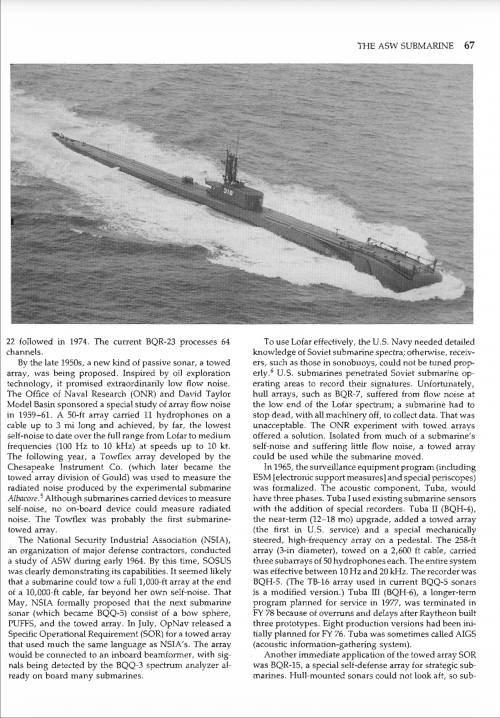
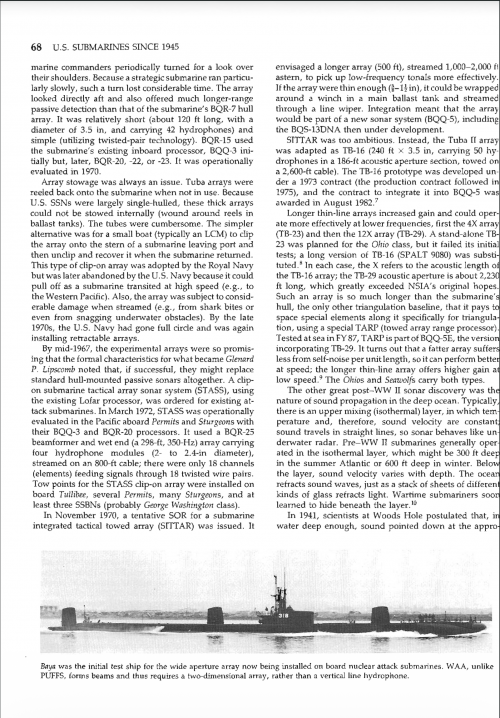
They're not particularly common figures to come across, but they have been published in unclassified/declassified material for a while. See U.S. Submarine since 1945 by Norman Friedman published in 1994 (relevant pages attached). The figures are (with the TB-29C and TB-34A given earlier):

ArrayAcoustic Length (ft.)Diameter (in.)Cable Length (ft.)No. Hydrophones
BQH-4 (Tuba II)25832,600150
BQR-151203.542
BQR-25 (STASS)2982–2.4800
TB-162403.52,60050
TB-23~960
TB-29~2,880 (2,230?)
TB-29C2,7071.5
TB-34A2463
 

Attachments

  • Screenshot 2026-02-18 at 5.16.22 PM.png
    Screenshot 2026-02-18 at 5.16.22 PM.png
    2.6 MB · Views: 50
  • Screenshot 2026-02-18 at 5.16.25 PM.png
    Screenshot 2026-02-18 at 5.16.25 PM.png
    1.9 MB · Views: 44
There were three Seawolves built not three IIRC before being cancelled (Which turned out to be a short-sighted decision).
They were super expensive, hence the Virginia class which was supposed to provide 80% the capability at 50% of the cost (or some such).
 
I think, we should stay with the technical status, and maybe the status of procurement, but better avoid current operational events, especially, as those news are just speculation still yet.
Better for this thread, to my experience ....
;)
 
I think, we should stay with the technical status, and maybe the status of procurement, but better avoid current operational events, especially, as those news are just speculation still yet.
Better for this thread, to my experience ....
;)
Agreed. Thread cleaned up.
To be honest a lot of the non-project posts could be spun out now the Virginias are well in service, but that's for another day.
 
A couple of comments. Through one of my connections, the VPM "hump: is asymmetrical, the four tubes are not centered on it, but more aft. Also the lower dihedrals are not present on the Blcck V. Missing in the drawing in the article are the three WAA as well as the Large vertical WAA, which is just aft of the sail one the hull,
They must have very quickly mocked up the graphic; the bow is basically hemispherical, which is not true on the real submarine.
 
A great step at a time when the US is producing more sub tonnage than essentially ever before and probably a lesson to learn for future LSC and amphib production
 
The navy is still figuring out what exactly they want from SSN(X) but go off queen, apparently you're prescient
To be fair though, it's slowly approaching the time where they'll have to nail something down and go with it. It's arguable how competitive the Virginia-Class will be in the 2040s
 
To be fair though, it's slowly approaching the time where they'll have to nail something down and go with it. It's arguable how competitive the Virginia-Class will be in the 2040s
You underestimate just how many and how frequently technological advances are implemented into Virginia classes and their successive blocks.
 
That's expected.

The last ~10 688s all packed bits and pieces of Seawolf and Virginia hardware. A couple had propulsors, some had the anhedral stabilizers instead of the vertical endplates on the stern planes, IIRC two of them had the Virginia-class periscopes/photonics masts, another few had parts or more of the different sonars and CMS.

So I fully expect the last ~10 Virginia-class to be testing things from the SSNX.
 
The last ~10 688s all packed bits and pieces of Seawolf and Virginia hardware.
That would be the four Mod 25 boats (SSN 766, 771-773), which had similar machinery to the Seawolf. None of them got propulsors though (they had a hybrid/ringed propeller with a different pitch). The Pittsburgh tested several propulsors in the 1990s.
some had the anhedral stabilizers instead of the vertical endplates on the stern planes
All the 688Is and the Memphis got the dihedral stabilizers with 6-inch countermeasures. No 688 ever had endplates on the horizontal stabilizers.
 
https://www.navy.mil/Press-Office/P...hipbuilding-contract-to-cement-undersea-domi/
WASHINGTON – Today, the Department of War expanded its undersea warfighting capabilities by awarding a five-ship contract modification to General Dynamics Electric Boat (GDEB) for the construction of five Columbia Class ballistic missile submarines (SSBNs), a nine-ship contract to GDEB and HII-Newport News Shipbuilding (HII-NNS) for the construction of Fiscal Year (FY) 2025 through FY 2029 Virginia Class submarines, and previously awarded shipyard productivity efforts to the two companies. These awards represent a historic investment in maritime modernization and supremacy, with a combined total value of $76.6B
 
Been saying for ages the stretched Virginias were too long and unwieldy to be proper hunter killer submarines. Now officially Block V and Block VI with VPM's will be classified as SSGN's rather than Attack Submarines while those without the VPM module will continue to be classed as SSN's.

20% increased length increases turning radius by 50%, 25% extra mass with the same propulsors and rudders as the regular Virginia's. I wouldn't want these anywhere near littoral waters and yet they will have to pickup the special forces roles of the Seawolfs beyond the one Virginia Block V being specially modified for seabed warfare.
 
Last edited:
Been saying for ages the stretched Virginias were too long and unwieldy to be proper hunter killer submarines. Now officially Block V and Block VI with VPM's will be classified as SSGN's rather than Attack Submarines while those without the VPM module will continue to be classed as SSN's.
It's just for Congress, really. Probably the Navy was worried that members of Congress who didn't know any better would think that it was weird to replace some of the SSGNs' capability with SSNs. But at the end of the day it's just semantics. Since all Virginias have VLS tubes, rationally all should be SSNs or all should be SSGNs. We haven't really built an SSGN since the Halibut anyway.
 
It's just for Congress, really. Probably the Navy was worried that members of Congress who didn't know any better would think that it was weird to replace some of the SSGNs' capability with SSNs. But at the end of the day it's just semantics.
Perhaps but that bombastic press release is an embarrassment... could have been written by a 12 year old fanboy.

Adding the letter G to a designation is a "decisive step to sharpen its competitive edge," "unleashing next-generation strike power", a "pivotal shift signaling a leap forward in undersea warfighting capability and lethal combat power"?? LOL.

A few other head scratchers such as "these reclassified SSGNs will operate with impunity in contested waters, ensuring the United States Navy maintains absolute undersea supremacy". Glad to know they rate themselves so highly... hopefully the PLAN won't test that premise.
 
20% increased length increases turning radius by 50%, 25% extra mass with the same propulsors and rudders as the regular Virginia's
Keep in mind that the rudders (propulsor doesn't matter) on a longer submarine have a longer moment arm. This is why SSBNs have generally have smaller stern appendages that are disproportionately small compared to SSNs.

This is also probably why the dihedral stabilizers are not present on the Virginias with the VPM: to retain the same dynamic stability (which influences the turning circle diameter) they need less surface area because of the greater moment arm.
 
Dihedral stabilizers stop the natural propensity for rolling on high speed turns, I think that's being dispensed with due to the Virginia finally getting 'fly by wire' computer controlled rather than manually steered hydraulically actuated rudder controls.
 
Dihedral stabilizers stop the natural propensity for rolling on high speed turns, I think that's being dispensed with due to the Virginia finally getting 'fly by wire' computer controlled rather than manually steered hydraulically actuated rudder controls.
No, the dihedral stabilizers are being removed for the VPM boats because they would provide too much dynamic stability and add unnecessary drag. SSN 802, the only Block V without the VPM, has dihedral stabilizers.

It has nothing to do with fly by wire, which has been the case since the Virginia. It is not possible for the Virginia class to reduce snap roll by differential control of the rudders and stern planes. The rudders and two sets of stern planes (inner and outer) are each on their own stock and thus cannot move differentially.

I am also very doubtful of that 50% turning circle diameter increase claim. Do you have a source?
 
My thinking is rate of turn is inversely proportional to ship length: W inversely proportional to v/L, as the rudder size stays the same then W is 1/1.2xoriginal W which is about 17% less turning rate. The turning circle is then 2πR or about 50% greater than original.

While your right that there is a longer moment arm its cancelled out by the increased water resistance in the turn from the added length of the submarine.
 
My thinking is rate of turn is inversely proportional to ship length: W inversely proportional to v/L, as the rudder size stays the same then W is 1/1.2xoriginal W which is about 17% less turning rate. The turning circle is then 2πR or about 50% greater than original.

While your right that there is a longer moment arm its cancelled out by the increased water resistance in the turn from the added length of the submarine.
I'm sorry, but this is just nonsense. Please don't just make stuff up.
 
You might think that, but even using the simplified rule of thumb advance and transfer 3-5 ship lengths, the turning circle increases with ship length even if the same turning rate (W) is maintained by the longer vessel by proportionally increasing the size of the rudder. This is due to the centre of gravity of the boat being further from the rudder.
 
Last edited:
You might think that, but even using the simplified rule of thumb advance and transfer 3-5 ship lengths, the turning circle increases with ship length even if the same turning rate (W) is maintained by the longer vessel by proportionally increasing the size of the rudder. This is due to the centre of gravity of the boat being further from the rudder.
I'm not sure where you're getting this, and honestly I find it difficult follow the logic as it does not appear to be consistent.

Submarine maneuvering is quite complicated (see Chapter 8 of Concepts in Submarine Design by Burcher and Rydill). What you are not considering is that by removing the dihedral stabilizers, the dynamic stability likely remains similar to a short-hull Virginia whereas you seem to be implicitly assuming that it increases (which would be true if the stern appendages were unchanged). The turning circle diameter is, to greatly simplify, proportional to the rudder effectiveness and inversely proportional to the dynamic stability (see section 8.6 in Burcher and Rydill). Since the rudder effectiveness is unchanged, and the dynamic stability is similar, the turning circle diameter should be similar.

And this is not really surprising, is it? The Virginias with the VPM still have to perform as SSNs and the naval architects at NAVSEA understand this far better than we do.
 
Last edited:
Why do you keep insisting an unchanged rudder on a boat that is 20% longer and 25% heavier with the same propulsor has unchanged performance? There is no change in the water passing over the rudder but it has to do more work. Rudder effectiveness is a constant derived from experimental data during sea trials and is generated from size, water passing over it at various speeds, and length of the boat, if the rudder is unchanged and the length of the boat increases then rudder effectiveness therefore decreases at the same given speed (water over the rudder). Your arguing that if you take the rudder off a 30ft yacht and stick it on a 40ft yacht or a 60ft it will have the same effectiveness as on the 30ft.
 
Last edited:
Why do you keep insisting an unchanged rudder on a boat that is 20% longer and 25% heavier with the same propulsor has unchanged performance? There is no change in the water passing over the rudder but it has to do more work. Rudder effectiveness is a constant derived from experimental data during sea trials and is generated from size, water passing over it at various speeds, and length of the boat, if the rudder is unchanged and the length of the boat increases then rudder effectiveness therefore decreases at the same given speed (water over the rudder). Your arguing that if you take the rudder off a 30ft yacht and stick it on a 40ft yacht or a 60ft it will have the same effectiveness as on the 30ft.
(1) The stern appendages are changed. The dihedral stabilizers are omitted, thus decreasing the dynamic stability in the horizontal plane compared to the case where they are retained. If we were talking about sailboats, this would be like lengthening the hull and then cutting off a section of the keel and/or skeg to compensate.

(2) The rudder effectiveness (in terms of how much lift force per unit rudder deflection it produces) is unchanged since the section and size of the rudder is unchanged. The same rudder on a longer hull produces the same force, but a greater torque due to the longer moment arm. This increased torque can compensate for the increase in the yaw moment of inertia (if the hull was drastically lengthened, the moment of inertia, which scales as L^2, would probably overwhelm the increase in rudder torque, which scales as L, but we are talking about a fairly modest length change).

It is the combination of these two components, dynamic stability and rudder effectiveness, that are most important for the submarine's turning circle diameter. As those two factors are probably unchanged from the short-hull Virginias, my conclusion is that the turning circle diameter is likely similar. It may be a bit larger, but 50% seems like a gross overestimate.

To directly address your last sentence, that is not what I am saying. In terms of your analogy, if you were to take a rudder off a 30-foot boat and put it on a 36-foot boat, while also removing some fixed keel/skeg to keep the dynamic stability constant, indeed the two boats would turn similarly. I recommend that you read the Burcher and Rydill book that I mentioned.

Edit: Also not really sure why you mention the propulsor as it is not relevant to this discussion.

 
Last edited:

Similar threads

Back
Top Bottom