
You are using an out of date browser. It may not display this or other websites correctly.
You should upgrade or use an alternative browser.
You should upgrade or use an alternative browser.
The Future of the Royal Navy and the 'Hybrid Navy' Initiative - News, Platforms, Development and Speculation
- Thread starter Reuben James
- Start date
Ainen
I really should change my personal text
- Joined
- 25 August 2011
- Messages
- 2,834
- Reaction score
- 4,939
There's no modern fleet BMD without powerful radars, able to discriminate low rcs targets far away enough to react. Which btw means that distributed ships will be just as defenseless against same threat.That's why UK radar efforts include distributed models. Where single über massive radars be not necessary.
What UK does here is it effectively cedes for good all the blue navy ambitions it wasted so much into since the 2000s onwards.
It, in turn, turns both QEs into vanity ships/US-enabled assets.
It seals RN into a shadow version of its 1980s self, which was already widely criticized for being someone else's instrument. Now it's the same, worse, as now it's a fleet built against imaginary threat
Sacrificing so much for pretence of GCAP because of pushy japanese PM is frankly funny.
Last edited:
- Joined
- 15 July 2007
- Messages
- 5,732
- Reaction score
- 6,313
There's no interception of long range ballistic missiles or hypersonic missiles based solely on shipboard sensors.There's no modern fleet BMD without powerful radars, able to discriminate low rcs targets far away enough to react. Which btw means that distributed ships will be just as defenseless against same threat.
Oooohhh sooo political!!!!!!What UK does here is it effectively cedes for good all the blue navy ambitions it wasted so much into since the 2000s onwards.
It, in turn, turns both QEs into vanity ships/US-enabled assets.
Indeed.It seals RN into a shadow version of its 1980s self, which was already widely criticized for being someone else's instrument. Now it's the same, worse, as now it's a fleet built against imaginary threat
Thanks to mismanagement and _____(oh so political) we're ever more declined into the North Atlantic box and tied up mostly in North Sea to the GIUK Gap to Norwegian Sea.
While idiots still drool over massed conscript armies we cannot achieve without economic collapse.
Because Nightfall and Brakestop come too late to even lurch towards a Sandys style dream of missiles replacing planes and ships and tanks.
We will not even become Iran.
Ainen
I really should change my personal text
- Joined
- 25 August 2011
- Messages
- 2,834
- Reaction score
- 4,939
Demonstrated many times, including several months ago; ships provide the real estate, power and positioning. Sensors also need to be serviced, and it makes sense to keep humans there.There's no interception of long range ballistic missiles or hypersonic missiles based solely on shipboard sensors.
Moreover, while it's a less than ideal trade, ships can provide both metropolian defense and fleet ABM, depending on where they are.
There's no Soviet Union around.Indeed.
Thanks to mismanagement and _____(oh so political) we're ever more declined into the North Atlantic box and tied up mostly in North Sea to the GIUK Gap to Norwegian Sea.
Living off Russian threat justifies Norwegian navy and transport helicopters; UK has commitments(just demoed...in the worst way possible) however stretch from Crete to east of Suez.
It does seem like any alternative to Type 83 requires multistatic radar (and comms to match), which isn't ready yet. It also requires self defence, even .as an unmanned platiform with offboard area defence.There's no modern fleet BMD without powerful radars, able to discriminate low rcs targets far away enough to react. Which btw means that distributed ships will be just as defenseless against same threat.
Maybe aircraft carriers have had their time from UK's perspective. If they are needed for NATO support then other NATO countries should share the cost or buy one of them outright.What UK does here is it effectively cedes for good all the blue navy ambitions it wasted so much into since the 2000s onwards.
It, in turn, turns both QEs into vanity ships/US-enabled assets.

EmoBirb
ACCESS: Top Secret
- Joined
- 18 January 2025
- Messages
- 2,702
- Reaction score
- 6,928
Not only that, the Israel-US war on Iran has proven that land based BMD is infinitely more vulnerable than ship based BMD. When THAAD and land based ABM radars were picked apart and exhausted, US destroyers remained safe and could still intervene to the degree their magazine and engagement geometry allowed them to.The solution there isn't to divest from naval BMD/long range anti-air but to also invest in land based BMD/LRAA as well.
You want land based BMD for volume and huge early warning radars to fend off the first wave, you want capable BMD ships because they're survivable and mobile, you can move them to where they're needed and redeploy them elsewhere when necessary.
Ballistic missile defence is a multidomain affair that takes place not in one dimension but on land, air, sea and in the virtual realm through jamming (although most BMs have INS to fall back upon). It's not one or the other, it's all of them and looking to integrate them meaningfully with each other to increase coverage and effectiveness of the whole system. If you can only afford one aspect, you're not serious about BMD, because you'll be overwhelmed by the very first salvo, the first of many.
Thus ships offer survivability and mobility, flexibility in exchange for magazine depth and reduced theoretical maximum radar size compared to land based solutions. They have their merits and especially when you're an island nation they can be vital assets in a national emergency.
USVs can alleviate the magazine depth issue, but no USV can be acquired in volume that offers sensor capabilities comparable to a proper BMD destroyer, simply because the sensors drive the cost in this case. So foregoing a promising BMD ship that was already meant to operate with "missile barges" in favor of a fleet of unmanned systems that are less capable and cannot be procured in the numbers that are used to sell them to the Royal Navy, controlled by a slightly modified frigate (which itself lacks a powerful ABM radar), well that's not a good outlook for the Royal Navy. Especially given their track record with modern procurement of anything that's advertised as futuristic and cutting edge.
One only has to look towards the two most powerful naval forces in the world, the PLAN and USN to see that they still very much invest into large BMD capable ships, while complementing such high value assets with UUVs, UAVs and USVs. Neither China nor America will replace the Type 055 or Arleigh-Burke Flight III with a small squadron of USVs and UUVs managed by a Type 054A or Freedom-Class.
Ainen
I really should change my personal text
- Joined
- 25 August 2011
- Messages
- 2,834
- Reaction score
- 4,939
Is it possible to replace raw power when it comes to detecting very small RCS objects hundreds of miles away, when they do several km/s?It does seem like any alternative to Type 83 requires multistatic radar (and comms to match), which isn't ready yet. It also requires self defence, even .as an unmanned platiform with offboard area defence.
The main problem with sensor ships (and overall hybrid navy) is that it's a substitution of concepts. Multirole groups (which logically can replace T26) replace Area defense assets instead.
Which is strange, as distributed formations themselves need BMD cover. Everything does - local defenses are (1)local, and (2)can't be expected to win without an area node.
But they don't divest carriers (they're getting their share of drone programs, for instance). Only their survivability, as well as feasibility of their fighter bomber fleet(F-35A order cuts into F-35B).Maybe aircraft carriers have had their time from UK's perspective. If they are needed for NATO support then other NATO countries should share the cost or buy one of them outright.
Overall, it's clear that the UK doesn't have the money to keep up, but politics screwed Royally the Navy specifically.
It's is already is in a bad position(attempt to break out into a small 1st tier one failed for multiple reasons), and now it effectively is sealed for good as a collapsing 2nd tier force in a desperate wish of a wonder(drones).
Last edited:


- Joined
- 11 February 2007
- Messages
- 4,140
- Reaction score
- 8,885
It might show advantages at the task group rather than individual unit level. Once you have several CCVs in amid a flock of Type 9xs, you start to get a degree of cross-role redundancy you don't get with dedicated platforms.Here it looks like the end result is you need 3-4 platforms to do the same job of current high-end frigates
(And I wouldn't bet against mission-space fits to add the control role to Type 26 and Type 31)
It's safe to bet that the concept has been extensively wargamed.
(Which isn't to say I wouldn't prefer Type 83 with a CCV capability).

Brett Davidson
ACCESS: Top Secret
- Joined
- 26 September 2006
- Messages
- 4,449
- Reaction score
- 12,848
Discussion by Navy Lookout.
https://www.navylookout.com/all-in-on-the-hybrid-navy-the-royal-navys-surface-fleet-gamble/
A quite lengthy article, looking at numerous aspects.
Some commentators portray the proposals as reckless experimentation driven entirely by Treasury pressures. Others present them as visionary innovations that could redefine naval warfare. These two views are not necessarily mutually exclusive. The RN is undoubtedly among the most ambitious Western navies in embracing autonomous surface warfare. Few other fleets have articulated such a comprehensive vision for integrating large uncrewed vessels into front-line operations. The thinking is coherent and reflects lessons emerging from Ukraine, advances in artificial intelligence and the increasing vulnerability of concentrated naval formations.
The DIP may ultimately be remembered as the moment the RN fully committed to the Hybrid Navy. This is a gamble which, if successful, could produce a larger, more resilient and more lethal fleet than would have been possible through traditional procurement. Yet the risks are equally significant. The full costs, together with the technical and doctrinal challenges to overcome, are being underplayed. The apparent abandonment of the Type 83 leaves the future fleet without a direct successor to the world’s premier air defence destroyer at precisely the moment long-range missiles, ballistic threats and autonomous attack systems are proliferating. Today, the Type 45 provides the UK’s only sovereign naval ballistic missile defence capability, a role that will become more important, not less, over the coming decades.
https://www.navylookout.com/all-in-on-the-hybrid-navy-the-royal-navys-surface-fleet-gamble/
A quite lengthy article, looking at numerous aspects.
Some commentators portray the proposals as reckless experimentation driven entirely by Treasury pressures. Others present them as visionary innovations that could redefine naval warfare. These two views are not necessarily mutually exclusive. The RN is undoubtedly among the most ambitious Western navies in embracing autonomous surface warfare. Few other fleets have articulated such a comprehensive vision for integrating large uncrewed vessels into front-line operations. The thinking is coherent and reflects lessons emerging from Ukraine, advances in artificial intelligence and the increasing vulnerability of concentrated naval formations.
The DIP may ultimately be remembered as the moment the RN fully committed to the Hybrid Navy. This is a gamble which, if successful, could produce a larger, more resilient and more lethal fleet than would have been possible through traditional procurement. Yet the risks are equally significant. The full costs, together with the technical and doctrinal challenges to overcome, are being underplayed. The apparent abandonment of the Type 83 leaves the future fleet without a direct successor to the world’s premier air defence destroyer at precisely the moment long-range missiles, ballistic threats and autonomous attack systems are proliferating. Today, the Type 45 provides the UK’s only sovereign naval ballistic missile defence capability, a role that will become more important, not less, over the coming decades.
EmoBirb
ACCESS: Top Secret
- Joined
- 18 January 2025
- Messages
- 2,702
- Reaction score
- 6,928
Quite honestly, this is probably a result of not only penny pinching but also demographic issues and the associated recruitment crisis.
Unfortunately, systems fully capable of replacing trained sailors and capable enough to conduct high end naval warfare don't come in cheap, so the penny pinching will pinch the people in charge back, eventually. While the other issue is ultimately beyond addressing in the United Kingdom, that train has long left.
Unfortunately, systems fully capable of replacing trained sailors and capable enough to conduct high end naval warfare don't come in cheap, so the penny pinching will pinch the people in charge back, eventually. While the other issue is ultimately beyond addressing in the United Kingdom, that train has long left.
- Joined
- 15 July 2007
- Messages
- 5,732
- Reaction score
- 6,313
What I will say, is this concept of a Type 83, isn't necessarily over and that funding and "the current thing" (drones) has been the public justifications that drove it's cancellation.
We can assume, that other reasons exist, which may have been either more important or which will be reached for later on. Some of which I've speculated on in this thread.
Technologies that either now be possible to achieve or developements that need more time (radar).
Though we're not party to any official views on them and that will one day emerge from the secrecy of the state's archives.
We can assume, that other reasons exist, which may have been either more important or which will be reached for later on. Some of which I've speculated on in this thread.
Technologies that either now be possible to achieve or developements that need more time (radar).
Though we're not party to any official views on them and that will one day emerge from the secrecy of the state's archives.
Well BAE publicly stated that multi static radar in development is a "generation after next" project, so i interpret that to mean it won't be ready in Type 83 timeframe. And yes the comms and processing would have to be phenomenal to produce targetting quality data on ballistic/hgv threats.What I will say, is this concept of a Type 83, isn't necessarily over and that funding and "the current thing" (drones) has been the public justifications that drove it's cancellation.
We can assume, that other reasons exist, which may have been either more important or which will be reached for later on. Some of which I've speculated on in this thread.
Technologies that either now be possible to achieve or developements that need more time (radar).
Though we're not party to any official views on them and that will one day emerge from the secrecy of the state's archives.
Some hard conversations needed. I would say the SSBNs and carriers both create capabilities that require huge chunks of defence budget. They also need ASW bastions and AAW escorts, and if you can't provide your biggest investments with defence then you need to reassess who has veto power over your budget, and if that veto is citizens looking for free stuff then some efficiency in those services is in order. Otherwise reduce the requirements for nuclear deterrent.

Gessler
ACCESS: Confidential
- Joined
- 30 June 2026
- Messages
- 54
- Reaction score
- 194
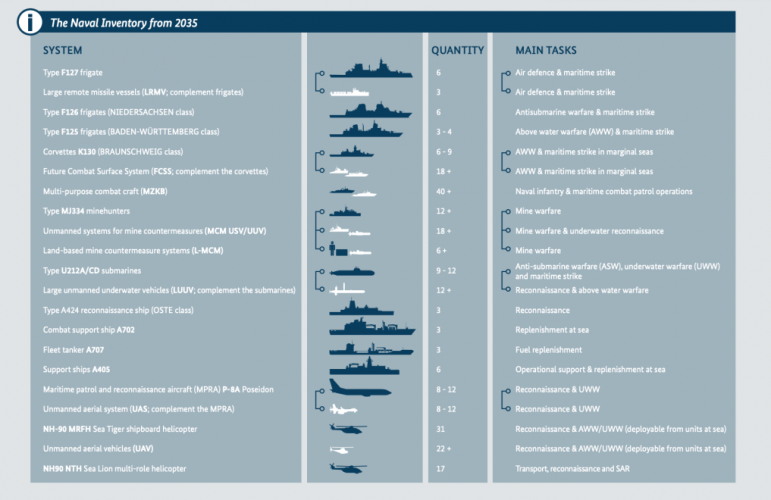
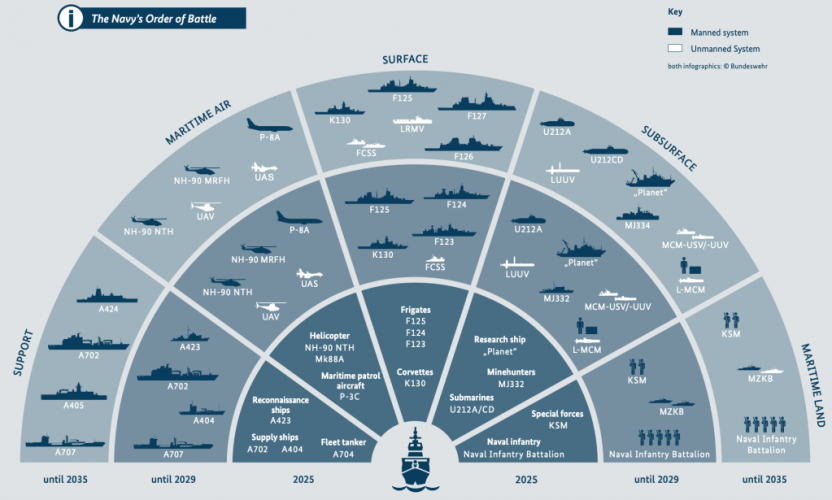
I'm wondering if this decision (abandoning larger capital ships in favour of smaller ships + unmanned arsenal ships) is becoming a pan-European theme. The Germans also cancelled their large F-126 'frigate' and are going for smaller MEKO 200-based designs. They've also been talking about/considering unmanned arsenal barges (LRMV in these charts) for a while now...
Attachments
Ainen
I really should change my personal text
- Joined
- 25 August 2011
- Messages
- 2,834
- Reaction score
- 4,939
F126 was 6-ship ASW solution; replacement is in fact more numerous, and is weaker on multirole rather than on ASW side of things.I'm wondering if this decision (abandoning larger capital ships in favour of smaller ships + unmanned arsenal ships) is becoming a pan-European theme. The Germans also cancelled their large F-126 'frigate' and are going for smaller MEKO 200-based designs. They've also been talking about/considering unmanned arsenal barges (LRMV in these charts) for a while now...
German AAW solution is a big run of F127s.
I.e. it's a chain failure of several European large ship programs, but with completely different consequences.
what is the multi static radar?Well BAE publicly stated that multi static radar in development is a "generation after next" project, so i interpret that to mean it won't be ready in Type 83 timeframe. And yes the comms and processing would have to be phenomenal to produce targetting quality data on ballistic/hgv threats.
Some hard conversations needed. I would say the SSBNs and carriers both create capabilities that require huge chunks of defence budget. They also need ASW bastions and AAW escorts, and if you can't provide your biggest investments with defence then you need to reassess who has veto power over your budget, and if that veto is citizens looking for free stuff then some efficiency in those services is in order. Otherwise reduce the requirements for nuclear deterrent.

TorpedoJ
ACCESS: Secret
- Joined
- 11 October 2023
- Messages
- 434
- Reaction score
- 869
From Navy Lookout, "The Royal Navy's next-generation radar"what is the multi static radar?
This is talking about the NGTRM so I don't think it's the 'generation after next' stuff.The philosophy behind the module is consistent with the company’s historic approach. Rather than relying solely on high output power, effort is being directed into extremely sensitive receivers and sophisticated signal processing, delivering performance through a combination of sensitivity, digital beamforming and noise management. This approach also enables promising multi-static and passive modes, which exploit distributed sensors or non-cooperative emissions. Multi-static radar involves the use of widely dispersed transmitters and receivers operating as a single sensor and aligns well with the FADS concept of multiple Sensor-Efector platforms (SEP) commanded from the Type 83 destroyer. It also offers greater potential for detecting stealthy or very low-observable targets.
EmoBirb
ACCESS: Top Secret
- Joined
- 18 January 2025
- Messages
- 2,702
- Reaction score
- 6,928
Just that these will complement 8 AEGIS AAW destroyers, rather than replacing them together with a control frigate.They've also been talking about/considering unmanned arsenal barges (LRMV in these charts) for a while now...

Forest Green
ACCESS: USAP
- Joined
- 11 June 2019
- Messages
- 14,534
- Reaction score
- 31,602
UK Sacrifices Its Future Destroyer As Part Of Massive Bet On Drones Across Its Forces
https://www.twz.com/news-features/u...rt-of-massive-bet-on-drones-across-its-forcesReally not sure about this but I guess it is the trend. Difficult to determine whether this is stupid or clever at this stage, it reduces the amount of high cost prestige targets for the likes of Chinese AShBM/HWs to aim at but it leaves one wondering what air defence vessels will be protecting the carriers??
More details here:
https://www.secretprojects.co.uk/th...what-equipment-and-how-much.23925/post-923010
Last edited:

GK. Dundas
ACCESS: Confidential
- Joined
- 22 July 2025
- Messages
- 122
- Reaction score
- 210
And if Drones prove only to a game changer in the context of the Ukrainian conflicts .
And while I personally think they make a marvelous addition to a nation's arsenal.
I don't believe they're going to replace manned platforms entirely.
Tanks were one such game changer, we haven't placed every soldier in the Army inside a tank . They form part of the solution but aren't the be all and end all either.
Ah well, it's not Labor particularly likes Defence anyway. And the Conservative like politicians everywhere have strangely short memories themselves aren't the champions of the realm's defence they are now claiming to be either.
The UK has a shortfall of 28 Billion pounds and is tossing 13 Billion at it . Issue as many press releases you like .That isn't going to make that shortfall go away.
And neither is the reason you're forced to spend this to begin with.
Drones are not a panacea. No matter how cheap they appear to be .
You may very well find that an over reliance on Drones are incredibly expensive. And not just in money.
And while I personally think they make a marvelous addition to a nation's arsenal.
I don't believe they're going to replace manned platforms entirely.
Tanks were one such game changer, we haven't placed every soldier in the Army inside a tank . They form part of the solution but aren't the be all and end all either.
Ah well, it's not Labor particularly likes Defence anyway. And the Conservative like politicians everywhere have strangely short memories themselves aren't the champions of the realm's defence they are now claiming to be either.
The UK has a shortfall of 28 Billion pounds and is tossing 13 Billion at it . Issue as many press releases you like .That isn't going to make that shortfall go away.
And neither is the reason you're forced to spend this to begin with.
Drones are not a panacea. No matter how cheap they appear to be .
You may very well find that an over reliance on Drones are incredibly expensive. And not just in money.
EmoBirb
ACCESS: Top Secret
- Joined
- 18 January 2025
- Messages
- 2,702
- Reaction score
- 6,928
???it reduces the amount of high cost prestige targets for the likes of Chinese AShBM/HWs to aim at
Last time I checked the PLAN didn't operate in the North Atlantic. So that's not a concern whatsoever. And let's not pretend like a dozen unmanned assets (the UK couldn't afford more, if these are to be even remotely capable and survivable enough to replace manned systems) wouldn't be sunk in a heartbeat as well.
It's not too early to tell if that's stupid or genius, it's pretty clear that this is a stupid undertaking, forced upon the Brits because they're cash strapped, because their government is a mess, because their demographics and recruitment numbers plummet and because they try to maintain prestigous assets like two aircraft carriers, a fleet of SSNs and SSBNs on a third world shoe string budget.
The SSBNs are non-negotiable, everything else is pure vanity.
Gessler
ACCESS: Confidential
- Joined
- 30 June 2026
- Messages
- 54
- Reaction score
- 194
UK Sacrifices Its Future Destroyer As Part Of Massive Bet On Drones Across Its Forces
https://www.twz.com/news-features/u...rt-of-massive-bet-on-drones-across-its-forces
Really not sure about this but I guess it is the trend. Difficult to determine whether this is stupid or clever at this stage, it reduces the amount of high cost prestige targets for the likes of Chinese AShBM/HWs to aim at but it leaves one wondering what air defence vessels will be protecting the carriers??
More details here:
https://www.secretprojects.co.uk/th...what-equipment-and-how-much.23925/post-923010
There's certainly risk in this move, a lot of it. Especially as they're talking about using these concepts in stead of AAW destroyers, not for supplementing them.
In a future potentially filled with AI-backed cognitive EW, one has to wonder how secure intra-flotilla datalinks can really be. Fully autonomous self-contained units are one thing, one ship shepherding others remotely is another matter entirely.

- Joined
- 15 July 2007
- Messages
- 5,732
- Reaction score
- 6,313
The only thing is that land based AAW is dependent on mobile assets of command, radar and missile batteries tied by datalinks and this concept seems to follow a similar layout. Only on ships.
Bizarrely this is inefficient, compared to mounting the lot on a single ship. I say bizarre, because the great god efficiency is worshiped by our Elite as the justification of all they do.
But in theory it could be robust and degrade gracefully under attack. The loss of a battery or a radar isn't the loss of the entire system.
But that does depend on more than one radar ship per force.
Bizarrely this is inefficient, compared to mounting the lot on a single ship. I say bizarre, because the great god efficiency is worshiped by our Elite as the justification of all they do.
But in theory it could be robust and degrade gracefully under attack. The loss of a battery or a radar isn't the loss of the entire system.
But that does depend on more than one radar ship per force.
Forest Green
ACCESS: USAP
- Joined
- 11 June 2019
- Messages
- 14,534
- Reaction score
- 31,602
There will be 6 CCVs as well as the 8 Type 26 and 5 31s and a Type 91 uncrewed missile platform.There's certainly risk in this move, a lot of it. Especially as they're talking about using these concepts in stead of AAW destroyers, not for supplementing them.
In a future potentially filled with AI-backed cognitive EW, one has to wonder how secure intra-flotilla datalinks can really be. Fully autonomous self-contained units are one thing, one ship shepherding others remotely is another matter entirely.
At least six Common Combat Vessels will be built for the Royal Navy
https://www.navalnews.com/naval-new...bat-vessels-will-be-built-for-the-royal-navy/When in service, these CCVs will work alongside eight Type 26 and five Type 31 crewed frigates, as well as Type 91 uncrewed missile platforms, Type 92 uncrewed underwater sensing platforms, Type 93 Extra-Large Uncrewed Underwater Vehicles and Type 94 uncrewed sensor platforms, representing a once in a generation investment in new maritime capability.
So looking at the plan, there's likely going to be more air defence missiles.
- Joined
- 15 July 2007
- Messages
- 5,732
- Reaction score
- 6,313
LPI and LOS remain very secure.In a future potentially filled with AI-backed cognitive EW, one has to wonder how secure intra-flotilla datalinks can really be.
The higher the AI, the less the need to be communicated with.
While using flags is unlikely to make a comeback, laser as the successor to heliographs is quite plausible even in bad weather.
TorpedoJ
ACCESS: Secret
- Joined
- 11 October 2023
- Messages
- 434
- Reaction score
- 869
The CCVs need to carry a few VLS and a duplicate radar to the T94 otherwise the concept simply multiplies the number of single points of failure across the task force. If it's just a decision making hub then losing any one of the T91, T94 or CCV in the minimum viable task group of 1 each would cripple the others.The only thing is that land based AAW is dependent on mobile assets of command, radar and missile batteries tied by datalinks and this concept seems to follow a similar layout. Only on ships.
Bizarrely this is inefficient, compared to mounting the lot on a single ship. I say bizarre, because the great god efficiency is worshiped by our Elite as the justification of all they do.
But in theory it could be robust and degrade gracefully under attack. The loss of a battery or a radar isn't the loss of the entire system.
But that does depend on more than one radar ship per force.
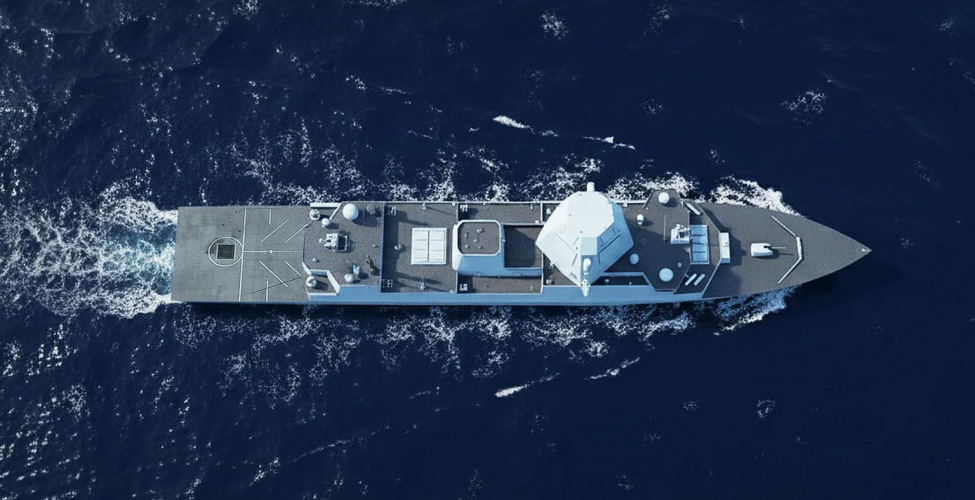
T94 as an adjunct to the radar on the CCV makes sense as it will allow a single manned escort to combine with a larger fleet of USVs to provide wider defence to a carrier group, which would provide an intermediate between the current options of 1 or 2 T45s. But not using the size of the CCV to accommodate a radar alongside the crew is silly.
As such I think the 150m intermediate BAE FAWCS is the sort of thing CCV should look like, perhaps with only 48 or 64 VLS rather than 80. It won't be as cheap as a T31 with a larger ops room but would be a much more robust system with a better balance between the CCV and the USVs.
- Joined
- 5 May 2007
- Messages
- 2,016
- Reaction score
- 4,277
In principle, a T91/T94/CCV mix allows you to decouple the three systems. Yes, the minimum group with one of each is potentially more vulnerable. But you can add T91s for more missile capacity without having to add extra radars and ops rooms. Or add T94s if you need more radars but not missiles. You might have a second CCV as a secondary command ship.The CCVs need to carry a few VLS and a duplicate radar to the T94 otherwise the concept simply multiplies the number of single points of failure across the task force. If it's just a decision making hub then losing any one of the T91, T94 or CCV in the minimum viable task group of 1 each would cripple the others.
Also, the operating cycle for the three ships can be different. A CCV is very constrained, since the crew tend to insist on things like 'food' and 'shore leave', so you're only getting about a third of them (ish, depending on all sorts of things) actually doing operational tasking. The T91s can stay on task much longer, but if things get shooty they can go to replenish ammunition in waves while leaving the CCV and T94s on station. And the T94s can just keep on radiating until something breaks or they run out of fuel.
Potentially, that means that an unaffordable traditional force which might require (say) 12 large air warfare destroyers to maintain 4 radars and 320 VLS on station can be replaced by 6 CCVs, 5 T94s, and 12 32-cell T91s. The numbers are made up but plausible; it's not hard to see how that might well work out cheaper and more flexible.
I do fully expect the CCV to sprout a Type number and be described (probably) as a destroyer at some point. Remember how the Global Combat Ship wasn't a frigate?

Reuben James
ACCESS: Top Secret
- Joined
- 15 September 2024
- Messages
- 546
- Reaction score
- 1,113
I think we might need to re-evaluate the kind of radar we expect the CCV to carry. The T31 is currently believed to be the preferred platform for the CCV, which means we're limited in what can be carried to about something the size of APAR (which is heavier than SAMPSON).The CCVs need to carry a few VLS and a duplicate radar to the T94 otherwise the concept simply multiplies the number of single points of failure across the task force. If it's just a decision making hub then losing any one of the T91, T94 or CCV in the minimum viable task group of 1 each would cripple the others.
T94 as an adjunct to the radar on the CCV makes sense as it will allow a single manned escort to combine with a larger fleet of USVs to provide wider defence to a carrier group, which would provide an intermediate between the current options of 1 or 2 T45s. But not using the size of the CCV to accommodate a radar alongside the crew is silly.
As such I think the 150m intermediate BAE FAWCS is the sort of thing CCV should look like, perhaps with only 48 or 64 VLS rather than 80. It won't be as cheap as a T31 with a larger ops room but would be a much more robust system with a better balance between the CCV and the USVs.
View attachment 816736
I know that many here will want a US-level capability. It is worth keeping in mind that some have assessed the FDI's Sea Fire 500 as similar in capability to some low tier versions of SPY-6 and SPY-7.
With the acknowledgement in the DIP that the UK will purchase ground-based BMD, then perhaps we should be looking for an FDI-type radar.
For example, a four-panel version of Artisan-NG?
Anyway, I wouldn't be surprised for the UK to end up with essentially six modernised Iver Huitfeldt-class air defence frigates. The T94 frigates might carry the equivalent of the S1850M.
Reuben James
ACCESS: Top Secret
- Joined
- 15 September 2024
- Messages
- 546
- Reaction score
- 1,113
Reuben James
ACCESS: Top Secret
- Joined
- 15 September 2024
- Messages
- 546
- Reaction score
- 1,113
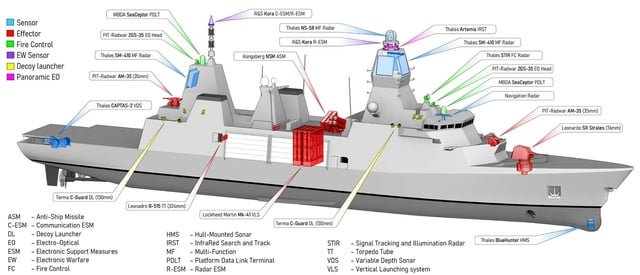
The SM-400 offers (would you believe it) 400km instrumented range in the S-band, on a technology base that's been around for a while now.
I could see Artisan NG equalling SAMPSON in performance at least, whilst relying on T94 for volume search, precisely because volume search isn't as reliant on horizon limitations.
I could see Artisan NG equalling SAMPSON in performance at least, whilst relying on T94 for volume search, precisely because volume search isn't as reliant on horizon limitations.
bobthemonkey
ACCESS: Confidential
- Joined
- 9 February 2011
- Messages
- 86
- Reaction score
- 203
Agree - a CCV with around the missile capacity of the current T45, and at least a credible AAW radar feels like the sensible target. The ‘barebones’ T31 derived solution that Babcock referenced seems too extreme a reduction in capacity, just a much as some of the BAE T83 proposals were almost always going to be too high end.The CCVs need to carry a few VLS and a duplicate radar to the T94 otherwise the concept simply multiplies the number of single points of failure across the task force. If it's just a decision making hub then losing any one of the T91, T94 or CCV in the minimum viable task group of 1 each would cripple the others.
T94 as an adjunct to the radar on the CCV makes sense as it will allow a single manned escort to combine with a larger fleet of USVs to provide wider defence to a carrier group, which would provide an intermediate between the current options of 1 or 2 T45s. But not using the size of the CCV to accommodate a radar alongside the crew is silly.
As such I think the 150m intermediate BAE FAWCS is the sort of thing CCV should look like, perhaps with only 48 or 64 VLS rather than 80. It won't be as cheap as a T31 with a larger ops room but would be a much more robust system with a better balance between the CCV and the USVs.
View attachment 816736
The overall hybrid proposal does raise interesting questions; what other assets are going to get the command suite? Could we see a QEC effectively ‘self’ escort just using Type 9x drones.
Last edited:
Reuben James
ACCESS: Top Secret
- Joined
- 15 September 2024
- Messages
- 546
- Reaction score
- 1,113
Definitely worth thinking about, but I'd want them to wargame the ever-living shit out of the concept first.The overall hybrid proposal does raise interesting questions; what other assets are going to get the command suite? Could we see a QEC effectively ‘self’ escort just using Type 9x drones.
As to T31 being too small, it's still large enough to carry a SAMPSON equivalent. Volume search can be off-loaded more easily to T94, and from there, the T31's other short-coming, its small missile capacity, can be compensated for with T91.
Last edited:
Reuben James
ACCESS: Top Secret
- Joined
- 15 September 2024
- Messages
- 546
- Reaction score
- 1,113
Worth thinking about proceeding with a configuration similar to that of the T45: a long-range volume search in the S1850M, and then a main air defence/fire control radar in SAMPSON.
A Type 31-derived CCV definitely has the weight margins to replace its current NS-110 and mast with a SAMPSON-sized radar - something in the size range of the radars in use on the Polish versions of the ship.
Artisan-NG offers a path to superior performance in the same size range as both SAMPSON and MS-400.
Volume search, the function fulfilled by the S1850M, could then be offloaded onto a pair of T94s, as well as the carrier if operating in a CSG.
Hidden in the DIP is an intention to purchase both long-range ballistic missiles defence radars for the UK, and long-range ballistic missile interceptors as well.
If the CCV no longer needs to provide homeland surveillance and defence, and can concentrate entirely on fleet defence, perhaps the need for a large central radar as previously envisioned is less pressing.
A Type 31-derived CCV definitely has the weight margins to replace its current NS-110 and mast with a SAMPSON-sized radar - something in the size range of the radars in use on the Polish versions of the ship.
Artisan-NG offers a path to superior performance in the same size range as both SAMPSON and MS-400.
Volume search, the function fulfilled by the S1850M, could then be offloaded onto a pair of T94s, as well as the carrier if operating in a CSG.
Hidden in the DIP is an intention to purchase both long-range ballistic missiles defence radars for the UK, and long-range ballistic missile interceptors as well.
If the CCV no longer needs to provide homeland surveillance and defence, and can concentrate entirely on fleet defence, perhaps the need for a large central radar as previously envisioned is less pressing.
TorpedoJ
ACCESS: Secret
- Joined
- 11 October 2023
- Messages
- 434
- Reaction score
- 869
What carries the radar allowing for counter-hypersonics and BMD then? Aster B1NT will be right at the limit of what SAMPSON can do and the threat will only evolve in 50 years' time when the CCVs leave service. If even the Houthis were firing AShBMs in 2024 high altitude, high speed and manoeuvring targets are likely to become widespread; the Russians already have Zircon and will evolve it. Radar performance isn't just about range.I think we might need to re-evaluate the kind of radar we expect the CCV to carry. The T31 is currently believed to be the preferred platform for the CCV, which means we're limited in what can be carried to about something the size of APAR (which is heavier than SAMPSON).
I know that many here will want a US-level capability. It is worth keeping in mind that some have assessed the FDI's Sea Fire 500 as similar in capability to some low tier versions of SPY-6 and SPY-7.
With the acknowledgement in the DIP that the UK will purchase ground-based BMD, then perhaps we should be looking for an FDI-type radar.
For example, a four-panel version of Artisan-NG?
Anyway, I wouldn't be surprised for the UK to end up with essentially six modernised Iver Huitfeldt-class air defence frigates. The T94 frigates might carry the equivalent of the S1850M.
Artisan-NG is just the demonstrator for the NGTRM, which is scalable but has 4 rectangular modules in that case. Each module seems to be almost exactly a 1m by 0.5m (higher than they are wide) so slightly larger in area than an SPY-6 RMA. A 2x2 array seems to have been decided as compact enough to replace Artisan but the vast arrays on FAWCS, assuming that those and not the higher panels are based on NGTRM, are 5m square and so would be made up of 50 modules. Anything in between would be possible but bigger is better IMO.
I would like to see the QEs upgraded with the control system and radars from FADS or whatever it is called now for exactly that reason. They are the tallest and largest ships in the fleet and would easily be able to host whatever radar the CCVs or T94 would carry, while the mission planning and ops room spaces could host spaces for commanding USVs. If the CCVs are as lightly equipped as some have suggested there is very little point having them in a CSG when such a large and flexible platform, which is already critical to the task group, can host the decision-making facility anyway.The overall hybrid proposal does raise interesting questions; what other assets are going to get the command suite? Could we see a QEC effectively ‘self’ escort just using Type 9x drones.

A Tentative Fleet Plan
I really should change my personal text
- Joined
- 9 April 2018
- Messages
- 1,386
- Reaction score
- 3,475
Babcock have displayed models of Arrowhead 140 with SPY-6.I know that many here will want a US-level capability. It is worth keeping in mind that some have assessed the FDI's Sea Fire 500 as similar in capability to some low tier versions of SPY-6 and SPY-7.
Scott Kenny
ACCESS: USAP
- Joined
- 15 May 2023
- Messages
- 19,572
- Reaction score
- 28,042
Anyone thinking that a Type 94 with the same radar as the CCV will be substantially cheaper than the CCV is smoking something they need to share.
TorpedoJ
ACCESS: Secret
- Joined
- 11 October 2023
- Messages
- 434
- Reaction score
- 869
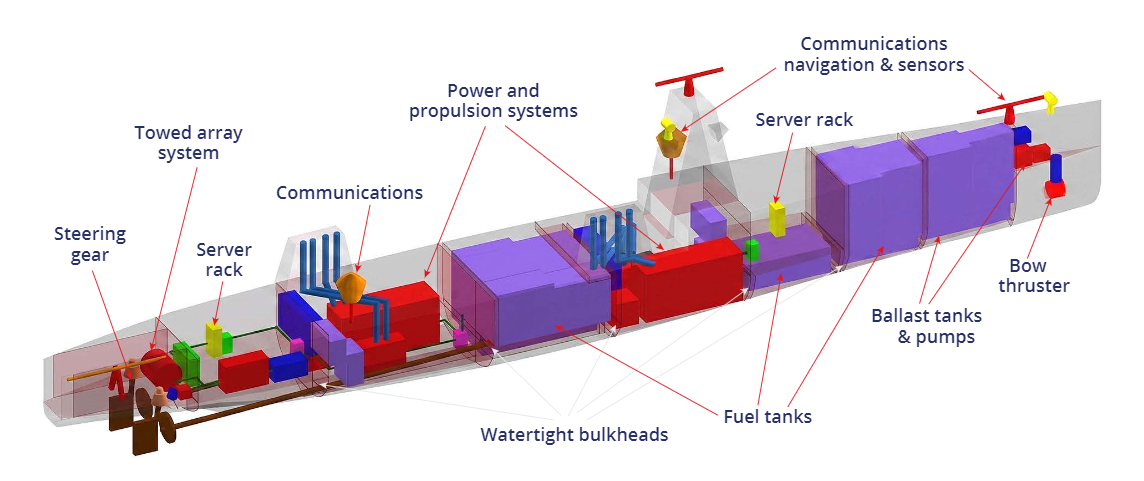
https://www.navylookout.com/squarin...ions-that-will-make-or-break-the-hybrid-navy/
Good article by BMT's head of innovation and research on the choices that will have to be made in order to turn the Hybrid Navy ambition into a useful force. Includes a handy picture of the internals of one of BMT's ASW USV designs:

Good article by BMT's head of innovation and research on the choices that will have to be made in order to turn the Hybrid Navy ambition into a useful force. Includes a handy picture of the internals of one of BMT's ASW USV designs:
Similar threads
-
 Norwegian/British Future Mothership Programme - Discussion and News
- Started by Reuben James
- Replies: 43
-

-

-
Offense and Defense against Medium Craft swarms in and around the Seas
- Started by MadRat
- Replies: 5
-
