The Future of the Royal Navy and the 'Hybrid Navy' Initiative - News, Platforms, Development and Speculation

Generally agree here. I've kinda been running with the idea of each combat vessel in the USN operating 3x ASW 2XL-USVs. So the concept of the ASW FF would go away, replaced by a 2XL-USV with dual towed arrays with about 12x VL-ASROCs and 12x ESSM quads (24x Mk41).

For UK purposes, they'd need about the same long range ASW weapon load, regardless of who makes it (Japan makes a really nice long range one that is Mk41-compatible), but would have a big mushroom farm for CAMM instead of ESSMs.
It's still RN doctrine that the helicopter is the most effective means of hunting a submarine and that rocket torpedoes are a snap shot for self defence now that heavy torpedoes now wildly outrange surface launched ones. So I think that the USVs would only carry a few LRAW, especially as IMO the ASW and AAW support functions should be separated into two classes.
My fitout would be
T91: 32mk41 plus room for 4-6 TEUs, Artisan NG radar, possibly thin line sonar in the TEUs.
T92: Fixed CAPTAS-4 sonar, 12 CAMM, Giraffe 1X level radar, 4-6 TEUs with containerised LRAW and extra AAW weapons, or even containerised LWT launchers.
You still need the second radar for backup, so you do need the second destroyer.

But I think you can get away with only one manned ASW frigate if the USVs each have the dual towed arrays.
We also have the carriers, which are the tallest radar platforms in the fleet. Presumably when FADS comes in and replaces Sea Viper they will be refitted to take the new radars, though of course having a full sized search radar on the high value target presents issues with hiding its location.
 
It's still RN doctrine that the helicopter is the most effective means of hunting a submarine and that rocket torpedoes are a snap shot for self defence now that heavy torpedoes now wildly outrange surface launched ones. So I think that the USVs would only carry a few LRAW, especially as IMO the ASW and AAW support functions should be separated into two classes.
Remember that a typical ASROC response is 3 weapons into a circle around the contact. A dozen ASROC/LRAW is only 4 engagements.

Plus, even the Japanese equivalent is only a 30km range.

So helos are the better answer for long range ASW.


My fitout would be
T91: 32mk41 plus room for 4-6 TEUs, Artisan NG radar, possibly thin line sonar in the TEUs.
T92: Fixed CAPTAS-4 sonar, 12 CAMM, Giraffe 1X level radar, 4-6 TEUs with containerised LRAW and extra AAW weapons, or even containerised LWT launchers.
Disagree here, the ASW USV should have both a VDS and a surface towed array. Containerized is fine, but you need both. The surface towed array is to look for subs at periscope depth, the VDS is to look for subs below the first thermocline.

Arguably, the ASW USV should also have a hull array for littoral work, and/or minesweeping. Those are two separate things.


We also have the carriers, which are the tallest radar platforms in the fleet. Presumably when FADS comes in and replaces Sea Viper they will be refitted to take the new radars, though of course having a full sized search radar on the high value target presents issues with hiding its location.
That's kinda the reason the USN plans to install SPY6 on everything. Admittedly with different numbers of RMAs, but all the same emissions pattern.
 
Remember that a typical ASROC response is 3 weapons into a circle around the contact. A dozen ASROC/LRAW is only 4 engagements.

Plus, even the Japanese equivalent is only a 30km range.

So helos are the better answer for long range ASW.
If we have 2 USVs accompanying each T26 with 8 LRAW on the frigate and 4 each on the USVs then by your reckoning that gives at least 5 engagements and would only take up one container on each drone, perhaps. Add in 2 Proteus ASW UAVs on the frigate and that's quite a lot of the Northern fleet that can be engaged at once.
Disagree here, the ASW USV should have both a VDS and a surface towed array. Containerized is fine, but you need both. The surface towed array is to look for subs at periscope depth, the VDS is to look for subs below the first thermocline.

Arguably, the ASW USV should also have a hull array for littoral work, and/or minesweeping. Those are two separate things.
S2087 and I think some other CAPTAS-4 variants are twin tow, with the VDS and a passive array on separate reels. As it would be a fixed installation on T92 I can't see any reason why that couldn't be repeated. I also agree with the hull sonar but we have other USVs for minehunting and sweeping so it would just be ASW. I personally favour a SWATH hull for T92 as it allows a smaller size for Atlantic Bastion (though the ASW escort support might need something different) so it could look more like a flank array than a bow dome.
 
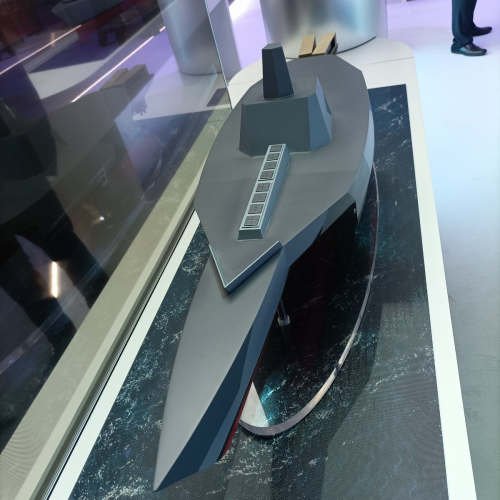
I'm praying BAE have developed or are developing a UK VLS system. Each silo also appears to only have 1 lid (on the DSEI model too) so it might be a large-diameter VLS with multipacking of smaller missiles, which would be excellent.

As others have said I think the lack of a helicopter deck is a major drawback, as it would hinder maintenance and if the whole thing shuts down would make recovering the vessel much more difficult. It also tries to do both ASW and AAW, which seems like a waste of the additional mass we could generate with specialised USVs.
However it does look like a decent vessel if we wanted a reconfigurable more general USV.

BMT always seem to jump onto the bandwagon with a shipbuilding competitor to get their design built. They joined the Arrowhead consortium and then paired up with Navantia to offer FSSS. If they win the design competition the govt might force Navantia to build them but Babcock are currently dependent on an American USV design.
Can you provide photos of the vls that appeared on desi?
 
Can you provide photos of the vls that appeared on desi?
Here's one from a twitter post just up the thread. I was wrong about the single lid thing, that was just because the photos that came top on google were simply too low quality to distinguish the gaps between the hatches. Looking at this photo from a much better angle, I think there's an exhaust exit running side to side in the middle of each quad silo? It's almost exactly like a half mk41 unit but I can't find any record of such a thing existing.
1781119174141.png
 
这是一条来自推特帖子的帖子,就在帖子上方。我之前说单盖的问题是错的,那只是因为谷歌上最上面的照片质量太低,无法区分舱盖之间的缝隙。从更好的角度看这张照片,我觉得每个四缸筒仓中间都有一个左右的排气出口?它几乎和半个mk41一模一样,但我找不到任何关于这种东西存在的记录。
View attachment 814992
国防部几天前发布的RFI会不会就是这个东西?

Machine Translation: Could this be the RFI that the Ministry of National Defense released a few days ago?
 
Last edited by a moderator:
This is an English language site.
It was this:
Could the RFI released by the Ministry of Defense a few days ago be this thing?
In theory RFIs are supposed to be the very first stage of discussions with industry before a procurement, where somebody at the MoD has identified a possible future requirement and then the MoD checks whether there are any companies who could supply or develop a solution to the problem. There are however some cases where the RFI seems to be aimed at a particular company, where the MoD appears to have noticed the release of an interesting new product and writes an RFI for it to both find out more and determine whether there are any competitors who might have a better product along the same idea.

In this case I think it might be a combination of the two, where the Navy have realised that mk41 and Sylver are unsuitable for long deployments on unmanned vessels and BAE have shown images of a mysterious new 4-cell silo at similar times.
 
Well if we're going by Type numbers, then this sounds more Type 63 than Type 83.
Less "Air Dominance" than "Air Direction".

But if we're climbing the ladder of scale to mount both superlative radars, missile 'farms' and large swarms of drones, we're likely headed north of 18,000tons.

Colossus II, a Majestic return ;)
 
Well if we're going by Type numbers, then this sounds more Type 63 than Type 83.
Less "Air Dominance" than "Air Direction".

But if we're climbing the ladder of scale to mount both superlative radars, missile 'farms' and large swarms of drones, we're likely headed north of 18,000tons.

Colossus II, a Majestic return ;)
It sounds like the air defence solution is going to be a command vessel carrying the giant radar and only modest weapons fit, accompanied by USVs carrying VLS and a small radar. BAE are working on some interesting ideas in multi-static radar so it would be very capable in medium- and low-altitude defence.
The danger is that the MoD decides that the large central radar isn't necessary and so limits the capability of the whole formation against high altitude targets.
 
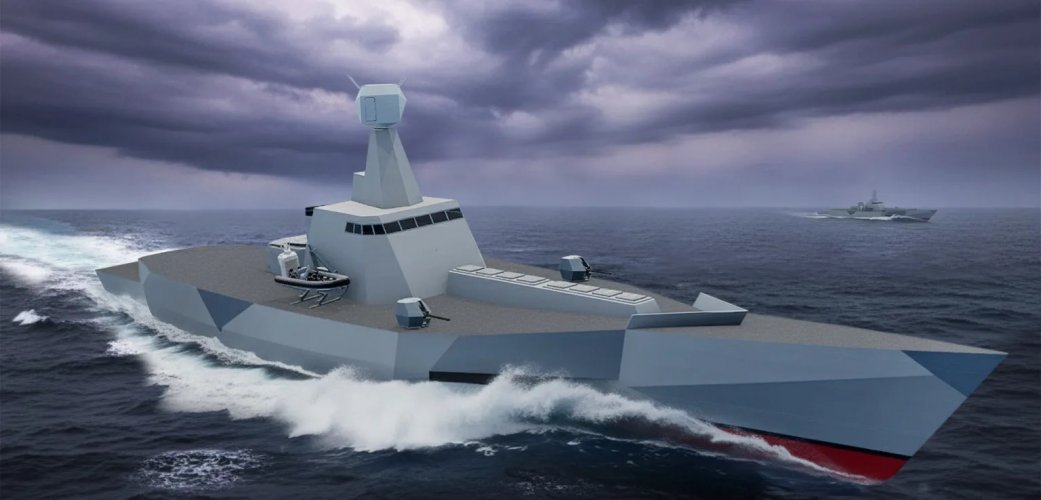
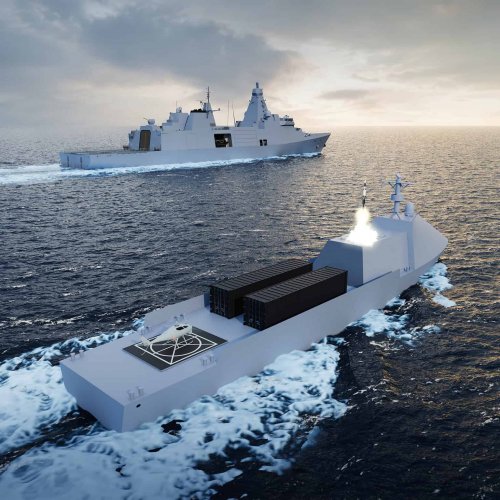
The (paywalled) Telegraph article referenced a new, 300ft+ radar carrying USV design as Type 94, with a suggestion that it would be controlled from a carrier when operating as part of a CSG. That aligns with the purest form of the Babcock concept where the CCV is focused on the ‘decide’ element with weapons AND sensors on other platforms.

https://www.telegraph.co.uk/news/20...-royal-navy-type-45-destroyers-cheaper-ships/

Cdr Tom Sharpe, a retired frigate captain, said: “Destroyers have been the backbone of the Navy for so long it is almost incomprehensible to get rid of them.
I’m deeply uncomfortable about this. It’s been done because someone has made the case it will be cheaper. And it will be, because it will be s---.”
 
What do you think the Common Combat Vessel will be? I saw someone say it will only be an improved version of the Type 31
 
The (paywalled) Telegraph article referenced a new, 300ft+ radar carrying USV design as Type 94, with a suggestion that it would be controlled from a carrier when operating as part of a CSG. That aligns with the purest form of the Babcock concept where the CCV is focused on the ‘decide’ element with weapons AND sensors on other platforms.

You can get past the paywall if you click 'stop' before it finishes loading. You need to be quick.

For comparison, HMS Victory is 186 feet long and a Type 45 is 500. The size given in the Telegraph article approximates the BAES Type 91 concept.

https://www.navylookout.com/bae-systems-large-uncrewed-warship-proposal/

Still, per The Telegraph:

Frances Tusa, a defence expert, feared the size of the ships meant they would struggle in the rough waters of the North Atlantic.

BAES suggests that their Type 91 is large enough (from the Navy Lookout article):

SEP could also become the standard RN low-crewed or autonomous platform and be fitted for other duties, for example, performing the Type 92 sloop role optimised for ASW, being more than large enough to cope with the weather conditions in the North Atlantic.

But is it penny wise and pound foolish?

There is a critical balance to be found between a cheap platform that can be mass produced in large numbers (a modern ‘Flower-class corvette’ equivalent) or a more sophisticated combatant. Once high-end radars, CIWS and accommodation to support a crew for more than a few days are included, the vessel is no longer just a ‘missile barge’. While more survivable and effective, costs rise, and it becomes less expendable. A very clear decision has to be made about how sophisticated the SEP is allowed to become to avoid mission creep and ensure FADS and the wider fleet gain meaningful mass.

Also, as a matter of simple geometry, a radar's going to be limited by the distance to the horizon, so it needs a tall mast and a big hull for stability. Maybe a trimaran, like the BAES concept (the potential competitors are monohulls), might allow a tall but relatively stable mast.

Placing the Type 94 well ahead of the CCV so it can see farther is not a complete solution as missiles could come from any direction. How many would be needed to provide full coverage? Would a space-based surveillance system be integrated into this hybrid navy?

From-Triton-to-Type-91-uncrewed-warship-5-1536x738.jpg
 
Last edited:
The US squandered DDG(X) and soon possibly BBG(X) too, now the UK squandered Type 83 as well. One becomes curious if anglophone Navy's are allergic to smoothly run programs meant to deliver results in form of a capable modern surface combatant.

Luckily countries like Japan, Korea and Germany can provide solutions on the export market.
 
Something else I noticed considering the penny wise pound foolish thing.

From https://www.navylookout.com/bae-systems-concepts-for-royal-navys-future-air-dominance-system/

A lesson from the Type 42 programme was that building smaller ships to make modest financial savings in build was not a good idea and ended up costing more and disproportionately reduced capability in the long run.

This article looks at the BAES proposals for the Type 83 - they considered a number of sizes, cut like sausage to suit budgets. The smallest version, based on their proposal for the Type 32, an 'Adaptable Strike Frigate', was paused because it could not accommodate the power and cooling systems for a large radar. That doesn't bode well for a 'Type 94.'

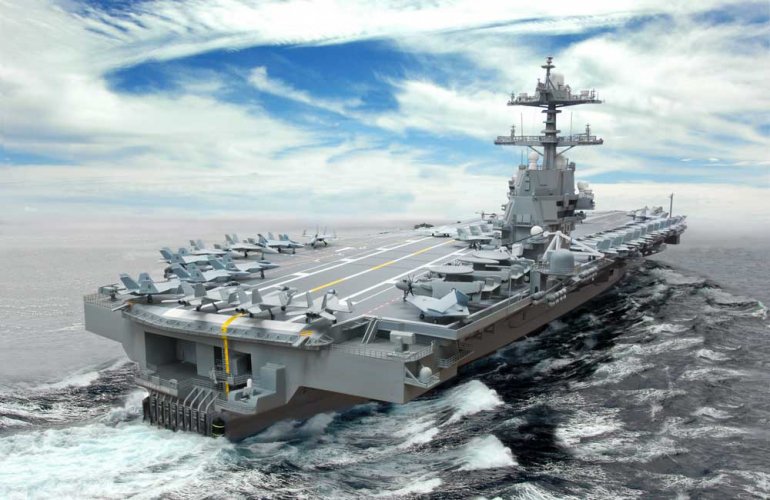
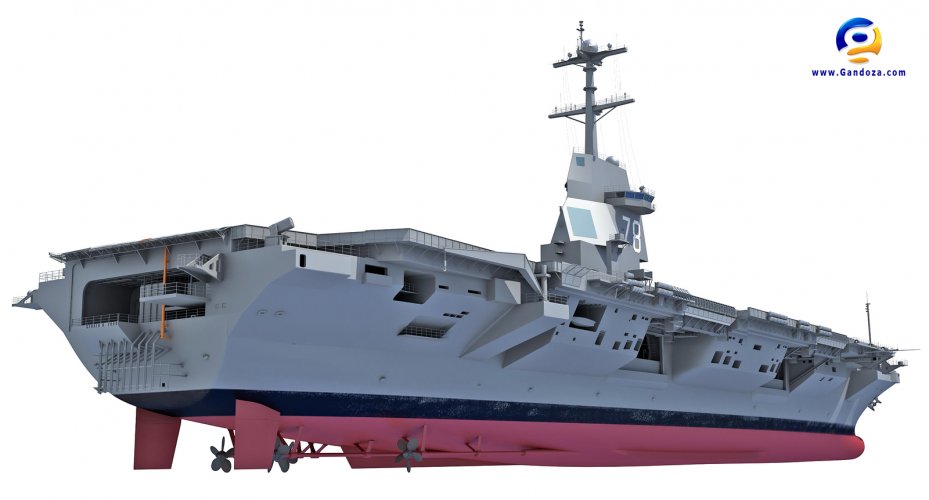
Building 'for not with' sounds like penny-pinching but in the real world it allows for the inevitable addition of new systems not foreseen in the original design brief throughout the life of the platform. A somewhat bigger, initially overpowered platform with voids actually makes sense. I've heard that the Vanguard subs have been maintenance nightmares because of their cramped interiors while the Ford-class carriers had wide sponsons added precisely to allow additional systems throughout the ships' lives (compare the two images below).

(I have visions of the Arleigh Burkes being like Mr Creosote in Monty Python's Meaning of Life being persuaded to eat a 'wafer-thin mint.')
 

Attachments

  • 10324.jpg
    10324.jpg
    235.3 KB · Views: 57
  • cvn7804.jpg
    cvn7804.jpg
    516.4 KB · Views: 58
The danger is that the MoD decides that the large central radar isn't necessary and so limits the capability of the whole formation against high altitude targets.
It would be the job of the First Lord to lean on the Minister of Defense to make sure that doesn't happen.


The (paywalled) Telegraph article referenced a new, 300ft+ radar carrying USV design as Type 94, with a suggestion that it would be controlled from a carrier when operating as part of a CSG. That aligns with the purest form of the Babcock concept where the CCV is focused on the ‘decide’ element with weapons AND sensors on other platforms.
Putting the big fecking radar on the USV will not make for a cheap USV.


Also, as a matter of simple geometry, a radar's going to be limited by the distance to the horizon, so it needs a tall mast and a big hull for stability. Maybe a trimaran, like the BAES concept (the potential competitors are monohulls), might allow a tall but relatively stable mast.
I'm not sure about the Trimaran design, the US Independence-class LCS have a cracking issue where the trimaran attaches to the center hull.


Placing the Type 94 well ahead of the CCV so it can see farther is not a complete solution as missiles could come from any direction. How many would be needed to provide full coverage?
4-6.


Would a space-based surveillance system be integrated into this hybrid navy?
Hopefully.

Of course, it'd need to be a NATO-sovereign design instead of only the US system.
 
The US squandered DDG(X) and soon possibly BBG(X) too, now the UK squandered Type 83 as well.
Type 83 was still at the "We probably want something like this, what can you guys offer?" stage. Not only had no metal been cut, but no plans had been finalized, we hadn't even selected whose concept we wanted. It's entirely possible the new Common Combat Vessel will end up in something looking remarkably like the Type 83, just with a few extra drone control consoles, it'll certainly use the same technologies at the system level.

It's not as if this hasn't happened before, cf Type 22 Batch 1 vs Type 22 Batch 3 and Type 23 vs initial concepts (and linked to that whether the Fort Victorias got Sea Wolf or not).

One becomes curious if anglophone Navy's are allergic to smoothly run programs meant to deliver results in form of a capable modern surface combatant.

Luckily countries like Japan, Korea and Germany
Type 126 *
MÜKE (Mittlere Überwasserkampfeinheit) / K131 *
Aegis Ashore vs ASEV
etc

* So two major reversals on the one project, whoops.
 
Within the regional defence of the North Atlantic, the chief concern is just finding stuff and tracking it accurately.

Stuff being Russian submarines. And nothing you mentioned except "swarms of USVs and UUVs" address that concern. HGVs and AShBMs don't hit a Yasen-M. And UUVs and USVs sufficiently capable in the realm of ASW to reliably find and continously track submarines of this generation and the next require sensors that drive cost up exponentially (thus reducing fleet size). The northern fleet surface component is by far not the chief concern of NATO in the northern Atlantic.

Type 83 was meant to provide AAW and BMD capability for Royal Navy formations and NATO formations at sea as well as being able to serve as part of the wider national BMD network. Which is to say, that the purpose was to deal with the missiles fired by ships, submarines, aircraft and drones at the own and allied assets. For modern BMD you need large and sophisticated sensors and interceptors, same applies to deal with HGVs and high performance sea skimmers really. Subsequently the cost of unmanned vessels, often hailed as cheap or affordable, skyrockets tremendously as soon as you want something more than just an autonomous barge with VLS cells.

At that point you may as well create a capable air warfare destroyer that serves the sensor and control focal point, with additional unmanned systems extending it's magazine depth and providing cover against close range threats like UUVs and USVs.

Going with a slightly enlarged frigate and thinking it's reasonable to offload everything else with regards to sensors and weapons onto small, glorified (multimillion euro, thanks to the sensor equipment) Dinghy's is a very strange choice. It shows how out of touch UK procurement is with reality.
 
Type 83 was still at the "We probably want something like this, what can you guys offer?" stage. Not only had no metal been cut, but no plans had been finalized, we hadn't even selected whose concept we wanted. It's entirely possible the new Common Combat Vessel will end up in something looking remarkably like the Type 83, just with a few extra drone control consoles, it'll certainly use the same technologies at the system level.

It's not as if this hasn't happened before, cf Type 22 Batch 1 vs Type 22 Batch 3 and Type 23 vs initial concepts (and linked to that whether the Fort Victorias got Sea Wolf or not).


Type 126 *
MÜKE (Mittlere Überwasserkampfeinheit) / K131 *
Aegis Ashore vs ASEV
etc

* So two major reversals on the one project, whoops.
Let's not forget the F125 debacle as well.
 
It's entirely possible the new Common Combat Vessel will end up in something looking remarkably like the Type 83
Not what's being pitched though.

I do respect the effort to try to paint the newest culmination of the Royal Navy's decades long failures as something of a success or anything else than utter failure. Because spending years and money trying to define a successor for 4 aging destroyers with abysmal availability and reliability and ultimately dropping it is definitely a great achievement.

But as I stated, when the newest attempt of the Brits to get a somewhat useful ship into the water fails, there will be the MEKO A400 AMD for them to pick up.
 
I can't speak for the American programmes, but my observations of UK programmes suggests the biggest driver of waste is lack of long term commitment by a political landscape that changes with the wind.
Most certainly. Incompetence usually originates at a government level, rarely at the Shipyards
 
But as I stated, when the newest attempt of the Brits to get a somewhat useful ship into the water fails, there will be the MEKO A400 AMD for them to pick up.
Nice swerve around the examples of far worse German changes in focus. Exactly how much had been spent on Type 126 before it was cancelled? 2.3Bn Euros seems to be the ballpark figure. I'd be surprised if Type 83 spend is out of the 10s of millions, and much of that will likely carry over to CCV. Meanwhile Type 26 is progressing without drama, and the only drama on Type 31 is because Babcock got ahead of themselves.

Meanwhile Japan had such a big concept change between Aegis Ashore ($1.6Bn spent) and ASEV it changed from a hole in the ground to a ship.
 
F126 didn't fail on a political level though, nor funding, it's the dutch shipyard that couldn't deliver on their promises. As a consequence a German solution is now taking it's place, something that should have happened from the very start and something that also transformed F127 from a Sachsen-With-Extra-Steps to what's being projected to be the most capable AAW destroyer in the entirety of Europe (and when it hits the water, the most sophisticated AEGIS destroyer too).

Meanwhile with Type 83 the UK sat on their hands for years, not going forward or backward while the Type 45s are basically falling apart. Now they took a step, but one that's such a 180 that nothing envisioned for Type 83 will find it's way into what's next, with some arguing it to be based on the new frigates of the RN lol.

As for ASEV, I'm unsure what point you try to prove? Turning two shore based AEGIS batteries into the two most capable BMD cruisers in the Pacific Ocean certainly makes sense for an Island nation with a powerful Navy, required to ensure it's national security. If only I could think of another island nation that needs capable AAW and BMD ships to ensure it's security against a large power that operates in their proximity and is known to deploy missiles in large numbers from land and sea....
 
Meanwhile with Type 83 the UK sat on their hands for years, not going forward or backward while the Type 45s are basically falling apart. Now they took a step, but one that's such a 180 that nothing envisioned for Type 83 will find it's way into what's next, with some arguing it to be based on the new frigates of the RN lol.
The T45s are not 'basically falling apart'. Are you thinking of the T23 frigates?
 
Stuff being Russian subsubmarines
For the moment, but that is dealt with by other systems, as you note.
But Stuff in the context of UK defence doesn't stop at just Russian vessels.
Type 83 was meant to provide AAW and BMD capability for Royal Navy formations and NATO formations at sea as well as being able to serve as part of the wider national BMD network.
BMD is best done from land.

Type 83's best case is loitering up in the GIUK Gap or the Med and hitting overflying ballistic missiles aimed at the UK.

Other, cheaper and higher performance systems can do that from land.

For quick reaction to defend a fleet, other systems be needed when dealing with long range ballistic missiles or hypersonic missiles. This is explicitly the case in US efforts, reliant on a host of sensors not mounted on a ship.

For assets on the surface prosecuting submarines, long range attacks can be forewarned by larger land based or satellite based sensors. These days they can give increasingly accurate data in real time.

Seriously the whole Destroyer thing is a legaistic fiction. As what gives enough power, stability and magazine depth is fundamentally a travesty to describe as a Destroyer.

That's why UK radar efforts include distributed models. Where single über massive radars be not necessary.
 
Yeah you can see the inconvenience of relying on the naval platforms with them having to sail a Type 45 up the Thames and anchor it in London whenever they expected an increased air threat level during special events.
 
The T45s are not 'basically falling apart'. Are you thinking of the T23 frigates?
Having only 3 out of 6 destroyers operational is not an indicator for outstanding readiness, just how HMS Dragon essentially breaking down immediately after it was deployed off Cyprus and then had return to port was a huge embarassment for the RN. And having half of the destroyers operational is already a big achievement, there have been times when less were operational at a given time.

The Type 45s have terrible readiness and are plagued with technical issues, so yes, they're essentially falling apart as soon as they leave Portsmouth. For a nation that relies more or less 100% on it's Navy for national security and enforcement of national interests, that should be unacceptable.
 
50% availability is about expected. It's roughly in line with what the French get from their fleet.

HMS Dragon went in for a scheduled stop alongside Charles de Gaulle. Defects were found and rectified, but she didn't 'break down' in the sense that she was unable to operate. Since then, she's not had any major issues.

Of the other five ships, only one is really 'broken down', and that's Daring, who is now expected to rejoin the fleet within the year.

Defender and Diamond are both undergoing upgrades.

Dauntless and Duncan are operational.

So no, none of them are 'falling apart'.
 
Pinches of salt at the ready, but journalists from the Telegraph are now posting on Twitter that the CCV will be derived from the Type 31, with changes made during procurement.
 
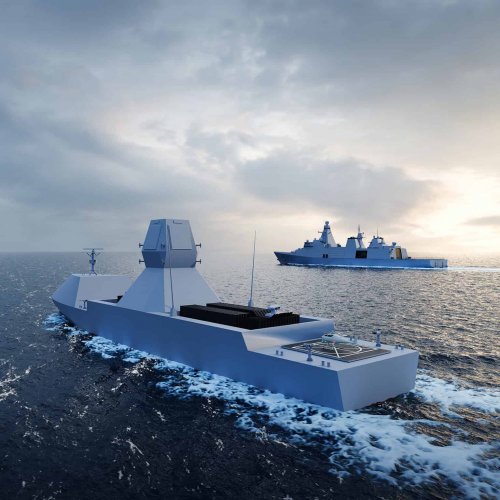
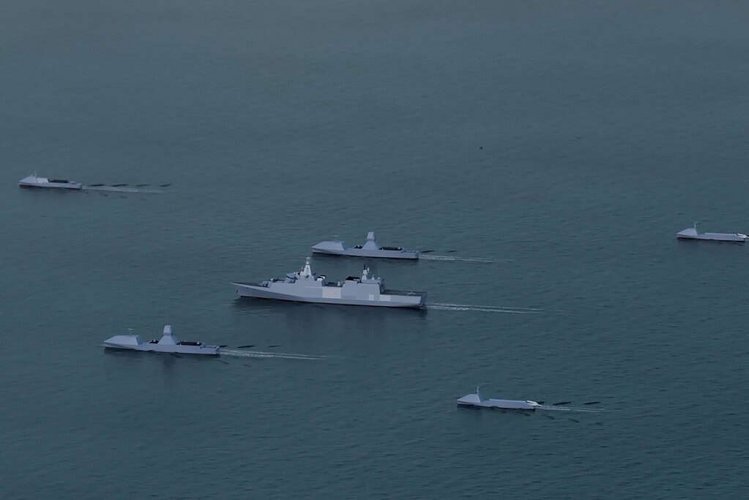
Here are those images for anyone interested:
 

Attachments

  • Hero-Images_Radar_FINAL-1-1536x1536.jpg
    Hero-Images_Radar_FINAL-1-1536x1536.jpg
    112.7 KB · Views: 68
  • Hero-Images_Strike_FINAL-1-1536x1536.jpg
    Hero-Images_Strike_FINAL-1-1536x1536.jpg
    168.7 KB · Views: 62
  • Babcock-Fleet-Still-001-crop2-1024x683.jpg
    Babcock-Fleet-Still-001-crop2-1024x683.jpg
    27 KB · Views: 69
I'd feel a lot better if they still had plans for the CCV to be individually capable of high-end combat.

Here it looks like the end result is you need 3-4 platforms to do the same job of current high-end frigates like Mogami, FDI or FREMM Evo:
  • T94 for the AAW radar coverage with fixed array AESA radar
  • T91 missile barge with VLS for area air defence SAMs
  • T92 ASW sloop with CAPTAS VDS sonar
  • CCV (basically T31 Evo) as the mothership with C4 capabilities, ASW helicopter, boarding teams, maintenance teams, small USVs etc.
The result looks rather brittle and not exactly cheap. It would be less risky if the unmanned T9X vessels were seen as complementary capabilities to a high-end combattant (the US or Dutch approach), rather than going all in and betting that radical new small platforms can replace the capabilities aboard larger combattants (the Jeune Ecole model).
 
Last edited:
The result looks rather brittle and not exactly cheap. It would be less risky if the unmanned T9X vessels were seen as complementary capabilities to a high-end combattant (the US or Dutch approach), rather than going all in and betting that radical new small platforms can replace the capabilities aboard larger combattants (the Jeune Ecole model).
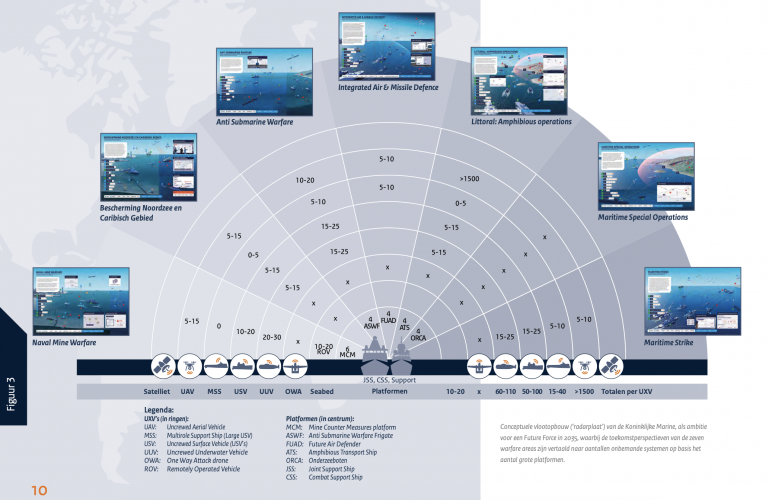
For those interrested in the dutch approach a document has been published recently (in dutch but you can probably understand the slides)
https://www.defensie.nl/site/binari...aritime-uncrewed-toekomstvisie-a4-liggend.pdf

This slide presents the planned target force levels for uncrewed systems in 2035.
Mine warfare is obviously the most advanced domain currently, thanks to the ongoing Dutch–Belgian rMCM program.
image.png
 
Last edited:

Similar threads

Back
Top Bottom