I think the deeper issue is taking all of the metrics for an aircraft and reducing it to a single number
Energy-Maneuver does it, too.


Which aircraft will Su-75 replace in Russian Airforce eventually ?
MiG-29, and any of the smaller ground-attack planes that didn't get replaced in the 1980s/90s. So not Su-24s, but Su-17s, MiG-27s, etc.
 
I think VKS is more than capable of properly defining what force composition they need, and Su-34 for instance are performing just fantastic.
I think we all know the results of the 2022 campaign, and can for sure say that neither sentence holds.
Su-34 was not meant to be a tactical bomb truck (in this role, it does that, say, any J-10 can do, for a fraction of the cost). Su-34 was meant as a penetration bomber (as they performed early in the war), but failed.
As a tactical bomb truck, it was an emergency development, using a completely unplanned set of weapons, developed under military emergency.

Su-75 is a good example that the Russian industry is far more capable of understanding the moment than VKS itself.

Both in the fact industry rather than the air force proposed it, in that industry has to develop it by itself, and in that VKS to this day isn't even verbally committed.
In Gen Z terms, both Su-75(stealth strike fighter, following general F-35 pattern), and Mig-35 (just a "normal" modern multirole fighter without evident capability gaps; more or less a Super Hornet) are just "META" planes. It's OK to not be like others when you perform better than others do.
But if you fail at an air force mission against a force from 1991 with a force structure of 2022, or fail to stop small surface ships even in conditions of uncontested air dominance, something is deeply wrong with what you're doing.
MiG-35 as drone hunter is simply not required (the problem demands other approaches in order to reach a favorable economical ratio per kill) and would create great operational complications. It is clear the military is not impressed with what they see from MiG in that regard.
Betting on just spamming expensive ground assets is a glaring success we see day by day. I.e. it isn't that they're bad; quite the opposite.
But any air defense 101 tells you that static defenses can be overwhelmed at any specific point (even in Moscow), especially when the attacker gets optimal pathing from space. It's exactly what happens, even when Ru traditional GBAD production (systems and ammo) has reached frankly ridiculous levels(and investment).

Furthermore, starlinked drones can and do attrit GBADs themselves. The same is true for a broad range of other tasks, which we nowadays normally see done by other air forces in the Middle East.

Russian military ... was visibly committed to other metrics. We see results to this day over Ukraine (though it was already visible over Syria).
 
Last edited:
Russian military ... was visibly committed to other metrics. We see results to this day over Ukraine (though it was already visible over Syria).
I mean yeah, other metrics are needed then just an air force in Ukraine to maintain dominance based on my file attachments examples. But the air force still plays a role hitting its targets in an ongoing war. Systematically killing millions of men in one country somewhere in europe might take a longer time period then just 3 years of killing 87,500 rebels in the middle east whom had inadequate funding.
 

Attachments

  • Screenshot 2026-06-07 194909.png
    Screenshot 2026-06-07 194909.png
    573.8 KB · Views: 44
  • Screenshot 2026-06-07 195052.png
    Screenshot 2026-06-07 195052.png
    737.7 KB · Views: 41
  • Screenshot 2026-06-07 195358.png
    Screenshot 2026-06-07 195358.png
    107.7 KB · Views: 42
I mean yeah, other metrics are needed then just an air force in Ukraine to maintain dominance based on my file attachments examples. But the air force still plays a role hitting its targets in an ongoing war. Systematically killing millions of men in one country somewhere in europe might take a longer time period then just 3 years of killing 87,500 rebels in the middle east whom had inadequate funding.
VKS does do a lot of bloody work; there's no doubt about that. It delivers an absolutely bonkers number of explosives day by day, every day, without exhausting weapon stocks(compare it with recent USAF/Israeli experiences). Which is sort of normal for an industrial power at war.
But wars, until they turn into a matter of doing(attrition campaign), are a matter of achieving(decisive campaign). And a large reason Russian air forces couldn't and still can't achieve goals is very technical.

VKS was preparing for a great conventional defensive war against NATO, both to keep Russia's great power status, and to keep the full escalation ladder open to the political leaders. I.e. it was preparing for the exact things that we saw in play against Iran.
Unlike Iran, Russia does indeed gets main ones more or less in time (rather than with a 10-year delay, like Iran); being a major industrial power (for centuries) and a larger economy helps a lot.

But all of that seems sort of meaningless, because the actual deterrence is done by nukes; furthermore, as we can see everywhere, gray suits don't really care whether stealth planes are designed to find other stealth planes (which is military logic), or large planes, capable of extended patrols over Russian expanses. Decision makers look at numbers, how many stealth planes (and planes in general) does the opponent have. Deterrence is not an objective metric; it's a factor of fear.

As such, I consider JSFski(Su-75) as a far more beneficial plane for VKS, than the Su-57 they actually focused on. It's more usable against weaker opponents whom Russia may need to attack(stealthier, better striker, higher numbers); it's also a way better deterrent against larger EU/NATO (looks stealthier, higher numbers, better striker=can bring nukes).
Yet, VKS went for a more complex, defensive capability, which placed priority on fighting a hypothetical/unlikely/unwinnable conflict(though, to be fair, the only one which actually threatens Russia as a state), instead of being an actual instrument of a state (serving well being of a country...at the expense of others, if necessary).

The same equation was true for migs - mig force would've been more universal and larger than a pure flanker force, being more capable of striking weaker opponents, and looking scarier to a stronger one.
As we know, VKS couldn't afford to integrate or procure things like targeting pods onto their flanker force - and Sukhoi itself was pushing in different directions (they certainly helped international customers with their pods, but those aren't available to Russia).
On MiG, they happened by themselves because MiG (and its ecosystem) prioritized them. As it happened with HMD, AESA, and all other small bits and pieces, which Sukhoi planes will get from the government, ~10 years later than Mig, and 6-7 years later than the war they should've been present at.
 
Last edited:
It's certainly debatable to call the T-75 the better striker, especially as it's one IWB down compared to the Su-57 and thus lacking behind it in the internal ordnance department, not like there is something better in it's category, the F-35 has rather limited internal carriage capabilities, especially with regards to the variety of munitions and the spectrum in which they operate.

But it certainly seems like you equate integrated EOTS with being a superior offensive asset, when the Su-57 posesses favorable kinematics in order to enter and leave a critical space under less risk while carrying more payload.

The real difference is that T-75 will be cheaper to produce and operate while cutting down on raw stats and improving serviceability and improving on the low observable characteristics. It gives up certain merits the Su-57 posesses in order to gain advantages that complement the Su-57. But the 57 is a fully grown, modern stealth multirole aircraft, so I wouldn't claim that the T-75 is going to be the inherently better strike platform, especially when the Su-57 has proven to be effective for long range precision strike. It's the more economical strike platform and thus more suited from an operative perspective, especially as this means the Su-57 can be tasked with other missions the T-75/LTS/Su-75 couldn't perform to the same degree.

As for the VKS, the Su-34 and their operations. The Su-34 was designed a high speed precision strike platform, that's true, but it was also developed to fill the bomb truck shoes, taking on missions from both the Su-24 as well as the Su-25. The volume and frequency of munitions delivered speaks for itself, it's only operational shortcoming in this day and age is that it's not low observable platform, which makes it dependent on stand off range to reduce operational risk, but this applies to every non-stealth aircraft and actually aircraft in general, the harder you're to see and track the less likely it becomes you're getting shot at and successfully hit. But the chance is never zero and this was proven just earlier this year. But even the T-75 is not a next generation Su-34 in that sense, T-75D + S-70/T-75B approaches that, yes. But if you'd want it in one airframe you'd need a dedicated stealth fighter bomber, "Su-64", so to speak. Because the T-75S on it's own isn't close to that.
 
It's certainly debatable to call the T-75 the better striker, especially as it's one IWB down compared to the Su-57 and thus lacking behind it in the internal ordnance department, not like there is something better in it's category, the F-35 has rather limited internal carriage capabilities, especially with regards to the variety of munitions and the spectrum in which they operate.

But it certainly seems like you equate integrated EOTS with being a superior offensive asset, when the Su-57 posesses favorable kinematics in order to enter and leave a critical space under less risk while carrying more payload.
Yes, I think the presence of integral EOTS (=bomb sight, i.e., ability to effectively spot, track, idenitfy and mark targets under the plane with all benefits of the visual and IR band) instead of a targeting pod, together with likely a substantially lower signature, is decisive.
T-75 is also marketed (and we know that the eventual configuration was chosen for supersonic performance) as a supercruiser.
Finally, while the internal volume of Su-57 is certainly bigger, its ability to carry the preferred stand-in PG weapon of choice, which is KAB-250L, is equal. Both take 4 (KABs fit into fast bays).

The real difference is that T-75 will be cheaper to produce and operate while cutting down on raw stats and improving serviceability and improving on the low observable characteristics.
That's indeed the case - and in my opinion, the most basic trait of aircraft is when you can afford to send it on a mission.
This is non-binary(yes/no), and is tied to available fleet, consequences of loss, and economic weight(including pilots).

This is why, for instance, I dislike single-type F-35 fleets, pursued by smaller countries; what's attritable to the US/Israel, isn't really attritable for them. Can they even politically afford to lose a F-35 over enemy ground?
If no, and they can only really be used together with the US, then isn't that effectively a downgrade, despite all the capability of the bird?

Then there's production capability: T-75, beyond costs, is 1 engine, 1 radar, 1 EOTS, and EODAS (OLS-50M ball seems to be gone from the last model from Singapore). Su-57 is 2 engines, 4 x- arrays(with ~2 times TRM count), 3 OLS, EODAS and a targeting pod (likely closely linked to Sukhoi EOTS). That's a lot of stuff to produce, and a lot of abbreviations that the rest of VKS is thoroughly deprived of.
As for the VKS, the Su-34 and their operations. The Su-34 was designed a high speed precision strike platform, that's true, but it was also developed to fill the bomb truck shoes, taking on missions from both the Su-24 as well as the Su-25. The volume and frequency of munitions delivered speaks for itself, it's only operational shortcoming in this day and age is that it's not low observable platform, which makes it dependent on stand off range to reduce operational risk, but this applies to every non-stealth aircraft and actually aircraft in general, the harder you're to see and track the less likely it becomes you're getting shot at and successfully hit.
I'd say that the main operational shortcoming of Su-34 as it is, is that it takes 80/20 rule and turns it onto it's head.
It's full of theoretical "20%" capabilities, which don't really work and can't be used. Of all of those capabilities, the only one VKS managed to put to good use is a mighty central pylon, able to take a singular ~3.6t load (bomb+kit+pylon). It indeed works as a cookie bomber.

Other than that, su-34 instead works as a parcel delivery plane (4 bombs per sortie), for a very high maintenance cost and time. The same duty can be done by a much smaller plane, for no perceived downsides.
I once made a simple pencil calculation, that doing the same bombing VKS does today, but via J-10Cs instead of Su-34 (escorted by Su-35) saves so much, that the entire necessary order of J-10s will be fully covered by just 1 (one) year of savings. To become economically efficient attrition bomber, Su-34s have to start bringing either more bombs per sortie (which is not always feasible, as targets aren't under obligation to follow your sortie planning), or bring them to more consequential targets.

 
Last edited:
I want to believe it will also replace MiG-29SMT or M, but so far kinematic characteristics of the airframe leave a lot to be desired.
Which ones? Overload is the only one below standards, and this can have a lot to do with the engine and the export nature of the information that has been disclosed until now (lighter structure with less g tolerance to allow for a weaker export engine). Keep in mind that a 5th gen engine is in the works and also that a re-design effort of the airframe has been going on for the last years, where control and lifting surfaces have been increased.
I think we all know the results of the 2022 campaign, and can for sure say that neither sentence holds.
Sure. Everyone from the outside knew better than the VKS. I have seen this before...
Su-34 was not meant to be a tactical bomb truck (in this role, it does that, say, any J-10 can do, for a fraction of the cost). Su-34 was meant as a penetration bomber (as they performed early in the war), but failed.
Su-34 is a versatile platform. It has elements of a penetration bomber, fighter, even CAS airplane. But it is also extremely robust and reliable and carry huge loads. I can agree that nowadays a cheaper, lighter plane with reduced RCS and stand-off weapons seems to check all relevant boxes, but still what is the opinion of the crews? What are the complains re. Su-34? Looking from the outside and having actual data from real world are different things.
Su-75 is a good example that the Russian industry is far more capable of understanding the moment than VKS itself.
VKS has inertia and responsibility for multi-decade planing, it is to be assumed that they will be conservative. and it is also expected that the country leadership will promote a contrast of approaches, as it is doing by supporting and funding the LTS, as well as ongoing alignment between Sukhoi and the military.
But if you fail at an air force mission against a force from 1991 with a force structure of 2022, or fail to stop small surface ships even in conditions of uncontested air dominance, something is deeply wrong with what you're doing.
1991 force? You mean Ukraine, with the strongest AD of the whole Western block by a country mile?
Betting on just spamming expensive ground assets is a glaring success we see day by day. I.e. it isn't that they're bad; quite the opposite.
But any air defense 101 tells you that static defenses can be overwhelmed at any specific point (even in Moscow), especially when the attacker gets optimal pathing from space. It's exactly what happens, even when Ru traditional GBAD production (systems and ammo) has reached frankly ridiculous levels(and investment).
I don't mean ground based AD, but that is another discussion.
As such, I consider JSFski(Su-75) as a far more beneficial plane for VKS, than the Su-57 they actually focused on. It's more usable against weaker opponents whom Russia may need to attack(stealthier, better striker, higher numbers); it's also a way better deterrent against larger EU/NATO (looks stealthier, higher numbers, better striker=can bring nukes).
Yet, VKS went for a more complex, defensive capability, which placed priority on fighting a hypothetical/unlikely/unwinnable conflict(though, to be fair, the only one which actually threatens Russia as a state), instead of being an actual instrument of a state (serving well being of a country...at the expense of others, if necessary).
Please don't call it JSFski, it hurts my eyes xD

Su-57 served to develop the technologies that now allow for a quick development of LTS. And an air superiority fighter is indeed needed as a backbone of the air force. But numbers matter a lot of course, and once the high end capability niche is covered, planes as LTS can deliver just that. I dont understand what is there to be critisiced, the strategy has been quite sucessful I would say.

In general I perceive a familiar criticism in your comments, as in 'it works, but it could work much better'. Either you are Russian, or you think like one of them ;)
 
Which ones? Overload is the only one below standards, and this can have a lot to do with the engine and the export nature of the information that has been disclosed until now (lighter structure with less g tolerance to allow for a weaker export engine). Keep in mind that a 5th gen engine is in the works and also that a re-design effort of the airframe has been going on for the last years, where control and lifting surfaces have been increased.
I cant really elaborate on that now, but the decisions taken during development of the layout are more to the “simplicity” side than to “advanced aerodynamics”. JSF and PAK FA strike the exact middle, having a great and the greatest transsonic characteristics, while satisfying electronics and observability requirements of their respected programs.

For a plane, which started development as “light strike plane”, requirements for kinematic performance were obviously lower.
Lack of a proper horizontal stab really shows and “pivotable part of the tail boom”, even in the latest form, does not fully substitute. Using the wing* from Su-57 is both a great decision and a major performance restricting factor the plane had to be designed around… Although its wingloading is really low, there’s still more to be desired.

Maybe I’m spoiled by the exceptional performance of Su-57 and F-35, but current (and the one that will likely fly, unless there will be redesign of the rear section again) LTS layout is underwhelming to me. As a Su-17 replacement it will perform greatly, but, personally speaking, as all present 5th gens are super-maneuverable, to me LTS future performance is a bit underwhelming.
 
I have read somewhere forgot the specific thread or page from a certain forum that commie blocks or some soviet architecture was built to at least offer as much resistance to a nuclear blast or bombings. This might also in some cases require more air to ground campaigns in a large country then air campaigns in a smaller country with weaker buildings.
 
It'll be interesting to see how Su-57D might impact demand for T-75D and if it will even be developed to maturity. T-75S is a safe bet, T-75B could as well be, as part of a future force structure for the VKS alongside S-70. But T-75D seems like the odd one in the trio, especially as drone control and signal intelligence may be inherently more suitable for the larger Su-57D. Which will boast more range, endurance and power, while signature concerns are less relevant in that role.
 
As a UAV fanatic, they can take all the time in the world if they want on this project.
-A.I. keeps improving levels after levels as time passes and PICs with other new technology in developement further boosts A.I.
-Good amount of Su-57Ds have to be produced 1st before an aerial command structure for pilots and UAVs have assigned roles.
-Satellite projects to communicate with UAVs.
-Cheaper rockets from large, medium to miniature launches to launch said satellite projects to control UAVs

Su-75 UAV will have even more enhanced stealth without cockpit, longer flight range and perform maneuvers that a living pilot couldn't pull on the aircraft.

We are overdue for another Maks airshow, I know Shvabe, their electronics/photonics industry, missile designers, radar designers have gradually made significant progress that they maybe can showcase publicly some information.
 
I cant really elaborate on that now, but the decisions taken during development of the layout are more to the “simplicity” side than to “advanced aerodynamics”.
Certainly the LTS is designed for cost effectiveness and that means ultimate performance is not the goal (i.e. fixed DSI vs. a very complex, low RCS adjustable one on the Su-57). Obviously the requirement for speed on mil power is different, probably max speed too. Ceiling is also understandably lower on the numbers plane than that of the air dominance one... it would be illogical to do it otherwise.

As to JSF having 'advanced aerodynamics' different to LTS... I am not sure if you refer to technology/optimization or to performance... If you mean the second, only with the layout advantage, the LTS is most likely way more efficient in supersonic regime, on top of having same practical range and payload, but with the capacity of carrying 4x medium and big pieces of A2G ordnance in the weapons bays. If you mean optimization, I would call the compromises made for the STOVL version of the JSF a much heavier burden than reusing components from the Su-57 in the LTS.
JSF and PAK FA strike the exact middle, having a great and the greatest transsonic characteristics, while satisfying electronics and observability requirements of their respected programs.
JSF is very limited in supersonic regime, while Su-57 is not called 'the needle' for nothing.
For a plane, which started development as “light strike plane”, requirements for kinematic performance were obviously lower.
As it should
Lack of a proper horizontal stab really shows and “pivotable part of the tail boom”, even in the latest form, does not fully substitute. Using the wing* from Su-57 is both a great decision and a major performance restricting factor the plane had to be designed around… Although its wingloading is really low, there’s still more to be desired.
You seem to ignore the presence of TVC, as well as of any quantitaive data to support your claim. At low airspeeds, control surfaces like the H-stabs have little effect, and TVC, much more effecttive, is present at the engines that could power the LTS. At higher speeds, they cannot be deflected fully. So what is the obvious downside? Because the advantages in weight, lift and drag of the LTS solution without h-stabs are for sure there.
Maybe I’m spoiled by the exceptional performance of Su-57 and F-35, but current (and the one that will likely fly, unless there will be redesign of the rear section again) LTS layout is underwhelming to me. As a Su-17 replacement it will perform greatly, but, personally speaking, as all present 5th gens are super-maneuverable, to me LTS future performance is a bit underwhelming.
Without actual data I find it difficult to support that claim. Specially considering that an unmanned version is being developed, where g restrictions associated to the pilot can be removed. On top of that:
- The design has been already defined as STOL capable. Means, the lift is very high and TVC most probably there
- Lift and control surfaces have been enlarged in the redesign (maybe thinking on improving capabilities of the UAV version and parameters like service ceiling?)
- Considering the absurd levels of lift demonstrated by the Su-57 on live performances, I cannot but wonder what is exactly wrong for the kinematics of the LTS by using the same wings. At the end it is lift what mostly determines sustained turn rate to this day, and especially at high altitudes and speeds, any amount of lift is never enough. In terms of excess power at supersonic speeds, lower drag will compensate lower engine power vs. F-35, in the subsonic regime the bigger difference will most likely be due to the engine, which is in the process of being sustantially improved as we see with the izd. 177 and an eventual 932 mm inlet version of it, or an even more advanced domestic model. F-35's lift to drag can probably be very good at subsonic speeds due to the optimized sweep angle, but the amount of lift itself does not look impressive.
I therefore assume an excellent supersonic / high altitude maneuverability for the LTS as it is, with other points of the envelope not having obvious problems and depending more on the engine, which will be improving over time.
 
Last edited:
he end it is lift what mostly determines sustained turn rate to this day, and especially at high altitudes and speeds any amount of lift is never enough. In terms of excess power at supersonic speeds, lower drag will compensate lower engine power vs. F-35, in the subsonic regime the bigger difference will most likely be due to the engine
So if I am to understand this correctly, the Su-75 is able to supersede the four fundamental forces of flight in that it will have massive amounts of lift and very little drag?
 
So if I am to understand this correctly, the Su-75 is able to supersede the four fundamental forces of flight in that it will have massive amounts of lift and very little drag?
You can answer yourself Mr
 
I've been criticized for this approach to comparison for twenty years, but no one has come up with a better solution
I've come across several comparisons, such as those from the MiG company, and the results are close to mine

The point is not that I critizise your approach; i simply do not understand the way you come to certain conclusions and indeed the point why a comparison to the Su-24 is one point of concern! Only after I am aware what you are doing, then I am maybe able to criticise ... at the moment it looks like a fascinating mysterious black box of data with certain factors I do not undestand in which way you weight them against each other and that some are IMO irrelevant.

That's the point, but I'm eager to learn!
 
I figure Sukhoi wants to produce a success story like the MiG-21. It doesn’t need to be top of the line as long as it is affordable and offers good performance values. Being smaller might compensate for the lack of radar power output. If they do it right they could end up like a Russian f-16. The problem is the war kinda made their equipment look inadequate, their global reputation has gone down and now China has 3 fighter aircraft offering plus their financial backing. As an aviation enthusiast I’ll love to see the su-75 take off; most of other stealth aircraft look very conservative from the design point of view.
 
I figure Sukhoi wants to produce a success story like the MiG-21. It doesn’t need to be top of the line as long as it is affordable and offers good performance values. Being smaller might compensate for the lack of radar power output.
It isn't small(27t MTOW), nor is it especially unpowerful(16t engine with state of the art genset).

It isn't enough to power full su-57 disco, but for a f-35 like system it is fully adequate.
 
It isn't small(27t MTOW), nor is it especially unpowerful(16t engine with state of the art genset).

It isn't enough to power full su-57 disco, but for a f-35 like system it is fully adequate.
So it's right at the size of the F-35.

Which should probably be expected, an aircraft packing 2x 2000lb bombs et sim internally is going to have a minimum size attached to the project.
 
Being smaller might compensate for the lack of radar power output.
AFAIK there is no indication that the radar aperture is actually smaller than the one in the Su-57.

Due to (unavoidable) space requirements needed to carry substantial A2G weapons internally, 'light' 5th gen fighters are not light at all (i.e. F-35A being heavier than a F-15C), so the result is that they are not 'the half' of the twin engine relatives in terms of radar power, payload or range.
If they do it right they could end up like a Russian f-16.
That was my assumption too, but in reality the plane offers the range/payload performance of a Su-30, only it should be much cheaper to procure and operate, on top of being much more effective / survivable.
 
That was my assumption too, but in reality the plane offers the range/payload performance of a Su-30, only it should be much cheaper to procure and operate, on top of being much more effective / survivable.
Bravo. I came to exactly the same conclusion.
The same applies to the future replacement of the - very successful export - Su-30 "series" on the international market.
 
That was my assumption too, but in reality the plane offers the range/payload performance of a Su-30, only it should be much cheaper to procure and operate, on top of being much more effective / survivable.
Perhaps you are correct, but I don't see a LO aircraft beating legacy platforms in terms of sustainment & maintanence cost. That's the price any service has to be willing to pay for the associated advantages these LO designs offer.
 
That was my assumption too, but in reality the plane offers the range/payload performance of a Su-30, only it should be much cheaper to procure and operate, on top of being much more effective / survivable.
Tbf, it's either range or payload, not both simultaneously.
Different class of aircraft in the end.
 
Yes, I think the presence of integral EOTS (=bomb sight, i.e., ability to effectively spot, track, idenitfy and mark targets under the plane with all benefits of the visual and IR band) instead of a targeting pod, together with likely a substantially lower signature, is decisive.
I disagree. It's a significant boon when playing against opponent with old/bad IADS and detecting capabilities. As Ukraine showed, when both sides IADS are actively ambushing and hunting, using EOTS to spot, lase targets is an additional time, pilot distraction and a risk to loose multimillion plane along with pilot.
It's much easier, cheaper and in most of cases more useful due to long loiter time to move this task to tactical drones such as Orlan-30, Forpost and ilk, loss of which is acceptable.

Essentially, in restrictive IADS environment strike planes transform into glorifed bomb buses.

Edit: typos.
 
Last edited:
Everything is known in comparison. Here is a simple scheme, using tabular data as the most accessible. We do not have any others. The possibilities of air combat we compare with the Su-27, air - land abilities with the Su-24.
You can compare with anyone, I made this choice.
Unfortunately, I am now on the train on the way to the sea and limited in communication
 
Perhaps you are correct, but I don't see a LO aircraft beating legacy platforms in terms of sustainment & maintanence cost. That's the price any service has to be willing to pay for the associated advantages these LO designs offer.
The only data available related to maintenance of LO planes comes from US, whose military budget is 1T and that started to experience the challenges of taking care of coatings and so on a long time ago, but the technology has advanced a lot since the early days. On top of that, one instead of two engines is 50% off in one of the most cost and labor intensive elements to maintain on a plane. Fuel consumption of a lean plane carrying internal weapons compared to 4th gen using external stations should be sensibly lower.
Tbf, it's either range or payload, not both simultaneously.
Different class of aircraft in the end.
Who says a Su-30 loaded with external stations has a longer range than a Su-75 with equivalent payload carried internally? The drag added by the external load is substantial, even when Su-30 does not usually need to use EFTs.
 
Who says a Su-30 loaded with external stations has a longer range than a Su-75 with equivalent payload carried internally? The drag added by the external load is substantial, even when Su-30 does not usually need to use EFTs.
T-75, aiming for anywhere near full weapon load, uses external points, too - and there'll be no low drag coefficient stations in this case.
Ultimately, Su-30 is a significantly larger plane with significantly more power; yet, it lacks IWB.
It's a rather slender plane, even with a protruding cockpit.
T-75 is many things, but slender isn't one of them.
 
T-75, aiming for anywhere near full weapon load, uses external points, too - and there'll be no low drag coefficient stations in this case.
Ultimately, Su-30 is a significantly larger plane with significantly more power; yet, it lacks IWB.
It's a rather slender plane, even with a protruding cockpit.
T-75 is many things, but slender isn't one of them.
One of Sukhoi's stated teachings from the Syrian campaign was that the average sortie did not demand the max weapon load of a heavy twin engine. Ukraine has proven the same, with Su-34s carrying typically 4x FAB500 (only recently we started seeing 6x bombs in some pictures). A Su-75 could carry 2x ca. 500 kg warhead weapons in the main bay plus 2x KAB-250, all internally, for essentially the same attack package, without added drag and preserving very low RCS.

As to the Su-30 being slenderer than the Su-75... I defer to Paralay to confirm if he is so kind, but probably the first has almost twice as big a cross sectional area as the later, which possesses a markedly long fuselage and very good fineness values for a 5th gen. BTW, the channel between the engines in the Su-30 is a known source of interference drag.

EDIT: the Su-75's fuselage (nose to nozzle) is only 1 meter shorter than F-22, while only having one engine and smaller cross sectional area. I would call it definitely slender
 
Last edited:
One of Sukhoi's stated teachings from the Syrian campaign was that the average sortie did not demand the max weapon load of a heavy twin engine.
Well, it's Sukhoi being reasonable v VKS procurement madness (ironically caused not the least by previous Sukhoi lobbying/success).

One day, which won't be too far away, VKS may find that one can carry all standard "Ukrainian" bombloads to "Ukrainian" ranges (with full safe basing stand off, itself largely caused by how large flankers are) and beyond on a single F414 without much problem. For just a fraction of fuel and maintenance time.

Moreover, it'll also be able to cover "special" missions (LACM) without much penalty, as per my observation flankers rarely launch 3 cruise missiles per sortie. 1-2 is more typical.
EDIT: the Su-75's fuselage (nose to nozzle) is only 1 meter shorter than F-22, while only having one engine and smaller cross sectional area. I would call it definitely slender
It still has a combination of serpentine duct and main iwb (which is broadly comparable to engine in area projection). Plus side bays, which otherwise could be sliced away, are there.

T-10 is a big girl for sure, but she's in very tight clothes. There's no parasitic volume inside.

Things are certainly stretched well in T-75,(which is why it really is not unlike su-7/17, "tube with tail), but any LO aircraft will never be as streamlined as non-LO. Especially a single engine one, yet tied to the same bay dimensions.
 
Last edited:
The only data available related to maintenance of LO planes comes from US, whose military budget is 1T and that started to experience the challenges of taking care of coatings and so on a long time ago, but the technology has advanced a lot since the early days. On top of that, one instead of two engines is 50% off in one of the most cost and labor intensive elements to maintain on a plane. Fuel consumption of a lean plane carrying internal weapons compared to 4th gen using external stations should be sensibly lower.
One less engine to deal with in the case of Su-30 v. Su-75 may help with sustainment cost to some extent, but if the experience of the US could convey any clues, it's that operating a single-engine LO platform won't necessarily result in comparatively cheaper cost efficiency. The F-35, despite sporting a single powerplant, costs roughly the same to operate as the heavier twin-engine F-15E, per CBO.

Now, this is all largely anectodal as we cannot infer the USAF sustainment cost ratios with VKS, especially since the Su-75 is still in development phase and it's unknown how Sukhoi (along with VKS) will go about the sustainment angle.
 
It still has a combination of serpentine duct and main iwb (which is broadly comparable to engine in area projection). Plus side bays, which otherwise could be sliced away, are there.
Things are certainly stretched well in T-75,(which is why it really is not unlike su-7/17, "tube with tail), but any LO aircraft will never be as streamlined as non-LO. Especially a single engine one, yet tied to the same bay dimensions.
Yes and no, optimization is the key. The trick in the layout of the Su-75 compared to other 5th gen planes and especially to F-35 (the only other singe engine we can compare with) is that the main weapons bay is directly in front of the engine, while the airduct hides behind the cockpit and the side bays are a part of the integral aerodynamic design (blended wing body). So, the cross sectional area is kept very contained (of course it needs to be bigger than that of previous generation planes, not discussing that) and the plane is mainly enlarged in the longitudinal axis, increasing wetted area and weight, but also helping with fineness.

T-10 is a big girl for sure, but she's in very tight clothes. There's no parasitic volume inside.
The cross section of the Su-57 is a little smaller than that of the T-10 (per Paralay, IIRC) and follows the same pattern, but includes IWB, also in a very smart way, hiding them behind the unavoidable cross-sectional area taken by the nose and cockpit.

Moreover, it'll also be able to cover "special" missions (LACM) without much penalty, as per my observation flankers rarely launch 3 cruise missiles per sortie. 1-2 is more typical.
Yes, it is logical to attack as soon as you have a target, since most are time critical. 'Beast modes' are fun, but I don't see their practical use that much.
 
The cross section of the Su-57 is a little smaller than that of the T-10 (per Paralay, IIRC) and follows the same pattern, but includes IWB, also in a very smart way, hiding them behind the unavoidable cross-sectional area taken by the nose and cockpit.
That is why my mental model of FAXX and SCAF went with tandem IWBs (or one really long IWB for SCAF). Parallel IWBs does horrible things to a plane's cross-sectional area!

Admittedly, IWBs always mess with your area ruling, but the space between the engines is a good place to try to stick the main bays.


'Beast modes' are fun, but I don't see their practical use that much.
They assume that the IADS has been degraded to "ineffective-to-nonexistent".
 
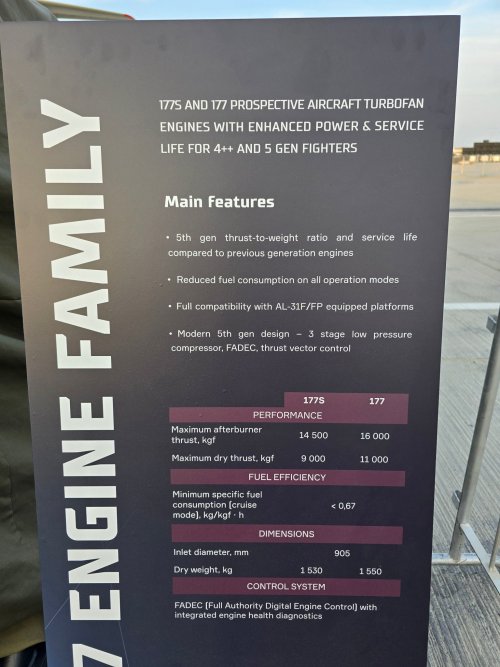
with the izd. 177 and an eventual 932 mm inlet version
In your opinion, what is the reason for maintaining the inlet diameter of 905 mm in the 177 version, probably intended for fifth-generation aircraft? G54LaXEbQAAfere.jpeg
 
In your opinion, what is the reason for maintaining the inlet diameter of 905 mm in the 177 version, probably intended for fifth-generation aircraft?
One single engine you can fit in all flankers, su-57s, s-70s and 75s is a dream of Russian aviation. Making incompatible versions again would just break it once again.
 
One single engine you can fit in all flankers, su-57s, s-70s and 75s is a dream of Russian aviation. Making incompatible versions again would just break it once again.
Then find out the inlet diameter of 117.
 
One single engine you can fit in all flankers, su-57s, s-70s and 75s is a dream of Russian aviation. Making incompatible versions again would just break it once again.
Losing almost 1 tf by doing that on a plane that has already been designed for (at least) 932 mm inlet diameter makes no sense at all, unless you see yourself so ahead of your rivals that you don't even need to break sweat. I don't think it is the case, but who knows how they plan the Su-57 development roadmap...

In your opinion, what is the reason for maintaining the inlet diameter of 905 mm in the 177 version, probably intended for fifth-generation aircraft?
Maybe having an export engine with 5th gen parameters compatible with T10 models and Su-57E, but without compromising the actual data of izd. 30 and the performance advantage of the domestic version. Only with the airflow increase you get 7% extra thrust, not considering technology or design margins not disclosed in this sales info published for export.
 
Losing almost 1 tf by doing that on a plane that has already been designed for (at least) 932 mm inlet diameter makes no sense at all, unless you see yourself so ahead of your rivals that you don't even need to break sweat. I don't think it is the case, but who knows how they plan the Su-57 development roadmap...
16t of thrust isn't exactly little.
Want more - you're most welcome to finish AL51F.
 
Maybe having an export engine with 5th gen parameters compatible with T10 models and Su-57E, but without compromising the actual data of izd. 30 and the performance advantage of the domestic version. Only with the airflow increase you get 7% extra thrust, not considering technology or design margins not disclosed in this sales info published for export.
I agree.
Personally, I believe that the 177/177S with openly published parameters are a broader part of the "Indian campaign". Within one package for upgrading MKI and installing it in export Su-57s, almost identical engines are to be produced, which will allow - in addition to unification - a favorable offer/life cycle price.
If the 177/177S is the result of the Udlinitel' project, then in the version with a diameter of 932 mm it will offer significantly higher thrust (in the version for the T-50 around 166 - 167 kN) and will quite possibly be the basis of a unified engine for the "VKS Trio" .
So in the future we could expect a thrust of around 170 kN for the T-75 when using a "generational mixed" solution and of course even more for the use of the new generation (30).
170 kN would mean similar characteristics to the F-35 for an aircraft with an empty weight of just under 12 tons (say 11,750 kg).
 
Last edited:

Similar threads

Back
Top Bottom