F-22B and F-35 double-seater projects

Maybe it's just a case of philosophy. The Navy still refuses to use single engined aircraft, although
it may be quite hard to prove the claimed increase in safety by statistics. It's not all that logic in
this business, I'm afraid.
 
Part of the reason for two seaters is the demands of highly complex close air support in the era of immensely restriction rules of engagement. Despite the aircraft being able to fly itself and fuse data across hundreds of square miles you sometimes need two people so one can talk to the guy on the ground while the other looks for people hiding in alley ways. Are you going to need this in WWIII? No, though you would then need two people for dual key nuclear weapons release. The biggest mistake anyone can make is see a surface similarity in these things to what went on in the 1960s and then assume it’s for the same reason now as it was then.
 
Even in these situations, the human(s) desn't in principle need to be actually in the aircraft so long as secure encrypted data link can be maintained. Dual key nuclear release is probably more secure if the persons involved is not actually also flying the aircraft for their very lives at the same moment. The aircraft can in principle be unscrewed and essentially autonomous, requiring human intervention through telepresence only for situations specified by doctrine.
 
Jemiba said:
Maybe it's just a case of philosophy. The Navy still refuses to use single engined aircraft...

You mean, other than all the F-35s they're planning to buy?
 
i had an interesting chat with a friend a while ago who was an f15 pilot, who was involved with both projects somehow, he stated that the reason both aircraft were single seat was that its cheaper to train and employ just pilots without worrying about the extra manpower and support for a second seat.
 
Given the structural breakdown of the F-35, any version, a two-seater would have to extend from the back bulkhead of the present cockpit and that's going to do interesting things to weight and balance, which would especially affect the F-35B. It would be tight, but I'd be prepared to argue for side-by-side seating instead of tandem seating if they did produce a two-seat F-35. ISTR that someone did a comparison and the cockpit of the TF-102 looked to fit fairly well.
 
Given the structural breakdown of the F-35, any version, a two-seater would have to extend from the back bulkhead of the present cockpit and that's going to do interesting things to weight and balance, which would especially affect the F-35B. It would be tight, but I'd be prepared to argue for side-by-side seating instead of tandem seating if they did produce a two-seat F-35. ISTR that someone did a comparison and the cockpit of the TF-102 looked to fit fairly well.
Yeah, that was me Evan, I'm still working on it but it's a long-term project at the moment.
Robert
 
Double seater derived from F-22 is highly unlikely simply because the F-22 is in fact single purpose fighter. So there is only a need of training, that can be with the state of the art computer technology fully satisfied.

But with the much universal F-35, well, this is the real question for the future. In the electronic jamming variant or attack/strike variant the second crew member should be very handy.
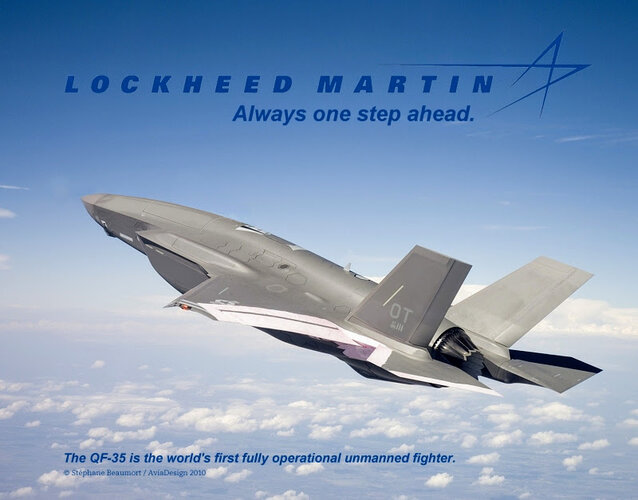
A 2-seat F-22 or F-35 would be very handy to wrangle all those Loyal Wingman drones.


The only place a tandem version of either would be needed is for dedicated special aerial ops where the workload is simply too high for one person and a second set of eyes is necessary......SEAD......AEW........possibly nuclear delivery, etc.
Wrangling Loyal Wingman drones...


The insinuation that more, rather than less, than one pilot would be needed is a step in the wrong direction towards a pilot free drone world.
The AH-64E MUMT projects have shown that you absolutely need a second pilot/drone operator to keep flying the manned plane while also flying the drone.
 
An USMC aviator from the now deactivated Marine Fighter Attack Training Squadron (VMFAT) 101 mentioned on the Fighter Pilot Podcast, that they would like a modern two-seater fighter jet for close air support. IMHO eighter a F/A-18F(AW) aka "F/A-18M(arines)" or a CTOL two-seater F-35 just for the USMC. But the USMC brass want only to invest in the single-seat F-35B and F-35C.
 
An USMC aviator from the now deactivated Marine Fighter Attack Training Squadron (VMFAT) 101 mentioned on the Fighter Pilot Podcast, that they would like a modern two-seater fighter jet for close air support. IMHO eighter a F/A-18F(AW) aka "F/A-18M(arines)" or a CTOL two-seater F-35 just for the USMC. But the USMC brass want only to invest in the single-seat F-35B and F-35C.
I understand why the USMC is trying to only have a single fast jet in their inventory, it's a pretty big logistical savings. The problem is that the USMC alone doesn't have enough power to get LockMart to make a 2-seater F-35.

Maybe once the USAF and USN realize that they need a back seater to wrangle drones they'll pay for a 2-seat version of the F-35A, which can be ported into a 2-seat F-35C.
 
How hard would it be to put a second seat and canopy in place of the lift fan (so not F-35B obviously) ? TF-35A and TF-35C ?
 
How hard would it be to put a second seat and canopy in place of the lift fan (so not F-35B obviously) ? TF-35A and TF-35C ?
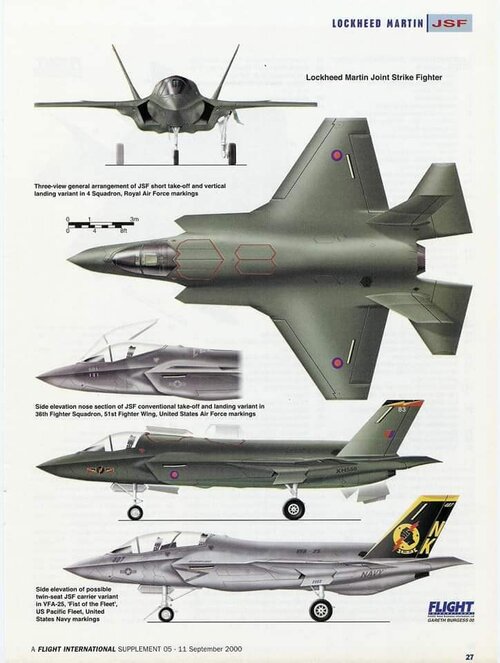
According to some old LockMart plans, not very. The 2-seater As/Cs would lose about 75nmi of range due to taking up part of the fuel tank. And I believe it's been designed already, they'd just need to make tooling to make the parts.

However, a 2-seat B would be a very serious redesign, stretching the forward fuselage about 4-6 feet, with attendant changes to center of gravity limits and location. Much like the TAV-8s got a stretched nose. This would be very expensive and time consuming to do.

I was going for F-35D/E/F for the 2-seater designations, as full combat drone wranglers. D for standard, E for STOVL, F for CATOBAR.
 
According to some old LockMart plans, not very. The 2-seater As/Cs would lose about 75nmi of range due to taking up part of the fuel tank. And I believe it's been designed already, they'd just need to make tooling to make the parts.
Would these official Lockheed Martin TF-35A/TF-35C plans happen to be accessible anywhere on the internet?
 
What is the point of having a two seater with less range? SHirley they will have to be accompanied by single seaters and commonality of mission ability would assist mission planning immenseley.....

Note to self, "Shut up that is logical, never happen".
 
What is the point of having a two seater with less range? SHirley they will have to be accompanied by single seaters and commonality of mission ability would assist mission planning immenseley.....

Note to self, "Shut up that is logical, never happen".
As mentioned previously - SEAD/DEAD and (most likely) drone control. Even with the amount of automation in the single-seat F-35, having a second crew member in the plane to control loyal wingmen is a more appealing proposition.

I am not certain that a reduced-range 2-seater would have a drastically different mission set to the single-seat F-35 in any of the theaters the USA expects to be entering in the near future, however.
 
If the main mission of the F-35/2 is drone control, then there would be no reason for it to not carry a pair of LO-designed drop tanks - much like those that have been tested for the F-22A.

An internal payload of just A-A missiles and the external tanks should do the trick.
 
From page 9 of CRS Report for Congress (PDF), August 29, 2005:
In response to the Department of the Navy’s need to replace its aging EA-6B Prowler electronic attack aircraft, Lockheed Martin has proposed the development of a two-seat electronic attack variant of the JSF. Dubbed the EA-35B, the aircraft could potentially be available by 2015, according to industry representatives. The Navy currently plans to replace the Prowler with an electronic attack version of the F/A-18E/F. The Marine Corps, which currently has no plans to procure either F/A-18E/F’s or the EA-18G electronic attack variant, has reportedly expressed interest in the EA-35B. The EA-35B is, however, still in the very early concept phase, has received no DOD development funding.

This referenced to
Craig Hoyle, “US Outlines New Electronic Attack Aircraft,” Jane’s Defence Weekly, June 4, 2003.

Anyone have any more information?
 
Two-seat F-35's would require some interesting contractural changes as the break between the forward section and the upper and lower mid sections is the aft bulkhead of the present cockpit. A two-seat F-35B might require side-by-side seating to avoid major redesign while two-seat equivalents of the F-35A and F-35C could have the forward fuselage pushed forward and a second seat addede. That you'd still need forward-hinged canopies could make life "interesting".
 
If the main mission of the F-35/2 is drone control, then there would be no reason for it to not carry a pair of LO-designed drop tanks - much like those that have been tested for the F-22A.

An internal payload of just A-A missiles and the external tanks should do the trick.
Since every plane requires a custom-designed external tank anyways, there's no reason to design a non-LO tank for LO aircraft.
 
Anyone have any more information?
It certainly seems to have been a hope the USMC had during the early 2000s, probably building on the F-35's inherent EW capabilities. By 2008 they seemed to be settling for using stock F-35Bs to replace the EA-6B's capability: CP08Ch3P4_Joint_Strike_Fighter_Transition_Plan.pdf

I suspect the EF-35 never got much beyond the Powerpoint slide phase.
 
Looking back at a podcast featuring a well-connected military observer around the J-36's maiden flight in late 2024, he briefly touched on the EF-35. He noted that a two-seat variant wasn't part of the J-20's original design requirements. The J-20S's twin-seat configuration was engineered primarily for electronic warfare (EW), with loyal wingman drone coordination being merely a secondary capability.

He claimed the J-20S boasts EW capabilities on par with the J-16D—which would be staggering for a stealth platform. I remain highly skeptical of that, though. Also, the J-20S wasn't designated as the J-20D precisely because it retains the full air-to-air combat capabilities of the baseline J-20A.

As for the J-36, it was confirmed to feature a three-engine configuration as early as around 2014. According to his account, the primary requirement driving its massive airframe was electronic warfare. He asserts that the J-36's EW capabilities surpass those of the J-16D, approaching the level of a dedicated large-scale electronic warfare aircraft.
 
The J-20S's twin-seat configuration was engineered primarily for electronic warfare (EW), with loyal wingman drone coordination being merely a secondary capability.
Main counterargument will be that array and antenna arrangement is absolutely same as on J-20A. I.e. if there's going to be aby practical difference, it's human operator.
This is not to say base J-20A capability is anyhow bad; we saw ourselves that F-35A/I buddy jamming works wonders over Iran.
But, it just shouldn't be all that different.
He claimed the J-20S boasts EW capabilities on par with the J-16D—which would be staggering for a stealth platform.
It isn't staggering: there are now two such aircraft with sets of large, 360 deg active MESA arrays (su-57 and soon b-21).
But, it's immediately visible and known (what's the point of denying if it's visible).

J-16D(or other escort jammer) capability isn't magic, it's from dedicating significant volumes and sweet spots of the airframe to ELINT and ECM equipment, as well as giving it functional priority (jamming>comms, for example).
J-36 is quite likely to do it, but with J-20... You may have all AI processing of this world and even all the power, but if you don't have rear facing 1000-2000 MHz directional antenna to apply that to a bogey in that sector - no luck.

 
Main counterargument will be that array and antenna arrangement is absolutely same as on J-20A. I.e. if there's going to be aby practical difference, it's human operator.
This is not to say base J-20A capability is anyhow bad; we saw ourselves that F-35A/I buddy jamming works wonders over Iran.
But, it just shouldn't be all that different.

It isn't staggering: there are now two such aircraft with sets of large, 360 deg active MESA arrays (su-57 and soon b-21).
But, it's immediately visible and known (what's the point of denying if it's visible).

J-16D(or other escort jammer) capability isn't magic, it's from dedicating significant volumes and sweet spots of the airframe to ELINT and ECM equipment, as well as giving it functional priority (jamming>comms, for example).
J-36 is quite likely to do it, but with J-20... You may have all AI processing of this world and even all the power, but if you don't have rear facing 1000-2000 MHz directional antenna to apply that to a bogey in that sector - no luck.
Do you mean that the Su-57's electronic warfare capabilities might therefore rival those of the J-16D? I find that highly unlikely. I suspect that the J-20S has already undergone internal modifications similar to those the J-16D has relative to the standard J-16.

Last year, Fu Qianshao, a senior Chinese military observer, 'speculated' after an airshow displaying a J-20S model that the J-20S would carry electronic warfare pods in its side weapon bays. He very likely knows some key information.


It seems the EF-35 was also previously considered for carrying electronic warfare pods. But given the J-20's unique side bays, the impact on its stealth profile would be less significant.
 
Do you mean that the Su-57's electronic warfare capabilities might therefore rival those of the J-16D? I find that highly unlikely. I suspect that the J-20S has already undergone internal modifications similar to those the J-16D has relative to the standard J-16.
You're asking me to give a comment on a subject I can't have any idea about...

The only thing we know is that Su-57 has 360 X- and 270 L- band jamming capabilities via it's radar arrays, and even secondary arrays are huge by standards of most tactical pods. "Active" real estate on Su-57 is world leading for it's generation. But EW isn't just hardware space, it's hardware level, software, and timely keep up work.
Especially now, when we have to take significant account for AI, and Russia isn't really among AI leaders, which in general, starting from 2020s onwards, should give you an additional question sign for EW systems coming from second tier nations(RU/EU/UK/whatever). It isn't just about fundamental physics/engineering/software prowess any longer. You may have access to best ITAR hardware and still lose to an angry kitten, built on shitty 1980s wideband pod hardware.

It's possible to install internal racks comparable to J-16D; they aren't that big. Though the assumption should be J-20(A) has the same capability out of the box, there's little magic there...with exception of things which aren't needed.
J-16 has it set up like this because it's a different generation plane.

But most mission specific hardware for J-16D jamming comes in several sets of pods, not in internal racks. We simply don't have anything similar to these antennas on J-20a(s) airframe.
 
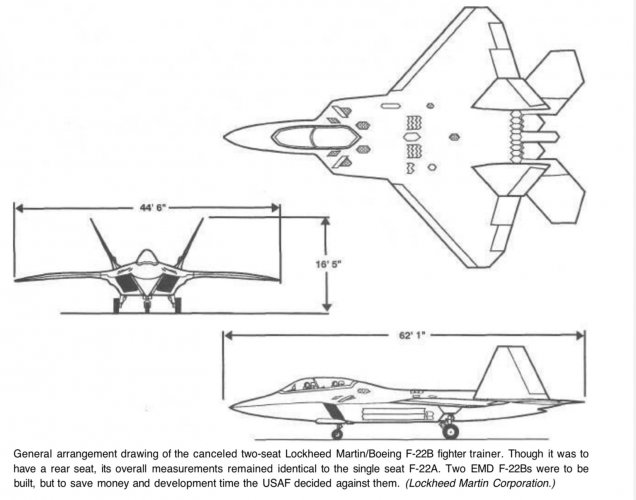
Here is a F-22B three view from an unattributed source. It most certainly isn't from either Air International or Janes?
The image appears to be directly from Lockheed Martin, and published in @Steve Pace's 1999 book F-22 Raptor: America's Next Lethal War Machine, page 29. Here is a higher resolution version of the image with the caption.

Note that this appears to be an intermediate configuration between Configuration 638, the one submitted for EMD in 1990, and 645, the F-22 configuration that was actually flown. The external shaping and geometry are almost identical, but some of the panel and interface edges differed, with the final production version having larger serrations (readily apparent by the nozzles and side weapon bay doors). I believe this was the result of revised RCS software simulations and testing during EMD.
 

Attachments

  • IMG_1163.jpeg
    IMG_1163.jpeg
    176.5 KB · Views: 127

Similar threads

Back
Top Bottom