
You are using an out of date browser. It may not display this or other websites correctly.
You should upgrade or use an alternative browser.
You should upgrade or use an alternative browser.
FFG(X) - NEWS Only

- Joined
- 16 April 2008
- Messages
- 10,603
- Reaction score
- 18,181
For what it's worth, the recently released article mentioned they were specifically looking at Japan and South Korea.
It doesn't sound like we are anywhere near signing contracts though.
No, we have $1.85 billion to spend on studies first.
No, we have $1.85 billion to spend on studies first.
And that, I agree, is just crazy.
Its probably safer to convert the yard, workforce, and supply chain to metric than trying to convert a foreign design.It wouldn't be hard to pick an off-the-shelf design from one of these big yards, install USN weapons (MK41 VLS, NSM, RAM, 57mm gun) and subcontract hull modules at scale across US and foreign yards. Assemble at both a US yard and a foreign yard. I would wager even COMBATSS-21 or a variant of AEGIS CMS could be installed without too much difficulty, plus various USN sensor & comms systems. But please for the love of god don't touch the platform below the main damage control deck... none of this "we need to meet NAVSEA standards" BS.
johnpjones1775
ACCESS: Top Secret
- Joined
- 27 May 2023
- Messages
- 1,373
- Reaction score
- 767
Heard from my buddy. 30 year build plan is out.
Constellation expected to be delivered in 2029, and hull 2 2030, same time as FFX hull 1.
Constellation expected to be delivered in 2029, and hull 2 2030, same time as FFX hull 1.
Scott Kenny
ACCESS: USAP
- Joined
- 15 May 2023
- Messages
- 19,687
- Reaction score
- 28,173
I still think that the USN should be looking at 3XL-USVs as their FFs (sonar towers) with every ship getting a control console for 3-18(!) of the things. The high count comes from the carrier Underway Replenishment Group escort mission. More normally would be each warship controlling 3 of the things. (It may be viable to drop USV control consoles into the AOE etc ships)It's a genuine race. But they should continue to progress the FFG(X) family rather than dump it. FF(X) < FFG(X)
Still doesn't really fix the "freeing up Burkes" problem, however.
johnpjones1775
ACCESS: Top Secret
- Joined
- 27 May 2023
- Messages
- 1,373
- Reaction score
- 767
constellation class is an undeniably better ship 1:1, but it is it a better fit for our fleet considering all the different factors involved?It's a genuine race. But they should continue to progress the FFG(X) family rather than dump it. FF(X) < FFG(X)
If the Connie is significantly more expensive and has fewer yards that can built or repair them it’s a hard no.
If one or the other is the case I’d still say it’s not the right fit for our fleet.
I never thought the constellation class was the ship our navy needed.

Cifu
ACCESS: Confidential
- Joined
- 21 February 2008
- Messages
- 57
- Reaction score
- 63
I never thought the constellation class was the ship our navy needed.
I think the original Italian FREMM ASW variant with 16x Mk.41 VLS and 8x NSM would do the job, what the US Navy needed.
A modern, capable, good ASW frigate with potent firepower and 2x helo (or 1x manned helo and 1x unmanned helo) - a new OHP.
What the US Navy did wrong it's incapability to make a bold decision to accept the FREMM with minimal modifications.
If they want a fully custom tailored ship then why they green light an RFP with off-the-shelf design?
This lead the Constellation-class ultimate fate, that's why the cost spiraled upward without limits and that's why the design never finalized correctly.
johnpjones1775
ACCESS: Top Secret
- Joined
- 27 May 2023
- Messages
- 1,373
- Reaction score
- 767
The problem is that it still cost a billion dollars to build one of those, and it’s so big there would be very limited option for yards that could build them or do serious repair/maintenance work on them.I think the original Italian FREMM ASW variant with 16x Mk.41 VLS and 8x NSM would do the job, what the US Navy needed.
A modern, capable, good ASW frigate with potent firepower and 2x helo (or 1x manned helo and 1x unmanned helo) - a new OHP.
What the US Navy did wrong it's incapability to make a bold decision to accept the FREMM with minimal modifications.
If they want a fully custom tailored ship then why they green light an RFP with off-the-shelf design?
This lead the Constellation-class ultimate fate, that's why the cost spiraled upward without limits and that's why the design never finalized correctly.
We need ships that could be built and repaired m/maintained in more yards.
We cannot grow our fleet if all new construction and all maintenance/repair availabilities are all competing for the same yard time that is currently pretty well stretched to capacity.
Logistics like always is the limiting factor.
And this is why I think we need to start investing in smaller boat yards getting them contracts for things in the size range of the MK VI and start building up their naval capabilities
Cifu
ACCESS: Confidential
- Joined
- 21 February 2008
- Messages
- 57
- Reaction score
- 63
The problem is that it still cost a billion dollars to build one of those,
The FF(X) not really cheaper, yet considerably less capable ship...
and it’s so big there would be very limited option for yards that could build them or do serious repair/maintenance work on them.
That's a shipyard / logistic problem and not ship problem.
Actually that's something need to solve anyway...
I think the main problem is first determine what kind of ship the USN need.And this is why I think we need to start investing in smaller boat yards getting them contracts for things in the size range of the MK VI and start building up their naval capabilities
The whole LCS drama started an impossible requirement list. 40+ knots with 4000 nm range and so on.
The Connie failed because the USN still want an impossible thing: an off-the-shelf design, because that's cheap and it's can be procure fast - and tailored then it's own image.
If the USN want a cheap, small ship, then try to find one...
The FF(X) not really cheaper, yet considerably less capable ship...
That's a shipyard / logistic problem and not ship problem.
Actually that's something need to solve anyway...
I think the main problem is first determine what kind of ship the USN need.
The whole LCS drama started an impossible requirement list. 40+ knots with 4000 nm range and so on.
The Connie failed because the USN still want an impossible thing: an off-the-shelf design, because that's cheap and it's can be procure fast - and tailored then it's own image.
If the USN want a cheap, small ship, then try to find one...
You can't ignore shipyard/logistics. You can draw up anything you want but if you can't produce it and in numbers, it doesn't matter.
It is true shipbuilding need to improve/expand in the USA but we also need to be realistic about what can be delivered anytime soon.
Last edited:
johnpjones1775
ACCESS: Top Secret
- Joined
- 27 May 2023
- Messages
- 1,373
- Reaction score
- 767
It is a ship problem as much as it’s an infrastructure problem, and that infrastructure problem isn’t going away any time soon, particularly since shipyards are currently struggling to hire and retain workers.The FF(X) not really cheaper, yet considerably less capable ship...
That's a shipyard / logistic problem and not ship problem.
Actually that's something need to solve anyway...
I think the main problem is first determine what kind of ship the USN need.
The whole LCS drama started an impossible requirement list. 40+ knots with 4000 nm range and so on.
The Connie failed because the USN still want an impossible thing: an off-the-shelf design, because that's cheap and it's can be procure fast - and tailored then it's own image.
If the USN want a cheap, small ship, then try to find one...
We’ll see how much the constellations end up costing per hull vs the FFX. I bet FFX ends up at least $300m cheaper per hull. Not massive but if you’re looking at $1.6b v $1.3b I’ll take the $1.3b option especially if we can build and repair that option in more places.
An off the shelf design has to be altered to fit our material reality. Building exact copies of the Italian ASW FREMM would end up costing significantly more to maintain in the long term because we’d have a limited bespoke supply line just for them.
We’d have to open a brand new GM C school, etc.
Not to mention navies buy ships that are built with pretty significant variations all the time. Look at the up coming type 31 FFG. Indonesia is getting type 31s but have significant changes to its armament being made
2 76mm guns and a millennium gun instead of 1 57mm and 2 40mm.
Indonesian version will be fitted for but not with 64 roketsan VLS vs the UK’s version with 32 mk41 VLS
The Indonesian version also has different sensor suite.
The problem isn’t altering an existing design. The problem is building a ship before the design is finalized.
Which isn’t that different of an issue the LCS had in building the ships before the modules were designed and ready for deployment.
Last edited:
The problem isn’t altering an existing design. The problem is building a ship before the design is finalized.
The scope of design alterations matters. With FFG-62, NAVSEA chose to go way beyond what was best practice and proven to work elsewhere.
They should never have touched the hull, for example. If you look at foreign designs, there are rarely any changes below the main damage control deck. Propulsion, hull scantlings, compartments stay the same. What is allowed to be tailored in foreign designs are the sensor & weapons fit, along with small variations in the superstructure arrangement. At most a hull plug that doesn’t impact the other compartments. That’s how Meko, Sigma, Gowind, Type 31 etc handle customer specific requirements.
Meanwhile the USN changed the entire propulsion system, scantlings, beam, bow structure. None of the superstructure even looks remotely the same. What level of commonality is left? It’s basically a new design, but on the cheap, without the design team and resources that would normally be dedicated to a new design. No wonder it has taken this long to finalize the design.
The scope of design alterations matters. With FFG-62, NAVSEA chose to go way beyond what was best practice and proven to work elsewhere.
They should never have touched the hull, for example. If you look at foreign designs, there are rarely any changes below the main damage control deck. Propulsion, hull scantlings, compartments stay the same. What is allowed to be tailored in foreign designs are the sensor & weapons fit, along with small variations in the superstructure arrangement. At most a hull plug that doesn’t impact the other compartments. That’s how Meko, Damen, Gowind, Type 31 etc handle customer specific requirements.
Meanwhile the USN changed the entire propulsion system, scantlings, beam, bow structure. None of the superstructure even looks remotely the same. What level of commonality is left? It’s basically a new design, but on the cheap, without the design team and resources that would normally be dedicated to a new design. No wonder it has taken this long to finalize the design.
Your built on the cheap comment is debatable. We will see what this thing costs if it ever gets delivered.
I meant they didn’t allocate the level of design resources needed for an all new design.Your built on the cheap comment is debatable. We will see what this thing costs if it ever gets delivered.
Everyone pretended that this was an easy case of deriving from a known parent hull when in fact at some point there should have been an official acknowledgment that due to Navsea requirements this was an all new design, with the proper resources allocated accordingly.
I meant they didn’t allocate the level of design resources needed for an all new design.
Everyone pretended that this was an easy case of deriving from a known parent hull when in fact at some point there should have been an official acknowledgment that due to Navsea requirements this was an all new design, with the proper resources allocated accordingly.
I see. I don't disagree.
johnpjones1775
ACCESS: Top Secret
- Joined
- 27 May 2023
- Messages
- 1,373
- Reaction score
- 767
My type 31 example the weapons fit is pretty extreme in the differences with 32 vs 64 VLS since I’m pretty sure that’s split across 2 missile decks, that’s a lot of change to interior spacesThe scope of design alterations matters. With FFG-62, NAVSEA chose to go way beyond what was best practice and proven to work elsewhere.
They should never have touched the hull, for example. If you look at foreign designs, there are rarely any changes below the main damage control deck. Propulsion, hull scantlings, compartments stay the same. What is allowed to be tailored in foreign designs are the sensor & weapons fit, along with small variations in the superstructure arrangement. At most a hull plug that doesn’t impact the other compartments. That’s how Meko, Sigma, Gowind, Type 31 etc handle customer specific requirements.
Meanwhile the USN changed the entire propulsion system, scantlings, beam, bow structure. None of the superstructure even looks remotely the same. What level of commonality is left? It’s basically a new design, but on the cheap, without the design team and resources that would normally be dedicated to a new design. No wonder it has taken this long to finalize the design.

- Joined
- 11 February 2007
- Messages
- 4,150
- Reaction score
- 8,901
Even if the FFX has a fraction of the capability of the Constellations? How much reduction in capability is $300m worth?We’ll see how much the constellations end up costing per hull vs the FFX. I bet FFX ends up at least $300m cheaper per hull. Not massive but if you’re looking at $1.6b v $1.3b I’ll take the $1.3b option especially if we can build and repair that option in more places.
No it doesn't, that's an elective choice.An off the shelf design has to be altered to fit our material reality.
Every other service has vehicle unique supply lines, somehow they manage to make it work.Building exact copies of the Italian ASW FREMM would end up costing significantly more to maintain in the long term because we’d have a limited bespoke supply line just for them.
FREMM was selected on the basis that the USN wanted a lower-risk, in-service design. That required accepting the associated costs.
The Arrowhead 140 was designed for turret variations from the start, it can go all the way up to 127mm. With the 76mm Sovraponte you don't even have deck penetrations to provide for.Not to mention navies buy ships that are built with pretty significant variations all the time. Look at the up coming type 31 FFG. Indonesia is getting type 31s but have significant changes to its armament being made
2 76mm guns and a millennium gun instead of 1 57mm and 2 40mm.
The midships VLS sits over the Boat/Mission Bay, there's space provided for expansion as part of the design.Indonesian version will be fitted for but not with 64 roketsan VLS vs the UK’s version with 32 mk41 VLS
Yes, it's easy enough to substitute a different mast. Not so easy when the radar is integrated into the superstructure.The Indonesian version also has different sensor suite.
No, the problem is altering a design beyond the degree of modular structure it was built for. Italy and France have happily customized their FREMMs within the basic common design. The US intended 85% commonality with the core design, but then they threw away the core design and started changing everything, resulting in only 15% commonality.The problem isn’t altering an existing design. The problem is building a ship before the design is finalized.
More like utterly different. The LCS had empty space to fit mission modules in, just as Mekos have empty spaces to drop modules into. The Constellations didn't have module spaces or mission bays for customization, they had a largely fixed design that the USN then proceeded to rip up.Which isn’t that different of an issue the LCS had in building the ships before the modules were designed and ready for deployment.
johnpjones1775
ACCESS: Top Secret
- Joined
- 27 May 2023
- Messages
- 1,373
- Reaction score
- 767
The modules are part of the ship. The ships began construction before the modules had finished being designed let alone were operational.Even if the FFX has a fraction of the capability of the Constellations? How much reduction in capability is $300m worth?
No it doesn't, that's an elective choice.
Every other service has vehicle unique supply lines, somehow they manage to make it work.
FREMM was selected on the basis that the USN wanted a lower-risk, in-service design. That required accepting the associated costs.
The Arrowhead 140 was designed for turret variations from the start, it can go all the way up to 127mm. With the 76mm Sovraponte you don't even have deck penetrations to provide for.
The midships VLS sits over the Boat/Mission Bay, there's space provided for expansion as part of the design.
Yes, it's easy enough to substitute a different mast. Not so easy when the radar is integrated into the superstructure.
No, the problem is altering a design beyond the degree of modular structure it was built for. Italy and France have happily customized their FREMMs within the basic common design. The US intended 85% commonality with the core design, but then they threw away the core design and started changing everything, resulting in only 15% commonality.
More like utterly different. The LCS had empty space to fit mission modules in, just as Mekos have empty spaces to drop modules into. The Constellations didn't have module spaces or mission bays for customization, they had a largely fixed design that the USN then proceeded to rip up.
And no, it wasn’t optional to make changes because if we hadn’t we’d have systems that are bespoke and that would make operating them more expensive, not to mention we don’t have a C school for the 76mm gun any more…
So you’d rather have long term operational cost go up in order to save money on the front end?
Again, I’ll accept less capability if we can actually build them faster and in larger numbers.
Constellations are pushing close to the cost of burkes, and provide 1/3 the VLS while coming up to 1/2-3/4 the price of a Burke.
Googled price for F3 and Connie. Connie is 62% of the cost of a Burke, and will compete for yard space with burkes.
FFX being significantly smaller can have work done in smaller yards, and can be built at a rate of likely 2 for the cost of 1 F3.
If they had stayed with the enclosed mast...Yes, it's easy enough to substitute a different mast. Not so easy when the radar is integrated into the superstructure.
They do have mission spaces, but that wasn't the focus of the redesign.The Constellations didn't have module spaces or mission bays for customization, they had a largely fixed design that the USN then proceeded to rip up.
- Joined
- 11 February 2007
- Messages
- 4,150
- Reaction score
- 8,901
You don't seem to understand how modular design works, or why it is used (and I thought we were discussing FREMM, not LCS). Building the ship early isn't a problem (though a bit pointless if you want anything more than a gunboat). The modules slot into place when needed, in fact the entire point of LCS was that the modules could be changed out at whim. It gives you the freedom to install new modules that haven't even been thought about during the initial design phase - which is effectively what the Surface Warfare Module became when PAM/LAM was cancelled and eventually they got VLS Hellfire in its place.The modules are part of the ship. The ships began construction before the modules had finished being designed let alone were operational.
That is a choice! Are you seriously saying that no service can ever adopt a weapon it doesn't currently use? Because the USN is perfectly happy doing that for other systems, such as the new Coyote launchers, and the containerised launchers you keep lauding for the FF(X). And in terms of modular design, 76mm vs 57mm barely reaches the level of trivial change.And no, it wasn’t optional to make changes because if we hadn’t we’d have systems that are bespoke and that would make operating them more expensive, not to mention we don’t have a C school for the 76mm gun any more…
The point isn't to save at the front end, that's a bonus, the point is it's the price you pay for de-risking the design and building something that's already in the water with the bugs shaken out in order to have it faster. It's precisely how it works for most of the nations on the planet, but the USN likes to pretend it doesn't work like that. Until it does.So you’d rather have long term operational cost go up in order to save money on the front end?
Which would you rather have, the fleet with half-a-dozen Constellations in service and more building, or the clusterfuck we have now?
I've no doubt we could have hundreds of coracles crewed by a guy with a rifle in service tomorrow, but would that be a worthwhile saving? Quality vs quantity is a difficult balancing act, quantity gets you some advantages, but past a certain qualitative differential quality dominates - consider the success, or lack of, of the Iraqi and Iranian air forces. It's clear to almost every serious observer that an OPV with a paint job is just not up to holding down a first line position in the Pacific.Again, I’ll accept less capability if we can actually build them faster and in larger numbers.
Because NAVSYS screwed the pooch on the redesign work. That's not a situation that reflects normal design costs.Constellations are pushing close to the cost of burkes
The Italians are paying $1.5Bn for two FREMM Evos (not each, for the pair). That's what the USN could have paid for the Constellations if it hadn't been convinced it could do better. How much are they paying for FFX again? And which would any sensible navy rather have? And how exactly is the NAVSYS way saving money?
Or if you really want a low end frigate, there's Type 31 at £350m/$470m per unit.
The FF(X) is 1.8-1.9 bil per hull, BEFORE cost overruns start piling up plus any additonal modifications for flight 2. I expect the FFG(X) to be the same price at this point.It is a ship problem as much as it’s an infrastructure problem, and that infrastructure problem isn’t going away any time soon, particularly since shipyards are currently struggling to hire and retain workers.
We’ll see how much the constellations end up costing per hull vs the FFX. I bet FFX ends up at least $300m cheaper per hull. Not massive but if you’re looking at $1.6b v $1.3b I’ll take the $1.3b option especially if we can build and repair that option in more places.
An off the shelf design has to be altered to fit our material reality. Building exact copies of the Italian ASW FREMM would end up costing significantly more to maintain in the long term because we’d have a limited bespoke supply line just for them.
We’d have to open a brand new GM C school, etc.
Not to mention navies buy ships that are built with pretty significant variations all the time. Look at the up coming type 31 FFG. Indonesia is getting type 31s but have significant changes to its armament being made
2 76mm guns and a millennium gun instead of 1 57mm and 2 40mm.
Indonesian version will be fitted for but not with 64 roketsan VLS vs the UK’s version with 32 mk41 VLS
The Indonesian version also has different sensor suite.
The problem isn’t altering an existing design. The problem is building a ship before the design is finalized.
Which isn’t that different of an issue the LCS had in building the ships before the modules were designed and ready for deployment.
You say the FFG(X) is close to AB cost, but do you have any sources? A AB cost 2.7B per ship, the FFGX is still a long ways away at 1.6B with the latest unofficial estimates. Plus the FFGX can do tasks the FFX and AB cannot or do very poorly, namely ASW and trans-pacific escort (due to much lower fuel costs/longer range from IEP).
I've been through this with him for tens of pages, he doesn't understand that the floor for acceptable combat ship is more or less at the FFGX level now. Nor does he seem to understand crewing, operational, and maintaince costs for additional hulls.You don't seem to understand how modular design works, or why it is used (and I thought we were discussing FREMM, not LCS). Building the ship early isn't a problem (though a bit pointless if you want anything more than a gunboat). The modules slot into place when needed, in fact the entire point of LCS was that the modules could be changed out at whim. It gives you the freedom to install new modules that haven't even been thought about during the initial design phase - which is effectively what the Surface Warfare Module became when PAM/LAM was cancelled and eventually they got VLS Hellfire in its place.
That is a choice! Are you seriously saying that no service can ever adopt a weapon it doesn't currently use? Because the USN is perfectly happy doing that for other systems, such as the new Coyote launchers, and the containerised launchers you keep lauding for the FF(X). And in terms of modular design, 76mm vs 57mm barely reaches the level of trivial change.
The point isn't to save at the front end, that's a bonus, the point is it's the price you pay for de-risking the design and building something that's already in the water with the bugs shaken out in order to have it faster. It's precisely how it works for most of the nations on the planet, but the USN likes to pretend it doesn't work like that. Until it does.
Which would you rather have, the fleet with half-a-dozen Constellations in service and more building, or the clusterfuck we have now?
I've no doubt we could have hundreds of coracles crewed by a guy with a rifle in service tomorrow, but would that be a worthwhile saving? Quality vs quantity is a difficult balancing act, quantity gets you some advantages, but past a certain qualitative differential quality dominates - consider the success, or lack of, of the Iraqi and Iranian air forces. It's clear to almost every serious observer that an OPV with a paint job is just not up to holding down a first line position in the Pacific.
Because NAVSYS screwed the pooch on the redesign work. That's not a situation that reflects normal design costs.
The Italians are paying $1.5Bn for two FREMM Evos (not each, for the pair). That's what the USN could have paid for the Constellations if it hadn't been convinced it could do better. How much are they paying for FFX again? And which would any sensible navy rather have? And how exactly is the NAVSYS way saving money?
Or if you really want a low end frigate, there's Type 31 at £350m/$470m per unit.
CastleBravo
ACCESS: Confidential
- Joined
- 21 January 2026
- Messages
- 197
- Reaction score
- 184
Even if FFG(X) costs as much to build as a Burke, it would still be worth it as the crew and operating costs would be less. I thought the problem with FFG(X) was that there are serious concerns the design will even work.
Last edited:
johnpjones1775
ACCESS: Top Secret
- Joined
- 27 May 2023
- Messages
- 1,373
- Reaction score
- 767
I have not seen any sources saying that.The FF(X) is 1.8-1.9 bil per hull, BEFORE cost overruns start piling up plus any additonal modifications for flight 2. I expect the FFG(X) to be the same price at this point.
You say the FFG(X) is close to AB cost, but do you have any sources? A AB cost 2.7B per ship, the FFGX is still a long ways away at 1.6B with the latest unofficial estimates. Plus the FFGX can do tasks the FFX and AB cannot or do very poorly, namely ASW and trans-pacific escort (due to much lower fuel costs/longer range from IEP).
I've been through this with him for tens of pages, he doesn't understand that the floor for acceptable combat ship is more or less at the FFGX level now. Nor does he seem to understand crewing, operational, and maintaince costs for additional hulls.
The most I’ve seen is $1.4b where’s that $400-500b extra you’re claiming coming from exactly?
Come on, the Constellation cost is obviously for the first in class. What was the first in class cost of AB in 2026 dollars? You would see Connie costs drop quite alot as you approach hulls 5 and 6.Constellations are pushing close to the cost of burkes, and provide 1/3 the VLS while coming up to 1/2-3/4 the price of a Burke.
Besides, the utility of FF(X) is minimal until the Freedom class needs replacing, basically only has advantage for its transit range. Would have more value if it could take LCS mission modules.
johnpjones1775
ACCESS: Top Secret
- Joined
- 27 May 2023
- Messages
- 1,373
- Reaction score
- 767
That same logic can be applied to the first FFX and its price.Come on, the Constellation cost is obviously for the first in class. What was the first in class cost of AB in 2026 dollars? You would see Connie costs drop quite alot as you approach hulls 5 and 6.
Besides, the utility of FF(X) is minimal until the Freedom class needs replacing, basically only has advantage for its transit range. Would have more value if it could take LCS mission modules.
It’s not minimal, but ok.

Sintra
ACCESS: Secret
- Joined
- 7 April 2008
- Messages
- 200
- Reaction score
- 548
That same logic can be applied to the first FFX and its price.
It’s not minimal, but ok.
The difference is that you are trading what arguably would be the most capable anti submarine surface escort in the US Navy, one that would have 32 MK41 VLS and an AEGIS set by a ship that does not have VLS´s (or even a sonar...) and its air combat radar is a Sea Giraffe AMB... at between 63% (first FF(X)) and 75% (second FF(X)) of the cost of a Connie... The US Navy is trading a very, very capable heavy frigate by... a lightly equiped and armed OPV.
Last edited:
Sintra
ACCESS: Secret
- Joined
- 7 April 2008
- Messages
- 200
- Reaction score
- 548
I have not seen any sources saying that.
The most I’ve seen is $1.4b where’s that $400-500b extra you’re claiming coming from exactly?
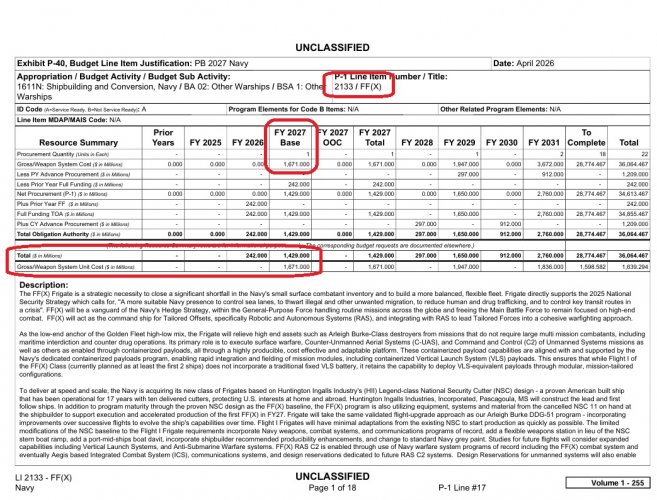
The latest US Navy Budget.
1671 million US$ for the first ship, 1947 million US$ for the second.
https://www.secnav.navy.mil/fmc/fmb/Documents/27pres/SCN_Book.pdf
Last edited:
I'm curious where you've heard about the newest FFGX costs?The difference is that you are trading what arguably would be the most capable anti submarine surface escort in the US Navy, one that would have 32 MK41 VLS and an AEGIS set by a ship that does not have VLS´s (or even a sonar...) and its air combat radar is a Sea Giraffe AMB... at between 63% (first FF(X)) and 75% (second FF(X)) of the cost of a Connie... The US Navy is trading a very, very capable heavy frigate by... a lightly equiped and armed OPV.
I'm curious where you've heard about the newest FFGX costs?
To the best of my knowledge, there have been no recent reports on Constellation design progress, construction or expected costs.
Sintra
ACCESS: Secret
- Joined
- 7 April 2008
- Messages
- 200
- Reaction score
- 548
I'm curious where you've heard about the newest FFGX costs?
They are not new, the budget for the two Connies was alocated in FY2025 and FY2026, the detailed costs are available in both the US Navy Budget 2026 and 2027.
I've put the link for the 2027 document right in the last post.
While its range (6000 nm), weaponry, and weight are oddly underwhelming for what the target capabilities which were promised, it is better than constant stops and starts and new direction changes. FFG(X) may not be a great ship compared to an Arleigh Burke, but it was not meant to be. Seems if anything they skimped on capability and threw a big price tag on it. Figure out the ridiculous costs in FFG(X) and maybe you figure out where the underlying problems really originate. Make the Constellation program better and make the Navy as a whole better.
We knew a multidomain approach would come...
https://www.marineinsight.com/china...track-u-s-nuclear-submarines-in-indo-pacific/
https://www.marineinsight.com/china...track-u-s-nuclear-submarines-in-indo-pacific/
aonestudio
I really should change my personal text
- Joined
- 11 March 2018
- Messages
- 3,381
- Reaction score
- 9,228

- Joined
- 6 November 2010
- Messages
- 6,360
- Reaction score
- 8,243
From TWZ:
Q: Why didn’t the Navy just take the base class and do minimal modifications to it? It became what seemed like a totally new ship.
A: That’s a great question, Howard, but I would need to speculate to answer that one, and I wouldn’t want to do that, because you’re right. But at the same time – what’s the saying? Hindsight is 20/20. It’s probably one of those occasions at this point. But it’s a great question. I’d love to be with you when we pose it to the right folks.
From TWZ:
He has to be careful and diplomatic in his responses because the Navy is his client.
In response to the Constellation disaster, the Navy is taking the bold and innovative step of putting someone in charges of shipbuilding projects and letting that person make decisions.
Radical stuff that.
What he's really saying is that NAVSEA couldn't get out of its own way and said one thing during the selection process, claiming that they would be flexible and would accept the intrinsic trade-offs of selecting a foreign parent design, then pivoted hard afterwards to insist on by-the-book alignment with every NAVSEA standard, irrespective of the cost-benefit trade-offs, schedule impact and whether NAVSEA's requirements were even materially better than foreign standards.In response to the Constellation disaster, the Navy is taking the bold and innovative step of putting someone in charges of shipbuilding projects and letting that person make decisions.
Translated for you below:
The way the Constellation class program was initially laid out and envisioned, potentially a lot of the things that were driving it may have been ahead of its time. Whileyou’rethe navy was sayingyouthey wanted to attempt to do one thing, but at the same timeyou’re not evolvingthey failed to evolve the wayyouthey executecan lead you to an undesiredwith disastrous effect.
And I say this because in my eyes, some of those lessons learned out of Constellation are being manifested in the things that the Navy has been rolling out the past few months – a new approach that empowers PAEs [Navy Portfolio Acquisition Executives] to make decisions, to minimize change, to embrace innovation and new technologies. All these elements that we see now being rolled out, I think to a certain degree, connect back to lessons that have been learned out of the Constellation class journey.
The navy failed to figure out whatyouthey want to prioritize, to what extent you want to prioritize schedule, and what’s the best way to say this? When you know when you need something delivered and at what pace, then enable the right level of decision-making to override stupid NAVSEA requirements. Because otherwise – I don’t want to sound this the wrong way – but NAVSEA cared more about perfectionsometimes is the enemy of more than good enoughthan having a real combat ship in the water.
Going beyond the Constellation class, now the needs are for vessels to be out there for the warfighter as soon as possible. For sure, we will see many cases where it will be considered that a vessel with these capabilities – even though potentially, in some areas, it may not have enough tons of steel on its sides, or whatever over engineered NAVSEA survivability requirement – it will be good enough to assist the warfighter as they head into harm’s way.
Those trade-offs are now being placed at the PAE level, allowing Navy leaders at that level to make the right decisions – figuring out whether to continue going down a design spiral to meet inflexible, gold-plated requirements versus just moving out with production and enabling us to have the right capabilities on time for the warfighter.
Had we kept on track with what was, back then, the principles that led to the selection – but also how it was originally set up – we probably would have kept closer to the original design. And thus allowing [us] to be closer to the original schedule. And thus allowing [us] also to build the vessel that was desired, without delays or major changes. You selected us in full knowledge that this was a foreign design, promised you would adopt a flexible approach to align design standards, then threw the book at us and spent years forcing us to jump through hoops rather than removing barriers to get this ship in the water.
On our end, from day one or day two – let me say that once the Navy decided their shift, we opted to consciously become a true partner and showcase that we are a true partner to the Navy and the nation. We said, ‘Okay, we will adjust, we will move forward’ Everyone knew moving away from the parent design was dumb but no one in the Navy wanted to put on their big boy pants and tell NAVSEA to take a hike so we played along with the fiction that you could change the whole design and not impact delivery.
Similar threads
-
 Royal Navy frigates in the 70s
- Started by uk 75
- Replies: 45
-
-

-