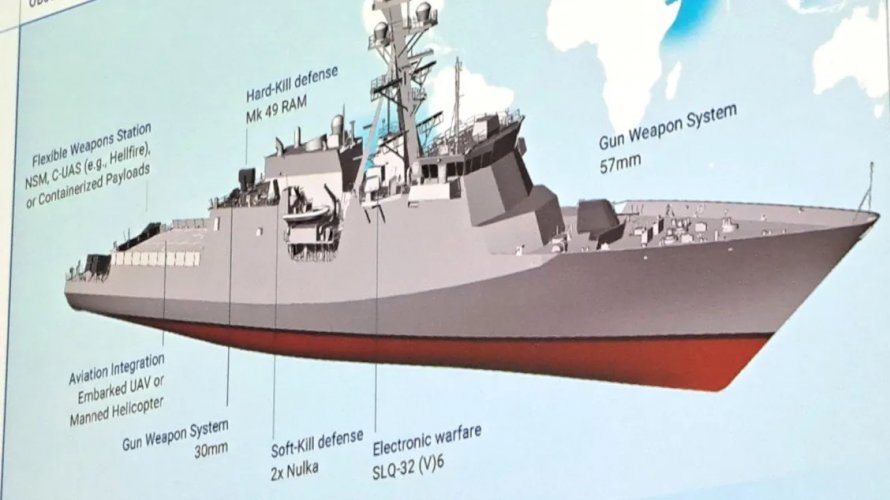
US FF(X) Program

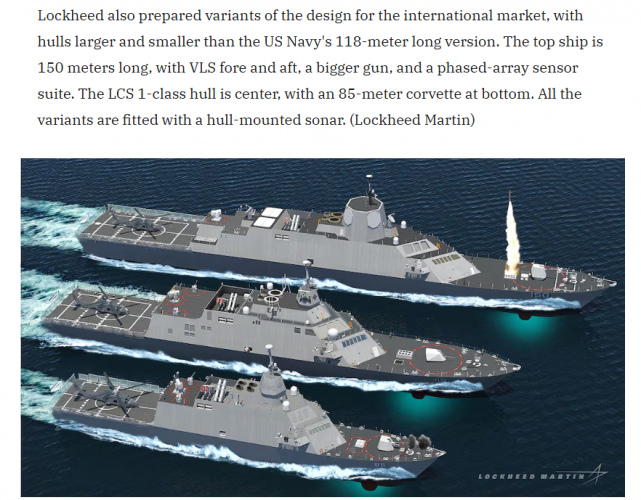
The MMSC is the one being made for the Saudi's, they don't seem to have the full-fat version as it supposedly can take up to 16 Mk41 tubes.

I see that Jonepaul has finally come around to my idea of MMSC after I poo-pooed the FFX enough.

 
SO. . .

A pair of SeaHawks
16/32 cell VLS w. ESSM / ASROC
57mm or 76mm
RAM launcher
Several Mk 38 gun mounts
8 NSM cells
If we can find volume or are using a trimaran hullform which grants a wide hangar, I'd like to increase the helo complement to "a pair of Seahawks and a pair of VTOL UAVs", assuming the VTOL UAVs are roughly half the size of a Seahawk.

Even with quad-packing ESSMs, 16 cells is kinda painful. 6x ASROCs means only 40x ESSMs. Plus, I suspect that someone is going to insist on strike-length cells so that the US can continue its tradition of Tomahawk Diplomacy. Which suggests a minimum capacity of 40-48 VLS with 8-16 Tomahawks loaded. 6x ASROCs is IIRC only 2 engagements, so I'd honestly expect a dedicated ASW ship to have more like 12-16x ASROCs. But let's continue assuming only 6x ASROCs, so we have 24 cells remaining out of that 40-48. Now we can add SM2s or Patriots to the main battery and could load ~16x SM2s/Patriots plus 32x ESSMs (or however you care to balance that load).

Gun I would prefer the 76mm because of DART and VULCANO ammunition, but it is unlikely for the USN to adopt a new caliber at this point.

Agreed on RAM launcher, might go so far as to ask for multiple. 1 is required, 2 would be better.

On the Mk38s, I would want a radar on the mounts in addition to the EOTS on the Mod4s. And I want 4 guns for coverage.

And yes, 8x NSM/Harpoon/whatever light AShM sounds right.

Propulsion ?
Speed ?
Displacement?
Propulsion is absolutely going to be IEP, so it doesn't matter what the prime movers spinning those generators are. High end generation is almost certainly gas turbines, hotel load could be diesels or GTs. Needs to be properly rafted/silenced for ASW work, however!

Edit: Needs to have at least double the battery capacity of current ships, so that you can normally operate the ship with the battery between 25-75% and always have a little extra space so your running generators can be pushed a little harder to get onto their best-efficiency setting.

Speed, if we're going to insist that this ship escort carriers, needs to be 30+ knots. Else we can accept ~25-28kts to stay with/ahead of merchant ships.

Displacement would be "however big the systems need it to be". If SPY6v3 needs 7000tons to be sufficiently stable then we have a 7000ton "ASW Frigate" and you tell Congress "that is how big the ship needs to be to keep the radar stable enough. Steel is cheap and air is free."
Judging on displacement jump from Spruance to Burke IIIs, we're likely looking at a minimum of 20% displacement growth over an FFG7. Which would suggest an absolute minimum size of about 5000tons with very little growth margin.
Displacement jump from Burke III to Zumwalt is 61%, which gets us to a minimum size of about 6600tons.
So, yeah, looks like 5500-6500tons is a not-unreasonable expectation for the FFG, and 7000 including extra growth margin.
 
Last edited:
The MMSC is the one being made for the Saudi's, they don't seem to have the full-fat version as it supposedly can take up to 16 Mk41 tubes.

I see that Jonepaul has finally come around to my idea of MMSC after I poo-pooed the FFX enough.

I was always in the MMSC/bigger independence camp from the announcement of the FFG(X) program. After that I said it should have been HII’s offer (even though it was never public it was always going to be a legend variant)

As a supporter of the LCSes for many years now the MMSC or the independence variant made the most sense. Hot production lines, cheapest options available most likely.
 
AEGIS/SPY-6 is a huge step up from the grand total of two channels of fire on the FFG-7.

Missile counts on the FFG-62 are 32 cells of VLS plus 16 NSM, so minimum of 48 missiles (plus more if any of those 32 are ESSM quadpacks).
So lets just replace it with zero VLS? Phelan seems to think its not a bad compromise. But in a way you can argue that 2 fire channels was suitable for an old frigate, but a new one needs to deal with a swarm. Space reserved for a big laser and multiple AD guns would seem to be mandatory on a new design.
One would have assumed that, because they're calling it a frigate, it would have similar roles and capabilities as previous US frigates like the OHP and Knox classes.
Yes, one would think so...
The Perry-sized hole in USN mission requirements. You may design your frigate as an OPV, but people are going to demand you use it to fill FFG-sized holes if you don't actually have any real FFGs.
Even if those people dont want to risk the FF(X) in a more demanding role, the commanders dont always have optimal choices available.
But the OHP and a Knox classes in and of themselves filled separate roles, particularly during the later years of their lives
You would probably find many combat ships fill a different role in the last few years before retirement. The point was the roles they were built for, and what role is currently a capability gap in USN.
This isn't to say I love FF(X) but the idea that fleet architecture shouldn't evolve is beyond me
But FF(X) isnt an evolution, its a stopgap until something can be found that it can do without being a liability. Maybe it can function somehow in cooperation with LUSV and MUSV, but I doubt theres an existing requirement for that (or that FF(X) is the best fit).
Ultimately the USN has quite successfully filled the air warfare role in the post 1991 world via masses of Burkes but has failed to fill the ASW role due to the outcome of DDG-1000 and the currently abortive acquisition of FFG(X).
I realise DDG-1000 would be quite a good ASW hunter, but it had too much other stuff added for ASW to be more than a secondary role (even if the concept started out as ASW).
Notably the composition of the PLAN forces different focuses on the USN than they had during the Cold War, and when we combine this with advances in technology I do not consider the OHP to be the best point of comparison for a modern USN frigate.
Exactly. But since the closest alternative reference is LCS, which doesn't have useful ASW propulsion even if the modules were amazing, the best reference probably ends up being Royal Navy.
I mean it can, but it doesn’t need to.
Pretty sure its not designed for the extra top weight of a steel superstructure. Change the centre of gravity too much and you either lose growth margin or redesign everything from the keel up.
 
The presence of AGS is overstated because it was so visible. The low observability features did not detract from the ASW role
AGS probably would have hardly been used even if its ammunition had more reach and less dollars, it just was designed around the concept of putting an expensive "exquisite" hull within range of virtually every truck mounted ASCM to be able to fire off its AGS rounds. Made sense at the time I guess.
That is a Command deal not a design deal.

If you can not stop youself from Micromanaging you crews or cannot Prioritizes tasking well you deserve what coming to you.

A burke captain if given the orders to hunt subs...
The commander needs assets available for competing tasks. You could say tactics are about what to do with available assets, while strategy is what assets can be built to enable winning tactics. Do you build 80 do-everything destroyers or have some optimised for tasks that would be the most demanding for a general purpose ship? The so called design decision is about providing the best options to the commander.
Bigger issue come from the old numbers game. And since the gear needed to do whatever is the expansive part of the ship, not the hull or engines which are the cheapest...

It pays to unified the designs to get economically of scale and all.
that has been the USN strategy for the last few years, but appears to have led to a fleet that is very good at missile defence, but struggles to do as well at other tssks. USN gets beaten in ASW exercises every single time. Notto mention the "hull and engines" being less than ideal for modern ASW against quiet submarines, and in future even quieter UUVs.
60 Zumwalts be cheaper then 30 Constellations both in price tag and crews, which is honestly the bigger limiting factor then the gear. With those Zumwalts, even the cut down versions being as good as an ASW hunter as the Connies. The Full Bore ones be a submariner nightmare. And 60 Zumwalts give you far more ASW coverage then 30 Connies just from numbers.
Do you really think you ever had a chance of getting 60 Zumwalts? And comparing first-of-class costs doesnt look like the 20th Zoomie was ever going to be half the price of the 20th Connie. And if you say cut down Zumwalt, the cut down bits would be (and turned out to be) the AAW fit and guns. So yeah kind of turning it into a Connie. Its all hypothetical now, only one of those options is in production.
Only when you limit the purposes to single use does that change.

However comma, if you go for single uses designs. You CANNOT bitch when said design has no Add abilitie worth the Name cause that the opportune cost for you.
I think the whole debate about FFG(X) vs FF(X) is about multirole vs single role, and functional vs nasty. So I agree with you that FF(X) will suck at almost everything, except that we arent really sure its going to fill any role at all. Something about "drone mothership" but havent seen any info about having a CIC capable of that.
 
AGS probably would have hardly been used even if its ammunition had more reach and less dollars, it just was designed around the concept of putting an expensive "exquisite" hull within range of virtually every truck mounted ASCM to be able to fire off its AGS rounds. Made sense at the time I guess.
A stealthy hull at the time when there were very few AShMs with the legs to reach it.

The "coastal artillery" role means you only have about 30km range to see the target. Anything beyond that requires the trucks to have MPA spotting for them, and the MPAs could engage anyway.
 
A stealthy hull at the time when there were very few AShMs with the legs to reach it.
Only if you don't want to engage any deeper ashore than the surf line. Development time was not kind to the assumptions behind Zumwalt, or the entire From the Sea doctrine.

If you're kind and match the 150km AGS vs 2010 AShMs (first AGS delivery rather than 2016 for Zumwalt's commissioning date), then available AShMs would include:

Iran
Noor Phase 2, range = 130km
Noor Phase 3, range = 170km
Kader, Range = 200km

Russia
SSC-6 Sennight/Kh-35 Uran/Bal, range = 130km
SSC-7/P-270 Moskit/3M80E, range = 120km

Moving the timeline up to date brings in things like:
China
CX-1, range = 280km
YJ-12/CM-302, range = 460-500km
YJ-15, range = ?
HD-1, range 290km
CJ-1000, range =?

Iran:
Ghadir, range 300km
Khalij-e Fars, range 300km (ASBM)

Russia:
SSC-5 Stooge/K-300P Bastion N, range = 300km
SSC-12/P-270 Moskit/3M80MVE, range = 140/240km
Klub-K+3M54T Kalibr, range = 660km
3M22 Tsirkon, Range = 1000km

North Korea
KN-19/Kumsong-3, range = 240km

Ukraine
Neptune, range = 280km

Vietnam
VCM-01, range = ? (Uran derivative)

India
BrahMos, range = 8-900km
NASM-MR, range = 350km? (trials due this year)

 
Last edited:
AGS probably would have hardly been used even if its ammunition had more reach and less dollars, it just was designed around the concept of putting an expensive "exquisite" hull within range of virtually every truck mounted ASCM to be able to fire off its AGS rounds. Made sense at the time I guess.
Not all wars are the same, but it seems to me that 32 DDG-1000s with their AGS would be pretty useful in the current conflict with Iran.
 
AGS probably would have hardly been used even if its ammunition had more reach and less dollars, it just was designed around the concept of putting an expensive "exquisite" hull within range of virtually every truck mounted ASCM to be able to fire off its AGS rounds. Made sense at the time I guess.

Blame the Marines. AGS/VGAS Objective range was defined by the need to counter-battery D-30 122mm guns firing at a Marine beach crossing point from 25 nautical miles offshore. That standoff was chosen because it was expected that ships could detect and engage ASCMs with that much lead time.

This wasn't a number totally picked out of a hat. LPD-17 was based around the same standoff range, launching AAAVs from 25nm offshore. That in turn drove the AAAV's 25 kts water speed, because about 1 hour (plus some staging time) was about the longest troops could ride in a floating amtrack and land in something like combat-ready condition. The AAAVs would be supported by tanks landed via LCAC.

And only "exquisite" ships could be expected to survive inside 25nm. You needed both signature reduction and competent self-defense capabilities to pull it off. Losing the VLS and thus the enhanced self-defense capability on the LPDs was the first sign of the whole 25nm offshore concept falling apart. But even without VLS on the amphibs, one might expect a couple of DD-21s to defend themselves and a small force of forward amphibs during a quick landing operation. The larger LHAs and less-protected LSDs would stand further offshore, using helos to launch their assault forces and then sustaining the landing using LCUs and LCACs, ideally from closer to shore, once the coast defense threat was worn down.
 
Only if you don't want to engage any deeper ashore than the surf line. Development time was not kind to the assumptions behind Zumwalt, or the entire From the Sea doctrine.

If you're kind and match the 150km AGS vs 2010 AShMs (first AGS delivery rather than 2016 for Zumwalt's commissioning date), then available AShMs would include:
Zumwalt as it was designed, would've been an absolute game changer v Iran. 1 horizon stand off is sufficient to guarantee effectively normal engagement v low flying ASCMs (with very significant seeker problems due to low rcs hull).

At the same time, it also would've provided an effectively unlimited pool of ammo for MALEs(and, more persistently, small drones) to work with in coastal areas.

Either Zumwalt or an adequate state of the LCS program would've effectively allowed to lock Iran out of its own Gulf and Strait.
But there's no Zumwalt, and LCS surface combat capability is a joke when benchmarked against the evolution of the threat. FFGX is stillborn, too.
Russia:
SSC-5 Stooge/K-300P Bastion N, range = 300km
SSC-12/P-270 Moskit/3M80MVE, range = 140/240km
Klub-K+3M54T Kalibr, range = 660km
3M22 Tsirkon, Range = 1000km
Some of those ranges are substantially wrong, but more importantly, most of these are mounted exclusively or primarily on mobile platforms, and this is the case since the 1950s(i.e., for over 70 years at this point). This makes any range comparisons between stand-off and stand-in systems fundamentally irrelevant, unless the plan is to silence MG nests with MRBMs.
 
Last edited:
most of these are mounted exclusively or primarily on mobile platforms, and this is the case since the 1950s(i.e., for over 70 years at this point). This makes any range comparisons between stand-off and stand-in systems fundamentally irrelevant, unless the plan is to silence MG nests with MRBMs.
That depends alot on the set up of hte launchers, and their fire and move times.

There is alot to be said to be hidden in a hid say 5 miles inland, pop out, fart off 4 missiles at a ship and booking it before the ship has a change to respond with counterfire, be it gun missile or drone.

That is if you cant remote the launch. IE drop the trailer with the missiles here camo all up, ad fuck off wth the prime mover say 1km that way, easy to do with fiberoptic wire.

Use spotters or datalinks to get the target data, fire when ready, drive leasuriely away cause they are looking THAT way and not This way.

All this relies on being able to do that shot and scoot work with the launch, cause if you are still there five minutes after the first missile launches....
 
Only if you don't want to engage any deeper ashore than the surf line. Development time was not kind to the assumptions behind Zumwalt, or the entire From the Sea doctrine.

If you're kind and match the 150km AGS vs 2010 AShMs (first AGS delivery rather than 2016 for Zumwalt's commissioning date), then available AShMs would include:

Iran
Noor Phase 2, range = 130km
Noor Phase 3, range = 170km
Kader, Range = 200km

Russia
SSC-6 Sennight/Kh-35 Uran/Bal, range = 130km
SSC-7/P-270 Moskit/3M80E, range = 120km

Moving the timeline up to date brings in things like:
China
CX-1, range = 280km
YJ-12/CM-302, range = 460-500km
YJ-15, range = ?
HD-1, range 290km
CJ-1000, range =?

Iran:
Ghadir, range 300km
Khalij-e Fars, range 300km (ASBM)

Russia:
SSC-5 Stooge/K-300P Bastion N, range = 300km
SSC-12/P-270 Moskit/3M80MVE, range = 140/240km
Klub-K+3M54T Kalibr, range = 660km
3M22 Tsirkon, Range = 1000km

North Korea
KN-19/Kumsong-3, range = 240km

Ukraine
Neptune, range = 280km

Vietnam
VCM-01, range = ? (Uran derivative)

India
BrahMos, range = 8-900km
NASM-MR, range = 350km? (trials due this year)
I mean I see 4 missiles that could be destroyed by AGS outside of their range.

TLAM the longer ranged missiles, at least some of them, but most importantly their radar systems, and then use AGS for the shorter ranged ASMs.

You could even go a few miles within their maximum range, to fire and simply sail out of Ranger after launch and keep firing the whole time.
 
That depends alot on the set up of hte launchers, and their fire and move times.

There is alot to be said to be hidden in a hid say 5 miles inland, pop out, fart off 4 missiles at a ship and booking it before the ship has a change to respond with counterfire, be it gun missile or drone.

That is if you cant remote the launch. IE drop the trailer with the missiles here camo all up, ad fuck off wth the prime mover say 1km that way, easy to do with fiberoptic wire.

Use spotters or datalinks to get the target data, fire when ready, drive leasuriely away cause they are looking THAT way and not This way.

All this relies on being able to do that shot and scoot work with the launch, cause if you are still there five minutes after the first missile launches....
Just like with SAM batteries the real method of neutralizing them is to destroy the radars that would be detecting targets and possibly guiding them.

A radar that can see that far off shore isn’t packing up and moving in anything like a short time period.

A 500km range is useless if the launcher vehicle doesn’t have eyes to tell the missiles where to go.
 
The amount of civilization within 200 km of the shore is quite astonishing. Not every target will threaten to hit back. Not many perhaps, because effective shore-launched AShMs is still largely to be proven. Until then the gun has plenty of room to operate.
 
The amount of civilization within 200 km of the shore is quite astonishing. Not every target will threaten to hit back. Not many perhaps, because effective shore-launched AShMs is still largely to be proven. Until then the gun has plenty of room to operate.
I mean we have at least 4 examples of successful ASM strikes launched from shore.

‘67- sinking of the eilat
‘80s- Iran launches during the tanker war
‘06- hezbollah strike against Israeli corvette(sa’ar 3 iirc)
‘22- ukrain sinking Moskva
 
I mean we have at least 4 examples of successful ASM strikes launched from shore.

‘67- sinking of the eilat
‘80s- Iran launches during the tanker war
‘06- hezbollah strike against Israeli corvette(sa’ar 3 iirc)
‘22- ukrain sinking Moskva
And one in Falklands. But once drones were able to provide targeting instead of an MPA, you needed to be very aware of your enemy's capabilities and 32 Zumwalts would have been cancelled as soon as that was obvious.

In the event we never had to wait for that. So of course DDG1000 isnt going to be getting too littoral anymore. If you stripped out half the VLS, replace the guns, add useful closein defences, and delete anything unnecessary, you probably still costing more than a serial production Constellation. At least would be more useful than a Legend, the CIC might even be just what you need for modern drone fleets.
 
Only if you don't want to engage any deeper ashore than the surf line. Development time was not kind to the assumptions behind Zumwalt, or the entire From the Sea doctrine.
Oh, absolutely.

I'm still surprised how quickly AShMs got longer ranged compared to how long it took to field Zumwalts.
 
I mean I see 4 missiles that could be destroyed by AGS outside of their range.
That presumes you know where they are, which for a vehicle capable of hiding inside any warehouse or similar is problematical (and then there's the known, but heavily fortified, Russian launch sites such as Oбъект 100 which were designed to survive nuclear strikes). And during a landing operation you can't wait out of range for the launchers to reveal themselves, you have to move close enough inshore to interdict targets tens of miles beyond the shoreline.

Land Attack in the Zumwalt's mission is not an end to itself, but an enabler for amphibious operations, and the ships of the ARG have no option but to move (relatively) close inshore, even with LCACs as connectors.
 
Last edited:
Just like with SAM batteries the real method of neutralizing them is to destroy the radars that would be detecting targets and possibly guiding them.

A radar that can see that far off shore isn’t packing up and moving in anything like a short time period.

A 500km range is useless if the launcher vehicle doesn’t have eyes to tell the missiles where to go.
Did you entirely miss the Russian focus on ESM for AShM targeting? The land-based variant of Mineral ME-2 is road-mobile, and can supposedly monitor 50 targets at 450km in passive mode.

On top of which there's airborne MPAs and ELINT platforms, OTH radar that can be well outside the combat zone (I'd be surprised if 2B96 Container, range 3000km plus, doesn't have a maritime search mode, and Podsolnukh, 450km range, definitely does), space based ocean surveillance radar (Kondor, plus likely the Chinese Huanjing), plus the known Russian capability for missiles such as SSN-12/Granit/Vulkan conducting their own targeting with one missile in scout mode doing active search and the entire salvo organising its own targeting, which obviously has potential for inclusion in later missiles.
 
It was always a flawed premise as you can make a 50% longer ranged missile in wartime in a few months by extending the fuel tanks and/or reducing warhead size where as you need a decade ish for a ship design, build, and comissioning.

I was always in the MMSC/bigger independence camp from the announcement of the FFG(X) program. After that I said it should have been HII’s offer (even though it was never public it was always going to be a legend variant)

As a supporter of the LCSes for many years now the MMSC or the independence variant made the most sense. Hot production lines, cheapest options available most likely.
No the MMSC is too anemic for FFG(X). I only bring it up as it's less shit than FFX, and it's ready to be build today for lower cost.
 
That presumes you know where they are, which for a vehicle capable of hiding inside any warehouse or similar is problematical (and then there's the known, but heavily fortified, Russian launch sites such as Oбъект 100 which were designed to survive nuclear strikes). And during a landing operation you can't wait out of range for the launchers to reveal themselves, you have to move close enough inshore to interdict targets tens of miles beyond the shoreline.

Land Attack in the Zumwalt's mission is not an end to itself, but an enabler for amphibious operations, and the ships of the ARG have no option but to move (relatively) close inshore, even with LCACs as connectors.
As I said, you don’t target the launchers, you target the radar. It will be emitting to see you which means you’ll be able to see it and hit.

Trying to hit individual launchers weather ASM or SAM, is a game of whack-a-mole, and there’s a lot more launchers than there are sensors.
 
It was always a flawed premise as you can make a 50% longer ranged missile in wartime in a few months by extending the fuel tanks and/or reducing warhead size where as you need a decade ish for a ship design, build, and comissioning.


No the MMSC is too anemic for FFG(X). I only bring it up as it's less shit than FFX, and it's ready to be build today for lower cost.
FFG(X) doesn’t need to be a light destroyer in a fleet with 90 heavy destroyers.

In 2019 the cost for the entire MMSC program was $1.9b for a total of $490m per hull.
Thats the price range we need to be in for our frigate program. Some thing we can afford to build 50+ total and several per year.


You also don’t need to design a ship to counter longer ranged missiles. You just need to increase the gun range.
Sub caliber rounds is an option for example.
 
Last edited:
FFG(X) doesn’t need to be a light destroyer in a fleet with 90 heavy destroyers.

In 2019 the cost for the entire MMSC program was $1.9b for a total of $490m per hull.
Thats the price range we need to be in for our frigate program. Some thing we can afford to build 50+ total and several per year.
IMO we need to be pushing XLUSVs to the point they are large enough to haul a decent towed array or two, and use those for our FF needs.**

Something big enough yet cheap enough for each combat ship in the USN to have 3 hanging around it, with control capabilities for many more.

Edit: ** Still need FFGs to act as control nodes for the XL-USVs, though.
 
Last edited:
IMO we need to be pushing XLUSVs to the point they are large enough to haul a decent towed array or two, and use those for our FF needs.

Something big enough yet cheap enough for each combat ship in the USN to have 3 hanging around it, with control capabilities for many more.
I don’t disagree on utilizing USVs, but we still need manned small surface combatants and in fairly large numbers whether they’re LCSes, FFs with or without the G designation, we need ships that can do the peacetime jobs that burkes are way too much for.

We need ships in wartime to escort MSC and civilian ships, as well as covering secondary and tertiary theaters, or support the burkes in the primary theater.
 
I don’t disagree on utilizing USVs, but we still need manned small surface combatants and in fairly large numbers whether they’re LCSes, FFs with or without the G designation, we need ships that can do the peacetime jobs that burkes are way too much for.

We need ships in wartime to escort MSC and civilian ships, as well as covering secondary and tertiary theaters, or support the burkes in the primary theater.
Fair point. I need to clarify that post. We still need FFGs, if only as controllers for those XL-USVs.

In the Cold War the USN had ~120 FF+FFGs and when the US got rid of all the frigates we really lost out on the raw hull numbers to be doing all the peacetime jobs.
 
FFG(X) doesn’t need to be a light destroyer in a fleet with 90 heavy destroyers.

In 2019 the cost for the entire MMSC program was $1.9b for a total of $490m per hull.
Thats the price range we need to be in for our frigate program. Some thing we can afford to build 50+ total and several per year.
Ship design is a tradeoff between what you need/want and what you can get. Also, you focus so much on labelling something a destroyer that you miss (again) their comparative capabilities. Burke is rubbish at ASW against modern subs, has no mission bay, requires large crews, and is optimised and trained for AAW. FFG complements that and can defend
Sub caliber rounds is an option for example.
Those are pretty much antimissile rounds, and I doubt they outrange the next generation of ASMs, even if you go hunting their radar systems. A UAV or satellite will spot you first.
IMO we need to be pushing XLUSVs to the point they are large enough to haul a decent towed array or two, and use those for our FF needs.**
It does sound like that might be the default FF(X) plan, until someone discovers its not much good at that either. I thought the MUSV (that was) had towed arrays already. Would be interesting to see another MUSV that can do a low cost air/surface picket with small radar and maybe a 40mm gun. Basically a self contained CIWS on its own hull, to escort the FF...
Something big enough yet cheap enough for each combat ship in the USN to have 3 hanging around it, with control capabilities for many more.

Edit: ** Still need FFGs to act as control nodes for the XL-USVs, though.
Yeah LUSV as the missile barge, especially if FFGs are in short supply.
 
Zumwalt as it was designed, would've been an absolute game changer v Iran. 1 horizon stand off is sufficient to guarantee effectively normal engagement v low flying ASCMs (with very significant seeker problems due to low rcs hull).

You don't need stealth in a 25 mile wide waterway, it's positively contra-indicated when anyone on a tall-ish building can see you and control drones and missiles all the way into your exquisitely expensive superstructure. (One hit and bye-bye low RCS).

At the same time, it also would've provided an effectively unlimited pool of ammo for MALEs(and, more persistently, small drones) to work with in coastal areas.

Unlimited? When every car or window may hide someone with a Shahed or similar? The unlimited ammo problem is pointing the exact opposite way you seem to think.
Some of those ranges are substantially wrong,

Is that like being a little bit pregnant? Because as long as the other guy has one system that can reach you ....

but more importantly, most of these are mounted exclusively or primarily on mobile platforms, and this is the case since the 1950s(i.e., for over 70 years at this point). This makes any range comparisons between stand-off and stand-in systems fundamentally irrelevant, unless the plan is to silence MG nests with MRBMs.
They're mobile, so they're irrelevant? Seriously? There's only two questions here: how close inshore did a Zumwalt need to be for its AGS CONOPS (25 miles, we know this), and secondly, could the other guy reach out and touch it at that range? That was already starting to be the case when the first AGS was delivered, it was definitely the case when Zumwalt finally commissioned, and its far worse nowadays, when even Vietnam and North Korea are building coast defence systems that outrange AGS.

Of course the situation was even worse for LCS because Netfires PAM was canned before it ever saw service (and only had 25 miles range anyway)..
 
Last edited:
You don't need stealth in a 25 mile wide waterway, it's positively contra-indicated when anyone on a tall-ish building can see you and control drones and missiles all the way into your exquisitely expensive superstructure. (One hit and bye-bye low RCS).
Ship stealth, almost always(maybe extreme cases are different), isn't about being invisible, it's about being troublesome to radars and seekers(including behind countermeasures and/or between other signatures).
As everyone could see, Iranian radar seekers aren't exactly world beaters.

Unlimited? When every car or window may hide someone with a Shahed or similar? The unlimited ammo problem is pointing the exact opposite way you seem to think.
750 rounds(engagements), easily replenishable at sea. We're comparing to single digit ammo count(on MALEs, nothing on smaller drones), going directly against loiter time and altitude.
While it is probably ineffective for Israeli approaches to urban warfare(155 guided rounds aren't really good for that in the first place), this will satisfy just about any sensible ability of the current drone fleet to identify targets.
Is that like being a little bit pregnant? Because as long as the other guy has one system that can reach you ....
The other guy in the quote flies, sails nuke submarines, and so on.
The range off the coast is absolutely irrelevant; for SSGN, you're equally vulnerable 25 miles off and 250 miles off coast.
Threat instead is defined by redfor missile pool(at sea and overall, as these are high-end missiles with highly limited available stock), making threat levels effectively "flat".

You have to be able to defend (or assume you can not, and sometimes luck is just not on your side) against this threat regardless of proximity to the coast.
 
Last edited:
Ship design is a tradeoff between what you need/want and what you can get. Also, you focus so much on labelling something a destroyer that you miss (again) their comparative capabilities. Burke is rubbish at ASW against modern subs, has no mission bay, requires large crews, and is optimised and trained for AAW. FFG complements that and can defend

Those are pretty much antimissile rounds, and I doubt they outrange the next generation of ASMs, even if you go hunting their radar systems. A UAV or satellite will spot you first.

It does sound like that might be the default FF(X) plan, until someone discovers its not much good at that either. I thought the MUSV (that was) had towed arrays already. Would be interesting to see another MUSV that can do a low cost air/surface picket with small radar and maybe a 40mm gun. Basically a self contained CIWS on its own hull, to escort the FF...

Yeah LUSV as the missile barge, especially if FFGs are in short supply.
We have missiles for taking out satellites and UAVs.

Doesn’t matter if Burke wasn’t designed for ASW, constellation class didn’t need to be a 7k ton ship with top tier radar in order to be the fleet’a ASW platform.
 
Hi,
I was under the impression that most of the size requirement was driven by the US Navy deciding that any modern surface combatant would have to meet a certain set of minimum defensive an survivability requirements that drove the overall ship size up, including a certain minimum radar fit to detect and track the latest expected threats and having a certain degree of separation of some of the critical stuff onboard. I would guess if the Navy goes back a decides instead that a new class of surface combatant won't be expected to operate independently in high-threat areas then maybe they might be able to meet a reduced radar requirement and/or defense and survivability requirement and a smaller ship like a militarized WMSM/NSC based platform could be acceptable.
 
I kind of like the Vixby and how they set it up. The downside is it basically has worse crew accommodations than an LCS will supplies for only 14 day missions. Really limits the utility of the concept.
 
Hi,
I was under the impression that most of the size requirement was driven by the US Navy deciding that any modern surface combatant would have to meet a certain set of minimum defensive an survivability requirements that drove the overall ship size up, including a certain minimum radar fit to detect and track the latest expected threats and having a certain degree of separation of some of the critical stuff onboard. I would guess if the Navy goes back a decides instead that a new class of surface combatant won't be expected to operate independently in high-threat areas then maybe they might be able to meet a reduced radar requirement and/or defense and survivability requirement and a smaller ship like a militarized WMSM/NSC based platform could be acceptable.
To be honest, a lot of it has to do with the 'floor' for an FF/FFG rising so high within a scant few decades. The FFG became a mini-Burke because that's the new 'floor'. Like how destroyers went from a few hundred tons to just short of 6k tons in a handful of decades.

The FF program is likely to hit the same situation: a Congress unable (or unwilling) to understand that the situation has changed and the military is unable to do anything about it because its right to tell Congress they're being complete idiots has been stripped from them.

I wouldn't be surprised if we're going to have a BeuOrd situation...
 
Currently FFX is likely the results of a corrupt administration looking for kick backs.

Not to say that congress is not also problematic
 
Currently FFX is likely the results of a corrupt administration looking for kick backs.

Not to say that congress is not also problematic

More likely the result of a shipbuilding process NAVSEA/Industry that can't build ships anymore.

FFX is about building what you can, not what you want.
 
A competent security of the navy wouldn’t have ordered these. As we’ve been over many times, they won’t arrive until FFGX does and they serve little purpose
 

Similar threads

Back
Top Bottom