(this vid shows the A&AEE test, fast taxi over the grass at Farnborough, over concrete slabs and a taxiway to prove it could handle varying terrain - yes its lightly loaded and no weaps, but that was the original ethos of the ECAT programme, a light fighter that could use grass)
And is particularly attractive for each country who has at its borders an potential enemy who has the airbases in the range of it`s ballistic and cruise missiles. The recent strikes on american facilities from the Gulf area have demonstrated that not even the strongest military in the world isn`t able to fully protect it`s airfields.
But no airbases have been operationally knocked out.
Airbases are notoriously hard to totally destroy unless you lob a nuke at them. Using cruise missiles or drones to dismantle them building by building is not really cost effective.
First of all: The Swedish road basing system Bas 90, and which traces it’s origins to the 1950’s, was not done because Sweden “lacked runways”: It was a premeditated decision based on the then head of the SwAF Nordenskiöld’s visit to Germany after the war, and inspired by the Germans use of Autobahn sections as runways. And the SwAF realized early on that much as the Luftwaffe’s air operation were curtailed by the Allies in the later stages of the war, so would the SwAF’s be by the Warsaw Pact’s numerical superiority in any future conflict.
And while MTBF numbers of course are extremely important, you also need to consider HOW you know what is wrong and how EASY it is to fix. And can it be done in the field with conscripts, or do you need a heated hangar and skilled technicians. And if you start off with clean sheet of paper, and one of the design requirements is that you should be able operate the aircraft in austere conditions and with minimal conscript crew, as has been the case in Sweden since the 1960's, you DESIGN IN certain features from the beginning, like what is most likely to fail? How can we distribute functionality in such a way that we will minimize the amount of test equipment needed in the field (Gripen’s BIT testing is designed with this in mind) and minimize the amount of LRU’s they need to stuff in the 20-foot container? FOD damage will be inevitable, so let’s design the engine for easy changeout, and re-use those nifty hand operated load cranes to do it etc. I’m sorry, if you can’t understand the difference between designing in such features from the beginning, compared to taking an aircraft that was designed to be serviced by a host of skilled technicians in a warm hangar surrounded by a lot of fancy test equipment, and press ganging that to road base service then I can’t help you.
Then when it comes to air intakes: You can’t just measure the distance from the ground up to the lower lip of the air intake and make a ruling on the risk of FOD damage based on that: It’s much more complicated than that because it also depends on the size of the air intake area, the mass flow (i.e. engine thrust). I never worked with this myself, but I’ve seen study results from the research institute FFA for dorsal inlets and comparisons to side- and ventral inlets and know SAAB just didn’t slap on the side inlets without thought: This was done because it turned out to be the best compromise and that dorsal inlets, while fantastic in many ways, were struck off the list because of strake vortex ingestion when you got a sideslip component. Ventral inlets were also considered because they were fantastic aerodynamically, but not from a FOD perspective.
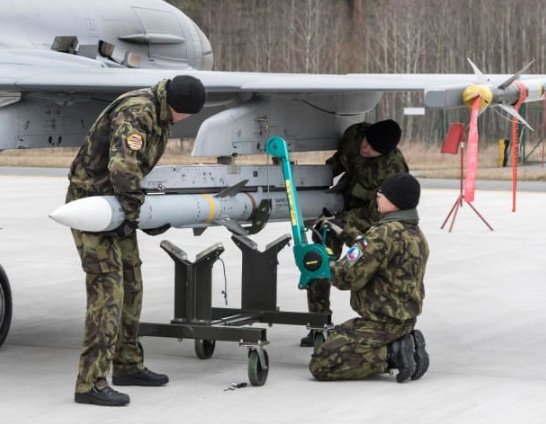
Finally, I've always thought that the below hand operated loading crane was something unique to Swedish road base operations:
But no airbases have been operationally knocked out.
Airbases are notoriously hard to totally destroy unless you lob a nuke at them. Using cruise missiles or drones to dismantle them building by building is not really cost effective.
To be fair, nuke is absolutely a valid concern for a european war.
Nuke and risks of both ubiquitous space sensor coverage and the lack of it (via denial or destruction).
Russia doesn't really plan to destroy specific infrastructure types conventionally, you can say it just from the lack of munition categories Soviet union had (airfield cratering being one of them).
Overall, I believe we had this conversation before. Gripen isn't unique in how it can be operated away from established basing - aircraft isn't ITER. Even Tu-95s were operated from makeshift remote ice airstrips during the cold war, when weather forecast predicted nukes.
But, it is:
-smallest(easiest to hide, fits under normal trees and in many non-aircraft warehouses; easiest to supply with enough fuel);
-built for dispersal specifically(lower base support equipment footprint, easier access to service in simpler conditions), plus it's swedish(usually helps).
-built for austere/contested basing operations specifically (heavy chassis, some key support equipment onboard rather than on the ground, priority attention to FOD).
-already has a mobile, concealed support equipment ecosystem.
-relies on the most accessible western weapon ecosystem in the world(Hi Rafale).
Nothing in this list is too extreme, this is indeed not a VTOL. But you can expect to get the most out of your limited resources, if pushed into a desperate defense against a larger opponent.
Before WWII the germans recruited civilist's, spies, accross the UK, And in wartime they reported everything, the movement of troops, logistics, airfields, ships etc.
Because the British counter intelligence effort is seen as the model of how to do it...post war analysis found that the German's had no spies of note operating...none that hadn't been caught by British Intel and turned anyway....
Regarding the number game, we must consider the local conditions. In Europe for example the road network is very dense. Each country usually has thousands of kilometers of motorways and tens of thousands kilometers of higways and local roads covered in tarmac. You can`t bomb each strip of several hundred meters long straight road.
Nor can you use the overwhelming amount of that road network without extensive preperation...90% of it would be unusable regardless of the prep...
They're not normal roads in use in Sweden and Finland.....they're specially prepared, designed and maintained....just like runways in fact....street furniture, cabling, medians, dividers, turning areas, vegetation, drainage, strengthening of the road surface...etc etc...
Well they kind of did have few runways...and still do in large parts of the country....that wasn't a huge issue in Western Europe during the Cold War...
That will often be a function of the RoE, the logistics system (i.e. how many spares does one have and how quickly) and also how one measures it (are we saying every system on the aircraft are serviceable and it is Full Mission Capable or are only enough are serviceable to allow it to take off but not do much more).
And is particularly attractive for each country who has at its borders an potential enemy who has the airbases in the range of it`s ballistic and cruise missiles. The recent strikes on american facilities from the Gulf area have demonstrated that not even the strongest military in the world isn`t able to fully protect it`s airfields.
And yet, as has already been stated a number of times, the features you are talking about are not inherent in the Gripen design itself but rather the broad system itself...and that is not what Saab are selling.
How can we distribute functionality in such a way that we will minimize the amount of test equipment needed in the field (Gripen’s BIT testing is designed with this in mind) and minimize the amount of LRU’s they need to stuff in the 20-foot container?
Actually the number of LRUs needed is driven more by the reliability of said LRUs along with the planned RoE of flying - a part that breaks on average every X number of flight hours doesn't lessen in demand just because it is easier to replace on the platform. It is something that a well done Logistics Support Analysis (LSA) program during the initial acquisition phase (and kept up to date throughout the life of the program ideally since new failure modes inevitably appear the longer they are in service) should address. What easier access/maintainability will do for you (assuming the spares are available) is speed up the TAT. It won't lessen the quantity of spares needed though.
compared to taking an aircraft that was designed to be serviced by a host of skilled technicians in a warm hangar surrounded by a lot of fancy test equipment,
Nice little false equivalence argument trying to be used there. Let's go with it though: dare I say that most humans (highly trained technicians or basic trained conscripts - though I believe you will get better results and greater flexibility with the former than the latter) will prefer the warm dry environment (or cool depending upon the environment - remember not everyone operates in the Swedish or even European environment) to work and if you have the latter you will find there is greater endurance of their ability to operate.
BTW, when it comes to comparing BIT (not exactly a new concept or one unique to Gripen) to traditional external systems, one could possibly go even further and look at the type of systems introduced on the F-35 which has taken lessons from the airline industry, being able to advise its support teams what is broken/potentially breaking before it even gets back on the ground...thus allowing parts to be ready to be used.
Because the British counter intelligence effort is seen as the model of how to do it...post war analysis found that the German's had no spies of note operating...none that hadn't been caught by British Intel and turned anyway....
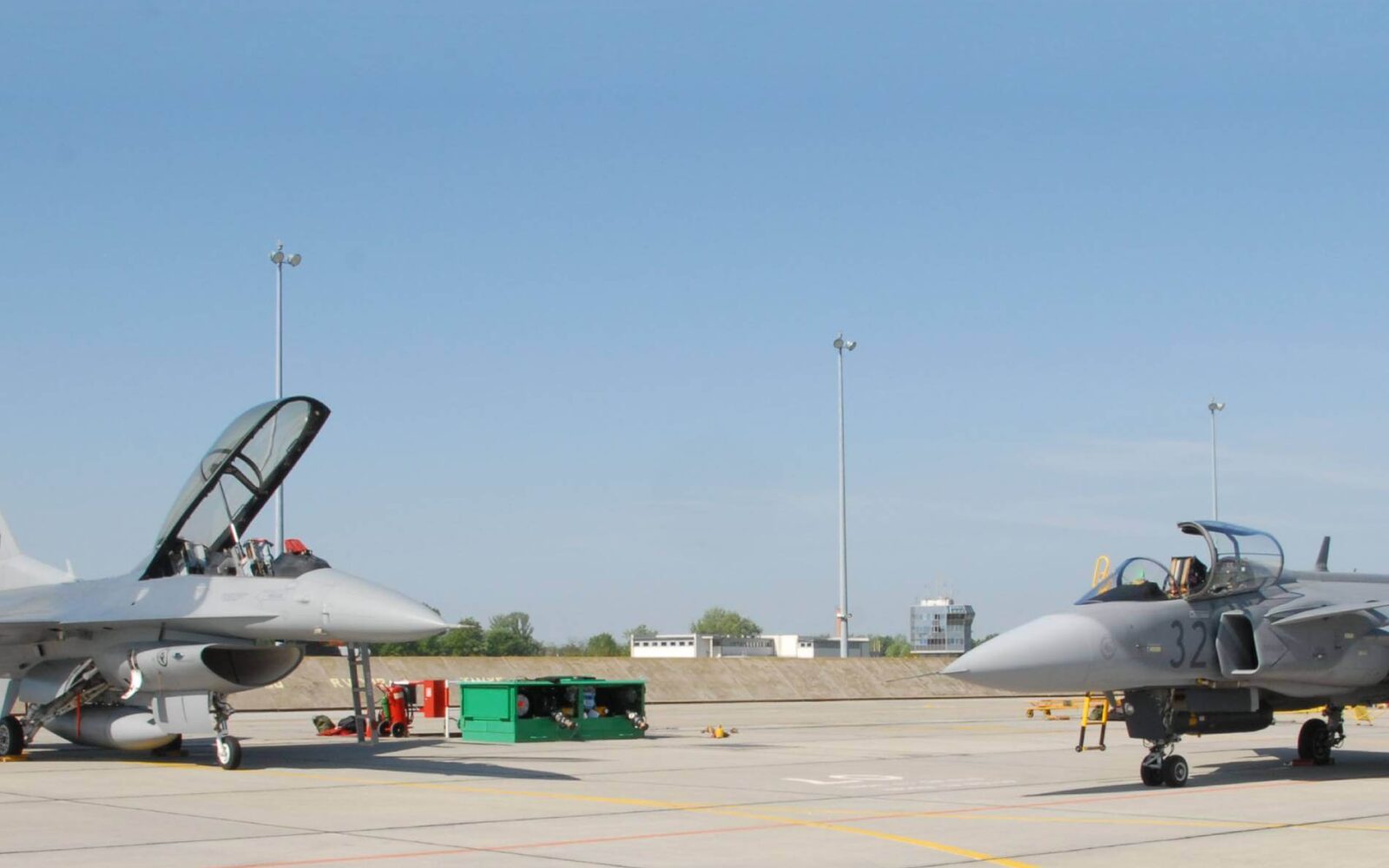
I haven't done the exact measurements (feel free somebody to do so) but a quick side-by side would appear to indicate that there is not much difference in height of the comparative intakes:
The F-16, despite its under fuselage intake does have an arguable advantage in that the nose wheel is behind it though so less chance of throwing debris up. either way, I know of no air force who will willingly operate from dirty runways if they have an ability to avoid doing so. Forgetting intake issues, just avoiding tyre issues or other under fuselage damage is something most try to avoid. I seriously doubt there is much to distinguish between various types here.
BTW, at min 14:30 you can see the pilot beside the air intake. The lower site starts at shoulder level.
In comparisson, a F-16 tour. At min 9:15 you it can be seen that the air intake is significantly lower. Upper side ends at shoulder level.
The debris thrown by the front wheel is not the biggest problem, but the dirt already existing on the runway. Even a missing hit which lands beside the tarmac will contaminate with a significant amount of dirt the runway, and this can be sucked by the passing by aircrafts.
I used some scale drawings, and as far as I can see the Gripen E's lower lip on the air intake is at 1.3 m while it's only at 1,1 m on the F-16.
Now if you to that add the fact that the latest block F-16's maximum thrust is all of 130 kN and the Gripen E's is only 98 kN AFAIK, this in combination makes the F-16 a very effective vacuum cleaner indeed.
Maybe they could use them at Bas 90 sites? Could be quite useful to have an F-16 taxi around the road strips to prepare them for Gripen take offs.
Let´s not forget that dispersed operations are not there to deal with runway cratering but aircraft survival. Base attacks target first the aircraft in their parking area and bomb the runway(s) only for to delay operations.
Having dispersed aircraft augments your exchange ratio with your opponent at the detriment of sorties generation (at least for large packages). Only an Air force that is heavily committed to stealth can use such dispersed area to launch sorties and match enemy strikes operations, while the context makes stealth an advantage (which is far longer that what as been anticipated - see Ukr and Iran).
In other words, a radar sparkling airframe like the Canards configured Gripen would only offer parity in such operations IF your enemy doesn´t use stealth and you have mass on your side (Gripen being smaller can´t fly as far with an equal weapon load).
Then there is the drone menace. An aggregated defense, like the one that is only possible on large bases in the foreseeable future, is always better suited than a single mobile defense system tasked to face a swarm of attacking Kamikaze drones while being a single point of failure (tracking/Intel) in the overall deception effort around which dispersed operations are constructed.
So, Yes to Gripen as an interceptor based on dispersed rwy in remote (less populated) regions. No to Gripen outlasting/Outgunning an enemy like Russia (the one that was anticipated before Ukraine) or China.
This equation was fairly ascertained by Norge, Finns and Swiss, among others, that understood the concept after years of practice and went for F-35. I am surprised that we continue to the same false assumptions, even at the detriment of the Swedish industry future and country defensive capabilities.
Heck, I won´t be surprised to see F-47 having rugged terrain capable landing gear, Jaguar like. (what would explain Safran commitment).
Now if you to that add the fact that the latest block F-16's maximum thrust is all of 130 kN and the Gripen E's is only 98 kN AFAIK, this in combination makes the F-16 a very effective vacuum cleaner indeed.
You do realise that air mass flow from the intake is only part of the equation to generating engine thrust don't you?
Either way, as already pointed out, the FOD threat to aircraft isn't just limited to debris being sucked into intakes and damaging engines. It also impacts tyres, under fuselage and even munitions hanging below wings. By way of an extreme, though very graphic, example consider the Air France Concorde incident from July 2000 where runway debris being thrown up resulted in damaging parts of the landing gear and causing the integral fuel tank to rupture resulting in the tragedy of the crash. Now I will acknowledge that that might be an extreme case but the ointment remains the same - FOD can do more damage than just to engines. Thus most, if not all, air forces, even the Svenska flygvapnet, will prefer to avoid any FOD risks.
Let´s not forget that dispersed operations are not there to deal with runway cratering but aircraft survival. Base attacks target first the aircraft in their parking area and bomb the runway(s) only for to delay operations.
Having dispersed aircraft augments your exchange ratio with your opponent at the detriment of sorties generation (at least for large packages). Only an Air force that is heavily committed to stealth can use such dispersed area to launch sorties and match enemy strikes operations, while the context makes stealth an advantage (which is far longer that what as been anticipated - see Ukr and Iran).
In other words, a radar sparkling airframe like the Canards configured Gripen would only offer parity in such operations IF your enemy doesn´t use stealth and you have mass on your side (Gripen being smaller can´t fly as far with an equal weapon load).
Then there is the drone menace. An aggregated defense, like the one that is only possible on large bases in the foreseeable future, is always better suited than a single mobile defense system tasked to face a swarm of attacking Kamikaze drones while being a single point of failure (tracking/Intel) in the overall deception effort around which dispersed operations are constructed.
So, Yes to Gripen as an interceptor based on dispersed rwy in remote (less populated) regions. No to Gripen outlasting/Outgunning an enemy like Russia (the one that was anticipated before Ukraine) or China.
This equation was fairly ascertained by Norge, Finns and Swiss, among others, that understood the concept after years of practice and went for F-35. I am surprised that (some) Swede just continue pulling out the same false assumptions, even at the detriment of their industry future and country defensive capabilities.
Heck, I won´t be surprised to see F-47 having rugged terrain capable landing gear, Jaguar like. (what would explain Safran commitment).
Dispersed road base operations will benefit you irrespective if you have stealth or not:
Even if the enemy has radar coverage and know exactly where the aircraft landed (which won’t be the case in most cases anyway if you cover the last part of your ingress to the road base at low altitude), you could even so have taxied to any of the numerous dispersal sites. These can, and in wartime will be, masked with Barracuda camouflage netting which covers everything from the ultraviolet, visible, infrared to the radar spectrum.
In addition, stealth only works as long as you have no external stores, and for many missions you will need external fuel tanks, anti-ship missiles, jamming pods, cruise missiles, bombs and bomb pods etc anyway so stealth goes out the window rather quickly.
So for an enemy to figure out where the Gripens are parked will be like finding a needle in a haystack, meaning you would deplete your stock of Iskanders in no time. Also, the best defense against drones is distance and dispersion: They have limited range and trouble finding dispersed units. Take the Archer artillery system for example. Its survival rate in Ukraine has been stellar, even though it's one of the most hunted targets around. So again, the best defense for an aircraft in today's combat environment lies in mobility and dispersion: Just as the Bas 90 system provides.
In addition, I don’t think the SwAF will care much if some anonymous poster in an aviation forum makes unsubstantiated claims about how Norway, Finland and Switzerland have drawn different conclusions than Sweden. In fact, I would even say that it has the exact opposite effect and only strengthens any Swede’s conviction that we are on the right path when rejuvenating Bas 90, since anything connected Swedish defense efforts so groundlessly but vociferously objected to, is probably good for us.
I am not Russian or Pro-Russian (Putin's Russia).
I do however have a weak spot for Slavic (and non-slavic/eastern) ladies (something well shared among westeners...).
Hope that fix the thing with more precise arguments...
I am not Russian or Pro-Russian (Putin's Russia).
I do however have a weak spot for Slavic (and non-slavic/eastern) ladies (something well shared among westeners...).
Hope that fix the thing with more precise arguments...
Then there is the drone menace. An aggregated defense, like the one that is only possible on large bases in the foreseeable future, is always better suited than a single mobile defense system tasked to face a swarm of attacking Kamikaze drones while being a single point of failure (tracking/Intel) in the overall deception effort around which dispersed operations are constructed.
It isn't really. Best way v drones/space recon is not being seen, which is far easier with airframe that fits in/under less obvious cover. Light fighter can be hidden under normal trees and in many other normal agricultural cover options, which isn't the case with medium fighters.
This equation was fairly ascertained by Norge, Finns and Swiss, among others, that understood the concept after years of practice and went for F-35. I am surprised that we continue to the same false assumptions, even at the detriment of the Swedish industry future and country defensive capabilities.
It just says none of these even seriously considered resisting superior force alone, it was always either cavalry arrives / good guys begin first(somewhere).
Sweden actually did care.
@TomcatViP : Let's not make this a habit: After all, if we work things like this out ourselves, we will put the moderators out of a job and we wouldn't want to do that would we?
It just says none of these even seriously considered resisting superior force alone, it was always either cavalry arrives / good guys begin first(somewhere).
Sweden actually did care.
Yes, Sweden never planned for having to stand alone in the long run. But even so, the SwAF have always had a very high capability against a sea borne invasion: First with the J 32 Lansen and AJ 37 Viggen with Rb 04, and then later Gripen and RBS 15. And as long as the Bas 90 bases were intact, I would say a Soviet invasion would have been basically impossible without horrendous losses. This is also why the road base system and Bas 90 were so important: As long as this was intact we were more or less safe from invasion.
Yes, Sweden never planned for having to stand alone in the long run. But even so, the SwAF have always had a very high capability against a sea borne invasion: First with the J 32 Lansen and AJ 37 Viggen with Rb 04, and then later Gripen and RBS 15. And as long as the Bas 90 bases were intact, I would say a Soviet invasion would have been basically impossible without horrendous losses. This is also why the road base system and Bas 90 were so important: As long as this was intact we were more or less safe from invasion.
Sweden at least had WW2 hedgehog experience, which lasted them through.
Nordics/Finland even before 2022 didn't really intend to fight on their own for any extended period of time at all.
And F-35A is a clear indicator here, it's just not the aircraft you choose to defend. Only to attack, and attack in a one-sided manner.
Why would an aircraft that lets you fly over your or your adversaries airspace virtually undetected, allowing you to engage adversary aircraft and land assests attacking your country, not be an aircraft you choose to defend with...
Dispersed operations are all nice and dandy, and a decent feature especially for forces that seek a certain kind of autonomy and fail-safe in case of an armed attack. But as @GTX already mentioned, the aircraft itself is just a single component in a wider ecosystem. And that ecosystem even in the Home country of the Gripen has been severely degraded, while being non-existent in the handful of Gripen customers that exist. But other factors also play a part, for example fleet size, dispersed operations may increase survivability of a single airframe, but when you have like...10? (How many Gripen E/F exist since it's unveiling? 20 at Max?) these can be quickly and efficiently hunted down in the age of easily available ballsitic missiles, cheap long range drones, accessible and compact surveillance drones and at the higher end of the spectrum round-the-clock satellite surveillance. Meaning when the pool you start out with is already kinda small, it can actually be exhaust quickly. While supportive such dispersed operations for a large fleet of aircraft requires a lot of infrastructure and personelle (obviously like any other large fleet). Just that this infrastructure comes on top of the existing regular air bases, which in turn requires funding. Lastly I'd also just like to mention cost, what seperates the Gripen and let's say the MiG-21 (as someone brought it up as an example) is that the Gripen is still an expensive asset to procure and also maintain. Especially the more capable and modern models are not cheap to acquire. One only has to look at the now almost failed state of South Africa to see that they struggle incredibly hard to keep their small fleet of Gripens operational.
Yes the Gripen and especially the Gripen E/F are not only capable aircraft but also fascinating and quirky. But it isn't as groundbreaking as some like to make it out to be and it cuts back elsewhere to offer the specific advantages that define it. The export market has not been kind to it, which in my eyes is unfortunate because like most of us I'm very fond of the aircraft. But this, in my eyes, proves that dispersed operations or the optimization for it is not a huge selling point. And seemingly doesn't outweigh the advantages offered by other products on the market, like the fellow Eurocanard Rafale or the omnipresent and still evolving F-16.
To conclude, there's a lot more to dispersed operation than just the aircraft itself, or even the aircraft and the equipment to make it ready to fly on short notice. It doesn't seem like it's a strong selling point to export customers and while the Gripen is a capable and quirky jet, it's not as oustanding or unique as many, especially online, make it out to be (especially post 2022). And while this may upset some people who view aircraft as objects of national pride, I'd say it's a very honest look at the jet and the idea around it. And idea that is not as present or having the resurgence some think it has.
Why would an aircraft that lets you fly over your or your adversaries airspace virtually undetected, allowing you to engage adversary aircraft and land assests attacking your country, not be an aircraft you choose to defend with...
It has big vulnerable fooprint, which is far more consequentual for defensive operations. Especially if they're meant to be extended for a significant period of time. If you can operate such assets freely, flying over adversaries airspace, it means your homeland isn't under much of a threat. Which is not a condition of defense.
What matters more for defense is not being virtually undetected over adversarial airspace (cost incurring attack v larger force can be perfectly done with stand off weapons - especially if it's done by smaller force, where every plane counts), it's detecting virtually undetectable adversarial assets over your own. Especially those that threaten to compromise integrity of far more mission-critical survivable GBADs.
F-35A is neither significantly dispersable, nor it is that much added value v threatening assets(for significant operational and acquisition costs). I.e. it is a primarily offensive asset.
It has big vulnerable fooprint, which is far more consequentual for defensive operations. Especially if they're meant to be extended for a significant period of time. If you can operate such assets freely, flying over adversaries airspace, it means your homeland isn't under much of a threat. Which is not a condition of defense.
Disgree. If I want to protect my country I would be far more successful by preventing the adversary from generaing combat power especially from the air. The F-35 can land on runways/highways like any other fighter aircraft and if you're looking for enhanced short field dispersed ops then operate the B or C fleet ovr the A.
What matters more for defense is not being virtually undetected over adversarial airspace (cost incurring attack v larger force can be perfectly done with stand off weapons - especially if it's done by smaller force, where every plane counts), it's detecting virtually undetectable adversarial assets over your own. Especially those that threaten to compromise integrity of far more mission-critical survivable GBADs.
And in that context a Gripen E offers no advantage over any other comparable airframe. Meanwhile being non VLO it will be detected by a competent adversary the moment it takes off.
Disgree. If I want to protect my country I would be far more successful by preventing the adversary from generaing combat power especially from the air. The F-35 can land on runways/highways like any other fighter aircraft and if you're looking for enhanced short field dispersed ops then operate the B or C fleet ovr the A.
If they would've procured B - this would make a solid argument indeed; but they didn't, nor did they invest into dispersed/survivable infrastructure. As things stand, the only F-35 force which was seriously considering aircraft survivability on land from day 1 is RAF(legacy of harrier force)... though they didn't really have money to back it up, but at least they tried. Them and Singapore, which is perhaps the only solid case(from get go) put into practice.
USMC came to that need later on (Philippines ops v rapidly developing China).
Others just don't care - judging from the way they procure.
And in that context a Gripen E offers no advantage over any other comparable airframe. Meanwhile being non VLO it will be detected by a competent adversary the moment it takes off.
It's primary advantage is being dispersable indeed, it isn't all that unique capability otherwise. Just modern.
(though it carries everything mission-specific, like LWIR IRST)
Because we literally have a recent example in Ukraine of that exact thing....even with surprise on their side (incredibly despite the precise warnings from UK and US), and a colossal attack involving cruise missiles, ballistic missiles AND manned aircraft...the Russian's weren't able to do more than briefly suppress a handful of Ukrainian airfields...and the majority were completely untouched....4.5 years later the Ukrainian Air Force is happily still operating from those bases...and the Russian efforts to put them out of action have effectively ceased due to failure...meanwhile the Ukrainian's are running far more effective airfield denial operations than the Russian's are....
If you compare Ukraine to Central and Eastern Europe you find hundreds more airfields available, that are much, much further away from the threat so would have far longer/greater warning, are better prepared for battle damage repair, better protected etc etc...and will act on prior intelligence warnings....
Could the Russian's suppress a small number of nearby airfields temporarily, or make them unusable due to the threat? Yes. (looking at you Šiauliai, Amari and Lielvārde in the Baltic States)? But they neither have the scale, capability, systems etc etc to do so. How many missiles can they actually launch in the first 2 hours? How many targets are there....
?
8k bombs last month, against same couple hundreds from Ukraine (number being inflated by SDBs, actual sorties are pitiful).
Part of it is that VKS, while it can't cross FLOT, bombs whatever wherever it wants, for Ukraine it's a complicated operation of several groups of jets with short jumps via intermediate airfields every time.
The basic assumption for Bas90 was actual presense over country(against what happens in Iran). And note that Ukraninian denial is effective only via GBAD which still no european country can match, and only for extended campaign(unacceptable losses longterm).
Some people in this forum argue that because the Gripen has not sold in any greater numbers, that this would somehow prove that both the aircraft itself and the Swedish dispersed road base concept are not any good.
However, there are a couple of other explanations to this as well: The first of which is the procurement cost, which is arguably not one of the Gripen’s strongest sales points. And while the Gripen’s operating expenses are very competitive (and also the life cycle cost), the procurement price is on the high side.
But there is a simple answer to this as well, and that is that it’s a Catch-22 situation: The unit price is high because the series size is small, while competitors like the US have an enormous production run to distribute the development costs on.
Secondly, if a nation has ever expressed interest in SAAB aircraft, the US has not exactly been very supporting historically: First of all, India was very interested in the Viggen back in the 1970’s, but this was stopped by the US even though it was powered by a Swedish developed military aircraft engine based on the civilian Pratt & Whitney JT8D used in airliners. So it was fine for the US to sell it in the Boeing 727, 737, and Douglas DC-9’s etc, but not for Sweden!
In addition, one nation interested in the Gripen was apparently told by a US sales representative that there was a looooong backlog to fill before any AMRAAM’s could be delivered if they went with the Gripen. However, if they went with the US produced F-XX then those AMRAAM’s could be part of a package deal, wink, wink. True story or not? It was at least something I heard spoken about at the time I was in the industry.
So while some may officially laud free markets and free competition from a speaker’s podium, things can be quite different when push comes to shove. And if the market is rigged, it’s difficult to secure sales, and you end up in the Catch-22 situation I mentioned earlier.
So in summary, I would therefore be very reluctant to judge either the Gripen as an aircraft, or the Swedish dispersed road base system based solely on Gripen sales figures.
In addition, one nation interested in the Gripen was apparently told by a US sales representative that there was a looooong backlog to fill before any AMRAAM’s could be delivered if they went with the Gripen. However, if they went with the US produced F-XX then those AMRAAM’s could be part of a package deal, wink, wink. True story or not? It was at least something I heard spoken about at the time I was in the industry.
I would like to emphasise that I am not against the concept of dispersed field operations per se. I actually find the concept quite fascinating. My only issue within the context of the current discussion is the claim by some that the Saab Gripen (as a platform itself, not as part of a broader system) is either unique in this capability or that the platform itself automatically bestows the capability on any operator. If an air force is prepared to invest in either pre-positioning support and /or in appropriate support assets it is quite possible for many types to achieve the same.
As an adjunct to this, I refer people to the way the RAF Harrier force was planned to be operated during the height of the cold war (just a couple of articles):
I find it particularly interesting such comments that "...war sites used minor roads for take off after taxiing out from ‘sheltered accommodation’ within existing infrastructure. This does not mean that all aircraft hides were within buildings – some were in adjacent yards to factories and camoufiaged. No war sites operated from woods...”.
As already mentioned elsewhere int his thread, in many respect a STOVL/VTOL platform offers even greater dispersable capability that ones such as the Gripen. Mind you, even with this, much needs to be done to ensure the logistics support is available otherwise all one ends up with is expensive aircraft sitting around the place unable to do anything.
Some people in this forum argue that because the Gripen has not sold in any greater numbers, that this would somehow prove that both the aircraft itself and the Swedish dispersed road base concept are not any good.
The Gripen carries US baggage with the high US content in the aircraft. That is as much a reason for the low sales numbers as its general low capability against comparable airframes as Gripen remains a lightweight fighter in comparison to rivals and suffers the consequences of such with reduced payload and range. Previous to the second iteration of Trump if you are going to enter the US ecosystem then you might as well go neck deep with platforms that are US as the long term support and sustainment is much more certain. With Trump's foreign partner attitudes that US dependance is a further issue to future sales.
In addition, one nation interested in the Gripen was apparently told by a US sales representative that there was a looooong backlog to fill before any AMRAAM’s could be delivered if they went with the Gripen. However, if they went with the US produced F-XX then those AMRAAM’s could be part of a package deal, wink, wink. True story or not? It was at least something I heard spoken about at the time I was in the industry.
I find this hard to believe. The US sales representative that sells you the airframe, ie LM or Boeing, is different to the one that sells you the missile, RTX and you don't get a package deal where LM or Boeing throw some missiles in to sweeten the sale...
Additionally US missile sales are two eyes agreements, ie any purchase of AMRAAM is a US to that specific nation contract and does not involve a third country.
Some people in this forum argue that because the Gripen has not sold in any greater numbers, that this would somehow prove that both the aircraft itself and the Swedish dispersed road base concept are not any good.
Elephant in the room: until Ukraine, few countries in the world actually did need a small country invasion denier.
Best way to deny an invasion until 2020s for a west-aligned nation was to be as friendly with US as possible. Or, better, US, Eurofighter gmbh(UK above all) and France altogether.
Like, it's probably best fighter possible for DPRK, but they just won't get it. It's quite possibly best fighter possible for Taiwan(better than the F-CK) - but Sweden won't sell, and US goodwill is more important than any fighter.
Otherwise, it's selling point was being non-aligned(very small market) and relatively cheap for western aircraft(Koreans now eat this cake).
Elephant in the room: until Ukraine, few countries in the world actually did need a small country invasion denier.
Best way to deny an invasion until 2020s for a west-aligned nation was to be as friendly with US as possible. Or, better, US, Eurofighter gmbh(UK above all) and France altogether.
Ukraine has survived fine without the aircraft to date and fighting with what they have or have had donated. best way to deny an invasion is probably to build kilometers of dragon teeth and layer your border with mines...
Like, it's probably best fighter possible for DPRK, but they just won't get it. It's quite possibly best fighter possible for Taiwan(better than the F-CK) - but Sweden won't sell, and US goodwill is more important than any fighter.
Otherwise, it's selling point was being non-aligned(very small market) and relatively cheap for western aircraft(Koreans now eat this cake).
Gripen has never been non-aligned though. With a US engine it always required US approval for a sale and the high UK content allowed them to veto Argentina, hence the market for Gripen has always been small and likely will remain so.
This site uses cookies to help personalise content, tailor your experience and to keep you logged in if you register.
By continuing to use this site, you are consenting to our use of cookies.