Northrop Grumman "RQ-180"

I thought maybe we saw it because of technical issues but if people have been observing it there for sometime that seems less likely. Maybe we’ll get a fact sheet like the USAF put out for the RQ-170 when it kept being observed?
 
I thought maybe we saw it because of technical issues but if people have been observing it there for sometime that seems less likely. Maybe we’ll get a fact sheet like the USAF put out for the RQ-170 when it kept being observed?
Barring that the internet has provided incorrect information... Greece would be a good start point. Fly over the Black Sea, turn north and take a look. Fly over the Black Sea turn south and take a look. So it is possible that Greece was/is allowing the platform to operate from it's territory quietly. When someone finally noticed "Oh! We had to land there for a technical issue."

These aren't the droids you are looking for...
 
I’m surprised they would not operate it out of Diego Garcia where there would be no civilian observers.
May be a new generation is soon to enter in service , and they don't care about the sighting of RQ-180 now. This is not the more aesthetic stealth plane is flat shape and elongated wings much more than the B-21 seem to match to a low speed cruising in the range of RQ-4, in my opinion I don't see it having a strike capacity.
 
Barring that the internet has provided incorrect information... Greece would be a good start point. Fly over the Black Sea, turn north and take a look. Fly over the Black Sea turn south and take a look. So it is possible that Greece was/is allowing the platform to operate from it's territory quietly. When someone finally noticed "Oh! We had to land there for a technical issue."

These aren't the droids you are looking for...
Very well possible, but even so a base like Incirlik or Akrotiri would make much more sense. Depending on it’s airspeed that would shorten the roundtrip by around 4 hours which is quite a lot, even if it can refuel in flight. I could understand if Larissa is a remote base, but instead it’s the opposite: it’s located in a very populated urban area. The only reason I can think of is that Iran has spies in and around those bases, and less likely around Larissa.

If true that it has been operating in the open since 2 march the USAF has decided it’s no longer sight sensitive. Of course, in a war operational and military priorities can have precedence over secrecy. We’ve seen that with the RQ-170 and F-117A.
 
I think it’s actually XRQ-73, and it is a DARPA program for a hybrid IC/electric class 3 UAV. Sequel to…Horned Owl? Owl something XRQ-72. Relatively small flying wing ISR aircraft that achieve high fuel efficiency and low thermal signature via hybrid propulsion.

Not a program of record AFAIK, though there might be a black budget follow up or it might ultimately become one.
 
Do we know the genesis of the name RQ180 considering this is an unannounced aircraft?
Aviation reporter Bill Sweetman claimed in 2013 that the classified, stealthy, unmanned intelligence, surveillance, and reconnaissance (ISR) platform being produced by Northrop Grumman was designated RQ-180. I asked him about this because it didn't make any sense to me (there was a logic to the Lockheed Martin RQ-170 designation that didn't apply to the NGC platform). Bill insisted that a source had specifically referred to the new plane as the RQ-180. I still remain skeptical.

Unclassified USAF briefing materials from 2009 and 2010 refer to it variously as MQ-L/O (multi-mission, unmanned, low-observable) and Penetrating-ISR or P-ISR. One source told a reporter from Aviation Week & Space Technology that it was the "RQ-XXX," though he may have been self-censoring the number. Frankly, I would expect it to have an MQ designation because it likely has at least some offensive capabilities (EW/EA and/or SDB delivery?). Much about the platform remains highly speculative.

 
Hard to say. There would be advantages to some kind of minimal payload for very high priority targets, though I assume the primary mission is ISR regardless.
 
my opinion I don't see it having a strike capacity.
I agree that it’s unlikely. First of all, it’s build to operate above contested area; it would expose itself the moment it opens it’s bomb bay, putting it at tremendous risk of it getting shot down. If it’s area of operation is not contested there would be no need for a RQ-180; other platforms will suffice, so there’s no real logic for it to carry weapons.

Secondly, as I’ve said before, spying is one thing - flying a weapons platform deep inside another country is an act of war. The political implications of it being a weapons platform are tremendous.

Third, you don’t really need an RQ-180 to strike, just follow up with a B2/B21.

I wouldn’t be surprised if they’ve been designed with an option that would make it fairly easy to retrofit them as a weapons platform, especially as newer more stealthy P-ISR platforms come online in the future.
 
Seems unlikely on an NG product, unless they have a similar design that does not violate patent.
 
I agree that it’s unlikely. First of all, it’s build to operate above contested area; it would expose itself the moment it opens it’s bomb bay, putting it at tremendous risk of it getting shot down.
Employing something like a GBU-39, dropped from high altitude, would allow for an impressive standoff distance that would reduce risk to the delivery platform. If the RQ-180 has such a capability, it would serve as a useful "silver bullet" for covert missions where you wouldn't necessarily need or want a B-21.
 
Seems unlikely on an NG product, unless they have a similar design that does not violate patent.
Do you know that the F22's main and side weapons bay patents or that the airflow purge design inside the intake patent are Boeings?

Can you explain logic behind this suggestion?
Since they all have pretty much the same planeform as well as having a belly bulge and we can't tell the size there's a possibility of them being mistaken for one another. The crucial difference would be in the contrail as the RQ-73 shouldn't have because that's the point of its a hybrid design. This woulld rule out the white airframe but not the black ones.
 
Employing something like a GBU-39, dropped from high altitude, would allow for an impressive standoff distance that would reduce risk to the delivery platform. If the RQ-180 has such a capability, it would serve as a useful "silver bullet" for covert missions where you wouldn't necessarily need or want a B-21.

Assuming there isn't a dedicated high-tier penetrating strike platform out there.

For something that's likely optimized for being at the extreme high end of endurance, altitude, observability and range, the additional weight and aerodynamic penalty of building in structure to support weapons carriage and employment seems counter-purpose.
 
I'd suspect that the USAF has a process for using patented concepts in a Black program.
There are at least two laws that overule regular access to patents in the states and by extension the rest of the world either directly through licensing or indirectly through competition.

The "Invention Secrecy Act of 1951" is mainly used to prevent disruptive inventions from harming big business.

reserves goverment access in the name of national security and for war time production.

But as we have seen with the F35 apparently companies can preserve their IP rights via contracts. Or maybe this only applies to big business with influence.
 
Do you know that the F22's main and side weapons bay patents or that the airflow purge design inside the intake patent are Boeings?


Since they all have pretty much the same planeform as well as having a belly bulge and we can't tell the size there's a possibility of them being mistaken for one another. The crucial difference would be in the contrail as the RQ-73 shouldn't have because that's the point of its a hybrid design. This woulld rule out the white airframe but not the black ones.

Fair enough on the patent issue.

XRQ-73 is a class 3 UAV, although at the ragged edge of the definition. It also is a DARPA project, not an in service type. It can safely be excluded as a possibility.
 
Since they all have pretty much the same planeform as well as having a belly bulge and we can't tell the size there's a possibility of them being mistaken for one another.
They actually have quite different planforms (with -73 having tapered, clipped wings) - even if we imagine that operational RQ-73 exists when its scaled prototype even wasn't flown yet.
 

Attachments

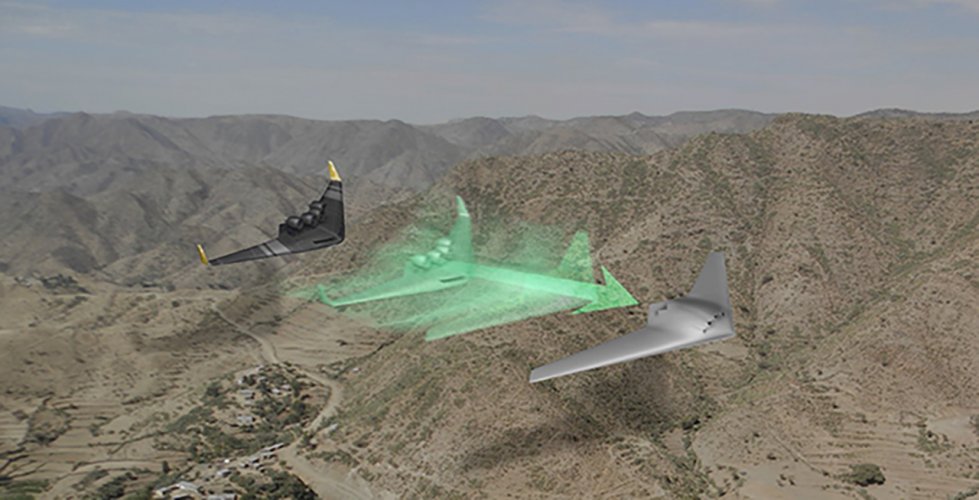
  • DARPA_XRQ-73_SHEPARD_2.jpg
    DARPA_XRQ-73_SHEPARD_2.jpg
    406.6 KB · Views: 145
Last edited:
During this conflict? I'm not so sure about that, Iran already struck Nakhchivan and it might have prompted a move.

Larissa underwent infrastructure upgrades over the last couple years, including adding two shelters at the east end of the base that are a fair bit bigger than the MQ-9s deployed there. Not out of the realm of possibility.

View attachment 805934

So far the information I have accumulated on construction at Larissa AB and those hangars in particular do not seem to support the hypothesis that these upgrades were to support a LO aircraft or secret aircraft.

The two hangars highlighted here were part of a ~$35m investment in upgrades that began in 2021. These hangars have supports Reaper and Global Hawk operations, and the hangars were built by local (Greek) contractors. It would be... challenging to clear them for working on spaces designed to support LO aircraft.
 
So far the information I have accumulated on construction at Larissa AB and those hangars in particular do not seem to support the hypothesis that these upgrades were to support a LO aircraft or secret aircraft.

The two hangars highlighted here were part of a ~$35m investment in upgrades that began in 2021. These hangars have supports Reaper and Global Hawk operations, and the hangars were built by local (Greek) contractors. It would be... challenging to clear them for working on spaces designed to support LO aircraft.
The contractors building the hangars would have no need to be read in on what would go in the hangars.
 
The contractors building the hangars would have no need to be read in on what would go in the hangars.

For a LO maintenance hangar they would be exposed to enough for it to be a problem. Other hangars for LO aircraft have security requirements for construction contractors.
 
For a LO maintenance hangar they would be exposed to enough for it to be a problem. Other hangars for LO aircraft have security requirements for construction contractors.

Again, the contractors building the hangar would have zero need to know for what would be parked in the hangar. Additionally, the RQ-170, for example, does not require special hangars like the B-2 does as that is an issue specific to the B-2 itself.

Your argument here makes no sense. Exposed to what? Building materials? So they would immediately surmise that an unacknowledged reconnaissance aircraft would be parked in it?
 
Again, the contractors building the hangar would have zero need to know for what would be parked in the hangar. Additionally, the RQ-170, for example, does not require special hangars like the B-2 does as that is an issue specific to the B-2 itself.

No, that’s not an issue specific to the B-2 . Most VLO aircraft require climate/humidity controlled spaces for coating stacks to cure properly. This include the RQ-170, F-35 and others.

Your argument here makes no sense. Exposed to what? Building materials? So they would immediately surmise that an unacknowledged reconnaissance aircraft would be parked in it?

The design and requirements for the building.
Again, facilities for other VLO aircraft facilities have security requirements . I can’t think of a single one that used “local” contractors in a foreign county.
 
Again, the contractors building the hangar would have zero need to know for what would be parked in the hangar.
But they would know, pulling examples out of my ass, that the big hangar needs to hold 70degF+-2 regardless of external temperatures and needs to flow at least 1000cubic feet of air per minute.

And that's not typical for a hangar.
 
Aviation reporter Bill Sweetman claimed in 2013 that the classified, stealthy, unmanned intelligence, surveillance, and reconnaissance (ISR) platform being produced by Northrop Grumman was designated RQ-180. I asked him about this because it didn't make any sense to me (there was a logic to the Lockheed Martin RQ-170 designation that didn't apply to the NGC platform). Bill insisted that a source had specifically referred to the new plane as the RQ-180. I still remain skeptical.

Unclassified USAF briefing materials from 2009 and 2010 refer to it variously as MQ-L/O (multi-mission, unmanned, low-observable) and Penetrating-ISR or P-ISR. One source told a reporter from Aviation Week & Space Technology that it was the "RQ-XXX," though he may have been self-censoring the number. Frankly, I would expect it to have an MQ designation because it likely has at least some offensive capabilities (EW/EA and/or SDB delivery?). Much about the platform remains highly speculative.

Yes the 2013 timeframe comes back to what I've found too.

I've seen some stuff on a discord server that the RQ180 is (was?) meant to be a manned/unmanned as needed aircraft and considerably bigger than this thing that's been seen- hence its crash site was thought to be an SU27 crash site on the NTTR a few years ago. So I'm also a bit doubtful this particular aircraft is the RQ180 myself.
 
No, that’s not an issue specific to the B-2 . Most VLO aircraft require climate/humidity controlled spaces for coating stacks to cure properly. This include the RQ-170, F-35 and others.


The design and requirements for the building.
Again, facilities for other VLO aircraft facilities have security requirements . I can’t think of a single one that used “local” contractors in a foreign county.
I’m not entirely convinced.

First of all, we’ve seen Larissa Afb IS actually being used by a VLO platform, one that almost certainly requires climate control. It’s been operating out of there since at least march 2 (I believe the locals, why would they lie?).

It wouldn’t be too difficult to build a hangar with local contractors and add climate control later with your own staff. Nobody would raise an eyebrow if you hand them a design for a hangar with options to change or improve them later on.

Also, the climate at Larissa is much more temperate than Edwards, Guam or Area 51. They would still need climate control at Larissa, but the requirements of the installation could be different.

Question, does Sigonella Afb have climate controlled hangars? The RQ-170 is confirmed to be operating from there, does building at Sigonella confirm your claim about security requirements when building a hangar?

If it’s really operating out of there it won’t be long before another picture will be posted online, that would settle the debate.
 
Last edited:
Any photographic experts out there who can estimate it’s size within decent limits?

Judging by eyesight I estimate it being considerably smaller than the B21, and on the lower side of the 30-40 meter it has been estimated at previously.

30+ meters is still BIG!
 
I tried to determine the location where one of the videos was recorded, but unfortunately I have not succeeded yet. Based on a standard 3-degree descent angle during the approach, combined with the type of phone used, I can make a reasonably robust estimate of its actual size.
 

Attachments

  • 1000208131.jpg
    1000208131.jpg
    215.1 KB · Views: 161
Last edited by a moderator:
What makes you believe that a country who pioneered the military usage of drones in the 21st century, has a robust tech sector, established MIC and unprecedented access to confidential US material couldn't develop something as basic as a stealthy, flying wing ISR drone?

Everyone and their mom developed at least a prototype of similar drones since the 2010s.

I can't believe I'm saying this but I agree with @EmoBirb and disagree with @quellish. The notion that Israel can't develop a stealthy ISR drone just because it doesn't have an outdoor far field RCS range seems completely counterintuitive to me and I finally have the evidence to prove it. Israel built and validated a compact RCS range designed to emulate far field conditions. Although I don't know exactly when they built it or where it is, 2 papers about it were published in 2023, which would line up with the timeline for the Israeli ISR drone/RA-01. I've attached all the relevant documentation I can find below, hopefully someone with radar expertise can comment on the more technical aspects.
View: https://www.youtube.com/watch?v=WDGAG3YUCHI&t=3s


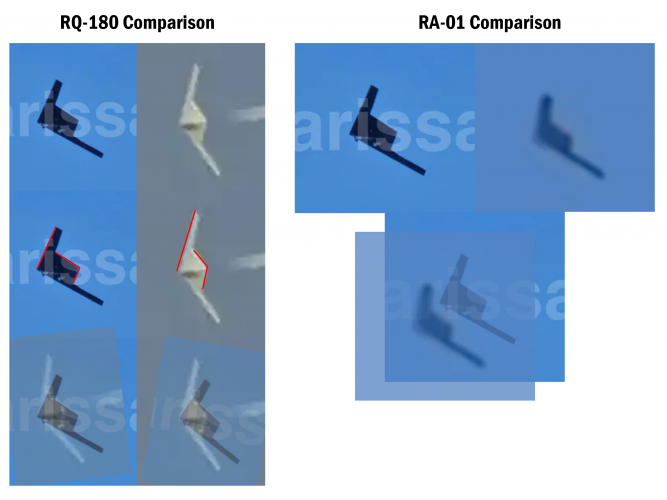
With that out of the way, I'm 99% sure that the "Lady of Larissa" is the RA-01. As @lancer21 pointed out, the size, planform, and color are an exact match. The actual RQ-180 is a lot bigger, has a lower wing sweep for high altitude operation, and although color isn't a good indicator, there don't seem to be any good reasons to change from white for such a high altitude asset. It seems that a lot of the defense sites just ran with the RQ-180 for clicks but this entire discussion should really be moved to the Israeli drone thread.
 

Attachments

  • RQ180 vs RA01.png
    RQ180 vs RA01.png
    623.9 KB · Views: 112
  • Compact RCS Range LinkedIn.png
    Compact RCS Range LinkedIn.png
    69.3 KB · Views: 51
  • Compact RCS Range Paper 2.pdf
    483.7 KB · Views: 7
  • Compact RCS Range Paper 1.pdf
    1.4 MB · Views: 10
  • Compact RCS Range Poster.png
    Compact RCS Range Poster.png
    1.1 MB · Views: 55
  • Compact RCS Range Overview.pdf
    9.3 MB · Views: 11
Last edited by a moderator:
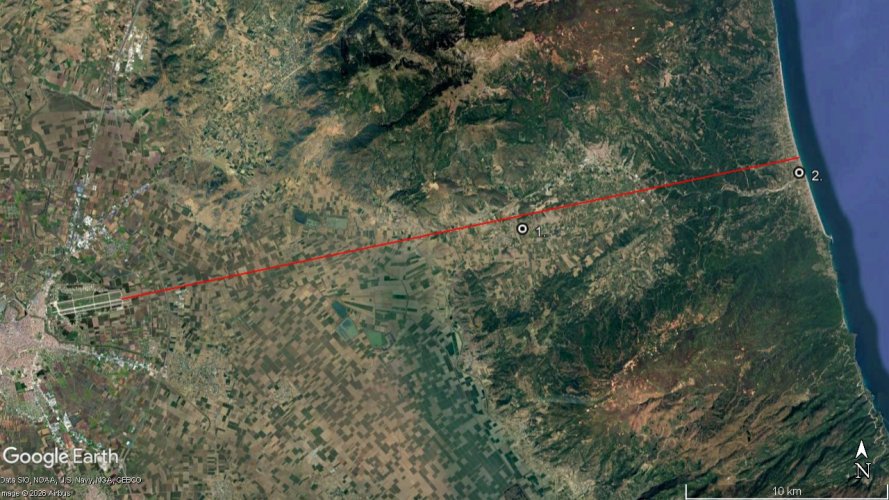
Here is my shot at the size of the plane, I assume the footage was taken with a modern smartphone sensor using the standard 1x field of view. There is very little populated area under the approach path to runway 26. I therefore worked on the basis of a 3-degree glide path, which gives the respective altitudes used in my calculations.
  1. Point 1 is located near the two towns of Anavra and Aetolofos, roughly 20 km from Larissa Air Base, directly under the approach path to runway 26. Because there is a lack of Street View imagery in the region that made it near impossible to pinpoint where the video was taken, I used villages lying roughly under the approach path as reference points. Based on the pixel measurement, the estimated object size comes out to be around 24 meters at 1000 meters altitude, which results in a smaller wingspan than expected.
  2. Point 2 is located closer to the coastline, at approximately 33 km from the base. The aircraft was on approach from the west. Under the same assumptions, the estimated object size comes out to be around 40 meters at 1700 meters altitiude, which makes the object appear very large.
This creates a problem in the analysis: at Point 1, the estimated span is smaller than expected, while at Point 2, farther out near the coast, the estimated size becomes unusually large... *Terrain elevation differences were taken into account in the calculations. (~100m)
 

Attachments

  • _path.jpg
    _path.jpg
    435.6 KB · Views: 102
Last edited by a moderator:

Similar threads

Back
Top Bottom