What country is buying a 7500ton corvette?
The Finns have four 4200 ton corvettes currently being built with a superior 4-fixed panel Sea Giraffe 4A radar and they carry similar armaments. They have fewer Mk41 cells obviously. But endurance is only planned for 14 days.

.Correct. 1 gun per hemisphere
The Italians like to mount them in a staggered tandem up front.

So out of the two options USN has standardised on, you want the Mk-45. With its rate of fire, your guided round better gets its first shot. But i still agree that an effective CIWS-like capability against SRBMs would make sense, so those hit-to-kill 57mm MAD-FIRES rounds might happen one day?
The point I was making is that we can have multiple types on one ship to ensure against saturation attacks and having the wrong type for the situation. Plus I believe ships should have one large caliber dual-purpose weapon for unloading on targets of opportunity that can hopefully dull the nose on an incoming BM. I don't think ALaMO or VULCANO really meet that goal. And Mark 45 would be great, but it was not typically put on frigates.
 
Last edited:
Even for late cold war (the 600-ship Navy), the plan for the convoy defense groups was a Spruance and 9x FF/FFGs (Ideally all FFGs). So 9x FFG(X) and a Burke today would be expected.
I disagree. For one the planned buy of FFG(X) was "at least 20". There is no way you're sustaining convoy defense operations of this magnitude unless you have 30+ FFG(X)s. Secondly convoy operations in the Pacific are either out of the combat area, in which little to no escort is required or deep within the combat area in which more Burkes will need to be assigned than Constellations anyway.
From the current point of view, the problem is more about insufficient Congressional control over military, than excessive...
Still contributing nothing of value and even less common sense then. Not altogether surprising
The Finns have four 4200 ton corvettes currently being built with a superior 4-fixed panel Sea Giraffe 4A radar and they carry similar armaments. They have fewer Mk41 cells obviously. But endurance is only planned for 14 days.
Huge difference between 4200 tons and 7500+ tons. Also "superior... Sea Giraffe" when compared to what? Also it makes sense that a Baltic focused ship doesn't require massive endurance, especially given they won't be operating with a permanent global presence in mind
The point I was making is that we can have multiple types on one ship to ensure against saturation attacks and having the wrong type for the situation. Plus I believe ships should have one large caliber dual-purpose weapon for unloading on targets of opportunity that can hopefully dull the nose on an incoming BM. I don't think ALaMO or VULCANO really meet that goal. And Mark 45 would be great, but it was not typically put on frigates.
The solution you are looking for is RAM
 
So are ships! Besides, insurance firms will more readily accept a non-lethal weapon, like LRAD or a big microwave zapper, than a Phalanx which requires technical support from a military or armed forces unit. It's not as if Phalanx would be useful for anything besides literally one or two drones.
Phalanx can engage small surface targets though, pirates or otherwise.
 
Phalanx can engage small surface targets though, pirates or otherwise.

Yeah, but they require a naval detachment to be assigned to a merchant vessel, because mariners can't operate/maintain the Phalanx.

PMSCs just used .50 cals and FALs in the Horn of Africa. A microwave device could probably be maintained by mariners, or contractors, because it's essentially a really powerful radar. Chaff/flares should be fairly simple albeit somewhat hazardous due to the explosive nature of the projectiles.

No shipping firm is going to be putting CIWS on a Panamanian or Guatemalan flagged merchant ship. Too expensive and I rather doubt the U.S. State Department would allow the sales anyway. Between a microwave device, timely ballistic missile track updates from a loitering zone escort like a T45, Burke, or Horizon, and chaff/flares there shouldn't be any issues running merchants through a low to mid threat like Hormuz or the Red Sea.
 
Yeah, but they require a naval detachment to be assigned to a merchant vessel, because mariners can't operate/maintain the Phalanx.
Something along the lines of the World War II / Cold War DEMS system might be a viable option. The United States Navy Armed Guard might also prove be to be a useful historical precedent. And with regards as to the normal crews on American flagged vessels, the Merchant Marine Act of 1936 still formally classifies such mariners as military personnel in times of war, which may also help to get around any remaining legal and regulatory roadblocks to properly arm such merchant vessels for self-defence purposes.
 
Something along the lines of the World War II / Cold War DEMS system might be a viable option.

That would work if merchant mariners needing escort were still American. They're usually Bangladeshi/Sri Lankan/Indian or Filipino driving Indonesian or Panamanian flagged ships. Notably, the Chinese and Iranian flagged ships are at zero threat in the Hormuz due to Iran being fairly selective with the Russian offboard/orbital assets giving them targeting data.

And with regards as to the normal crews on American flagged vessels, the Merchant Marine Act of 1936 still formally classifies such mariners as military personnel in times of war, which may also help to get around any remaining legal and regulatory roadblocks to properly arm such merchant vessels for self-defence purposes.

The U.S. merchant fleet isn't operating in Hormuz and even if it were there's fewer than 100 U.S. ships that are crewed by Americans. The issue isn't really "regulatory roadblocks": Jones Act qualifying ships can be armed within 90 days or so with a gamut of defensive measures including a naval detachment and CIWS. It's mostly the whole "arming foreigners, who have no loyalties to the United States, with American weapons" part.

If Indonesia or Panama want to arm their merchant fleets they can. Nobody would stop them from having a stockpile of such things.

Hormuz is not a low to mid threat area, what world are you living in? I can't understate how detached this idea is from reality, Arleigh Burke class destroyers would struggle to run escort operations and not sustain damage, if not losses

A high threat is the North Sea against a Soviet Backfire regiment or something. A mid high threat is Taiwan. Hormuz is low mid. If they mine the strait, it will become a mid threat due to the indiscriminate nature of mines, but they don't seem to want to do that or they can't.

It's not amateur hour but it's not like it's a dire threat that can't be defeated by fairly basic countermeasures. A PMSC with those funny Ukrainian thermal camera miniguns and some chaff launchers (to stop Noors/Saccades), which could be airlifted and fitted to merchants, plus on station BMD and protected corridors for Western-aligned merchants, would be able to stop most of the attacks easily.

This is because at the moment they're just firing rockets and OWAs at anything that isn't the Russian ghost fleet, or Iranian or Chinese merchants, and that's whatever. Houthis 2. They clearly know what they're aiming at too, so it's not like you can't just corral all the potential targets into a narrowly defined protected area.

Over the next few weeks the TBM launches will subside as the TELs begin to hit zero. They may not be completely destroyed but the threat of shipping attacks is mostly because Iran is no longer capable of striking Dubai or Qatar, much less Tel Aviv, due to massive attrition of their TEL force. So they're striking shipping instead. Eventually that will stop too and then it's just OWAs. That might actually be worse for merchants but it's nothing an escort needs to worry itself with.
 
Last edited:
You won't be doing BMD at all with FFGX, as anticipated load outs would likely look like 8 ASROC, 16 ESSM, 16 SM2, 4 TLAM or maybe SM6 once more important ships get enough SM6 10 years or more down the line. So you'll have very few shots to do BMD with on top of an insufficiently powerful radar to make great use of SM3 when alone.
No SM-6
The SPY-6(V)3 fitted to the Connie is not large enough (only 9 x 2' square RMAs per face) to guide the SM-6 at long range. The radar aperture is only 6' so diffraction limited to ~ 3.8 degrees which is pretty poor by current naval search radar standards and unlikely to provide engagement quality target tracks at long range for the SM-6.
 
I don't think there's much point in putting TLAM on FFGX for gunboat diplomacy. What are you going to do with 6-8 TLAM, look at the numbers fired at Syria/Iran. You'd need dozens of these there, or just have 2 DDG or a SSBN. It would make more sense to be a SM2 and SM6 mix (in the future) to provide some bare minimum ABM capability if it's positioned correctly on top of a fast ASM.
Sure, we can debate the mix for a 32-cell Mk41. Pass a beverage around.

But the real debate about FFGs is "how many cells should they have". I'm thinking 48-64, which makes Tomahawk Diplomacy much more viable.


I wouldnt expect you would need SM3 for an SRBM, maybe an IRBM? Even SM6 is an expensive thing to throw at a cheap SRBM, and you would have less warning so might be a lower altitude intercept.
Honestly the issue with SM3 is that it is exo-atmospheric interceptions only.

GPI/Glide Breaker will be much more useful as it will have the speed to put the EKV outside the atmosphere and the EKV still has a DACS to be able to maneuver outside the atmosphere, in addition to being designed around engaging high-mach targets inside the atmosphere.


Seems like USN sees "escort" as an AAW role, while ASW is a more loosely attached independent effort.
No, the USN used to practice high/lo capabilities for primarily-ASW ships. In the 1980s, the Spruance-class was the high-end ASW ship while the Perrys were the low-end ASW ship.

The USN screwed itself by not fighting to build the entire Zumwalt production run because the Zs were supposed to replace the Spruance-class DDs in the high-end ASW role for carrier escorts and convoy-escort command ships. Plus the Zumwalt-derived CGXs to replace the Ticos as the escort group flagships.

Instead we're stuck with using the newer Burkes as the ASW escorts for carrier groups and the older Burkes without good sonars as the AAW ships, and nothing able to replace the Ticos.


Both SM-2 and SM-6 aren't exactly great at ABM. They have a shot, but this is not something you want to rely on; furthermore, they're big.
Answer is PAC-3.
Too bad PAC-3s aren't integrated into Mk41 VLS yet.

Is it dimensionally possible to twin-pack PAC-3s into Mk41?


Chinese sub skippers must be licking their lips then...

A noisy Destroyer with, for the majority of the Class, sub-par ASW sensors....

Only 17 of the 74 ships to date have an Passive AND Active towed array (23% of ships, all Flight IIA assigned to Western Pacific, IIA Restart, IIA Tech Insertion and 1 x Flight III)....34 have the 40 year old TACTAS passive array only (46% of ships)....and 23 of the Flight IIA's (31% of ships) have no towed array whatsoever...
So, we use the newer ships as the ASW destroyers and the older ships as the AAW destroyers, everyone is supposed to be on the same Aegis build. If the ships have TACTAS installed we can replace TACTAS with a newer array that takes up the same hull volume and get a more competent ASW ship even if you don't have both active and passive towed arrays.


I disagree. For one the planned buy of FFG(X) was "at least 20". There is no way you're sustaining convoy defense operations of this magnitude unless you have 30+ FFG(X)s. Secondly convoy operations in the Pacific are either out of the combat area, in which little to no escort is required or deep within the combat area in which more Burkes will need to be assigned than Constellations anyway.
Convoy operations in the Pacific can roughly be described as "Mainland to Midway" for a low-but-still-present submarine threat that FFs and FFGs could reasonably handle, and then the "Midway to China" side where you're going to need Burkes.

 
The Finns have four 4200 ton corvettes currently being built with a superior 4-fixed panel Sea Giraffe 4A radar and they carry similar armaments. They have fewer Mk41 cells obviously. But endurance is only planned for 14 days.


The Italians like to mount them in a staggered tandem up front.


The point I was making is that we can have multiple types on one ship to ensure against saturation attacks and having the wrong type for the situation. Plus I believe ships should have one large caliber dual-purpose weapon for unloading on targets of opportunity that can hopefully dull the nose on an incoming BM. I don't think ALaMO or VULCANO really meet that goal. And Mark 45 would be great, but it was not typically put on frigates.
That is a big increase, but still well short of 7500
 
I wouldnt expect you would need SM3 for an SRBM, maybe an IRBM? Even SM6 is an expensive thing to throw at a cheap SRBM, and you would have less warning so might be a lower altitude intercept.

Seems like USN sees "escort" as an AAW role, while ASW is a more loosely attached independent effort.

And yet thats partly the point of a FFG(X) thread...


Didn't it start as "60% of the cost" and get debunked several times? Again, comparing the first 2 ships in a class with the latest iteration of a class running for the last 40 years...

I was trying to say that "3rd line" is an antiquated concept that doesn't really reflect how a modern navy would task its fleet.
I don’t think that’s true.

1st line would be the ships in the CSGs and MEU/ARGs on the ‘front lines’ of the naval conflict so to speak. CVs, L classes, CGs, DDGs, higher end FFGs

2nd line would be escorting merchants/MSC into the primary theater and do mid line patrols against subs and modern armed merchants, fight lower end threats like corvettes/missile boats/FAC, and other dedicated ‘minor’ warfare areas like MCM, so lower end FFGs, things like LCS, corvettes, etc.

3rd line would be primarily peace time patrol and show the flag ships, that patrol ‘home’ waters/back line with shore based air support. OPVs dedicated subchasers if those ever come back, etc.
 
dedicated subchasers if those ever come back, etc.
You mean 3XL ASW USVs. Maybe called FF USVs?

Something big enough to pull a towed array or TA+VDS, and armed with maybe 16 cells of Mk41 plus the usual defensive bits. Plus a lily pad for ASW helos and VTOL UAVs. They'd have Burke+ range while towing all arrays.

I could seriously see the USN building and buying many of those. Like more than 3 for every combatant hull. ~18 per carrier group, ~18 per underway replenishment group, ~18 per Amphib group, ~9 per convoy escort group if merchant ships remain slow enough for convoys to make sense versus subs, and ~6 per Amphib command group. On the order of 600 of the things!
 
USVs would be handy for all sorts of things, like angled SAM and NSM launchers. Some of the proposed USVs are big enough for the Mark 70 containerized launchers. Those unmanned underwater vehicles would be pretty handy for deploying the on and off and on again submarine-launched JSM derivative. Could frigates resupply the USVs at sea or would they need to visit replenishment ships to reload?
 
USVs would be handy for all sorts of things, like angled SAM and NSM launchers. Some of the proposed USVs are big enough for the Mark 70 containerized launchers. Those unmanned underwater vehicles would be pretty handy for deploying the on and off and on again submarine-launched JSM derivative. Could frigates resupply the USVs at sea or would they need to visit replenishment ships to reload?
USVs would probably need dedicated tenders to resupply them.
 
You mean 3XL ASW USVs. Maybe called FF USVs?

Something big enough to pull a towed array or TA+VDS, and armed with maybe 16 cells of Mk41 plus the usual defensive bits. Plus a lily pad for ASW helos and VTOL UAVs. They'd have Burke+ range while towing all arrays.

I could seriously see the USN building and buying many of those. Like more than 3 for every combatant hull. ~18 per carrier group, ~18 per underway replenishment group, ~18 per Amphib group, ~9 per convoy escort group if merchant ships remain slow enough for convoys to make sense versus subs, and ~6 per Amphib command group. On the order of 600 of the things!

Burke doesn't have much range it's one of its weaknesses but the USVs will be about 2,500 nmi at least. They will likely be forward deployed anyway. Current plan is a mix of MUSV/LUSV defined by how many containers (roughly a MK70) they carry: two and four. Somehow they're supposed to float these in 18 months for a selection for mass production after that. It's possible it will happen but that's getting into the war window for Taiwan.

The helpful part of rapid production is they're going to be built to commercial specification and so anyone can make them, theoretically.
 
Burke doesn't have much range it's one of its weaknesses but the USVs will be about 2,500 nmi at least. They will likely be forward deployed anyway.
The point was that a group with these and a Burke would not be range-limited by the USV.

Forward deployed is fine, but they still need their own refit time after ~8 months at sea. And the manned ships need to spend time working with USVs during work-ups, to the point where I really think the correct CONOPS is "each warship has a trio or more of 3XL ASW USVs that it works with all the time."


Current plan is a mix of MUSV/LUSV defined by how many containers (roughly a MK70) they carry: two and four. Somehow they're supposed to float these in 18 months for a selection for mass production after that. It's possible it will happen but that's getting into the war window for Taiwan.

The helpful part of rapid production is they're going to be built to commercial specification and so anyone can make them, theoretically.
Believe that when I see it.

If we can get the USN to not mess with a design once production contracts are signed it'd help. I'm at the point where I think anyone starting to do business with the USN needs to write penalty clauses into their contracts such that every change order costs millions, and any change order that requires ripping out completed work costs billions. Teach NAVSEA to have a design complete before they take bids on producing it one way or the other...
 
The point was that a group with these and a Burke would not be range-limited by the USV.

They might have a longer range but the minimum is 2,500 nmi at 25 kts for the LUSV replacement (MASC) with four TEUs consuming 75 kW ea. There's a high capacity MASC that seeks to have no defined minimums with a similar payload (four TEUs) but 50 kW per TEU instead. The low capacity unit has a single TEU and 75 kW with no minimum speed or range.

Forward deployed is fine, but they still need their own refit time after ~8 months at sea. And the manned ships need to spend time working with USVs during work-ups, to the point where I really think the correct CONOPS is "each warship has a trio or more of 3XL ASW USVs that it works with all the time."

They're supposed to have 30 days of unmanned endurance apparently.

Believe that when I see it.

Yeah fr lmao. The Damen boat is booting NAVSEA out and FMM is getting that one with Bollinger but nobody knows what FMM will do.
 
Secondly convoy operations in the Pacific are either out of the combat area, in which little to no escort is required or deep within the combat area in which more Burkes will need to be assigned than Constellations...
PLAN would be trying to range attacks to ambush unprotected assets, so destroyers going for reloads and especially logistics/fuel supplies. They would aim to do it out of range of US aviation. Within theatre, I'm guessing more submarine threat within their AD umbrella so most ASW assets would need to focus on the highest threat areas
Huge difference between 4200 tons and 7500+ tons. Also "superior... Sea Giraffe" when compared to what? Also it makes sense that a Baltic focused ship doesn't require massive endurance, especially given they won't be operating with a permanent global presence in mind
I think his point was that a 4200T ship might get closer to 6000T if you add endurance.
The solution you are looking for is RAM
Against ballistic missiles? Isn't it air-burst?
USVs would probably need dedicated tenders to resupply them.
FFX concept sounded like its going to be a USV tender but that might have been just a reach for anything thats even viable. Maybe the design to be modified for this purpose?

Any USV (maybe the small single TEU one) used for serious ASW needs quiet propulsion. Probably easier to do on this size ship but not just a module swap. Bonus if electric propulsion is more reliable.
 
PLAN would be trying to range attacks to ambush unprotected assets, so destroyers going for reloads and especially logistics/fuel supplies. They would aim to do it out of range of US aviation. Within theatre, I'm guessing more submarine threat within their AD umbrella so most ASW assets would need to focus on the highest threat areas

I think his point was that a 4200T ship might get closer to 6000T if you add endurance.

Against ballistic missiles? Isn't it air-burst?

FFX concept sounded like its going to be a USV tender but that might have been just a reach for anything thats even viable. Maybe the design to be modified for this purpose?

Any USV (maybe the small single TEU one) used for serious ASW needs quiet propulsion. Probably easier to do on this size ship but not just a module swap. Bonus if electric propulsion is more reliable.
For small USVs like seababy sized, not for M/LUSV.
 
A mid high threat is Taiwan.
WHAT
Against ballistic missiles? Isn't it air-burst?
His point was about gunfire based PD. It really doesn't work for anything short of drones and in that case it isn't worth fitting gun based systems beyond a 5in or 57mm with HVPs or ALaMO. RAM is a better all round system for PD and is indeed the bare minimum now
 
It's been abundantly clear he's a very confused individual with regards to Chinese capabilities. He was also calling China vs Taiwan with Korea, Japan, Australia, Philippine, US, African, UK, and middle east involvement would just fit the classification of a major regional conflict.
 
Last edited:
If China were comparable to the threat posed by the USSR, the U.S. would need a military similar to the kind it had to fight the USSR...

...curious that it's smaller than that, then. Even in its most dramatic and exaggerated forms, the U.S. Navy and Marine Corps remain below their recent peak sizes in the 1980s. Almost as if the PLA is less of a threat than the Red Army and Soviet Navy? Maybe there's a reason China is considered a "near peer" rather than a "peer" threat?

The last time the U.S. had a peer threat, Mikhail Gorbachev was still alive, and the world had never heard of Vladimir Putin. The USSR, and the Soviet AV-MF and Red Army, are still the standard for a "high" threat. The PLA has yet to surpass them, let alone equate them, but they're getting there. Maybe in 20 years they'll approach the threat that the USSR was to the U.S.

That's assuming they're still around.
I don't understand why all analysis of current events in this place is based upon Cold War conditions, also this is just dumb
vulnerability and limited range.
An unjustifiable position
 
WHAT

His point was about gunfire based PD. It really doesn't work for anything short of drones and in that case it isn't worth fitting gun based systems beyond a 5in or 57mm with HVPs or ALaMO. RAM is a better all round system for PD and is indeed the bare minimum now
Confused? You mean gun based point defence doesnt work for more than drones? I disagree, but mostly because if supersonic missiles get close enough for guns then RAM and ESSM leaked, and you are going to have issues with minimum range thresholds. You also then have a problem with why it happened, the threat missile was probably a more complicated target than you were ready for, and there could be several more on the way. Kind of like the Russians allegedly tweaked some Iranian missile trajectories and it was taking 15 PAC3s to take them down. If true, that is when you are staring at guns with sufficient rate of fire and the right ammunition being the last remaining option. So guns should be generally more useful against both air and surface drones, but they are also a last ditch against anything faster. If they cant deal with a threat as is likely, better get MAD-FIRES or VULCANO to improve your chances.

And where have you been? USSR doesn't exist anymore and you really dont know if PRC is ready to debut their own stealth aircraft. They definitely have high altitude surveillance drones, and their economy isn't really comparable to the US. A war could go either way, and depends on what suprises both sides have in store.
 
FFX concept sounded like its going to be a USV tender but that might have been just a reach for anything thats even viable. Maybe the design to be modified for this purpose?

Any USV (maybe the small single TEU one) used for serious ASW needs quiet propulsion. Probably easier to do on this size ship but not just a module swap. Bonus if electric propulsion is more reliable.

Most small USVs use waterjets but that shouldn't be an issue as the best way to do ASW on a very small platform is "sprint & drift" with a combination of dipping sonar and sonobuoys. The waterjet won't be making any noise while drifting.

Also possible to tow a very small array, but that will take up a lot more space & weight. And the loads might be too high if operating at speed or in waves.

Most frigates over 3,000 tonnes can fit up to 4x RHIBs/USVs (2 amidships and 2 on stern ramps) so carrying a pair of USVs for barrier ASW patrols would be fairly easy. They could be hoisted back onboard to refuel/resupply. The USVs won't have enough range/endurance to keep up with a task force with a high speed of advance however, but great for chokepoints or littoral ops.
 
The Iranians were deploying decoys which is why missiles were struggling. PAC-3 doesn't currently pick out the most probable target in a cloud. They are working on it. Iron Dome has the same difficulties. When targeting a ship they are going to either emit or use passive lens, unlike aiming for a fixed target like a building. Much of those BM flights at fixed targets take place under an INS system, regardless if maneuvering or not.

Some interceptors simply lacked the kinetic energy to redirect trajectories, which is also relevant to defeating bigger AShMs.
 
Most small USVs use waterjets but that shouldn't be an issue as the best way to do ASW on a very small platform is "sprint & drift" with a combination of dipping sonar and sonobuoys. The waterjet won't be making any noise while drifting.

Also possible to tow a very small array, but that will take up a lot more space & weight. And the loads might be too high if operating at speed or in waves.
You still need to adequately silence the engine mounts etc. Which requires significant design effort.
 
Most small USVs use waterjets but that shouldn't be an issue as the best way to do ASW on a very small platform is "sprint & drift" with a combination of dipping sonar and sonobuoys. The waterjet won't be making any noise while drifting.

Also possible to tow a very small array, but that will take up a lot more space & weight. And the loads might be too high if operating at speed or in waves.
I think you will need a towed array if the USV is supporting a moving fleet as opposed to monitoring a choke point. Still relying on a small seaboat sized USV means your mothership has to stop and recover it unless its fast enough to catch up to your frigate and drive up a stern ramp, if they haven't been removed...

However I was thinking of something like a MUSV that might be self sustained. Whether Sea Hunter is setup for that scenario I dont know. Something similar that can operate as a frigate fill-in would be ideal. Maybe the small "drift" USV with sonar buoys etc to localise the target if the helos are being stretched.
Most frigates over 3,000 tonnes can fit up to 4x RHIBs/USVs (2 amidships and 2 on stern ramps) so carrying a pair of USVs for barrier ASW patrols would be fairly easy. They could be hoisted back onboard to refuel/resupply. The USVs won't have enough range/endurance to keep up with a task force with a high speed of advance however, but great for chokepoints or littoral ops.
i would be suprised if many frigates carry 4 RHIBs on davits for quick launches. Some OPVs maybe, since they are more oriented to boarding ops.
You still need to adequately silence the engine mounts etc. Which requires significant design effort.
If its a dedicated ASW vessel, might as well do it properly.
 
Dedicated ASW platforms have traditionally been smaller than AAW platforms. Seems like the "G" in FFG(X) denotes more of a cimbination AAW and land attack role. NSM imho is sufficient for most of that role, but Mark 70 erector launchers could be justified for carrying TLAM. With cost and role, wouldn't an FF hull make more sense for a dedicated ASW? Gibbs & Cox had versions of the same hull lineage used for NSC that could meet needs of the ASW mission.

FFG(X) should be about protecting from air threats as the priority.
 
Dedicated ASW platforms have traditionally been smaller than AAW platforms. Seems like the "G" in FFG(X) denotes more of a cimbination AAW and land attack role. NSM imho is sufficient for most of that role, but Mark 70 erector launchers could be justified for carrying TLAM. With cost and role, wouldn't an FF hull make more sense for a dedicated ASW? Gibbs & Cox had versions of the same hull lineage used for NSC that could meet needs of the ASW mission.

FFG(X) should be about protecting from air threats as the priority.
The issue is you’re already paying for a long range hull with significant propulsion, quieting, a minimal radar and combat suite, and maintenance and the crew. It’s only a incremental cost to add a better radar plus VLS cells. There is no reason not to pay the one time incremental cost of 100-200 million for the better performance in a new deign. This would likley be an incremental 5-10% in lifetime costs. This won’t be doable for the NSC as there’s not enough growth margin.

If you’re talking an unmanned platform, which means it can not have a radar, no crewing costs, and be much smaller for the same range. Minimal setups make much more sense

For example the base NSC cost over a billion in today’s dollars to make. There is no world in which it will be a cheap frigate. Also the GC NSC derivates were just concepts and not fully designed out. If you want something minimal more or less off the shelf, the new Taiwanese frigates also designed by GC would make more sense
 
We have plenty of indigenous designs. The new Korean designs have half the range and lack the reinforced stern that is found on USN vessels.
 
Seems like the "G" in FFG(X) denotes more of a cimbination AAW and land attack role.

FFG(X) had no significant land-attack role, despite Congress pushing to add Tomahawk. It was an ASW platform first and foremost, with the G indicating some area air defense capacity, just as the FFG-7 was an ASW specialist with a small area AAW capacity.
 
The issue is you’re already paying for a long range hull with significant propulsion, quieting, a minimal radar and combat suite, and maintenance and the crew. It’s only a incremental cost to add a better radar plus VLS cells. There is no reason not to pay the one time incremental cost of 100-200 million for the better performance in a new deign. This would likley be an incremental 5-10% in lifetime costs. This won’t be doable for the NSC as there’s not enough growth margin.

If you’re talking an unmanned platform, which means it can not have a radar, no crewing costs, and be much smaller for the same range. Minimal setups make much more sense

For example the base NSC cost over a billion in today’s dollars to make. There is no world in which it will be a cheap frigate. Also the GC NSC derivates were just concepts and not fully designed out. If you want something minimal more or less off the shelf, the new Taiwanese frigates also designed by GC would make more sense
Radar are normally a massive part of a ship’s cost, improving it increases a ship’s cost by a lot…a ship that costs $700m-1b ‘$100-200m’ is a big increase in cost…at least 10-20%…
 
Radar are normally a massive part of a ship’s cost, improving it increases a ship’s cost by a lot…a ship that costs $700m-1b ‘$100-200m’ is a big increase in cost…at least 10-20%…
I said lifetime costs. Also the cheapest possible NSC is over 1 billion, with the ones they end up ordering likely costing 1.2 billion or more. A SPY-6v1 costs 160 million so yea, between 1-200 million for a radar upgrade + VLS cells.
 
Last edited:
I said lifetime costs. Also the cheapest possible NSC is over 1 billion, with the ones they end up ordering likely costing 1.2 billion or more. A SPY-6v1 costs 160 million so yea, between 1-200 million for a radar upgrade + VLS cells.
$160m or $160m per array? Thats a pretty big difference
 
Got a source for that claim? Seems utter tripe.

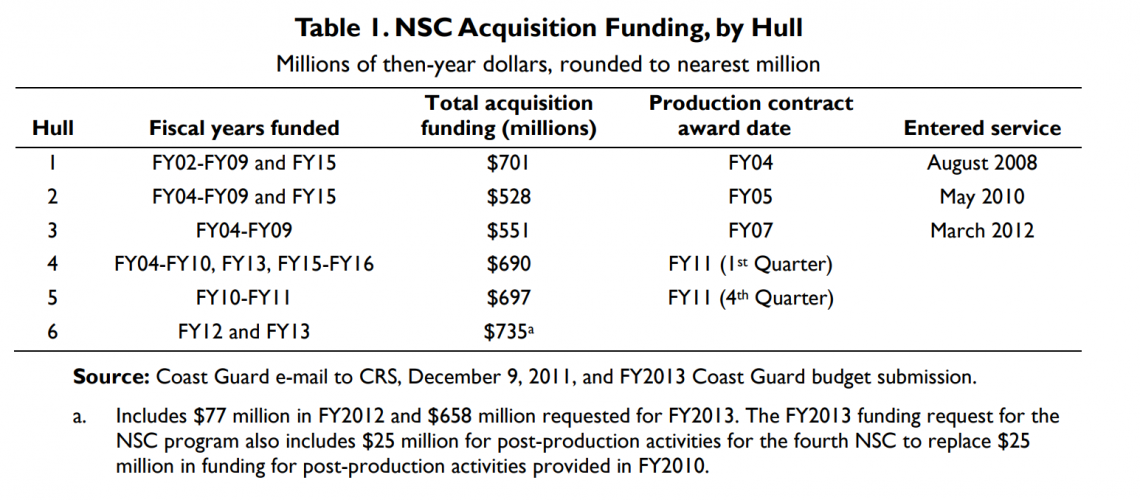
Hull 6 was $710 million in FY2012 so mid 2011 dollars which is 1027 million inflation adjusted. Add on some modifications and re tooling you're easily spending another 100+ million.

Then add on the fact that the the ship yards are having more issues than back then and you're over 1.2 billion.

1773878012121.png
 
Last edited:

Hull 6 was $710 million in FY2012 so mid 2011 dollars which is 1027 million inflation adjusted. Add on some modifications and re tooling you're easily spending another 100+ million. Then add on the fact that the the ship yards are having more issues than back then and you're over 1.2 billion.

View attachment 805924
As suspected, flawed methodology and vibes based extrapolation. Why don’t you reference more recent ships? Is this because it won’t align with your agenda?
 

Similar threads

Back
Top Bottom