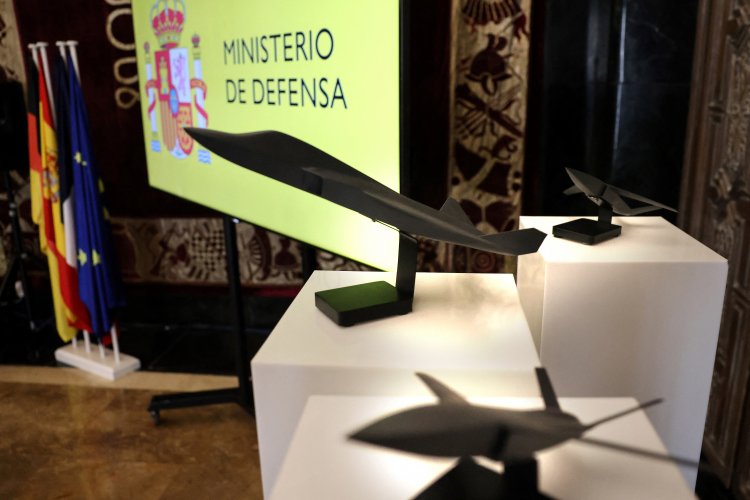
Future Combat Air System (FCAS / SCAF / FSAC) - Speculation and Theories

Too bad my post on FCAS didn't get moved here. So i'll write it again, as this thread is quite suitable for it.

Germany (and Spain, Sweden and probably a lot of other countries) don't really need a 6th gen plane. What they need is something better than what Russia could throw at them. So better than Su-57. At the pace Russia is going, anything a generation better than the Su-57 is gonna take 25+ years for Russia.

So in a sense, something a tad better than F-35, tech and design wise. It doesn't need massive range like GCAP. Also doesn't need to be that much bigger than the F-35. Also, not being saddled by F-35B design choices or dimensions, overall it still might be meaningfully more capable than the F-35A. Maybe it'll have worse engines, tech wise, than F-35, but given that overall design might be less chubby, the ultimate power/weight and power/drag ratios might still be fairly competitive.

For Germany, Spain, Sweden and many third party countries that might buy such a plane - that might be perfectly enough. And that's what FCAS countries, sans France, should aim for. Try to get Sweden and SAAB into the fold. Sweden wants a new plane anyway, they just lack money to do it on their own. Seems like a doable goal.

If for any reason the mentioned countries can't pull it off on their own, there's the option of South Korea. Who also wants a clean sheet design of similar class, instead of going on with advanced KF21 variants. (and is working on an engine of its own for it) There might be some give and take between Germany and SK in that regard, but maybe a deal could be worked out. Between German, Korean and Swedish know-how on engines, something should be workable, even if it won't be a cutting edge engine. Maybe even get Netherlands into it, for their electronics know how, even if their own air force won't use it.

After all is said and done, such a plane might be perfectly positioned to take many export orders. Smaller and cheaper than GCAP, F-47, yet very competitive against F-35. And probably cheaper than whatever France can muster on their own, given the small production run France would be saddled with when it comes to their own, separate FCAS design.
 
So what about designing a new nuclear missile that would fit inside the weapon bays of SCAF without being too long like ASN4G, unless the French want the ASN4G to be carried externally instead.
[Special edition ON]
We have no clear indication about ASN4G. It may be more a lifting body, so thicker than ASMPA but not longer.
[Special edition OFF]
 
Yes. Tbh, I don't understand this point I some time read that designing a carrier capable jet would something of an handicap.
Sure, it may cost a little more to design that capability on the airframe from the start, but having a far more versatile airframe in the end far outweighs that cost.
Not going to enumerate the numbers of carrier capable designed jets that had long successful service lives in Air Forces.
While if you have done air force only jet, and find yourself having to replace your SVTOL navy jets for the brand new carriers you're building, or if there is an opportunity to sell a carrier capable of jet to someone, you end up with things like these carrier capable Typhoon or Gripen projects that goes nowhere.
It's pretty clear now that :
Navy fighters --> usually makes good Air Force fighters.
Air Force fighters --> usually makes poor Navy fighters.
One Eurocard prove that it is possible to create 3 frames with high commonality (Navy, single seat air force, dual seat air force), but remaining each very potent.
And this target was very clear from the begnning. The germans saying now that nuc mission and carrier version may add too much penalty (Rafale prove that it is marginal) is fully rubbish.
F-35 has penalty from nuc missian, but also big penalty from B variant.... And they purchase it !
As said in french (don't know if the trad will be pertinent) : "If you want to kill your dog, pretend it has rage".
 
It's cost in terms of money, but also cost in terms of air vehicle performance. The additional structural mass of airframe strengthening, and the impact of achieving lower approach speeds (mass, aero efficiency) combine together to result in lower range, acceleration, turn rate etc. for all else being equal

Previous examples indicate that this is a significant (like >10%) penalty

There's a negligible export market for carrier fighters, so unless you're making one anyway for your own navy then you're much better saving the money and getting better performance.
You may have the same external shape, but with different structure strenght inside. The penalty is then smaller (but not a zero one).
As you will not keep a heavy naval undercarriage on a air force variant. But in this case there is a (small) penalty because the landing gear bay is a little too big for the smaller air force gear.
 
One Eurocard prove that it is possible to create 3 frames with high commonality (Navy, single seat air force, dual seat air force), but remaining each very potent.
And this target was very clear from the begnning. The germans saying now that nuc mission and carrier version may add too much penalty (Rafale prove that it is marginal) is fully rubbish.
F-35 has penalty from nuc missian, but also big penalty from B variant.... And they purchase it !
As said in french (don't know if the trad will be pertinent) : "If you want to kill your dog, pretend it has rage".

F-35 is multi-role with emphasis on strike. In the Luftwaffe, it´s a replacement for the Tornado IDS.
Luftwaffe top-brass wants (or prefers) a 6th gen. jet optimized for air-superiority. For them the manned-jet part of FCAS/SCAF is (or was) somewhat a compromise (more emphasis on multi-role/strike requirements, to operate from carriers, etc.).
Now that the partners are about to have a divorce, the players highlight not what they have (or could have) in common but what sets them apart.
 
I feel like people underestimate the requierments of the Bundeswehr and the impact the french requierments have.
First of the Bundeswehr isn't sure how good it is to abandon properties for a good air superiority fighter for this multirole fighter.

There arguments for going both ways makes this already quite hard as they can conflict with other requierments that the 3 nations faces.

Then lets talk about range.
The Bundeswehr wants to have atleast the capability to start in west germany then fly too the nato east flank on internal fuel and be able to go from there to do there mission and back.
Just going from Fliegerhorst Büchel (where germanys F-35 are) too Talinn is impossible * for the F-35 on an air to air loadout mutch less air to ground. That means there is a need for an range quite a bit higher than F-35 (how mutch we don't know but 20-30% doesn't seem unlikely).
Now this means an quite large aircraft considering the french want to carry AS4NG internaly (nothing against that) which is no small missile at all atleast its doubtfull that it will be any smaller than ASMP.


This means we need an big aircraft, with quite large range, quite large internal volume, capable of landing on carrier and potentialy having the need for an quite agile (and fast) fighter.

I think we all can see how this can become an challenge for the 3 nations.


* The distance between Büchel and Talinn is around 1.500km
 
The French wanting FCAS to carry the ASN4G internally? That would mean two large weapons bays kqcke for you.
 
The French wanting FCAS to carry the ASN4G internally? That would mean two large weapons bays kqcke for you.
That is my understanding of it. I could be wrong but in that case someone would need to correct me.

And we can see how difficult it get as shown here:
Agree. I've been playing around with bay sizes and fitting 1 long weapon like ASMP/ASN4G basically turns the aircraft into a strategic bomber without AAMs, much like a B-1/B-2 or Mirage IVA!

Would that be acceptable? Possibly, with other fighters providing escort.

Now the main benefit of a tandem bay is that it should allow for a skinnier fuselage, as the bay can occupy part of the cavity between the engines (where fuel would normally go). This is important if you're designing a "small" 15t empty stealth fighter like NGF is supposed to be. That's basically F-15 sized... Indeed, if you took an F-15C with CFTs and modern 120kN engines it would weigh ~13.5t empty; add ~10% empty weight penalty for stealth and you've got a pretty good proxy for NGF in terms of size, weight & internal volume.

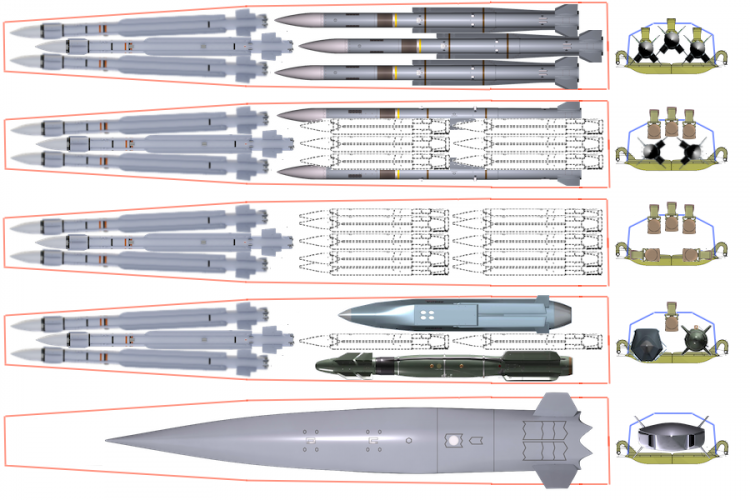
Below I've sketched a possible tandem bay layout (7.2m in length x 90cm to 1m in width) for up to 5 AAMs in the A2A role, 1x ASMP-A in the nuke bomber role (no AAMs) or 2x AAMs plus the following A/G loads:
  • 1x heavy store up to 4.3m in length (i.e. LRASM or JSM sized)
  • 2x midsized stores (MK-83 JDAM, 500lb GBU or AASM)
  • 3x 500lb bombs (MK-82 JDAM)
  • 8x 250lb SBD-class weapons
This is really the skinniest, minimum package that would make sense. Length is driven by the need to fit A2G stores behind the AAMs. Width is driven by the need to fit 4x SDBs or 3x MK-82s abreast. Height is driven by the height of the heavy store which occupies the middle ~60%, height could taper off to each side where only smaller stores would need to fit.... this taper is critical to allow enough structural spacing between the engines and weapons bay. The front AAMs would probably be door mounted as on the F-35, in order to allow for tighter stores packaging... the front doors would then open up to provide clearance to drop the rear stores.

View attachment 804147

Lastly here's the tandem bay overlayed over an F-15 cross-section to illustrate fit. The engines and ducts have been angled slightly outwards to leave enough structural margins for the tandem bay. The bay sits half inside the F-15's original mold line, half projects outside to create an almost flat underbody. In practice the CFTs would probably also be shaped differently for better stealth and lower drag making them a bit smaller than the F-15's, with some of the lost fuel volume transferred to dorsal tanks for more body lift.

View attachment 804148

Here's an illustrative comparison of a tandem bay in 2 fighters with identical cross-sections: F-15 versus a stealthy NGF with estimated ~15t empty weight and 2x 120kN engines.

This shows the importance of engine duct size and location - the engines must be well separated in order to accommodate the tandem bay, but not too much in order for the ducts to curve outwards and shield the fans from the inlets. The tandem bay shown here would have approx the same capacity as the F-15 Silent Eagle's conformal weapons bays, keeping fuel capacity and therefore range about the same (800-900nm), but with the option of carrying 1x heavy store internally. However it remains quite size constrained compared to larger stealth fighters... perhaps 2x AAMs could also be carried in side bays, but that would reduce internal fuel and impact combat radius.

(Thanks to @VTOLicious for his amazing F/A-XX drawing, which I modified and scaled down to match the F-15 cross-section)

Hypothetical NGF (top) vs. F-15 (bottom)
View attachment 804305
 
Range problems will occur or tiny yield or a gravity nuclear bomb instead of a standoff missile.
During his recent speech, Macron said that France would not go back to tactical nukes so a small yield missile seems out of question.
Macron reaffirmed France's rejection of the tactical use of nuclear weapons
One Eurocard prove that it is possible to create 3 frames with high commonality (Navy, single seat air force, dual seat air force), but remaining each very potent.
And this target was very clear from the begnning. The germans saying now that nuc mission and carrier version may add too much penalty (Rafale prove that it is marginal) is fully rubbish.
F-35 has penalty from nuc missian, but also big penalty from B variant.... And they purchase it !
As said in french (don't know if the trad will be pertinent) : "If you want to kill your dog, pretend it has rage".
Doesn't Germany simply want to go beyond the 32-34 tons MTOW that the carrier requirement brings? They seem to want something sized between the French vision for NGF and GCAP. Well that's the rumor that has been circulating for a few years but I don't know if we've ever heard an official statement about this.
 
Last edited:
During his recent speech, Macron said that France would not go back to tactical nukes so a small yield missile seems out of question.


Doesn't Germany simply want to go beyond the 32-34 tons MTOW that the carrier requirement brings? They seem to want something sized between what the French vision for NGF and GCAP. Well that's the rumor that has been circulating for a few years but I don't know if we've ever heard an official statement about this.
DLR FFD factsheet (the latest iteration of FFD shown) looked at a 35t mtow design so yeah already at the top maybe even other the catapult limit. That design also never was stated to be designed with carrier capabilitys in mind so its likely that any design would even heavier.

In generell those iterations from DLR show the quite a grow in what is asked in the current situation.
 
One Eurocard prove that it is possible to create 3 frames with high commonality (Navy, single seat air force, dual seat air force), but remaining each very potent.
And this target was very clear from the begnning. The germans saying now that nuc mission and carrier version may add too much penalty (Rafale prove that it is marginal) is fully rubbish.
F-35 has penalty from nuc missian, but also big penalty from B variant.... And they purchase it !
As said in french (don't know if the trad will be pertinent) : "If you want to kill your dog, pretend it has rage".
And the most hilarious thing is the argument that it cost too much or it brings too much penalties (lol) to incorporate carrier capability from the beginning to an airframe comes from countries using these Typhoons "with 10% more performances in every ways because not navalised", but now stuck to having to spend money buying F-35 for their carriers and to carry US nukes... So much cheaper indeed.
 
The French wanting FCAS to carry the ASN4G internally? That would mean two large weapons bays kqcke for you.
If it's not carried internally it blows your stealth.

And despite the range of ASN4G, there are targets it may want to hit that require the carrying aircraft to get past the outer edges of Russia's IADS. And that means internal carriage.

Oh, I should also note that I really only expect 1 or 3 bays. 1 big main bay that can hold a single ASN4G or other AAMs and AGMs/AShMs, and maybe a couple of side bays for AAMs if the aircraft shape works out to have them. Su-57 "Armpit bays" as the least favorable option, I really prefer side bays on the inlets.


DLR FFD factsheet (the latest iteration of FFD shown) looked at a 35t mtow design so yeah already at the top maybe even other the catapult limit. That design also never was stated to be designed with carrier capabilitys in mind so its likely that any design would even heavier.

In generell those iterations from DLR show the quite a grow in what is asked in the current situation.
The catapult limits are higher than 35tonnes. A plane that weighs in at 40 tonnes could be launched by EMALS. Maybe even 45 tonnes if the stall speed is low enough.

The problem is the landing weight limit. 25 tonnes/55,000lbs. The Advanced Arresting Gear doesn't have a higher weight limit, it is capable of safely catching lighter aircraft like drones (reapers etc). Lighter than A-4 Skyhawks, even.
 
That is also my thinking for the SCAF Scott Kenny. I like the Su-57 quick bays and I could also see them in use on the SCAF to house short range infrared missiles, but if the French don't want them for whatever reason then the traditional side bays would be good enough I would think.
 
If it's not carried internally it blows your stealth.

And despite the range of ASN4G, there are targets it may want to hit that require the carrying aircraft to get past the outer edges of Russia's IADS. And that means internal carriage.

Oh, I should also note that I really only expect 1 or 3 bays. 1 big main bay that can hold a single ASN4G or other AAMs and AGMs/AShMs, and maybe a couple of side bays for AAMs if the aircraft shape works out to have them. Su-57 "Armpit bays" as the least favorable option, I really prefer side bays on the inlets.
Yup which brings ous to the big IWB or multiple. I do like the concept ones for FFD with 2 secondary which are large enough for meteor.
The catapult limits are higher than 35tonnes. A plane that weighs in at 40 tonnes could be launched by EMALS. Maybe even 45 tonnes if the stall speed is low enough.

The problem is the landing weight limit. 25 tonnes/55,000lbs. The Advanced Arresting Gear doesn't have a higher weight limit, it is capable of safely catching lighter aircraft like drones (reapers etc). Lighter than A-4 Skyhawks, even.
Yes but this studie likely goes for the ideal case and we all know how mutch designs grow + a potential grow for the carrier requierments would mean that the designs gets heavier and especially the empty weight.

But this just reflects exactly what we can see. Growing requierments from the Luftwaffe combined with the french requierments do create an hard challenge for an single frame design to fill all the boxes.
 
Sometimes too many requirements produce an overly constrained design space. Both F-111 and P.1154 provide historical examples for concurrent land/maritime designs which did not lead to a viable design, and then programme failure.
 
Sometimes too many requirements produce an overly constrained design space. Both F-111 and P.1154 provide historical examples for concurrent land/maritime designs which did not lead to a viable design, and then programme failure.
But one might argue that programme failures of the examples you provide doesn't comes from doing a land/naval design per se, but by trying to make a workable land/maritime swing wing heavy fighter bomber, and a pegasus type engined supersonic land/maritime fighter.
THAT was indeed looking for troubles.
 
The case studies into both those failed projects have many learning points unrelated to their specific technology choices
 
Then lets talk about range. The Bundeswehr wants to have atleast the capability to start in west germany then fly too the nato east flank on internal fuel and be able to go from there to do there mission and back.
Just going from Fliegerhorst Büchel (where germanys F-35 are) too Talinn is impossible * for the F-35 on an air to air loadout mutch less air to ground. That means there is a need for an range quite a bit higher than F-35 (how mutch we don't know but 20-30% doesn't seem unlikely).

* The distance between Büchel and Talinn is around 1.500km
I've heard this range requirement mentioned several times. It sounds like a classic case of requirements creep.

Most German bases are within 650-750nm (1,200-1,400km) of the Russian border, with the bases in the north being well placed to cover the Baltics and the bases in the south being well placed to cover the Polish/Ukrainian border all the way up to Kaliningrad. Of course you can write a 800-900nm range requirement in order to fly missions from the Franco-German border, cross the entire width of Germany and Poland all the way to Russia, unsupported and without external tanks, but that's starting to look like an edge case with big implications.

Would be much more reasonable IMHO to stick to 650-750nm as the base requirement (similar to F-35 and most current jets) with additional flex provided by forward basing, air-to-air refueling, drop tanks etc. I expect the French (who will also need 1,000nm+ range for some missions) are taking a more flexible view on this.
 
Sometimes too many requirements produce an overly constrained design space. Both F-111 and P.1154 provide historical examples for concurrent land/maritime designs which did not lead to a viable design, and then programme failure
Could add Jaguar M too.

Rafale and F-35 managed to do a 'thing', when you consider these earlier attempts.

Maybe it's having common missions that matters. Navy versions were more high altitude fighter, land versions more low level attack, for F-111, P.1154 and Jaguar, hence joint project failure?

The Phantom showed how to do it of course.
 
Last edited:
I've heard this range requirement mentioned several times. It sounds like a classic case of requirements creep.
One can question how good is it but if the leadership sees this as an requierments because of a fear against missiles from Kaliningrad (as example) then thats what it is.
Most German bases are within 650-750nm (1,200-1,400km) of the Russian border, with the bases in the north being well placed to cover the Baltics and the bases in the south being well placed to cover the Polish/Ukrainian border all the way up to Kaliningrad.
Yet they want even the most western bases to be capable of reaching the russian boarder. There is sense for smaller and larger range against russia but they seem dead on with the larger one.
Of course you can write a 800-900nm range requirement in order to fly missions from the Franco-German border, cross the entire width of Germany and Poland all the way to Russia, unsupported and without external tanks, but that's starting to look like an edge case with big implications.

Would be much more reasonable IMHO to stick to 650-750nm as the base requirement (similar to F-35 and most current jets) with additional flex provided by forward basing, air-to-air refueling, drop tanks etc. I expect the French (who will also need 1,000nm+ range for some missions) are taking a more flexible view on this.
My assumption is that they don't want to be depending on air to air refueling as they are a limited asset, no drop tanks as they could hinder the mission and forward basing because it may be seen as a danger to the aircraft.

My personal guess is that they wanne have a "do it all platform" atleast if they push for something shown like the DLR FFD. Enough range for missions as a tactical bomber, performance good enough to have the edge for air superiority and all of that in a modern package no less capable than an F-35.
It seems like they don't want any range limitations in case of combat deep behind enemy lines
 
Last edited:
Below I've sketched a possible tandem bay layout (7.2m in length x 90cm to 1m in width) for up to 5 AAMs in the A2A role, 1x ASMP-A in the nuke bomber role (no AAMs) or 2x AAMs plus the following A/G loads:
  • 1x heavy store up to 4.3m in length (i.e. LRASM or JSM sized)
  • 2x midsized stores (MK-83 JDAM, 500lb GBU or AASM)
  • 3x 500lb bombs (MK-82 JDAM)
  • 8x 250lb SBD-class weapons
Looking at my tandem bay I may have been too conservative as I didn't look into staggering the AAMs or installing them on door-mounted launchers to allow carriage of A2G weapons above them, which would make much better use of the available volume.

So it looks like you could fit 6 AAMs (3 Meteor/AMRAAM + 3 MICA/ASRAAM/IRIS-T) by staggering the missiles.

NGF weapons bay 6x AAMs 100px=1m.png

Then on top of that you can mount the lateral missiles on door launchers, which allows you to use the remaining height of the bay to carry small 125kg class smart munitions (SDB/Spice 250/Smart Cruiser) above the A2A missiles. (This height being needed for large A2G missiles such as ASN4G). And finally you can use the door launchers for more 125kg munitions instead of missiles. So now the possible A2G configurations include:
  • 4x AAMs + 7x 125kg smart munitions
  • 3x AAMs + 10x 125kg
  • 2x AAMs + 11x 125kg
  • Or various other mixes (e.g. 1x 1,000lb JDAM/500lb AASM/PJDAM + 5x 125kg smart munitions + 2 A2A missiles)
This allows for a better balance of A2A and A2G requirements depending on the number of desired aim points. Still doesn't provide a fully satisfactory option for 2x heavy munitions, but this bay is quite small at only ~3,200L vs. much larger bays on other stealth fighters (~5,000L for YF-23 for example).
 
Still doesn't provide a fully satisfactory option for 2x heavy munitions, but this bay is quite small at only ~3,200L vs. much larger bays on other stealth fighters (~5,000L for YF-23 for example).
I don't belive that there is a call for 2x ASN4Gs. Mirage and Rafale only carry a single ASMP, after all.

Also, how many 2000lb+ class weapons does France even operate? Wiki says Rafale carries:
  • Storm Shadow(SCALP)/Apache (same airframe, different warheads and apparently propulsion)
  • GBU-24 (could arguably be replaced with -27 tail fins for internal carriage. Also may be on the way out, replaced by 1000kg AASM-SAL)
  • Exocet
  • Stratus LO
  • Stratus RS (Split these out because I'm not sure they will be the same size, I roughly expect Stratus RS to be the size of ASALM)
  • AASM Hammer (basically a JDAM operationally, but with an IIR seeker as well as SAL options. Dimensionally more like Paveways, however)
  • debatably AS30L (1960s design, painfully short ranged. SCALP has the same target set with a lot more range)
Have I missed anything important?


Of that list, I think the big trouble packing the bay would be a pair of Storm Shadows/Apaches, as they're 5.1m long and 630mm wide. Does internal carriage of Apache/SCALP make sense? Are there mission profiles where you'd need to penetrate A2AD/IADS and then launch Apache/SCALPs? Or does it make more sense to leave Apache/SCALP to "beast mode" only?

Side note for the new carriers: Storm Shadow and ASMP/ASN4G define the size of the weapons elevators, while means that Stratus RS could be some 5.4m long! That means longer weapons than the USN can use.
 
Let's see what happens in regards to SCAF's weapons bay it will be highly interesting to see where Dasault goes in this regard to internal weapons because of the need to have the ASN4G to be carried internally.
 
I would love to talk about Internal Bay as I try to get the perfect size which i struggle find.. I enjoy H_K diagram it which is like to read and look at it, i love it.. thank for it ;-) (as i love do design my fanstay aircraft use procreate app :) with Affinty Designer 2 ipad maybe i happy shared my SVD / Procreate app design board with grid / dot / ruler with no number so u can put number on it and play around it) anyway...
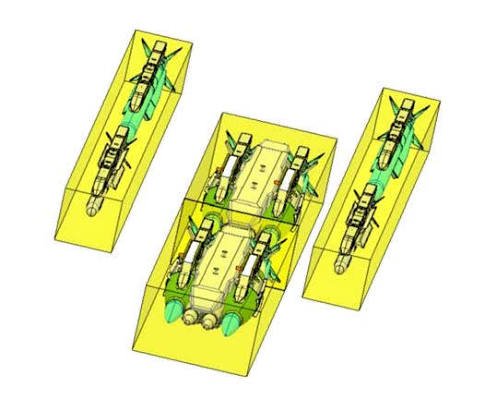
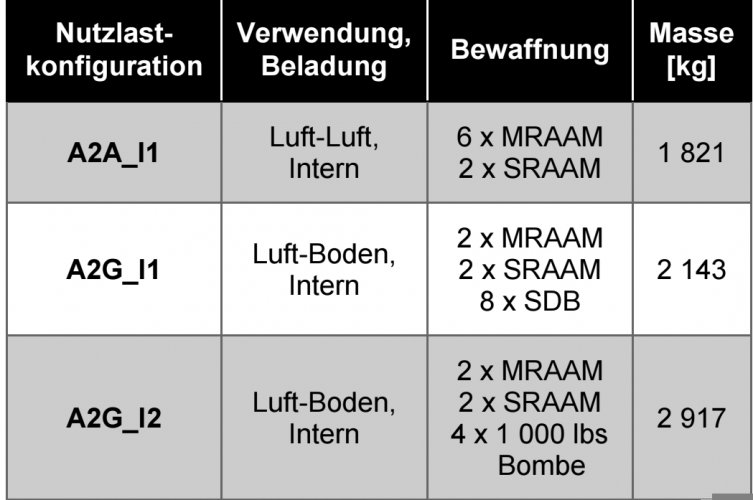
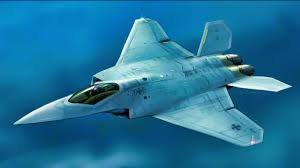
i would preferred these

Lenght :
Main Bay
6.85m vs 7.7m (7.7m preferred as could get 4x Spear inline 7.2m + 0.5m gap also ASRAAM 2.9m (CAMM 3.2m if upgrade) + METEOR 3.65m, gap 0.3m = 6.55-6.85m ) for Heavy Strike / Fighter

4.5m vs 5.4m vs 5.9m vs 6.55m (5.9m could fix a meteor bottom + a spear 3 top (maybe 6.55m for 2 Paveway inline 3.1m x 2 + 0.3m gap I prefer this) for Fighter / Light Strike

Side Bay
3.85m vs 4m vs 4.5m (4.25m preferred)

The width and depth of this annoy me more as I couldn't work out drop weapon mech, etc. Also, bay hinge door, etc., I couldn't get number or idea to put add)

Main Bay Width (I rubbish at this)
Single IW - 1.85m vs 2.25m vs 2.55m (prefer 2.55m)
Double IW - 0.95m v 1.1m vs 1.25m vs 1.54m (prefer 1.54m, yet 1.25m is quite good, twin 1.85m for IW is a better option, but I think is too big for it)
Depth: (I rubbish at this)
0.95m vs 1.1m vs 1.25m

Side Bay Width
0.6m vs 0.95m vs 1.1m vs 1.25m (1.1m is my preferred as could bear fix 2 meteor)
Depth:
0.6m vs 0.75m vs 1.1m (0.75m is small enough for inside one missile for Meteor or Spear 3)

anyway about internal size etc, i go shut up about these.. i would waffle about it..

whatever FCAS / GCAP / other aircraft go for next generation will interest to me see them.. as they might/more likely rely UCAV for launch weapon to keep themselves hide or out of reach or use UCAV data to intel and strike them.

which we would see lots of warfare MCAV (manned Crew Aircraft Vehicle) Sent UCAV vs UCAV & MCAV not MCAV vs MCV & UCAV

so possible internal bay maybe not important but personally preferred choice large internal bay better as could add fuel inside to extended range and allowed UCAV do "dirty-job" not sure correct term word for it
or use internal bay if they possible need to go MCAV solo

(forget add:- somewhere i saw say Internal weapon is now "Internal Modular Bay" rather Internal weapon Bay (IWB); Internal Modular Bay would make sense, as non-weapon could add it ie fuel bay or sensor or something else or Even Weapon, or Spawn UCAV/UAV droppet or etc)

depend range and mission required, Risk level, Cost-effective mission etc .. .
 
Last edited:
DLRs FFD concept also showed ous what they tought for the IWB. The side bays are quite long and thin but from the Images we can say that its around 7m long and was width larger than 318mm my guess something like 400mm.

The Main bay is over 730mm long (as it needs to fit atleast 2 meteor + spacing) and over 679mm wide (using the MK.83 as example) so easily over 700mm.

24374.jpg
Concept of potential armaments in the early iterations:
24376.jpg


These are quite large as for example if the side bays are more than 460mm wide they could fit a BRU-61/A rack there.
And if they main IWB is large enough for 4 BRU-61/As then you could carry 24 SDBs internally.
 
That was what I was thinking about the SCAF weapons bays should look like kqcke for you, large enough to hold bombs and missiles at the same time.
 
DLRs FFD concept also showed ous what they tought for the IWB. The side bays are quite long and thin but from the Images we can say that its around 7m long and was width larger than 318mm my guess something like 400mm.

The Main bay is over 730mm long (as it needs to fit atleast 2 meteor + spacing) and over 679mm wide (using the MK.83 as example) so easily over 700mm.

View attachment 804455
Concept of potential armaments in the early iterations:
View attachment 804456


These are quite large as for example if the side bays are more than 460mm wide they could fit a BRU-61/A rack there.
And if they main IWB is large enough for 4 BRU-61/As then you could carry 24 SDBs internally.


i like this, and 7m length for side internal bay interest, as i had not yet see until this, interest concept, make a sense swap shoulder pylon into internal bay for length.

Main Internal Bay around 7m it is way big and might not enough space for engines as they possible over 5m length.. due over 120kn as non-heat and generation electrical maybe stick around 4m if they find they way.

7m + 5m + Space for Airflow for Engine, so it like over 20-23m overall length. maybe that why GCAP is 19.5m + with internal bay maybe short that 6m

Carrier for this size i not sure.. i'm sure they would like prefer around 17-18m. maybe they similar Su-57 or F-14 engines so it possible.
(FCAS 1) internal bay 7m middle i dont think it is will happen
FCAS2.jpg
this possible (FCAS 2 design) would make sense if they go for this 1x 7m (maybe inline 2x) internal bay middle and
FCAS1.jpg
Maybe this able fit middle (FCAS3)
FCAS3.jpg


i'm not sure which one will pick ?
 
My personal guess is that they wanne have a "do it all platform" atleast if they push for something shown like the DLR FFD. Enough range for missions as a tactical bomber, performance good enough to have the edge for air superiority and all of that in a modern package no less capable than an F-35.
It seems like they don't want any range limitations in case of combat deep behind enemy lines
With regards to range, I think a 850-900nm combat radius is achievable even with a ~15t empty platform.
  • F-35 A2A combat radius is officially quoted as 760nm (with 4 AAMs). Fuel fraction ~0.37
  • F-15C with CFTs is 840nm (also 4 AAMs). Fuel fraction ~0.38. If I adjust this down to ~0.37 I get ~810nm combat radius.
Now it's fairly likely that NGF will have a better lift-to-drag ratio, reducing fuel consumption in cruise. In addition, engine specific fuel consumption could be improved, especially with variable cycle technology. For every 1% improvement in L/D + SFC you can increase radius by ~20nm. So a 5% improvement in both these variables would lead to a 100nm combat radius improvement to 850-900nm. More range could also be achieved by increasing fuel fraction, with higher power density engines taking up less space and requiring less air flow, also eliminating the internal gun etc. That would get you 900-1,000nm.

As for weapon bays, I'd estimate the DLR FFD bays at close to 5,000L (~2,500L for the main bay 7.5 x 0.8 x 0.4m) and >1,100L for each side bay (6.8 x 0.4 x 0.4m). That's similar to YF-23's 5,000L bay and quite a lot of internal volume... probably too much for a ~15t empty fighter.

My long & skinny ventral bay only takes up ~3,500L and works quite well for various combos of A2A missiles (up to 6 AAMs) and 250lb class A2G munitions (up to 10 SDB/Smart Cruiser/Spice 250 + 3 AAMs). Still workable for 500lb class munitions (2x 500lb GBUs/AASM 250/RC200 + 2x 250lb class + 3 AAMs). As you go larger it works less well (e.g. only 1x LRASM/NSM + 2 AAMs). And you can only fit one large missile like ASN4G, Stratus, GBU-24 etc, losing all A2A missiles. But perhaps that's fine considering those could be carried underwing and launched from stand-off ranges (or for missions where 1x heavy weapon MUST be carried internally, then perhaps 2x AAMs could be carried underwing without degrading stealth too much... and then there's always the option of escort fighters).

NGF weapons bay 100px=1m v4.png
 
Last edited:
Im working on an average number game for a better sense of scale for the concept buys that are shown.

Tho i do have some problems like average spacing height, increased height trought pylon and more so don't take any of these as accurate but more as a general rule of thumb.
 
Im working on an average number game for a better sense of scale for the concept buys that are shown.

Tho i do have some problems like average spacing height, increased height trought pylon and more so don't take any of these as accurate but more as a general rule of thumb.
Boeing's Enclosed Weapons Pod (EWP) can help provide some rough numbers.

EWP's volume is approx 1,800L (4.2 x 0.7 x 0.6 LxWxH) and it can fit 4x AIM-120s or 2x AIM-120s + 6x SDBs. That's ~450L per AIM-120 or ~150L per SDB. You can trade 3x SDBs for each AIM-120.
 
The upper fin to the notches for the mounting the weapon is around 164mm.
As Missile ejector for the side mount i assume similiar dimensions as LAU-147 43 x 8.5 x 4 in or 1.093mm x 216mm x 102mm. This means we can figure out the square volume it would ocupy.
Each side bays would be more around 544mm tall (assuming non cropped Meteor missiles), and over 492mm wide.
This would be very tighlty but large enough to fit 4 SDBs instead of meteor tho it could be that those would be in 2 twin stacks for a bit more space for each if they can mount on the doors. Double stacking SDBs would be impossible tho because it would pretty mutch exceep our limits (a quad SDB mound is already 406mm tall and any extra SDB without its ejector would already be almost 600mm.
In theory we could fit 1 extra SDB near the frontal mounted SRAAM but this seems unlikely too me.
Tho with sutch diameters it is possible to fit even some Mk.83's in the side pods.

Now in the main IWB we See our 4 Mk.83 and something in the middle. At first i tought this was some kind of dual rack but the more i Look at it the more it looks like a quad rack for 4 SDBs or 2 Mk.82.
I assume those 4 ejector holding the Mk.83 are BRU-68 which have the following dimensions 37 x 13 x 4 in or 944 x 331 x 102mm. Now im going to assume that middle pod is a BRU-61/A for SDBs because that seems the most similiar thing. That would put the height at around 681mm + spacing too the doors as the Mk.83 has a 350mm diameter which is then mounted on the 331mm rack.
Now the interresting part becomes the width as 2 350mm Mkm83 bombs + 1 BRU-61/A would get ous 1.100mm which would still be without spacing. Tho this doesn't seem so unlikely considering that it also seems to be atleast enough space for 3 Mk.83 which already is 950mm without any spacing. Using a scale, I measured the height between the lower and upper fin (from the side view) to be around 492 mm (I rounded up).
The distance from the upper fin to the notches for mounting the weapon is around 164 mm.
As the missile ejector for the side mount, I assume similar dimensions to the LAU-147: 43 × 8.5 × 4 in, or 1,093 mm × 216 mm × 102 mm. This means we can figure out the square volume it would occupy.
Each side bay would be around 544 mm tall (assuming non-cropped Meteor missiles) and over 492 mm wide.
This would be very tight but large enough to fit 4 SDBs instead of a Meteor, though it could be that those would be in two twin stacks to allow a bit more space for each if they can mount on the doors. Double-stacking SDBs would be impossible, though, because it would pretty much exceed our limits (a quad SDB mount is already 406 mm tall, and any extra SDB without its ejector would already be almost 600 mm).
In theory, we could fit one extra SDB near the front-mounted SRAAM, but this seems unlikely to me.
Though with such diameters it would even be possible to fit some Mk.83s in the side pods.
Now in the main IWB we see our 4 Mk.83 and something in the middle. At first I thought this was some kind of dual rack, but the more I look at it, the more it looks like a quad rack for 4 SDBs or 2 Mk.82s.
I assume the four ejectors holding the Mk.83 are BRU-68, which have the following dimensions: 37 × 13 × 4 in, or 944 × 331 × 102 mm.
Now I'm going to assume that the middle pod is a BRU-61/A for SDBs, because that seems the most similar system. That would put the height at around 681 mm + spacing to the doors.
Now the interesting part becomes the width, as two 350 mm Mk.83 bombs + one BRU-61/A would give us 1,100 mm, which would still be without spacing. Though this doesn’t seem so unlikely, considering that there also seems to be at least enough space for three Mk.83s, which already is 950 mm without any spacing.


Side bay volume:
Length: 6.8m length + 0.3m spacing = 7.1 m
Width: 0.492m width + 0.2m spacing = 0.692 m
Height: 0.544m height + 0.1m spacing = 0.644

Volume per side bay: ≈ 3.16 m³
Since there are two side bays:
Total side bay volume: ≈ 6.32 m³

Main IWB:
Length:
7.4 m + 0.3 m spacing = 7.7 m
Width:
1.16 m + 0.5 m spacing = 1.66 m
Height:
0.681 m + 0.1 m spacing = 0.781 m
Volume:
Main bay volume: ≈ 10.0 m³
Total volume: ≈ 16.32 m³

Alternative Main IWB assuming its only 2 MK.83 bombs:
Main Bay Volume (Alternative Calculation)Length:
7.4 m + 0.3 m spacing = 7.7 m
Width:
0.7 m + 0.3 m spacing = 1 m
Height:
0.681 m + 0.1 m spacing = 0.781 m
Volume:
Alternative main bay volume: ≈ 6.0 m³
Total volume: ≈ 12.32 m³
 
As Missile ejector for the side mount i assume similiar dimensions as LAU-147 43 x 8.5 x 4 in or 1.093mm x 216mm x 102mm. This means we can figure out the square volume it would ocupy.
Each side bays would be more around 544mm tall (assuming non cropped Meteor missiles), and over 492mm wide.
The missile ejector on Boeing's EWP is much smaller than that: 450mm x 160mm x 102mm (7L volume).

For Meteor I have 460mm high x 470mm wide (uncropped) or 360mm high x 390mm wide (cropped fin). Aside from the fins, the other key Meteor dimensions are body width (310mm) and height (270mm) due to the ramjet intakes.

- Single Meteor bay: width is 310mm + margin, say ~400mm. Except the tail area (~40cm long) which should be 390mm wide + margin, say 480mm. So single Meteor volume should be ~3350mm x 400mm x 300mm (missile body) + 400mm x 480mm x 400mm (cropped fins) or 400mm x 560mm x 500mm (uncropped) = 480L (cropped) or 515L (uncropped).​
- Bay with 2x staggered Meteors volume is: ~3350mm x 750mm x 300mm (body) + 700mm x 850mm x 400mm (cropped fins) or 700mm x 920mm x 500mm (uncropped) = 990L (cropped) or 1,075L (uncropped).​
- Bay with 3x staggered Meteors volume is: ~3350mm x 1100mm x 300mm (body) + 700mm x 1200mm x 400mm (cropped fins) or 700mm x 1280mm x 500mm (uncropped) = 1,440L (cropped) or 1,550L (uncropped).​

Sorry for all the math, but this was useful to check if there was any benefit to staggering Meteors. Although there isn't any benefit, the good news is that staggered Meteors have the same cross section as a MK-83, making them easily interchangeable. In addition staggering allows for a longer ~4.2m bay that can now fit larger munitions like JSM, JSOW, AARGM-ER and MBDA's RCM2 concept. (And only a small further lengthening would also accommodate large cruise missiles like LRASM).

Bottom line, a 4.2m x 1.1m is probably an ideal bay length x width for the widest possible range of A2A and A2G weapons in 3x abreast (widening to 1.2-1.3m in the rear for fins). Height should be at least 40cm throughout, ideally 50-60cm in the middle for larger A2G weapons on a centerline pylon. That gives a bay volume of ~2,000 to 2,500L.
 
Last edited:
The missile ejector on Boeing's EWP is much smaller than that: 450mm x 160mm x 102mm (7L volume).
I reused the F-35 ones for simplicity reasons.
For Meteor I have 460mm high x 470mm wide (uncropped) or 360mm high x 390mm wide (cropped fin). Aside from the fins, the other key Meteor dimensions are body width (310mm) and height (270mm) due to the ramjet intakes.
I was a bit larger based on some measurements but that was intended to give myself some extra headroom.
View attachment 804509
- Single Meteor bay: width is 310mm + margin, say ~400mm. Except the tail area (~40cm long) which should be 390mm wide + margin, say 480mm. So single Meteor volume should be ~3350mm x 400mm x 300mm (missile body) + 400mm x 480mm x 400mm (cropped fins) or 400mm x 560mm x 500mm (uncropped) = 480L (cropped) or 515L (uncropped).​
- Bay with 2x staggered Meteors volume is: ~3350mm x 750mm x 300mm (body) + 700mm x 850mm x 400mm (cropped fins) or 700mm x 920mm x 500mm (uncropped) = 990L (cropped) or 1,075L (uncropped).​
- Bay with 3x staggered Meteors volume is: ~3350mm x 1100mm x 300mm (body) + 700mm x 1200mm x 400mm (cropped fins) or 700mm x 1280mm x 500mm (uncropped) = 1,440L (cropped) or 1,550L (uncropped).​

Sorry for all the math, but this was useful to check if there was any benefit to staggering Meteors. Although there isn't any benefit, the good news is that staggered Meteors have the same cross section as a MK-83, making them easily interchangeable. In addition staggering allows for a longer ~4.2m bay that can now fit larger munitions like JSM, JSOW, AARGM-ER and MBDA's RCM2 concept. (And only a small further lengthening would also accommodate large cruise missiles like LRASM).
Question is how big would be FC/ASW missiles....
Bottom line, a 4.2m x 1.1m is probably an ideal bay length x width for the widest possible range of A2A and A2G weapons in 3x abreast (widening to 1.2-1.3m in the rear for fins). Height should be at least 40cm throughout, ideally 50-60cm in the middle for larger A2G weapons on a centerline pylon. That gives a bay volume of ~2,000 to 2,500L.
Maybe tho i just wanted to show the rather large size the concept seemed to have had in its V3 configuration.
 
Question is how big would be FC/ASW missiles....
Remember that there are two different missiles under the FCASW/Stratus name: Stratus Low Observable and Stratus Rapid Strike.

I think a safe answer would be no larger than JSM for Stratus LO (4m L by 480mm W by 520mm H), on the assumption that the UK will want them to fit into F-35 bays.

Stratus RS will likely be larger, more like JASSM size (or rather ASALM size): 18" tall by 25" wide.
 
Imho, it's going to be slightly larger than F35.

If it's a center bay it going to be sized for a single ASN4G and ajusted to maximize for 3 AASM-500 Hammer. And two side bays for A2A missiles. This the most ideal setup.

Otherwise it's likely two combo bays on the sides though. In this case I don't think ASN4G will be internaly carried.
 
Imho, it's going to be slightly larger than F35.

If it's a center bay it going to be sized for a single ASN4G and ajusted to maximize for 3 AASM-500 Hammer. And two side bays for A2A missiles. This the most ideal setup.
Twin engines makes it a lot easier for packaging for the Main+Side Bays layout, even if the long main bay does make for a bit of a wide airframe.

This bay concept by @H_K seems to work out for the Main+Side Bays
My long & skinny ventral bay only takes up ~3,500L and works quite well for various combos of A2A missiles (up to 6 AAMs) and 250lb class A2G munitions (up to 10 SDB/Smart Cruiser/Spice 250 + 3 AAMs). Still workable for 500lb class munitions (2x 500lb GBUs/AASM 250/RC200 + 2x 250lb class + 3 AAMs). As you go larger it works less well (e.g. only 1x LRASM/NSM + 2 AAMs). And you can only fit one large missile like ASN4G, Stratus, GBU-24 etc, losing all A2A missiles. But perhaps that's fine considering those could be carried underwing and launched from stand-off ranges (or for missions where 1x heavy weapon MUST be carried internally, then perhaps 2x AAMs could be carried underwing without degrading stealth too much... and then there's always the option of escort fighters).

View attachment 804463
I guess the real question is if it is wide enough to hold 3x AASM-500s across the back. I'm not totally sure, since the design overlaps the fins on the Meteors.

Wasn't one of the concepts showing the side bays as long as the main bay, just a lot narrower? Being able to pack either 2x Meteor or 1x MICA and 1x Meteor per side bay would be highly useful, and would allow for using more of the main bay for A2G munitions in those missions.


Otherwise it's likely two combo bays on the sides though. In this case I don't think ASN4G will be internaly carried.
I don't think that is likely, on the grounds that there are missions that need ASN4G carried into and launched from inside an IADS/A2AD zone.
 
i like this, and 7m length for side internal bay interest, as i had not yet see until this, interest concept, make a sense swap shoulder pylon into internal bay for length.

Main Internal Bay around 7m it is way big and might not enough space for engines as they possible over 5m length.. due over 120kn as non-heat and generation electrical maybe stick around 4m if they find they way.

7m + 5m + Space for Airflow for Engine, so it like over 20-23m overall length. maybe that why GCAP is 19.5m + with internal bay maybe short that 6m

Carrier for this size i not sure.. i'm sure they would like prefer around 17-18m. maybe they similar Su-57 or F-14 engines so it possible.
(FCAS 1) internal bay 7m middle i dont think it is will happen
View attachment 804461
this possible (FCAS 2 design) would make sense if they go for this 1x 7m (maybe inline 2x) internal bay middle and
View attachment 804460
Maybe this able fit middle (FCAS3)
View attachment 804462


i'm not sure which one will pick ?

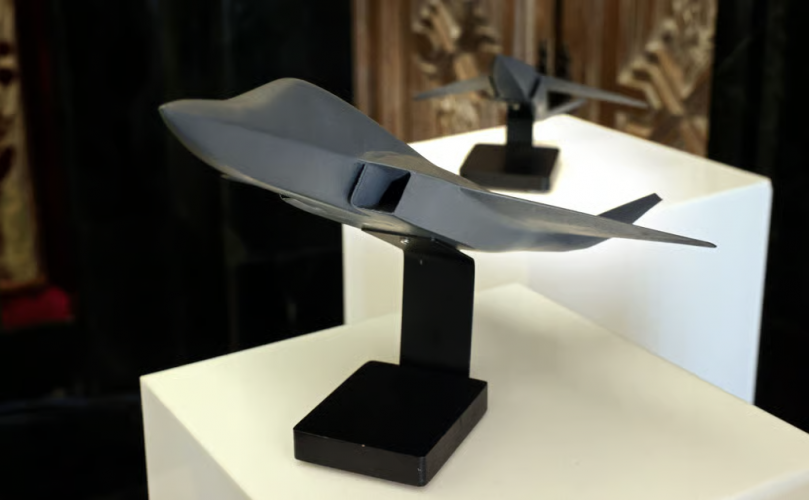
This model looks like Dassault's original NGF but longer and with better maneuverability:

NGFv2.png

If the engines spacing is kept the same, this model could be compatible with ASN4G.

PS: Thomas Coex is the photographer.
 
Looks sort of like the F-22 from the side view, especially the air intakes I think.
 
Back
Top Bottom