Future Combat Air System (FCAS / SCAF / FSAC) - Speculation and Theories

helmutkohl

ACCESS: Top Secret
Staff member
Senior Member
Joined
29 November 2010
Messages
2,286
Reaction score
5,210
This thread is for speculation on the (as of now) Franco-Greman-Spanish FCAS/SCAF project in order to keep the News thread focused on news.
Like the news thread, keep it clean, any country vs country BS will lead to infractions and thread bans.
 
Apart from entry into service date and political will is there any serious difference the FCAS, CGAP, F47 and FA/XX?
 
Apart from entry into service date and political will is there any serious difference the FCAS, CGAP, F47 and FA/XX?
There's not enough information on any of these to really talk about differences and commonalities in a big picture.

Some fundamentals are that FCAS and F/A-XX have to be able to operate from aircraft carriers. All of them are intended to work alongside some form of unmanned platforms in a networked battlefield formation. F-47 and IIRC FCAS are supposed to utilize variable cycle engines.

That's basically the only concrete stuff we can compare. It's also worth noting that the F-47 is supposedly the furthest along while all the others are still stuck in the early stages.
 
F-47 is supposedly the furthest along while all the others are still stuck in the early stages.


F-47 is the furthest along, the first EMD aircraft is being produced right now.
F/A-XX follows closely. EMD contract-award could already have happened, if the DoD/DoW had not been holding it up.
SCAF/FCAS is (nearly) dead. GCAP is progressing but a demonstrator hasn´t flown yet.
(purely spoken about the manned parts of these families of sytems)
 
There's not enough information on any of these to really talk about differences and commonalities in a big picture.

True for the details, but they're all stealthy, networked, long range, large internal weapons load, fast etc, - all the generic stuff. Differences will be in detail rather than overall, it's not as if one won't be stealthy or work with loyal wingman drones.
 
True for the details, but they're all stealthy, networked, long range, large internal weapons load, fast etc, - all the generic stuff. Differences will be in detail rather than overall, it's not as if one won't be stealthy or work with loyal wingman drones.

Well the French seem to want FCAS to be significantly smaller than the competition, much like Rafale was back in the day. So that’s going to be a key difference and will require some design trade offs.

Specifically based on the numbers released publicly they’re looking at ~1.5x Rafale’s thrust and weight:
  • 15t empty
  • 32-33t takeoff weight
  • 2x 12t thrust
 
Well the French seem to want FCAS to be significantly smaller than the competition, much like Rafale was back in the day. So that’s going to be a key difference and will require some design trade offs.

Specifically based on the numbers released publicly they’re looking at ~1.5x Rafale’s thrust and weight:
  • 15t empty
  • 32-33t takeoff weight
  • 2x 12t thrust

The French carrier requirements make cooperation difficult, as a few more tons of airframe can equate to considerably more capability.
 
The carrier requirement isn’t so limiting as it’s the same launch & recovery gear as for F/A-XX. What seems to be driving FCAS’s size is the engine thrust limitation of ~12t… why they don’t want to go for more thrust I don’t know (probably a mix of technological and budgetary concerns).

That said 1.5x Rafale (or 1.25x KF-21 or 1.15x F-35) in a much stealthier 6th gen package should leave plenty of room for a pretty interesting strike fighter.
 
Last edited:
Well the French seem to want FCAS to be significantly smaller than the competition, much like Rafale was back in the day. So that’s going to be a key difference and will require some design trade offs.

Specifically based on the numbers released publicly they’re looking at ~1.5x Rafale’s thrust and weight:
  • 15t empty
  • 32-33t takeoff weight
  • 2x 12t thrust
sounds like a plane in the ballpark of the F-35 and J-35 weight.
I could see India being interested in this for their navy.
 
Apart from entry into service date and political will is there any serious difference the FCAS, CGAP, F47 and FA/XX?
As @Desertfox said: Broadly speaking, GCAP and F-47 are comparable (land based air superiority) while SCAF and FAXX are comparable (carrier strike fighters).


Well the French seem to want FCAS to be significantly smaller than the competition, much like Rafale was back in the day. So that’s going to be a key difference and will require some design trade offs.

Specifically based on the numbers released publicly they’re looking at ~1.5x Rafale’s thrust and weight:
  • 15t empty
  • 32-33t takeoff weight
  • 2x 12t thrust
"Significantly smaller"?

33 Metric tons is ~73,000lbs. That's the size of a Tomcat!

But yes, I'm kinda expecting the actual MTOW of FAXX in beast mode to be clear up around 95,000lbs. Normal mission load for FAXX I'm expecting to be around 80,000lbs, with ~12,000lbs internal weapons.

It's also being said that F-47 is about the MTOW of an F-22, ~83k. I'm assuming that's with no external tanks or weapons.
 
sounds like a plane in the ballpark of the F-35 and J-35 weight.
I could see India being interested in this for their navy.

The current Indian AMCA being developed is

12 tons empty.
27 tons mtow.
2×12.23 tons(120kn)thrust,( developed with france, 120-140kn class)

For final varient.


I would prefer FCAS to be slightly larger than these projected specs of 32-33 tons mtow, more thrust too.


* 17-18 tons empty.

* 34-35 tons mtow

* 2× 14.27t(140kn wet, 95-100kn dry) thrust, on future engines.


As one the main known capabilities for 6th gen is significantly higher electrical power need to act as a command node, along with having better future upgrade potential, because you expect such a expensive investment to serve decades.


France would also prefer to be able to internally carry its air-launched tactical nuke missile.


Also prefer,with this weight (same as su57) , it being somewhat larger than Su-57 in size.


1772172482631.png
 
Last edited:
The big problem for SCAF is how big the ASMP/ASN4G is. ASMP is 5.4m long, ASN4G is likely longer.

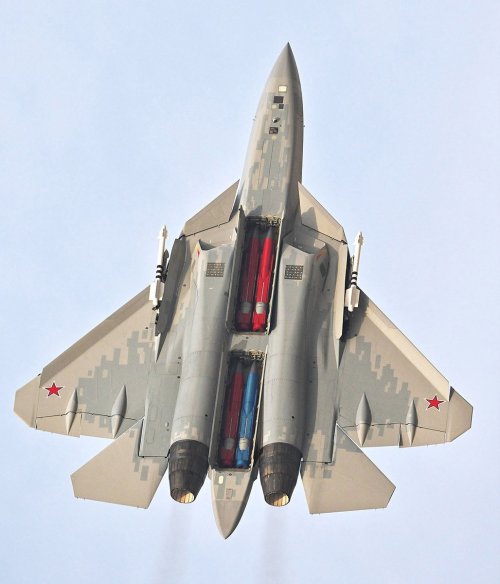
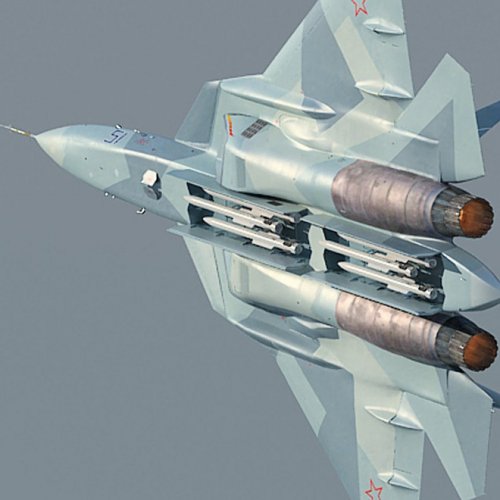
Admittedly, that does suggest a layout much like the Su-57. Very long bay between the engines.
I think a single long IWB should be within space availability for a fighter the size of Su57 or somewhat bigger.

6m long, 1.5m wide.

Challenging to make such a single large cavity, but possible.

Along with 2 smaller SWB's.
 
I think a single long IWB should be within space availability for a fighter the size of Su57 or somewhat bigger.

6m long, 1.5m wide.

Challenging to make such a single large cavity, but possible.

Along with 2 smaller SWB's.
Thing is, a bay the right length for ASMP/ASN4G is too short to allow for tandem carriage of other weapons.
 
Thing is, a bay the right length for ASMP/ASN4G is too short to allow for tandem carriage of other weapons.
The Bay of dimension i gave should be able to carry a single ASN4G given from its renderings,missile seems more flatter and wider in width or two smaller/narrower cruise missiles/A2G missiles or 6BVR missiles( 4 inside bay, 2 attached to each weapons bay door) or 9 small glide bombs.


Here's SU57 with IWB dimensions of 4.4m × 0.9m, and shallower.


G6htQosasAAOJYB.jpg c0d1c67d93424b4b14f16ea58dd86dc37e213a6a.jpeg
 
Last edited:
It should be noted that the first picture is shopped in order to show the second bay open too (not that big of a deal). The second picture is entirely fictional though.
 
Thing is, a bay the right length for ASMP/ASN4G is too short to allow for tandem carriage of other weapons.
Agree. I've been playing around with bay sizes and fitting 1 long weapon like ASMP/ASN4G basically turns the aircraft into a strategic bomber without AAMs, much like a B-1/B-2 or Mirage IVA!

Would that be acceptable? Possibly, with other fighters providing escort.

Now the main benefit of a tandem bay is that it should allow for a skinnier fuselage, as the bay can occupy part of the cavity between the engines (where fuel would normally go). This is important if you're designing a "small" 15t empty stealth fighter like NGF is supposed to be. That's basically F-15 sized... Indeed, if you took an F-15C with CFTs and modern 120kN engines it would weigh ~13.5t empty; add ~10% empty weight penalty for stealth and you've got a pretty good proxy for NGF in terms of size, weight & internal volume.

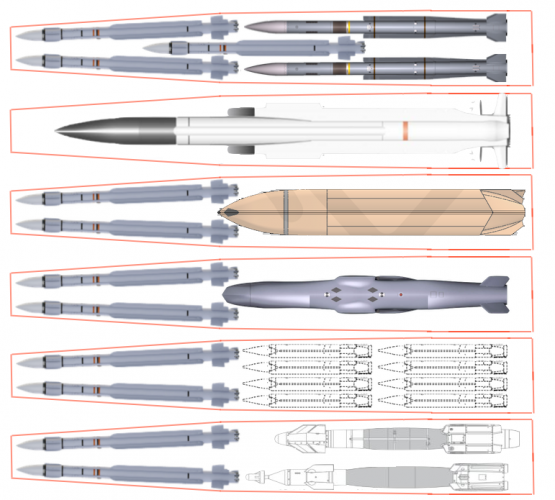
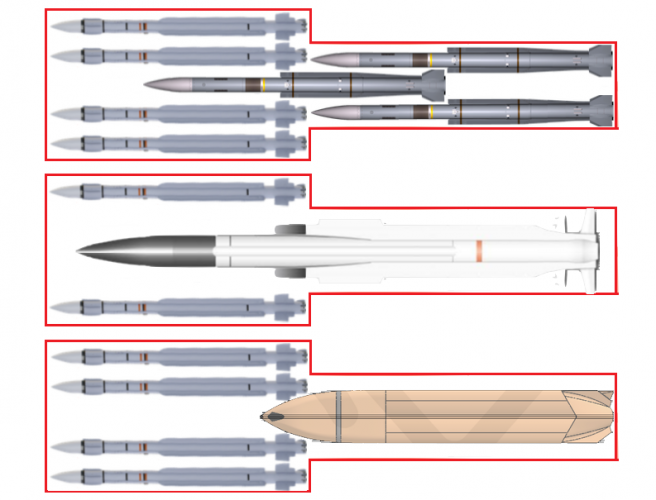
Below I've sketched a possible tandem bay layout (7.2m in length x 90cm to 1m in width) for up to 5 AAMs in the A2A role, 1x ASMP-A in the nuke bomber role (no AAMs) or 2x AAMs plus the following A/G loads:
  • 1x heavy store up to 4.3m in length (i.e. LRASM or JSM sized)
  • 2x midsized stores (MK-83 JDAM, 500lb GBU or AASM)
  • 3x 500lb bombs (MK-82 JDAM)
  • 8x 250lb SBD-class weapons
This is really the skinniest, minimum package that would make sense. Length is driven by the need to fit A2G stores behind the AAMs. Width is driven by the need to fit 4x SDBs or 3x MK-82s abreast. Height is driven by the height of the heavy store which occupies the middle ~60%, height could taper off to each side where only smaller stores would need to fit.... this taper is critical to allow enough structural spacing between the engines and weapons bay. The front AAMs would probably be door mounted as on the F-35, in order to allow for tighter stores packaging... the front doors would then open up to provide clearance to drop the rear stores.

NGF Tandem Weapons Bay example 7.2x1m v2.png

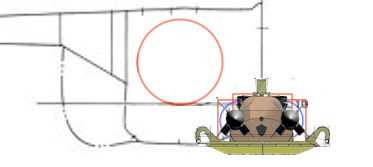
Lastly here's the tandem bay overlayed over an F-15 cross-section to illustrate fit. The engines and ducts have been angled slightly outwards to leave enough structural margins for the tandem bay. The bay sits half inside the F-15's original mold line, half projects outside to create an almost flat underbody. In practice the CFTs would probably also be shaped differently for better stealth and lower drag making them a bit smaller than the F-15's, with some of the lost fuel volume transferred to dorsal tanks for more body lift.

Tandem centerline bay F-15 100px=1m v2.png
 
Lastly here's the tandem bay overlayed over an F-15 cross-section to illustrate fit. The engines and ducts have been angled slightly outwards to leave enough structural margins for the tandem bay. The bay sits half inside the F-15's original mold line, half projects outside to create an almost flat underbody. In practice the CFTs would probably also be shaped differently for better stealth and lower drag making them a bit smaller than the F-15's, with some of the lost fuel volume transferred to dorsal tanks for more body lift.
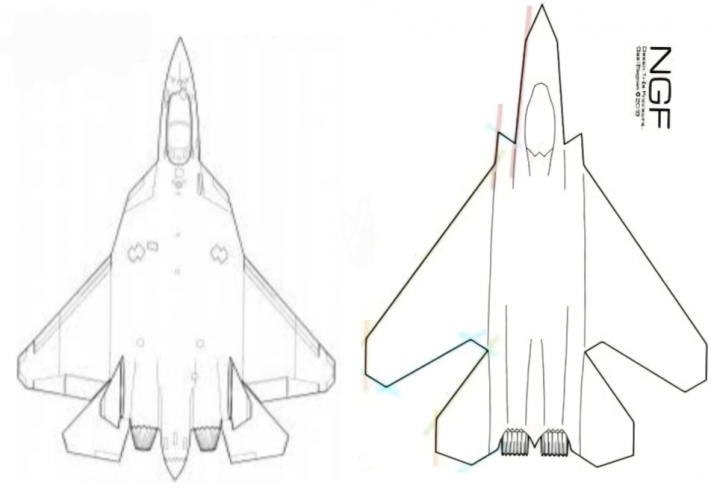
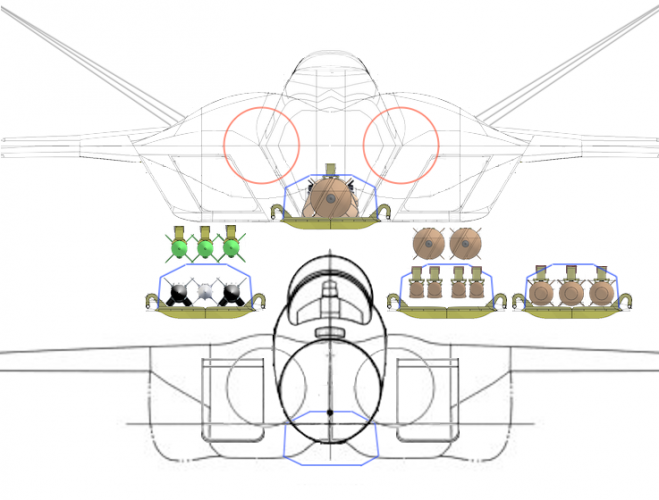
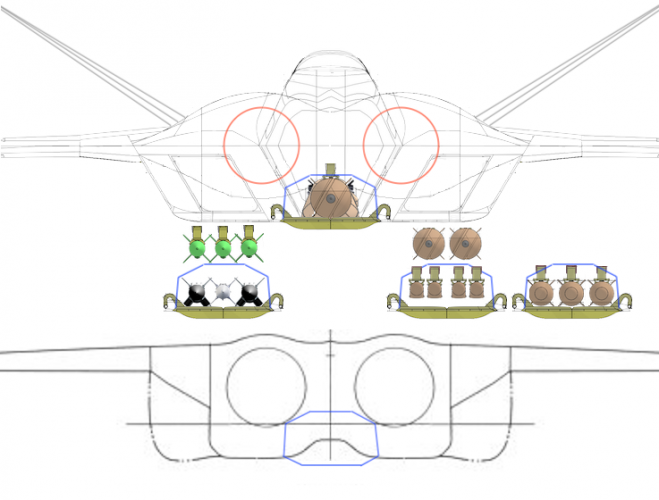
Here's an illustrative comparison of a tandem bay in 2 fighters with identical cross-sections: F-15 versus a stealthy NGF with estimated ~15t empty weight and 2x 120kN engines.

This shows the importance of engine duct size and location - the engines must be well separated in order to accommodate the tandem bay, but not too much in order for the ducts to curve outwards and shield the fans from the inlets. The tandem bay shown here would have approx the same capacity as the F-15 Silent Eagle's conformal weapons bays, keeping fuel capacity and therefore range about the same (800-900nm), but with the option of carrying 1x heavy store internally. However it remains quite size constrained compared to larger stealth fighters... perhaps 2x AAMs could also be carried in side bays, but that would reduce internal fuel and impact combat radius.

(Thanks to @VTOLicious for his amazing F/A-XX drawing, which I modified and scaled down to match the F-15 cross-section)

Hypothetical NGF (top) vs. F-15 (bottom)
NGF mod vs F-15 100px=1m v4.png
 

Attachments

  • NGF mod vs F-15 100px=1m v2.png
    NGF mod vs F-15 100px=1m v2.png
    143.5 KB · Views: 43
Last edited:
Agree. I've been playing around with bay sizes and fitting 1 long weapon like ASMP/ASN4G basically turns the aircraft into a strategic bomber without AAMs, much like a B-1/B-2 or Mirage IVA!

Would that be acceptable? Possibly, with other fighters providing escort.
I mean, two birds with ASN4Gs and 4 with AAMs would work nicely.


Below I've sketched a possible tandem bay layout (7.2m in length x 90cm to 1m in width) for up to 5 AAMs in the A2A role, 1x ASMP-A in the nuke bomber role (no AAMs) or 2x AAMs plus the following A/G loads:
  • 1x heavy store up to 4.3m in length (i.e. LRASM or JSM sized)
  • 2x midsized stores (MK-83 JDAM, 500lb GBU or AASM)
  • 3x 500lb bombs (MK-82 JDAM)
  • 8x 250lb SBD-class weapons
This is really the skinniest, minimum package that would make sense. Length is driven by the need to fit A2G stores behind the AAMs. Width is driven by the need to fit 4x SDBs or 3x MK-82s abreast. Height is driven by the height of the heavy store which occupies the middle ~60%, height could taper off to each side where only smaller stores would need to fit.... this taper is critical to allow enough structural spacing between the engines and weapons bay. The front AAMs would probably be door mounted as on the F-35, in order to allow for tighter stores packaging... the front doors would then open up to provide clearance to drop the rear stores.

View attachment 804147
I had honestly expected them to go with a bay long enough to hold two tactical weapons in tandem, such as a pair of GBU-15s or that quad rack of SDBs (forget the designation). And 2 weapons side by side (because the ASN4G is wide enough to force that much space). Which makes for a rather large bay, but only a squidge longer than your "small" bay.
 
On a slight tangent, given the changes in the international order is there a future for SDBs? If future wars are far more high-stakes won't ordnance be optimized for destructive effect rather than collateral damage limitation? IIUC SBDs were developed to fit in the tight confines of the F22 and newer aircraft have roomier bomb bays designed in.
 
On a slight tangent, given the changes in the international order is there a future for SDBs? If future wars are far more high-stakes won't ordnance be optimized for destructive effect rather than collateral damage limitation? IIUC SBDs were developed to fit in the tight confines of the F22 and newer aircraft have roomier bomb bays designed in.
I think so. SDB2s are viable for tank-busting, if a bit overkill. SDB1s are for popping bunkers and hardened aircraft shelters, as we just saw in Iran.

One major advantage is that SDBs (1s or 2s) let a plane carry a lot more separate targets-engaged. My personal favorite is the A-10 with 16 or 20 SDBs racked up.
 
Agree. I've been playing around with bay sizes and fitting 1 long weapon like ASMP/ASN4G basically turns the aircraft into a strategic bomber without AAMs, much like a B-1/B-2 or Mirage IVA!

Would that be acceptable? Possibly, with other fighters providing escort.

Now the main benefit of a tandem bay is that it should allow for a skinnier fuselage, as the bay can occupy part of the cavity between the engines (where fuel would normally go). This is important if you're designing a "small" 15t empty stealth fighter like NGF is supposed to be. That's basically F-15 sized... Indeed, if you took an F-15C with CFTs and modern 120kN engines it would weigh ~13.5t empty; add ~10% empty weight penalty for stealth and you've got a pretty good proxy for NGF in terms of size, weight & internal volume.

Below I've sketched a possible tandem bay layout (7.2m in length x 90cm to 1m in width) for up to 5 AAMs in the A2A role, 1x ASMP-A in the nuke bomber role (no AAMs) or 2x AAMs plus the following A/G loads:
  • 1x heavy store up to 4.3m in length (i.e. LRASM or JSM sized)
  • 2x midsized stores (MK-83 JDAM, 500lb GBU or AASM)
  • 3x 500lb bombs (MK-82 JDAM)
  • 8x 250lb SBD-class weapons
This is really the skinniest, minimum package that would make sense. Length is driven by the need to fit A2G stores behind the AAMs. Width is driven by the need to fit 4x SDBs or 3x MK-82s abreast. Height is driven by the height of the heavy store which occupies the middle ~60%, height could taper off to each side where only smaller stores would need to fit.... this taper is critical to allow enough structural spacing between the engines and weapons bay. The front AAMs would probably be door mounted as on the F-35, in order to allow for tighter stores packaging... the front doors would then open up to provide clearance to drop the rear stores.

View attachment 804147

Lastly here's the tandem bay overlayed over an F-15 cross-section to illustrate fit. The engines and ducts have been angled slightly outwards to leave enough structural margins for the tandem bay. The bay sits half inside the F-15's original mold line, half projects outside to create an almost flat underbody. In practice the CFTs would probably also be shaped differently for better stealth and lower drag making them a bit smaller than the F-15's, with some of the lost fuel volume transferred to dorsal tanks for more body lift.

View attachment 804148

You don't have to do much to add these extra two AAMs with the nuclear cruise missile.

test1.png

I don't think this layout will hamper much the range of the aircraft.

Cheers
 
On a slight tangent, given the changes in the international order is there a future for SDBs? If future wars are far more high-stakes won't ordnance be optimized for destructive effect rather than collateral damage limitation? IIUC SBDs were developed to fit in the tight confines of the F22 and newer aircraft have roomier bomb bays designed in.
Stormbrreaker & likes ie sdb based r the future.
 
The big problem for SCAF is how big the ASMP/ASN4G is. ASMP is 5.4m long, ASN4G is likely longer.

Admittedly, that does suggest a layout much like the Su-57. Very long bay between the engines.
ASN4G will be fitted on Rafale (or may be a dedicated ASN4G....) => lenght will be constrain around 5.4m. But it is already a long weapon!
 
So what about designing a new nuclear missile that would fit inside the weapon bays of SCAF without being too long like ASN4G, unless the French want the ASN4G to be carried externally instead.
 
In theory yes.
The 2 twins eurocanard don't demonstrate it.
Yes. Tbh, I don't understand this point I some time read that designing a carrier capable jet would something of an handicap.
Sure, it may cost a little more to design that capability on the airframe from the start, but having a far more versatile airframe in the end far outweighs that cost.
Not going to enumerate the numbers of carrier capable designed jets that had long successful service lives in Air Forces.
While if you have done air force only jet, and find yourself having to replace your SVTOL navy jets for the brand new carriers you're building, or if there is an opportunity to sell a carrier capable of jet to someone, you end up with things like these carrier capable Typhoon or Gripen projects that goes nowhere.
It's pretty clear now that :
Navy fighters --> usually makes good Air Force fighters.
Air Force fighters --> usually makes poor Navy fighters.
 
Another aspect to think about is that, along with China, Russia is also actively working on longer range anti-ship capabilities, though next gen aircraft carrier defenses are also developing, but even a single decent hit can operationally take out the carrier temporarily & the direction seems to be carrier defences are trying to catch up not the other way around.

and unlike airbases where damage to runways could be quickly repaired, you can't do the same for carriers.

One of the main requirements of Fa-xx is longer range, so carriers can operate from more farther away.

And unlike US, France only has 1 carrier, and future replacement is also going towards the direction of 1 larger carrier.

Plus the fleet defenses of the french are not on par with US navy, though much better than british( no fixed wing awacs)

So, IMO a fighter with longer range for carrier ops should be even more important for french.

This along with the increase in electrical power generation & cooling, more time on station to cooperate with CCA's and manage other assets, more powerful & capable avionics, ability to carry ASN4G internally etc.


Should atleast require a 35 tons mtow range fighter.
 
So what about designing a new nuclear missile that would fit inside the weapon bays of SCAF without being too long like ASN4G, unless the French want the ASN4G to be carried externally instead.
The problem is the speed requirement of ASN4G, that drives a slender weapon. Then the range requirement makes a slender weapon very long.


It's pretty clear now that :
Navy fighters --> usually makes good Air Force fighters.
Air Force fighters --> usually makes poor Navy fighters.
A good Navy fighter makes a good Air Force fighter.
 
Sure, it may cost a little more to design that capability on the airframe from the start, but having a far more versatile airframe in the end far outweighs that cost.
It's cost in terms of money, but also cost in terms of air vehicle performance. The additional structural mass of airframe strengthening, and the impact of achieving lower approach speeds (mass, aero efficiency) combine together to result in lower range, acceleration, turn rate etc. for all else being equal

Previous examples indicate that this is a significant (like >10%) penalty

There's a negligible export market for carrier fighters, so unless you're making one anyway for your own navy then you're much better saving the money and getting better performance.
 
It's cost in terms of money, but also cost in terms of air vehicle performance. The additional structural mass of airframe strengthening, and the impact of achieving lower approach speeds (mass, aero efficiency) combine together to result in lower range, acceleration, turn rate etc. for all else being equal

Previous examples indicate that this is a significant (like >10%) penalty


There's a negligible export market for carrier fighters, so unless you're making one anyway for your own navy then you're much better saving the money and getting better performance.
Sure sure... like anyone can see that a Rafale C or a M navy version has less range, less acceleration and lower turn rate than a Typhoon.
Oh wait, just heard some people disagree ...
 
Last edited:
The problem is the speed requirement of ASN4G, that drives a slender weapon. Then the range requirement makes a slender weapon very long.


A good Navy fighter makes a good Air Force fighter.
Yes, I wrote "usually" but I in fact have hard time finding an exception to that rule.
 
Yes, I wrote "usually" but I in fact have hard time finding an exception to that rule.
The F-14 perhaps? Great bomber interceptor and supersonic missileer, but against dedicated air superiority fighters like the F-15 it might have struggled due to the penalties of variable geometry and higher bypass turbofans which were necessary to meet naval requirements (patrol endurance + low take-off & approach speeds).
 
Back
Top Bottom