What would have happened if the Allies had not sent aid to the Soviet Union and had used those resources to advance the assault on Normandy while the Germans penetrated deep into Soviet territory, stretching their supply lines to the limit?

You are using an out of date browser. It may not display this or other websites correctly.
You should upgrade or use an alternative browser.
You should upgrade or use an alternative browser.
What would have happened if the Allies had not sent aid to the Soviet Union ?
- Thread starter Justo Miranda
- Start date
When should the assault happen?What would have happened if the Allies had not sent aid to the Soviet Union and had used those resources to advance the assault on Normandy while the Germans penetrated deep into Soviet territory, stretching their supply lines to the limit?
Rule of cool
ACCESS: Top Secret
- Joined
- 16 January 2024
- Messages
- 3,568
- Reaction score
- 4,521
What would have happened if the Allies had not sent aid to the Soviet Union and had used those resources to advance the assault on Normandy while the Germans penetrated deep into Soviet territory, stretching their supply lines to the limit?
The Allies would then have an overabundance of spam and Studebaker trucks.
In all seriousness the US in particular decided to limit their divisions to 90, rather than 215 (1941) or 165-200 (1942). As such much of their enormous productive capacity would have nowhere to be deployed. I believe that if the US decided not to help the Soviet Union it would need to raise more than 90 divisions, and likely more than the 105-120 numbers that were floated as sustainable.
That in exchange for the annihilation of Stalin's regime, the weakening of the Werhrmatch, the huge losses of the Luftwaffe in the East, the destruction of the oil industry within the Reich by the bombing of areas, and the atomic destruction of Berlin. The world could have been spared the cold war, the oil crisis of 1973 and fifty years of terrorism. In my opinion a good change.

Colonial-Marine
UAVs are now friend, drones are the real enemy.
- Joined
- 5 October 2009
- Messages
- 1,717
- Reaction score
- 1,827
I'm not sure I follow, are you saying let the Germans make their full effort to destroy the USSR by not allying with the Soviets? This could easily backfire into a war that is costlier and longer for the western Allies. I very much doubt the French would appreciate being told "just wait as they destroy each other".That in exchange for the annihilation of Stalin's regime, the weakening of the Werhrmatch, the huge losses of the Luftwaffe in the East, the destruction of the oil industry within the Reich by the bombing of areas, and the atomic destruction of Berlin. The world could have been spared the cold war, the oil crisis of 1973 and fifty years of terrorism. In my opinion a good change.

EmoBirb
ACCESS: Top Secret
- Joined
- 18 January 2025
- Messages
- 2,714
- Reaction score
- 6,959
Assuming the Soviet Union ultimately collapses as a singular entity and breaks into smaller individual factions, it would have allowed Germany to take control of the vast oil, gas and raw material resources of the east, in large part far out of the reach of the allies. It would have strenghtened the position of anti-soviet partisans in the balkans and eastern Europe and ultimately provided Germany with additional manpower, resources and production capabilities far away from the British and American Forces. Which means more time, more opportunities to field and scale the production of new systems and maybe the continuation of nuclear research in eastern europe.
Now though, the lend and lease provided by the western Allies to the USSR didn't single handedly prop the Soviets up. But it reinforced especially their logistics at a point when they were presumably at their most battered. It comes down to how unified the USSR could have remained in the face of absolute defeat. If the Union falls apart, then it's done and Germany has relatively easy access to everything listed above. If the Soviet government would manage to reign in their troops, then a grueling war to the bitter end would have been the result.
Now though, the lend and lease provided by the western Allies to the USSR didn't single handedly prop the Soviets up. But it reinforced especially their logistics at a point when they were presumably at their most battered. It comes down to how unified the USSR could have remained in the face of absolute defeat. If the Union falls apart, then it's done and Germany has relatively easy access to everything listed above. If the Soviet government would manage to reign in their troops, then a grueling war to the bitter end would have been the result.
yeetmahboi
ACCESS: Top Secret
- Joined
- 6 April 2022
- Messages
- 1,025
- Reaction score
- 1,435
The Soviets would’ve live through that, warring states went through far worse but it’d be a very tough pill to swallow.
Was the Nazi really that bent on the annihilation of communism or would they concentrated for a moment of lucidity and negotiated a ceasefire with the soviets (or the allies, or both).
That being said a weaker SU is not desirable for Allied command, imagine if they capitulated at the most crucial moment.
Was the Nazi really that bent on the annihilation of communism or would they concentrated for a moment of lucidity and negotiated a ceasefire with the soviets (or the allies, or both).
That being said a weaker SU is not desirable for Allied command, imagine if they capitulated at the most crucial moment.
EmoBirb
ACCESS: Top Secret
- Joined
- 18 January 2025
- Messages
- 2,714
- Reaction score
- 6,959
A ceasefire with the Soviets would have only been in the cards if they were deemed so weakened that cleaning up at a later date would have been an easy undertaking. The obliteration of the communist regime on Eurasian soil was the highest priority, Ideologically speaking. France, which was already beaten down, the UK and the US were seen as foolishly misguided, but not really as the mortal enemy of national socialist ideology, although it rejected capitalism as practiced by the US and the monarchic imperialism of the UK.
So, no. The USSR would have been crushed given the opportunity. And a ceasefire would have only been deemed acceptable by high command if the possibility of wiping the communist leadership out later was a guranteed prospect. Fighting the western allies to a stalemate or a ceasefire was in the cards, but that option never existed on the eastern front.
And circling back to the original topic, if lend lease didn't happen, the pressure exerted on the USSR would have been tremendous. And one may question if the western allies were willing to go all in after they just witnessed the Soviet Union breaking apart, regardless of the atomic bomb.
So, no. The USSR would have been crushed given the opportunity. And a ceasefire would have only been deemed acceptable by high command if the possibility of wiping the communist leadership out later was a guranteed prospect. Fighting the western allies to a stalemate or a ceasefire was in the cards, but that option never existed on the eastern front.
And circling back to the original topic, if lend lease didn't happen, the pressure exerted on the USSR would have been tremendous. And one may question if the western allies were willing to go all in after they just witnessed the Soviet Union breaking apart, regardless of the atomic bomb.
- Joined
- 23 August 2011
- Messages
- 2,566
- Reaction score
- 8,460
They could have sent it to defend Malaya and Singapore.
There is some truth in that. Some of the materiel sent to SU in 41 would have been very gratefully received in Far East, particularly the tanks and aircraft.
But...those supplies were critical around Moscow...
Volkodav
I really should change my personal text
- Joined
- 28 March 2014
- Messages
- 990
- Reaction score
- 1,668
Malaya was a much closer run thing than many realise; even a squadron of Matildas could have changed everything. The issue is, though, while the troops were good enough, they really did have the B team in terms of leadership; Bennett was an egotistical clown.There is some truth in that. Some of the materiel sent to SU in 41 would have been very gratefully received in Far East, particularly the tanks and aircraft.
But...those supplies were critical around Moscow...
- Joined
- 23 August 2011
- Messages
- 2,566
- Reaction score
- 8,460
Now though, the lend and lease provided by the western Allies to the USSR didn't single handedly prop the Soviets up. But it reinforced especially their logistics at a point when they were presumably at their most battered.
I think this undersells how crucial lend lease was. The SU didn't make a single locomotive between 1942 and 1945, despite colossal losses of locomotives in the opening phase of the war. People often mention the trucks, but the US and Canadian locomotives were every bit as crucial.
SU was able to focus on tank, artillery and small arms production precisely because they didn't need to make much else....radios, radar, telephone cable, 100 octane fuel, explosives etc etc came primarily from the 'West'...
You're not going to be able to build 50,000 T-34 if you also have to build 2,000 locomotives, 11,000 railcars and flatbeds...and 620,000 tonnes of rail and 425,000 vehicles....which was what the US alone supplied...UK and Canada adding even more...
Without Allied support the Red Army wouldn't have been able to move towards Germany...

Grey Havoc
ACCESS: USAP
- Joined
- 9 October 2009
- Messages
- 24,500
- Reaction score
- 18,175
Indeed, there would likely have been no Soviet Union left in the fight in the first place.Without Allied support the Red Army wouldn't have been able to move towards Germany...
A thing that many people, that had no part of their country under the Nazi boot, forget, is the incresed suffering of the occupied peoples. Every extra day and every extra square mile the Nazis had under their control means there is more of the civilian populace to be hit, oftentimes lethally. More hunger, more diseases, more deaths.
Yet another thousands of deaths of the Jews, Slavs and undesirables perhaps does not register on some people's radar scopes. It does on mine.
Yet another thousands of deaths of the Jews, Slavs and undesirables perhaps does not register on some people's radar scopes. It does on mine.
- Joined
- 23 August 2011
- Messages
- 2,566
- Reaction score
- 8,460
A thing that many people, that had no part of their country under the Nazi boot, forget, is the incresed suffering of the occupied peoples. Every extra day and every extra square mile the Nazis had under their control means there is more of the civilian populace to be hit, oftentimes lethally. More hunger, more diseases, more deaths.
Yet another thousands of deaths of the Jews, Slavs and undesirables perhaps does not register on some people's radar scopes. It does on mine.
I don't think anyone is advocating for the Nazi's winning the war, or for the war to last even longer here....the original poster, in my reading, is asking if the war could be ended sooner by Allies focusing all resources on their own forces and confronting the Nazi's with them from Normandy onwards. I don't believe that would have been possible or the quickest result at all.

- Joined
- 23 August 2011
- Messages
- 2,566
- Reaction score
- 8,460
It seems that thirty years after the collapse of the Soviet Union, some people have begun to deny the Soviet Union's contribution to the entire Second World War. Not at all surprising.
No one is denying the Soviet Unions contribution....

scautomoton
ACCESS: Secret
- Joined
- 19 January 2024
- Messages
- 316
- Reaction score
- 788
I think its probably more likely that many people don't appreciate or comprehend the sheer number of Russians that died during WW2. The fact that Kennedy pointed out that their suffering surpassed everyone else's says a lot.It seems that thirty years after the collapse of the Soviet Union, some people have begun to deny the Soviet Union's contribution to the entire Second World War. Not at all surprising.
- Joined
- 23 August 2011
- Messages
- 2,566
- Reaction score
- 8,460
Poland suffered more proportionally than the Soviet Union.
And its always worth remembering that the Soviet Union attacked them as well...
And its always worth remembering that the Soviet Union attacked them as well...

Resister1976
ACCESS: Confidential
- Joined
- 9 April 2021
- Messages
- 87
- Reaction score
- 76
Why not think about that American leader is Trump when WWII?
Additionally, the victims of Stalinist terror were deliberately counted as casualties of World War II to exaggerate the scale of losses inflicted by the enemy. A similar approach was applied to civilian casualties resulting from the Soviet "scorched earth" policy and the intentional destruction of infrastructure, which directly victimized their own citizens.

Dilandu
I'm dissatisfied, which means, I exist.
The war would be even more destructive. USSR would emerge as solo victor in Europe, basically dictating terms of post-war Old World. Cold War would be even more bitter, since all Europe would view USSR as their savior, and dismiss allies as "covards who hide behind ocean while Russians were doing all work". United States would likely relapse back into isolationism, leaving Britain to fight countless colonial wars across the crumbling empire.What would have happened if the Allies had not sent aid to the Soviet Union and had used those resources to advance the assault on Normandy while the Germans penetrated deep into Soviet territory, stretching their supply lines to the limit?
EmoBirb
ACCESS: Top Secret
- Joined
- 18 January 2025
- Messages
- 2,714
- Reaction score
- 6,959
It's unlikely the USSR would have existed in the early 1950s as a coherent state entity if lend-lease didn't happen. Let alone being the only one left standing in Europe.The war would be even more destructive. USSR would emerge as solo victor in Europe, basically dictating terms of post-war Old World. Cold War would be even more bitter, since all Europe would view USSR as their savior, and dismiss allies as "covards who hide behind ocean while Russians were doing all work". United States would likely relapse back into isolationism, leaving Britain to fight countless colonial wars across the crumbling empire.
The Soviets were already taking casualties of unspeakable proportions, lend-lease alleviated their most aching logistical pains, the Red Army essentially ran on US trucks. Without that, the logistical situation would have become untenable. And with mounting pressure from continued German offenses as well as the liberal usage of anti-soviet partisans sourced from the balkans and eastern europe (i.e. freeing up Wehrmacht and SS troops who would have otherwise be tasked with pacifying the soviet population behind German lines) it's rather logical to assume that the USSR would have broken into various smaller factions, similar to the Chinese Warlord Era.
It's also worth noting that the Chinese Communists would have most likely suffered immensely as a consequence. But even without chinese communist partisans and the looming Soviet forces in the far east, the situation for Japan was always more dire than it was for Germany. As the naval war in the pacific has been decided at American shipyards, rather than during naval engagements.
In short, no lend-lease would have most likely led to the collapse of the USSR in the late 1940s rather than in the early 1990s. Germany would have gained access to oil, gas and raw material reserves in the east, out of reach of the adversary. Allied landings would have most likely happened but with no high intensity eastern front presumably fought to a stand still before reaching Germany proper. Presumably the US would have nuked perhaps Berlin, Dresden, Cologne or Hamburg. A ceasefire would have frozen the conflict in Europe. Concessions being made in Southern Europe and North Africa. Eastern Europe unaffected. Japan would have still lost the Pacific War. Germany would have started to seriously invest in the nuclear program. So the outcome would have ultimately still been a cold war and an iron curtain. Just that this Iron Curtain would have run through the BeNeLux or parts of France.
Ultimately Lend-Lease gave the Soviets the room to breathe and move resources, troops and equipment that they needed. Lend-lease without the Soviet commitment would have yielded little, but the Soviet commitment without the lend-lease assistance would have ultimately been futile as well.
Last edited:

Owens Z
quaerimus scientiam
- Joined
- 6 October 2023
- Messages
- 553
- Reaction score
- 820
What would have happened if the Allies had not sent aid to the Soviet Union and had used those resources to advance the assault on Normandy while the Germans penetrated deep into Soviet territory, stretching their supply lines to the limit?
The Soviets would’ve live through that, warring states went through far worse but it’d be a very tough pill to swallow. Was the Nazi really that bent on the annihilation of communism or would they concentrated for a moment of lucidity and negotiated a ceasefire with the soviets (or the allies, or both). That being said a weaker SU is not desirable for Allied command, imagine if they capitulated at the most crucial moment.
I think this undersells how crucial lend lease was... Without Allied support the Red Army wouldn't have been able to move towards Germany...
Indeed, there would likely have been no Soviet Union left in the fight in the first place.
It seems that thirty years after the collapse of the Soviet Union, some people have begun to deny the Soviet Union's contribution to the entire Second World War. Not at all surprising.
I think its probably more likely that many people don't appreciate or comprehend the sheer number of Russians that died during WW2. The fact that Kennedy pointed out that their suffering surpassed everyone else's says a lot.
I've been interested in alternate history speculations along these lines for a long time, Justo Miranda. Credit should be given where it's due, so it's important to be strictly truthful, as communists were (and are) not. The United States gave at no charge not just weapons (of which the UK also freely gave) but massive quantities of machine tools, fuel, and aluminum ingots (allowing Soviet warplanes to move away from shpon plywood at last), and, famously, hundreds of thousands of US-made trucks and jeeps. And perhaps most crucial of all, food (not only Spam). Tremendous support. And that's just what made it through—due to German efforts, a substantial fraction of Lend-Lease sank to the bottom of the sea, along with many American merchant sailors.
(For honest completeness, I should mention here that the USSR did give a relatively small amount of reverse Lend-Lease to the USA—most valuably, strategic metals.)
And yet, as statistics prove, most of that American material arrived after mid-1943 (i.e. after the Battle of Kursk was won), when the Germans had already been put permanently on the defensive on the Eastern Front. Therefore, I think that in the alternate history you speak of, Justo, where the Western Allies and the USSR go all-out to defeat Nazi Germany while ignoring each other (which was indeed plausible), the Red Army would still have won out, after more time and more casualties. Many more starving to death without US food, or being killed at the front, would hardly have bothered Stalin and his cronies. In this alternate history, surprisingly little would change, I believe. Units of the Western Allies and Soviets would meet somewhere east of Torgau. The substantial delay in the Soviet advance to victory, using the same horse-drawn wagons that the German Army used, would mean US atom bombs would be dropped on their original intended target, Berlin. USAAF planes in trouble that landed behind Soviet lines would still be seized and reverse-engineered, as in real history. Soviet casualties would still be intentionally undercounted as "twenty million dead" after the war, as was the official claim when I was a kid.
Recommended references include the books Feeding the Bear: American Aid to the Soviet Union 1941-1945 by Hubert van Tuyll, and Lend-Lease and Soviet Aviation in the Second World War by Vladimir Kotelnikov.
(For pro-communists [and others that are reflexively anti-American] who might claim that eventual Soviet victory over Germany with zero US help would lead to a worsened Cold War: as was revealed from the defection of Igor Gouzenko in September 1945, the USSR had long conspired to undermine and cheat its own allies even while they generously gave. And anyways, the actual American help was minimized and belittled inside the USSR for forty years. So again, little change to real Cold War history.)
Owens Z
quaerimus scientiam
- Joined
- 6 October 2023
- Messages
- 553
- Reaction score
- 820
The late comedian Norm MacDonald on Germany versus the world: the match "was actually close"
View: https://www.youtube.com/watch?v=uXdtafGdIVM

If the Germans had defeated the Russians, you would be living in the Great World Third Reich today
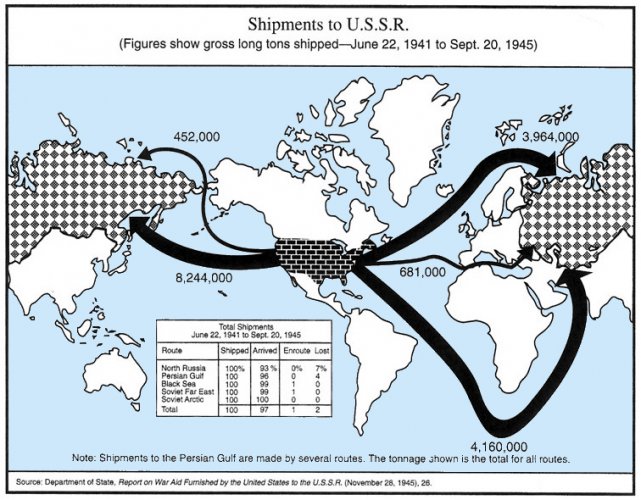
Without wishing to diminish the efforts of the seafarers of all nations who transported Lend Lease supplies to the USSR there are a few things to note from the map below:-

Note how little of the overall totals was lost.
Nearly half of all Lend Lease supplies to the USSR went unmolested via the Pacific in Russian flagged and manned ships only some of which had themselves been supplied under Lend Lease. Most of the supplies going by this route were of materials rather than military equipment, to avoid causing trouble with the Japanese, who, as they were entitled to do under international law, did occasionally stop, search and sometimes delay the passage of Russian flagged ships.
The route via the Black Sea was only opened up at the very end of 1944 once German forces had been confined to a few isolated garrisons in the Aegean area.
The Persian Gulf deliveries were by various routes. Supplies through this route only began to flow in mid-1942. Until mid-1943 that was largely via the Cape. Once the Med was reopened to through traffic from May 1943, a shorter route via the Suez Canal could be used.
Overall 100 merchant ships were lost on the Arctic run to Murmansk, with 47 being US flagged and 35 British flagged. 51 of those were lost in just three convoy rotations, PQ16 / QP12 in June 1942, PQ17 / QP13 in July & PQ18 /QP14 in Sept. After that losses were significantly reduced though the suspension of arctic convoys in summer 1943 & 1944 (escorts needed elsewhere) and the use of heavier escorts. Many of the later convoys were larger and able to complete their journeys without loss.
But even without Lend Lease, how much material would the USA have been willing to sell to the Soviets on a Cash & Carry basis as existed for Britain until March 1941? And, leading on from that, how long could Russian reserves, particularly gold, last for? Remember in April 1942 about 5 tons of Soviet gold intended as payment for supplies, ended up on the ocean bottom in HMS Edinburgh.
Note how little of the overall totals was lost.
Nearly half of all Lend Lease supplies to the USSR went unmolested via the Pacific in Russian flagged and manned ships only some of which had themselves been supplied under Lend Lease. Most of the supplies going by this route were of materials rather than military equipment, to avoid causing trouble with the Japanese, who, as they were entitled to do under international law, did occasionally stop, search and sometimes delay the passage of Russian flagged ships.
The route via the Black Sea was only opened up at the very end of 1944 once German forces had been confined to a few isolated garrisons in the Aegean area.
The Persian Gulf deliveries were by various routes. Supplies through this route only began to flow in mid-1942. Until mid-1943 that was largely via the Cape. Once the Med was reopened to through traffic from May 1943, a shorter route via the Suez Canal could be used.
Overall 100 merchant ships were lost on the Arctic run to Murmansk, with 47 being US flagged and 35 British flagged. 51 of those were lost in just three convoy rotations, PQ16 / QP12 in June 1942, PQ17 / QP13 in July & PQ18 /QP14 in Sept. After that losses were significantly reduced though the suspension of arctic convoys in summer 1943 & 1944 (escorts needed elsewhere) and the use of heavier escorts. Many of the later convoys were larger and able to complete their journeys without loss.
But even without Lend Lease, how much material would the USA have been willing to sell to the Soviets on a Cash & Carry basis as existed for Britain until March 1941? And, leading on from that, how long could Russian reserves, particularly gold, last for? Remember in April 1942 about 5 tons of Soviet gold intended as payment for supplies, ended up on the ocean bottom in HMS Edinburgh.
I would like to remind members interested in this topic that we are in a section of the forum devoted to speculative fiction and there is no point in actual historical references or the usual ideological positions. It is only a matter of imagining what the military and economic consequences would have been of a strategic decision that the Allies decided not to make.
In my opinion, the Germans attacked the USSR for mainly ideological reasons without properly measuring the medium-term consequences of their actions. The defeat of Stalin's regime and the destruction of the industrial complexes behind the Urals would not have ended the war in the East but would have forced the Wehrmacht into an endless guerrilla struggle while the heavy industry of the Reich was systematically destroyed by the RAF and the Eighth U.S. Air Force. I suggest to those concerned that they investigate how many divisions Germany had to employ to gain partial control of Yugoslavia.
In my opinion, the Germans attacked the USSR for mainly ideological reasons without properly measuring the medium-term consequences of their actions. The defeat of Stalin's regime and the destruction of the industrial complexes behind the Urals would not have ended the war in the East but would have forced the Wehrmacht into an endless guerrilla struggle while the heavy industry of the Reich was systematically destroyed by the RAF and the Eighth U.S. Air Force. I suggest to those concerned that they investigate how many divisions Germany had to employ to gain partial control of Yugoslavia.
Volkodav
I really should change my personal text
- Joined
- 28 March 2014
- Messages
- 990
- Reaction score
- 1,668
As I mentioned earlier, I see this what-if in terms of the secondary, many unforeseen, consequences. In particular, in the early days its my understanding that the UK was transferring war materiel, such as tanks and aircraft, that would have been invaluable in defending against Japan. In fact, the Empire war plans against Japan were completely derailed by being unable to adequately reinforce Malaya and Singapore, while nowhere near the greatest factor in this, supply of equipment to the USSR, was a factor.
The irony is, the USSR, with its strategic depth, was in less danger of collapsing than the Far East and the Pacific. I have raised this, possibly on this forum, years ago, strategically, what was more important, bolstering the USSR, a former Nazi ally, that would likely survive on its own, or defending territories that were providing necessary materiel and personnel?
Failure to defend Malaya and Singapore resulted in Australian forces being mostly withdrawn from the Middle East and the European Theatres.
Another effect of the other materiel transferred to the USSR was the US and UK became more reliant on Australian output, which resulted in Australia having substantial Lead Lease credits by the end of the war.
The irony is, the USSR, with its strategic depth, was in less danger of collapsing than the Far East and the Pacific. I have raised this, possibly on this forum, years ago, strategically, what was more important, bolstering the USSR, a former Nazi ally, that would likely survive on its own, or defending territories that were providing necessary materiel and personnel?
Failure to defend Malaya and Singapore resulted in Australian forces being mostly withdrawn from the Middle East and the European Theatres.
Another effect of the other materiel transferred to the USSR was the US and UK became more reliant on Australian output, which resulted in Australia having substantial Lead Lease credits by the end of the war.
- Joined
- 15 July 2007
- Messages
- 5,739
- Reaction score
- 6,322
This.And perhaps most crucial of all, food (not only Spam)
Ultimately this alone made everything else possible.
The Soviets had crashed agricultural production through forced collectivisation and communist incompetence throughout the 30's.
And those bailouts only stopped in the early 70's.
This is also why Germany's victorious extension of control over swathes of territory yielded such a disaster. Starving populations unable to turn around the agricultural productivity in time to even justify holding that territory.
Beyond the ideological justifications for slaughtering Slavs, or the normalised use of methamphetamines in the German Army, there simply wasn't enough food being produced and so another more brutal logic added to the horror.
And the logistics of poor East-West transport links hindered everything.
So a Germany that faces a collapsing Soviet Regime is one that has to accept limits on a victory in terms of what is actually of any use in any reasonable timescale. Holding anything more is a massive drain on resources.
In other words, pretty much what they had taken from St.Peterburg to the Caucasian mountains.
And remember the Germans were themselves poorly equipped for such a massive territory and environment.
Agreed, it will lengthen the war .. perhaps by a decade and with lots more casualties but ultimately it will end once the population can't bring up the necessary number of bodies to keep it going. I can't say whether for good or worse but the world would definitely be different.
What could be possibly wrong with something like ww2 going on for another decade?Agreed, it will lengthen the war .. perhaps by a decade and with lots more casualties but ultimately it will end once the population can't bring up the necessary number of bodies to keep it going. I can't say whether for good or worse but the world would definitely be different.
smh
What seems to be forgotten is the possibility that if the west cold-shoulders USSR like that, nothing stops Stalin making some kind of armistice with Germany at some point, as a sort of payback among others, especially after stopping them at Moscow and Stalingrad. I assume the soviets still wins these with fairly minimal changes because aiui the help from the west up to these battles was still very small in the grand scheme of soviet military production in that period.
So if this armistice happens, good luck to the west fighting the germans that probably relocated a large portion of their troops from USSR to the west and Med, and fueled by soviet oil and other critical supplies. Meanwhile Stalin bids his time, building the Red Army to huge levels of equipment especially (since there is no combat attrition), ready to strike after both the west and germans bled themselves dry, preferably around the time of the landings (which might happen somewhat later in this TL). Ironically, the soviets could get more of Europe if not all of it and at much lower casualty cost.
And while at it, the japanese also have a severe shortage of oil and other critical supplies, so maybe Stalin will think why not some trade between perfectly neutral countries, after all what business does the USSR have with the japanese war in the Pacific.
So if this armistice happens, good luck to the west fighting the germans that probably relocated a large portion of their troops from USSR to the west and Med, and fueled by soviet oil and other critical supplies. Meanwhile Stalin bids his time, building the Red Army to huge levels of equipment especially (since there is no combat attrition), ready to strike after both the west and germans bled themselves dry, preferably around the time of the landings (which might happen somewhat later in this TL). Ironically, the soviets could get more of Europe if not all of it and at much lower casualty cost.
And while at it, the japanese also have a severe shortage of oil and other critical supplies, so maybe Stalin will think why not some trade between perfectly neutral countries, after all what business does the USSR have with the japanese war in the Pacific.

Lascaris
ACCESS: Secret
- Joined
- 14 November 2008
- Messages
- 357
- Reaction score
- 460
At how many nuked cities Germany surrenders? Because in a scenario the Soviets are off the picture, western options are they either build up another 200 divisions themselves and somehow land them in France in the face of 200+ German divisions instead of 60, or that they nuke the hell out of Germany sometime in 1946-47.
Rule of cool
ACCESS: Top Secret
- Joined
- 16 January 2024
- Messages
- 3,568
- Reaction score
- 4,521
If the West abandoned the Soviets and they withdrew from the war, the war on western front would be radically different. Nuking Germany would be no simple task once Germany shifted its production to the western threat.
Scott Kenny
ACCESS: USAP
- Joined
- 15 May 2023
- Messages
- 19,656
- Reaction score
- 28,136
I remember grain shipments to the USSR in the 1980s.This.
Ultimately this alone made everything else possible.
The Soviets had crashed agricultural production through forced collectivisation and communist incompetence throughout the 30's.
And those bailouts only stopped in the early 70's.
Ostfront isn't much of an area of study of mine, but IMO Germany needed to be laying new rail lines in their captured territories in addition to making use of Russian lines. (possibly re-gauging the russian rails, it's trivial to swap trucks under a train once and be done with it)This is also why Germany's victorious extension of control over swathes of territory yielded such a disaster. Starving populations unable to turn around the agricultural productivity in time to even justify holding that territory.
Beyond the ideological justifications for slaughtering Slavs, or the normalised use of methamphetamines in the German Army, there simply wasn't enough food being produced and so another more brutal logic added to the horror.
And the logistics of poor East-West transport links hindered everything.
So a Germany that faces a collapsing Soviet Regime is one that has to accept limits on a victory in terms of what is actually of any use in any reasonable timescale. Holding anything more is a massive drain on resources.
In other words, pretty much what they had taken from St.Peterburg to the Caucasian mountains.
And remember the Germans were themselves poorly equipped for such a massive territory and environment.
Hire the friendly locals to do the work under German supervision, but you can make several miles a day just using manual labor, nevermind using heavier equipment. The US record for all manual labor was 10 miles of track per day on fairly flat ground.

topspeed3
ACCESS: Secret
- Joined
- 31 January 2011
- Messages
- 495
- Reaction score
- 276
Not only attacked but eliminated the intelligentcia....with neck shots.....priests and officers as well.Poland suffered more proportionally than the Soviet Union.
And its always worth remembering that the Soviet Union attacked them as well...
Similar threads
-
 Tank development if the Cold War had continued
- Started by uk 75
- Replies: 15
-
 What if the Soviet Union collapsed in 1995 instead of 1991?
- Started by helmutkohl
- Replies: 23
-
What if yak-141 fleet instead?
- Started by helmutkohl
- Replies: 15
-
-
What if the Sino-Soviet split did not occur
- Started by helmutkohl
- Replies: 18