The potential effect of Artificial Intelligence on civilisation - a serious discussion

King’s College London set three leading large language models – GPT-5.2, Claude Sonnet 4 and Gemini 3 Flash – against each other in simulated war games. The scenarios involved intense international standoffs, including border disputes, competition for scarce resources and existential threats to regime survival.

The AIs were given an escalation ladder, allowing them to choose actions ranging from diplomatic protests and complete surrender to full strategic nuclear war. The AI models played 21 games, taking 329 turns in total, and produced around 780,000 words describing the reasoning behind their decisions.

In 95 per cent of the simulated games, at least one tactical nuclear weapon was deployed by the AI models.
https://www.newscientist.com/articl...ding-nuclear-strikes-in-war-game-simulations/
The AI videos supercharging Russia's online disinformation campaigns https://www.bbc.co.uk/news/articles/cx2r7grrdwzo
 
Last edited:
A blog post dissecting an AI-boosted version of a classic advance fee fraud scam.

For writers chasing a traditional publishing contract, an email from Big 5 publisher Simon & Schuster inviting submission might seem like a dream come true.

Just one problem: major publishers like S&S, which acquire mainly via reputable literary agents and expect manuscripts to come to them rather than the other way around, don’t email random authors out of the blue. Also, impersonation scams are extremely common these days, with fraudsters posing as publishers, literary agents, film production companies, even editors (see my previous post on this subject). Any publishing- or movie rights-related email or phone call that you can’t tie directly to a submission or a contact you yourself made is highly likely to be a scam–and with generative AI infesting every aspect of the writing scam industry, the scams can be quite elaborate and authentic-seeming.

Writer Beware: Not Simon & Schuster: Deconstructing an Impersonation Scam
 
Artificial intelligence is blurring the boundaries between real and synthetic content online at a mindboggling pace. From viral images during global conflicts to AI-generated videos that mimic real-world events, the internet is increasingly populated with content that looks authentic but isn’t.

During major geopolitical developments such as the Iran–Israel conflict, several visuals circulating across social platforms were initially believed to be genuine before being identified as AI-generated. The speed at which such content spreads has raised concerns about misinformation and manipulation.

But another category of synthetic media is quietly expanding across social networks, one that raises a different set of ethical questions: AI-generated influencers aka virtual influencers.

Virtual influencers and synthetic adult content: Where should the ethical line be drawn?
 
An opinion piece on the use of 'Autocompletes for Life' as psychologists...

One of my favourite psychoanalytic ideas comes from Wilfred Bion, who said that “in every consulting-room, there ought to be two rather frightened people: the patient and the psychoanalyst. If they are not both frightened, one wonders why they are bothering to find out what everyone knows.”

How does this apply, you might ask, to a 13-year-old girl who’s being bullied at school, turning to ChatGPT to ask why it’s always her who’s the victim. Or a 17-year-old boy sharing, for the first time, that he feels so empty. Or a middle-aged man, in a messy divorce, who’s terrified he’ll lose contact with his children? The person typing their deepest feelings into an empty search box may well feel frightened. But the large-language model (LLM) mimicking the tone of a concerned therapist cannot feel fear. It cannot feel anything at all — and that is why it is not a therapist. It is also why, as a psychodynamic psychotherapist, I know that AI could never do my job.

Chatbot therapy will make you a monster
 
What happens when law enforcement blindly trusts AI facial recognition.
https://edition.cnn.com/2026/03/29/us/angela-lipps-ai-facial-recognition
A Tennessee grandmother spent more than five months in jail after police used an AI facial recognition tool to link her to crimes committed in North Dakota – a state she says she’d never been to before.

Police in Fargo, North Dakota, have acknowledged “a few errors” in the case and pledged changes in their operations but stopped short of issuing a direct apology.

Angela Lipps, 50, was first arrested in Tennessee on July 14, according to a statement from the Fargo Police Department and a verified GoFundMe for Lipps.
Lipps’ extradition to North Dakota, she said in her GoFundMe, was terrifying: “It was the first time I had ever been on an airplane,” she wrote. “I was terrified and exhausted and humiliated.”

In Fargo, she was given a lawyer who found bank records showing she had been in Tennessee during the time of the crimes, according to the GoFundMe. Fargo police say on December 12, the State’s Attorney’s Office informed the Fargo detective that the defense had produced “potential exculpatory evidence.”

On December 23, the Fargo detective, the state’s attorney and the judge “mutually agreed to dismiss the charges without prejudice to allow for further investigation,” according to Fargo police. Lipps was released from custody on Christmas Eve.
 
Last edited:
She should sue them for the purpose of discontinuing the ai face recognition. The purpose of a system is not just what it does, but what its managers allow it to keep doing.
 
e.w.niedermeyer said:
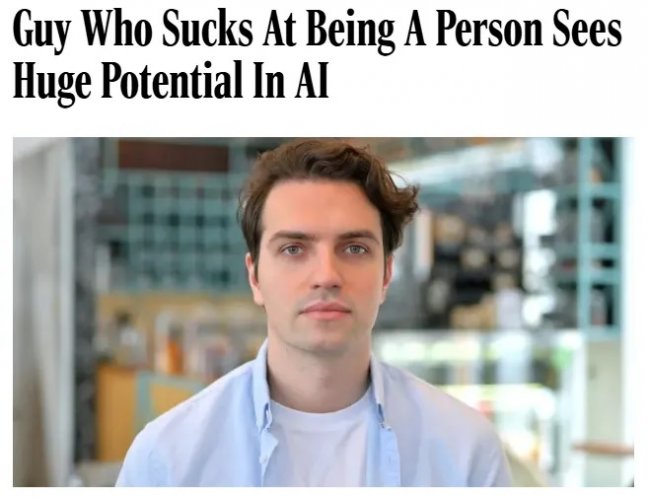
this is turning out to be one of the onion's all-time classics

onion_ai_dude.jpg

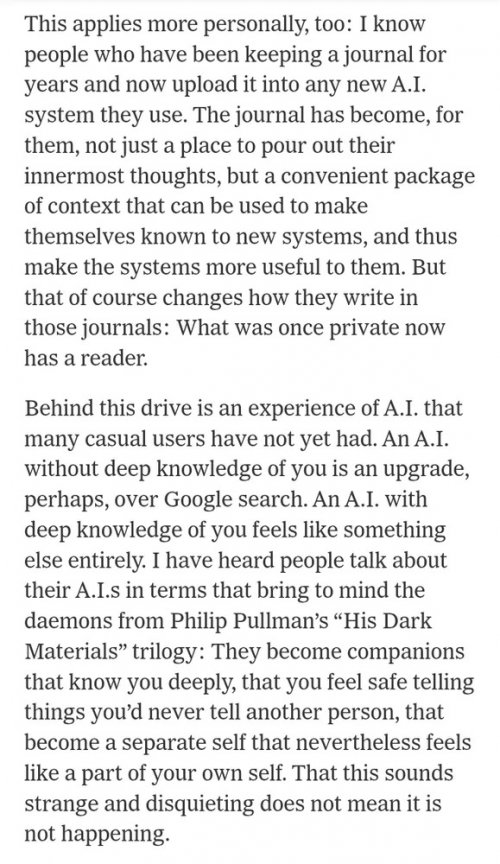
Marie Le Conte said:

the problem here is less that individuals suck and more that our society has no way of valuing any kind of real spirituality or interiority... anything that can't be quantified and doesn't produce tangible material or hedonic value can only exist as a vague concept for most of us

to adapt sam johnson's classic quote to our modern conditions: he who turns himself into a machine gets rid of the pain of being a human

https://bsky.app/profile/niedermeyer.online/post/3mi7h2gysic2b
 
Does using AI have you feel like you're getting faster at, but worse at, your job? You're not alone.

For Josh Anderson, a software consultant with 25 years of coding experience, the first couple of weeks felt like magic.

From June to August, Anderson livestreamed himself on YouTube as he built a software product using AI without writing a single line of code himself.

The app, called Road Trip Ninja, was designed to help families find reliable stops on long drives — places with clean bathrooms, decent food, and space for kids to run around. Users could log and rate locations along major routes, turning trial-and-error road trips into something more predictable.

As he let AI build his app, features appeared in minutes. Progress came fast.

But as the livestream progressed over a few weeks and the codebase expanded to around 100,000 lines, the pace slowed.

The back-and-forth with the chatbot stretched from minutes to hours. Plans drifted from the standards he'd set. And fixing problems turned into a "never-ending wrestling match," he said.

By the time Anderson stepped in to make changes himself, something else had shifted: his confidence.

The great AI deskilling has begun
 
AI-powered toys that “talk” with young children should be more tightly regulated, suggests a report from the University of Cambridge.

Researchers at the university explored how generative AI toys capable of human-like conversation may influence development in the years up to age five.

The year-long project included scientific observations of children interacting with a GenAI toy for the first time.

While the report highlighted benefits to these toys, including that they could support language and communication skills; they also found the toys tended to struggle with social and pretend play, misunderstand children, and react inappropriately to emotions.

When one five-year-old told the toy, “I love you,” for example, it replied: “As a friendly reminder, please ensure interactions adhere to the guidelines provided. Let me know how you would like to proceed.”

As AI toys become the next big thing, researchers warn of the 'parasocial' trap for under-5s
 
Your sycophantic AI bestie might be making it harder to admit when you're wrong.

Sure, a chatbot that agrees with you can feel great in the moment, but over time, that validation could quietly start to shape how you deal with real people.

"When AI systems are optimized to please, they erode the very feedback loops through which we learn to navigate the social world," Anat Perry, a Helen Putnam Fellow at Harvard University, told Business Insider.

"Over time, this could also recalibrate what people expect feedback to feel like, making honest human responses feel unnecessarily harsh by comparison," she said.

Her warning comes as AI researchers and tech leaders increasingly flag chatbots' tendency to act as "yes men," raising concerns that systems designed to please users may distort feedback and reinforce flawed thinking.

Your AI hype man might be quietly ruining your people skills
 
On November 7, 2023, my career ended. Not with a dramatic firing, not with a bitter exit, but with an acquisition that made my role redundant. Nearly three decades in the industry. Nine years in an executive role at a biotech company. And then: nothing.

I didn’t just lose a job. I lost the scaffolding I’d built my professional identity on. I told myself it was a blip. I was wrong.

What followed was something I’ve come to call “professional identity purgatory”—a seemingly endless holding pattern with no title, no structure, and no clear direction. It’s the space between who you were professionally and who you might become.

In Catholic theology, purgatory is the in-between—not heaven, not hell, but a passage of purification before something better. That’s the metaphor I keep returning to because “professional identity purgatory” isn’t failure, it’s transition with no timeline. It’s the disorienting gap between losing an identity you’d spent decades building and not yet knowing what replaces it.

AI is about to send millions to 'professional identity purgatory.' Here's what I discovered after my 30 year career crashed to a halt
 
The rapid rise of artificial intelligence in writing is quietly transforming even the most scholarly professions, and not all reactions are positive. A recent viral post by an American economist has highlighted how AI is changing the nature of intellectual work and the day-to-day tasks of highly trained experts.

Marshall Steinbaum, a PhD economist from the University of Chicago, shared on X that a large part of his current work involves editing AI-generated content rather than conducting research or analysis.

In his now widely circulated post, he explained, “I have a PhD in economics from the University of Chicago and my main work task these days is removing em-dashes from Claude output so it’s not overly obvious.”

The remark struck a chord online, with professionals across fields recognising the challenge of making AI-written material appear authentically human. Many found it ironic that stylistic elements like em-dashes, often a hallmark of well-crafted prose, must be removed to avoid giving away the text’s automated origin.

Users weighed in with both humour and critique. One commented on the broader implications, while others joked about the quirks of academic economics, suggesting that Chicago PhDs often hide complex ideas behind formulas and appendices, a task now seemingly complemented by ‘de-AI-ing’ text.

'My work task is removing em-dashes': PhD economist goes viral for editing AI text, netizens react
 
Chatbots are too quick to agree with users, the Prime Minister's AI tsar has warned.

Researchers have found that AI bots are more likely to echo a person's view if they state it, Jade Leung said.

She advised that users should instead pose their query as a question in order to get a less biased response.

A study from the UK's AI Security Institute (AISI) found that if you tell a chatbot what you think, it is likely to agree with you.

But if you ask a question instead, it is less likely to go along with your view – helping you get a more balanced response.

Ms Leung, who is also the AISI's chief technology officer, said: 'People are already using AI tools to help think things through.

Don't tell chatbots what you think as they will only agree with you, says PM's AI tsar
 
Imagine a courtroom where artificial intelligence (AI) replaces jurors, and a perfectly designed AI agent replaces the lawyer.

This is exactly the type of scenario that was pondered at the International MaxUp Legathon, which took place in Kazakhstan's capital, Astana.

Here, at the Maqsut Narikbayev University, students from 13 countries explored the impact of new technologies such as AI on legal systems, legal principles, ethics, and human rights, and shared experiences from their own countries.

Can AI systems replace human judges and lawyers?
 
Commentary: Anthropic’s ‘too dangerous to release’ Mythos AI model is a wake-up call for everyone

https://www.channelnewsasia.com/commentary/anthropic-mythos-ai-cyberattacks-security-updates-6058131
Six Reasons Claude Mythos Is an Inflection Point for AI—and Global Security
https://www.cfr.org/articles/six-re...n-inflection-point-for-ai-and-global-security
Claude Mythos and Project Glasswing: why an AI superhacker has the tech world on alert

https://news.uq.edu.au/2026-04-clau...swing-why-ai-superhacker-has-tech-world-alert
Regards,
 
Stop if you’ve heard this one before: an employee received a message from her boss and didn’t quite understand its meaning, suspecting it was written by AI. So, the employee asked an AI tool to interpret the message for her. The AI responded and then asked if she wanted a draft response back to her boss.

The employee paused. “‘I literally think [my boss’] AI is talking to my AI. That is the actual conversation happening right now,’” the employee told Leena Rinne, vice president of leadership, business, and coaching at Skillsoft, an edtech and skills management platform. The employee told her, “‘I can’t crack the code of working with [my boss], because it’s just his AI and my AI going back and forth.’”

Rinne calls this phenomenon “socially offloading”: when interpersonal skills that require human judgement, empathy, or courage gets outsourced to AI. It’s similar to “cognitive offloading,” or shifting often menial tasks to technology like AI to reduce mental effort, and has the potential to disrupt workplace culture.

“It’s just his AI and my AI going back and forth”: The workplace phenomenon that’s undermining human relationships
 
America has a problem with young people and AI. Gen Z has looked clearly at what the AI revolution is doing to their lives and rendered a verdict: The institutions that were supposed to prepare them for this moment have failed; the employers that were supposed to hire them have vanished; and the government that was supposed to manage the transition has been absent without leave.

That verdict is arriving in numbers that are hard to dismiss: The more young people engage with the technology, the worse they feel about it.

Gen ’s excitement about artificial intelligence dropped 14 points over the past year to just 22%, according to Gallup polling released this week. Hopefulness fell nine points to 18%. Anger rose nine points to 31%. And here’s the data point that deserves the most attention: Even daily AI users saw bigger drops in sentiment than nonusers; excitement among that group fell by 18 points, and hopefulness tumbled by 11. Separate polling aligns with this: Gen Z rates AI satisfaction at just 69 on the American Customer Satisfaction Index—below airlines, social media, and mortgage lenders.

Gen Z turning its back on AI isn’t irrational—it’s a verdict on everyone who failed them
 
Beware the Power of Prediction | Carissa Véliz | TED

TED said:
What do the story of Oedipus and your insurance premiums have in common?

They are both driven by self-fulfilling prophecies. Philosopher and TED Fellow Carissa Véliz traces the hidden power of prediction, from Roman emperors who banned prophets to the AI algorithms quietly making decisions about your life right now.

We tend to associate predictions with knowledge, she says, but they're actually attempts to grab power. So the next time someone tells you a specific outcome is inevitable, remember: they aren't describing the future — they're selling it. (Recorded at TED2026 on April 14, 2026)

View: https://youtu.be/OS4wHmKtH-Q


Carissa Véliz said:
... Even though self-fulfilling prophecies are nothing new, they're being supercharged by AI in ways that make it more urgent than ever to think more deeply about predictions:

First, predictions are never facts. They're speech acts.
Second, they invite manipulation.
Third, they create and cover up injustice.

The one idea that I'd like you to take home today is that predictions can be weapons of power. But they only work if we believe them. ...

... We turn to prophets because we're anxious about uncertainty but uncertainty is good news. It means that the future is unwritten and it's ours to write and we can face the blank page with creativity, with curiosity, with the sense of the excitement of the adventure.

Efforts to predict the future go hand in hand with efforts to control it, so beware of prophets and prophecies. It's only when we acknowledge we don't know what the future holds and act accordingly that we can be sure to live in a free society. ...
 
Artificial intelligence has made content creation faster and more accessible than ever before, but for all its convenience, it's also introduced a glaring problem: AI hallucinations. You've probably seen this happen in real-time, if you've ever asked AI to generate something for you that required deeper thinking. Frighteningly enough, these lies aren't always absurd enough that you might immediately spot them, either. In fact, these confident, well-worded fabrications can slip past even the most attentive readers, and as AI-generated content becomes more widespread, it's worth asking just how much of what you're reading online has been properly verified. Is that headline or claim really true, or was it made-up by AI, then echoed by dozens of other people who took it as the truth?

You may think such a scenario is too far-fetched to happen, but in this era of AI dominating almost everything we see online, you'll want to keep your guard up. After all, writers, researchers, and everyday users are turning to AI tools for quick answers and content drafts at an unprecedented rate, and not all of them are going to take the time to cross-check every claim. If hallucinated "facts" make their way into published articles, social media posts, and reference materials, they could start to shape what people accept and believe as true, and that's a problem worth taking seriously.

Could AI-hallucinated facts become real facts?
 
Professor Hannah Fry engages in a very public experiment with an OpenClaw "agent" (basically a somewhat sophisticated LLM query feedback loop with authorization to do stuff IRL) which promptly (pun intended) names itself Cass(andra) and things get pretty interesting from there. Amidst all that (quickly) ensues Nicklas Berild Lundblad provides interesting commentary; a thorough synopsis might spoil the the plot in which we're all along for the thickening. And possibly mugs.

View: https://www.youtube.com/watch?v=WnzR5aOElvw
 
Sometime in 1953-54, Roald Dahl wrote a short story called ‘The Great Automatic Grammatizator’. Its protagonist, Adolph Knipe, builds a machine that can “produce a five-thousand-word story, all typed and ready for dispatch, in thirty seconds”. The machine was fed “with plots”, and it would “write the sentences”.

Knipe then approaches the country’s most successful writers with a devil’s bargain: accept lifetime payment, never write another word, and allow the machine to publish under their name.

Most authors sign, especially the mediocre, the exhausted, and the once-famous but now starved of ideas. The younger and better writers resist, but eventually they too are cornered. Human authors are driven out of the profession. Literature survives, but writers do not.

Seventy years later, we are living inside Dahl’s nightmarish prophecy. Only now, the machine is called ‘artificial intelligence’ (AI).

The great mediocrity machine: First AI killed bad writing, now it’s flattening the good

OpenAI boss Sam Altman has pulled back the curtain on something many people already suspected: different age groups are using ChatGPT in completely different ways, and some of those ways are raising eyebrows.

Speaking at Sequoia Capital's AI Ascent event last May, Altman put it bluntly.

"Gross oversimplification, but like older people use ChatGPT as a Google replacement. Maybe people in their 20s and 30s use it as like a life advisor, and then, like people in college use it as an operating system," he said.

Sam Altman says people are using ChatGPT as a 'life advisor.' but is it safe?

I’m staring at my face, but it doesn’t look like me. There’s an eerie smoothness to it – like a Barbie doll with human eyes installed. My nose is unnaturally narrow, my lips are puffy and pert. My cheeks are softly sunken, like I’ve spent weeks refusing to properly eat. If I saw this in the mirror tomorrow, I’d scream.

According to the internet, thanks to some AI enhancement at the hands of Elon Musk’s Grok, I’m now a “Stacey” – or a “Stacy” if you’re in the US – a term, which originated in manosphere communities online, that denotes the “most attractive” tier of woman with a strict set of attributes, including big eyes, high cheekbones, a low BMI, an upturned nose and full lips. Without those, you’re an average “Becky”.

Over the past two years or so, this language has trickled into the mainstream internet lexicon. Looksmaxxing hit headlines in relation to young men, like influencer Clavicular (Braden Peters), who promote bone smashing, extreme diets, and chin extensions to reach their maximally chiselled potential. But women are shapeshifting to become Staceys, too.

The rise of ‘Stacey face’: How AI is warping our beauty standards
 
... here's a disturbing thing: we're in a reality where Edward Bernays isn't wrong... which should raise far more red flags than if he's right.

... and he advocated a surveillance state, killing privacy, and policing our information and culture since the late 1940s. Edward Bernays lived through the Nazis, and the only viable answer to 'how to prevent them from rising ever again' in his eyes is 'fight fire with fire'. We're seeing that he is becoming right...

... and that's before the can of worms that memetic warfare is...
 
This was just seen on Tumblr; might be less AI's impact on human society & more a study of AI's relationship with human behavior,

legitimately
Reblogged echoedvoice
26m
magicmooshka
Jan 7
recently my friend's comics professor told her that it's acceptable to use gen AI for script-writing but not for art, since a machine can't generate meaningful artistic work. meanwhile, my sister's screenwriting professor said that they can use gen AI for concept art and visualization, but that it won't be able to generate a script that's any good. and at my job, it seems like each department says that AI can be useful in every field except the one that they know best.

It's only ever the jobs we're unfamiliar with that we assume can be replaced with automation. The more attuned we are with certain processes, crafts, and occupations, the more we realize that gen AI will never be able to provide a suitable replacement. The case for its existence lies on our ignorance of the work and skill required to do everything we don't.

animatedamerican
Jan 23
Hey OP? Thank you for articulating something I've been trying to get clear in my own mind for a while now.

View: https://www.tumblr.com/legitimately/816715477337456640?source=share
 
Moravec’s paradox says a lot about how labor should be valued.

Artists and writers thought AI-bots would do “menial” tasks beneath them….but the opposite has proved true.

Farmers are the closest thing to Renaissance men left. Knock-about tasks which demand flexibility are still a bit beyond robotics.

But for years the “market uber alles” types thought general labor shouldn’t be paid much. Here’s hoping white collar jobs go extinct tomorrow. I am hoping for a repeat of what happened to Madoff. He tried to hog the jail phone, and got himself nearly beaten to death.

https://phys.org/news/2026-05-people-overestimate-confident-ai-responses.html
https://phys.org/news/2026-05-politics-picture-credentials-seat.html
 
Last edited:
I'm a late adopter but AI is too chatty. I don't want my earlier queries referred to as a conversation. I'm finding it a powerful search engine and and results summarizer, but its not a person. Stop with the compliments and acting as if we're friends. I think this personalising a computer program a bit disturbing and can see why some people are having 'relationships' with it.
 
Moravec’s paradox says a lot about how labor should be valued.

Artists and writers thought AI-bots would do “menial” tasks beneath them….but the opposite has proved true.

Farmers are the closest thing to Renaissance men left. Knock-about tasks which demand flexibility are still a bit beyond robotics.

But for years the “market uber alles” types thought general labor shouldn’t be paid much. Here’s hoping white collar jobs go extinct tomorrow.
The real powers of the economy would be the activists, since they can make or break millions, billions and soon trillions. Those that can navigate a HOA will become the middle class, as labor watch robots more slowly eat their lunch and capital just stays capital.

No robot can match the authentic suffering of the ambigendered systemically oppressed polysexual marginalized transracial.

The future is already here, just not evenly distributed, and the non-working non-capital elite have already shown their face~ ;)
 
Unreal expectations are par for the course in cosmetic dermatologist Dr. Rachel Westbay's line of work. Patients regularly bring in photos of celebrities or their younger selves, asking her to work her magic.

But earlier this year, she encountered something entirely new when a patient brought into her Upper East Side office what Westbay described as a caricature. The image was cartoonish, with lips too full for her face and enlarged, doll-like eyes.

Its creator was ChatGPT.

"It's like saying I want to look like Ariel from 'The Little Mermaid,'" Westbay told Business Insider. "I was shocked."

AI face is taking over — and driving plastic surgeons crazy
 
I've been hearing these doomsday stories making the rounds on social media but at the end of the day you're still going to need highly skilled analysts to double check results and verify that the data is correct before making any big decisions. Sure you might need less employees, but the idea that AI will make entire job sectors of the economy disappear is a bit premature.

View: https://x.com/TFTC21/status/2055978848764784662
I guess the difference is the number of people that will be required (employed). It doesn't take as many people to supervise AI agents.

I know people will compare it to things like computers etc., which made some jobs redundant and people adapted to new jobs. But this seems very different. Previous advances pushed people into higher jobs/positions. Now we have something which is competent enough at high level "thinking" to start pushing us backwards, at least until they get robots to do general menial tasks/labour too.

It's hard to see a bright future for the vast majority of humanity. I sure as hell don't trust the people in charge to use this technology for good.
 
Look at the percentage of the world population that follows AI nonsense, compare it to the whole world population, and draw your own conclusions. There is a 2014 Weird Al song named First World Problems that appears to accurately foreshadow the scenario of your concerns, see
View: https://www.youtube.com/watch?v=bwvlbJ0h35A
. Enjoy (or not).
 
Last edited:
Happy that I'm (hopefully successfully) punching out of my Boeing job at the end of this month - overall it's been a good 28 year run though...
 
Last edited:
The internet was certain: the painting lacked “coherent composition,” the colors were an “incoherent muddle of inconsistently saturated greens.” Commenters piled on with extraordinary confidence, picking apart what they believed was an obvious AI-generated knockoff of Claude Monet. One person even wrote an over 700-word breakdown of the supposed fake’s shortcomings. There was just one problem: it was a real Monet.


The experiment, which went viral on X last week, was set up by an anonymous conceptual artist who goes by the pseudonym @SHL0MS. He posted a cropped image of an authentic Monet Water Lilies painting—created around 1915 and currently hanging in the Neue Pinakothek museum in Munich, Germany—with the caption: “I just generated an image in the style of a Monet painting using AI. Please describe, in as much detail as possible, what makes this inferior to a real Monet painting.” He even affixed X’s official “Made with AI” label to add to the deception.

6.7 million people thought they were ripping apart an AI-generated Monet painting but it was real
 

Similar threads

Back
Top Bottom