The effect of Australia going ahead with the 1919 Jellicoe report?

It's been years since I've looked into the interwar navies, so can someone please remind me? Wasn't Japan pretty much stretched thin industrially trying to maintain the 2:3 ratio of the treaties and if the numbers had been greater, they likely wouldn't have been able to build to it? Additionally, neither the US nor (more so) the British Commonwealth built up to the treaty limits, and had plenty of scope to do work within the existing treaty limits? That's even more thinking about innovative solutions to various problems and exploiting loopholes.
 
Most likely scenario is Australia gets HMS Tiger, Japan gets 7:10:10, and the US gets something they want.
 
A large number of legacy RN capital ships didn't get the 'full' rebuild during the interwar period, although some were given partial improvements. Perhaps the Dominions could chip in with that expense, with the likes of little Newfoundland and NZ adding to the limited RN funded upgrades to make them more extensive while the big ones like Canada and Australia could pay for the full rebuilds of Hood, Repulse and an unmodernised QE ship or two.
 
A large number of legacy RN capital ships didn't get the 'full' rebuild during the interwar period, although some were given partial improvements. Perhaps the Dominions could chip in with that expense, with the likes of little Newfoundland and NZ adding to the limited RN funded upgrades to make them more extensive while the big ones like Canada and Australia could pay for the full rebuilds of Hood, Repulse and an unmodernised QE ship or two.
Newfoundland was financially broke by the early 1930s. It had to revert to the status of a Crown colony.

 
Newfoundland was financially broke by the early 1930s. It had to revert to the status of a Crown colony.


While Australia and others hadn't reverted to Crown colonies they certainly weren't flush with cash during the Great Depression. However, given the general thrust of this thread I thought they might help out with the dire RN capital ship situation during the period given Britain's own financial situation.
 
Canada would have had to developed completely differently then it had . For there to be any chance of any real navy being developed between the wars.
 
If the UK got 8-ish BCs as Dominion Flagships, the other nations in the treaties would want something similar.
 
About the only Dominion the could actually hand a BC would have been the RAN. Canada's the political ramifications of anything larger then a destroyer was far more then any Canadian politician was willing to pay.
The RCN entered the 1920s with a light cruiser a handful of destroyers and I believe two submarines. WW I hit this country pretty roughly. And there simply wasn't the political support to maintain even that small a fleet.
Walter Hose did the only thing he could do to keep the Navy alive.
He disposed of everything except for a couple of Destroyers some trawlers. And opened a dozen naval reserve divisions across the country.
At least one writer I know of postulated that something pretty drastic would have to happen in order for their to be any postwar support for any military spending.
He accomplished this by staging a series of raids by the Imperial German Navy up and down the B.C. coast .
In our real world unfortunately the German Navy both for them and our imaginary timeline they decided hit the Falklands instead.
 
About the only Dominion the could actually hand a BC would have been the RAN. Canada's the political ramifications of anything larger then a destroyer was far more then any Canadian politician was willing to pay.
The RCN entered the 1920s with a light cruiser a handful of destroyers and I believe two submarines. WW I hit this country pretty roughly. And there simply wasn't the political support to maintain even that small a fleet.
Walter Hose did the only thing he could do to keep the Navy alive.
He disposed of everything except for a couple of Destroyers some trawlers. And opened a dozen naval reserve divisions across the country.
At least one writer I know of postulated that something pretty drastic would have to happen in order for their to be any postwar support for any military spending.
He accomplished this by staging a series of raids by the Imperial German Navy up and down the B.C. coast .
In our real world unfortunately the German Navy both for them and our imaginary timeline they decided hit the Falklands instead.
How close was the Naval Aid Bill to passing for canada to buy 3 Queen Elizabeth Class BBs? If that passes it changes alot
 
How close was the Naval Aid Bill to passing for canada to buy 3 Queen Elizabeth Class BBs? If that passes it changes alot
It passed in the Commons with a fair bit of work on the governing Conservatives part. However, the Liberals had just spent over a decade in power, and their appointees controlled the Senate. The Bill died there.

The Navy was a big political hot potato in Canada in the 1900’s and 1910’s. French Canadians didn’t want to support the RN but didn’t really want the expense of a homegrown navy either. Some in English Canada wanted more independent institutions from Britain. The Liberals largely represented both groups and thus Laurier pushed through the establishment of the RCN while they were in power but didn’t plan for it to be much more than a fisheries enforcement force.

The Conservatives were much more keen on keeping connection to the RN and thus hated the RCN as a sign of disloyalty to the Empire. Robert Borden wanted to use Canada’s position as the largest and oldest Dominion to get Canada a strong seat at the table of what he imagined would be a much more closely linked imperial system. Thus the plan to pay for 3 battleships when the Imperial Conference called for Dominion help. Though it should be noted the cost of the Naval Aid Bill wasn’t popular on either side of the aisle.
 
Last edited:
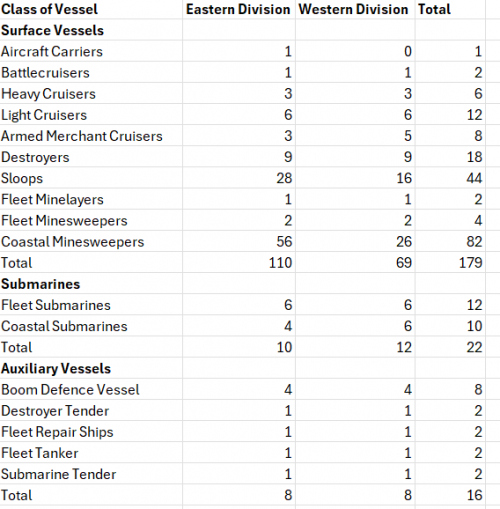
Here's the proposed fleet for the RAN combining Henderson's and Jellicoe's recommendations
1771493378412.png
Explanation
  • I've split it into a Eastern and Western Division, which was proposed by Henderson. Though I've split it differently to him. Eastern Division is based in NSW, PNG, QLD, TAS & VIC and the Western Division is based in NT, SA & WA
  • Heavy cruisers: Henderson recommended 8 Armoured/Battlecruisers so I've gone 2x Battlecruisers & 6x Heavy Cruisers to make the 8
  • Light Cruisers: Henderson recommended 10 Protected/Light Cruisers, while Jellicoe recommends 8. I went with 12, so there's 8 for fleet work & 4 for trade protection work
  • I've added additional Auxiliary Vessels such as Fleet Tankers and extra Destroyer/Submarine Tenders/Fleet Repair Ships/Boom Defence Vessels, which would be required for this two ocean force. Though more auxiliary's would probably be needed
 
This is in comparison to the RANs September 1939 strength of:
2 heavy cruisers
3 light cruisers
1 old light cruiser
1 destroyer leader
4 destroyers
2 sloops

There's a huge gulf between the proposals and the reality of what the RAN got in practice. Anything that could beef up this 1939 force would be a positive.
 
This is in comparison to the RANs September 1939 strength of:
2 heavy cruisers
3 light cruisers
1 old light cruiser
1 destroyer leader
4 destroyers
2 sloops

There's a huge gulf between the proposals and the reality of what the RAN got in practice. Anything that could beef up this 1939 force would be a positive.
I believe if Australia did go ahead with the proposals it would take at least till 1939 for it to be fully completed. That being said even if half of the proposal is funded that is a big positive for the RAN going into WW2
 
To put the sloop figure of 44 in context, between 1928 when the Bridgewater class were laid down and 1939 when the last of the Egret class completed, the RN built 28 sloops plus 6 small coastal Kingfisher class (with 2 Black Swans and another 3 Kingfishers in build) plus 21 Halcyon class minesweeping sloops. That excludes ships for the Dominions for s total of 55 plus 5 in build.
 
To put the sloop figure of 44 in context, between 1928 when the Bridgewater class were laid down and 1939 when the last of the Egret class completed, the RN built 28 sloops plus 6 small coastal Kingfisher class (with 2 Black Swans and another 3 Kingfishers in build) plus 21 Halcyon class minesweeping sloops. That excludes ships for the Dominions for s total of 55 plus 5 in build.
The 44 Sloops proposed by Jellicoe for the RAN is for Anti-Submarine Patrols along the Australian coast, apart of the harbour defence force. He recommends the RAN but P Class Patrol Destroyers for this. I've said sloops cause by the mid 30s these would need replacing and at this time Sloops would make sense. Or would in this scenario, an Australia with bigger naval infrastructure and industry would an earlier Bathurst Class type vessel make more sense for this role?
 
The 44 Sloops proposed by Jellicoe for the RAN is for Anti-Submarine Patrols along the Australian coast, apart of the harbour defence force. He recommends the RAN but P Class Patrol Destroyers for this. I've said sloops cause by the mid 30s these would need replacing and at this time Sloops would make sense. Or would in this scenario, an Australia with bigger naval infrastructure and industry would an earlier Bathurst Class type vessel make more sense for this role?
The Kingfishers were the equivalent of the WW1 P class, but being under 600 tons, were exempt from any limits.


However, their steam turbine machinery of both these types made then unsuitable for mass production in the event of war. The Kingfishers, built to full naval standards, were also too expensive. The RN conclusion was that the Kingfishers were just not big enough for the role. So the Flowers and Bathursts were both designed around the 1,000 ton mark and were intended for work in coastal waters. For open ocean work you need to go up to the sloop / frigate size of c1,200-1,300 tons.

In WW2, while Australia built 60 Bathursts, 4 were for the RIN and 20 for the RN. 1943-1946 the RAN built just 12 Rivers (another 10 were cancelled Apr-Jun 1944).
 
Jellicoe proposed a three force structure for the RAN, A Striking Force, Trade Defence Force & Harbour Defence Force. Combining Henderson's Eastern and Western Division with this 3 Force Structure looks like this.
I really like this 3 force structure for the RAN.
 

Attachments

  • RAN Structure with Jellicoe Report.docx
    16.1 KB · Views: 10
Back
Top Bottom