Canada Future fighter capability project (ex-Next Generation Fighter Capability)

Gripen E for Canada, as part of a mixed fleet with F-35s, probably causes more cost issues due on the additional logistics, despite having a lower operational cost than F-35s. Not sure if NORAD compliance will be pushed but it could add to costs as well. it also doesn't really give content independence either due to parts from the US. But politically.. the general public doesn't really know or care too much. All they will see is "our leaders are sticking it to the US by buying Swedish", and that increases political support.

If it were me, I'd get the FA-50 instead to serve as a lead in fighter trainer to replace the Hawk, and to do light policing, leaving the remaining F/A-18s and F-35s to do the front line work, as well as giving pilots more flying hours. Long term, invest in GCAP if they still want to reduce dependency on the US.

Canada is only committed to 16 paid-for 'CF-35s'. Ottawa just paid for "long-lead items" sufficient for another 14 x airframes ... although that's a long way from fully buying an addition 14 x F-35As.

A mixed type RCAF fighter fleet now seems inevitable. If only 16 'CF-35s' are taken on, it would make sense to employ them in a DACT role (since relying on complete support and software upgrades has become more than a little dodgy).

That would make any 'CF-39E' the frontline RCAF fighter. If the USAF insists that the Gripens are not 'NORAD compliant', suitable upgrades can be stuck on the never-never. (Current Admin insists that they don't "need Canada" or NORAD, anyway.) As for "the general public doesn't really know", remember that applies to US voters in the mid-terms as to Canadian citizens.

Fully agree on the Korean FA-50 for the FLIT role - with similar caveats to your comment about American-controlled components in Gripens. Of course, with the CT-155 Hawks long-gone, RCAF FA-50s would actually be replacing USAF T-38s out of Sheppard AFB in Texas.
 
Are they looking for affordable, I haven't seen that or any other actual criteria for what they now want other than the US not being the supplier. Given the US content on Gripen that should actually exclude it from serious consideration.
"looking into F-35 procurement"(too expensive) was one of agenda items for political sport and reelections for last 1.5 decades. Even if it wasn't serious originally, at this point it most certainly is.
The problem with "other" - the only other in the (western)world is Rafale; Eurofighter is in overall same position as Gripen (but - expensive).
You'll have to buy your way into ecosystem for Rafale (everything different, all economies of scale like NASAMS crumble), and with that the deal will cost substantially more per aircraft, and provide them later due to Rafale line overload.

Eurofighter and Gripen lean into Canadian US ecosystem overall, but with enough weapon independence to remain feasible just in case.
But Eurofighter is expensive, and its advantages (raw performance, mostly useful for air superiority/intercept) is honestly of no importance to Canada. Not after buying F-104s, F-18s and F-35s in a row for last 70 years.
All well and good to buy something that purportedly has lower costs but the intent of buying military equipment is to use it to win a conflict. Gripen is not that aircraft when the F-35 is available.
Any jet aircraft is aircraft, as long as it does aircraft things. Especially in Canadian case, where "to win a conflict" is realistically not a concern - others are responsible for doing that, Canadian interest is "taking part".
100% F-35 fleet is "participation" throttled to 100%, Canada buying 1st day fighter reserve for US. 4.5s participate in 1st day via stand off munitions, of which it carries full array (with some important items not directly matched by F-35 portfolio). Otherwise, do 2nd day tasks equally well - but much cheaper and at a much higher op tempo. Which means, better.
If it were me, I'd get the FA-50 instead to serve as a lead in fighter trainer to replace the Hawk, and to do light policing, leaving the remaining F/A-18s and F-35s to do the front line work, as well as giving pilots more flying hours. Long term, invest in GCAP if they still want to reduce dependency on the US.
F-18s stock is at the edge of falling out of the sky.
FA-50 isn't much of policing as things stand - or, to be exact, it's policing only. As of yet, Koreans and Poles haven't succeeded to get approval for US A2A weapon integration, which is why FA-50s come with AIM-9Js(!). Even with it installed, it'll be kinda token though.
 
Gripen does, it (substantially) reduces costs - and F-35 costs were a subject of controversy for well over a decade.
1. Citation needed on Grip having lower prices.

2. Correct me if I'm wrong but the Gripen is marketed in the E/F variants but cost numbers mostly refer to C/D variants.

3. Controversy is irrelevant. If it's a number - it's a number. Controversy doesn't change the number.
 
1. Citation needed on Grip having lower prices.
All of them speak about lower running costs, including the link above.
Gripen E is 1/2 of F-35 as aircraft (and Gripen C/D was more like 1/3).
2. Correct me if I'm wrong but the Gripen is marketed in the E/F variants but cost numbers mostly refer to C/D variants.
It's hard to have verified running costs for E/F indeed, as it's an aircraft which has never been run in operations.
But it's ultimately common sense - smaller/lesser aircraft are cheaper even before we add stealth and f-35 maintenance magic (parts restricted for allies and partners).
All aircraft in same classes tend to have roughly similar operational cost ranges, which visibly shift to the right with growth in size.

Even in most extreme cases for MRF (which Gripen E is, i.e. 2 classes below F-35) - like Mirage 2000 with constrained OEM supply in Taiwan(~27500/hr), is singificantly below lowest estimations for F-35 in optimal conditions. Before, when airframes were newer and PRC pressure on supply chain was milder, it was like 17k/hr.
Gripen E, normally, should be a bit cheaper than Mirage 2000 - as main maintenance items are simpler, fuel spending somewhat lower, and required ground personnel - smaller.
3. Controversy is irrelevant. If it's a number - it's a number. Controversy doesn't change the number.
Controversies are irrelevant in countries without elections, or in countries where military equipment materializes out from thin air.
Otherwise it's an immediate controversy - before 2024 it was only financial(internal politics) one, now it's also a very obvious political (international politics/sovereignty) one. Which is a big deal - before, it was arguably the single largest reason to buy F-35 in the first place.

Most F-35 clients ran into some sort of controversy - either softly(they decreased fleet or cut out stuff), or rather visibly (Switzerland, where government effectively had to fool its own electorate). Canada is a single most difficult case, as evidenced by continuous delays with decision. More difficult than Germany.
 
Canada just authorized their 30th F-35A. They are committed to 58 more. I don't think there is any chance to pivot towards Gripen/F-37.
 
All of them speak about lower running costs, including the link above.
Gripen E is 1/2 of F-35 as aircraft (and Gripen C/D was more like 1/3).
If they were that cheap, SAAB wouldn't be quoting very old F-35 data and Gripen C/D figures.
Here's a closer estimate that puts the F-35A even cheaper per flight hour than a Gripen.
And it also explains why every article and every PR statement can correctly put out different numbers.


But it's ultimately common sense - smaller/lesser aircraft are cheaper even before we add stealth and f-35 maintenance magic (parts restricted for allies and partners).
All aircraft in same classes tend to have roughly similar operational cost ranges, which visibly shift to the right with growth in size.
The F-35 is only $10 million more than a Gripen. For having much longer range, less drag, stealth, and more advanced systems and sensors, that seems like a bargain. Especially also because you don't need to buy all the infrastructure and associated costs of having an entirely distinct platform.


Most F-35 clients ran into some sort of controversy - either softly(they decreased fleet or cut out stuff), or rather visibly (Switzerland, where government effectively had to fool its own electorate). Canada is a single most difficult case, as evidenced by continuous delays with decision. More difficult than Germany.
Yeah well...
 
If they were that cheap, SAAB wouldn't be quoting very old F-35 data and Gripen C/D figures.
Here's a closer estimate that puts the F-35A even cheaper per flight hour than a Gripen.
And it also explains why every article and every PR statement can correctly put out different numbers.
Well, it's official sources.
Guy from your link, no disrespect, is about as unbiased and objective as SAAB PR team itself.
The F-35 is only $10 million more than a Gripen. For having much longer range, less drag, stealth, and more advanced systems and sensors, that seems like a bargain. Especially also because you don't need to buy all the infrastructure and associated costs of having an entirely distinct platform.
Fly away price is indeed true; it's frankly hardly surprising, as both have more or less exact system list. F-35 ones are larger, but it by itself doesn't add all that much cost.

It's also larger and will cost much more over life cycle.
Longer range for F-35 is tied to both being clean. If both are, JAS-39 rather likely has better intercept profile. If both aren't, F-35 isn't stealthy and is rather undefended for what it is (frontal directional jamming only).

Systems and sensors of 10 years old aircraft designed in 2000s shouldn't be overestimated; F-35 isn't magical and immune to technical progress just because it's F-35; outdated EOTS is a good indicator here. Updated block IV is in an endless development hell.
JAS-39, for all its "refresh" status, is the most state of the art western fighter out there. Arguably it's the simplest reason it lost almost all tenders for so long - it didn't even exist until about last year, SAAB literally had nothing to show. Prototype "i promise it'll work" doesn't impress customers, when your main pitch is serviceability.

Infrastructure for F-35 tends to be so expensive(and it is beyond aircraft base price), that few key nations even have full set within national boundaries. Which means significant operational constraints for what they have.

At the same time, Gripen comes with already available Meteor, ASCM, heavy LACM and so on. It will also come with escort jamming - something that F-35 both doesn't have in by itself, and really needs. Most importantly, all these capabilities are outside of US control, and yet Gripen fully uses basic US armament set available to Canada.

The problem, overall, is always the question how much a nation wants an air force, as opposed to paid USAF homage(and feudal obligation to send a few compagnie d'ordonnance when senior calls the banners). F-35 is a powerful aircraft, but it isn't a single stop solution. F-35 - Gripen E - Erieye is already something closer to an air force design.
 
Last edited:
Longer range for F-35 is tied to both being clean. If both are, JAS-39 rather likely has better intercept profile.
Who you intercepting clean with the Jas Queen? We gun fighting in 2026?
F-35 clean can pack AMRAAMs, Meteors, AIM-9s.
And if the Grip wants something like the EOTS it needs a pod.
When doing CAP you'll probably be having at least one pod and a couple missiles. Then the flight hour cost grows. Not the same for the F-35.

Also yeah he may be biased but numbers are numbers.
 
Canada just authorized their 30th F-35A.

No they didn't. Ottawa approved funding for "long-lead items" - not the entire aircraft.

They are committed to 58 more. I don't think there is any chance to pivot towards Gripen/F-37.

Yeah, "committed". That word doesn't have the same resonance that it did a year ago.
 
"looking into F-35 procurement"(too expensive) was one of agenda items for political sport and reelections for last 1.5 decades. Even if it wasn't serious originally, at this point it most certainly is.
You are completely missing the point of the current debate. Canada isn't looking at the Gripen because it is affordable, it is looking for a non US supplier. The cost of the F-35 was no longer an item of discussion and is not a factor in the concept of the Canadian Gripen.
The problem with "other" - the only other in the (western)world is Rafale; Eurofighter is in overall same position as Gripen (but - expensive).
You'll have to buy your way into ecosystem for Rafale (everything different, all economies of scale like NASAMS crumble), and with that the deal will cost substantially more per aircraft, and provide them later due to Rafale line overload.
Again, the issue isn't cost, it is the suppler. The only reason Gripen is being considered and not Rafael and Eurofoghter is because Gripen was the last one standing beside the F-35 after Rafale and Eurofighter pulled out.
.
Any jet aircraft is aircraft, as long as it does aircraft things. Especially in Canadian case, where "to win a conflict" is realistically not a concern - others are responsible for doing that, Canadian interest is "taking part
And in that case your ignoring the contribution Canada has made to NATO via their airpower. Canadian Hornets dropped per frame substantially more ordnance over Kosovo on that conflict than allied partners.

Canadian jets again deployed for Libya, doing more with their small fleet of aircraft compared to other nations.

Canadian CF-18s flew more than 10% of NATO’s strike missions, a significant share given Canada’s size relative to other coalition members. Historian David Bercuson notes, “The RCAF’s performance in Libya underscored Canada’s ability to contribute meaningfully to modern aerial warfare, demonstrating precision, coordination, and professionalism
https://militaryhistory.ca/libya-intervention/
Their ground forces contributed massively to the battles around Kandahar. They have been a military who does go in first to fight and fight to win.
 
What about airframe components?
I've seen the airframe subcomponents mentioned, and parts like wingspars, but I failed to find supporting claims. Seems like most of that would be included in an airframe purchase. Can you imagine buying a new car but have to prepay for tires, seals, brake pads, clutch plates, and fluids before assembly.
 
Helmets, I suspect because of the overall sophistication in the F-35, was specifically listed across multiple articles.
 
You are completely missing the point of the current debate. Canada isn't looking at the Gripen because it is affordable, it is looking for a non US supplier. The cost of the F-35 was no longer an item of discussion and is not a factor in the concept of the Canadian Gripen.
I tbh don't even think we're in a disagreement here; I'm specifically talking about old rationale, not 2024- one.
Current thing is current thing, which is added on top; manufacturer with strongest "independent" pitch (Dassault) stormed out for a reason.
Gripen isn't all that attractive as an aircraft without taking costs into account in the first place, especially since it comes with single weakest offset package in the world (nation with population of a big city and zero geopolitical weight).
Again, the issue isn't cost, it is the suppler. The only reason Gripen is being considered and not Rafael and Eurofoghter is because Gripen was the last one standing beside the F-35 after Rafale and Eurofighter pulled out.
And why it was the last one standing?
B/c they had a chance. Slim one, sure, but after F-35 was overturned twice on price grounds(every change of government is f-35 decision delay)- there was a point standing in.
Now, it paid off - the main advantage of F-35 (which isn't even F-35 capability, it is status of key US ally and literal part of US armed forces) is gone.
And in that case your ignoring the contribution Canada has made to NATO via their airpower. Canadian Hornets dropped per frame substantially more ordnance over Kosovo on that conflict than allied partners.
That's exactly what I'm talking about. Contributing. It doesn't mean less bombs (and btw gripen is likely a better transport system in terms of sortie generation), it means that Canada can't and doesn't have reasons to bomb Serbia without allied partners. It's military didn't have much meaning without Allied partners in the first place, as there's no threat - and Canada is almost comically ignorant of the threat that exists(Russian bombers and LACMs), chosing least capable arctic interceptors right since avro arrow.
Their ground forces contributed massively to the battles around Kandahar. They have been a military who does go in first to fight and fight to win.
Model homage commitment. Operation that doesn't have anything to do with Canada, which Canada even in theory can't execute by itself.
And full F-35 force is a step in a direction where you can't even employ Canadian military by itself - it's just an integral part of American(NATO if you wish) war capability.
Which was indeed the plan until 2024. After that it suddenly turned out that when nation is this integrated, it may very well be a state.
 
Last edited:
If they were that cheap, SAAB wouldn't be quoting very old F-35 data and Gripen C/D figures.
Here's a closer estimate that puts the F-35A even cheaper per flight hour than a Gripen.
And it also explains why every article and every PR statement can correctly put out different numbers.


The F-35 is only $10 million more than a Gripen. For having much longer range, less drag, stealth, and more advanced systems and sensors, that seems like a bargain. Especially also because you don't need to buy all the infrastructure and associated costs of having an entirely distinct platform.


Yeah well...
F35 cheaper to operate than Gripen E ???? are they pulling our leg ?
F35 with less drag than Gripen ? they are comparing a piece of sugar to an arrow...... one is not supercruising with 12 tons of dry thrust and the other is with 6 tons...
 
Since the last Canadian evaluation their criteria may have changed somewhat due to developments.

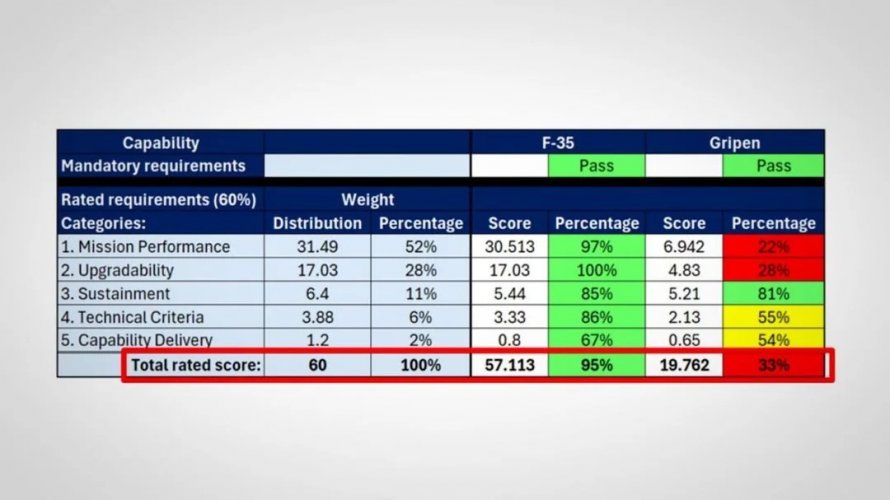
Villman out with a new (well, for the general public anyway) video. According to him, during Canada's last evaluation of their fighter options from 2021 a (substantial?) "risk coefficient" was applied to Gripen E/F because it wasn't yet in production. This is of course the very same evaluation that was recently leaked to the media as Canada is weighing options about whether to go forward with its F-35 buy. Gripen's scores without this coefficient are supposed to be very close to F-35's across all categories. He doesn't give his exact source for this information but implies it's a knowledgeable one. Intrigue notwithstanding, whatever the case, both options' technological and operational merits should be well known quantities for Ottawa by now.

View: https://youtu.be/3yI4r1bslA8
 
Villman out with a new (well, for the general public anyway) video. According to him, during Canada's last evaluation of their fighter options from 2021 a (substantial?) "risk coefficient" was applied to Gripen E/F because it wasn't yet in production. This is of course the very same evaluation that was recently leaked to the media as Canada is weighing options about whether to go forward with its F-35 buy. Gripen's scores without this coefficient are supposed to be very close to F-35's across all categories. He doesn't give his exact source for this information but implies it's a knowledgeable one. Intrigue notwithstanding, whatever the case, both options' technological and operational merits should be well known quantities for Ottawa by now.
Again that is a highly doubtful claim. Were this claim correct why didn't the Canadian Govt come out and state as such given the current relations with the US. They wouldn't have to give numbers but could easily issue a statement discussing a risk modifier applied to Gripen because it had yet to enter service. It wouldn't hurt them at this point and only increase their justification in moving to the Gripen. Instead we continually have statements from a guy who in his last written article showed he didn't understand the F-35 or modern air warfare, irrespective of his previous employment.

To add to the above the Finnish evaluation with Saab adding two Globaleye to their bid still didn't approach F-35 capability, the F-35 won every category over both the SH and Gripen even with the SH bidding and using Growler support. I'm not sure why the F-35 being a superior airframe should be controversial or contested anywhere. The technology between the two airframes is significantly different as well as the money invested in both programs. Quite simply you get what you pay for when it comes to fighter jets and no amount of claims to the contrary can deny that.
 
A new interview with Micael Johansson. SAAB seems to stand ready, entirely up to Ottawa then. GlobalEye and Gripen different issues, according to the CEO.

Some general background provided in this new TLDR News overview about the "informal" Nordic alliance. I'm not familiar with this channel but at least this video is well sourced, as evidenced by the extensive list in their video description.

View: https://youtu.be/GxWtq2ZLfgs


TLDR News EU said:
 
Anders Carp has reiterated that possible Canadian Gripen production can include foreign sales, including Ukraine.

https://www.thecanadianpressnews.ca...cle_19f37443-0c53-5644-ab48-ec467f511b81.html

The Canadian Press said:
Saab's deputy CEO Andres Carp told The Canadian Press that Canada could become a production and export site and could deliver Gripens to Ukraine if the federal government chooses to invest in the product itself.

"It has been discussed, offered for Canada for instance that, should they choose the Gripen and they want production in Canada, that could be one site to send Gripen to Ukraine from," he said.

View: https://youtu.be/d01Gd9vbJvA
 
Last edited:
This would be huge if confirmed to be true. I can't help but feel that the obnoxious behavior or a certain politician may have played a small role in forcing Canada to take a hard look at other options. It also would be practical. Do you really want to use an F-35 every time a civil aircraft in distress needs to be intercepted ? Having a cheaper alternative for those missions makes sense.
 
This would be huge if confirmed to be true. I can't help but feel that the obnoxious behavior or a certain politician may have played a small role in forcing Canada to take a hard look at other options. It also would be practical.
Make no mistake this is a short sighted decision made to appease an 18 month political issue that will go away in 2 and a half years, were it not for Trump then the RCAF would be acquiring their expected 88 F-35s. Long term Canadian military capability will take a hit, the overall cost will be higher than a single aircraft acquisition and the Gripen is simply no where near as capable as the F-35 across the mission sets that Canada will require its fighter aircraft to do.
Do you really want to use an F-35 every time a civil aircraft in distress needs to be intercepted ? Having a cheaper alternative for those missions makes sense.
The cheaper cost to operate is lost from having to maintain two different fleets.
 
The cheaper cost to operate is lost from having to maintain two different fleets.
Is it?
As GTX likes to point out, we don't know exact numbers, especially for E; but by design intent, difference in use per year should be monumental.
Gripen is effectively a modern LIFT with EW set on top. More so as ease of access/service is a prevailing design focus.
Gripen is simply no where near as capable as the F-35 across the mission sets that Canada will require its fighter aircraft to do.
Air police, going to international exercises, bombing harmless dudes in the middle East.
F-35 is only really needed if you want to hit harmful dudes in the first day missions(Iran) up close and personal, or fight for air superiority; 30 F-35A is still quite a fleet for that.
But whatever NATO forces may lack currently, it's hardly yet even more F-35s.
 
Is it?
As GTX likes to point out, we don't know exact numbers, especially for E; but by design intent, difference in use per year should be monumental.
Not unless the RCAF screws over their F-35 pilots on flight hours. You need to fly the planes enough for their pilots to be proficient. That's ~250-350 hours a year. 5-6 hours a week.

Even with 2x the number of Gripens in service, flying them all the same amount won't really save much money.
 
Not unless the RCAF screws over their F-35 pilots on flight hours. You need to fly the planes enough for their pilots to be proficient. That's ~250-350 hours a year. 5-6 hours a week.
I chickened out of manual estimate and asked grok, it gave me ~30-60% total lifetime savings over full 88 F-35A, or 14...29 billion CD in savings. (Gripen at 8/22k per hour; truth should be somewhere in the middle, but not too high, or we're in F-18 area).

That's a lot, it should cover (several times over) at least all direct US penalties for bailing out. Provided, of course, that F414 will be around.
 
Make no mistake this is a short sighted decision made to appease an 18 month political issue that will go away in 2 and a half years, were it not for Trump then the RCAF would be acquiring their expected 88 F-35s. Long term Canadian military capability will take a hit, the overall cost will be higher than a single aircraft acquisition and the Gripen is simply no where near as capable as the F-35 across the mission sets that Canada will require its fighter aircraft to do.

The cheaper cost to operate is lost from having to maintain two different fleets.
The economies are not lost. There is a huge difference of costs in operating these two different fighters. 5.000$/hour versus 30.000$/hour. If most of the fleet will consist of Gripens then the savings will be significant.
https://www.facebook.com/reel/1551431052620726

There are supplementary costs when operating two different aircrafts, but let us remember that both are NATO standard aircrafts. And this means interoperability. A lot of the ground equipment can serve different types of aircrafts, it is not specialised.
 
The economies are not lost. There is a huge difference of costs in operating these two different fighters. 5.000$/hour versus 30.000$/hour. If most of the fleet will consist of Gripens then the savings will be significant.
https://www.facebook.com/reel/1551431052620726

There are supplementary costs when operating two different aircrafts, but let us remember that both are NATO standard aircrafts. And this means interoperability. A lot of the ground equipment can serve different types of aircrafts, it is not specialised.
If you want to be taken seriously you need to use evaluations and not marketing rubbish provided by Saab.

Is it?
As GTX likes to point out, we don't know exact numbers, especially for E; but by design intent, difference in use per year should be monumental.
Well we know Canada want 88 fighter jets. If they acquire a mixed fleet then everything doubles at a minimum, that makes two conversion units including reducing aircraft and precious pilots actually available for combat duties, two sets of maintenance schools two sets of spares, different engines that have no common parts between them, two sets of simulators etc. In principal two of everything is required as well as basing the aircraft in different locations. Good news is we already have a study that evaluated what a mixed fleet would do for the RCAF providing aircraft to an international commitment and completing required missions. It was evaluated against the original requirement for 65 aircraft but the principal stands

Conclusion
This report compared a single fleet of aircraft, capable of fulfilling Canada’s NATO and NORAD commitments, against a mixed fleet consisting of these higher capability, higher cost aircraft combined with lower capability, lower cost aircraft. The analysis found that a mixed fleet of 38 higher capability aircraft, chosen for their ability to fulfill the most challenging of the NATO missions, and 34 lower capability aircraft, capable of fulfilling Canada’s NORAD obligations, could not provide the same capability as the single fleet of 65 higher capability aircraft. Assessing the viability and affordability of any particular aircraft or mix of aircraft is beyond the scope of this report, and as such this analysis assumes that any fleet size argument pre-supposes the suitability of any chosen option from a capability perspective. This report showed that unless the acquisition cost of the lower cost aircraft is half of the acquisition cost of the higher cost aircraft or less, then there is strong evidence to suggest that the mixed fleet is providing less capability at higher cost. While not definitive, this cost estimate is still indicative of the relative costs required to make a mixed fleet competitive with the single fleet from a cost perspective. If changes to Government of Canada policy were to lessen capability demands on the fighter force, then acquiring, operating, and maintaining a mixed fleet may become feasible without incurring additional cost. Fundamentally, the decision to purchase a single type of aircraft or two different aircraft will be a function of the aircraft’s ability to satisfactorily execute the desired mission set at an acceptable cost. This report showed that if Canada should choose to acquire a mixed fleet of fighter aircraft, then unless the acquisition cost of the lower capability aircraft is half or less that of the higher capability aircraft, the mixed fleet is expected to not only result in reduced overall fleet capability, but to also cost more over its lifetime, relative to a single fleet of the higher capability aircraft.
https://thehub.ca/wp-content/uploads/2025/03/06-05-Mixed-Fleet-En-final.pdf

The above study noted that the acquisition cost of the lower tier fighter needs to be less than half of the higher tier fighter to make it even close to comparable. So how much does a Gripen E manufactured in Canada actually cost? The honest answer is nobody knows but the Brazilians haven't exactly been shouting from the roof tops about it being cheap. How much to set up a production line for 60 aircraft. We know given economies of scale with F-35 production that the jet is at least comparable in cost to the Gripen E but any Canadian Gripen E production line will never reach any economies of scale not will it employ the thousands of people that Saab has claimed. Nor will it manufacture a single Gripen E for Ukraine which has been pretty clear if it actually does buy Gripen E Ukraine wants to manufacture the aircraft itself.

If we want as close an apples to apples comparison of costs we can looks to the Czechs who found the following,
An example is another report — from the Czech Ministry of Defense, published in 2023, when Prague justified its choice of American F-35s instead of Swedish Gripen E/F fighters.

According to Czech estimates, operating 24 Gripen E/F aircraft along with armaments would cost $174 million per year, or $7.25 million per aircraft. For the same number of F-35s, the figure reached $231 million — about $9.6 million per unit. Based on 200 flight hours per year, the cost per flight hour for the Gripen E/F would be about $36,200 compared to $48,000 for the F-35.
https://breaking-news.com.ua/en/new...-costs-of-the-gripen-with-other-fighter-jets/

We can also look at Finland where we have some great analysis across the whole HX competition from Corporal Frisk. His final comment on the cost equation, noting that the Saab bid included two Globaleye as well as 64 jets was broadly similar including that the F-35A was roughly similar in operating cost to the F/A-18C.
The tl;dr version was that “At the end of the day, all bids had roughly similar annual operating costs”, which also had been a stated requirement.
https://corporalfrisk.com/2025/11/26/canadian-concerns-finnish-findings/

Might be worth reading where he mentioned that Gripen E came last in that evaluation as well, even when two Globaleye were included in the scenarios and behind the SH and Growler combo.

Then we need to consider the upgrde path. A Gripen E is not going to be as survivable going forward as an F-35 nor does it have the defined upgrade path already laid out for the F-35 with twenty plus operating nations providing funding and support for that upgrade path. It won't have the security of supply that a total fleet size of F-35s probably ten times that of the Gripen E provides. There is a reason people are still buying F-16s today, they know they will be able to sustain them in the future. There is no where near that certainty for Gripen E.

Gripen is effectively a modern LIFT with EW set on top. More so as ease of access/service is a prevailing design focus.
Sure dude, as long as it has an EW system and has easy access Canada will be sweet as.
Air police, going to international exercises, bombing harmless dudes in the middle East.
F-35 is only really needed if you want to hit harmful dudes in the first day missions(Iran) up close and personal, or fight for air superiority; 30 F-35A is still quite a fleet for that.
But whatever NATO forces may lack currently, it's hardly yet even more F-35s.
So what does Canada want from a fighter? They actually decided this already against what they considered to be necessary requirements, ie mission profiles they expect the aircraft to fulfil. Clearly Gripen being a LIFT with EW is not capable of fulfilling the mission they required.

f35-vs-gripen-e-in-canada-score-v0-fuyn9tg9zveg1 - Copy.jpg

But whatever NATO forces may lack currently, it's hardly yet even more F-35s.
Yeah sure, NATO would happily say no definitely don't give us the longer ranged more stealthy and capable platform, we'll take the LIFT with EW instead...

The reality is this is a political decision and nothing more than that to appease a domestic audience who doesn't like, quite justifiably, the current US head of State.
 
Yeah sure, NATO would happily say no definitely don't give us the longer ranged more stealthy and capable platform, we'll take the LIFT with EW instead...
I think we can agree to disagree on these; neither of us is Canadian in any case. I respect your position.

But I'll specifically comment on the last one. One of the reasons the Russian VKS failed to gain air superiority over Ukraine (and the deal with Ukraine can be discussed, and Gripen will be able to operate against them) was this exact "biggest baddest aircraft" order of battle, procured for an unwinnable war with NATO, completely abandoning actual tasks of an air force(and armed forces in general).

As a result, they bought all of their aircraft with bigger radars, higher payloads, and longer range, instead of something more mundane, "but" with well-thought-out, easy access maintenance hatches, not requiring a whole truck of specialized tools. That, and just a normal set of standard capabilities, which their biggest, baddest Sukhois, lack. As a result, they wasted jet fuel for 4 years, flying outside of Ukrainian airspace. Yes, they never lost a single air battle to date; and?

"Lift with EW" is, in my eyes, one hell of a proposal. Applying it to Gripen(D/F especially) wasn't derogatory.
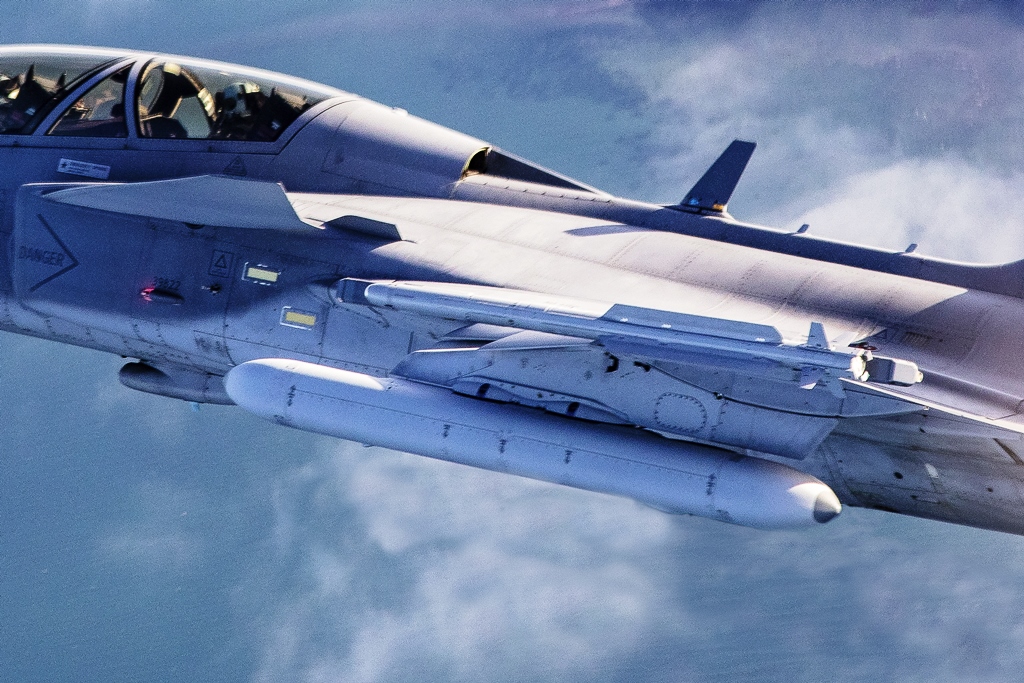
Gripen-E_2_05.jpg

Especially since there's quite a lot of EW there...
 
Last edited:
The fun part of this leaked evaluation is that Canadian politicians, those in charge at least, clearly say to their pilots that their lives doesn't matter that much.

What next, Canadian Cops with bubble guns?

B/w I wonder how the present US administration will react: ban F404 exports?
 
The fun part of this leaked evaluation is that Canadian politicians, those in charge at least, clearly say to their pilots that their lives doesn't matter that much.

What next, Canadian Cops with bubble guns?

B/w I wonder how the present US administration will react: ban F404 exports?
Best thing that could happen for Saab switching to a Euro engine eventually, and European mil aero engine industry in general. Great idea !
 
Best thing that could happen for Saab switching to a Euro engine eventually, and European mil aero engine industry in general. Great idea !
Emergency development of a substantially different version of an aircraft (and likely requiring a new variant of engine, F404/414 are more powerful than the competition, and single-engined fighters need every pound of thrust) is the single last thing Saab needs.

It'll add years of delays and many millions per aircraft, which is already widely mocked for being a bit late and not being stealthy. Saab really doesn't need distractions from their next generation program (ideally, manned).
 
Emergency development of a substantially different version of an aircraft (and likely requiring a new variant of engine, F404/414 are more powerful than the competition, and single-engined fighters need every pound of thrust) is the single last thing Saab needs.

It'll add years of delays and many millions per aircraft, which is already widely mocked for being a bit late and not being stealthy. Saab really doesn't need distractions from their next generation program (ideally, manned).
Of course, would be bad for the Gripen. But I bet the next Saab plane won't use any US engine anymore, and that would boost even more new Euro engines developments & fundings, if ever this US admin uses that great idea (and dumb as they are, their are perfectly capable of doing so).
But « N'interrompez jamais un ennemi qui est en train de faire un erreur. »
 
Last edited:
Back
Top Bottom