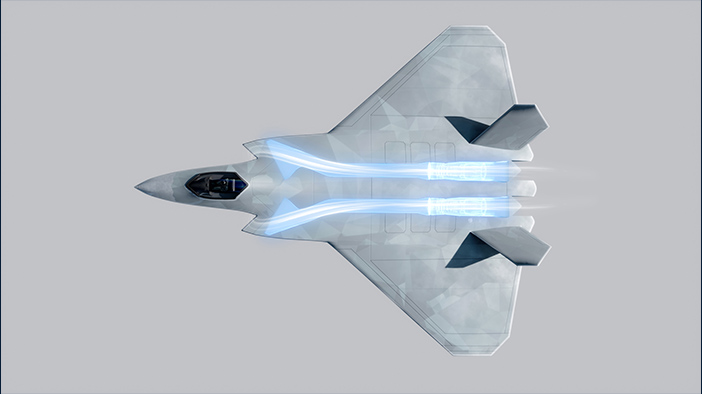
If you're designing bay space for weapons, I'd be wanting something sized for Meteors as the side bays, even if the current plan is to stick fat-SRAAMs in there.
Note: most of the released concept images for GCAP have a very F-22-like fuselage which means very nice location for AMRAAM/Meteor-sized side bays.
Then you can fuss with how to fit a pair of Stratus missiles and a pair of Meteors across the belly of the beast.


Sure.
Thing is, Hydra 70s have the longest range of that size rocket. CRV7s have only about a 4km range!

Maybe? I still have a fascination for the Pye Wacket lenticular missile shape for being able to fly at any relative wind angles.
If they drop the fat-SRAAMs down to 2-2.5m (hit-to-kill with no warhead?) then you could have a twin rail in each side bay or one Meteor. Or is that too much?
For the main bay IMO they should do an SU-57 style super long bay down the middle to accommodate either 2 Stratus or 4 Meteor, fore and aft, perhaps with the forwards end being wider for an extra 2 Meteor for a long range strike loadout of either 2 Stratus and 4 Meteor or 2 Stratus, 2 Meteor and 4 fat-SRAAMs. Then it really would be a bomber!

BAE are doing some interesting work with energetics in the UK so we might see some small SRMs with much longer range. That post-dates this concept, though.

RE Pye Wacket: wtf is that.
 
Thing is, Hydra 70s have the longest range of that size rocket. CRV7s have only about a 4km range!

Ahem.

2,185 lbf·s (2.2 sec) for the RLU-5002/B (C-15) note: burn time is for the C-14
1,515 lbf·s (1.07 sec) for the Hydra 70 Mk.4

So the CRV-7 has a much more powerful rocket engine (and longer burning). Any reduction in range would have to be down to the body design. The CRV-7 also has the smallest CEP of any unguided air-launched rocket - so its effective range should also be greater.

I suspect that the standard for determining range are simply different. Your Hydra 70 figures may be for pure ballistic range and the CRV-7 may be for maximum effective range.
 
Last edited:
Now I've got to admit a soft spot for Pye Wacket. Flipping out disc shaped missiles has some attractions for a LO design. Where orientation of the fusilage against enemy radars is a factor.

And a single long main weapons bay for a pair of Stratus could potentially hold a single long missile. Maybe an aeroballistic type or a ramjet nuclear armed weapon.
Or even a much longer ranged cruise missile.
 
why not just have separate self defence bays?
The micromissiles are also interesting. When will the aircraft ever be in close enough range to use what looks APKWS sized rockets for ground attack, and how would such a small missile be launched?
Self defence? Almost an active defence system like Trophy but for aircraft.
Possibly launched from a pod or even some internal bay with exhaust management?
I get the self-defence one (it would be cool, so I'm cool with it- that's the rule of thumb), it's just the ground attack. But storing and launching lots of small missiles would take a lot of space inside the airframe. They could use retractable rocket pods like those 1950s fighters but for self defence it would need really good over-the-shoulder firing which isn't the best way really.
That HK-DAS seems odd. At least in terms of the shaping.

I'd expect a defensive micromissile to fit into chaff/flare launchers by depth, if not diameter. While I know it's a draggy length/diameter ratio, I'm expecting something broadly comparable to a beer can. (Maybe as large as a 24oz can)

Kinetic self defense is a big challenge, especially in certain conditions like supersonic closure, attack from odd angles, etc.

1) BVR-AAM can be launched passively only when long range indirect/passive detection data is available via other air/surface/space assets.

2) Both side aircraft stealth would make aircraft detection late & at close ranges, means short range CCMs needed.

3) AAMs are not stealthy yet in RF & IR bands. If BVR-AAM approaching at say Mach 4 & targeted aircraft also at say Mach 1.5, then relative closure is Mach 5.5 at which longer detection maintaining aircraft stealth is huge challenge.

4) Missiles can approach from any of 8 spherical quadrants. The aircraft needs to have spherical coverage for RF+IR sensors, like ground vehicles are doing hemispherical coverage. IR sensor can be fully passive but RF seeker has challenge to scan w/o compromising stealth.

5) A group of targeted jets need to fly at moderate separation so that their sensors can identify which incoming missile is targeting which jet.

6) Micro-missile/MSDM at low speeds can be launched well at low speed but need to have some minimum momentum/size/weight to counter air resistance at high speeds. So a smaller can/grenade/mortar sized HK has constraints. The interception/explosion needs to happen at a safe distance to avoid shrapnel damage.

7) For quickest reaction, like VLS (Vertical Launch System), it is very tough to put an ILS (Inclined Launch System) bcoz many launch tubes/casings would be needed at different angles, spread out airframe for spherical coverage.

8) The separation of MSDM has to be safe at different speed, orientation, weather, not to strike the launching jet accidentally.

9) Many MSDMs would be needed, say at least 8. I think F-22's SWB might be able to carry 4 MSDMs each.

10) Alternatively, DIRCM can disorient IR seekers, & to disorient RF seekers, especially with HoJ (Home on Jam) capability, an overwhelming RF-DEW would be needed.
 
Missiles that coast early and drop down on their targets from the high stratosphere with no engines are more stealthy than those that have a flatter trajectory and rely on sustainer engines...
 
Below is from a while ago (Nov 25), think there was discussion on the "parasite" aspect as being setup to accept a variety of different weapons. But more looking at the final post I've quoted about:

"We are not competing with the F-35, and we're a different beast to the B-21 and the NGAD because we don't come from an air force that can afford to have seven or eight different platform types – we are building a Swiss Army Knife"

Perhaps implying GCAP will sit somewhere between NGAD & B-21, as a fighter-bomber, which lines up with other prior comments.

View: https://x.com/GarethJennings3/status/1994065778513977689?s=20


Going through my
@DefenceIQ
#IFC2025 notes ahead of the anticipated launch of the #GCAP full development and design phase, and a very interesting conops has the aircraft acting as "the perfect parasite"...1/4

Speaking under Chatham House Rule, an official said that the goal is to mimic the conops of the MiG-29, of all things, in that it should be able to use any and all base infrastructure, weapons, etc, wherever it happens to be operating from. 2/4

"We aim to make GCAP ‘the perfect parasite’. Allegedly, the MiG-29 was the most NATO compliant platform ever built. The idea being that as [the Soviets] rolled over [NATO airbases], it would use NATO ground power, would use NATO bullets, would load a Sidewinder that it found in a weapons dump rather than a [Soviet] A-11. That concept is what we want to use within GCAP so that wherever we land, we can make maximum use of what we already find, and not rely on having to wait for a C-17 or something [to resupply]." 3/4

Just putting it out there, but with #Tempest not yet a done deal as a name for GCAP, perhaps #Mosquito might better suit the 'perfect parasite' design philosophy? 4/4

Programmatically, #GCAP is thundering along per the official at
@DefenceIQ
#IFC2025 - "Politically, we've achieved a number of things that were not deemed to be possible in the timescales [...] I think one of the things that is misunderstood is how far down the path of design and delivery we already are [...] The engine is leading this, and we have achieved a number of very significant milestones with the propulsion system over the last few months that put us well on the track towards starting to freeze the design and set the outer mould line."

In terms of GCAP's final outcome, the official noted, "The most important point that I want to take away is that #GCAP is being carefully and precisely designed to complement fourth, fifth and planned sixth generation systems. We are not competing with the F-35, and we're a different beast to the B-21 and the NGAD because we don't come from an air force that can afford to have seven or eight different platform types – we are building a Swiss Army Knife."
 
Last edited:
Reporting on the same event from Nov 25, the Defence IQ International Fighter Conference in Rome

Bill Sweetman writes in his article -


"It is, he suggests, ‘a stealth F-111’. Known during its 37-year Royal Australian Air Force career as the Pig, and to the US Air Force as the Aardvark or just Vark, the swing-wing General Dynamics bomber..."

"He also refers to GCAP as a ‘21st century Mosquito’, recalling a high-performance World War II aircraft that could carry a mix of air-to-air weapons and bombs or an all-bomb load comparable with the B-17 bomber’s." @TorpedoJ (seems those working on GCAP are also thinking about a modern day Mosquito).

"Other lessons have been learned in basing and logistics. ‘We need to build platforms [aircraft] that are ready to move on a sortie-by-sortie basis,’ says the GCAP leader. ‘Don’t assume you will land where you take off, and you’re not going to wait for a C-17’ airlifter to arrive. "
 
Going through my
@DefenceIQ
#IFC2025 notes ahead of the anticipated launch of the #GCAP full development and design phase, and a very interesting conops has the aircraft acting as "the perfect parasite"...1/4

Speaking under Chatham House Rule, an official said that the goal is to mimic the conops of the MiG-29, of all things, in that it should be able to use any and all base infrastructure, weapons, etc, wherever it happens to be operating from. 2/4

"We aim to make GCAP ‘the perfect parasite’. Allegedly, the MiG-29 was the most NATO compliant platform ever built. The idea being that as [the Soviets] rolled over [NATO airbases], it would use NATO ground power, would use NATO bullets, would load a Sidewinder that it found in a weapons dump rather than a [Soviet] A-11. That concept is what we want to use within GCAP so that wherever we land, we can make maximum use of what we already find, and not rely on having to wait for a C-17 or something [to resupply]." 3/4

Just putting it out there, but with #Tempest not yet a done deal as a name for GCAP, perhaps #Mosquito might better suit the 'perfect parasite' design philosophy? 4/4
So the British and Italian plan for fighting a war with Russia, is to steal all of the needed ammo from Germany, Poland, Sweden and Finnland? Thats certainly one way to archieve more with less....
 
And a single long main weapons bay for a pair of Stratus could potentially hold a single long missile. Maybe an aeroballistic type or a ramjet nuclear armed weapon.
Or even a much longer ranged cruise missile.
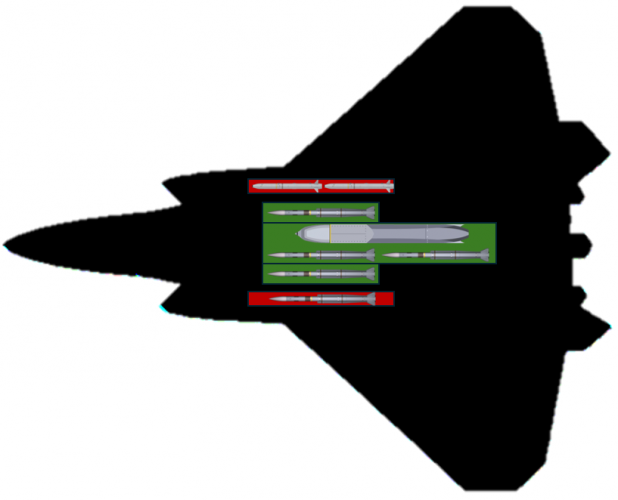
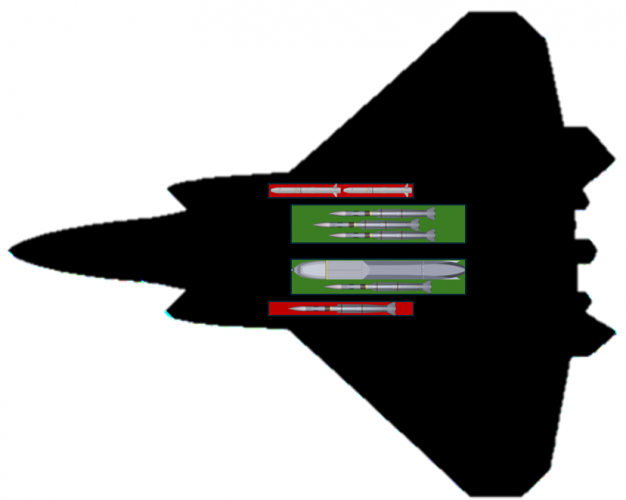
Don't tempt me... we have hypersonic programs going that might need a long booster stack, perhaps those would fit? I've sketched out two different weapon bay arrangements*, one with two Stratus+Meteor/Triple Meteor 6x1.2m bays and one with a single Twin Stratus, Twin Meteor/Sextuple Meteor bay. Both have the 5m long side bays for a fat-SRAAM twin pack or a Meteor.
The advantage of the two bays is that it can accommodate 6 BVRAAMs up to ~5.5m long so long as their fins don't get much wider (so more freedom for the Meteor replacement when that comes), and the advantage of the long bay as stated above is the potential for carrying a single really beefy weapon.
1770583171727.png 1770583364351.png
One thing I am noticing is that the bay for a fat-SRAAM twin pack is quite big, there'd have to be some jiggery-pokery to get everything to fit around the intakes.

*Very roughly, I think they all need to get a lot bigger because the clearance isn't really there around the fins- it's why folding fins would be real useful!
 
Logistics matter.
When the pace of conflict leaves little time to wait around for specific weapons to resupply. Getting something loaded that might be 'good enough' could make the difference between victory and defeat.
 
This graphic from MBDA was specifically related to the work MBDA were doing for Tempest, it has no relation to what they think will be a good idea for legacy aircraft.
Fair point that it was Tempest-related, however I think the idea there would be no thought to applications beyond Tempest is unrealistic. From the corporate perspective, the whole point of developing a new range of weapons is to ensure the future profitability of the company, and you maximize that by ensuring widespread applicability of your development work, not by limiting applicability to only one platform.
 
Pye Wacket would be so cool, indeed!
It would.
RE Pye Wacket: wtf is that.
Oh, your mind is about to be blown: https://en.wikipedia.org/wiki/Pye_Wacket

This is an early version with external control surfaces.
Pye_Wacket_missile_prototype_%28AEDC_Photo_59-1907-C%29.jpg


It was a bomber defense missile concept for the B-70 Valkyrie. The lenticular shape allowed it to be launched at any relative wind direction. At Mach 3. And you just hold a stack of them like records on a juke box, it's awesome.


So the CRV-7 has a much more powerful rocket engine (and longer burning). Any reduction in range would have to be down to the body design. The CRV-7 also has the smallest CEP of any unguided air-launched rocket - so its effective range should also be greater.

I suspect that the standard for determining range are simply different. Your Hydra 70 figures may be for pure ballistic range and the CRV-7 may be for maximum effective range.
8km effective range, 10.5km max range for Hydras.

While CVR-7s are far faster the drag goes up with the square of the velocity increase.
 
Fair point that it was Tempest-related, however I think the idea there would be no thought to applications beyond Tempest is unrealistic. From the corporate perspective, the whole point of developing a new range of weapons is to ensure the future profitability of the company, and you maximize that by ensuring widespread applicability of your development work, not by limiting applicability to only one platform.
But that doesn't sit with the fact that these concepts were developed for Tempest and explicitly presented as such.
It would be odd for them to develop a range of weapons for which the main application is 4.5 gens, as you seem to suggest, and then present them as designed for Tempest. Their exact press release was:
This collaborative arrangement is already showing the potential to deliver capability enhancements across a range of missions that have led to the concepts on display at DSEI this year.

In the domain of Survivability in Attack and Control of the Air, working closely with Leonardo and BAES has led to MBDA developing concepts for a Hard Kill Defensive Aid System (HK-DAS) capable of tracking, targeting and intercepting incoming missiles in high threat environments.

Leveraging commonality, modularity and reuse of the HK-DAS concept, MBDA are exploring a small form factor, scalable, Ground Attack Micromissile capability to enhance the Tempest system in the Close Air Support (CAS) role for Persistence in Attack.

Drawing upon the prior weapons integration experience of both MBDA and BAES, innovative payload bay and launcher concepts facilitate an improved weapon load out, like the twin WVRAAM (Within Visual Range Air-to-Air Missile) concept, or increased weapon release envelopes and the flexibility to introduce enhanced weapons capability like the increased calibre WVRAAM concept.
 
8km effective range, 10.5km max range for Hydras.

While CVR-7s are far faster the drag goes up with the square of the velocity increase.

Thanks for setting that straight!

(Although I do think the definition of effective range is probably quite different and the numbers aren't comparable on that).
 
It would.

Oh, your mind is about to be blown: https://en.wikipedia.org/wiki/Pye_Wacket

This is an early version with external control surfaces.
Pye_Wacket_missile_prototype_%28AEDC_Photo_59-1907-C%29.jpg


It was a bomber defense missile concept for the B-70 Valkyrie. The lenticular shape allowed it to be launched at any relative wind direction. At Mach 3. And you just hold a stack of them like records on a juke box, it's awesome.


8km effective range, 10.5km max range for Hydras.

While CVR-7s are far faster the drag goes up with the square of the velocity increase.
The 1950's must have been such an interesting time to be an Engineer. New tech being dreamed up and delivered almost monthly. If the maths showed it was feasible then build it and test it.
 
But that doesn't sit with the fact that these concepts were developed for Tempest and explicitly presented as such.
It would be odd for them to develop a range of weapons for which the main application is 4.5 gens, as you seem to suggest, and then present them as designed for Tempest. Their exact press release was:
I read their press release. It was a press release, it makes the point they want it to make, it does not lay out every part of their corporate planning.

Nor did I say the weapons were being developed for Gen 4.5 (or any Gen) platforms, I said it doesn't make sense for potential application to be limited to merely one platform. Hard-Kill Defensive Aid Systems are potentially applicable to any manned platform and some larger UAVs, ditto SRAAAMs/WVRAAMs, while CAS mini-missiles are applicable just about everywhere.

Remember, MBDA is a multinational with five home nations, only two of which are members of Tempest (the other three are in SCAF), the UK and Italian arms can work on Tempest, but outside of sovereignty-limited developments, the multi-national level of management will be tasking the national CEOs to maximise applicability of their developments - can they get those weapons onto SCAF? Kaan? KF-21? F-35? Rafale? Typhoon? F-16? UAVs? And if not, why not?

To draw an example using the same MBDA constituents, CAMM was developed for UK and Italy specific naval and GBAD requirements, yet they expanded that to Poland, displacing Stunner as the expected counterpart to Patriot, leveraging the development of an entirely new member of the CAMM family, far exceeding the initial Anglo/Italian range requirements, while the baseline CAMM and CAMM-ER are being snapped up by a bunch of other nations across 4 continents*. And if quadpacked CAMM in Sylver becomes a thing, then that growth could double again. Yet you seem to be saying they shouldn't be thinking of such sales.

* And nearly 5.
 
I read their press release. It was a press release, it makes the point they want it to make, it does not lay out every part of their corporate planning.

Nor did I say the weapons were being developed for Gen 4.5 (or any Gen) platforms, I said it doesn't make sense for potential application to be limited to merely one platform. Hard-Kill Defensive Aid Systems are potentially applicable to any manned platform and some larger UAVs, ditto SRAAAMs/WVRAAMs, while CAS mini-missiles are applicable just about everywhere.

Remember, MBDA is a multinational with five home nations, only two of which are members of Tempest (the other three are in SCAF), the UK and Italian arms can work on Tempest, but outside of sovereignty-limited developments, the multi-national level of management will be tasking the national CEOs to maximise applicability of their developments - can they get those weapons onto SCAF? Kaan? KF-21? F-35? Rafale? Typhoon? F-16? UAVs? And if not, why not?

To draw an example using the same MBDA constituents, CAMM was developed for UK and Italy specific naval and GBAD requirements, yet they expanded that to Poland, displacing Stunner as the expected counterpart to Patriot, leveraging the development of an entirely new member of the CAMM family, far exceeding the initial Anglo/Italian range requirements, while the baseline CAMM and CAMM-ER are being snapped up by a bunch of other nations across 4 continents*. And if quadpacked CAMM in Sylver becomes a thing, then that growth could double again. Yet you seem to be saying they shouldn't be thinking of such sales.

* And nearly 5.
MBDA is better thought of as 5 national companies who are often in direct competition with one another. They build VL-MICA and CAMM, Taurus and Storm Shadow, Akeron LP and Brimstone. On the level of individual products the multinational management aren't as involved as you suggest.
What happened with CAMM is that MBDA UK developed the initial missile for the UK's Rapier and Sea Wolf replacement. MBDA Italy then took the design and turned it into CAMM-ER for the Italian Aspide replacement. Now MBDA UK and PGZ are collaborating for CAMM-MR for Poland's air defence requirements. MBDA UK have also exported CAMM to Chile, NZ and Brazil while MBDA Italy have exported CAMM-ER to Pakistan.
What produced these graphics was an MBDA UK team wondering what new munitions might be needed for Tempest, at the point when it was a UK-only project. There was no expectation that the fat-SRAAM concept or the micromissiles would ever get turned into viable products, they were just wondering what might be needed for that specific aircraft in future. As such there would be no pressure to make them viable for other aircraft- it's just concerned with 6th gens. Hence why I was confused with having a twin rail for missiles that would most likely just go in a self defence bay.
 
Last edited:
https://www.asahi.com/sp/articles/ASV2B1124V2BUTFK002M.html
「英国の防衛投資計画の策定の遅れで、英国内でのGCAP関連の予算を確保できない状況が続き、遅れが生じている。英側の計画の策定時期は不透明で、策定を待たずに日伊の2カ国で先に費用を負担する案なども検討されているという。」
「The delay in formulating the UK's defense investment plan has meant that the budget for GCAP within the UK has not been secured, causing delays. The timing of the UK's plan's formulation is unclear, and it is said that one option is to have Japan and Italy share the costs first, without waiting for the plan to be formulated.」
 

Attachments

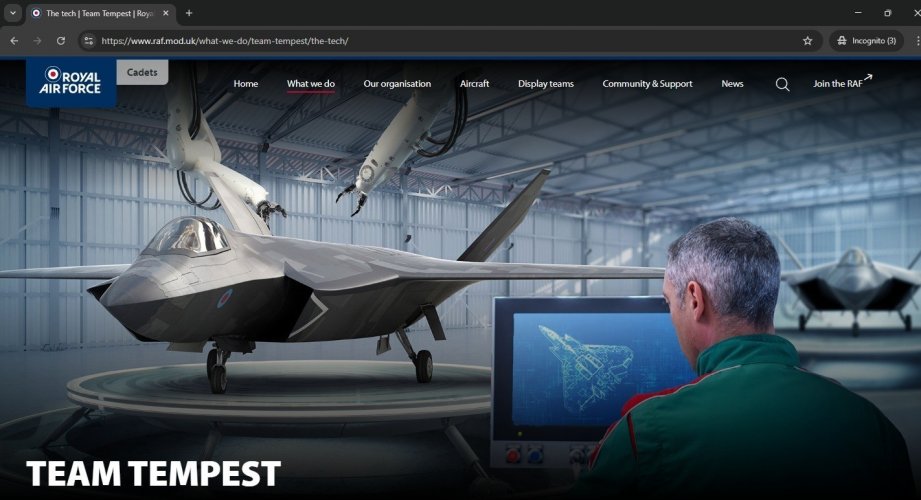
  • RAF-Team-Tempest_GCAP-render_FS.jpg
    RAF-Team-Tempest_GCAP-render_FS.jpg
    213.9 KB · Views: 111
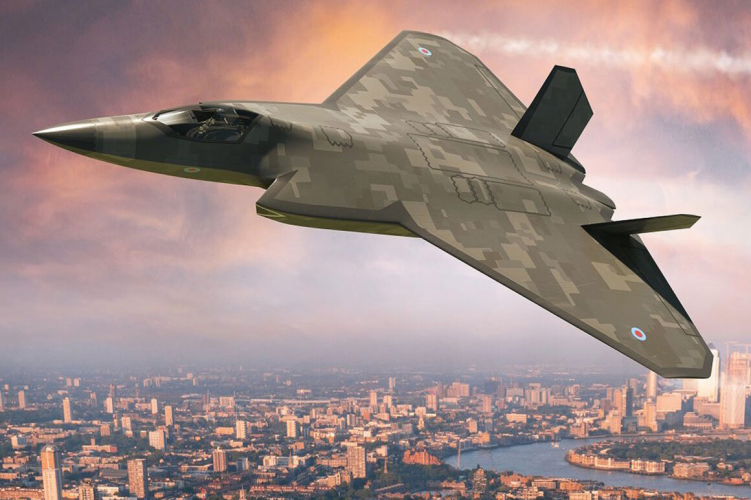
If I´m not mistaking, this concept-image or a link to it has not been posted before.
It´s a combination of 2 views shown earlier (including the 'fatty' one, on the right) though in a different setting.

I keep noticing the dorsal panels on the GCAP concept, ahead of the stabilisers.
They're quite a consistent feature, also seen here along with what looks like a boom refuelling receptacle ahead of them:
1770756205566.png
Are they just maintenance hatches or perhaps something more significant?
 
I keep noticing the dorsal panels on the GCAP concept, ahead of the stabilisers.
They're quite a consistent feature, also seen here along with what looks like a boom refuelling receptacle ahead of them:
View attachment 801635
Are they just maintenance hatches or perhaps something more significant?
I'm not sure what the single big hatch in the middle is. The outer three hatches are for the engine. I suspect that the two small hatches are engine air spill, with the larger hatch being engine access.
 
The large central hatch is clearly for a Pegasus engine. A requirement of the British.
How else were we supposed to get them off the Carriers?
I'm not sure what the single big hatch in the middle is. The outer three hatches are for the engine. I suspect that the two small hatches are engine air spill, with the larger hatch being engine access.
Not to be picky, but in the RR pictures with a slightly different panel arrangement in the same position they were nowhere near the engines.
1770793495565.png
 
I keep noticing the dorsal panels on the GCAP concept, ahead of the stabilisers.
They're quite a consistent feature, also seen here along with what looks like a boom refuelling receptacle ahead of them:
View attachment 801635
Are they just maintenance hatches or perhaps something more significant?
It's where R2D2 pops up.
 
View: https://www.youtube.com/watch?v=VfWeGHGQJYc


Excerpts I've pulled out from the transcript. Some time stamps are not exact but guesses based off closest auto generated time stamp (rather than being meticulous on exact timing), sufficient to locate it in the audio/video track.

Capability requirements

00:17:29
"...as part of that combat air system we described earlier, it is vital that we have at the heart of it a capability that can achieve that range survivability, connectivity and particularly compute power to take sensor inputs from across the force, make decisions at pace, downrange in order to be operationally effective against this sort of threat. That requires a really complex air system, combination of systems. And to do that, it's a very technically challenging and an expensive business. It requires a partnership between countries to bring the best of their industrial strengths and their technical strengths and yes, investment together.

Program allows sovereignty, cost sharing

00:19:40
... we are willing to work with other partners. We are genuinely a partnership of peers who are operating in tandem. It's not a program which is led by a single nation. And that gives us I think the strength of political support for the program. Which is incredibly important in something as challenging as this. It also allows us flexibility to have our sovereignty as three nations. Incredibly important to us, but to not have to pay for that individually.

00:20:21
And I think what we've seen is we're able to pull resources to achieve our each of our respective national sovereignties but without paying the full price. We can also bring in other partners if we choose to do so. And we've designed all of the partners agreed, in the outset, that we would look at bringing additional partners into the program in due course if that was appropriate.

Virtual flying of concepts in combat scenarios by human pilots

00:22:20
So we we've obviously spent a lot of time sharing our understanding of threat sharing our understanding of what the requirements that are driven by that and working on them together as three nations and I think it's an unparalleled in in my experience genuinely joint development of a set of military requirements. Based on that we have then been designing concepts air vehicles that could meet that those requirements.
We have been iterating those concepts as you can imagine and I think the really exciting thing that technology allows us to do now is to test those concepts genuinely fly them... with a pilot in a simulator flying a GCAP concept against different threat environments operating with other GCAPS and that allows us to iterate the concept in incredible detail and at pace which is extremely important.


GCAP designs shown so far are ""representative models" (i.e. not the actual airframe design?)

00:23:10
In terms of the next step we are absolutely now working through a set of engineering milestones further maturing the detail of the concept. We're pretty clear on what it needs to look like and the characteristics. Yes, we've shown some representative models to give people a sense of what we're talking about and I think the reaction to that has been really interesting. People can see that this is really different from what they've seen before. It's very much complimentary and differentiated from what F-35 can give.

[My note on above excerpt - concept images so far are "representative models to give people a sense of what we're talking about". My reading - don't take the concept images too literally. They give indications as to design attributes - size, range etc, but is unlikely to be the actual airframe design, it may look quite different.]

Breaking the exponential cost increase curve of combat aircraft / systems.

00:24:15
... So there's something called Augustine's law, and Augustine was an individual in the US
Air Force in the 60s or even earlier I believe who plotted all the cost of combat aircraft over time and he notices an exponential curve. So we can't continue an exponential curve. Governments will not continue to afford it. So one of the [things] at the heart of the program is breaking that curve by doing things differently. So yes, it's about a large aircraft, a large system, but it's also about how we do it, how we deliver it. And a lot of the work we've been doing in the UK over the last not
00:24:49
just last few years under the FCAS program, but beyond that is developing those core technologies. Those core skills around low observability, for example, with the Tyrannis program last decade, but also investments in digital and other areas to allow that to happen. We've done a huge amount of analysis to understand what makes program success.

Customer nations will have some freedom of modification

00:31:08
...we talked earlier about the differentiation between what we're doing and maybe other programs. It's really important for customer nations or partner nations these days to have a sense of sovereignty. They want to be able to modify capabilities to meet the threat and sometimes the technologies that they have. And I think GCAP with that open system architecture Herman describes gives us and them the opportunity, [so] they don't have to have all of the fundamental skills that we have provided, but they can achieve a degree of sovereignty that's much greater than if they were just a customer.

Prior experience with 6th gen technologies, & seeking to work to a pace of "half time" of prior projects

00:34:00
And of course it's technologies and we've been very privileged I would say in the UK compared to other nations thanks to the UK government also thanks to industry investments to really get the core technologies for a sixth generation program in place. I mentioned earlier the Tyrannis program a low observable unmanned combat aircraft that flew more than 10 years ago but the technologies are absolutely still relevant today and the engineers who design in GCAP today learn their trait on that program >> 10 years ago >> and that's just one example of the investments we're making there are many others in the engine domain in the sensor domains as well with our partners in Leonardo and Rolls-Royce that allows us to control the risk on the program going forward but it remains is an incredibly challenging program. But I think we've made some fantastic first steps. If you look at where we are today on the program on GCAP and compare it to the equivalent point of Typhoon is about half the time. And we of course will endeavor to continue to keep that half time mantra alive as we go forward.

Your description of a recipe required to achieve pace in the program is a good one. and there are so many ingredients required to make the recipe work. How we define our requirements and when we try to achieve them ensuring an incremental approach to capability delivery rather than trying to do everything in the first iterations of a program. The technology allows us to have a block strategy that can genuinely apply different capabilities over time.

Futureproofing

00:37:14
you futureproof something like GCAP when you think about not even years but decades ahead? ... So we're in a very critical phase of the program on the point you mentioned there. So the first thing we're doing today is making sure that all the physical attributes of the system are future proof. Will it been able to carry enough sensors in the future? Will it be able to carry enough payload in the future? so the concepting work we're doing today in very close collaboration with the government requirements managers aims to address that. But the most powerful part of the answer to your question is the open systems architecture. ... It segregates the application software from the operating software. So it makes it easier when there will be new computing chips available to simply take the hardware out and stick the other hardware in and the system will continue to operate in the same configuration that you saw before.

Unmanned aircraft contribution.

00:41:15
We run thousands of scenarios overnight and they just don't focus on what the aircraft needs to be but they focus what the system needs to be. So we're flying you know a manned asset with two or three collaborative combat unmanned collaborative combat aircraft or one and we exploring what capability that needs to have. So that gives us more flexibility again to deal with the future proofing because it might be easier in the future to adapt and change an autonomous collaborative combat aircraft particularly when we're looking at low cost manufacturing for them then continue to worry about the quarterback as I referred to it earlier. So the future proofing extends itself beyond the man aircraft into the total system solution as well. The other aspect of the future combat air system that that's been really important in the last few years it's not just an aircraft program.

 
Last edited:
The nose looks rather strange to me TylrrTylrr, I suppose we will have to wait to see what the nose cone looks like properly once photo's come out.
 
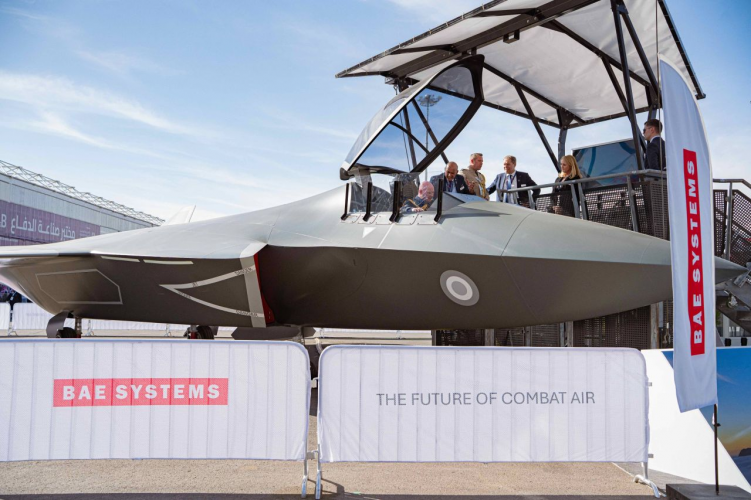
Is that a self defence bay indicated under the wing? It doesn't look related to the undercarriage, but it looks a bit wide and long to have an ASRAAM in it.
It could be a bay large enough for a full on Meteor.

Remember that launching a missile from the side of the plane in a radar shadow doesn't make your RCS bloom.
 
View attachment 801799
Photo from the GCAP mockup at the World Defence Show in Saudi.
Is that a self defence bay indicated under the wing? It doesn't look related to the undercarriage, but it looks a bit wide and long to have an ASRAAM in it.

It could be a bay large enough for a full on Meteor.

Remember that launching a missile from the side of the plane in a radar shadow doesn't make your RCS bloom.
And they did say they were developing the adaptable weapons bay, could also be a normal panel
 

Similar threads

Back
Top Bottom