View: https://youtu.be/bERb6Ni5utE

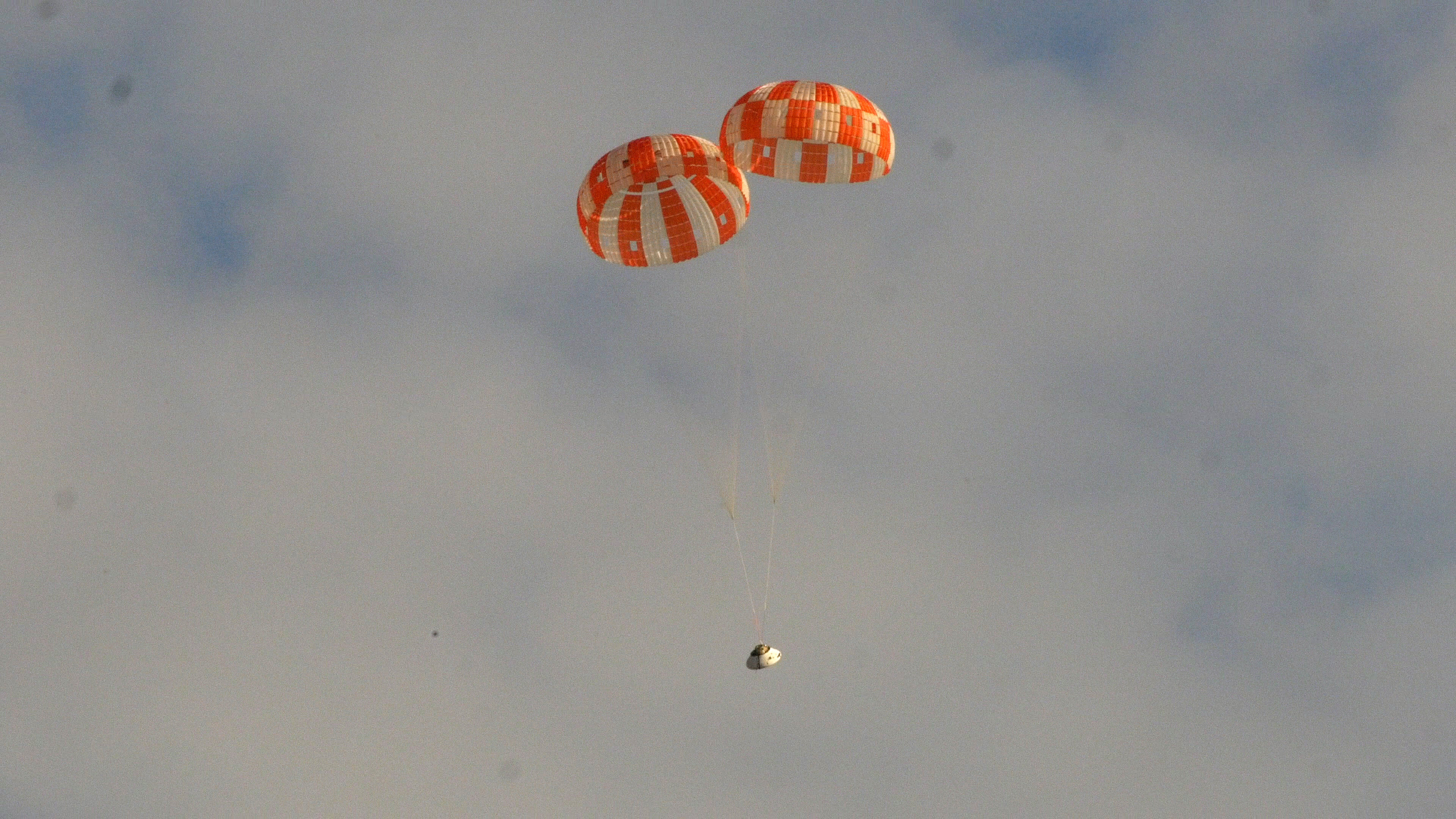
Orion’s parachute system is a critical part of returning future crews who will travel to an asteroid, on toward Mars and return to Earth in the spacecraft. The first parachutes deploy when the crew module is traveling more than 300 mph, and in a matter of minutes, the entire parachute system enables it to touch down in the ocean at about 20 mph.

That system is composed of 11 total parachutes that deploy in a precise sequence. Three parachutes pull off Orion’s forward bay cover, which protects the top of the crew module — where the packed parachutes reside — from the heat of reentry through Earth’s atmosphere. Two drogues then deploy to slow the capsule and steady it. Three pilot parachutes then pull out the three orange and white mains, on which Orion rides for the final approximately 8,000 feet of its descent. Orion’s main parachutes are densely packed and sit on the top part of the spacecraft. Once fully inflated, they could cover almost an entire football field.

 
Take a Tour of NASA Marshall’s Twin Control Rooms for Artemis

Jan 27, 2026
NASA’s Marshall Space Flight Center in Huntsville, Alabama, is home to twin rooms able to support missions and operations in lunar orbit or on the Moon’s surface in real time, helping to ensure mission success and astronaut safety for the agency’s Artemis missions. Take a tour of the LUCA (Lunar Utilization Control Area) and LESA (Lander Engineering Support Area) inside Marshall’s Huntsville Operations Support Center. The LUCA will support Artemis science operations, beginning with Artemis II, while LESA will provide engineering support for landing astronauts on the Moon, beginning with Artemis III.

View: https://www.youtube.com/watch?v=ISBJioPBkKI


Keeping NASA’s Artemis II Mission Connected


Jan 28, 2026
NASA’s Artemis II mission will transport four astronauts around the Moon, bringing humanity closer to its journey to Mars. Throughout the mission, astronaut voice, images, video, and vital mission data must traverse thousands of miles, carried on signals from NASA’s powerful communications systems: the Near Space Network and Deep Space Network.

View: https://www.youtube.com/watch?v=uWzFAxcHOLQ
 
So what type of science will the Artemis 2 astronauts carry out during the long voyage to the Moon and when they orbit the Moon?
 
More on that topic
Emission Imager for Lunar Infrared Analysis in 3D (EMILIA-3D). The EMILIA-3D payload will create three-dimensional thermal models of the lunar terrain:

Lunar Instrumentation for Subsurface Thermal Exploration with Rapidity (LISTER). The LISTER instrument will measure the heat flow of the moon's interior by drilling beneath the lunar surface:

Site-agnostic Energetic Lunar Ion and Neutron Environment (SELINE). The SELINE payload will provide new insight into the moon's radiation environment by studying, for the first time at the lunar surface, the radiation from both primary galactic cosmic rays and their secondary particles and how this radiation interacts with the lunar regolith.

That's your big three:
The Artemis II mission will actually break the record set by Apollo 13 for distance traveled from the Earth with a plan to go farther than the 248,655-mile distance that crew hit during their flight in 1970.

Some odds and ends
A 1-inch by-1-inch swatch of muslin fabric from the original Wright Flyer the Wright Brothers used to make the first powered flight in 1903 will be flying aboard Artemis II, lent by the Smithsonian's National Air and Space Museum.

Also flying aboard the Artemis II mission will be a 13-by-8-inch American flag, which flew with the first shuttle mission, STS-1, the final shuttle mission, STS-135


More:

implications

The future?
 
Last edited:
Scott Manley has uploaded a video on the first toilet to fly beyond the Moon on the upcoming Artemis II mission:


Artemis II will return human astronauts beyond the moon for the first time in over 50 years, and while this is something that's been done before, this is a new spacecraft and there's all sorts of 'firsts' that will be claimed on this flight. And I have decided to focus on the first toilet to fly this far into space, and you might think this is a joke, and there are jokes, but handling human hygene in space is an essential part of human spaceflight and requires innovative engineering and high tech materials.​
 
Philip Sloss recently uploaded a new video update on Artemis II:


Artemis II could be two weeks from launching to the Moon, but NASA still isn't saying. First, there's a Wet Dress Rehearsal tanking test, and then there's a flight readiness review, and then there might only be hours until a launch countdown. I'll run through what we know about the pad flow and the uncertainty about when the tanking test will happen and when the mission might launch.​
I'll go through the similar uncertain circumstances surrounding Artemis III, the agency's top priority, where we're rarely aware of plans for the future or milestones when they happen. And there's a couple of other news and notes from the past week, from a live RS-25 engine test to enactment of an actual, "regular order" NASA budget for the first time in two years.​
Imagery is courtesy of NASA, except where noted.
Links to social media posts:
https://x.com/audrey_decker9/status/1...https://www.youtube.com/redirect?ev...ker9/status/1989352112728510935&v=1CY-QepNfFQ
https://x.com/davill/status/201184389...https://www.youtube.com/redirect?ev...vill/status/2011843892015178197&v=1CY-QepNfFQ
https://x.com/blueorigin/status/20136...https://www.youtube.com/redirect?ev...igin/status/2013686788167000239&v=1CY-QepNfFQ

00:00 Intro
01:24 Artemis II Watch: On the pad, getting ready for tanking and launch count
10:55 Uncertainty still reigns over Artemis III Watch
21:41 The latest guess about China's lunar launch schedule
23:46 SLS updates Core Stage-3 assembly milestones from December, New Year's
28:29 Other news and notes: a live RS-25 confidence test
32:26 NASA's Fiscal Year 2026 budget is finally enacted
33:01 Thanks for watching!
 
Former NASA scientist warn of potential safety issues for Artemis II:


ABC News’ Elizabeth Schulze spoke with two former NASA scientists who say they are concerned about a potential safety issue with the Artemis II spacecraft ahead of its highly-anticipated launch.

Two 60 Minutes articles concerning Artemis II


In 2024, Bill Whitaker continued his reporting on Artemis, NASA's program which aims to send people back to the moon, establish an outpost at the south pole, and, eventually, make it to Mars.


Artemis II echoes the Apollo-era missions that paved the way for the first moon landing — and sets the stage for what comes next.
 
Something to look forward to publiusr, if all goes well with Artemis 2 then it could well be our equivalent of Apollo 8 when that went round the Moon before the Apollo 11 landing.
To boldly retread where humanity has already gone before decades ago. But sure, I know participation trophies are all the rage these days...
 
60 Minutes has a new Artemis II segment uploaded on YT:


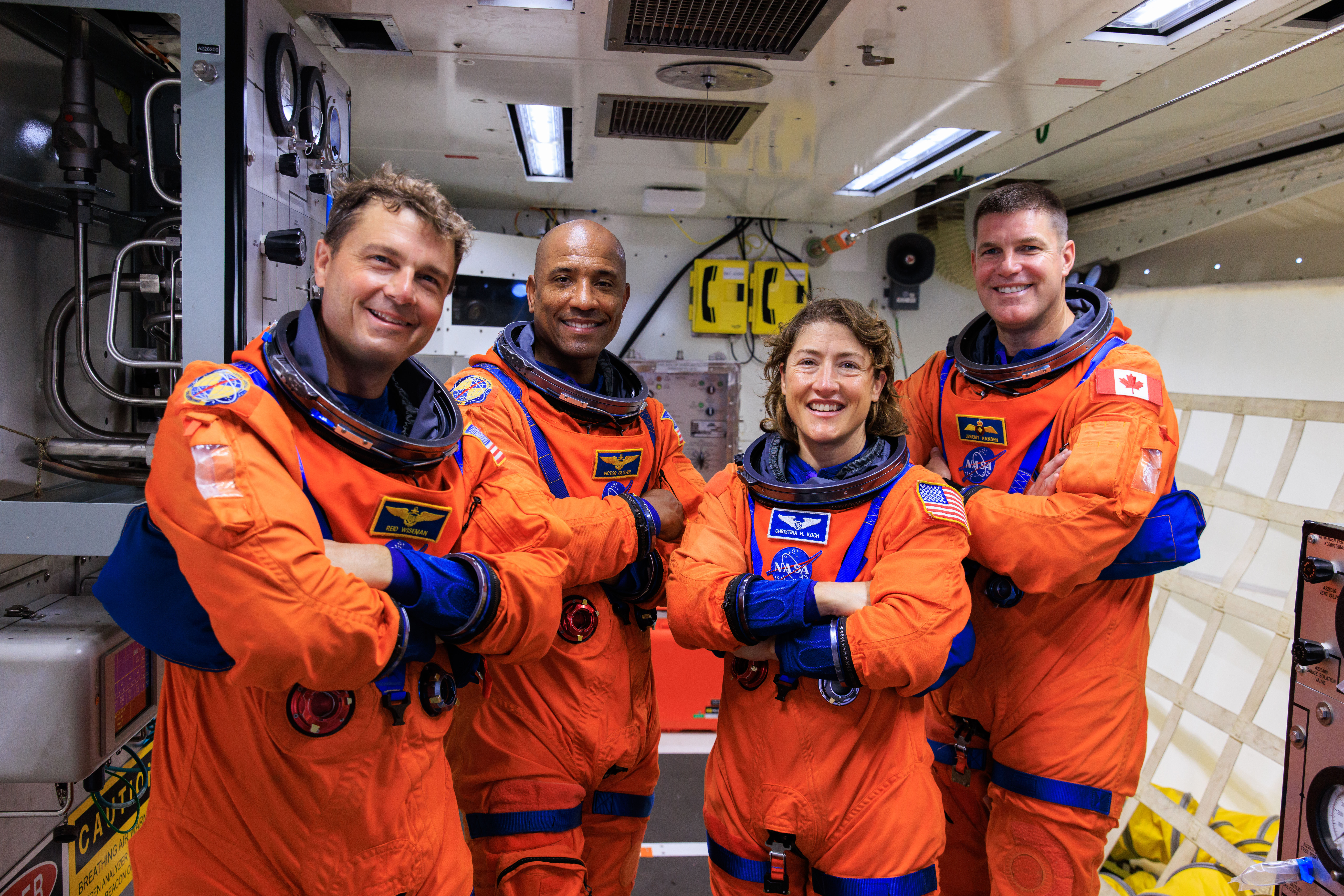
More than 50 years after NASA's last human mission to the moon, four astronauts, three Americans and a Canadian, are set for the 10-day Artemis II mission to the far side of the moon.
 
60 Minutes has a new Artemis II segment uploaded on YT:

This is quite simply the equivalent of any transatlantic airline passenger on a first class commercial flight from New York to Paris complete with champagne and caviar/escargot service claiming to relive Lindbergh's pioneering flight. Shame on you, NASA...
 
The weather and orbital mechanics cooperated, giving us a great
@Space_Station
pass over
@NASAKennedy
for the Artemis II wet dress rehearsal! I got a long lens (1600mm) set up in the WORF (Window Observational Research Facility) window in the lab and got a few nice shots of SLS (Space Launch System) on the pad as it is getting ready for the test. It has also been a beautiful full Moon (this shot from the Cupola yesterday). Go Artemis II!

View: https://twitter.com/Astro_ChrisW/status/2018365716181705015

Artemis II: Liquid hydrogen and oxygen are both in "fast fill" mode, flowing into the core stage's two propellant tanks; the team appears to be running about a half hour to 45 minutes behind schedule given the late "go" for tanking; but with propellants flowing, we assume no leaks or other major problems to this point

View: https://twitter.com/cbs_spacenews/status/2018380735179096499
 
Well, Amy Shira Teitel (Of the Vintage Space channel fame) isn't exactly enthused with the upcoming Artemis II mission (She's a big Project Apollo fan-girl):


00:00 Intro
01:19 Part 1: The Artemis story
06:45 Part 2: Our history of Mars promises
09:25 Our historical comparison with Apollo
15:09 What future is Artemis starting?
31:25 Matryoshka dolls of editing comments (I know)
38:59 Intro to my Nebula channel!
This is ALL MY OWN OPINION! I just feel like we know it's hard and expensive, and having one or three landing missions doesn't make a lasting presence. It still feels short-sighted and cool as an individual mission might be -- what happens next. And maybe I'm wrong! Maybe this will start something big! But history suggests slow and steady is the way to go in space.​
 
What is the MADV?
That's LockMart's Mars Basecamp lander concept. RL-10...it and SLS both hydrolox.

Amy has been swayed by what passes for common wisdom...yet we have already seen Orion fly twice--atop Delta IV and SLS...using Delta IV upper stages. She should not let herself get soured

America had a fine Moon Rocket before...and reusability hype gave us a tiled craft that was supposed to be this and that.

Let's not repeat that mistake.

Keep the faith Amy--don't let anyone steal your joy.

On Gateway
 
Last edited:
What is the MADV?
A vehicle that will likely never exist except on paper. Lockheed doesn’t often build spacecraft like that on its own hook.
This is ALL MY OWN OPINION! I just feel like we know it's hard and expensive, and having one or three landing missions doesn't make a lasting presence. It still feels short-sighted and cool as an individual mission might be -- what happens next.
Amy is spot on. Artemis is a disjointed mess, and the best parts by far are the monies that have gone to SpaceX and Blue Origin. It’s another in a long line of examples of government projects where accomplishing something is incidental, but ensuring some people kept power, and companies like Boeing and Lockheed got their cut, were paramount. If we have lunar bases by 2040, they’ll almost certainly be built and run by the private sector.
 
This is ALL MY OWN OPINION! I just feel like we know it's hard and expensive, and having one or three landing missions doesn't make a lasting presence. It still feels short-sighted and cool as an individual mission might be -- what happens next.

I didn't say that, it's Amy's opinion and is in her video's description.
 
Getting a feel of history repeating here with Artemis 1 seeing its launch delayed by weeks due to a number of leaks.

NSF - NASASpaceflight.com
@NASASpaceflight
·
1m
Artemis II WDR scrubbed. Hydrogen leak during terminal count.

NASA "The Artemis II wet dress rehearsal countdown was terminated at the T-5:15 minute mark due to a liquid hydrogen leak at the interface of the tail service mast umbilical, which had experienced high concentrations of liquid hydrogen earlier in the countdown, as well. The launch control team is working to ensure the SLS (Space Launch System) rocket is in a safe configuration and begin draining its tanks."

View: https://twitter.com/NASASpaceflight/status/2018558252582154588
 
Launch now moved back to March.

View: https://twitter.com/NASAAdmin/status/2018578937115271660


With the conclusion of the wet dress rehearsal today, we are moving off the February launch window and targeting March for the earliest possible launch of Artemis II.

With more than three years between SLS launches, we fully anticipated encountering challenges. That is precisely why we conduct a wet dress rehearsal. These tests are designed to surface issues before flight and set up launch day with the highest probability of success.

During the test, teams worked through a liquid hydrogen leak at a core stage interface during tanking, which required pauses to warm hardware and adjust propellant flow. All core stage and interim cryogenic propulsion stage tanks were successfully filled, and teams conducted a terminal countdown to about T-5 minutes before the ground launch sequencer halted operations due to an increased leak rate. Additional factors included extended Orion closeout work, intermittent ground audio dropouts, and cold-weather impacts to some cameras, along with the successful demonstration of updated Orion closeout purge procedures to support safe crew operations.

As always, safety remains our top priority, for our astronauts, our workforce, our systems, and the public. As noted above, we will only launch when we believe we are as ready to undertake this historic mission.

This is just the beginning. It marks the start of an Artemis program that will evolve to support repeated and affordable missions to the Moon, in line with President Trump’s national space policy. Getting this mission right means returning to the Moon to stay and a future to Artemis 100 and beyond.

I want to thank the talented workforce at NASA, along with our industry and international partners, who are working tirelessly on this effort. The team will fully review the data, troubleshoot each issue encountered during WDR, make the necessary repairs, and return to testing. We expect to conduct an additional wet dress rehearsal and then target the March window.

We will continue to keep the public and the media informed as readiness progresses.
 
NASA press it said:
As always, safety remains our top priority, for our astronauts, our workforce, our systems, and the public.

Which is why they're strapping four people to a pair of solid boosters, right...?

I'd have some respect for them if they'd said something like "of course there's risk but our priority is on minimising it" instead of that vacuous nonsense.
 
Last edited:
Which is why they're strapping four people to a pair of solid boosters, right...?

I'd have some respect for them if they'd said something like "of course there's risk but our priority is on minimising it" instead of that vacuous nonsense.
The only reason Challenger was lost was because they didn't listen to their engineers. Do that and a liquid booster could just as easily fail.
 
It looks like the Hydrogen tank Sferrin seems rather strange after all Boeing built it so it should have no places for Hydrogen to leak out off. It may take them a little while to see exactly where the Hydrogen leaked out from before they repair it which may be why the launch has been delayed until March, it is a bit of a let down I was looking forward to the launch after all.
 
Don't forget that the issue at stake today does not lies solely with the leak but also with the process that failed to detect it prior to the rehearsal. Moreover, one leak can be a precursor for similar ones. This also need to be assessed thoughtfully.
 
Working with hydrogen is a huge PITA; that’s why most every system is moving away from it. I think the newer CZs that pre date F9 use it, but I struggle to think of what else besides SLS doesz
 
Working with hydrogen is a huge PITA

Due to LH2 being the second coldest liquid in the Universe, a very low density (Meaning large, heavy storage tanks) and the smallest molecule around (Why it leaks like crazy), however it is the best chemical fuel in terms of Isp so it will continue to be used in second (And third) stages.​
 
Working with hydrogen is a huge PITA; that’s why most every system is moving away from it. I think the newer CZs that pre date F9 use it, but I struggle to think of what else besides SLS doesz
In the US, Vulcan, New Glenn and Stoke's Nova do; New Glenn's second stage isn't particularly special, but Stoke's appears to be a brilliant design. As with anything, there are good ways (Nova) and bad ways (SLS) to use it.
 
Related article:

NASA finally acknowledges the elephant in the room with the SLS rocket - Ars Technica

Relevant quote, since they are talking about the challenges of this Artemis II flight:
During the news conference, I asked about this low flight rate and the challenge of managing a complex rocket that will never be more than anything but an experimental system. The answer from NASA’s top civil servant, Amit Kshatriya, was eye-opening.

“You know, you’re right, the flight rate—three years is a long time between the first and second,” NASA’s associate administrator said. “It is going to be experimental, because of going to the Moon in this configuration, with the energies we’re dealing with. And every time we do it these are very bespoke components, they’re in many cases made by incredible craftsmen. … It’s the first time this particular machine has borne witness to cryogens, and how it breathes, and how it vents, and how it wants to leak is something we have to characterize. And so every time we do it, we’re going to have to do that separately.”

So there you have it. Every SLS rocket is a work of art, every launch campaign an adventure, every mission subject to excessive delays. It’s definitely not ideal.
 

Similar threads

Back
Top Bottom