He 100 vs. Bf 109

Hi,

The He 100D performance data that we know of are not very helpful.

Which He 100D performance data source are you thinking of (and what would be required to make it more helpful)?

Regards,

Henning (HoHun)
 
Hi,


Which He 100D performance data source are you thinking of (and what would be required to make it more helpful)?

Regards,

Henning (HoHun)

We have performance data from literature about He 100D-0.

The 670 kph top speed and about 1000 km range.
The range figure is highly questionable due to the fuel capacity being smaller than the Bf 109E-3's AFAIK.

The top speed would have suffered by ~80 kg of added armour and 2nd MG FF to match Bf 109E-3's firepower (and make 20 mm usable at all) and the enlarged conventional cooler to be able to use the wing less for cooling and more for the 20 mm.

An in-service He 100D with Bf 109E-3 equivalent firepower would have been little better than Bf 109F series in aerodynamics and weight.
Add an enlarged wing and they're VERY close.
 
We have performance data from literature about He 100D-0.

The 670 kph top speed and about 1000 km range.
The range figure is highly questionable due to the fuel capacity being smaller than the Bf 109E-3's AFAIK.

The top speed would have suffered by ~80 kg of added armour and 2nd MG FF to match Bf 109E-3's firepower (and make 20 mm usable at all) and the enlarged conventional cooler to be able to use the wing less for cooling and more for the 20 mm.

An in-service He 100D with Bf 109E-3 equivalent firepower would have been little better than Bf 109F series in aerodynamics and weight.
Add an enlarged wing and they're VERY close.
Let's say that these changes happen - 'normal' cooling, two MG FF in the wings + two MG 17s in the wing roots, protection added - and that the resulting A/C is about as good as a comparable fighter like that was the MC.202.

It means a 15-20 km/h advantage over the Spitfire I/II instead of having the 20-30 km/h disadvantage. Removal of the systems associated to the surface cooling allows for the installation of extra fuel tankage, so the He 100 now has more fuel instead of less than the 109E/F. More fuel + lower drag = much better range/radius.
And it can be had before ww2 starts.
 
Hi,

We have performance data from literature about He 100D-0.

Any specific book? "Literature" is a bit more confindence-instilling than "the internet", but still a bit vague ...

Regards,

Henning (HoHun)
 
  • ISBN-10 ‏ ‎ 1857802608
  • ISBN-10 ‏ ‎ 088740345X
  • ISBN-10 ‏ ‎ 3763761160

for example

There are many German books that cover it, some with English translations.
Nowarra's books are not considered terribly reliable, though.
 
Hi,

We have performance data from literature about He 100D-0.

The 670 kph top speed and about 1000 km range.
The range figure is highly questionable due to the fuel capacity being smaller than the Bf 109E-3's AFAIK.

As he recently published a book including a chapter on Mr 109E range figures, maybe @AndersJ could provide a realistic estimate of the Emil's range as a baseline? I checked the map in his book, and it shows a combat radius, including time at combat power and a reserve, of about 400 km for a cruise at 0.76 ata, which probably means that for the usual "best straight line range" without such allowances, the Emil would easily exceed 800 km.

The low drag of the He 100 would translate into superior range at the same fuel load, so the question would be, what was the range with the smaller fuel load ot had?

(The He 100 might not have reached the nice round 1000 km figure, but could it match the historic Me 109 range?)

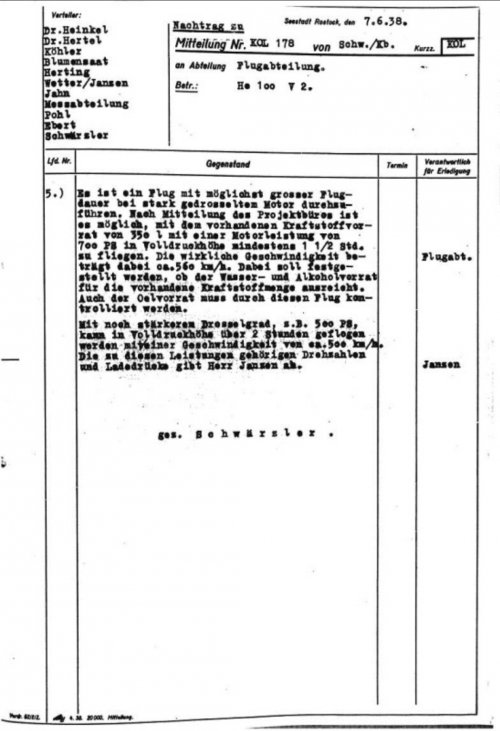
I have attached a Heinkel document on range trials with He 100 V 2. I believe it's from a collection of documents originally published on the old cockpitinstrumente.de website.

Regards,

Henning (HoHun)
 

Attachments

  • Screenshot_20260126_122530_Firefox.jpg
    Screenshot_20260126_122530_Firefox.jpg
    412 KB · Views: 35
1)
There was no Me 109. There was a Bf 109

2)
Range figures were (and still are) tricky.
There's a most economic cruise and a fast cruise (realistic in wartime over enemy land).
Radius figures may additionally have reserves subtracted, IIRC typically in Germany 25% reserve, so a 20% cut from the technically possible radius. Moreover, external stores reduced speed and thus range by added drag (not relevant in this case).

3)
In practice, Bf 109s were said to have only 20 minutes of air combat time over London while being based closed to Calais. So the effective combat radius of a Bf 109E-3 was about 150 km.
Complication: This may have been true for close escort. Close escort requires fighters to stay close to the (SLOW!) bombers. He111H cruise speed was only about 310 kph. A close escort may have been forced to fly uneconomically slow at first, then when English land was in sight at high cruise speed (for combat readiness) but in zig-zags.
Test flights with a single fighter airplane do not account for this.
 
Hi,

1)
There was no Me 109. There was a Bf 109

Since that's quite an interesting topic in itself, but off topic here, I'll just refer you to this in-depth discussion on a German forum (having deduced from the ISBNs you provided that you probably read German):


Regards,

Henning (HoHun)
 
Hi,


As he recently published a book including a chapter on Mr 109E range figures, maybe @AndersJ could provide a realistic estimate of the Emil's range as a baseline? I checked the map in his book, and it shows a combat radius, including time at combat power and a reserve, of about 400 km for a cruise at 0.76 ata, which probably means that for the usual "best straight line range" without such allowances, the Emil would easily exceed 800 km.

The low drag of the He 100 would translate into superior range at the same fuel load, so the question would be, what was the range with the smaller fuel load ot had?

(The He 100 might not have reached the nice round 1000 km figure, but could it match the historic Me 109 range?)

I have attached a Heinkel document on range trials with He 100 V 2. I believe it's from a collection of documents originally published on the old cockpitinstrumente.de website.

Regards,

Henning (HoHun)

Under the same assumptions, I get circa 850 km at 1.15 ata and 1400 km at 0.76 ata for the Bf 109 E. But that would be with a higher respectively lower power outtake out of the Bf 109 E's DB 601 A engine than what is assumed in the document you posted. So 1000 km "range" at 500 Ps for the He 100 does not seem totally unreasonable, but to really say one would need to calculate it and I don't have the He 100 modeled so I can't say.

1)
There was no Me 109. There was a Bf 109

2)
Range figures were (and still are) tricky.
There's a most economic cruise and a fast cruise (realistic in wartime over enemy land).
Radius figures may additionally have reserves subtracted, IIRC typically in Germany 25% reserve, so a 20% cut from the technically possible radius. Moreover, external stores reduced speed and thus range by added drag (not relevant in this case).

3)
In practice, Bf 109s were said to have only 20 minutes of air combat time over London while being based closed to Calais. So the effective combat radius of a Bf 109E-3 was about 150 km.
Complication: This may have been true for close escort. Close escort requires fighters to stay close to the (SLOW!) bombers. He111H cruise speed was only about 310 kph. A close escort may have been forced to fly uneconomically slow at first, then when English land was in sight at high cruise speed (for combat readiness) but in zig-zags.
Test flights with a single fighter airplane do not account for this.

Assuming even a reduction of fuel for climb to 5 km, 20 min combat, and a 25% reserve, I get a range radius of 180 km even if the Bf 109 E was to fly at 1.15 ata.

But as you point out, that would make it far to fast and why would you fly at 1.15 ata if you are escorting bombers anyway? So a more logical setting would be 0.76 ata or even lower until RAF fighters are sighted, and then the range will be much better since you have consumed so much less fuel on the outbound leg.

In addition, a reserve of 25%, i.e. 100 l seems excessive, and IIRC then even the red light warning did not come on until at around 80 l in the Bf 109 E.

So again, as I argue in my book, this Wikipedia range chart seems quite conservative to say the least.
 
We have performance data from literature about He 100D-0.

The 670 kph top speed

If we assume that the 560 km/h at 700 Ps that @HoHun posted in the document above is what the He 100 can deliver, this equates to about 690 hp.

So all other things being equal, how much power would be needed to get the He 100 to do 670 km/h?

If we use the cube law, this gives 1182 hp.

And this is also roughly what the DB 601 M can supply at the take-off setting AFAIK, but this is the 1 min setting and the top speeds of the Bf 109 E-3 and Spitfire Mk I which are about 570 km/h is at the 5 min setting. And for the DB 601 A, the 5 min setting gives around 920 hp.

So if we instead compare all three fairly, i.e. assuming the 5 min limit, then the He 100 top speed would be in the order of 613 km/h which while certainly a lot better than the Spitfire and Bf 109 at 570 km/h, is still nowhere near 670 km/h, because if we are to accept that number, then we would be making an apples to pears comparison.
 
Under the same assumptions, I get circa 850 km at 1.15 ata and 1400 km at 0.76 ata for the Bf 109 E.
The table posted here gives far lower numbers for the clean 109E.
Also these two tables (one, two - 'glued' together they make a single table) are interesting, seems like that the clean 109E will need a bit less than half a liter of fuel for one km flown at the most economical setting - IOW, even under ideal conditions, it will be hard pressed to make 800 km without the drop tank.

And this is also roughly what the DB 601 M can supply at the take-off setting AFAIK, but this is the 1 min setting and the top speeds of the Bf 109 E-3 and Spitfire Mk I which are about 570 km/h is at the 5 min setting. And for the DB 601 A, the 5 min setting gives around 920 hp.
The 5 min rating for the DB 601A was 1020 PS at 4-4.5 km, depending on the supercharger.
See here, and here.
 
Hi Anders,

If we assume that the 560 km/h at 700 Ps that @HoHun posted in the document above is what the He 100 can deliver, this equates to about 690 hp.

So all other things being equal, how much power would be needed to get the He 100 to do 670 km/h?

If we use the cube law, this gives 1182 hp.

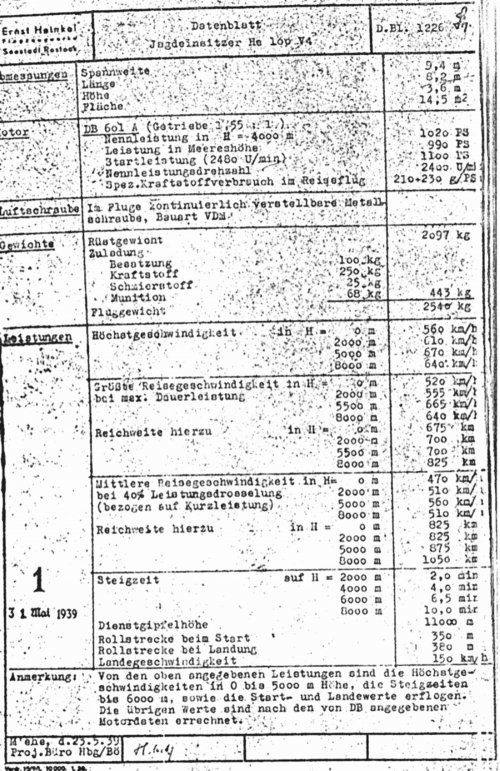
Here's another Heinkel document, showing some key performance values for the He 100 V7 with a DB601A engine, which might be useful for an apples-to-apples comparison to the Me 109E:

He100V4-Doc.jpg

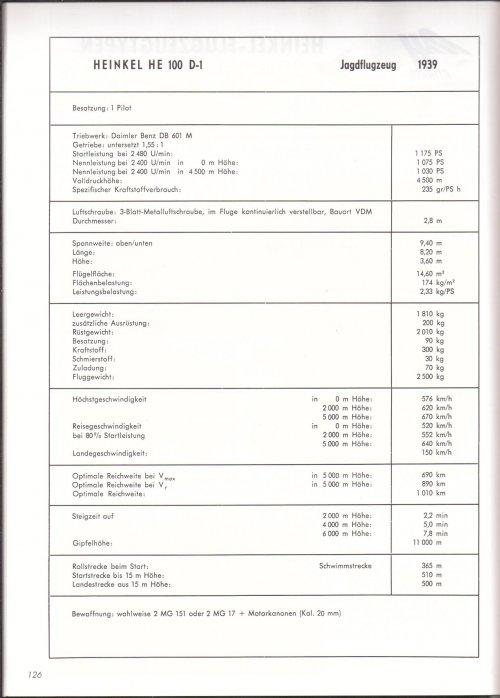
And a He 100D-1 data sheet reproduction from a collection of Heinkel data sheets reprinted by Aviatik-Verlag ... I'd have preferred a direct copy of the original, but I haven't seen that anywhere yet:

Heinkel_Aviatic_p126s.jpg

Regards,

Henning (HoHun)
 
The table posted here gives far lower numbers for the clean 109E.
Also these two tables (one, two - 'glued' together they make a single table) are interesting, seems like that the clean 109E will need a bit less than half a liter of fuel for one km flown at the most economical setting - IOW, even under ideal conditions, it will be hard pressed to make 800 km without the drop tank.

You can't compare that table to the He 100 calculation because that table (the one for the Bf 109 you posted) contains reductions for fuel consumed during climb, combat and reserve. This was also why I wrote that my calculation for the Bf 109 E comparing the He 100 was done under the same assumptions that was done in the Heinkel calculation, i.e. with no such reductions.

The 5 min rating for the DB 601A was 1020 PS at 4-4.5 km, depending on the supercharger.
See here, and here.

My calculation was only a ballpark, but fine lets assume 1020 hp instead: That gives 638 km/h so still far short of 670 km/h.

But the main point I was making was that the 670 km/h number seems to be with the 1 min Startleistung setting, since if you do a ballpark calculation then you need closer to 1180 hp.
 
Last edited:
Hi Anders,


Here's another Heinkel document, showing some key performance values for the He 100 V7 with a DB601A engine, which might be useful for an apples-to-apples comparison to the Me 109E:

View attachment 799949

And a He 100D-1 data sheet reproduction from a collection of Heinkel data sheets reprinted by Aviatik-Verlag ... I'd have preferred a direct copy of the original, but I haven't seen that anywhere yet:

View attachment 799950

Regards,

Henning (HoHun)

That was interesting data so thanks for posting Henning.

Now if we look at the bottom data sheet, it states 640 km/h at 5 km altitude at 80% Startleisting, and 670 km/h as "Höchtsgeschwindigkeit"

So using this new datapoint of 80% of 1175 Ps equals 940 Ps, how much power would we need for 670 km/h using the cube law?

Well using this data point then about 1078 Ps so indeed quite feasible for the Nennleistung 1075 Ps using this data point instead of the 560 km/h with 700 Ps I used in my old estimate.

However, I have flight test data for both the Bf 109 E and Spitfire Mk I placing them both at around 570 km/h with similar power so I will remain sceptical that the He 100 was all of 100 km/h faster until I see solid test data on this.

Far to often I've seen very optimistic data sheets put out by the manufacturer, and usually these seem built on wishful thinking and involve highly polished, sealed, and pampered test specimens with tweaked engines. Not saying this necessarily applies to these Heinkel data sheets, but again, for me the jury is still out on this one.

Just consider what it says regarding armament: Two MG 151 20 mm or two MG 17, and one 20 mm engine cannon. And all this done in an aircraft that weights only 2500 kg, and flies 100 km/h faster than the competition? ;)

My goodness! Where do I sign up for one of these beauties? And how on earth could the Luftwaffe have passed up such a world beater?
 
Last edited:
Hi Anders,

Just consider what it says regarding armament: Two MG 151 20 mm or two MG 17, and one 20 mm engine cannon.

From the Heinkel documents published by cockpitinstrumente.de, it seems that Heinkel responded to a request for a "Super VJ [Verfolgungsjäger]", or interceptor, for which the RLM actually had intended an armament of two 20 mm cannon - because they were expecting a twin-engine design in response to their request. Focke-Wulf responded to the "Super VJ" request (not sure it was an actual tender) with the Fw 187, while Heinkel basically said, "We've got a really fast single-engine design on the drawing board, is it OK if it only has MGs and a single cannon at first?", with the RLM coming back, "Just as well, we don't have the cannon yet anyway".

The Heinkel documents mention that the idea was to fit cannon in the wings later, so I presume that's why they show up on the data sheet, but I'd be surprised if the rest of the data sheet reflects the two-cannon installation.

Regards,

Henning (HoHun)
 
Hi Anders,


From the Heinkel documents published by cockpitinstrumente.de, it seems that Heinkel responded to a request for a "Super VJ [Verfolgungsjäger]", or interceptor, for which the RLM actually had intended an armament of two 20 mm cannon - because they were expecting a twin-engine design in response to their request. Focke-Wulf responded to the "Super VJ" request (not sure it was an actual tender) with the Fw 187, while Heinkel basically said, "We've got a really fast single-engine design on the drawing board, is it OK if it only has MGs and a single cannon at first?", with the RLM coming back, "Just as well, we don't have the cannon yet anyway".

The Heinkel documents mention that the idea was to fit cannon in the wings later, so I presume that's why they show up on the data sheet, but I'd be surprised if the rest of the data sheet reflects the two-cannon installation.

Regards,

Henning (HoHun)

Yes, that was my take as well: That data sheet is probably without any armament and that alone will add non-negligeable drag. For example, while I don't recall the actual numbers offhand, on the Bf 109 & Fw 190 just sealing the cowling gun ports and stopping internal flow and leakage in the cowling added quite a number of km/h in top speed IIRC. Wing armament adds drag, and so does armoured glass and pilot seat and back armour and all those guns add weight and hurts climb. Also, the Germans found that using putty, sanding and polishing gave good results as well. So I would not be surprised if the He 100 V4 tested was on the same level as the He 70 Beverly Shenstone saw when he visited Heinkel and was so enthusiastic about, when he described it to Reginald Mitchell upon his return. Long story short, I suspect that those Heinkel He 100 data sheets are sprinkled with fairy dust, but I could be wrong of course. Would love to see some solid test data data on the He 100 of the type we used to be able to find for the Bf 109 and Spitfire on wwiiaircraftperformance.com back in the days. But until then, I won't be holding my breath until I see a He 100 do 670 km/h that's for sure. ;)
 
My calculation was only a ballpark, but fine lets assume 1020 hp instead: That gives 638 km/h so still far short of 670 km/h.

But the main point I was making was that the 670 km/h number seems to be with the 1 min Startleistung setting, since if you do a ballpark calculation then you need closer to 1180 hp.

Startleistung is merely the take-off rating. The 670 km/h number is achieved at high altitude, 5 km, where the max was 1020 PS. That fits well with the 4.5km rated altitude increased because of the ram effect.
But I agree that we need to take the manufacturer's figures with the grain of salt. It wouldn't surprised me if the He 100 was doing about 10% less than Heinkel advertised wrt. the speed and range, and probably no better than 600 km/h with the 'normal' cooling.
 
Hi Tomo,

Startleistung is merely the take-off rating. The 670 km/h number is achieved at high altitude, 5 km, where the max was 1020 PS. That fits well with the 4.5km rated altitude increased because of the ram effect.

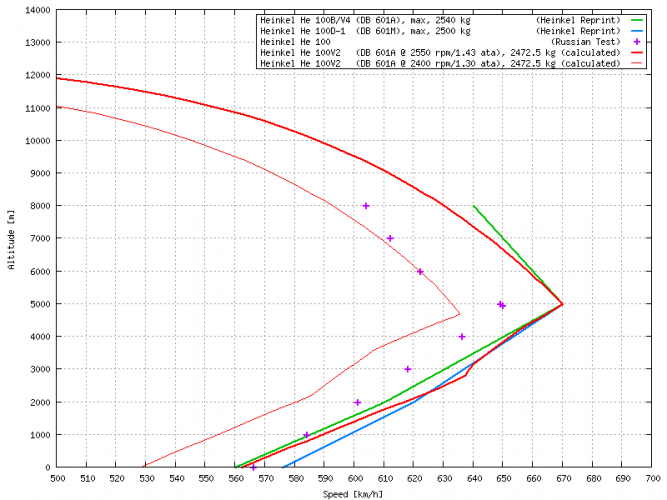
Back in 2011, I prepared this analysis:

He 100_Speed_Comparison.png

Unfortunately, I am unable to tell now what the source for the "Russian Test" data points were, other than they were probably posted on some forum back then. Do you perhaps have any idea? We've been hanging out in the same forums for ages, so I figure there's a chance ... :)

Regards,

Henning (HoHun)
 
Unfortunately, I am unable to tell now what the source for the "Russian Test" data points were, other than they were probably posted on some forum back then. Do you perhaps have any idea? We've been hanging out in the same forums for ages, so I figure there's a chance ... :)
No idea at all :)
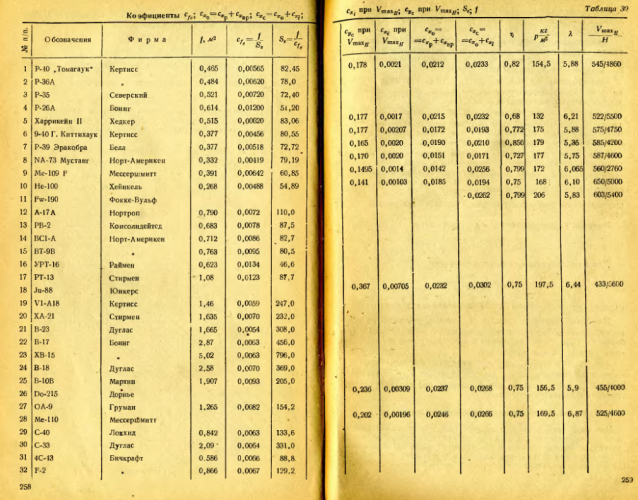
All Russian stuff that I've encountered is in dribs and drabs, two-three pages at best. And no hard data on speed (bar the table posted above by sienar) , boost/rpm/power etc.
 
So now I wasted a morning’s work on modeling the Heinkel He 100 in my simulator.

What I’ve done is to take the Spitfire Mk I as a base, then I totally eliminated cooling drag and reduced the drag of the wings in proportion to the reduction of wing area from a hefty 22.36 to a puny 14.5 sqr m. Then since the He 100 is nicely streamlined and smaller overall, I’ve assumed that what is left only has 90% drag of a Spitfire.

Now to me that would be a fair estimate of a He 100 in service condition, but without guns. Running this model assuming it’s powered by a DB 610 A I get a top speed of around 650 km/h at 5500 m altitude.

Then as I recall it, when Ernst Heinkel showed Berverly Shenstone the He 70, it was so smooth and shiny devoid of any imperfections that Shenstone asked him if it was made of wood. But as the story goes, Heinkel informed him that it was actually a metal airplane, but that it had been puttied, sanded and polished and waxed.

Now if we apply the same treatment to a He 100, would it add another 20 km/h? Sure, maybe it could. So in conclusion, yes, such a laboratory specimen of the He 100 with no guns could theoretically MAYBE do 670 km/h.

But what on earth would this have in common with an in-service condition aircraft like the Spitfire Mk I and Bf 109 E-4 that do 570 km/h? These are aircraft that are not puttied, sanded and polished. They have guns in the wings and cowlings, are armoured, are painted in camouflage paint, and have access panels and joints with air leakage etc.

So let’s ask ourselves, what sort of performance could we then expect from a He 100 that has cowling and wing guns and is not puttied, polished and sanded, and is painted in camouflage paint?

Would such a plane really be capable of 670 Km/h like Heinkel’s laboratory specimen? I don’t think so. Granted, my Spitfire based estimation yielding 650 km/h is only an extrapolation (if someone has solid data I will update the model), but if we add drag from wing and cowling guns, then I would be very surprised if it exceeded 630 Km/h after this.

Then what about weight? If it weighed 2500 kg even without guns and armour, what would the He 100 have weighed with all those added? And to top it all, all this needs to be carried with a wing area of 14.5 sqr m, i.e. almost 2 sqr m less than on the Bf 109! What kind of wing loading and climb performance would that have resulted in? Landing and take-off speeds? Ability to carry external stores like bombs and drop tanks?

What you are left with, is basically a WW2 variant of the F-104 Starfighter, and which would have made even the Bf 109 looking like it could turn on a dime.

PS: @HoHun : Sure, I can also model the He 100 to do exactly 670 km/h to a decimal point. All it takes is tweaking the Cdo somewhat. But what does that prove? When I was working at Ericsson R&D doing simulations there, we used to have a saying: "Tell me what results you want to see, and I shall simulate them!" ;)
 
Hi Anders,

PS: @HoHun : Sure, I can also model the He 100 to do exactly 670 km/h to a decimal point. All it takes is tweaking the Cdo somewhat. But what does that prove? When I was working at Ericsson R&D doing simulations there, we used to have a saying: "Tell me what results you want to see, and I shall simulate them!" ;)

I did indeed use the 670 km/h data point for speed calibration for the red graphs, but mainly because I somehow concluded (probably from the Heinkel material published by cockpitinstrumente.de) that Heinkel had run the DB 601A of the He 100V-2 at a higher power setting than the engine was rated for in service, and I wanted to illustrate that using the service setting, this would have resulted in a markedly lower "service" top speed (though of course the He 100V-2 was not a service aircraft).

With regard to the Russian data, it seems clear the Russians were very interested in the He 100 and actually flight-tested it. Their aircraft were armed with either two or three guns, and to me it looks as if they did indeed get 650 km/h at 5000 m from their test aircraft. There are in fact favourable contemporary Soviet quotes on the speed of the He 100 floating around on the internet, but also less favourable ones on the armament, and on its practical value as a fighter.

Interestingly, I've found mention that their aircraft were actually equipped with DB 601Aa engines, which had a bit more low-altitude power than the DB 601A-1, but it probably didn't make any (or much of) a difference at full throttle height, but I'm a bit confused about the DB 601Aa power levels as it looks as if the supercharger was of the "early" type, and I have no idea if it could be swapped against the "late" type with (slightly) increased full throttle height as it could be on the DB 601A-1. However, I suppose the Russian data snippets I had didn't come with specified power settings, or I'd have most likely have noted that in the graph, so it's difficult to put in to context now.

One fellow forum member (on various other forums) who take a close look at the He 100 and especially the range question was "Krieghund", but I haven't seen him around for a long time.

Regards,

Henning (HoHun)
 
Would such a plane really be capable of 670 Km/h like Heinkel’s laboratory specimen? I don’t think so. Granted, my Spitfire based estimation yielding 650 km/h is only an extrapolation (if someone has solid data I will update the model), but if we add drag from wing and cowling guns, then I would be very surprised if it exceeded 630 Km/h after this.

Then what about weight? If it weighed 2500 kg even without guns and armour, what would the He 100 have weighed with all those added? And to top it all, all this needs to be carried with a wing area of 14.5 sqr m, i.e. almost 2 sqr m less than on the Bf 109! What kind of wing loading and climb performance would that have resulted in? Landing and take-off speeds? Ability to carry external stores like bombs and drop tanks?

Let's not ask too much from a fighter. It's job is to fight enemy aircraft. As for the weight of the drop tanks - the bigger & much heavier but still tiny Fw 190 was able to take off with a torpedo, as well as with the 1800 kg bomb.
I see the He 100 as the German Yak-3 - not something that we'd be hanging the bombs on it, but a high performer despite the obsolete engine. Even if the 'normal' cooling is used.
 
Hi Henning,

If you look at the data points from the Russian tests, the top speed data at the FTH look a bit like outliers to me since if you join the three data points from above the FTH with the four data points below, it looks like these would converge at a FTH top speed of around 635-640 km/h rather than 650 km/h. Regarding the use of DB 601 Aa, that may then explain why the slope of the speed curve at lower latitudes deviates from your DB 601 A simulations.

Anyway, sure it would have been faster than both the Spitfire and Bf 109. How could it not with a 14.5 sqrm wing area, integrated cooling and meticulously streamlined, polished an waxed?

But as a viable alternative to the Bf 109? If anything, I think the RLM were wise to stay clear of it.

Cheers

Anders

PS: With the DB 601 A with the "Alte lader" I'm down to circa 643 km/h and now at 5000 m.
 
Last edited:
Let's not ask too much from a fighter. It's job is to fight enemy aircraft. As for the weight of the drop tanks - the bigger & much heavier but still tiny Fw 190 was able to take off with a torpedo, as well as with the 1800 kg bomb.
I see the He 100 as the German Yak-3 - not something that we'd be hanging the bombs on it, but a high performer despite the obsolete engine. Even if the 'normal' cooling is used.

Absolutely: As a pure interceptor, i.e. made to quickly climb up and shoot down bombers then land and refuel then maybe. But as a dogfighter and for ground attack? I doubt it.

In addition, Supermarine had a lot of issues with overheating on their similar wing integrated cooling system for their early Spitfire concept, and I would very much like to see more about how the He 100’s cooling system performed in climb conditions and under warmer conditions.

Then about battle damage susceptibility: I know some say that “Well there were radiators on the Bf 109 and Spitfire as well” but what about the target area? There is an awful lot of area where just one single 303 round from a Spitfire’s or Hurricane’s guns could ruin a He 100 pilot’s day, that’s for sure.

No, I think the Germans were wise to stay away from this one. Looks like it would have done well pole dancing at Reno though. Maybe that’s were Ernst should have marketed it? ;)
 
Absolutely: As a pure interceptor, i.e. made to quickly climb up and shoot down bombers then land and refuel then maybe. But as a dogfighter and for ground attack? I doubt it.
Horses for courses. Simply opt not to hang any external loads of the He 100 and you're golden.
Fighting the enemy fighters requires playing to the strengths - don't turn with the enemy, but use the superior speed to gain the favorable firing solution.

In addition, Supermarine had a lot of issues with overheating on their similar wing integrated cooling system for their early Spitfire concept, and I would very much like to see more about how the He 100’s cooling system performed in climb conditions and under warmer conditions.

Then about battle damage susceptibility: I know some say that “Well there were radiators on the Bf 109 and Spitfire as well” but what about the target area? There is an awful lot of area where just one single 303 round from a Spitfire’s or Hurricane’s guns could ruin a He 100 pilot’s day, that’s for sure.
Fair points.
The vulnerably ares/volume on the He 100 was probably not that bigger than what the Zero, Oscar or Bf 110 had, while neither of these was a fast fighter to help them out not to get hit.

Converting the He 100 to the normal cooling would not probably be that much hared than it was the conversion of the Italian fighters from radial 'power' to the liquid cooled engines. Get some drag, loose some speed, while decreasing the vulnerable area/volume.
 
Hi Anders,

If you look at the data points from the Russian tests, the top speed data at the FTH look a bit like outliers to me since if you join the three data points from above the FTH with the four data points below, it looks like these would converge at a FTH top speed of around 635-640 km/h rather than 650 km/h. Regarding the use of DB 601 Aa, that may then explain why the slope of the speed curve at lower latitudes deviates from your DB 601 A simulations.

You might be right, or they could be for a different power setting. In any case, it's independent test data for an armed aircraft - too bad it's only a collection of number with no context, though :-(

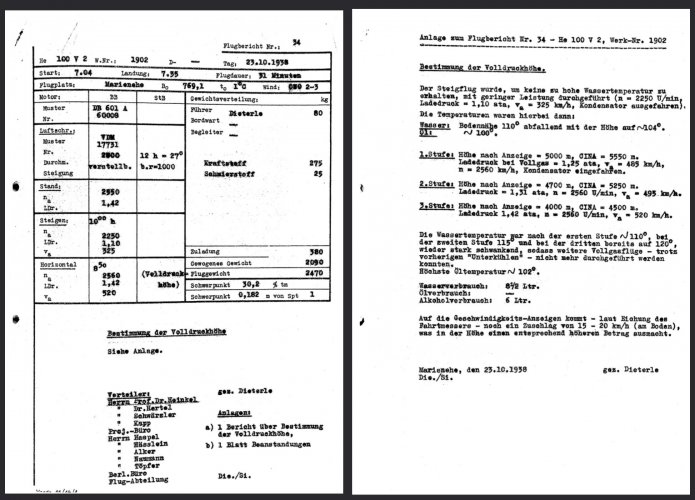
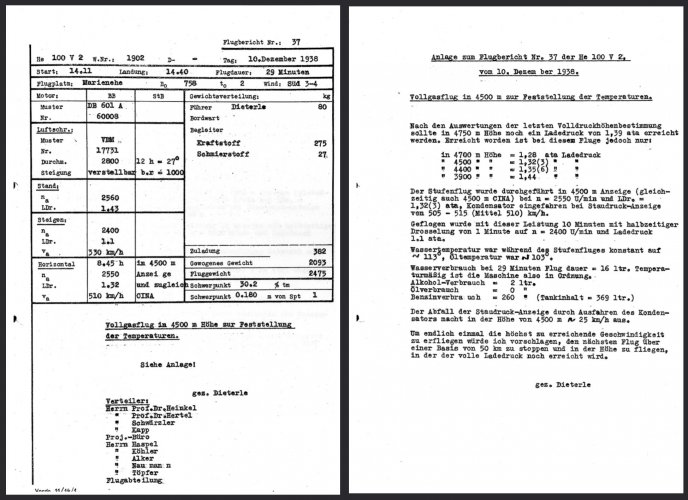
Here's an excerpt of the cockpitinstrumente.de collection, showing an internal Heinkel test report, which demonstrates that He 100V-2 was capable of quite high speeds, even if it was having a lot of teething problems.

V2Flugbericht34.jpg

He 100V2 Flugbericht Nr. 37.jpg

(Note that the quoted "v_a" figures are indicated airspeeds.)

Regards,

Henning (HoHun)
 
1) waxing & polish
Can be done with all aircraft, but at the time it was afaik only done for photo reconnaissance, record flights and occasionally for aircraft of experts/aces if time permits

2) Fw 190 payload; the Fw 190 was alread heavily burdened with a 500 kg bomb under Eastern Front conditions. A torpedo or more was practical only with exceptionally good airfields.

3) The wing profiles were very different and at least for the Spitfire it should be possible to identify the NACA code of the profile. Heinkel likely used a very different one, thus different drag.

4) Susceptibility of surface cooling to bullets: It depends on whether individual perforated cooling surfaces would be decoupled by valves automatically (triggered by too little pressure) to prevent loss of the coolant. In German books I saw the claim that the He 100's cooling system was actually less susceptible than the Bf 109E's.
 
Hi Henning,

Those were two very interesting documents so thanks for sharing.

So here we finally have some test data which also includes information about the atmospheric conditions and engine power used. So finally something solid.

My first observation is the ground temperature during these tests: Just 1 and 2 deg C, so cool winter temperatures and even so they still have problems with the cooling!

In addition, this means we need to dial back the speed results somewhat, since they were done at below standard atmospheric 15 deg C temperature conditions.

Looking at the highest speed reached, this was 520 km/h IAS (at 4500 m CINA altitude) but with the caveats that the PEC had not been done and that 15-20 km/h should be added for some reason as I understand it. So a bit unclear on what corrections needs to be done and why for sure. But in conjunction to this it should be noted that on the Spitfire Mk I and Bf 109 E, the PEC is in between minus 12-22 km/h at high speed. The error on the He 100 may of course not be as large, but if you first subtract 12-22 km/h and then add 15-20 km/h (yes I know they say more at FTH but not how much) then you are basically back to 520 km/h at the FTH which would then equate to a bit over 640 km/h TAS. But then since the test was done at 1-2 deg and not at 15 deg C, then maybe 630 km/h in standard atmospheric conditions is not such a bad guess after all.

And then we can return to the engine settings: Now the 1.42 ata used on the He 100 V 2’s DB 601 A in that trial sounds awfully much like Startleistung to me. In addition, they are running it at a whopping 2560 rpm when the official Startleistung is only 2400 rpm 1.4 ata!

So in the end, 670 km/h with 1.3 ata 2400 rpm looks pretty distant to me. At least based on this testing.

And then we have not even taken into account the effects of any guns, since the T/O weights in these trails were 2470 and 2475 kg.

But you are the native German speaker Henning, and TBH, I only browsed it and may have missed some of the finer points, so I would be very interested in hearing your take on this as well.

Best wishes

Anders
 
1) waxing & polish
Can be done with all aircraft, but at the time it was afaik only done for photo reconnaissance, record flights and occasionally for aircraft of experts/aces if time permits

You are missing the point: The point was that Heinkel was known for his attention to detail and aircraft that had a very high standard on the surface finish like the He 70. So is it likely that Heinkel's speed trials were done on He 100 specimens that had poorer surface finish than the He 70 that so impressed Beverly Shenstone?

2) Fw 190 payload; the Fw 190 was alread heavily burdened with a 500 kg bomb under Eastern Front conditions. A torpedo or more was practical only with exceptionally good airfields.

Not sure where you are going with this? So will a He 100 handle that 500 kg bomb or torpedo any better? Or are you saying that it does not matter anyway since lugging bombs around is so impractical on a fightrer? I think all those JABO units who flew Fw 190s on the Eastern front don't quite agree with you though.

3) The wing profiles were very different and at least for the Spitfire it should be possible to identify the NACA code of the profile. Heinkel likely used a very different one, thus different drag.

The wing profile means less than you seem to think: Once you apply a coat of camouflage paint on wing laminar flow goes out the window (lots of P-51 data on this). The biggest driver is actually the wetted surface (i.e. a small fuselage and wing area) and streamlining, both of which are strong points for the He 100 and why it is so fast. The wing profile effects are minor compared to that.

4) Susceptibility of surface cooling to bullets: It depends on whether individual perforated cooling surfaces would be decoupled by valves automatically (triggered by too little pressure) to prevent loss of the coolant. In German books I saw the claim that the He 100's cooling system was actually less susceptible than the Bf 109E's.

So you are not seeing the problem that basically all of the aircraft is a target area connected to the cooling system? Look at the picture @sienar posted on the previous page here: items 1, 2, 4, 5, 6, and 7 are all connected to the cooling system.
 
Last edited:
So this interesting discussion gets me curious about this, would the He-100 with normal radiators, Bf-109E like armour, and whatever armament can be fitted, either 3 MGs, or perhaps two MGs and two MG FFs in the wings if possible, be faster that the Bf-109E and Spitfire Mk I/II, and have more range than the Bf-109E? Would it's performance be generally similar to say Bf-109F-1/2? If the answer is yes, then with hindsight it would worth having He-100s instead of the Me-110, at least for the long range escort role, not to mention you can have 2 He-100 for each Me-110.

Speaking of which, what is the range and radius of the 1940 BoB timeframe Me-110 without any auxiliary/drop tanks? I'm confused by the www figures some of which suggest a range barely greater than 1000km, while others suggest figures such as 1300km. Just trying to find apples to apples comparisons.
 
So this interesting discussion gets me curious about this, would the He-100 with normal radiators, Bf-109E like armour, and whatever armament can be fitted, either 3 MGs, or perhaps two MGs and two MG FFs in the wings if possible, be faster that the Bf-109E and Spitfire Mk I/II, and have more range than the Bf-109E?

Bf 109E was one draggy aircraft, so having a less draggy fighter should be faster on same engine power. We can take a look at the MC.202 - basically the same engine as what the Bf 109E had, but some 40+ km/h faster.
So IMO, even if it gets the normal cooling and the upgrade in military load it should've still been much faster than the 109E, and faster than the Spit I/II.
As-is, the He 100 carried less fuel than the 109E, so the range might be a bit better due to the better streamlining, but probably not better with the normal cooling and the full military load?

Would it's performance be generally similar to say Bf-109F-1/2? If the answer is yes, then with hindsight it would worth having He-100s instead of the Me-110, at least for the long range escort role, not to mention you can have 2 He-100 for each Me-110.

Boon for the LW. They will just need to find the extra pilots (might get tricky, pilots' training needs time and fuel), and/or export the 109s for hard cash and whatnot.

Speaking of which, what is the range and radius of the 1940 BoB timeframe Me-110 without any auxiliary/drop tanks? I'm confused by the www figures some of which suggest a range barely greater than 1000km, while others suggest figures such as 1300km. Just trying to find apples to apples comparisons.
With full fuel (1200+ L) and on max continuous power, 1040 km (data sheet; I don't know whether the allowances are accounted for). Going with the cruise power will increase that figure.
 
Hi Anders,

Looking at the highest speed reached, this was 520 km/h IAS (at 4500 m CINA altitude) but with the caveats that the PEC had not been done and that 15-20 km/h should be added for some reason as I understand it.

It's not perfectly positive, but I'd tend to believe the airspeed indicator was already calibrated, as "laut Eichung des Fahrtmessers" means "according to the calibration of the airspeed indicator", i. e. the calibration would have to be applied. However, Dieterle's comment at the end makes it clear the recorded speeds hadn't been achieved with full boost pressure, and thus were not yet showing the full potential type.

The top speed was achieved at 4500 m with 1.23 ata boost pressure, while it was expected that the engine would be good for 4750 m with 1.39 ata, which would allow a considerably higher speed. (All at 2550 rpm ... the 2560 rpm are from the ground run data block.)

Wouldn't the comment for flight no. 37, "4500 m according to altimeter, equal to 4500 m CINA", indicate that at altitude, temperatures were conforming to standard atmospheric conditions, thus elimininating the need for an adjustment? On flight no. 34, indicated and CINA atmosphere differed, so they must have recorded actual atmospheric conditions at altitude.

With regard to cooling, the comment for flight no. 37 is,"temperature-wise, the aircraft thus is OK". The problem on flight no. 34 seems to have been that the cooling was unreliable and the temperatures were fluctuating, while on flight no. 37, they were constant.

And then we can return to the engine settings: Now the 1.42 ata used on the He 100 V 2’s DB 601 A in that trial sounds awfully much like Startleistung to me. In addition, they are running it at a whopping 2560 rpm when the official Startleistung is only 2400 rpm 1.4 ata!

I suspect that they were using this power level in preparation for a projected engine version that was expected to be ready by the time the He 100 would be production-ready.

The surface conditions of He 100V2 seems to have been nothing special, by the way, as the document collection mentions that for the absolute world speed record aircraft, they expect considerable improvements there. V2 due to the many changes necessary as a result of testing doesn't seem to have been a development hack and not really a clean and neat aircraft - in the end, it was actually retired as "test-weary", if I'd have to sum it up in one word.

The data from Heinkel's 100 km record flight might be more representative for an aircraft in good condition, and with that kind of distance involved, it should actually have been using a more conservative power setting, but I'm not sure all relevant parameters are documented in the cockpitinstrumente.de document collection. By the way, from these documents it's clear that Udet piloting the record aircraft was a planned event, not a spontaneous last-second idea Udet came up with unexpectedly, as it's often reported.

Regards,

Henning (HoHun)
 
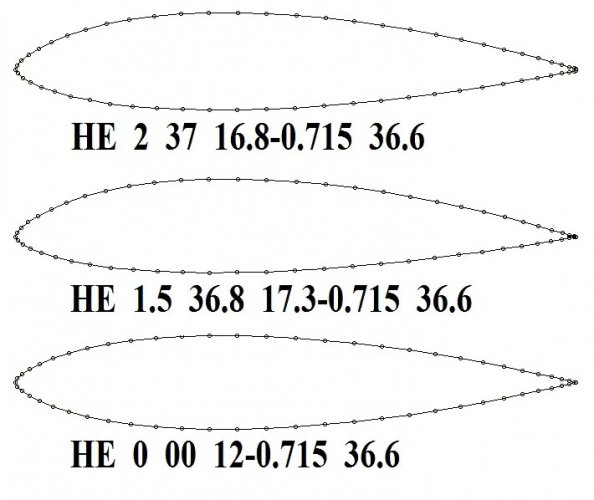
What I’ve done is to take the Spitfire Mk I as a base, then I totally eliminated cooling drag and reduced the drag of the wings in proportion to the reduction of wing area from a hefty 22.36 to a puny 14.5 sqr m. Then since the He 100 is nicely streamlined and smaller overall, I’ve assumed that what is left only has 90% drag of a Spitfire.
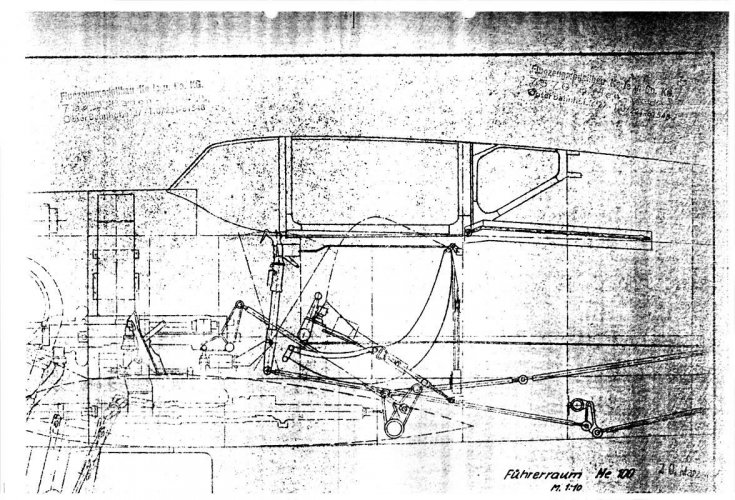
The He-100 used an unusual airfoil for its time with the maximum thickness near 40%.
cockpit draw_Page_1_Image_0001 - Copy.jpg
Hi Tomo,


Back in 2011, I prepared this analysis:

View attachment 800032

Unfortunately, I am unable to tell now what the source for the "Russian Test" data points were, other than they were probably posted on some forum back then. Do you perhaps have any idea? We've been hanging out in the same forums for ages, so I figure there's a chance ... :)

Regards,

Henning (HoHun)
The source of my Russian table;

Сутугин Л.И.-Основы проектирования самолетов
Sutugin L.I. Fundamentals of Aircraft Design
 

Attachments

  • heinkel airfoils.jpg
    heinkel airfoils.jpg
    61.9 KB · Views: 27
Hi again,

Interestingly, I've found mention that their aircraft were actually equipped with DB 601Aa engines, which had a bit more low-altitude power than the DB 601A-1, but it probably didn't make any (or much of) a difference at full throttle height, but I'm a bit confused about the DB 601Aa power levels as it looks as if the supercharger was of the "early" type, and I have no idea if it could be swapped against the "late" type with (slightly) increased full throttle height as it could be on the DB 601A-1.

This post features a DB 601Aa power graph:


Regards,

Henning (HoHun)
 
Hi Anders,


It's not perfectly positive, but I'd tend to believe the airspeed indicator was already calibrated, as "laut Eichung des Fahrtmessers" means "according to the calibration of the airspeed indicator", i. e. the calibration would have to be applied. However, Dieterle's comment at the end makes it clear the recorded speeds hadn't been achieved with full boost pressure, and thus were not yet showing the full potential type.

The top speed was achieved at 4500 m with 1.23 ata boost pressure, while it was expected that the engine would be good for 4750 m with 1.39 ata, which would allow a considerably higher speed. (All at 2550 rpm ... the 2560 rpm are from the ground run data block.)

Wouldn't the comment for flight no. 37, "4500 m according to altimeter, equal to 4500 m CINA", indicate that at altitude, temperatures were conforming to standard atmospheric conditions, thus elimininating the need for an adjustment? On flight no. 34, indicated and CINA atmosphere differed, so they must have recorded actual atmospheric conditions at altitude.

With regard to cooling, the comment for flight no. 37 is,"temperature-wise, the aircraft thus is OK". The problem on flight no. 34 seems to have been that the cooling was unreliable and the temperatures were fluctuating, while on flight no. 37, they were constant.


I suspect that they were using this power level in preparation for a projected engine version that was expected to be ready by the time the He 100 would be production-ready.

The surface conditions of He 100V2 seems to have been nothing special, by the way, as the document collection mentions that for the absolute world speed record aircraft, they expect considerable improvements there. V2 due to the many changes necessary as a result of testing doesn't seem to have been a development hack and not really a clean and neat aircraft - in the end, it was actually retired as "test-weary", if I'd have to sum it up in one word.

The data from Heinkel's 100 km record flight might be more representative for an aircraft in good condition, and with that kind of distance involved, it should actually have been using a more conservative power setting, but I'm not sure all relevant parameters are documented in the cockpitinstrumente.de document collection. By the way, from these documents it's clear that Udet piloting the record aircraft was a planned event, not a spontaneous last-second idea Udet came up with unexpectedly, as it's often reported.

Regards,

Henning (HoHun)

Hi Henning,

Not sure I make the same interpretation about if the calibration was included or not as you do. If IAS has been corrected for PEC, then this is CAS, and on both the Spitfire and Bf 109 you need to deduct 12-22 km/h PEC from the IAS to get closer to the CAS. However, for arguments sake, let’s assume that the PEC was indeed included even though they refer to Va:

The problem is that even so, the drag of the aircraft seems to have been higher than what was needed to get to 670 km/h: The numbers you refer to here are from Bericht 37, and there they do indeed mention that they did not achieve the power they were hoping for. However, I have been referring to the other test they did recorded in Bericht 34 in which they reached 1.42 ata at the FTH: “Bestimmung der Volldruckshöhe” at which they got only 520 km/h IAS with the engine running at 1.42 ata 2560 rpm. Now 520 km/h IAS is nowhere near 670 km/h at 5 km, and the power at 1.42 ata 2560 rpm is way higher than the “Nennleistung” 1020 to 1030 Ps at 2400 rpm the Heinkel data sheets talk about. In addition, since these power values are at a higher FTH and lower power level than the circa 1100 Ps the DB 601 Aa is supposed to deliver, I’m not that sure if they were actually referring to the Aa and not some other A variant. In addition, I see they are talking about adding another 15-20 km/h and even more at the FTH for some unspecified reason, but even so the point still stands as I see it: Even though they were operating their DB 601 at an astounding 1.42 ata 2560 rpm, i.e. at a much higher power level than the "projected power levels" 1020-1030 Ps the Heinkel spec sheets mention for 2400 rpm, they were even so not getting the 670 km/h out of the He 100 in that test. And again: Remember that the spec sheets say they were assuming to get the 670 km/h when operating a DB 601 at 2400 rpm delivering 1020-1030 Ps, which would be at 1.3 ata. And I don’t think they were referring to the Aa version because that delivers 1100 hp at 1.35 ata

Finally, about the surface finish on that tested specimen: I can’t see anything mentioned to conclude that it was "nothing special" and "test-weary" so I'm not sure what you base that conclusion on? But be that as it may, as I see it, the He 100 was still nowhere near 670 km/h in this test even when the engine was running at “Startlesitung” power levels and rpms and not the “Nennleistung” the spec sheets specify.

Best wishes

Anders
 
Last edited:
Back
Top Bottom