Pratt & Whitney PW1120

Lascaris

ACCESS: Secret
Joined
14 November 2008
Messages
357
Reaction score
460
I'm am trying to understand the logic behind choosing to develop PW1120 to power the Lavi as opposed to using an already existing engine. PW1120 was rated at 3530/20585 lbf. By comparison the F100-PW220 was rated at 14590/23770 lbf and on the other side of the spectrum the F404 17-18,000 lbf counting on the exact version.

So why would Israel choose on powering Lavi, already a very ambitious project for its size as it was with a new engine on top of it, even one derived from an existing one instead of just going for F100 which it already operated with F-15 and F-16? Or alternatively going for an F404 powered design? What was to be gained that actually justified the additional costs, complexity and potential risks of developing a separate engine?
 
As far as I understand the development background, one mayor aim was to re-engine the F-4E with the same powerplant too and even more the Lavi was not to be in the same weight/size class of the F-16, since it was more a A-4 replacement.
 
The wanted an engine of a certain size and power. The F100 is a much larger diameter and more powerful engine than they needed. The Lavi design started with a concept powered by a F404 and grew to something that required a larger engine (these days, a F414 would do but the Lavi came along rather earlier).
 
Pratt & Whitney conceived and developed the PW1120 independently of the Lavi to fill a market niche the F100 couldn’t. Their motivation was to use their latest engine tech from the F100 engine in a size that could fit into that of the J79 engine. In effect the PW1120 was a turbojet or leaky turbojet version of the F100 with smaller diameter fans. The Israelis selected the PW1120 for the Lavi because it provided the best combination of power and fuel efficiency they wanted for the size of aircraft. Using a larger F100 would have required a bigger plane with more drag. Lavi was an extremely well designed aircraft for very long endurance.

From FlightGlobal’s archive:

[font=]P&W develops new turbojet
FLIGHT International, 12 July 1980
PRATT & WHITNEY is developing a turbojet of around 20,0001b thrust, based on the core of its F100 turbofan. The new PW1120 will compete with growth versions of the General Electric F404 and Rolls-Royce RB.199. The company expects to flight-test the engine in 1983 with qualification in 1985. The PW1120 is regarded as a low-risk programme.
Design thrust-to-weight ratio is 7-25:1 compared with 7-9:1 for the 25,0001b-thrust F100. Operating temperatures will be lower than the F100 throughout the flight envelope, P&W says. More than 60 per cent of parts will be common with the existing engine. New components will include a low-pressure compressor and turbine and a simplified afterburner.
The PW1120 is 170in long (F100: 190in) and 33in diameter (F100: 40in). The company sees a market for 4,000 to 5,000 engines of this size over the next 20 years. Possible applications include Israel's Lavi and Sweden's JAS single-engined multirole fighter projects. By the time the PW1120 enters service, the F100 will have logged some 3 million flight hours.[/font]
 
Pratt & Whitney developed two major F100 derivatives in the early 1980s to cater for applications needing lower and higher thrust than the F100.


PW1120 - 20,000lb thrust, basically a leaky turbojet made from a standard F100 HP compressor with a cropped LP fan/compressor.
PW1130 - 30,000lb thrust, advanced high thrust F100 to compete with GE's F101DFE (F110)

PW1120 was sized to compete with high thrust F404 and RB199 derivatives in e.g. JAS-39, Lavi, Novi Avion, Eurofighter etc and the Lavi was its launch customer. I don't believe it was specifically intended to replace J79, I think that was a happy coincidence.
 
Note that the "max diameter" of the PW1120 was 40" - this was at the afterburner.
The "max diameter" of the F-100 is 46.5" at the afterburner.

The 33" and 40" diameters mentioned above are for the main body of the engines.


The PW1129 was the competitor to the F110... it went into production as the F100-PW-229 (F-15 & F-16block52) and F100-PW-229A (F-16block62).
 
I know this is an old thread, but was doing some research..

Why do some refer to the PW1120 as a turbojet, or leaky turbojet as opposed to a low bypass turbofan?

It has a bypass ratio squarely in the same category as the M88, EJ200, and F404 low bypass turbofans, at between 0.3 to 0.4.

I thought perhaps the bypass air was then only used for cooling, but a brief perusal of the released SFC figures of these engines all point to very similar SFC figures.
Indeed, the PW1120 actually has a slightly better SFC in dry thrust than some of them.
This would indicate to me that this is no turbojet, but exactly what I thought it always was: a low bypass turbofan.

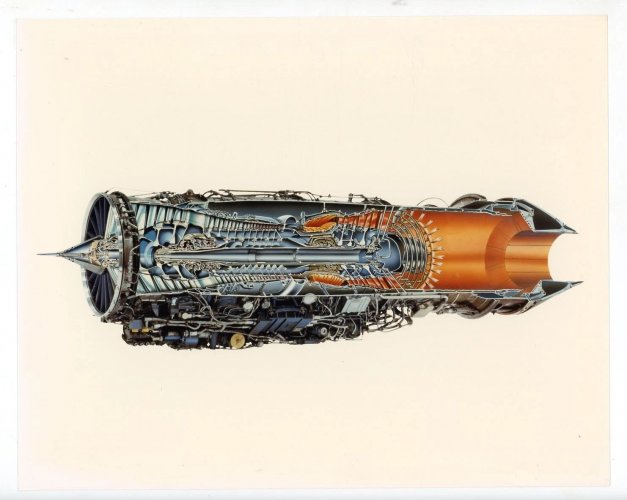
Are there any decent cutaways or sectional diagrams of the PW1120?

Thoughts?

Edit: Mods, this topic should be in Propulsion, perhaps?
 
Last edited:
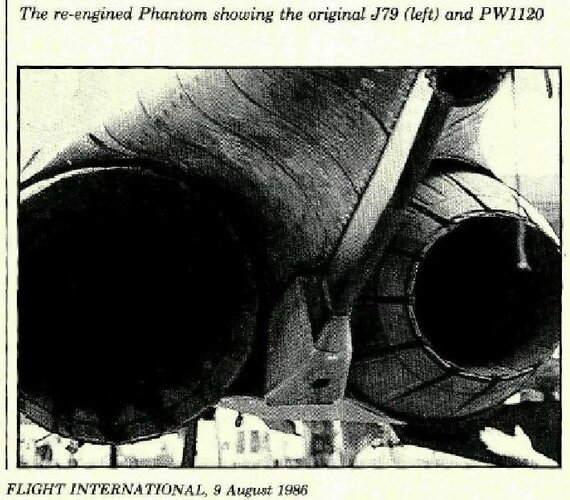
An interesting pic from Flight International in 1986 of the PW1120 (right) compared to the J79 in the Super Phantom.
 

Attachments

  • J79-PW1120.jpg
    J79-PW1120.jpg
    89.1 KB · Views: 174
You are correct that the PW1120 is a low bypass turbofan. The “leaky turbojet” nomenclature is just referring to the fact that the bypass air is primarily being used for cooling the outer skin of the engine (no need for heavy heat shielding around parts of the engine as needed by a true turbojet) and for cooling the AB liner and nozzle.

The ultimate leaky turbojet is the F119 engine with a bypass ratio somewhere around 0.15. At Mil power and above, 100% of the bypass air is being directed into the turbine exhaust case, AB liner, and exhaust nozzle liners for cooling, with no direct path into the exhaust flow except thru cooling passages.
 
@F119Doctor On a slight tangent, how hard would it be to do something similar today, but starting with a high bypass turbofan?

I.e. Take a modern 9,000-13,000lbf turbofan like the AE3007, PW812, CF34 or Silvercrest, keep the core, downscale the fan, to produce a ~7,000lb low bypass turbofan in a small package? This would seem ideal for UCAV or trainer applications?

Basically something that could replace the Adour?
 
@F119Doctor On a slight tangent, how hard would it be to do something similar today, but starting with a high bypass turbofan?

I.e. Take a modern 9,000-13,000lbf turbofan like the AE3007, PW812, CF34 or Silvercrest, keep the core, downscale the fan, to produce a ~7,000lb low bypass turbofan in a small package? This would seem ideal for UCAV or trainer applications?

Basically something that could replace the Adour?
Yes, it is possible, but not always practical. The high bypass commercial engines have a high compression ratio in the core compressor to match up with the low fan pressure ratio / high airflow desired for high propulsive efficiency. Going to a much smaller multistage fan with high fan pressure ratio for supersonic thrust both increases the overall pressure ratio and compressor exit temperature, pushing the high rotor to speed and turbine temp limits at much lower inlet temps, limiting the performance envelope of the engine. You also have the architectural challenges of building a smaller, faster Fan & LPT with its support structure, bearings, and seals that is compatible with the core design.

That said, P&W proposed to the USAF in the 2010-2015 time period what was then known as the PW9000 that combined the F135 Fan design with the PW1000G geared turbofan core (very similar to the PW800 series) to create a moderate bypass military engine, similar bypass ratio to the original F100, in the 0.7 to 1.0. There is some speculation that a non afterburning version of this is the engine in the B-21 instead of a non-afterburning F135 as most have reported.
 
I should add that the P&W geared turbofan architecture is probably the best suited for this type of conversion. The engine has a high speed low turbine driving a high speed low pressure compressor behind the gearbox and high bypass / low pressure ratio fan. Removing the Fan and Gearbox allows for the low pressure compressor to be enlarged into a low bypass fan occupying the same real estate, with little change to the aerodynamic cycle of the core flow.
 
For P & W the logic is clear for developing PW1120. It was there to head off increased thrust F404 developments with a smaller diameter engine with quite a bit of F100 component reuse.

Israel were looking to produce P1120 for refitting F-4 Phantoms as well as Lavi. Can't refit a Lavi with F100s.
 
Your official P&W cutaway illustration got me thinking that I had a P&W familiarization training guide for the PW1120 that had a great cross section line drawing of the engine.

Unfortunately, I can’t seem to find it in my library. Don’t know if I didn’t take it during one of my transfers, or if it got lost during one of the post retirement household purges….
 
I know this is an old thread, but was doing some research..

Why do some refer to the PW1120 as a turbojet, or leaky turbojet as opposed to a low bypass turbofan?

It has a bypass ratio squarely in the same category as the M88, EJ200, and F404 low bypass turbofans, at between 0.3 to 0.4.
When the F404 was still the YJ101, it was described as a "leaky turbojet"

So pretty much every engine in the same bypass ratio gets that description.
 
This is a good PW1120 doc.
Nothing seems to be attached.

If Northrop had went PW1120 and upscaled the F-20A more, it could have been more competitive. Super Hornet with PW1120 would have also been interesting.
 
Nothing seems to be attached.

If Northrop had went PW1120 and upscaled the F-20A more, it could have been more competitive. Super Hornet with PW1120 would have also been interesting.
The F414 is smaller, lighter, and more powerful than the PW1120.
 
The F414 is smaller, lighter, and more powerful than the PW1120.
It had lower thrust to weight ratio, but higher overall thrust and offered a significant margin for future improvements over F404. The F414 came way afterwards.
 
It had lower thrust to weight ratio, but higher overall thrust and offered a significant margin for future improvements over F404. The F414 came way afterwards.
"Super Hornet with PW1120..."

The Super Hornet has always had the F414.
 
Here's the PDF.

The PW1120 engine is a turbojet derivative of the F100 turbofanengine that has accumulated more than 1.9 million flight hours in F-15 and F-16 fighters throughout the free world. Pratt & WhitneyAircraft (P&WA) initiated design and development of the PW1120 as a company sponsored military engine development program in 1980 and the program has progressed on schedule through more than 1,000hours of development engine testing and Flight Clearance Testing. Performance goals and operational characteristics of the PW1120 engine at both sea level and altitude simulated flight conditions have been successfully demonstrated. Flight Clearance of the PW1120 will be completed during the second half of 1984 with full qualification in late 1986. Production will start in early 1987. Initial application is in the Israel Air Force's new indigenous fighter, the Lavi.

This paper addresses the design characteristics of the PW1120 engine and its commonality with the F100 engine, and discusses those commonality benefits in terms of reliability, maintainability, safety, and logistics support. Development program plans, achievements, and applications for the PW1120 engine are also discussed.
 

Attachments

  • THE PW1120 — A HIGH PERFORMANCE, LOW RISK F100 DERIVATIVE.pdf
    1.3 MB · Views: 22
"Super Hornet with PW1120..."

The Super Hornet has always had the F414.
True. I should have said Hornet. Between F404 and F414 there was much maturity. Consider PW1120 with similar modernizations and obviously it would have been more powerful than what would become F414.
 
Just a quick question, did the PW-1120 ever received an F-1XX designation, or info of what was supposed to be?
 
I don’t know, but the correct US designation would have been Fxxx (no dash)
 
But was it really a turbofan? I'd argue that bypassing air only to cool the nozzle and not adding thrust still qualifies it as a turbojet, so I would guess Jxx, following the last named turbojet, the J97 (a fantastic engine BTW)
 
You could be right. The PW1120 was a self cooling turbojet, with the bypass cooling the fan ducts, augmentor liner, and nozzle. However, that also pretty much describes the F119 engine.
 

Similar threads

Back
Top Bottom