@Not James Stockdale I dont have any ill will, but theres other threads where I think your comment could be entertained and discussed (or elements have already been discussed) in greater detail/ attention.
This risks going down an increasingly strategic and political route thats sure to invite some heated and off topic political arguments, which I think ought to be avoided.
I think there are political-strategic factors at play in the China scenario that were not there either in World War II or the Cold War that may make losing the war (or not fighting it) a better option than losing carriers.
First, US domestic political support for a war against China, even in the case of an overt invasion of Taiwan, is unlikely to be as strong as support for the war effort post-Pearl Harbor or in a full-scale Article V scenario in the 1980s. Like the Test Offensive, heavy casualties and the perception of enemy superiority could create enough domestic political pressure to threaten the war effort regardless of the actual situation, and it would only be worse if the US was legitimately losing, which is not out of the realm of possibility. In 1991, the plan for the Gulf War was carefully calibrated to give President Bush off-ramps to partial mission success in case the Iraqis managed to inflict serious casualties on US forces (probably at the level of ~500 KIA, which was very low considering how large the forces were, how heavily armed the Iraqis were, and the threat of chemical weapons). After spending six months in the desert facing the Iraqis, the Army had a good idea that resistance would be minimal, but the China scenario would basically require a full-scale war effort from Day 1, with no time actually set those kinds of expectations.
Second, even a successful operation to defeat a Chinese invasion or blockade could create serious, long-term ramifications for US power projection. Even if an invasion is defeated, neither side can seriously threaten the other's homeland with an invasion or occupation. As a result, even a successful defense of Taiwan would probably end as a rather uneasy ceasefire with the Chinese government intact and in control of the mainland, very similar to the end of the Iran - Israel War and certainly without any sort of unequal post-war arms limitations. If the Navy loses two or three carriers and a proportional number of surface combatants and submarines, replacing them could easily take 20 - 30 years. Even if the Chinese suffered relatively heavier casualties, the size of their shipbuilding and shiprepair sector would almost certainly allow them to rebuild their fleet faster than the US. If the Chinese then try again in ten years, their new fleet would be facing survivors of the last war except for a handful of new destroyers and submarines, and their numerical advantage would be even stronger than it is today. In the Cold War scenario, there was significantly more feeling that at least one bloc would not survive the war intact. Even if that happened, US shipbuilding had a significant advantage over Soviet shipbuilding in terms of volume and speed, so the US would be in position to replace lost ships faster than the Soviets, which is the opposite of the situation with regards to China.
I think there are political-strategic factors at play in the China scenario that were not there either in World War II or the Cold War that may make losing the war (or not fighting it) a better option than losing carriers.
First, US domestic political support for a war against China,
An attack on the US homeland, hitting the ships at the bases, would very likely result in a similar response to what happened after Pearl Harbor. Remember how the US united after 9/11?
Second, even a successful operation to defeat a Chinese invasion or blockade could create serious, long-term ramifications for US power projection. Even if an invasion is defeated, neither side can seriously threaten the other's homeland with an invasion or occupation.
Because the Chinese political system is less sensitive to public opinion and the Chinese carriers are less expensive and faster to build than US carriers, it would be easier for the Chinese to justify risking their carriers. I don't think carriers are obsolete either, but I do think there are valid reasons for somebody to hold the opinion that investing limited monetary and other resources in a new carrier-bases fighter right now (so soon after F-35C introduction) is not the best use of those resources. I would love to see an 80,000 lbs strike fighter for the Navy, but I don't know what would be given up to pay for it.
Coincidentally, an Essex class carrier in 1942 represented the same share of US GDP as a Ford class carrier does now ($75 million of $139 billion = 1/1853 = $16 billion of $30.6 trillion).
I really don't think they can. Look at the Iran - Israel War. Some of the damage to specialized military infrastructure has lasting impacts, but the economic damage on both sides (specifically from combat damage) has basically been negligible. Even then, the Chinese are better postured to repair that damage than the US.
Hegseth's basic position seems to be that the F/A-XX will not protect carriers from Chinese ASBMs and will not have the range to operate from outside the ASBM envelope. On the other hand, there are 15 runways (and many more taxiways) in the Marianas that cannot be sunk by ballistic missiles, and a lot of Seabees and RED HORSE to keep them operational under fire, which provides NGAD with a better argument. This is also the reason why the Navy wants CPS shooters as a large part of the surface force. At this point, it looks like China is all that matters in terms of procurement.
Yes, the DOD needs to be realistic about the fact that China has dedicated a significant amount of resources to counter carriers with something to show for it. None of it necessarily means carriers are useless, but it does change how they'll be used.
I'm very interested to see the direction they take with F/A-XX given that, and more-so interested if they'll take a more affordable/sustainable approach.
China only has a couple of large industrial clusters (4 I think), while the US has a lot more areas to hit (and therefore defend). Both coasts, Rustbelt, Texas...
If we really have to go down the compromise/variant route, then F-47 doing strike work is probably a little more likely than modifying some naval design for air superiority. The F-47 doesn't necessarily need to be modified or carry the A2G munitions to be useful against surface targets either. It just needs to be able to produce quality tracks on surface targets in order for it to be useful in that role.
It is good to see that you are now open to the idea of the shared design. Even if the F-47 has a similar IWB volume to the F-22/F-35 I think that is sufficient for F/A-XX. The Navy can always make a cleansheet weapon to fit in the bay. If the F-47 is launching anti-ship missiles while supercruising at 60,000 feet then they could fit a 500+lb warhead into a missile under 1,000lb
We have no official specification sheet stating the F/A-XX needs to carry four JASSM sized weapons internally. I think that is fantasy on this forum.
If it were the case that they plan on relying only on the F-47 and cancelling F/A-XX, buying a meager 200 is not going to be enough. But despite the troubles with F/A-XX, there's been no intention yet to buy more F-47s.
I expect the delivery schedule of the F-47 family to be similar to the F-35A and F-35C. The Naval F-35C variant entered service 3 years later. The first few years of production will be entirely the USAF air-to-air variant. Then production needs to shift to the US Navy variant.
Air-to-surface capability requires more development time in terms of software, sensors and weapon integration. This is why it makes perfect sense for the first F-47 production lots to be air-to-air only.
It is good to see that you are now open to the idea of the shared design. Even if the F-47 has a similar IWB volume to the F-22/F-35 I think that is sufficient for F/A-XX. The Navy can always make a cleansheet weapon to fit in the bay. If the F-47 is launching anti-ship missiles while supercruising at 60,000 feet then they could fit a 500+lb warhead into a missile under 1,000lb
We have no official specification sheet stating the F/A-XX needs to carry four JASSM sized weapons internally. I think that is fantasy on this forum.
I'm onlyopen to the idea of an air superiority fighter carrying a residual air to ground capability as the backup plan. If I really have to choose between a constrained F-47 and an even more constrained F-35 derivative, I'd rather have an F-47 with a very limited A2G or even carries no large A2G munitions than an F-35 that can carry the world but can't for the love of god get to the battlefield (I'm exaggerating).
I'm onlyopen to the idea of an air superiority fighter carrying a residual air to ground capability as the backup plan. If I really have to choose between a constrained F-47 and an even more constrained F-35 derivative
I'd be curious to know your list of differences you would expect from navalised F-47 versus a fully optimised F/A-XX design.
Obviously a larger weapon bay is the one feature that is frequently mentioned as a requirement for F/A-XX.
I would expect your fully optimised F/A-XX to be slower, have less range and have less agility than a navalised F-47. This is my eyes makes your optimised F/A-XX design inferior.
I would rather have the large weapons carried by drones and have a a carrier aircraft with better kinematics.
I also expect the F/A-XX requirement to have lower total lifetime cost per aircraft. Doubling the production rate by sharing a design with the USAF will achieve this lower cost per aircraft.
I'd be curious to know your list of differences you would expect from navalised F-47 versus a fully optimised F/A-XX design.
Obviously a larger weapon bay is the one feature that is frequently mentioned as a requirement for F/A-XX.
I would expect your fully optimised F/A-XX to be slower, have less range and have less agility than a navalised F-47. This is my eyes makes your optimised F/A-XX design inferior.
I really do not want to have this conversation again. I've done this so many times in this thread that at this point I'm too tired of it to even make jokes about it.
Fundamentally, I don't have a problem with turning an air superiority fighter into a striker - under the condition that the air superiority fighter was designed first and foremost as an air superiority fighter. The argument and need for a high performing air superiority fighter is very very high and that's not something that should be compromised with just to make room for modifications into a strike aircraft.
Quite frankly - I do not care even an inkling that a dedicated strike aircraft is slower, has less range and less agility than a navalized F-47. A strike aircraft's purpose is to carry a substantial complement of ground pounding munitions stealthily and deliver those targets.
Whether it needs to shoot from within the JEZ or just outside of the JEZ depends on what munitions you want it to carry and what kind of targeting roles you expect it to have.
A fast striker is obviously nice to have, but a slow striker can do the same job if it is LO enough and with supporting elements. It fundamentally comes down to a matter of operation and tactics for what you want out of a striker.
There's absolutely zero reason to have a very agile aircraft at this point. It also doesn't need air superiority level of kinematics. Again - how much kinematics you want is in part determined by how you use it and what tactics to employ. Operation and tactics can make both a highly kinematic aircraft work as well as a less kinematic striker. By virtue of a stealthy planform and IWBs alone, it'll already have better kinematics than the hornet or the F-35. That should be plenty for a strike platform.
It's going to have less range anyway and as long as it's range + weapon employment range can reach the target, then that offers enough capability to build around. It's not like it's relying on high value tankers for support either. Losing an MQ-25 every now and then isn't unacceptable.
We've also been through the following:
1. IWB depth difference, which you've mentioned as I have before.
2. Strike fighters tend to have heavier empty weight as you need beefier supports to handle larger weapons. Even if your strike fighter carries only 4 SiAWs, that's still requires strong supports for those weapons. The more specialized your platform is for it's role, the more that difference can increase
3. Naval fighters also tend to be heavier.
None of these are something that you can wave a magic wand over and make go away.
I'll give you some very real examples of things that differ between a dedicated air superiority fighter and a dedicated strike aircraft.
An air superiority fighter might be more concerned with azimuth scan across a wide sector. It would also be more concerned with scanning for targets approaching from lower or equal elevation given it's high operating altitude. This calls for a wide main array for narrower azimuth beams and side looking arrays for look down.
A dedicated strike fighter would be more concerned with elevation and horizon scanning from a higher altitude. It would also be concerned about scanning for aircraft flying at higher altitudes approaching from the side. This calls for a narrow but taller main array for narrower elevation beams and side arrays looking up.
A multirole fighter would have a relatively uniform array and may choose more neutral boresights for side arrays.
Now try developing a single radome that fits all three radars. This results in four scenarios:
1. You will have smaller arrays for everybody (even assuming that the radome's outer mold line can remain unchanged)
2. You go with the multirole fighter's array and sacrifice advantage in all directions
3. You now need a different radome with a different OML for both options
4. You accept one radome and corresponding array at the expense of another. Either your air superiority fighter is going to be good at its job at the expense of your striker, or vice versa.
Neither tradeoff is trivial. You can either specialize or choose mediocrity. Similar problems apply across the board to almost all major systems on an fighter, which is actually far more space constrained than you can probably imagine.
What do you need air superiority level of kinematics for? unless you want F/A-XX to be an air superiority fighter? Even self escorting strikers aren't nearly as performant kinematically as their air
There is value for carrying even stealthy munitions internally. Your launch point from 500 nmi away leaves 500 nmi for enemy ISR to pick up, track and destroy your salvos. You can reduce that possiblity by sending a stealthy platform to shoot from unexpected launch points, with much less reaction time. Like I posted in the F-47 thread - offloading capability to drones doesn't mean you can detract it from the manned platform.
I also expect the F/A-XX requirement to have lower total lifetime cost per aircraft. Doubling the production rate by sharing a design with the USAF will achieve this lower cost per aircraft.
Don't think I'm ever gonna see eye to eye with you for that.
What I can give you is an F-47 design dedicated for air superiority, and a more multirole F/A-XX derived from it. That can be a good backup plan if F/A-XX doesn't pan out. If this turns out to be true, then F/A-XX isn't as strike dedicated as what's been discussed here by more reputable people. The other options are that neither F-47 and F/A-XX were dedicated role fighters and both are multirole fighters, in which case sure - maybe they do share a design but at that point, why even have two programs? Why aren't there any mentions of these two programs sharing anything?
What I will not agree with is a naval strike fighter designed to be an air superiority fighter. Yes there's a difference. The costs of layout, differences in sensor complements, airframe compromises all add up and there's arguably a far more dire need for a dedicated PCA element than there is for a naval strike fighter.
The reason I don't believe either to be true is because for the past 10 years, nearly ever single piece of evidence and released / reported information has spoken of NGAD's PCA element as an high end air superiority fighter and F/A-XX as a strike fighter replacement for the F-18. There's been not a single inkling of evidence to suggest that these two fighters share anything beyond sensors and some weapon systems. So unless you can explain those discrepencies away, then I'm not inclined to believe you. Quellish has been right - even in public reporting for F/A-XX, there's been very very little mention of any air to air requirements.
For what it's worth - I think your interpretation is always a possibility, but any conclusions we draw must not contradict the other existing evidence - otherwise an explanation is needed as to why the other evidence doesn't or no longer fits. While I agree that there are pros and cons of sharing an airframe or a design, those points are based on speculation and "would like to have" rather than the agreement of evidence either spoken by those involved, released by the government, or whispered by those privy to the truth.
Again, assuming that F-47 is capable of holding SiAW, it will be capable of anything short of AGM-158. SiAWs aren't all that tall through the body, but their strakes make them nearly as wide as an AGM-158, and their tail fins make them nearly as tall as an AGM-158.
It may even be capable of holding AGM-158s, depending on just how long SiAW is.
The Navy already requires almost twice the number of aircraft the USAF is talking about. Just for carriers they need around 288 airframes (2 squadrons of 12 per carrier wing, 12 carrier air wings), add another 4 squadrons of 12 for OCU and T&E, and another probably 18-24 for the Blues.
What I can give you is an F-47 design dedicated for air superiority, and a more multirole F/A-XX derived from it. That can be a good backup plan if F/A-XX doesn't pan out. If this turns out to be true, then F/A-XX isn't as strike dedicated as what's been discussed here by more reputable people. The other options are that neither F-47 and F/A-XX were dedicated role fighters and both are multirole fighters, in which case sure - maybe they do share a design but at that point, why even have two programs? Why aren't there any mentions of these two programs sharing anything?
Fundamentally, I don't have a problem with turning an air superiority fighter into a striker - under the condition that the air superiority fighter was designed first and foremost as an air superiority fighter.
The argument and need for a high performing air superiority fighter is very very high and that's not something that should be compromised with just to make room for modifications into a strike aircraft.
History shows air superiority fighters make great strike fighters. The F-15 Eagle to F-15E Strike Eagle turned the best air superiority fighter into the best strike fighter. Both variants had a similar radar in the nose. The Strike Eagle gained additional radar models and the targeting pod.
The F-14 gained air-to-ground. The Eurofighter gained air-to-ground.
The high kinematics are needed to handle the weight increase for F/A-XX.
The naval modifications would increase the empty weight by 8.5% (Rafale) 10% (Su-33) 18% F-35C. This will slightly reduce range, speed and agility. I assume the kinematics for the carrier air defence role are also slightly lower than the USAF air dominance role.
It is like the NGAD and F/A-XX requirements have been designed to allow a single design to satisfy both. The F/A-XX requirement has slightly less range, speed and agility to handle the added weight of the carrier modifications. The same overall fuselage volume can be used with one variant having more weapon capacity and the other having more fuel capacity.
The Su-27 is the perfect example. Not only with the carrier Su-33 but also the Su-34 strike fighter where the weights and fuel capacity increased by a massive 30%. The excellent kinematics of the Su-27 allowed it to maintain good kinematics despite the large weight increase.
The other options are that neither F-47 and F/A-XX were dedicated role fighters and both are multirole fighters, in which case sure - maybe they do share a design but at that point, why even have two programs? Why aren't there any mentions of these two programs sharing anything?
When NGAD and F/A-XX both started nobody would have expected Boeing to win both programs with a single design. There was always the possibility of a different manufacturer winning each program. This is why the programs were separate.
The reason I don't believe either to be true is because for the past 10 years, nearly ever single piece of evidence and released / reported information has spoken of NGAD's PCA element as an high end air superiority fighter and F/A-XX as a strike fighter replacement for the F-18. There's been not a single inkling of evidence to suggest that these two fighters share anything beyond sensors and some weapon systems. So unless you can explain those discrepencies away, then I'm not inclined to believe you.
My explanation is that this comes down to LM making the NGAD demonstrator and Boeing making the F/A-XX demonstrator. No one expected Boeing's proposal to win NGAD. The assumption for the last 10 years was Lockheed would win NGAD and that would result in minimal parts shared with the Boeing F/A-XX.
Same thoughts here about Boeing winning NGAD insidersource, it came to me as a complete surprise but I suppose Lockheed cannot have everything since they dominated the fifth generation market so it is good to have a change in that respect.
I was not condoning the position, merely pointing out that Hegseth personally seems to be anti carrier. Canceling Ford is probably more or less impossible for a number of legal and practical reasons, but simply stalling the FA-XX program, which as a carrier aircraft he likely has no interest in, is relatively easy to do.
History shows air superiority fighters make great strike fighters. The F-15 Eagle to F-15E Strike Eagle turned the best air superiority fighter into the best strike fighter. Both variants had a similar radar in the nose. The Strike Eagle gained additional radar models and the targeting pod.
Didn't say they weren't. I just said that theres a weight increase you have to account for, hence why going from air superiority to a strike fighter could be more likely than the other way around.
Also - IWBs are not as forgiving as having external stores
Read the last paragraph of my last response. This is what I find most frustrating with people drawing this conclusion. Its like everyone just likes to cover their eyes, ignore reality and go ALALALALALALALA its not real it can't hurt me...
Literally evwrything you just said - falls into the "i think it would be nice to have or it could make sense to have" and not "this is what was said/ released/ based on XYZs statements".
Id love my super air superiority fighter to drop nukes, carry 9 antiship missiles and be completely invisible too.
The F/A-XX requirement has slightly less range, speed and agility to handle the added weight of the carrier modifications. The same overall fuselage volume can be used with one variant having more weapon capacity and the other having more fuel capacity.
The Su-27 is the perfect example. Not only with the carrier Su-33 but also the Su-34 strike fighter where the weights and fuel capacity increased by a massive 30%. The excellent kinematics of the Su-27 allowed it to maintain good kinematics despite the large weight increase.
As said above - I said the Air superiority platform to strike conversion is slightly more desirable if it had to be a conversion, but IWBsarent as simple as external stores.
Maybe think twice before pulling out the magic wand. This isnt magic camp.
When NGAD and F/A-XX both started nobody would have expected Boeing to win both programs with a single design. There was always the possibility of a different manufacturer winning each program. This is why the programs were separate.
And no one knows whether they did or not right now either lol????????
Do you know?
Do you know if industrial capacity problems are tied to F-47 contract or to B-21 development ?
If it were so easy as you say, should we not already have a contract awarded to boeing since its literally a wave of the magic wand away from the air superiority variant?
No one expected Boeing's proposal to win NGAD. The assumption for the last 10 years was Lockheed would win NGAD and that would result in minimal parts shared with the Boeing F/A-XX.
Ive literally read through every page of the PCA / F/A-XX twice. The only people who definitively thought LM was winning were us idiots. There was very little said regarding LM officially and the first mention of a preference was in 2023 by Vago - and for Boeing.
If you absolutely insist on continuing this fruitless conversation, I invite you to actually address and entertain mine qualms about your points instead of repeating the same thing over and over again. What youve stated- literally all of it- is either:
1. What you would like to have
2. Your own in impression based not in reality
3. You drawing connections despite contradictory logic and evidence
4. hand waving away major design problems - IWBs, OML problems and basing your assumptions entirely off 4th gen fighters. Not saying my shotty drawings have any value, but maybe you could start off with a 3d model of a fighter first that satisfies all the requirements before you wave away all those design issues. You'd be extremely surprised how hard it is to fit everything you are asking for into a single airframe.
Stop assuming shit. Idk why thats so hard to understand magic man.
Carriers are not obsolete then you would have to say all naval vessels are obsolete. If the US, China, UK and Japan (with basically LHAs to start with), all these countries see the value in carriers and these types of ships.
There is a big question as to whether Carriers are obsolete in a peer conflict. They could still remain useful as a way to project power toward smaller actors even after they become too vulnerable in a peer or near-peer environment.
There is a big question as to whether Carriers are obsolete in a peer conflict. They could still remain useful as a way to project power toward smaller actors even after they become too vulnerable in a peer or near-peer environment.
History shows air superiority fighters make great strike fighters. The F-15 Eagle to F-15E Strike Eagle turned the best air superiority fighter into the best strike fighter. Both variants had a similar radar in the nose. The Strike Eagle gained additional radar models and the targeting pod.
The F-14 gained air-to-ground. The Eurofighter gained air-to-ground.
When you're doing weapons bays, you gotta design the bay around the right sizes in the first place or you've got the F-22: unable to carry the largest air-to-ground weapons because the bays are too short and too shallow.
Because the Chinese political system is less sensitive to public opinion and the Chinese carriers are less expensive and faster to build than US carriers, it would be easier for the Chinese to justify risking their carriers. I don't think carriers are obsolete either, but I do think there are valid reasons for somebody to hold the opinion that investing limited monetary and other resources in a new carrier-bases fighter right now (so soon after F-35C introduction) is not the best use of those resources. I would love to see an 80,000 lbs strike fighter for the Navy, but I don't know what would be given up to pay for it.
People seem to think that authoritarian states are somehow not sensitive to public opinion. This is not the case! They are, if anything, more sensitive to public opinion because they do not have a useful way to register it. The alienation from the political process can make public unrest far more intense. Part of the reason that 1/6th of East Germany was a Stasi informant was so that the GDR government could understand what people were thinking.
To anyone who seriously thinks the PRC is not swayed by public opinion I would suggest looking at the success of the Zero Covid Protests in 2022, which changed a cornerstone national policy in ~1-2 months of people holding blank pieces of paper on social media, or the near constant protests against various development projects / evictions which occasionally get violent (as in Dongzhou in '06, where both several protestors and the police official who ordered them shot were arrested, or Wukan in '11 where the town threw out the local CCP government officials over land confiscations for a week and was resolved only when the provincial level CCP cadre came and agreed to most of their demands.)
Now, most of these protests frame themselves as being loyal CCP members betrayed by corrupt officials, but it's important to understand that protest happens and can work because the PRC government is (like all governments) reliant on the consent of the governed.
Add to that the structural issues which make parents reliant on children for old age care / support and the one child policy's legacy and you have a recipe for casualty intolerance. Too many dead soldiers means that you're looking at a lot of grieving parents staring down the barrel of abject poverty.
TO BE CLEAR, I don't condone the CCP or their governmental system. The CCP and PRC are awful authoritarians and the peoples they govern deserve representative democracy and the right to self-determination. I just want to note that they are still subject to the will of the people.
Regarding your point about limited monetary resources, the US is spending a comedically low percentage of GDP on defense compared to historic norms for periods of great power competition. 5-7% GDP would be normal by Cold War standards, but we're spending ~3.5%. An extra 500 billion a year on the low end goes a fuck of a long way to solving a great many procurement issues. Maybe we could even hit three digits of SM-3 per year!
This gets stupider when you remember that the timeline in vogue is the Davidson window, which argues that the Chinese are going to go for Taiwan in ~2027-2028. If that is a serious figure then spending on the scale of the Two Ocean Navy Act of 1940 (e.g. >140 billion dollars of new warships alone, not to mention other services) would be reasonable.
When you're doing weapons bays, you gotta design the bay around the right sizes in the first place or you've got the F-22: unable to carry the largest air-to-ground weapons because the bays are too short and too shallow.
The current best air superiority fighter in the world is the F-22. The current best strike fighter in the world is the F-35. Both aircraft have nearly identical weapon bay volume. Volume is all that matters.
It is very easy to design a common bay for both services. The weapon bay depth issue is easy to solve. Simply build the bay deep enough for JASSM and in air-to-air configuration you place two AMRAAM sized missiles on the same pylon. To utilise the extra depth an AMRAAM can be added on the weapon bay door like the F-35.
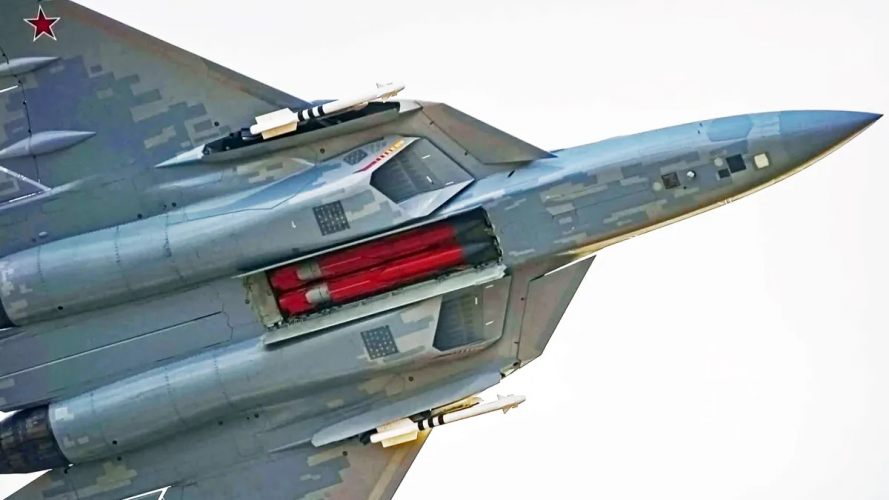
It is another huge coincidence that this Boeing designed weapon pod involves double stacking weapons. I'm not suggesting Boeing will use external weapon pods on the F-47 or F/A-XX I'm suggesting the double stacking solves all the weapon bay discussion.
Imagine F-47 having two of these weapon bay pods in tandem like the Su-57 integrated into the fuselage. You have previously mentioned tandem bays between the engines.
Then add two F-22 style side bay missiles to the F-47 design. This then gives 10 air-to-air missiles in USAF configuration.
The US Navy strike aircraft can carry one 2000lb JDAM + Six SDB + two AIM-120 + two side bay missiles. This is sufficient and larger than the F-35 and F-22 capacity.
This large tandem bay would fit a JASSM. 3 SDB wide is wide enough for JASSM. A SDB is 190mm wide. Three of them is 570mm. JASSM is 550mm. In terms of weapon bay length the far left config easily has 2 feet aft of the AMRAAM. The far right config shows how far aft the weapon bay goes.
I know you love the AIM-174B. Providing there is no bulkhead between the tandem bays then a single AIM-174B could theoretically be carried in one bay slightly extending into the second bay. JASSM is 429cm long. Two of these in tandem require a 860cm long bay. AIM-174B is 470cm long and AIM-120 is 360cm giving a total length of 830cm. This then gives a potential config of one AIM-174 + four AIM-120 + two side bay missiles.
This is one of many ways to solve the common weapon bay issue. I still prefer my original suggestion of one large F-22 style bay without a divider allowing four 2,000lb JDAM or three wider JASSM. The USAF then fits a ~4,000lb flat fuel tank inside the bay to allow 8 staggered AIM-160 all internal.
I don't think US Navy will care about designing the aircraft to fit all large weapons. The F-35C already can't carry, JSOW, SLAM-ER, Harpoon or LRASM internally. It is much easier to just design a new weapon to fit the F-47 and an added bonus if it will also fit the F-35C. AGM-88G was designed specifically to fit inside the F-35 and then we got the SiAW ground attack version.
In the space of a 2,000lb JDAM it is possible to make a unpowered glide weapon with a 1,000+lb warhead. 1000lb JDAM-ER fits and gives 50nm of standoff. It is also possible to make a 200nm powered missile with a 500+lb warhead in that footprint.
The Super Hornet needs the 500nm range LRASM when attacking ships as it is slow and unstealthy. A fast and stealthy design could have a smaller 200nm range weapon with a similar sized warhead. Harpoon has a 488lb warhead and 120nm range. The JSM for example could have its warhead size doubled and range halved and it now is similar to Harpoon but fits easily in the F-35 and F-47.
The current best air superiority fighter in the world is the F-22. The current best strike fighter in the world is the F-35. Both aircraft have nearly identical weapon bay volume. Volume is all that matters.
Yet F-22 is limited to either GBU-39 and GBU-32 - not in wide use by USAF. Both - externally cued only.
If volume is all that matters - something went wrong here.
The current best air superiority fighter in the world is the F-22. The current best strike fighter in the world is the F-35. Both aircraft have nearly identical weapon bay volume. Volume is all that matters.
Weapons bay length and depth matter, not just the volume.
The F-22 has a wide, flat bay. It can carry 8x SDBs plus 2x AMRAAMs, or 2x 1000lb plus 2x AMRAAMs. Yet the F-22 cannot carry 2000lb weapons AT ALL (or B61 nukes). The USAF doesn't use many 1000lb bombs, those are mostly USN.
The F-35 has two deep bays that are somewhat narrower in total than the F-22, so it can carry 2x 2000lb plus 2x ARMAAMs, 8x SDBs plus 2x AMRAAMs, or 6x AMRAAMs using the Sidekick racks.
This further confirms my point. The F-22 shallow bay allows twice as many air-to-air missiles as the current F-35. The F-35 deep bays allows 2,000lb class weapons. Both are compromises.
The double stacked method as shown in the Boeing rendering solves this issue completely. Zero compromises between variants and both can share a common weapon bay. The shallow bay, deep bay debate has gone for months like these are the only two options.
The F-22 was designed with no intention of it ever carrying air-to-ground weapons so it received the shallow bays. Boeing has known the F/A-XX and NGAD requirements for 10 years. Boeing would know that it is highly likely the USAF would desire a strike version of F-47 in the future. Every air-to-air only fighter in the last 50 years has gained ground attack capability. The F-47 having only shallow bays makes no sense.
Even the smaller KF-21 is designed for two 2,000lb class internal weapons in a similar central location to the F-22. The air intake ducts of the KF-21 still manage to go over the deep 2,000lb class bays. The KF-21 isn't fat looking either.
The assumption that the weapon bays need to be shallow to fit under the intake ducts is false.
The assumption that the aircraft need to be fat to fit deep bays under the intake ducts is also false.
Most people are surprised how narrow the intake ducts are when they see the bulkheads of a fighter jet. Here is a bulkhead from the F-22. The F-22 has plenty of room between the weapon bay and intakes compared to some other aircraft.
There are people on this forum who have hands on experience with internal weapons bays, flight test, and certifying weapons for release from bay as well as the design of internal bays and all of the complex tradeoffs that come with them.
It’s a little more complex that “how many of weapons can we stuff in here”.
This thread is a consensual hallucination or fever dream of what people want the program to be, not what is, and they’re still using the wrong range numbers. Oops.
The current best air superiority fighter in the world is the F-22. The current best strike fighter in the world is the F-35. Both aircraft have nearly identical weapon bay volume. Volume is all that matters.
No.... volume is NOT all that matters. Volume that fits the rest of the air frame and internals is what matters and broadly speaking, volume that enables the air frame to achieve it's intended requirements is what matters.
insider - if you had so much as spent the time at all to even do some doodling with pencil, you'd be much much more credible.
-----
The purpose of this write up is to very coarsely list out the thought processes and design decisions I've thought of and accounted for in my F-47 model - not for insidersource per se because he's beyond any saving at this point - but for other readers and for posterity - in case someone thinks insider source's magic wand waving is somehow credible.
@VTOLicious and @Nx4eu have done some very solid work modeling 5th and 6th gen fighters - much more rigorous than what I've done here.
Generally for a supersonic stealth fighter, the measure of density (MTOW kg / volume m3) is around 500 - 600 kg/m3. Although density does differ between designs, this range puts us in a ballpark of just how large a stealth fighter can get. For an air superiority fighter with an MTOW of 96,000lbs (already generous IMO), a thrust of 40,000lb per engine x2, I ended up with a volume around 87m3. In practice, the volume could be packed even tighter as I made worse case assumptions for a number of clearance parameters in addition to knowing little about what systems are crammed into the plane.
Disclaimer - I'm not claiming this to be what the F-47 is gonna end up as, but with some parameters in mind, this is to illustrate that it's incredibly difficult to fit things into a fighter cleanly. Treat this purely as a thought exercise for how little space and how much considerations goes into enlarging anything on a fighter jet.
Firstly - some assumptions:
1. 40klb engines, because a scaled down F-135 sized AETP engine producing 45klb thrust lands us around 36 - 40klb thrust - as was reported regarding NGAP.
2. 96klb MTOW. This comes from the common MTOW to single engine thrust ratio of the F-22. This is actually generous for you.
3. Density around the 500 - 600 kg/m3 range
5. 20 - 25,000 lb of internal fuel.
4. I happen to agree with Scott that at least lobbing anti radiation missiles in addition to an air to air complement could be very useful for PCA, so enough theoretical space and depth for two AARGM-ER / SiAWs.
5. As the US is only going for a single air superiority platform, it should have a performance capable of matching the J-36 and J-XDS (and probably most likely somewhere in between). I also deliberately made it a larger planform - hence large wings and shape. Compared to VTOL's 78m2 density for his concept, this fighter is already a little obese.
NGAP was derived from PW's own X102/3 concept and from the assumption of a 51 inches. This was built off the assumption of being somewhat greater in diameter in comparison to the F119 due to having a third stream. Paired with PW's own X102/3 concept from their video, the engine turned out to be 11.8 ft long without nozzles and 23 ft long combined with the exhausts (which were also length matched with the released concept).
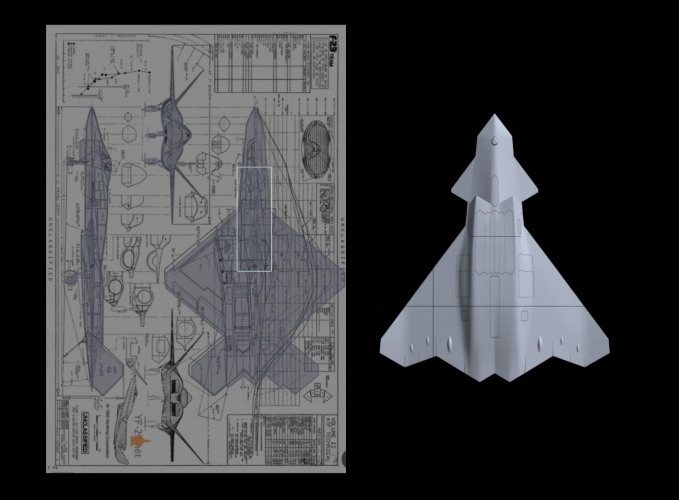
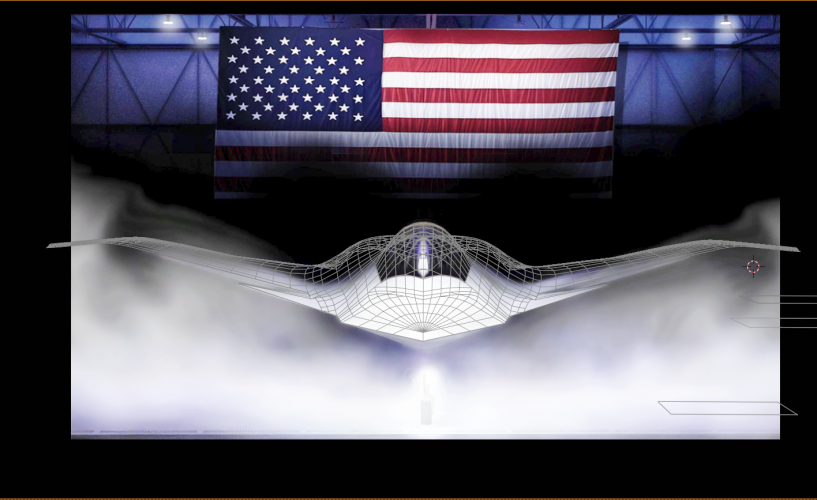
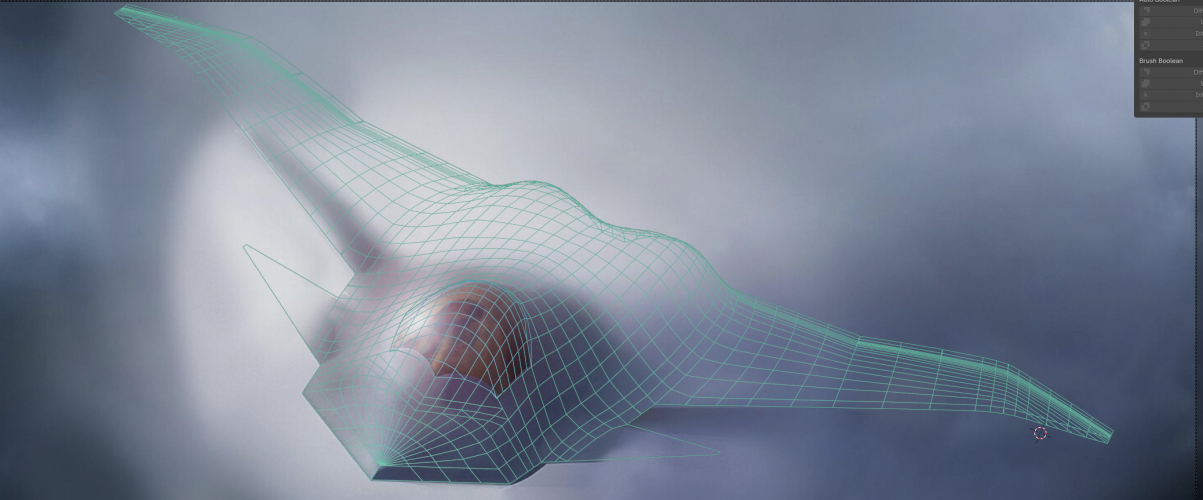
Might I also add - @insidersource - this was a model built from the perspective match of the F-47 renders thanks @targetpractice, which actually imposes even more constraints as ya'll will soon see.
This fighter concept turned out very F-22 sized:
53.2 ft wingspan
62.2 ft length
86m3 volume (the F-22 would be denser than this)
Now - onto the actual difficulty of how god awfully difficult it was to fit this much weapons into a fighter and generally satisfy these constraints.
1. Engine size, intake position and ducting
Attempting to abide as much as possible to the released renders of the F-47 and it's intended components, this ensures that the intakes must be ventral, must not be on the wings, and must be places somewhere between the forward leading edge of the strake/canard to just behind the leading edge of the wings.
In order to fit an engine of the perscribed diameter and derived length, in addition to the exhausts, it had to:
1. be positioned somewhat more forward in the airframe
2. must account for enough thickness for the engine housing and support rings / bulkheads, which was estimated from a cross sectional diagram of the YF-23. IIRC those clearences were 6 - 8 inches at least.
3. must account for auxiliary devices surrounding the main engine, which is also 6 - 8 inches
And in turn - the engine's placement affects:
1. Hot and cold sections determine what can and cannot be placed near the engine and to what proximity they can be placed.
2. Intake duct position, length and dimensions
3. Fuselage cross sectionals and smoothing
4. Landing gear folding mechanisms, storage
5. Fuel tank positioning
6. Clearances of wheel bays and other bays to the engine and the surrounding bloat
The result was:
- The engines were just far enough apart that I could squeeze a SiAW bay between the engines with enough plausible clearance as derived from YF-23 cross sectional cut diagrams
- Engines sit somewhat more forward due to a longer exhaust channel and naturally plausible tapering of the thickness of the fuselage and the engine support structures.
- Intakes and ducting starting inline with the trailing edge of the strake / canard, whose intake shape and width must not interfere with the normal rotation of the canard surface - if it is indeed a canard.
- Intake ducting that hides the entire engine face (this is actually a good thing for the weapon bays and realistically, this may or may not be possible due to requirements for intake air flow)
2. Fuel tanks
Fuel tanks requirements:
1. Must have sufficient clearance to all components - 1 to 2 inch to weapon bay walls, 2 - 3 inches from cold part of the engine, between tanks
2. Must avoid engine hot zones
3. Must remain only in the wing root of the wing
Result:
- I managed to fit around 23,000 lb JP 8 fuel into the aircraft by modeling in very very crude and probably not even feasible fuel tanks in a 13m3 volume.
3. Sensor arrays.
Requirements:
- The Radome seam must be a comparable and believable distance from the front apex of the cockpit glass.
- Assuming a radome thickness of 0.6 inches, the array's emitting element antenna tips must have at most a 1 inch clearance to the inner walls of the radome.
- The array must be canted 20 degrees upwards
- The array must have 2.5 ft of sensor space from the array mounting bulkhead to the sensor bay bulkhead
- The immediate array layered structure must be 8 inches thick
- Side array has a 9 inch thickness (and even that could be too tight) for a self contained array
Result:
A main 0.6m2 geometric area of the array emitting face (1.5m wide x 0.825m high) - comparable to what I measured on a 20.5m J-36 (0.6 to 0.7m2) after applying the same requirements.
A side array of 0.4m2, but that's entirely something I added just for the sake of having a side array.
An EOTS window whose electronics are stored within the same sensor bay just before the sensor bay's aft bulkhead
Weapon Bays
The weapon bays must:
1. Fit 6 AAMs and 2 SiAW sized weapons either separately or together as a single loadout
2. Uses LAU-128s as AMRAAM rails
3. 2 - 3 inch clearance between weapons, more clearance to the walls of the weapon bay to allow room for the hinges and open/close mechanisms.
4. Must retain sizeable clearance to the walls of the fuselage in addition to proper height so as to ensure there's enough room for a strong keel / stiffness in the aircraft to permit 9g maneuvers. Given this, the weapon bay between the engine could be precarious.
5. Proper clearance with the engines, ducting and wheel bays ~ 2 inches
6. Proper clearance with the intake ducts for enough of the weapon bay to allow for weapon bay bloat, wiring, adapters and what not. 1 inch at the thinnest.
Result:
An optimistic 6 AIM 120D footprint AAMs and 2 SiAW footprint weapons carried concurrently or alternatively 6 AIM 120D footprint AAMs and 2 LRAAMs carried concurrently.
I may or may not have made the intakes too wide to have not included enough meaningful width for the control surfaces between the strake and the wing. Also the aft weapon bay may very well violate the structral integrity of the aircraft for 9g maneuvering, so...
Realistically, the bay would hold at most 1 SiAW and 6 AAMs concurrently, and more pessimistically, a guaranteed 6 AAMs. This was me choosing to maximize the allowable space given the perspective match with the renders. The way this was determined was to ascertain the width of the upper fuselage, for which a lower fuselage was imagined to take as much advantage of the upper fuselage's width as possible without actually changing anything.
The bay clearance, which includes the thickness alotted for the adapters, grid like wall structures, structural thicknesses, adapter wiring and bloat, and weapon clearances is already very very tight. The AAMs radome cones fit under the intakes only barely because they taper.
Any weapon with a greater diameter will need a larger adapter, stiffer and higher load bearing supporting structures, not to mention more depth and width. In the above, the pink is the weapon bay clearence with the intake ducts just before the engine compressor face. The yellow outline is the weapon bay clearance with the intake duct at the very front of the weapon bays. As you all can see - the clearance is already very very tight. Literally any increased depth for a SiAW sized weapon aside from the center bay will require additional depth added. Carriage of two SiAW is further complicated if engine bloat and generators require usage of the space between the engines, thus removing viable space for a weapon bay there.
Oh and insider .... you do know that just because you can pack n number of weapons into a adapter weapons bay for an F-18 doesn't mean you can pack the same number of weapons onto a stealth fighter right? Please tell me you know? The pod on an F-18 doesn't have to contend with the dense internal packaging of a stealth fighter. The conversions done to a Su 27, a Mig-29, or an F15E did not have to contend with the dense internal packaging of a stealth fighter.
The non-credible decisions I had to make:
1. Thanks in part to the weapon bay clearances of the aft weapon bay stuck between two engines, my wheels have to have a sizeable wing root fairing to accomodate it's folding mechanism - and even that has clearances that I'm extremely uncomfortable with - measured in places under an inch. There's simply no room left there to accomodate more.
2. Due to requiring the correct dimensions for the PW102/3 shown in the PW renders, the engine is forward enough that it severely constrains the weapon bays too. If for any reason there must be certain electronics exceeding 2 inches in thickness, then that wheel bay is not gonna work.
3. There's essentially no room in the nose for a taller array. After perspective matching everything, this main array is actually shorter than the F-22's array while being substantially wider. This is desirable for an air superiority fighter as it improves azimuth wise beam width, but it pays a cost in elevation beam height - not something desirable for A2G modes and horizon scanning.
4. I've actually given substantially more credible volume to this design than what the original render may depict. Given the shallowness of the fuselage under the chine - and even if we can only see a very very small part of it, going off of a slightly aggressive expansion of that fuselage shape still required some funny hand waving at the joint between the intakes and the front fuselage to make work. In reality, even if the intake configuration is correct, the fuselage could be even thinner.
So... having written all that, just what would it take to be able to fit an additional two SiAWs in place of the AAMs in these weapon bays to allow for a baseline strike platform?
As you can see below, while the SiAW does technically fit in the weapon bay I've designed, it does not clear the margins left for engine bay wall thickness, bloat, or weapon clearance to weapon bay walls. This doesn't even account yet for the adapters, structural bulkheads that support the weapon bay as well as the fin clearance - which I basically eyed from proportions. In addition - this still does not account for the fact that the duct's shaping has stringent requirements too!
Option 1:
The entire intake assembly must be adjusted upwards, which may or may not be possible given ducting constraints for airflow. In order to not obstruct airflow, you now have to make your intakes longer to avoid being too curved and that in turn requires expansion of the outer mold line. This in turn forces changes to fuel tanks, pumps and routing too. This option is also untenable, because moving the intakes further forward may actually cause the intakes to be too small thanks to the tapering of the fuselage.
Option 2:
Engine must be moved backwards to create more longitudinal space to avoid the ducting. This requires even more changes to the outer mold line because you now need to change how the aft fuselage tapers and it may or may not need to adjust bulkhead spacing. Now the aft fuselage needs to be made thicker. This also requires change in ducting shape, which in turn impacts fuel tank shape, fuel lines and pumps, dorsal array clearances among other things.
Option 3:
Deeper fuselage just 1.8% thicker (about 2 inches at this point) to barely accommodate a bay deep enough for four SiAW weapons where the AAMs would be leads to an increase of 4m3. For reference, I measured the F-22's fuselage at it's weapon bays to be an average of 5 inches thinner than the F-35's fuselage. all of this is before you even add structural reinforcing for carrier landings or keel / bulkhead strengthening to support strike sized weapons. In practice you're looking at least at an F-35's depth to accommodate all that. Given these effects, to avoid drag (and consequently, heat) penalties, you now need a longer overall length, which now increases your volume further and increases structural strength requirements, which then calls for heavier support structures and thus heavier empty weight. This then either cuts into your meaningful payload and fuel amount or reduces your TWR.
Option 4:
Usually the magic happens here if possible - by doing some clever arranging of internal stores. However this is indeterminant and not guaranteed. The sidekick arrangement on the F-35 was a boon, and by and large an exception and not the rule.
I should also add - my SiAW is placed with strakes pointing sideways and the actual height is only 12.1 inches (the fins measure to 15.1 inches, but they can have less clearence to the imaginary weapon bay walls). I also haven't accounted for SIAW's adapters and whatever else supporting structures there are, which may or may not add bloat, depth and have their own dimensions requirements.
We haven't even considered all the other bloat that goes on an aircraft - power generators, transmission arrays, DEW weapons if any, any number of engine, ducting related electronics, any number of structural requirements, mechanical parts that spill into the central fuselage section.
We also haven't considered heavier and bigger weapons either. A Mk84 is 18 in in overall diameter not to mention a 25 inch wide tail. That's only ever going to fit in the area between the intakes - assuming the intakes aren't spaced closer together. Any talk of LRASM, JSM form factor cruise missiles are essentially completely out of the question without expensive OML changes given a boxier shape. If we were to actually include 18in diameter weapons, you are looking at least a 6 inch increase in depth. With no increase in length, you are beginning to pay the drag penalty of a multirole strike aircraft - on an air superiority fighter.
We still have not accounted for yet the increased weight of reinforced, folding wings for carrier stowage and for carrying 2000 + lb sized weapons on the external pylons, let alone something the size of HACM.
Finally, we still haven't accounted for the possiblity that the F-47 would carry no AARGM-ERs and SiAW sized weapons in the first place, which means the fuselage width would be narrower, and likewise the weapons bay will be narrower and flatter.
This is not necessarily to show that all of these penalties must be paid in full and in practice, there are ameliorating workarounds here and there, but ultimately the changes are almost always cascading, complex, and often times prohibitive and there is often no real way to avoid paying those penalties.
All the compromises made to fit an additional two SiAW:
1. 2 - 4 inches thicker fuselage in some sections, adding to wetted area and drag
2. Substantial rearrangements internally that impacts multiple systems and structures
3. There is absolutely zero space left for AAMs even after paying those penalties. You either choose no AAMs for a somewhat meaningful strike package, or you choose a measely 2 SiAW and 2 AAMs.
4. On a naval fighter, that aft weapons bay is most definitely going away for a stronger fuselage and tailhook. That actually leads to an even narrower fuselage that may or may not be able to fit 4 AAMs width wise.
If you put SDBs on your air superiority fighter without further changes and call it a day, sure that's workable sorta but that's not an F/A-XX - that's still an F-47.
If you start off with a multi-role fighter's fuselage and share it with an air superiority fighter, good luck man. If you ever thought 6 inches was too small to get screwed with, those 6 inches in girth is going to be the most painful 6 inches you'll have to take - raw and unlubed.
If you start off with a full on strike fighter's fuselage for your air superiority fighter ... then I charge 6 dollars an hour to teach Chinese to English speakers on Thursday nights only. Failing my tests will result in brutal beatings with a spatula. This teacher accepts no mediocrity.
To conclude:
Clearances inside an aircraft are measured in inches (or if you're more scientific, cm and mm). Fuselage heights are measured in inches. Likewise - the signature and drag penalties you pay also arise from differences of a few inches here and there. Things that look like they should fit don't always fit. The more sensitive a certain part is, the more clearance you need - array thicknesses, cooling devices, clearances to the hot section of the engines. A single change as substantial as a larger weapons bay or a reinforced undercarriage or hell - even a larger wheel in my design - often cascades to so many different places you'd never imagine it could affect that not a single change on a stealth fighter comes cheap or easy. Despite how thorough I've tried to be, I'm absolutely certain theres still non-practicalities built into my design.
Sure - a different planform like VTOL's planform could possibly utilize deeper weapon bays for a somewhat better strike complement, but again - not a single change on an aircraft is free.
So for you to handwave away everything as "Boeing magic" is... not credible.
I'm sorry. I feel bad for being acerbic, but I really cannot contain my contempt for a blantant disregard of nuance and evidence. Had you been a little less insistent and a little more open to thinking about what others have said in a little more detail - or hell just read the news - I wouldnt feel the need to constantly shut this idea of yours down. Literally the only time some variant of this idea is feasible is if F/A-XX gets cancelled and the F-47 had to see expanded A2G capabilities.
In any case, if in 10 years Trump's little antichrist son announces the contract for F/A-XX and you turn out to be right - I teach Chinese on Thursdays (no I dont... ) come learn before you have to learn
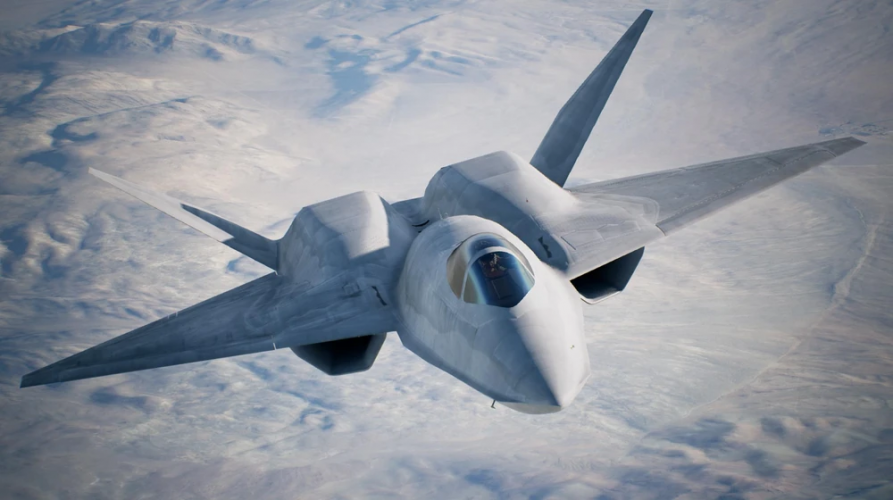
Now, that was the F-47 side of the world, and one that was perspective-matched to the two released Boeing renders. So I think it's very likely that F-47 will look like @Reddington777 's render.
My mental model of FAXX ends up looking a lot like the Su57 through the fuselage:
Engines spaced ~11-12ft apart to make space for a weapons bay wide enough for 2x AGM-158 or SiAW. Weapons ~22" wide and 18-20" tall.
They're also long weapons bays, long enough to hold an AIM-174 or whatever the longest possible weapon to fit on the weapons elevators ends up being. A weapon 15'6" long.
So, the tandem centerline bays are ~55" wide by 16'6" long. More or less a single big bay ~33'6" long(!) between the engines, but with a divider for aero reasons.
Internal weapons capacity of between 12-15,000lbs.
External weapons capacity of 4x 5000lb stowage (600gal fuel tanks are right at 5000lbs full), or ~3000lbs per missile. This is theoretically catapult launchable, but would not be able to recover on the carrier with that load.
Total load I'm thinking of is 4x BVRAAMs or 2x SiAW/AGM-158/VLRAAM per centerline bay, plus a couple of side bays or Su57-style armpit bays for AAMs (probably 2x HalfRAAMs per side bay in practice) and some external stores options in Beast Mode. Makes the standard load 10x BVRAAMs or 4x heavy plus 2x BVRAAMs.
Beast Mode would be on the order of 6-8x heavy stores and ~6x BVRAAMs (or 4x BVRAAMs and 4x HalfRAAMs).
Now, if you get creative in how the BVRAAMs mount in the bays, you can physically pack 8x AIM-120/AIM-260s per bay. This requires single-piece doors and a couple of missiles mounted to the doors, along with the doors opening far enough to clear the weapons bays. This would let you pack 2x SiAW, 8x BVRAAMs, and 4x HalfRAAMs internally.
While on the subject of packing weapons in, it is also possible to stuff 3x Mk84 series across one of those weapons bays, if you give the bay the structure to allow 5x mounts across the top of the bay. Each bay has 2 mounts for wide missiles or twin AAM racks, 3 mounts for Mk84s, and possibly 4 AAM racks on the doors.
4. On a naval fighter, that aft weapons bay is most definitely going away for a stronger fuselage and tailhook. That actually leads to an even narrower fuselage that may or may not be able to fit 4 AAMs width wise.
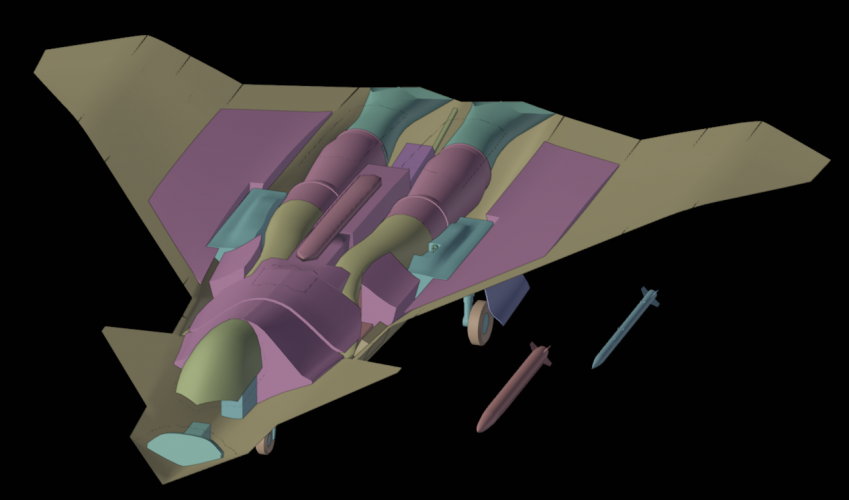
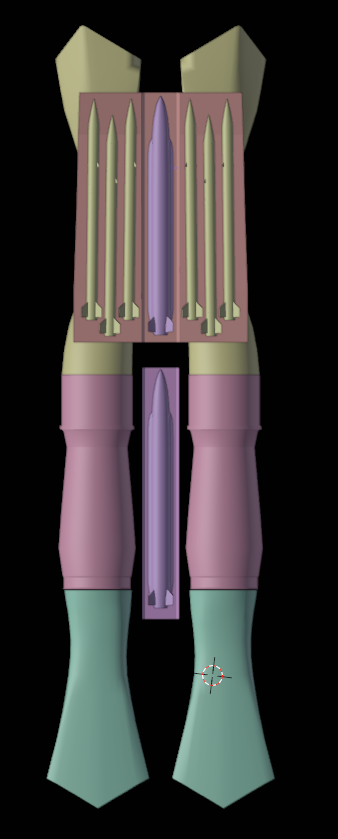
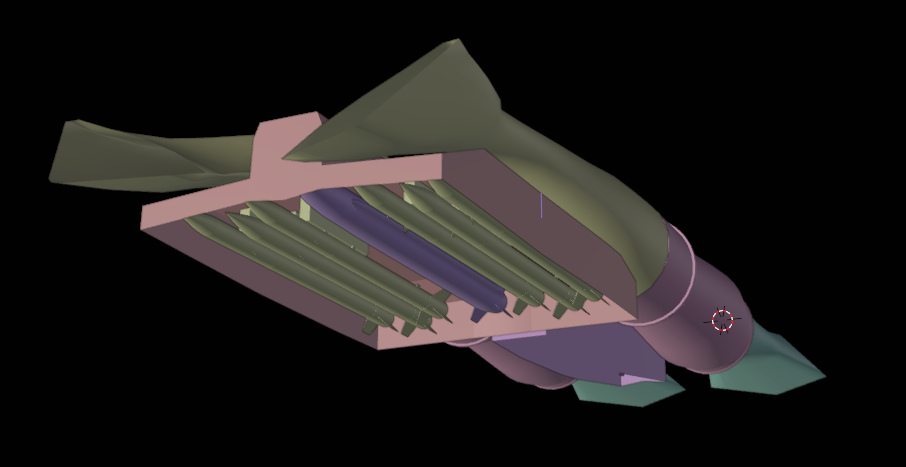
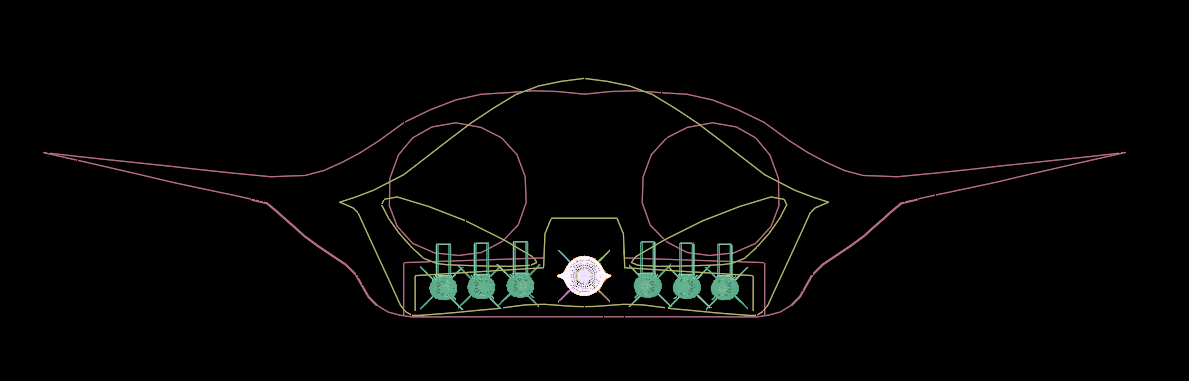
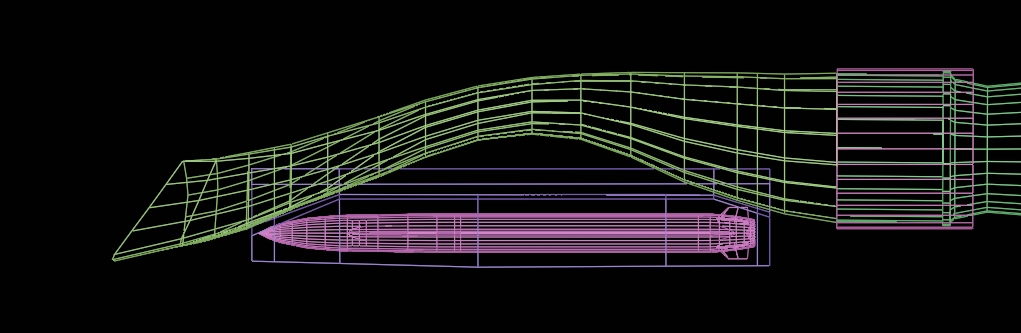
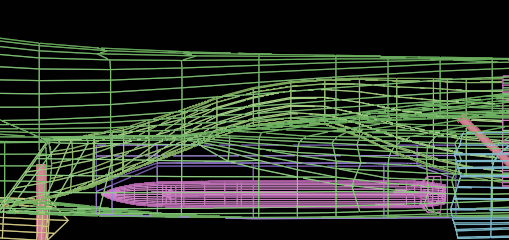
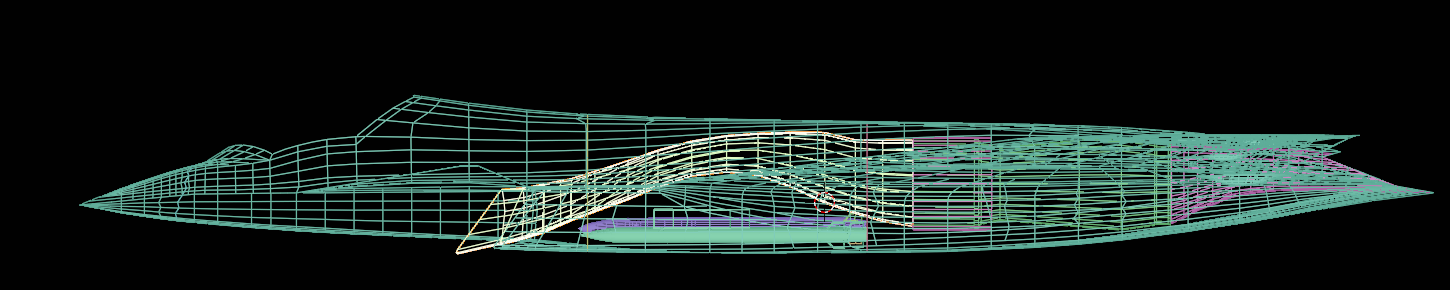
I have highlighted this section as I believe your central weapon bay is too far aft. If you change your nose landing gear to a forward retracting gear like the F-14, F-35 and YF-23 then the central weapon bay can move more than 2+ metres forward of the air intakes. This then allows for the aft tandem bay while retaining a tail hook. Scott Kenny has the idea of tandem bays for F/A-XX and they must be further forward than the Su-57 to allow for the tail hook.
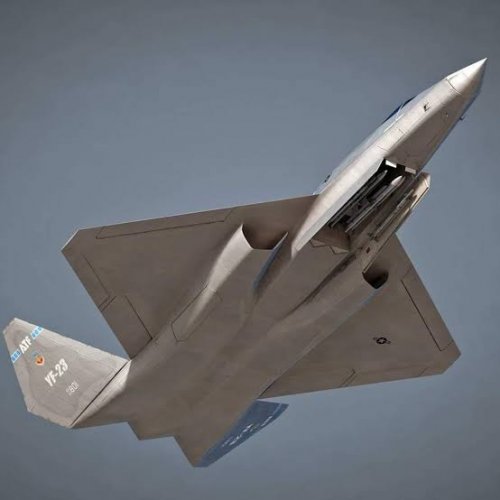
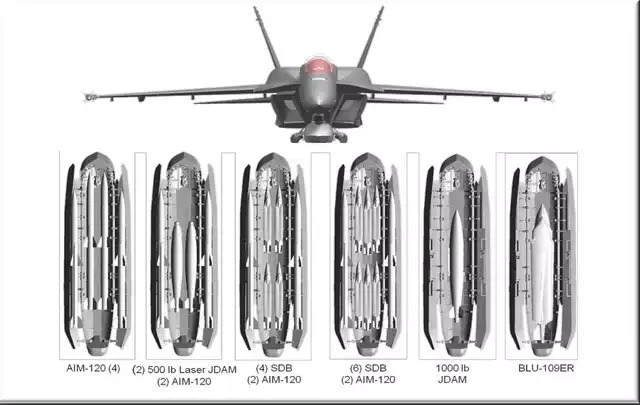
This modified YF-23 drawing is the perfect example of my proposed weapon bay positioning. It fits within the mould line of your rendering. The tail hook would be in the correct position just aft of the bay.
This tandem bay layout has the stacked AMRAAMs similar to the Boeing weapon pod. This allows 8 AIM-120 and two side bay missiles.
Now in the standoff strike mission for F/A-XX it allows two LRASM or JASSM with the side bay missiles for self defence.
A self escorting strike config could have a single 2,000lb JDAM completely filling the front bay. The rear bay can have six SDB with two AIM-120 on the doors.
Here is another hot take. AIM-260 will be multi-role missile and be able to take out enemy SAM sites. This means the self escorting config listed above solves the need for carrying a dedicated SEAD AGM-88G missile. Scott Kennys primary justification for his double width tandem bay was to allow for that large SEAD missile.
I'm not suggesting the AIM-260 will do the same job as a dedicated AGM-88 as the warhead us much smaller. Historically the Navy aircraft flew around with a single AGM-88 just for emergencies. The AIM-260 will be good enough for emergencies. I'm surprised no one has mentioned this as the AIM-260 even has tactical in the name.
I would also not discount a rearward retracting main landing gear like the Boeing MQ-28 Ghost Bat. This solves another issue and allows for the side bays like the F-22.
If you have time I would much appreciate if you could apply these changes to your drawing. It might require the nose to have a flat lower surface like the YF-23.
1) Forward retracting nose gear
2) Rearward retracting main gear.
3) Tandem bays 60cm wide. 60cm deep. 860cm combined length. The bay starts directly behind the nose gear.
4) F-22 side bays
However, I also believe that USAF and USN requirements necessitate separate airframes. As @Reddington777 explained in detail, countless compromises are necessary to implement a joint airframe , which ultimately impair the capabilities of one version or the other.
Your concept is very close to what I expect. That weapon bay volume is more than sufficient for the F/A-XX mission.
I think the engine bay size is too large by 5-10%. Thrust density is increasing every decade. A state of the art F110 sized engine would now be reaching 40,000lb of thrust. The XA102/103 would not need to be bigger than the F110.
I think your F-47 concept would 100% satisfy the USN requirement. Simply add a wing fold and tail hook. I'm curious what change you expect would be needed to satisfy the USN requirements?
No. Thats not at all how this works and my weapon bays are not too far forward.
The weapons bays available space is first and foremost determined by where the canards are and how wide and tapered the forward fuselage was, which was not at all dictated by myself. It was perspective matched to both renders at the same time. Even on a clean design, weapon bay space is determined by intake ducting, and engine placement.
The engine and intake space is also dictated in part by the wings and planform. You cannot have enough space between the engines to have substantial weapon bays with the wings dictated yet again by perspective match. The only reason YF 23 f22 and su57 had more room to play with was because they had noticeable LERX /shoulder at the intake. Again - not my choice to choose.
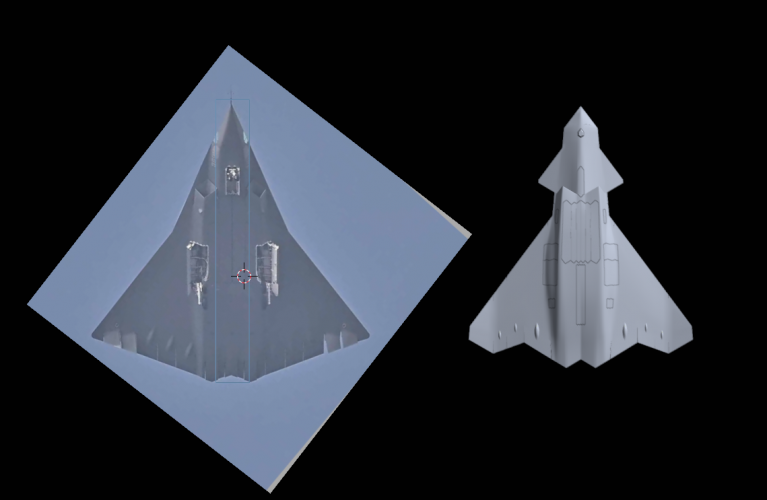
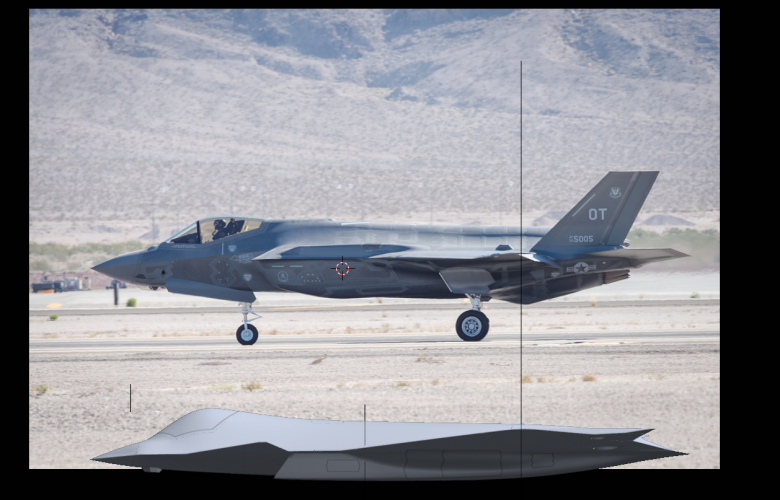
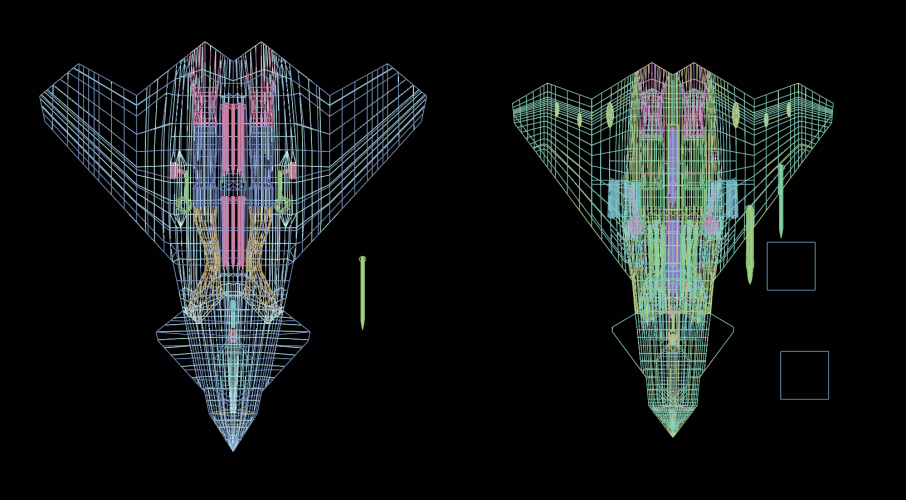
Here's the comparison with the YF-23. The bounding box highlights the location of the tandem bays - the bay placement is actually a lot further forward than most currently in service stealth fighters:
In fact by and large, my fighters weapon bays are a lot more common in placement than the YF-23, which happens to be characteristically more forward bay placement than most stealth fighters. So rather than mine being too far back, yours happens to be quite far forward.
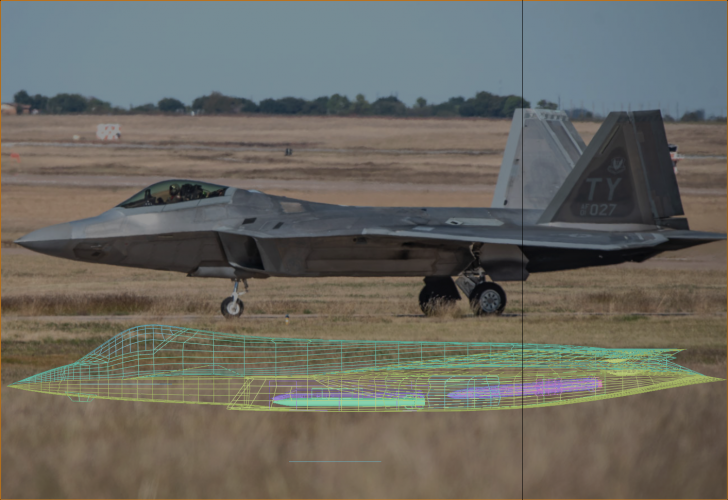
In fact mine lines up with the F-22 so well that the intakes, bays, and engines are almost all in the same longitudinal position.
Here's another comparison with the J-36. The J-36 has a longer intake and engine space than mine does, and yet the weapon bay placements are all in the same position.
Here's another one with the length matched F-35:
So at least that invalidates all of the weapon bay suggestions.
I actually made an earlier model that does satisfy what you said, but the volume was a whopping 105m3 internal volume compared to my already obese 86m3 and certainly much lower volumes of other 5th gen fighters.
Just to show you what needs to be done in order to fit tandem bays, this is how far the spacing of the engines needs to be on the left model. If you transfer that to my model, your engine spaces would have to be the same as that of the YF-23 and Su-57 - on the wing root fairings.
There are two main layouts for stealth fighters. One is the F-22 layout, which made sense for my perspective matched model, and the other is the YF-23 and su-57 layout - which may work, but 1 didn't fit the perspective match and 2 requires you to have a discontinuous planform shape consisting of "blocks" of fuselage rather than a continuous, blended body to meet tandem weapon bay space without exceedingly large volume. Even so - the bays are still constrained by width and by depth. You could theoretically fit all kinds of shit into a bay. I could geometrically fit 10 AAMs into my weapons bay, but you need clearances, room for adapters, room for fasteners and door hinges, door opening mechanism, bloat around those bays, their proximity to the hot section of the engines, and ultimately what else your airframe needs to perform it's mission and where those things fit.
If I was being more realistic, my tandem bay would be ripped out for generators, engine electronics and possibly a DEW.
If you have time I would much appreciate if you could apply these changes to your drawing. It might require the nose to have a flat lower surface like the YF-23.
I needed to perspective match, and that leaves very little room for discussion. The rear landing gear's folding mechanism is actually the same that the J-20 and J-XDS uses and very similar to the F-35 landing gears. I didn't use rearward swinging landing gears because I haven't found a single stealth fighter that does that. It could be possible, but again - the engine space and intakes is what determines bay placement in this case and not landing gears.
As for the flatter forward fuselage - id like that too, but the renders show a rounded and blended lower forebody, not a polygonal and faceted one
In case you are curious insider, here's the model perspective matched. Idk how long target practice spent matching it, but I know I spent nearly a month trying every combination I can possibly try and this was the closest we could get.
I work for a local university making web apps to keep students from hacking the school website and changing their grades (it happened more than once already)
I think the results obtained via perspective match and filling in the rest of the blanks should show that what was released as renders for the F-47 are probably not make belief and most likely some iteration of it's design for an air superiority fighter.
Having said that - hopefully I haven't derailed the topic too far. The purpose was to show how hard it is to get a strike platform to share an airframe with an air superiority fighter.
Your concept is very close to what I expect. That weapon bay volume is more than sufficient for the F/A-XX mission.
...
I think your F-47 concept would 100% satisfy the USN requirement. Simply add a wing fold and tail hook. I'm curious what change you expect would be needed to satisfy the USN requirements?
IMHO discussing changes to meet USN requirements would be pointless. My F-47 model is a hypothetical design, without any relation to actual customer requirements, obviously. I used public available information and assumtions discussed in this very forum instead. The model is based on the specifications of previous-generation stealth fighters and derived assumptions. Hence it just illustrates what could be possible, but it might be far off from reality. I could claim it illustrates the F-47, F/A-XX, or a superior configuration Phantom / Skunk Works was unable to come up with ...Pointless!
Just look at ATF: two very different airframes, despite being based on exactly the same customer requirements. Speaking of ATF, have you ever asked yourself why Northrop proposed a completely new airframe for NATF, rather than using the already validated (Y)F-23 airframe with a few modifications?
However, I also believe that USAF and USN requirements necessitate separate airframes. As @Reddington777 explained in detail, countless compromises are necessary to implement a joint airframe , which ultimately impair the capabilities of one version or the other.
The Air Force and Navy needs are substantially different and both services are desperately trying to avoid "joint" designs. That said, both programs will undoubtedly share common subsystems designed to government reference architectures.
Weapons bay length and depth matter, not just the volume.
The F-22 has a wide, flat bay. It can carry 8x SDBs plus 2x AMRAAMs, or 2x 1000lb plus 2x AMRAAMs. Yet the F-22 cannot carry 2000lb weapons AT ALL (or B61 nukes). The USAF doesn't use many 1000lb bombs, those are mostly USN.
The F-35 has two deep bays that are somewhat narrower in total than the F-22, so it can carry 2x 2000lb plus 2x ARMAAMs, 8x SDBs plus 2x AMRAAMs, or 6x AMRAAMs using the Sidekick racks.
This site uses cookies to help personalise content, tailor your experience and to keep you logged in if you register.
By continuing to use this site, you are consenting to our use of cookies.



 I was referring to Hegseth not you, edited post to clarify.



![yf23load[Mod5 alt weapons config].jpg](https://www.secretprojects.co.uk/data/attachments/333/333004-d4789965b8eca366cf19a8948ee4afc5.jpg "yf23load[Mod5 alt weapons config].jpg")