
Would make sense from a commonality and sustainment POVIt will be interesting whether Poland will want the F100-229 engine for their F-15EX, since they already produce, operate, and maintain that engine for their F-16 Block 52 fleet.

Would make sense from a commonality and sustainment POVIt will be interesting whether Poland will want the F100-229 engine for their F-15EX, since they already produce, operate, and maintain that engine for their F-16 Block 52 fleet.

There are F100 F-16s all over the place in NATO. And F110 F-16s.Switching the Polish F-15EXs to F100s would also make them different from USAF F-15EXs in a NATO situation.


How would that affect performance across the flight/mission regime?Would make sense from a commonality and sustainment POV
Would make sense.It will be interesting whether Poland will want the F100-229 engine for their F-15EX, since they already produce, operate, and maintain that engine for their F-16 Block 52 fleet.
Logistics on their end. Having all their F-16s and any EXs working on the same engine is the same reason the F-16 started out on F100 engines.Why would they want to delay induction and pay for the certification of an entirely new powerplant, from a different manufacturer, for the EX?

Right. Which would basically mean that Congress and administration plans on at least replacing some of the older F-15Es with new build EX aircraft given how long the ramp would take (and how little it would impact currently planned 129 EX deliveries). I think we will ultimately see the 144 EX for the ANG being restored and at least a wings worth of additional aircraft.Apparently there are mumblings and rumblings of getting Boeing to 36 EXs per year in the new funding bill
You do know that the F100-229 and F110-129 engines have virtually the same thrust ratings, and the -229 is lighter. It appears that the -129 has some thrust advantage in parts of the flight envelope, but the differences are small.Obviously but no Eagle II have that engine integrated. It would be just like if the 1946 RAF had requested Merlin on their Vampire...
Err...I said "commonality and sustainment ". Isn't that obvious??How would that affect performance across the flight/mission regime?
This is what I was after, thank you.Err...I said "commonality and sustainment ". Isn't that obvious??
That aside, comparing the engine options:
Thus arguably minimal difference in performance. If anything, I would argue slightly higher performance since the F100 variant has greater dry thrust and it will probably be more common for the engine to be used in this mode longer than in afterburner.
- Pratt & Whitney F100-PW-229 as used in F-16 Block 52 aircraft: 17,800 lbf (79 kN) thrust dry and 29,160 lbf (129.7 kN) with afterburner
- General Electric F110-GE-129 as typically used in F-15EX: 17,155 lbf (76.31 kN) thrust each dry, 29,500 lbf (131 kN) with afterburner
Noting the South Koreans operate both engines within their 60ish fleet of F-15Ks. Commonality is important but also other issues and commercial aspects come into play as well.Would make sense.
Logistics on their end. Having all their F-16s and any EXs working on the same engine is the same reason the F-16 started out on F100 engines.
Right. Which would basically mean that Congress and administration plans on at least replacing some of the older F-15Es with new build EX aircraft given how long the ramp would take (and how little it would impact currently planned 129 EX deliveries). I think we will ultimately see the 144 EX for the ANG being restored and at least a wings worth of additional aircraft.
Issue will be the operational downtime required for the squadrons to swap over. There will be enough disruption, especially if the engine stays with the GE, within the squadron/wings to expect that it would be a minimum of 12months to transition an active duty squadron and maybe closer to 18 months to get back to full operational status and certification. Can the USAF afford to stand down those units for those durations...I would imagine it comes down to the initial realities of EXs operating and sustainment picture. If the EX break down less, have lower direct operating costs and are easier to sustain than even upgraded Strike Eagles, it wouldn’t be nuts to considering an accelerated and/or partial recap of Strike Eagle wings with EX and stretch out the ANG recap.
Having several active EX wings might also improve Guard and Active operational coordination.
Totally speculating here
The initial batch F-15K were equipped with the F110-129 engines, with the ROKAF making the decision to establish the F110 support system in country. However, the 2nd batch of the F-15K changed to the F100-229, which the ROKAF already operated in their F-16 Block 52 fleet and had an existing in-country support system. I had heard that the ROCAF was not satisfied with the overall performance of the F110 (safety, cost, etc) and that was the reason that they decided to switch back, with the new production F100-229EEP engines achieving 6000 cycles before depot inspection. But my sources may have been biased.Noting the South Koreans operate both engines within their 60ish fleet of F-15Ks. Commonality is important but also other issues and commercial aspects come into play as well.
Yes heard the same. Just shows though that despite operating a large fleet of the same engine SK was happy to order a separate one based on specs or commercial considerations despite the potential larger fleet commonality opportunity.The initial batch F-15K were equipped with the F110-129 engines, with the ROKAF making the decision to establish the F110 support system in country. However, the 2nd batch of the F-15K changed to the F100-229, which the ROKAF already operated in their F-16 Block 52 fleet and had an existing in-country support system. I had heard that the ROCAF was not satisfied with the overall performance of the F110 (safety, cost, etc) and that was the reason that they decided to switch back, with the new production F100-229EEP engines achieving 6000 cycles before depot inspection. But my sources may have been biased.
You do know that the F100-229 and F110-129 engines have virtually the same thrust ratings, and the -229 is lighter. It appears that the -129 has some thrust advantage in parts of the flight envelope, but the differences are small.
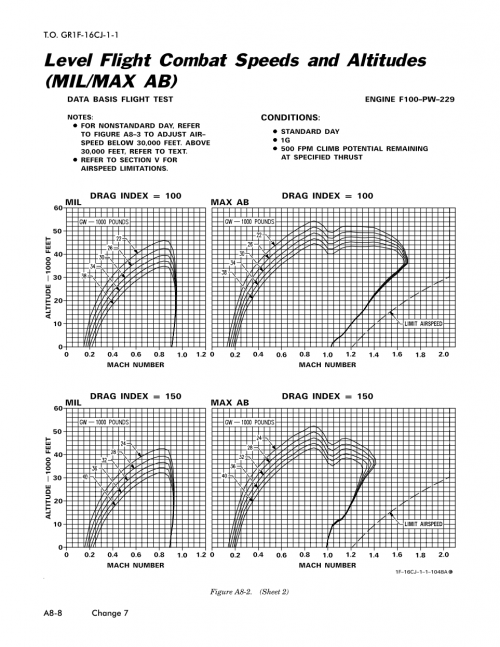
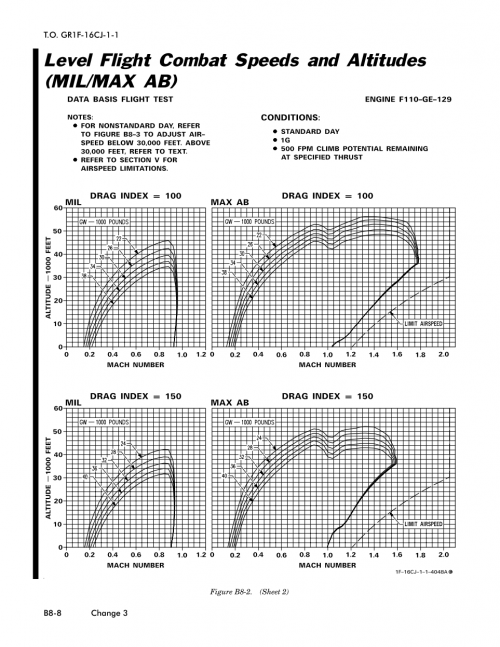
Yes, I said that there is some evidence (Greek Dash-1 comparison) that the -129 has some performance advantages in parts of the flight envelope.The Greek F-16 manual provides some insight. OK, in an F-15 the different engines might behave somewhat differently, but I guess it's close enough.
Some examples:
Acceleration 0.8-1.2 Mach @ 30klbs and drag index 50: 50.83 vs 41.33 seconds
Acceleration 0.8-1.2 Mach @ 31klbs and drag index 100: 70.85 vs 52.5 seconds
The first configuration is close to an F-16 with 4 AAMs and a centerline tank (DI 53), the second is close to an F-16 with 6 AAMs and 2 tanks (DI 105). So actual numbers in those configurations would be a bit higher. But it's obvious that the -129 engined Viper accelerates noticeably faster. On the other hand, there's also the weight difference. In the manual, the Block 50 is actually 200 lbs lighter, which is probably because the Greek Block 52 are Advanced Vipers. But this probably only makes a small difference.
To further illustrate, here's two graphs showing the flight envelopes:
View attachment 792800View attachment 792801

I still wonder why all F-15EXs aren't equipped with MAWS CMWS like the F-15SA/QA?Thing is I would not describe these differences as small.
With these numbers, it is surprising that Greece (launch customer) and others selected the PW engine for the advanced Block 50/52. It then took a while before the GE motor got any customers. So yes, there were probably other factors.
Back to the F-15, I'd be surprised if anyone picked the PW engine at this point. If only to keep any changes on a Boeing aircraft to a minimum... the F-15SA was years late.
In the news: Boeing has delivered F-15EX #15 - the eighth F-15EX for an operational unit.
View: https://x.com/BoeingDefense/status/1993417369939820762

Which would cost more—cranking up F-22 production

You spat a fact. Makes no sense to restart F-22 production now. Maybe 15 years ago there was a case for that.F-47 will probably be available before any possible modern F-22. It would require a total redesign since almost none of the original subcontractors produce the parts anymore. Hypothetically you could build something very similar, if you wanted to waste effort and resources.
It would require a total redesign since almost none of the original subcontractors produce the parts anymore.
Not necessarily as after the F-22 production line was stopped all of the jigs and tooling were very carefully removed and packed up before being put in a secure, controlled environment warehouse (IIRC the US army is guarding that facility). But certainly an upgrade of the F-22's avionics would be needed simply due to dealing with replacing obsolete and out of production electronic components.
While the F119 engine isn’t in production, most of the significant parts are in production to support the depot and base level inspection and maintenance activities. Putting the nozzle static structure back into production would probably be the biggest challenge, along with some of the control system components. Industrial capacity would be a challenge with the large quantities of F135 engines and the commercial PW1000 geared turbofans in production and the powder metal compressor & turbine discs needed to recover from the powder contamination issue.
You are absolutely correct - many of the F-22 and F119 electronic components are obsolete and out of production. While more modern components are available, software often needs to be updated to run correctly l, and requires recertification even if they can run on the newer components.I'd add to that, that many avionics have certainly been upgraded as well, at least with new components. So while their fit, form and function has possibly remained the same (some software updates apart), hardware has likely been upgraded as well. Obsolescence removal is a constant task in any programme. But this is the daily "boring" business that the casual audience is unaware off, as it's mostly the big ticket items and upgrades that get some press coverage, not the daily business items.
the decision has to be made whether to make a lifetime buy of the old parts, or go through the redesign / reprogramming for a new component.
With the F-22 when the decision was made to end its production run (Very foolishly) was such a lifetime buy production decision made?
Anyone know if the $8.6 billion includes the +25 option, i.e. contract will shrink if it's not realized?Israel orders 25 F-15IA with 25 more as options:
https://www.reuters.com/business/ae...-boeing-contract-f-15-jets-israel-2025-12-29/
(Israel Defense Forces)
Last November, Israel signed a $5.2 billion deal for 25 F-15IA jets, which were slated to be supplied in batches of four to six a year, starting in 2031.
With Monday’s announced deal, another 25 jets will be made for Israel, bringing the total number of F-15IAs to 50, adding to the 66 other F-15 variants in the Israeli Air Force’s arsenal.
IIRC, the flight control computers for the F-22 were done as a lifetime buy.You are absolutely correct - many of the F-22 and F119 electronic components are obsolete and out of production. While more modern components are available, software often needs to be updated to run correctly l, and requires recertification even if they can run on the newer components.
In the support system, when the component is becoming obsolete, the decision has to be made whether to make a lifetime buy of the old parts, or go through the redesign / reprogramming for a new component. The lifetime buy decision would be invalidated if you went back into production with new aircraft and engines


