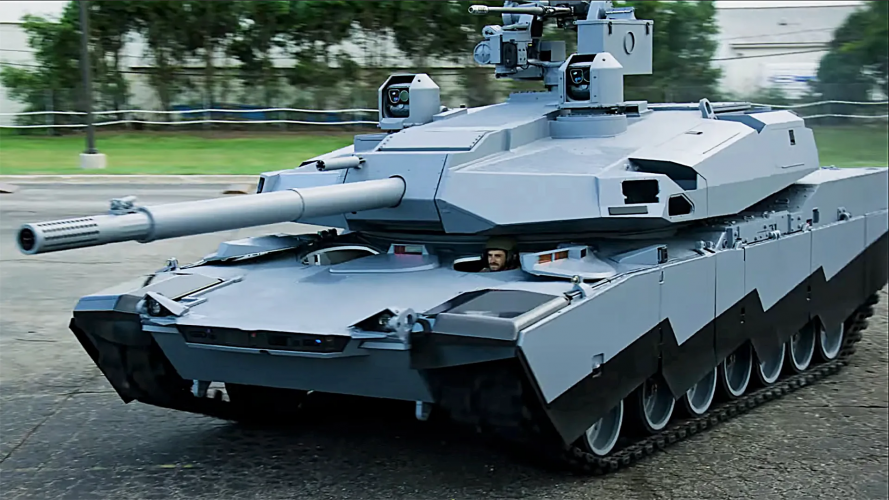
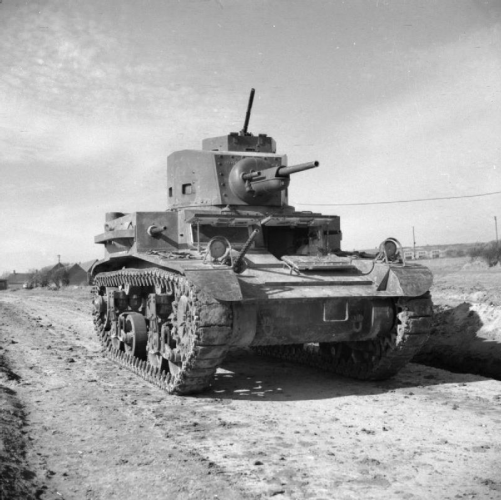
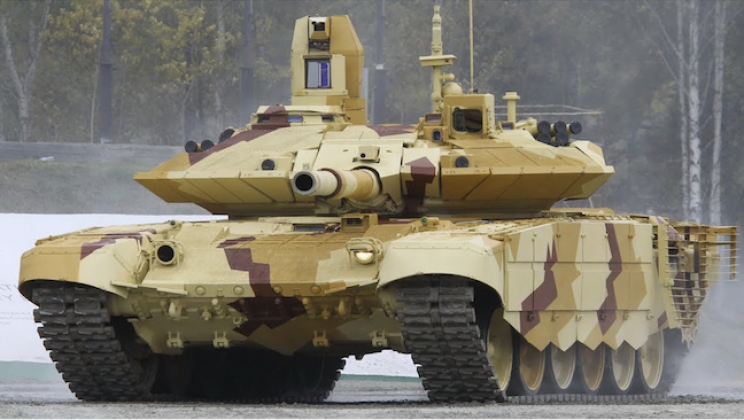
The Future of the MBT

The Army has procrastinated on a new MBT since 1992 when the Block III was shelved. Someone will inevitably comment on how the upgraded Abrams was just fine. It was if the mission was terrorizing goat herders.

To give credit, Robert Scales predicted the era of the transparent battlefield in the late 1990s.

The tank to be relevant in the future against real enemies will at the least require a massive improvement in sensors. Currently it never sees what’s coming at it.

That’s just for starters.
 
The tank to be relevant in the future against real enemies will at the least require a massive improvement in sensors. Currently it never sees what’s coming at it.
Good news is that finally cameras and low-light optics are a lot cheaper than they used to be. Thermals are still expensive, but digital night vision is absurdly cheap.

The hard part is how to make all those sensors talk through the armor.
 
The Army has procrastinated on a new MBT since 1992 when the Block III was shelved. Someone will inevitably comment on how the upgraded Abrams was just fine. It was if the mission was terrorizing goat herders.

To give credit, Robert Scales predicted the era of the transparent battlefield in the late 1990s.

The tank to be relevant in the future against real enemies will at the least require a massive improvement in sensors. Currently it never sees what’s coming at it.

That’s just for starters.
In the 90's or early 2000's, any new MBT design would remain more or less within the same form factor and capability set as their predecessors. No big innovation in protection, firepower, sensors, C2, or automotives happened at the time. You'd mostly trade logistical compatibility with the predecessors.

That is why currently no new MBT is finalized. A lot of R&D work done behind the scenes because manufacturers are waiting for various tech leaps to converge to justify an all new design, because said new design requires a new hull design.
New advancements at the time like APS, BMS, better armor coverage, more sensors, were all retrofitable.
 
Fortunately, compared with China’s, U.S. tanks use larger gun calibers, heavier armor, and place more emphasis on modularity. I hope this approach continues.
 
CMV of the Heavy Force Modernization plan and then Grizzly with the M1 chassis. Both passed on. Now it’s the M1150 I guess.
Yeah it's the same reason M4C2V died the death despite being really useful for what we need now. And the other M993 derivatives.
 
I believe they use a 125mm and autoloader design similar to that of the T-72/90 series. Bore diameter is 125mm versus 120mm but I don't believe the gun is rated to the same high pressure of the 120mm and the length of the APFSDS penetrator is limited by the two-piece ammunition design.

But I'm sure the Chinese have been toying around with their own larger caliber guns, probably 130mm or 152mm. While there are a lot of prototypes so far it seems nobody has actually made that jump to actually fielding such guns on their operational MBTs.
 
In reasonable scenario I can think of, their tank gun calibers would be smaller.
 
In the 90's or early 2000's, any new MBT design would remain more or less within the same form factor and capability set as their predecessors. No big innovation in protection, firepower, sensors, C2, or automotives happened at the time. You'd mostly trade logistical compatibility with the predecessors.

That is why currently no new MBT is finalized. A lot of R&D work done behind the scenes because manufacturers are waiting for various tech leaps to converge to justify an all new design, because said new design requires a new hull design.
New advancements at the time like APS, BMS, better armor coverage, more sensors, were all retrofitable.
30+ yrs of finalizing? It’s called “no new threat” and “we just aren’t sure what we want.” This isn’t some plan 30+ yrs in the making that’s been steadily followed.

Search some of the posts in the ASM thread or similar.

There was quite a lot new planned for in the late 80s. Block III for ex
140 mm gun
Modular armor
MTAS sensor incl mmW radar
Unmanned turret
Autoloader
New engine
Non contact defense system VIDS

I might post some of the stuff in those threads again
 
In reasonable scenario I can think of, their tank gun calibers would be smaller.
What scenarios would those be?

The majority of Chinese active tanks have 125mm main guns. Yes, they also have tanks with smaller calibre main guns such as 105mm, but the largest proportion of Chinese tanks have the 125mm.
 
30+ yrs of finalizing? It’s called “no new threat” and “we just aren’t sure what we want.” This isn’t some plan 30+ yrs in the making that’s been steadily followed.
Not 30 years.
When you face a new threat you can either adapt existing designs or create a new one.
Every new threat that emerged in that time was adequately answered with adaptations.
A new design was not necessary simply because there wasn't technology that allowed a radical improvement across the board. You'd just end up rearranging the same components.

During the cold war, both sides explored higher caliber weapons for MBTs, because they suspected each other of deploying heavier armor.
Eventually opting against it and sticking with existing designs meant avoiding making a less efficient machine.
Search some of the posts in the ASM thread or similar.

There was quite a lot new planned for in the late 80s. Block III for ex
140 mm gun
Modular armor
MTAS sensor incl mmW radar
Unmanned turret
Autoloader
New engine
Non contact defense system VIDS

I might post some of the stuff in those threads again
None of which was mature for practical use.
Late 20's were first envisioned, now it's mid 30's, for a vehicle that can combine all this new tech into one vehicle and implement it properly.

mmW radar for example. First deployed operationally in 2009. Now standard on all new production modern AFVs. You couldn't deploy it in the 90's. Not enough processing power to make it react quickly enough.

What defines the new gen is mostly that the internal layout has to be radically different. Reduced crew, potentially unmanned turret, lots of automation. This is tied to advancements in situational awareness. In the 90's you couldn't create such a setup. Project Carmel demonstrated numerous concepts, and they're being developed to maturation now.

It's no different from any other industry, where you see a demo about a decade before entering production. That demo is a proof of concept. That's very early stage.
 
What defines the new gen is mostly that the internal layout has to be radically different.
They were doing that then as well. TMEPS for one. Hesitation on top of hesitation because in the back of their minds, “will the tank survive?” A can permanently kicked down the road.

Other systems that have also gone through big technical changes still get introduced.
Manned bombers. Still there and new ones coming.

The MBT? “Uh, well, uh, well, uh…”
Its constituency is small and getting smaller.

I remember being ignored on here and Twitter when I said the M10 was a vehicle in search of a mission. Now, “What’s the M10? Never heard of it.”
 
Oh, absolutely.

I have no clue why the US doesn't field the full set of combat engineering vehicles like UK and Germany do.

The answer is the same as to why the U.S. doesn't have an Abrams based armored recovery vehicle. Not enough hulls. Production line shuttered decades ago. It's just some leftover blanks and conversions now. Of course, as Russia proves, even a near completely dead industry can be brought back ex nihilo but it will be a rough ride for the first few years.
 
They were doing that then as well. TMEPS for one. Hesitation on top of hesitation because in the back of their minds, “will the tank survive?” A can permanently kicked down the road.

Other systems that have also gone through big technical changes still get introduced.
Manned bombers. Still there and new ones coming.

The MBT? “Uh, well, uh, well, uh…”
Its constituency is small and getting smaller.

I remember being ignored on here and Twitter when I said the M10 was a vehicle in search of a mission. Now, “What’s the M10? Never heard of it.”
A transversely mounted engine is your example of a radically different internal layout?

I missed this at first. Is this the latest in fighting guerillas with RPGs? No serious threats on land will face the nation of this project.
Discrediting yourself speedrun.
 
The answer is the same as to why the U.S. doesn't have an Abrams based armored recovery vehicle. Not enough hulls. Production line shuttered decades ago. It's just some leftover blanks and conversions now. Of course, as Russia proves, even a near completely dead industry can be brought back ex nihilo but it will be a rough ride for the first few years.
The point was that the US could have bought enough hulls for ARVs and AEVs while the line was hot.

They just didn't.
 
Tanks simply haven't done much for decades. The side with tanks don't just beat the side without tanks. How many armored divisions did the taliban have? How did pickups of Chad beat the Libyans? How did the Syrian regime's armor fare against the rebels? How did Isis rout Abrams equipped Iraqis. Turkish and Azerbijan tanks gets exploded when their drones gets kill after kill without resistance. The side with the tanks against an opponent with air superiority just generate highlight reels for the nightly news as it happened pretty much every time.

It is not like the light formations just rolled over and died since the invention of the tank. All the frontline formations held ground and managed local counterattacks, it is only that "armor" that did exploitation.

Do compare and contrast with airpower, where when a side who managed sufficient capability can wage zero casualty wars forever, and just bomb the opponent into submission.

It also appears that the relevant amount of armor for offensive success is resistance to machineguns and artillery, which a pickup with some plates welded can manage with reasonable mobility, after decades of 4WD improvements. It is impossible to persistently overmatch peer opponent anti-armor and not necessary for success, simply destroy the opponent before one run out of forces.

Today motorbikes and golf carts are succeeding in taking the ground where ruins of decades of stockpiled tanks lie on the route.

Tanks is just a gun platform, and there are lot of ways to deliver explosives and there are kinds of substitutes that all have different advantages. Tanks are not stealthy enough, fast enough, nor have good enough sensing to do much other than fires today.

It isn't the era where Rommel can disappear a entire tank division behind the enemy while armies on land line telephones gets all confused.

30+ yrs of finalizing? It’s called “no new threat” and “we just aren’t sure what we want.” This isn’t some plan 30+ yrs in the making that’s been steadily followed.
People wanted the tank to help move infantry to the enemy part of the cover while under fire from machineguns.

The problem is solved with IFVs. IFVs get developed while tanks is defined by an arms race firepower-protection spiral that only relevant amongst itself. Exit the arms race and specialize in something else (more AA, more weapons range, different weapons config, etc), and it stops being a tank by the definition of the word.

Its like how battleships ceased existing, but large surface warships haven't. Exit the gun-armor arms race and fit different systems and it gets defined something else.

I assume you're referring to video games here, because IRL you cannot really "attach" a unit mid-combat. As in, teleport a unit into a combat zone the instant someone spooky appears. You have to send that unit in beforehand, to accompany the maneuvering unit along the way. And of course you scope out the area you assault to get a grasp of what you're going to face.
Ever since assault breaker knows you can spot tanks deep behind enemy lines thanks to the wonders of RADAR, and direct fast moving flying vehicles to the problem before the slowness of tanks becomes a problem.

Today, even ghetto forces can spam drones or other affordable sensors to spot tanks behind the enemy lines, and move anti-tank into position before contact is made. It is not like tanks actually do damage quickly however, and mobile reserves of land vehicles is fast enough to contain situations even without airpower. Consider:
That the German independent TD formations. For combat between countries with some strategic depth: if attacks are possible, it is also valid to retreat and counter attack.

Compare that with dealing with airplanes. Airplanes are both stealthy and fast, so not having sufficient concentration anywhere on the front can mean destruction.


Look I'm gonna be real honest here: I have absolutely no idea what kind of goofy assault force a single VSHORAD vehicle is. What's it trying to do? Force recon?
Where I said a single vehicle? It is more like you take a standard combine arms formation, and pick vehicles to delete because it is inefficient to have too many specialized vehicles: The lesson of the MBT over the mess that was interwar tank specialization showed that.

So: MBT, VSHORAD, Other AA, IFV/APC, Engineering, Artillery

Delete VSHORAD, drones kills you. Delete long range AA and classic air power kills you. Delete IFV/APC infantry get deleted by artillery. Delete Engineering, you get stuck. Delete artillery, the formation can't concentrate fire.

If you delete MBT from the formation while giving other random vehicles high performance AT-missiles, the formation would still work. The artillery can even conduct direct fire on structures as long as it is small arms protected and CRAM coverage is available.

APS is actually dirt cheap. You should familiarize with the topic. Tanks without SHORAD can actually survive quite well, and we have recent wars to demonstrate that.
C-RAM can be deployed by simply putting C-RAM on an offroad truck with a smaller independent radar.
Starstreak is also a large system, while an APS is a very compact system with streamlined integration.
Tanks without air defense get exploded in recent wars if opponent have air power, and with drones, everyone have airpower.

All vehicles without armor can get destroyed by classical artillery. Given that defensive system accuracy is not remotely perfect, C-RAM can't outshoot cluster artillery.

Without SHORAD, even if the opponent don't have a big EFP to pen top armor, drones can still pick off the radar and burn defensive charges with everything from classic bombing to gun-armed strafing runs (gun armed interceptors drones is now a thing) to just burn a bunch of FPVs since its dirt cheap anyways. APS radars also don't survive artillery.

Not enough space. Not feasible.
Sprut-SD is not that big or heavy for a full powered gun. Almost all IFV can fit a turret that mount this gun, from CV90120, Lynx 120mm, Centauro II. Sheridan packed 152mm on 15tons. There are a lot of light to medium weight formation that could have this class of weapon equipped, but almost none bother. The Stryker formations even replace 105mm MGS with 30mm Dragoon.

And soft targets, and light armored vehicles, and helicopters, and whatever else dares move in its LoS.

It's funny that you criticize people who over-focus on APFSDS and then you do the exact same thing.
Soft targets get destroyed by autocannons, only another Tank require 120mm. When a IFV that can carry troops can service the same target set, one wonders what is the point.
Trajectory is different between artillery and tanks. In fact, trajectory limitations are exactly why the workshare of artillery is decreasing.

Here's the effect of HE-MP shells in MOUT. You can selectively target just one specific area.

More munitions are inserted to the portfolio as time goes on to give the local commander more options of trajectory, warheads, effect types (e.g. penetration). Removing the premier precise direct fire option does not go well with that.
Just about every weapon can shoot direct, and lots of cheap ones.

Consider UAVs that can fly into windows and conduct search and destroy ops inside structures, direct fire is just clumsy.

Consider UGV that fits high explosive rockets of one's choice, the cost is now on the order of $30k. Every squad can have three instead of the rare heavy formation.

Consider every AFV with direct fire capable gun, it is not like concrete can bounce APHE. A gun mortar vehicle like Nona can be both artillery and do this mission, as well as shoot at rooftops, unlike how the Russians suffer heavy losses in grozny because tank guns don't elevate.
---
Of course, structure demolishing do favor specialized vehicles, but no one considers an AVRE or StrumTiger a war winner.

 
Direct fire is just clumsy for everyone but the unfortunate party under fire who probably desire the ability to return fire immediately versus doing nothing until indirect fire arrives. The tank main gun is very good at that job. IFVs are great but the nature of having to carry at least half a dozen infantrymen in back requires more compromises. They were always envisioned as a vehicle to cooperate with MBTs versus covering that role.
 
Tanks simply haven't done much for decades.
That's just objectively false. One of the two current/recent major wars heavily featured MBTs with tremendous success. The other stagnated due to a shopping list of mutual deficiencies not related to MBTs.
The side with tanks don't just beat the side without tanks. How many armored divisions did the taliban have?
The Taliban went into hiding in mountains, and only crawled back out when the US voluntarily withdrew.
How did pickups of Chad beat the Libyans? How did the Syrian regime's armor fare against the rebels?
How did Isis rout Abrams equipped Iraqis. Turkish and Azerbijan tanks gets exploded when their drones gets kill after kill without resistance. The side with the tanks against an opponent with air superiority just generate highlight reels for the nightly news as it happened pretty much every time.
How is any of that relevant to tanks?
It is not like the light formations just rolled over and died since the invention of the tank. All the frontline formations held ground and managed local counterattacks, it is only that "armor" that did exploitation.
Is defense more than one dimensional? Who could have thunk?
Do compare and contrast with airpower, where when a side who managed sufficient capability can wage zero casualty wars forever, and just bomb the opponent into submission.
Something which doesn't exist today.
It also appears that the relevant amount of armor for offensive success is resistance to machineguns and artillery, which a pickup with some plates welded can manage with reasonable mobility, after decades of 4WD improvements. It is impossible to persistently overmatch peer opponent anti-armor and not necessary for success, simply destroy the opponent before one run out of forces.
Do you want the US to arm and fight like Al Qaeda?
Today motorbikes and golf carts are succeeding in taking the ground where ruins of decades of stockpiled tanks lie on the route.
They're also succeeding in ballooning human losses to the attacking side.
Tanks is just a gun platform, and there are lot of ways to deliver explosives and there are kinds of substitutes that all have different advantages. Tanks are not stealthy enough, fast enough, nor have good enough sensing to do much other than fires today.
None asks them to do anything beyond direct fire.
It isn't the era where Rommel can disappear a entire tank division behind the enemy while armies on land line telephones gets all confused.
You actually CAN do that today.
People wanted the tank to help move infantry to the enemy part of the cover while under fire from machineguns.
I mean, if you said that during WW2 you'd be the dinosaur in the room.
The problem is solved with IFVs. IFVs get developed while tanks is defined by an arms race firepower-protection spiral that only relevant amongst itself. Exit the arms race and specialize in something else (more AA, more weapons range, different weapons config, etc), and it stops being a tank by the definition of the word.
Tank is just a vessel. If you're interested in the definition of the word, then an IFV is also a tank. But why is it that none substitutes their MBTs with IFVs? Is it perhaps because it doesn't work nor will ever work?
Its like how battleships ceased existing, but large surface warships haven't. Exit the gun-armor arms race and fit different systems and it gets defined something else.
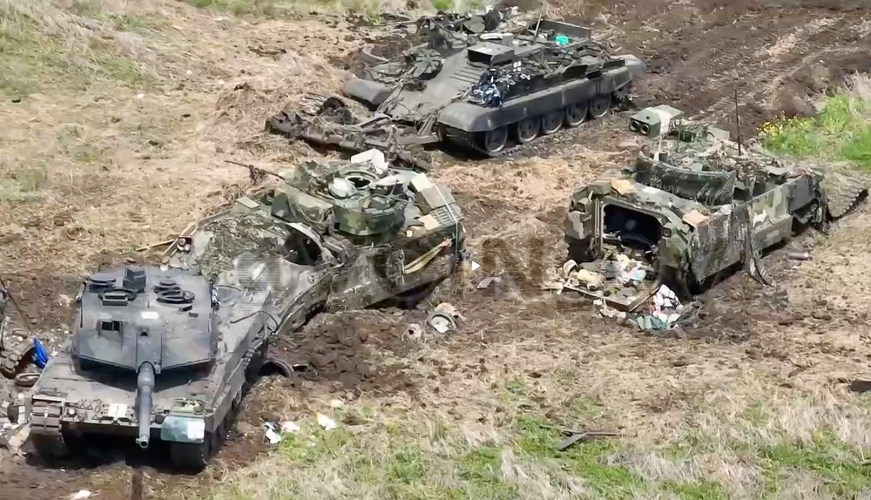
Does this
1765016307992.png

look like this to you?
1765016419461.png
Today, even ghetto forces can spam drones or other affordable sensors to spot tanks behind the enemy lines, and move anti-tank into position before contact is made. It is not like tanks actually do damage quickly however, and mobile reserves of land vehicles is fast enough to contain situations even without airpower. Consider:
That the German independent TD formations. For combat between countries with some strategic depth: if attacks are possible, it is also valid to retreat and counter attack.

Compare that with dealing with airplanes. Airplanes are both stealthy and fast, so not having sufficient concentration anywhere on the front can mean destruction.

Where I said a single vehicle? It is more like you take a standard combine arms formation, and pick vehicles to delete because it is inefficient to have too many specialized vehicles: The lesson of the MBT over the mess that was interwar tank specialization showed that.

So: MBT, VSHORAD, Other AA, IFV/APC, Engineering, Artillery

Delete VSHORAD, drones kills you. Delete long range AA and classic air power kills you. Delete IFV/APC infantry get deleted by artillery. Delete Engineering, you get stuck. Delete artillery, the formation can't concentrate fire.

If you delete MBT from the formation while giving other random vehicles high performance AT-missiles, the formation would still work. The artillery can even conduct direct fire on structures as long as it is small arms protected and CRAM coverage is available.

Tanks without air defense get exploded in recent wars if opponent have air power, and with drones, everyone have airpower.

All vehicles without armor can get destroyed by classical artillery. Given that defensive system accuracy is not remotely perfect, C-RAM can't outshoot cluster artillery.

Without SHORAD, even if the opponent don't have a big EFP to pen top armor, drones can still pick off the radar and burn defensive charges with everything from classic bombing to gun-armed strafing runs (gun armed interceptors drones is now a thing) to just burn a bunch of FPVs since its dirt cheap anyways. APS radars also don't survive artillery.


Sprut-SD is not that big or heavy for a full powered gun. Almost all IFV can fit a turret that mount this gun, from CV90120, Lynx 120mm, Centauro II. Sheridan packed 152mm on 15tons. There are a lot of light to medium weight formation that could have this class of weapon equipped, but almost none bother. The Stryker formations even replace 105mm MGS with 30mm Dragoon.


Soft targets get destroyed by autocannons, only another Tank require 120mm. When a IFV that can carry troops can service the same target set, one wonders what is the point.

Just about every weapon can shoot direct, and lots of cheap ones.

Consider UAVs that can fly into windows and conduct search and destroy ops inside structures, direct fire is just clumsy.

Consider UGV that fits high explosive rockets of one's choice, the cost is now on the order of $30k. Every squad can have three instead of the rare heavy formation.

Consider every AFV with direct fire capable gun, it is not like concrete can bounce APHE. A gun mortar vehicle like Nona can be both artillery and do this mission, as well as shoot at rooftops, unlike how the Russians suffer heavy losses in grozny because tank guns don't elevate.
---
Of course, structure demolishing do favor specialized vehicles, but no one considers an AVRE or StrumTiger a war winner.
We can summarize your way of thinking into 2 arguments

1. "Why do we have scissors if rock can easily beat it?".

2. Asymmetric > symmetric.

And to that I'll answer with:

1. Imagine paper.

2. Every asymmetric force that met a modern symmetric force, got disintegrated. Primary example is Iran.
Actually wanted to add Iraq but it's just an example of a symmetric force that was severely technologically neglected.
 
Direct fire is just clumsy for everyone but the unfortunate party under fire who probably desire the ability to return fire immediately versus doing nothing until indirect fire arrives. The tank main gun is very good at that job. IFVs are great but the nature of having to carry at least half a dozen infantrymen in back requires more compromises. They were always envisioned as a vehicle to cooperate with MBTs versus covering that role.
Yes, wondered why the 75mm Ares autocannon on a LAV was not pursued. Probably not a lot of carried dismounts.
 
The point was that the US could have bought enough hulls for ARVs and AEVs while the line was hot.

They just didn't.

I don't think anyone thinks the Peace Dividend was a particularly good idea, yeah. It happened though. Decisions made >30 years ago are coming back to haunt America's MIC. The Army isn't doing as well as the Air Force but at least it's not the Navy's surface fleet or naval aviation. The only guys actually having a okay time of it are submariners because 774 didn't go belly up. For now.

Yes, wondered why the 75mm Ares autocannon on a LAV was not pursued. Probably not a lot of carried dismounts.

Because the hull kept cracking on the MPWS. The ideal was a 90mm to handle T-62M and carry a useful HE payload, anyway.
 
Last edited:
Direct fire is just clumsy for everyone but the unfortunate party under fire who probably desire the ability to return fire immediately versus doing nothing until indirect fire arrives. The tank main gun is very good at that job. IFVs are great but the nature of having to carry at least half a dozen infantrymen in back requires more compromises. They were always envisioned as a vehicle to cooperate with MBTs versus covering that role.
Direct fire means much slower return fire if at all, because today both you and the enemy can spot each other beyond line of sight via elevated sensors. It is the direct fire force that can't shoot when the engagement happens.

The odds of unwanted close combat is inversely related to stealth of platforms, and in that case small things like drones and infantry is much more likely to get into line of sight ranges, and there a autocannon can do the job.

The urgency for shooting back also depends on the level of threat. In that case, a recon aircraft that is linked to all the fire support is far more dangerous than a tank that is stuck on the ground and can only spot and engage a few target at a time.

...They're also succeeding in ballooning human losses to the attacking side.

Does this

look like this to you?
This:
l-intro-1709691652.jpg
Looks like this:
article_5efffd8f8b2e40_41878927.png

In practice.

Tanks does nothing and the presence of modern tanks didn't lower casualties or increase rate of ground captures. If formations of infantry gets wiped by artillery before closing, how can tanks help even in theory?

The improvements since the conceptualization of the MBT does nothing to modern threats. Better front armor does nothing when threats comes from all vectors. Higher penetrating gun does nothing when not shooting at a tank. Better sensors does nothing when elevated sensors with better vantage point provide all the situation awareness.

APS/general armor/general survivability helps, but it is not tied to MBT concept.

All the while that this looks better: (otherwise a conversion wouldn't be attempted)
why-people-think-the-turtle-tanks-of-russia-are-stupid-isnt-v0-azzkq21uhr8d1.jpeg

As the sensor and gun is irrelevant, the mine roller is what matters!

We can summarize your way of thinking into 2 arguments

1. "Why do we have scissors if rock can easily beat it?".

2. Asymmetric > symmetric.

And to that I'll answer with:

1. Imagine paper.

There is nothing that the tank counters, while counters to tank also counter lots of other stuff.

155mm HE counters tank, and it also counters everything on the ground. FPV drones counters tank, and is also counters everything on the ground. Fighter bombers can counter tank, and it also counters everything else.

(attack helicopters counter tank, and gets countered by everything else, it is hard to see them being all that useful with the tank being so ineffective)


2. Every asymmetric force that met a modern symmetric force, got disintegrated. Primary example is Iran.
You mean every weak force. The successful force don't fight symmetric. Israeli beat Iran not by spamming ballistic missiles and light infantry symmetrically, it uses air power.

Some forces simply beat others as technology changes, own the force that wins.

I don't think anyone thinks the Peace Dividend was a particularly good idea, yeah. It happened though. Decisions made >30 years ago are coming back to haunt America's MIC.
If American is interested in consumption instead of that world police thingy, the peace dividend is great. The threats just defeat itself without serious effort, see how both of the long running threats ruining their own economy (again!) with military and general dysfunction.
 
Last edited:
The urgency for shooting back also depends on the level of threat. In that case, a recon aircraft that is linked to all the fire support is far more dangerous than a tank that is stuck on the ground and can only spot and engage a few target at a time.
Best case scenario of getting CAS on target is a few minutes. Realistic case is half an hour to several hours.
You need to not only spot an enemy but to also classify it sufficiently for a strike mission, then wait for that information to be relayed to relevant elements, then have an aircraft deliver its payload, which could be nearby and with the right munitions, or still not in the air as everyone else is preoccupied.

That is why aircraft are typically operated at the division level or above.

A stand-in force therefore needs to be able to respond independently within seconds and split-seconds.
This:
l-intro-1709691652.jpg
Looks like this:
article_5efffd8f8b2e40_41878927.png

In practice.
A force that is asymmetric or neglected will hardly benefit from having more modern tanks.
A force that is generally modern but uses a T-90M will only benefit from it marginally compared to a T-55. But it will benefit tremendously more if it operated a Leopard 2A8, M1A2SEPv3 + Trophy, or Merkava 4M.

If you neglect a part of your force, it becomes a weakness. An exploitable one.
The capability loss over time is exponential, hence the importance of continuous modernization.
Tanks does nothing and the presence of modern tanks didn't lower casualties or increase rate of ground captures. If formations of infantry gets wiped by artillery before closing, how can tanks help even in theory?
If you're referring to no specific war in general, then you're wrong. If naturally you're referring to Ukraine specifically, then you're wrong, and are over-learning the wrong lessons and ignoring the right ones.
A decrease in the use of armor has increased the total number of casualties in assaults. But also, you ignore the fact that since 2022, Russia has not conducted any mechanized offensive in logical sense of it.
It drove all sorts of AFVs into minefields but that is not what qualifies as an assault in the context of American doctrine.
So except maybe the Kursk offensive, we haven't seen a mechanized assault in Ukraine in the last decade.

Actually, the Kursk offensive does show us some things. It showed us a force that advanced fast enough that it could no longer receive artillery support because it couldn't keep up and wasn't secure at sufficient depth.
It also showed us that even a force as materially crippled as Ukraine's managed to disrupt local Russian defenses and response capabilities, achieving a breakthrough with minimal casualties and resistance.
It also showed us that it took Russia days to gather a first response, and weeks to stabilize the situation.
The improvements since the conceptualization of the MBT does nothing to modern threats.
False.
Better front armor does nothing when threats comes from all vectors.
Hence APS and all-around armor.
Higher penetrating gun does nothing when not shooting at a tank.
That's not a central vector of development.
Better sensors does nothing when elevated sensors with better vantage point provide all the situation awareness.
So you're saying that worse sensors are better.
APS/general armor/general survivability helps, but it is not tied to MBT concept.
And that's relevant how?
All the while that this looks better: (otherwise a conversion wouldn't be attempted)
why-people-think-the-turtle-tanks-of-russia-are-stupid-isnt-v0-azzkq21uhr8d1.jpeg

As the sensor and gun is irrelevant, the mine roller is what matters!
Tell me again how Russian armor is doing.
There is nothing that the tank counters, while counters to tank also counter lots of other stuff.
So if you were to stand in front of a tank and gave the order to fire - you'd survive?
155mm HE counters tank, and it also counters everything on the ground. FPV drones counters tank, and is also counters everything on the ground. Fighter bombers can counter tank, and it also counters everything else.
I see. What's your point?
You mean every weak force. The successful force don't fight symmetric. Israeli beat Iran not by spamming ballistic missiles and light infantry symmetrically, it uses air power.
No I meant the asymmetric force. I gave Iraq as an example of a symmetric but neglected and thus weak force.
A symmetric force is one which builds all necessary capabilities of a well rounded force in order to match response to a threat.

Israel's force was symmetric not because it used all capabilities simultaneously, but because it had a symmetric force and matched the relevant assets to the threat posed by Iran.
It used stealth F-35 aircraft together with light F-16 and heavy F-15s, supported by AEW&C aircraft of various types and roles, aerial refueling tankers, SAR assets, augmented with drones of varying sizes and ranges, employing very light stand-in munitions up to air launched ballistic missiles.
All boosted by the parallel deployment of intelligence and sabotage assets in Iran including the employment of ground based capabilities.
So technically, it DID use ballistic missiles and light infantry.

What did Iran do? It and its proxies relied heavily on artillery, ballistic missiles, and drones. No tanks, no aircraft, just spray and pray.
Needless to say they lost and it was really humiliating.

The US needs to stay symmetric. History shows it time and time again.
 
This isn't a Peace Dividend issue.

This was a "didn't buy the whole set of support vehicles on the same chassis in 1980" issue.

There was never going to be a production run of Abrams hulls extending to the 10,000 or so hulls needed for that. The 80s were too poor.

The Abrams wasn't even supposed to replace the M60s, the -A3s would have been upgraded through the 2000s with a special armor turret, which would have been about 3-4,000 gun tanks in the 2000s for the National Guard. M60AX got as far as automotive testing. Total tank fleet was going to be ~7,200 M1s and ~3,800-ish M60s by the 21st century. There might have been a possibility of keeping the M1 hull line at a low rate of production through the 90s, and piecemeal producing AVLBs and ARVs to replace the 60 hulls, but the Congress and DOD decided to shutter the hull production around 1993-94 instead. It's been closed ever since.

Which is why we have ~2,000 M88s and ~400-500 M60 AVLBs just hanging out in some form or another.
 
Last edited:
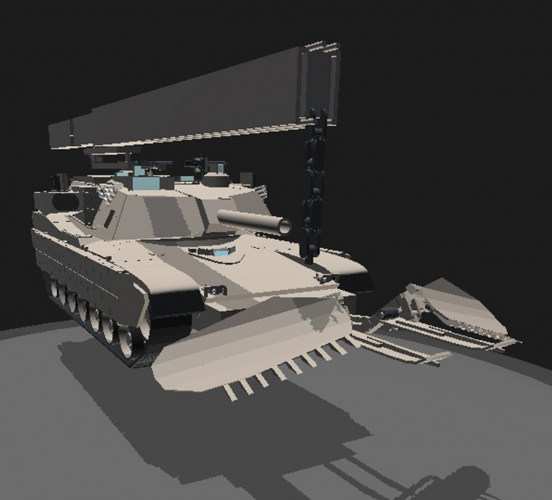
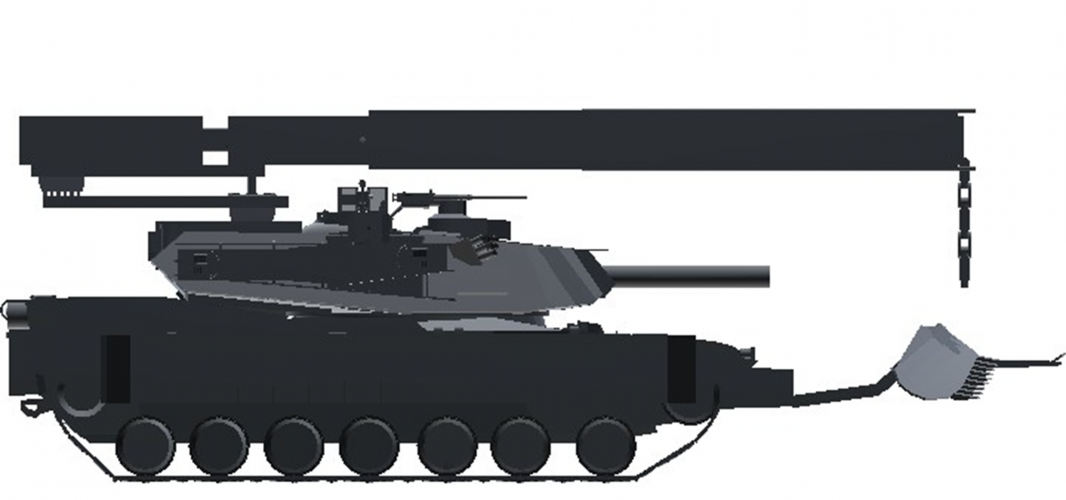
How about a Engineer Veh. w/Demolition Gun ..found on simpleplanes 1765089539933.png

1765089352728.png
 
Head of MANTAK at a defense expo:

We are reinventing the central role of the land combat platforms to prepare for future conflicts, which we expect to be complex and deadly.
We are working to insert robotic systems to tanks that enable data sharing between tanks, which enables completing the operational loop. We will continue to develop and work to reach these places.

One of the ways to do that is to move to off the shelf systems, combining military with civilian-military, unmanned with manned, in an advanced combat formation that allows bringing tremendous operational output.

We are talking about systems weighing tens of tons, whose operation in built up and complex areas poses significant challenge. Our teams found themselves operating in very difficult conditions, when beneath them are terror tunnels.
To operate an APS in full efficiency in urban environment is a very complicated task.

During the active fighting, the Trophy system proved itself and succeeded in defending our warriors. We realized we have to develop flexible systems that can adapt quickly. This is exactly what we mean when we say we'll reinvent AFVs. Our challenge is to ensure that in the future we'll also be able to acquire advanced vehicles and systems, in large quantities, better quality, and at low cost.
 
Last edited:
I never did that.
I did briefly mention a 12 day war (there are 365 days in a year; 12<365) as an example of symmetric vs asymmetric (opposite terms).
The purpose of that is clear as MBTs are assets acquired by symmetric forces, and often neglected by asymmetrical ones.
Facts are terrible things


“Neglected by asymmetrical ones” as if certain parties could afford MBTs and just said “nah.”
 
Facts are terrible things

This is over 2 years, not 1 year. Specifically 792 days (365 days in a year; 792>365).
“Neglected by asymmetrical ones” as if certain parties could afford MBTs and just said “nah.”
Iran certainly does have MBTs, and it and Israel have deployed ground forces against each other, but:
  1. It neglected them. Failed to either modernize existing ones or acquire new ones, despite having open defense trade with AFV manufacturers like Russia, China, and North Korea. Which even in a difficult sanctions environment, could supply individual critical components to enable modernization.

  2. As it deployed its forces around the middle east, it kept all of its armored forces within its borders, and only sent asymmetrical assets like LRRs, air defenses, OWA drones, personal and crew served equipment, and ballistic missiles.

  3. Its proxies like Hezbollah and the SAA also have armored vehicles and tanks. But chose to not utilize these, as well as most of their symmetrical assets, and instead fight asymmetrically.
The acquirer of shins argues that the MBT has no place in the modern battlefield. I argue based on the outcome of symmetry vs asymmetry, that this is a bad idea.
 
Head of MANTAK at a defense expo:
To operate an APS in full efficiency in urban environment is a very complicated task.

That is a drastic understatement.

During the active fighting, the Trophy system proved itself and succeeded in defending our warriors. We realized we have to develop flexible systems that can adapt quickly. This is exactly what we mean when we say we'll reinvent AFVs. Our challenge is to ensure that in the future we'll also be able to acquire advanced vehicles and systems, in large quantities, better quality, and at low cost.


All kinds of suspension of belief goin on there. Take the blue pill and be quiet.

In urban environments 'RPG sponges' are usually all that makes sense and that is left after way too much attrition of your own.

Stationing remote pilots inside these sponges close enough to control robotics is a start, but far from a sure bet.

So far there appears to be no realistic solution to clearing vast tunnel networks.
It appears to be too dangerous for even efficient use of robotics.

One would respond ok, more robotics, even "enough" robotics may well take way too long to build as well as being way too expensive as well as still not being a sure bet.

One can keep poring over it , but what if it doesn't crack?

Determination and especially not technology may well not be enough... As the saying goes 'love is not enough" As some point one has to be realistic.
https://www.google.com/search?sca_e...IDZ9auRAxWFrYkEHZ1lFiAQyNoBKAB6BAgbEAA&ictx=1
 
During the active fighting, the Trophy system proved itself and succeeded in defending our warriors. We realized we have to develop flexible systems that can adapt quickly. This is exactly what we mean when we say we'll reinvent AFVs. Our challenge is to ensure that in the future we'll also be able to acquire advanced vehicles and systems, in large quantities, better quality, and at low cost.

All kinds of suspension of belief goin on there. Take the blue pill and be quiet.
Hardly a reach. In Eurosatory 2010 the IDF said the export flyaway cost of the Merkava 4M is $4.5 million. Even if accounting for inflation, it doesn't reach current levels for the Leopard for example.

The reason is that Israel's defense ecosystem is built different. A key part of it is cost efficiency. The IDF's defense budget is nothing special. Kinda small even. But the capabilities and manpower and assets it has are tremendous in comparison.
It simply couldn't handle a multi year war like that if every Iron Dome interceptor cost $500k instead of 50.
In urban environments 'RPG sponges' are usually all that makes sense and that is left after way too much attrition of your own.
Armor attrition in Gaza was actually exceptionally low. APS played a big part.
Stationing remote pilots inside these sponges close enough to control robotics is a start, but far from a sure bet.
Unmanned M113s were employed. Honestly I don't know what method they used. I'm assuming they were remote controlled via a MALE drone, because that's the only way I can think of of getting qualified personnel within constant LoS.
So far there appears to be no realistic solution to clearing vast tunnel networks.
It appears to be too dangerous for even efficient use of robotics.
Most of it is classified. But people who went on shared Israeli-US forums on the topic say it was a huge collection of solutions and technologies, and that methods often changed from tunnel to tunnel.

Armor is involved in these mostly in the sense that it's disproportionately threatened by tunnels, as terrorists may pop up, attack, and go back down very very quickly.

Some tunnels are still intact months after being discovered, because they need to be reasonably mapped first.
So there's the challenge of how to handle tunnels temporarily to enable safer maneuver.
 
The Russians, in one the Chechen wars, was suffering around 7 RPGs from multiple ambush directions at a time. Urban canopy/canyon can be expected to present clouds of RPGs. An RPG sponge is still necessary to survive an urban jungle. these 'sponges' will need as much APS as possible but be ready to absorb. 'Curtain' based APS are start but shots from above down on the vehicle may require more projectile based APS than will be available on the vehicle. This is why a most advanced and lightened GCV size vehicle deserves a relook as does a CATTB-like form factor for a Future MBT..
 
Last edited:
Best case scenario of getting CAS on target is a few minutes. Realistic case is half an hour to several hours.

A stand-in force therefore needs to be able to respond independently within seconds and split-seconds.
Tanks are not deployed at the zero line as it'd get detected and destroyed by ranged fires. As such, front line forces do not get the help of tanks unless it is preplanned, and support from tanks at minimum takes the amount of time to cross artillery range. And artillery range have been increasing from 20km to some large number with ramjets shells and likes.

Patton reinforcing the bulge in 48 hours was considered an amazing feat while airpower works on different timetables.

Also in practice, the front screen is suppose to absorb opponent attacks, provide early warning, stall of time and perhaps die in the process. Not having a screen result in things like the 1st French Armored Division getting destroyed by panzers as they were on the front line and surprised when attacks hit.

Real organic fires are disposable assets like small UGVs and missiles that can be dug in and hidden to survive fires for long periods of time, and effective support fires are long range artillery, rockets and missiles where a battery can cover a wide front and deliver effects within 2 minutes.

As for airpower, all formations above the squad now can have organic aircraft, and networked communications reduce friction down to organization issues. AI enabled munitions like brimestone can area fire, as can conventional artillery as forces in cover is highly resistant while mobile forces are not.

A force that is generally modern but uses a T-90M will only benefit from it marginally compared to a T-55. But it will benefit tremendously more if it operated a Leopard 2A8, M1A2SEPv3 + Trophy, or Merkava 4M.
The Imperial Japanese would benefit tremendously from M1A2 given it is 80 years more advanced. I wonder if they could win the war with it.

It drove all sorts of AFVs into minefields but that is not what qualifies as an assault in the context of American doctrine.
So we can agree that Russians should not use armor because they are too "incompetent" for it

In any case, tanks does nothing in the context of Ukraine armored attacks. The IFV/APCs provide protected mobility which naturally lowers casualties, however the tanks can not and do not engage the casualty inflicting arms that are, mines, artillery and drone forces. Currently there is no rifleman covering the front with huge gaps that you can walk through, it is all indirect except in complex cover where line of sight is grenade range and cover is tough enough to resist aircraft glide bombs and tanks do nothing.

Okay, the tanks can push a mine roller and that'd lower troop carrier losses, so it isn't quite that worthless. The mine roller is also probably behind the turtle tank conversions, because the force structure needs breaching engineering vehicles far more than extra cannons.

Actually, the Kursk offensive does show us some things.
Yes, Kursk showed that even the nation with the most tanks in the world can not allocate armor to most of the fight, and instead motorized infantry is used to plug the gap, with the ultimate counter attack conducted by the likes of north korean light infantry. The shock of newly mass deployed fiber optics guided drones that cut logistics to the salient means Ukraine couldn't hold the position.

The low utilization of tanks is predictable, as tanks are not strategically mobile and require tank transporters and rail to move significant distances, while wheeled forces that can road march with far less prep and various medium weight formations were based on this.

The criticality of logistics for holding territory is also known in the Kherson campaign, where TBMs cutting bridges decided the fight. Interdiction can take ground when it can be completed. This can also be seen in the Kharkiv campaign, where armor formations are neutralized by sheer logistics failure.

Before force structures can have comprehensive C-RAM coverage of the logistics tail, front forces can not penetrate regardless of its own characteristics.

Higher penetrating gun does nothing when not shooting at a tank.
That's not a central vector of development.
We can agree that T-55 armor penetration capability is sufficient then.
So you're saying that worse sensors are better.
Good sensors, bad sensors, the drone gets initial spot. No one would attempt turtle tanks if the force is relying on tank sensors.

Money is tight for nations in a peer fight,

Tell me again how Russian armor is doing.
Vehicles based on failed doctrine and obsolete concepts can't be fixed without discarding it completely.

So if you were to stand in front of a tank and gave the order to fire - you'd survive?
Assuming that if someone put a sword beside your bare neck and make a cutting motion towards an artery would have some effect means that the Unitied States would need to recruit swordsman.
A symmetric force is one which builds all necessary capabilities of a well rounded force in order to match response to a threat.
I believe there is a suicide bomber, terrorist, flamethrower, technical, boghammer and chemical weapons gap.

I believe the Zulus need to be fought by spearman, none of this machinegun BS. I believe the indians need to be fought by bows, none of this rifle and revolvers BS leading to the bow gap. I believe the Polish cavalry need to be fought by a reformed order of teutonic knights and none of this using Panzers against them, fires can not generate the SHOCK effect of cold steel.
 
Most of it is classified. But people who went on shared Israeli-US forums on the topic say it was a huge collection of solutions and technologies, and that methods often changed from tunnel to tunnel.

Armor is involved in these mostly in the sense that it's disproportionately threatened by tunnels, as terrorists may pop up, attack, and go back down very very quickly.

Some tunnels are still intact months after being discovered, because they need to be reasonably mapped first.
So there's the challenge of how to handle tunnels temporarily to enable safer maneuver.
Commenters have eluded to and this uninformed opinion agrees w that there is 3 t problem which would be that would be true for any army in the world. Not enough 1.time 2.troops or 3.tech to solve this particular problem any time soon.
 
The Russians, in one the Chechen wars, was suffering around 7 RPGs from multiple ambush directions at a time. Urban canopy/canyon can be expected to present clouds of RPGs. An RPG sponge is still necessary to survive an urban jungle. these 'sponges' will need as much APS as possible but be ready to absorb. 'Curtain' based APS are start but shots from above down on the vehicle may require more projectile based APS than will be available on the vehicle. This is why a most advanced and lightened GCV size vehicle deserves a relook as does a CATTB-like form factor for a Future MBT..
Ukraine are reporting $30k for a turreted UGV mounting a M2. Maybe just spam the thing as it'd out number the infantry by order(s) of magnitude with a bit of effort.
 
Multi-Domain Operations (MDO) is a military concept for integrating Land, Air, Maritime, Space, and Cyberspace (plus non-military) efforts to create simultaneous threats and dilemmas for an adversary, achieving decisive advantage through speed, synchronization, and exploiting vulnerabilities across all domains, rather than relying on single-domain dominance. It involves converging military and civilian capabilities to influence situations from competition to conflict, leveraging technology for rapid, data-driven decisions and effects GAAGLE AI

No US armored unit operates independently nor would they ever attempt to operate in a single domain fight. If you are not crawl walk running into a Joint Force projection domination over Area Denial Anti-Access (AD/A2) strategy you have already lost. Reasons why for instance, A-10 & F-16 'gun & bomb truck convoys' are so important to prepare the battlespace.
 
Last edited:
An idea that the current European ground battle area is predictive of future battlespaces, is crack smoke. Both sides are losing and in a way both sides are tactics and asset starved. The battlespace is more a ramshackle rumble than a teachable moment. The evolving C2 & and other software developments being the only exception.
 

Similar threads

Back
Top Bottom