RAF New Jet Trainer Competition

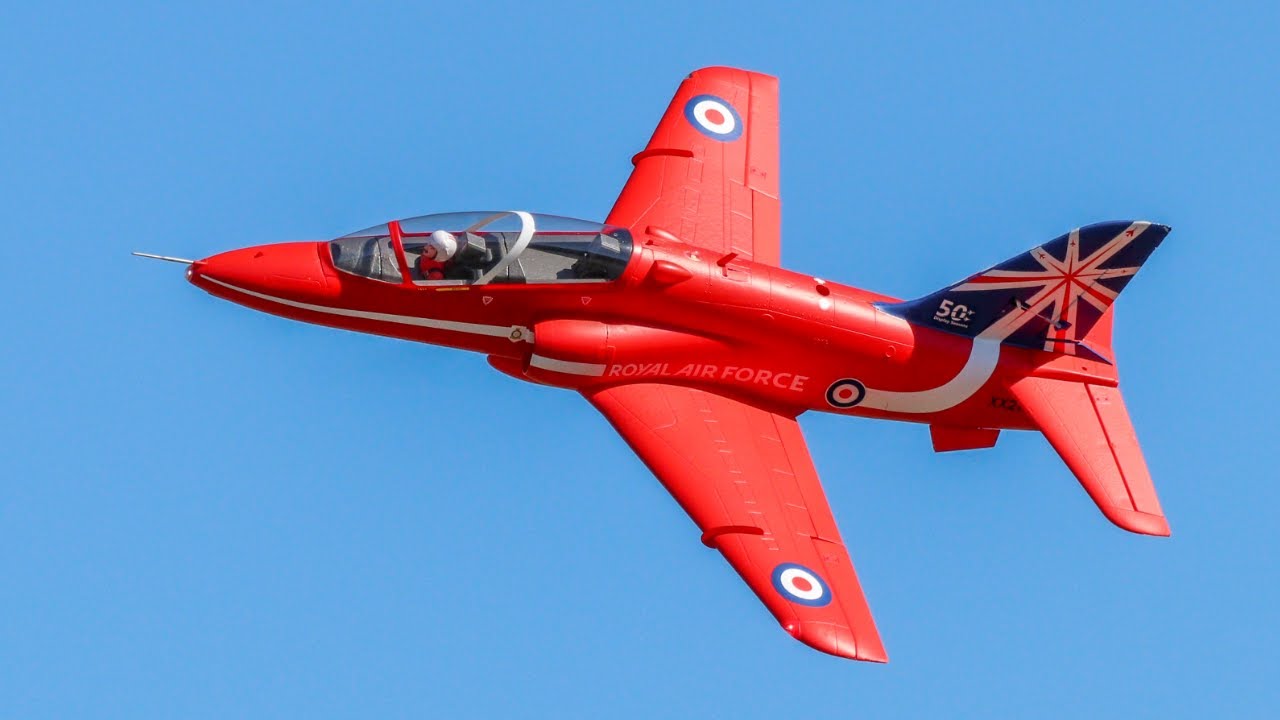
BAE Systems Marketing team get the wrong message when being told that the company will be proposing the Red Hawk...

maxresdefault.jpg


:p
 
 
T-7 for the Red Arrows? Did Trumps state visit have anything to do with it? It would certainly be a bumper purchase for Boeing if the deal goes through.
 
T-7 for the Red Arrows? Did Trumps state visit have anything to do with it? It would certainly be a bumper purchase for Boeing if the deal goes through.
The visit would not have anything to do with this. It is just another BAU example of a requirement for a new trainer being responded to by one of the candidates. It is not a done deal either - just a partnering announcement for the requirement. The Red Arrows is just one part of the RAF Hawk fleet too.
 
Well, I think the Red Arrows would look very nice in a T-7 regardless.

... even better in Eurofighters! :cool:
 
Frankly, I don´t know what would be the louder, 9x F404 or 18x EJ200! :eek:

The introduction of a new type would probably be the right time for the Arrows to return to seven, or even five, aircraft.

Nine was supportable when the RAF had over 700 combat jets and a corresponding pool of pilots from which to draw. Now it has about 140 jets.
 
How many T-7 Red Hawks are the RAF likely to buy?

I put it at around 40 based on the current numbers of BAe Hawks in service and the strong likelihood of the Red Arrows being reduced to 6 aircraft - 4 display aircraft and 2 spares.

BAe must be really hopeful of getting extra orders from all the other Hawk operators if they plan to invest in a UK T-7 factory.
 
To be honest anything that gives them more than 5 or 6 usable airframes on any given day could be considered a win... watch whats flying out of RAF Valley and most days the max number of Hawks you will see is 4... which out of a fleet of 28 is ridiculous... although we did have a good day last week when 7 were out...

A reduction to 4 for the reds would see a radical change to the display sequence and the loss of some signature elements... 6 would at least allow it to continue in a similar format with two sections (4+2 rather than 5+4)...

Zeb
 
A reduction to 4 for the reds would see a radical change to the display sequence and the loss of some signature elements... 6 would at least allow it to continue in a similar format with two sections (4+2 rather than 5+4)...

Zeb

The US display teams use eight aircraft: a four-ship formation, two solos, one spare, and one two-seater for VIP demonstration flights. The Reds could probably do with seven, since all their planes are two-seaters and the spare can double for VIP flights.
 
To be honest anything that gives them more than 5 or 6 usable airframes on any given day could be considered a win... watch whats flying out of RAF Valley and most days the max number of Hawks you will see is 4... which out of a fleet of 28 is ridiculous... although we did have a good day last week when 7 were out...

A reduction to 4 for the reds would see a radical change to the display sequence and the loss of some signature elements... 6 would at least allow it to continue in a similar format with two sections (4+2 rather than 5+4)...

Zeb
The latest AvWeek Check6 podcast covered this. An interesting comment was made on the timeline, that the reds need their replacement aircraft by latest 2029. The aircraft being used by the reds are older, T1s, than the regular training fleet, T2s, and therefore have an apparent drop dead date of 2030.

There has to be some question of whether the T-7 can make that timeline, certainly won't happen with a BAE British assembly line built aircraft but perhaps they can get some initial US builds and then hand them back as British built aircraft come onboard, of course noting the T-7 has to be selected first....
 
I can't see the MOD/Treasury liking the T-7s likely running costs to be honest.
Of course no T-7s are yet in service so Boeing can put whatever wishguessimates on the PowerPoint slides they want, but the Redhawk is not a fuel-sipper. And since the Hunter T.7 the MOD has never chosen a trainer with high running costs.
My money is still on the M-346.
 
I can't see the MOD/Treasury liking the T-7s likely running costs to be honest.
Of course no T-7s are yet in service so Boeing can put whatever wishguessimates on the PowerPoint slides they want, but the Redhawk is not a fuel-sipper. And since the Hunter T.7 the MOD has never chosen a trainer with high running costs.
My money is still on the M-346.
It's a single F404/414. How expensive is the T-50 to run?
 
It's a single F404/414. How expensive is the T-50 to run?
In terms of the propulsion side and more specifically fuel consumption you might be surprised:
  • M346: 2 x Honeywell/ITEC F124-GA-200, each with SFC of roughly 0.81 lb/(lbf⋅h) (23 g/(kN⋅s)), thus 1.62 lb/(lbf⋅h) (46 g/(kN⋅s)) in total
  • T-7/T-50 etc: 1 x F404 with SFC of 0.81 lb/(lbf⋅h) (23 g/(kN⋅s)) in military thrust (arguably where it will spend most time) or 1.74 lb/(lbf⋅h) (49 g/(kN⋅s)) in afterburner
Moreover, two engines mean twice the maintenance work/cost.

I am going to assume that airframe/avionics maintenance on all types is going to be roughly equal.
 
M346: 2 x Honeywell/ITEC F124-GA-200, each with SFC of roughly 0.81 lb/(lbf⋅h) (23 g/(kN⋅s)), thus 1.62 lb/(lbf⋅h) (46 g/(kN⋅s)) in total
The specific fuel consumption doesn't increase when you add more engines as it's relative to thrust. Double the fuel flow rate / double the thrust = same sfc

I doubt there's a massive difference between them. Probably an advantage to M346 now due to the longer time in service and larger fleet (for now).
 
Well, fighter pilots training syllabus is demanding in power. That ´s exactly why the USAF requested stringent climb rate and low sink rate while maneuvering. So, if the RAF has similar training requests, the T-7 would logically have a slight to comfortable margin in fuel consumption over the M-346.
The M-346 would also burn more flying hours as more of that is spend in climb to regain altitude, accelerate to regain speed etc... See the early pages of this thread where the RFI parametric were discussed extensively.
 
The specific fuel consumption doesn't increase when you add more engines as it's relative to thrust. Double the fuel flow rate / double the thrust = same sfc
That may be true but my point is that the fuel consumption of two engines will be high. More importantly two engines do typically mean more maintenance.
Probably an advantage to M346 now due to the longer time in service and larger fleet (for now).
That only counts for the M346 if competing against the T-7. If you include the T-50 in the mix, which I am sure is the case, the story is different as it has been in service for roughly a decade longer than the M346. Both the T-7 and T-50 also arguably offer more capability but it will really come down to what the RAF is looking for.
 
That may be true but my point is that the fuel consumption of two engines will be high. More importantly two engines do typically mean more maintenance.
That depends on the thrust requirements of each aircraft, not on the number of engines.

While we don't know the comparative thrust requirements, the M346 is quite light at ~4,600kg empty and ~6,700kg TO weight clean. The T-50 weighs >30% more (~6,400kg empty, ~8,800kg TO clean). I would expect the T-7A to be closer to the T-50. The heavier aircraft will need more thrust and will burn more fuel, given similar thrust specific fuel consumption.
 
The heavier aircraft will need more thrust and will burn more fuel, given similar thrust specific fuel consumption.

Again, those are not business jets to be compared in a cruise setting (where the above assumption would not even be true). The RAF is looking for a fighter pilot training jet where the metrics at play involve dynamic maneuvering, climb and acceleration.

To make it clear, imagine you have to design something to cruise state wise on the autobahn including the traffic. You would start looking at a 4 pots 2L engine just to understand that the high cruise speed regime and constant need to reaccelerate after the traffic will ruin your mileage and travel time. A bigger motor (or turbo) setup will fare better, even increasing the durability of your design.

This is similar. And that's how the T-7 won the T-X competition.
 
And that's how the T-7 won the T-X competition.
T-7 won by massively underbidding at a below cost price which Boeing has sucked up in well over $1bn in charges.

With jet engines then SFC generally improves at higher throttle settings so you want the smallest engine possible at highest throttle for maximising efficiency. An oversized engine results in low throttle settings where the sfc starts getting higher.

I'd go back to expecting that the smaller, lighter aircraft that's been in service longer has lower running costs. Given that RAF has managed their training syllabus fine with Hawk for decades then all these modern options are more aircraft than necessary which has a cost impact. But there's no real alternative choice.
 
Given that RAF has managed their training syllabus fine with Hawk for decades then all these modern options are more aircraft than necessary which has a cost impact. But there's no real alternative choice.
The rationale for expensive advanced trainers is probably justified by the shift to even more expensive stealth fighters.

I imagine one can save quite a bit of money by having pilots get their initial combat training and qualifications in T-7s (with virtual cockpits and kinematic performance that can replicate full combat missions from start to finish) before transitioning to F-35s, F-22s, and especially future 6th gen fighters like NGAD, GCAP etc.

You could even perhaps send experienced pilots back to T-7s to get advanced tactical qualifications in BFM, electronic warfare, mission commander for complex strike packages or drones, forward air controller etc.
 
Last edited:
The T-7 seems to me to be too high a spec for the RAF's syllabus.

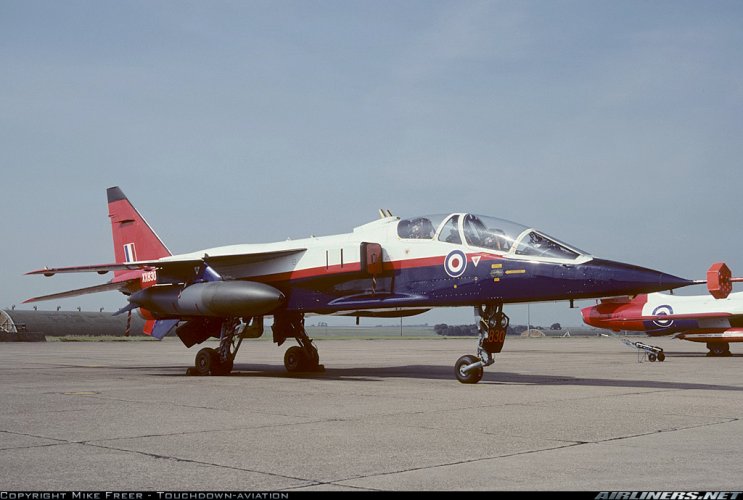
The last time they toyed with a high-performance trainer it only had 14,000lb thrust and that was considered too extravagant, even when fuel was cheaper than beer.

1455242.jpg

I can see the choice going to something less punchy that the T-7 purely on operating cost basis.

Given Japan's need for a T-4 replacement, a joint venture might have been productive but it's far too late for that now.
 
The T-7 seems to me to be too high a spec for the RAF's syllabus.

The last time they toyed with a high-performance trainer it only had 14,000lb thrust and that was considered too extravagant, even when fuel was cheaper than beer.

View attachment 792639

I can see the choice going to something less punchy that the T-7 purely on operating cost basis.

Given Japan's need for a T-4 replacement, a joint venture might have been productive but it's far too late for that now.

It's going to be M-346...

- For Leonardo and UK it would keep Yeovil open, especially with doubts over NMH, BAE have enough work on....
- Italy and UK are both going to use F-35A and B, Typhoon with ECRS.2 and GCAP....so tailoring the training aircraft and environment for those systems becomes a whole lot cheaper....this is a huge advantage over Red Hawk

The dream would be M-346FA with Grifo-E...but thats far too sensible...
 
Why not get aT-50 if you want a trainer with a good radar then?

Not going to keep Yeovil open....not in service with an Ally who will also be using the exact same combat aircraft we will be for the next 30 years....that makes training and adaptation for a new aircraft type so much easier.
 
That makes perfectly sense as a business analytic variable. The main argument however, as debated here, is the training capability offered by the airframe. ;)
 

Similar threads

Back
Top Bottom