USS Forrestal (CV-59)

Triton

Donald McKelvy
Senior Member
Joined
14 August 2009
Messages
9,704
Reaction score
3,488
Website
deeptowild.blogspot.com
United States Navy documentary showing construction of a modern aircraft carrier, the USS Forrestal (CV-59). The film shows all aspects of the building phase, from keel laying to sea trials and commissioning produced in 1955.

http://youtu.be/C0_45G8vwyo
 
http://www.foxnews.com/us/2013/10/23/forrestal-navy-first-supercarrier-sold-for-1-penny/
 
A question: what was the size of weapon elevators on Cold War era supercarriers? I'm trying to determine max weapon size (primary length) that could be used by Forrestal-class ships.
 
A question: what was the size of weapon elevators on Cold War era supercarriers? I'm trying to determine max weapon size (primary length) that could be used by Forrestal-class ships.
I can't answer your question but there's the (official) Booklet of General Plans of the CV-60 Saratoga available for download at https://maritime.org/doc/plans/index.php. You should be able to get at least a rough estimate from the drawings.
 
Hm. It seems that max length of the weapon that could be delivered by Forrestal elevator would be about 5 meters...
The weapons elevator dimensions may not be a hard constraint. It wouldn't be unheard of to keep a weapon disassembled into 2 parts (e.g. warhead section + motor section) which would then be reassembled in a weapons prep area at hangar level, so the weapon could then be moved by the aircraft lift to the flight deck or loaded directly on an aircraft in the hangar.

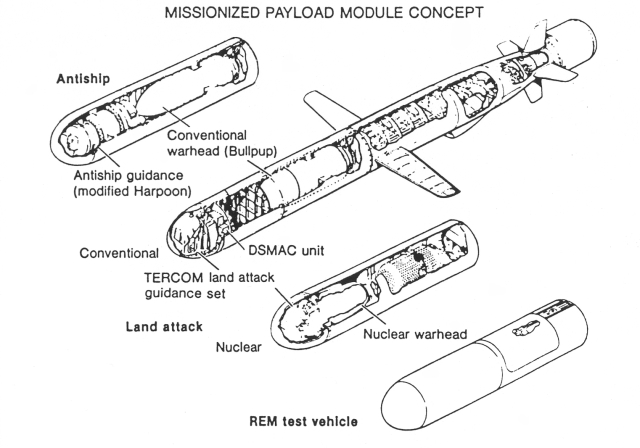
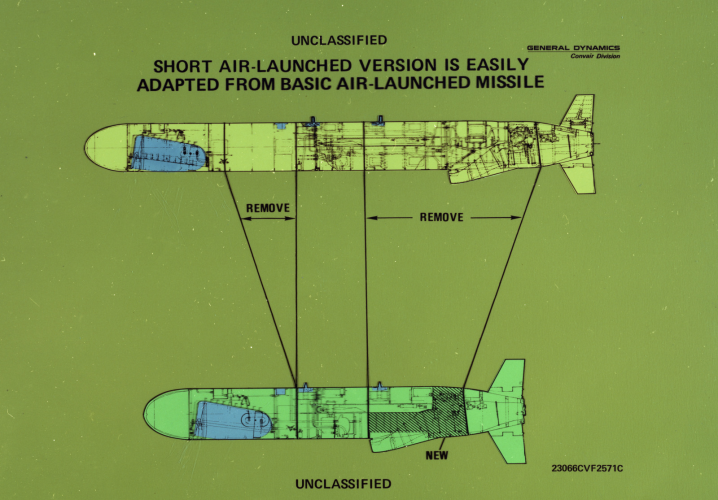
Kind of like AGM-109 Tomahawk which was proposed in various versions with different (swapable?) payload sections, and even in a short version (65 inches shorter) to fit inside the B-52's SRAM rotary launcher.


1763404444905.png
1763403731785.png
 
Last edited:
But the Navy MRASM was sized in part to fit CV weapon elevators (at 4.88 m). None of this family of missiles were field assembled from two sections. (The notional Army recce version might be the only exception.)
 
None of this family of missiles were field assembled from two sections. (The notional Army recce version might be the only exception.)
AFAIK keeping missiles in separate sections was more likely with nuke missiles due to the need to store warheads securely. How were the nuke Tomahawks stored?
 
The weapons elevator dimensions may not be a hard constraint. It wouldn't be unheard of to keep a weapon disassembled into 2 parts (e.g. warhead section + motor section) which would then be reassembled in a weapons prep area at hangar level, so the weapon could then be moved by the aircraft lift to the flight deck or loaded directly on an aircraft in the hangar.
That's was my thought too. Assemble missile on hangar deck, put it on plane & raise through the plane elevator. IRRC, some kind of munitions are allowed to be loaded in hangars?
 
AFAIK keeping missiles in separate sections was more likely with nuke missiles due to the need to store warheads securely. How were the nuke Tomahawks stored?

They were either in Armored Box Launchers or VLS. There's no sign that either mode called for the warheads to be stored separately.

That's the same with ASROC. Near as I can tell, those were stowed assembled as well, either in the launcher or the magazine.
 
Nuclear Talos may have been stored with the nuclear warhead separately. There's certainly a sperate warhead magazine on the CLG-3 class ships, and IIRC from touring CLG-4 the Talos spaces themselves did not have the security features normal for nuclear weapons, whereas the warhead magazine did.

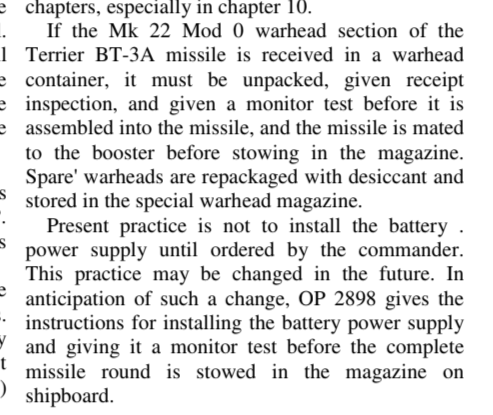
I can't think of any other weapon that would likely have the warhead stored separately. Terrier, Tomahawk, ASROC, Mk-45 where all integrated weapons only disassembled in shore side facilities. Gravity bombs are nothing but a warhead.

Generally speaking, anything that involves more than cosmetic maintenance on a weapon shipboard is discouraged for any number of reasons. Assembly beyond simple items like installing fins or fitting a seeker (i.e. assembling laser guidance kit to a dumb bomb) is not trivial, and requires significant special tooling, ordinance rated areas, test systems, etc. For instance, the test system used on the Mk-48 following IMA overhaul is a set of 8 ft cabinets about 30 ft long.

Assembly of a warhead or major sections of a weapon together would invariably need to take place in a magazine or specially designed space, not something you're going to do just randomly on the hanger deck. Think of it like major work on a car engine - you're not going to want to do so outside of a clean enclosed shop with the right tools available.

 
Assembly of a warhead or major sections of a weapon together would invariably need to take place in a magazine or specially designed space, not something you're going to do just randomly on the hanger deck.
On most carriers there usually are shops just forward of the hangar deck, including weapons shops with convenient access to the forward weapons elevators leading down to the fwd magazines. On CV-59 the weapons shop appears to have been mostly used for AIM-7 prep and maintenance, but in theory it could have been used to assemble other missiles.

The most relevant example I can think of is the French ASMP nuclear missile which is stored in 3 separate containers (engine section + warhead + command/guidance unit), then assembled onboard the carrier (previously Clemenceau & Foch, now CdG) in a very similar weapons shop located in front of the hangar.
 
Last edited:

Attachments

  • Screenshot_20251118-101712.png
    Screenshot_20251118-101712.png
    143 KB · Views: 6

Similar threads

Back
Top Bottom