8477556476_ba0d7c0267_o.jpg
 
airmobile.png
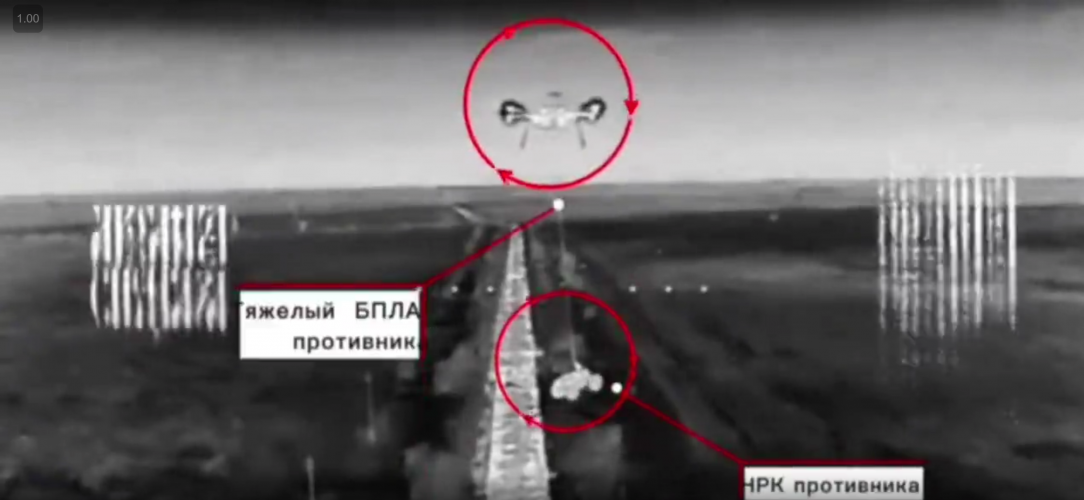
Claimed to be Russians posting what is supposed Ukrainian drone carrying UGV for attacks.

I did sort of anticipate this and started a thread on another forum asking about this (using EVTOL for air assault) and all the responses is just the poor range of electric aircraft...... Sometimes cost just matters.
 
Too bad details would likely only be known long after the war ends.

Details emerged only hours after that attempt, when the first Russian channels released footage of drones striking the troops that disembarked from the helicopter. With people later geolocating portions in the background which concluded that it was indeed the same location.

https://www.reddit.com/r/UkraineRussiaReport/s/LdEfwfu7L2

Ultimately it's a grandiose example in modern times why such tactics are not viable today. Another instance happened during the Israeli-American War against Iran when in Lebanon an Israeli helicopter tried to extract IDF forces which in turn suffered several casualties during that attempt at the hands of Hezbollah.

Rotarycraft are vulnerable at the line of contact, and throwing small groups of infantry right into the action leads to inevitable catastrophe. This type of mission is suitable for COIN or Special Operations against non-peer adversaries. But realistically speaking a modern peer force will neutralize any inserted fighting force either en-route or shortly after they disembarked from the helo.

Air assault via large fixed wing aircraft is even more suicidal though.
 
Details emerged only hours after that attempt, when the first Russian channels released footage of drones striking the troops that disembarked from the helicopter.
I've read the post too, but I reserve giving judgment when no one seems to have an good idea of the goals of the operation and various counterfactuals.

It is know that infantry losses range from heavy to extreme in this war, losses proves little. It is unclear whether any other method is safer when all methods of movement seems to produce lots of infantry killed.

But realistically speaking a modern peer force will neutralize any inserted fighting force either en-route or shortly after they disembarked from the helo.
Enroute, seems total annihilation is unlikely given that SEAD still works and aerial penetration by sometimes shockingly awful aircraft still works.

Being a isolated, light weight forces, being destroyed is something that was always possible. 75% loss rate was normal for soviet ww2 paratrooper deployments. (and they proceed to build VDV....)

The “death of armor" actually helps with light forces quite a bit, and if air mobile troops manage to dig in it may be much hard to dig them out than any time since the invention of the tank, which is to say the entire lifespan of air mobile troops! Vertical envelopment was considered as the alternative to mechanized maneuver as a solution to the static lines of ww1, and it has generally been eclipsed by the latter.

Things like high loss rates are perfectly acceptable when considering semi-disposable robots. Such disposability also in turn greatly lower aircraft costs resulting in just plain different economics and force balance considerations.
 
Being a isolated, light weight forces, being destroyed is something that was always possible.
It should be treated as inevitable, moral of troops is a serious factor.
A tiny, light infantry force surrounded on all sides with little hope of support is never going to be able to hold terrain - look at Hostomel airport, sabotaging the runway completely foiled the plan of landing transports and there didn't seem to be a plan B.
 
Details emerged only hours after that attempt, when the first Russian channels released footage of drones striking the troops that disembarked from the helicopter. With people later geolocating portions in the background which concluded that it was indeed the same location.

https://www.reddit.com/r/UkraineRussiaReport/s/LdEfwfu7L2

Ultimately it's a grandiose example in modern times why such tactics are not viable today. Another instance happened during the Israeli-American War against Iran when in Lebanon an Israeli helicopter tried to extract IDF forces which in turn suffered several casualties during that attempt at the hands of Hezbollah.

Rotarycraft are vulnerable at the line of contact, and throwing small groups of infantry right into the action leads to inevitable catastrophe. This type of mission is suitable for COIN or Special Operations against non-peer adversaries. But realistically speaking a modern peer force will neutralize any inserted fighting force either en-route or shortly after they disembarked from the helo.

Air assault via large fixed wing aircraft is even more suicidal though.

Dude44 rescue and absolute resolve are decent examples. Despite what people on twitter would lead you to believe air assault, airborne, and forcible entry operations are not dead in the modern environment. Like everything it involves changes. Is naval combat dead? Is maneuver warfare dead? Like everything it requires adaption. Now you can certainly argue that it is too expensive or complex for most nations to carry out effective operations in the modern era. Even COIN level air assaults carry risks. A well placed DShK can inflict heavy losses if not detected before hand.
 
Dude44 rescue and absolute resolve are decent examples. Despite what people on twitter would lead you to believe air assault, airborne, and forcible entry operations are not dead in the modern environment. Like everything it involves changes. Is naval combat dead? Is maneuver warfare dead? Like everything it requires adaption. Now you can certainly argue that it is too expensive or complex for most nations to carry out effective operations in the modern era. Even COIN level air assaults carry risks. A well placed DShK can inflict heavy losses if not detected before hand.
I don't think either of those events can be compared to full blown deployment of air-mech infantry units
 
It should be treated as inevitable, moral of troops is a serious factor.
A tiny, light infantry force surrounded on all sides with little hope of support is never going to be able to hold terrain - look at Hostomel airport, sabotaging the runway completely foiled the plan of landing transports and there didn't seem to be a plan B.
That is hardly new, look at battle of crete, where hundreds(!) of transports for destroyed by forced landing on an airfield under artillery fire. The airfield could have been simply closed if the defending forces didn't withdrawal due to communication mistakes! Yet the force fought on and won at a high cost.

Or maybe it is just a feature of government types, just ask how the IJA managed morale of banzai charges. Perhaps a regime specific force and operation type?

In any case, robots would be the main show here, given historical loss rates for this kind of op.

Claimed to be Russians posting what is supposed Ukrainian drone carrying UGV for attacks.
Adding some sources:
https://united24media.com/war-in-uk...actic-doesnt-drop-bombs-it-drops-robots-20894
 
It should be treated as inevitable, moral of troops is a serious factor.
A tiny, light infantry force surrounded on all sides with little hope of support is never going to be able to hold terrain - look at Hostomel airport, sabotaging the runway completely foiled the plan of landing transports and there didn't seem to be a plan B.
...but they did hold that terrain regardless. Doesn't add up.
Overall, Iran war shows that it's perfectly feasible to open up a way to aerial assault and lay sufficient suppression from air to make it work.
The main problem is that fixed-wing military transports have not seen much improvement in their air assault capabilities since the 1960s(when they caught up with ¬late 1940s bombers).

Which leads to an ironic situation - light infantry force right now is at its strongest ever, and it's easiest ever to keep them supplied behind enemy lines. But the insertion(at scale) part just stalled completely.
 
I'm a bit late to this thread but at We Have Ways Fest 2025, Dave Allen and Tony Pastor gave a presentation on parachute assaults in the 21st century. The gist of their argument was that an Atlas can be across the 700 mile distant DZ/LZ in ~2 minutes and deliver 100+ paratroops. A helicopter assault would require ~7 machines, landing/hovering to deliver the same while providing a target-rich environment for longer.

I must admit to being convinced by their argument.

Chris
 
I'm a bit late to this thread but at We Have Ways Fest 2025, Dave Allen and Tony Pastor gave a presentation on parachute assaults in the 21st century. The gist of their argument was that an Atlas can be across the 700 mile distant DZ/LZ in ~2 minutes and deliver 100+ paratroops. A helicopter assault would require ~7 machines, landing/hovering to deliver the same while providing a target-rich environment for longer.

I must admit to being convinced by their argument.
Chris
Much depends as the Russians found in 2022 on who is around at the DZ/LZ.
 
I'm a bit late to this thread but at We Have Ways Fest 2025, Dave Allen and Tony Pastor gave a presentation on parachute assaults in the 21st century. The gist of their argument was that an Atlas can be across the 700 mile distant DZ/LZ in ~2 minutes and deliver 100+ paratroops. A helicopter assault would require ~7 machines, landing/hovering to deliver the same while providing a target-rich environment for longer.

I must admit to being convinced by their argument.
The most significant issue is scatter. Yes, paratroopers have steerable parachutes now, that's not the issue. There's still a lot of drift and the sheer forward motion of the plane dropping paratroopers strings them out along a line about 5km long.

While a set of ~7x H-60 helicopters or MV-75s would deliver ~84 troops combat ready all in one location the size of a football field. The whole squad dropped off together. If you lose one helo you have only lost one squad. Also, if the delivery of ~100 dudes to the location is the most important part of the mission, you can crash land all 7 helos and only be out ~150mil. Say, an Eagle Claw or Bin Laden mission.

The second issue is that paratroopers need to jump at about 1200ft AGL to give their chutes time to open. I think the US minimum altitude, one swing under the main and you're dead if it doesn't open immediately, is 700ft. The WW2 Fallschirmjager jumped at 500ft but their chutes open too fast and cause too many injuries. 500ft AGL exposes the plane to every air defense element in the entire arsenal. While the Helos or tilt-rotors can be down at 50-100ft AGL and using hills or even buildings for cover against AAA.


I'd seriously trust squad-sized stealth gliders over parachuting in. Which is itself an interesting discussion.
 
Gliders can't just land anywhere, though. You still need a parachute for both to land in tight spaces. It's also a bit more challenging to transport many.
A wingsuit is a more convenient option. And people have tested powered flight, too. Although, I do question the use of a jet engine due to noise and fuel usage. Non civilian paragliders can get as far as 100+ km so these aren't that necessary for most SOF missions.
 
An air assault, regardless of parachute or heliborne in major combat operations (against a peer adversary) will require significant support from all of the combined and joint capabilities of the theater commander. I believe it would be the focal effort of the command for at least 48 hours. So it is not that it cannot be done, but the amount of effort to make the coefficient of battle favorable must be weighed against the other requirements of the battlefield.
That said in lesser conflicts (Afghan, Mali, etc.) I believe air assault will remain a mainstay method against widely dispersed enemies who do not have mass.

The idea of modern technology gliders with some level of low observability (but not stealth) that could be released at altitude from internal carriage in a cargo aircraft flying a civil air route then being able to glide ~97 Km / 50 NM (minimum) might be an intriguing way to open an operation.
"Gliders! Stop talking nonsense Major. No one does that any more. Ridiculous!"
 
Last edited:
Much depends as the Russians found in 2022 on who is around at the DZ/LZ.
There were about a 5,000 problems with the hostomel operation. Arguably the largest was the general incompetence and unsophisticated VKS. Years of corruption killing modernization efforts and lack of training led to the failure of achieving air superiority and suppressing Ukrainian ground elements.

Looking towards operational Absolute Resolve where most if not all adversary MANPADs, SAMs, Drones, and garrisons were destroyed before the ground force touched down. Air assault isn’t completely dead it just requires much more preparation and assets to a achieve. Most countries will not be able to achieve that.
 
How about dropping in directly on vehicles? AFAIK Soviet paratroops would have done that in wartime, and there are new aerial delivery systems (e.g. Atax Land) with much improved impact cushioning using air bags and very fast drive-off times. That would provide mobility and give more drop zone options.

On an A400M you should be able to fit fit 4x ISVs (4x 9 man squads = 36 soldiers) or 9x 463L pallet sized vehicles like the UNAC Fardier (9x 4 man with 2 rear seats = also 36 soldiers).

Tactics might involve dropping them 1-2 minutes drive away from the target, thereby avoiding direct assault. Dropping directly in vehicles would allow the assaulting troops to rapidly deploy more fire support (machine guns, FPV drones, 60-81mm mortar etc).
 
How about dropping in directly on vehicles? AFAIK Soviet paratroops would have done that in wartime, and there are new aerial delivery systems (e.g. Atax Land) with much improved impact cushioning using air bags and very fast drive-off times. That would provide mobility and give more drop zone options.

On an A400M you should be able to fit fit 4x ISVs (4x 9 man squads = 36 soldiers) or 9x 463L pallet sized vehicles like the UNAC Fardier (9x 4 man with 2 rear seats = also 36 soldiers).

Tactics might involve dropping them 1-2 minutes drive away from the target, thereby avoiding direct assault. Dropping directly in vehicles would allow the assaulting troops to rapidly deploy more fire support (machine guns, FPV drones, 60-81mm mortar etc).
The challenge, I think, is not the technology of the airborne troops, but the risk to the very precious commodity that is the heavy lift aircraft. They are not overly plentiful and senior commanders who are more concerned with logistics than tactics might be hesitant to risk them. These aircraft are flying just above stall speed and in their worst maneuver configuration. Well placed squad automatic machine guns could do significant damage to them, let alone air defense guns and shoulder fired missiles.
One could argue that dropping them away from all of these defenses could alleviate some of this, but that implies an ability to mass enough force and support capability to overcome resistance enroute to the objective. I am reminded of the British drop zones in Operation Market Garden.
Strategic surprise is very fleeting, made more so in this age of ubiquitous information. Video of C-17/An-124/A400 taking off one after the other from some aircraft spotter would very likely put paid operational security.
I suppose using smaller aircraft, say ATR size, might be an option. But then you are not likely to get much supporting equipment into the fight early. You will need more aircraft for the same mass of combat soldiers and that too adds complexity to a very orchestrated mission.
 
Last edited:
An air assault, regardless of parachute or heliborne in major combat operations (against a peer adversary) will require significant support from all of the combined and joint capabilities of the theater commander. I believe it would be the focal effort of the command for at least 48 hours. So it is not that it cannot be done, but the amount of effort to make the coefficient of battle favorable must be weighed against the other requirements of the battlefield.
That said in lesser conflicts (Afghan, Mali, etc.) I believe air assault will remain a mainstay method against widely dispersed enemies who do not have mass.

The idea of modern technology gliders with some level of low observability (but not stealth) that could be released at altitude from internal carriage in a cargo aircraft flying a civil air route then being able to glide ~97 Km / 50 NM (minimum) might be an intriguing way to open an operation.
"Gliders! Stop talking nonsense Major. No one does that any more. Ridiculous!"
Gyrogliders can landing in vertical

assault-airborne-gyroglider-kc-390.png
assault-airborne-gyroglider-kc-390-a.png
 

Similar threads

Back
Top Bottom