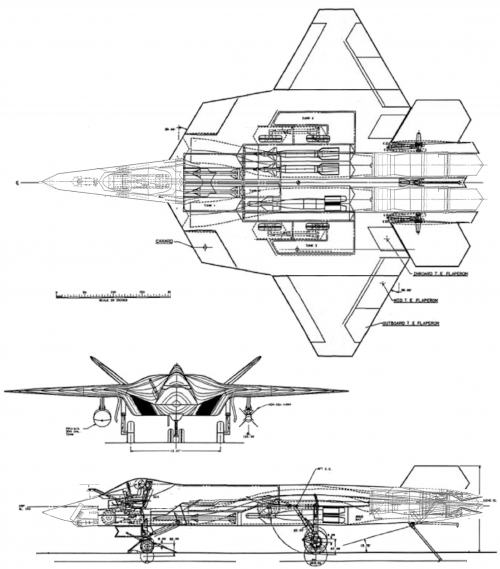
During ATA, our Northrop design from the beginning was a direct replacement for the A-6, side by side seating, large payload, F404 engines and the baby B-2/B-21 planform but we could not convince the Navy regarding medium to high altitude penetration to maximize LO, they wanted to fly on the deck, a flying wing does not belong on the deck, its a sitting duck. If NG wins F/A-XX, may probably by a modern hybrid of F-23/NATF-23 and would be a nice vindication after losing ATF, but that's OK, that's how things work. If the NG F/A-XX concept is somewhat accurate, NG has probably done a lot of classified work with a platform using over-wing inlets and shaping so they must have found the balance regarding engine performance, flight performance and LO based upon the requirements and hopefully NG had the opportunity to provide USN with some guidance as well regarding requirements, trying to be optimistic.
 
but we could not convince the Navy regarding medium to high altitude penetration to maximize LO, they wanted to fly on the deck, a flying wing does not belong on the deck, its a sitting duck.

So if Northrop had been able to convince the USN then you think that your former company's bid would've won?
 
So if Northrop had been able to convince the USN then you think that your former company's bid would've won?
NMaude, I think so with reference to the following:
1. If the USN would have agreed to our terms for a fixed-price contract, approx. $6.8B for FSD and only six FSD aircraft or agreed to a cost-plus funding profile, mainly due to risk.
2. Accept mid to high altitude attack profiles to exploit LO, no on the deck attack profiles. We knew what we were doing.
3. And don't dick around with the specification and stop changing things, that was a huge problem and a huge problem for GD/ McAir as well.

If NG can have a relationship with the USN as they currently have with USAF on B-21 all should be well in F/A-XX land.
 
It is interesting to see that the McDD/GD ATA example is much heavier than the NG variant Scott Kenny, did that have anything to do with the final decision that went McDD and General Dynamics way?
No, the NG team submitted a cost-plus bid when the contract was requiring a fixed-price bid.

Because there was a LOT of stuff that needed to be developed for those airplanes and a fixed-price contract means all the risk was on NG.
 
We know the design payloads, which is what I have been talking about.
  • 2x Harpoon, 2x GBU-15, and 2x AMRAAM; or
  • 10x Mk83s plus 2x AMRAAMs.
Also, the NG proposal was 70,000lbs MTOW while the MDD proposal was 80,000lbs MTOW.

In addition to ATA, there was also the short-lived AX and A/F-X program which was more of a strike-fighter like F/A-XX.

If you take that as your starting point (especially Northrop's proposal below) and add back some of the more performance oriented features from NATF (e.g. afterburning F119 engines) and a slightly smaller wing, you get a true strike-fighter hybrid with a large weapons bay for up to 4 JASSM/LRASM or similar 2,000lb class heavy weapons.


Here's Northrop's original "performance oriented" AX proposal:
northrop-ax-afx_performance-design-jpg.578061


Now here's a hypothetical mod with larger F119 engines, NATF's slimmer nose, and a smaller wing with LEVCONs instead of canards:

Northrop AX mod 100px=1m v4.png
 
In addition to ATA, there was also the short-lived AX and A/F-X program which was more of a strike-fighter like F/A-XX.

If you take that as your starting point (especially Northrop's proposal below) and add back some of the more performance oriented features from NATF (e.g. afterburning F119 engines) and a slightly smaller wing, you get a true strike-fighter hybrid with a large weapons bay for up to 4 JASSM/LRASM or similar 2,000lb class heavy weapons.
I still think this is too much payload for the mission. Yes it is a strike fighter but the USN has to look ahead when the aircraft will enter service and consider that it will have CCA accompanying it. This week's CAVASShips podcast had as their guest from the Hudson Institute Bryan Clark, who I have generally found is quite informed, and F/A-XX was discussed. He noted that the USN has three companies under contract for CCA, design work, and outlined the force design they were looking at. The expectation was by 2045 there would be 60% unmanned to manned. In that context does the USN really need a large internal payload fighter over a large fuel/long range fighter? If you limit the internal payload to slightly larger than F-35, so internal LRASM/SM-6 and AIM-260 in each bay or one big bay, you can probably reclaim space and payload weight for another 3-5k of fuel. The munition depth then comes from associated CCA and maybe MQ-25 (or its follow-on by 2045). The airframe is likely slimmer, lighter, more performant and marginally cheaper to acquire and operate.
 
I still think this is too much payload for the mission. Yes it is a strike fighter but the USN has to look ahead when the aircraft will enter service and consider that it will have CCA accompanying it. This week's CAVASShips podcast had as their guest from the Hudson Institute Bryan Clark, who I have generally found is quite informed, and F/A-XX was discussed. He noted that the USN has three companies under contract for CCA, design work, and outlined the force design they were looking at. The expectation was by 2045 there would be 60% unmanned to manned. In that context does the USN really need a large internal payload fighter over a large fuel/long range fighter? If you limit the internal payload to slightly larger than F-35, so internal LRASM/SM-6 and AIM-260 in each bay or one big bay, you can probably reclaim space and payload weight for another 3-5k of fuel. The munition depth then comes from associated CCA and maybe MQ-25 (or its follow-on by 2045). The airframe is likely slimmer, lighter, more performant and marginally cheaper to acquire and operate.
Strike is a sub optimal role for a CCA if you intend for it to have a short life span. The USN has talked about CCAs that would fly low dozens of missions; that does not translate to a bomb truck. I think the USN CCAs will handle EW, A2A, ISR, and refueling but strike requires a large airframe that is a lot less expendable than the other types (outside MA-25).

I am stucco ~4 mk83 internal, possibly/probably with room for a wing kit, and perhaps a pair of mk84/BLU-109 sized weapons if absolutely necessary. Double that externally as a beast mode option.
 
I'm going to remind people (again) that JSM, SiAW, AARGM-ER, and AGM-158 are all about the same external dimensions. AGM-158 is ~30cm longer than the others and maybe 5cm wider.

So if the plane is able to carry 2x AARGM-ER and 2x AGM-158 or JSM/NSM, it would be able to carry 4x AGM-158Cs by volume. And yes, I still think we're talking 4x big weapons plus 2-4x AAMs; roughly 12klbs if we're talking LRASMs, 9k if AIM-174s, ~10k if JDAM-ERs.

If my thought experiment that was ~40klbs empty and ~80k MTOW with 12klbs internal payload and 28klbs of fuel is accurate, you could hang another 12k externally if absolutely necessary and tank 12klbs of fuel immediately after takeoff. But that would be for a guaranteed strike mission, there's no way you'd be able to land with that much weight!
 
JSM fits in F-35 bays (A/C) but JAASM does not, so that is hard to square. NSM is not air launched.
Correct. I believe that JASSM is too long for F-35 bays. A GBU-31 (2000lb JDAM) is only 3.77-3.87m long (depends on warhead), while an AGM-158 is 4.29m long. JSM is only 4m long.

I still believe that the FAXX will have either two main bays in tandem or one super long bay between the engines, and able to hold AIM-174s or whatever USN hypersonic happens. A total bay length of ~33ft/10m, ~25" deep, and ~55" wide. Makes for a big plane, I'm guesstimating about 76ft/23m long and ~55ft wingspan. The size of an A-5 Vigilante.
 
Strike is a sub optimal role for a CCA if you intend for it to have a short life span. The USN has talked about CCAs that would fly low dozens of missions; that does not translate to a bomb truck. I think the USN CCAs will handle EW, A2A, ISR, and refueling but strike requires a large airframe that is a lot less expendable than the other types (outside MA-25).
I think you're being too narrow in your definition of Strike. While generation 1 of USN CCA may focus on ISR and A2A there is no way they will not move to platforms that can host weapons for the purpose of expanding the munitions available. That could be LRASM but could also be Barracuda 500s and all the other small cruise missile variants. It can also be any number of powered or unpowered SDB and similar variants that don't require anything other than a host platform within the battlespace to launch the weapon.

The surface fleet will have to go through the same transition, big platforms supported by MASC.

So if the plane is able to carry 2x AARGM-ER and 2x AGM-158 or JSM/NSM, it would be able to carry 4x AGM-158Cs by volume. And yes, I still think we're talking 4x big weapons plus 2-4x AAMs; roughly 12klbs if we're talking LRASMs, 9k if AIM-174s, ~10k if JDAM-ERs.
I'm suggesting one LRASM and one AIM-260 per bay or two of each of the previous in a combined single bay. For external carriage I'd also like to see no attempt to have jettisonable pylons. F-22 has moved away from that with their LO tanks and I think the USN can make the call to either go LO from the start or not.

I still believe that the FAXX will have either two main bays in tandem or one super long bay between the engines, and able to hold AIM-174s or whatever USN hypersonic happens. A total bay length of ~33ft/10m, ~25" deep, and ~55" wide. Makes for a big plane, I'm guesstimating about 76ft/23m long and ~55ft wingspan. The size of an A-5 Vigilante.
Too big and too expensive for me.
 
Last edited:
I think you're missing Scott's point. On another note the USN IMO fucked up when they chose the ATA instead of the A-6F.
ATA would have been good if you work with the premise of LO, medium to high altitude strike profiles as we said (Northrop) and tried to convince the USN. You want an A-6 replacement then design a high-speed, ground hugger with some acceptable level of LO (LO F-111-type derivative or an FB-23 LO supercruiser as examples) and create acceptable requirements and planning, otherwise you are screwed. The USN unfortunately in my opinion needs an F/A-XX platform because they pissed away any chances of having a decent strike platform.
 
ATA would have been good if you work with the premise of LO, medium to high altitude strike profiles as we said (Northrop) and tried to convince the USN. You want an A-6 replacement then design a high-speed, ground hugger with some acceptable level of LO (LO F-111-type derivative or an FB-23 LO supercruiser as examples) and create acceptable requirements and planning, otherwise you are screwed.

Perhaps what the USN should've done is split their ATA requirement into seperate aircraft with one fulfilling the LO, medium and high-altitude role with what became the A-12 and the high-speed on the deck, ground-hugger being the A-6F.
 
Perhaps what the USN should've done is split their ATA requirement into seperate aircraft with one fulfilling the LO, medium and high-altitude role with what became the A-12 and the high-speed on the deck, ground-hugger being the A-6F.
When I was in Navy back in the early 80s on CVN-65 , we had the A-6 and the A-7. A-6 flew low altitude and medium altitude attack profiles. The USN retired the A-5 Vigilante in 1979 one year before I enlisted but it was doing the recce role only. The A-7 was medium altitude primarily. As for the A-3, that was converted for electronic attack and SIGINT. We would pickup a squadron of EA-3s from NAS Cubi Point prior to deploying to the IO.

Your comment for splitting sounds good, it all lies in good requirements and planning and also listening to the prime contractor aircraft designers, we knew what we were doing. During the time of ATA for example us (Northrop) and Lockheed were investing a lot of corp money in LO, fighter, attack, cruise missiles, ISR and other platform development for "just in case" scenarios depending on the direction the USAF and USN were going to take and back then the USN really needed to get their s**t in order, hence the A-12 debacle. I think the successful teaming of USAF and NG on the B-21, I hope is a good example for other new programs going forward and hopefully F-47 will follow that path. Classified, rapid development programs can be a double-edged sword garnering fabulous next-gen tech or a black hole of constant wasteful funding with no results.

Like I said previously, the USN unfortunately has to go with an F/A-XX strike fighter, no other choice, plus the USAF and USN fly different missions. I am not an expert, the majority of my comments and observations are based upon personal engineering experience working in the military aerospace industry.
 
The images that I posted in this thread yesterday were Mods relocated here, at the start of a new thread:


The ones related to Space Based Interceptors posted by @dark sidius and myself are in in X-37B thread here (Mods also):

Edit:
@bring_it_on : Appreciate the credits. Thank you.
 
Last edited:
There have been dramatic changes to how aircraft can be produced since the F-35 was designed.
They all concentrate on assembly techniques and reduced cost. This is great by the way. There is no weight saving technology since the F-35.

Titanium bulkheads bolted together with carbon skins is peak aviation. 3D printed titanium while the shape can be more complex the porosity from printing results in no weight saving.

We are at the point of finishing returns in terms of the structure and aerodynamics. I would accept a combined 10% gain in structure and aerodynamic efficiency over the F-35. We have members here touting 30+% range, payload improvement with the same estimated weight. This is ridiculous.

The same applies with engines. There are no magical 20% fuel efficiency gains to be had without massively increasing the bypass ratio. The third stream can only change the bypass so far..
 
I'm suggesting one LRASM and one AIM-260 per bay or two of each of the previous in a combined single bay. For external carriage I'd also like to see no attempt to have jettisonable pylons. F-22 has moved away from that with their LO tanks and I think the USN can make the call to either go LO from the start or not.
That's basically the same as what an F-35 can haul, so I'd be surprised if the aircraft was that small.

F-35C with full internal fuel and full internal weapons is running about 60,000lbs at takeoff. ~35k empty, ~20k fuel, ~5k weapons.


Too big and too expensive for me.
Tomcat was also big and expensive, Navy doesn't have much choice on the matter. Super Bugs are obsolete and old.

Planes that big have operated off of carriers before just fine.

The reason I think it's going to be 4x big weapons is the strike mission. 2x SiAW/AARGM-ERs for SEAD/DEAD, 2x bombs for the target. 2-4x AAMs for self defense.
 
An observation that came to me a little bit ago in the F-47 thread is that the Su-57 is also right about the size of aircraft I'm thinking the FAXX will be. It's right about 40,800lbs empty, 77,000lbs MTOW, and holds 22,700lbs of fuel internally. Remove the tail structure to lighten the airframe and then expand the wings aft to give 5000lbs more fuel and we're right there at my thought experiment!
 
That's basically the same as what an F-35 can haul, so I'd be surprised if the aircraft was that small.
Having the same payload as the F-35 doesn't mean it will be small. 25% extra range and a higher cruising speed will result in an aircraft much bigger than the F-35C despite having the same payload.

An observation that came to me a little bit ago in the F-47 thread is that the Su-57 is also right about the size of aircraft I'm thinking the FAXX will be. It's right about 40,800lbs empty, 77,000lbs MTOW, and holds 22,700lbs of fuel internally. Remove the tail structure to lighten the airframe and then expand the wings aft to give 5000lbs more fuel and we're right there at my thought experiment!
You are way off.

Adding the carrier capability increases the weight. The Su-27 weighs 36,000lb and the carrier capable Su-33 that flew 5 years later weighs 40,500lb. A 12.5% increase in empty weight. The carrier capable Rafale also weighs 10% more than the air force version.

Using the same percentage weight increase the Su-57 empty weight of 40,800lb is now at 45,900lb once carrier capable. Expanding the wings to add 5,000lb of fuel will also increase the empty weight. You are now close to 50,000lb empty weight.

The Su-57 can't fit four JASSM missiles internally. Increasing the payload volume will also increase the empty weight and you've now blown right past 50,000lb. The MTOW and landing weight has now exceeded the carrier weight limits.
 
I think it’s worth pointing out again that there are like several hundred LRASM in inventory, or fewer than there are F-18s. No one is building a plane around that.
 
I think it’s worth pointing out again that there are like several hundred LRASM in inventory, or fewer than there are F-18s. No one is building a plane around that.
The question is not how many are there now, but how many will there be when it comes into service, and onwards from there.
 
I fail to see the reasoning behind arguing against the next generation naval strike fighter being able to carry the premier air-launched anti-ship missile used by the United States. And for the near future the LRASM will remain exactly that and a successor will probably retain a similar form factor. And internal storage is simply the most logical thing to do, given that especially ships these days have extremely powerful and large radars. So carrying them externally may not result in immediately getting shot down, but it's far easier for ships and especially ship-launched or long range AEW&C aircraft to pick up something. This is also what makes hanging them off of drones kinda meh, because the same thing applies, difference being that you will lose a couple million less and won't lose a pilot and systems operator.

So you either design your fighter around it, or you develop a bespoke UAV to carry it internally. And quite frankly, designing the fighter around the missile seems more logically, given that only so many aircraft fit on a carrier.

That it's possible to design a tactical fighter with the ability to carry ALCMs internally has been demonstrated by the Su-57, so I don't really see anything that would prohibit something similar with AShMs.
 
They all concentrate on assembly techniques and reduced cost. This is great by the way. There is no weight saving technology since the F-35.

This is not true at all. There have been many advancements that reduce weight, and others that increase fuel fraction. A lot has happened in 30 years.


We have members here touting 30+% range, payload improvement with the same estimated weight. This is ridiculous.

Math is hard.

The same applies with engines. There are no magical 20% fuel efficiency gains to be had without massively increasing the bypass ratio. The third stream can only change the bypass so far..

This is also untrue. The advanced engines being developed for NGAD incorporate more than just a third stream, and these advancements have to do with more than conventional bypass ratio. Previously engines were either high performance OR high fuel efficiency. The advanced engines can be both. That's the whole point of them.

 
That's basically the same as what an F-35 can haul, so I'd be surprised if the aircraft was that small.

F-35C with full internal fuel and full internal weapons is running about 60,000lbs at takeoff. ~35k empty, ~20k fuel, ~5k weapons.
My suggestion above was a LRASM/AIM-174 sized weapon to give the aircraft additional fuel over munitions. The aircraft doesn't necessarily need to be as small as an F-35C, it just doesn't need the much payload volume suggested. There are plenty of other things that can take that payload space.
Tomcat was also big and expensive, Navy doesn't have much choice on the matter. Super Bugs are obsolete and old.
Tomcat was built in an age of different budgets. Navy has all the choice they want given they are the ones who have defined and put to Industry the requirements.
The reason I think it's going to be 4x big weapons is the strike mission. 2x SiAW/AARGM-ERs for SEAD/DEAD, 2x bombs for the target. 2-4x AAMs for self defense.
The concept has always had manned/unmanned teaming as a central plank. Why overburden the design with more internal weapons than it needs when unmanned assets will be present, either carrier launched or land based, that can supply the munition depth and variety required?
 
Last edited:
I fail to see the reasoning behind arguing against the next generation naval strike fighter being able to carry the premier air-launched anti-ship missile used by the United States.
No one's arguing against the missile being carried internally. The argument is against 4 missiles carried internally. Multiple members have said 2 missiles internally so fractionally more volume than the F-35.


This is not true at all. There have been many advancements that reduce weight, and others that increase fuel fraction. A lot has happened in 30 years.
Yet you won't name a single advancement as that is your posting style. We just have to take your word for it.

Avionics have reduced in size/weight and the space could be allocated for increased fuel frsction. So your generic statement is true. I have made it crystal clear that I am talking about the structure. There has been no improvement since the F-35.

This is also untrue. The advanced engines being developed for NGAD incorporate more than just a third stream, and these advancements have to do with more than conventional bypass ratio. Previously engines were either high performance OR high fuel efficiency. The advanced engines can be both. That's the whole point of them.
They said the adaptive engines would improve fuel burn on the F-35 by 25%. They said the ITEP engine would give a 25% fuel burn improvement on the Apache and Blackhawk. Both are marketing spin.

The core of turbines are only getting 1-2% fuel burn improvements every decade. They are running slightly hotter with better turbine cooling. The 5-10% fuel burn gains seen from recent commercial turbofan engines are nearly entirely from increasing the bypass ratio and fitting a larger fan.

You would need a 2:1 bypass ratio to get a 25% fuel burn improvement over the current fighter engines such as the F135 and F110. Physics is physics. That huge bypass ratio means a less power dense engine. That huge amount of bypass air can't suddenly be closed off and funneled into the core. There is a limit of how much the bypass can be adapted.

The bypass ratio of the XA102/XA103 for example might change from 0.76:1 to 0.30:1. This is a realistic level of adaption between the front fan stages. These happen to also be the bypass ratio of the F110 and F119 engines. The best explanation in highpass mode the adaptive engine has the fuel burn of the F110 and in low bypass mode it has the dry thrust and supercruise ability of the F119. When they claim the 25% fuel burn improvement they will then use the F119 fuel burn figures and not the much better F110 fuel burn figures. That is how marketing works.

The Navy for many years claimed they did not want an adaptive engine for F/A-XX. They would use an engine that is effectively locked in "high bypass" mode and get the same fuel burn as an adaptive engine. A F110 engine with a tweak of the core effectively satisfies the original requirement. The Navy would then sacrifice having a low bypass mode so supercruising becomes more difficult.

The adaptive engine in the F-35 never could have achieved a real world 25% fuel burn improvement. As the engine bay size is fixed the only way to increase bypass ratio high enough would be to dramatically shrink the core. Shrinking the core reduces overall thrust. That's why they went with the core upgrade of the F135 that will give a nice 5-6% fuel burn improvement. It has been over 20+ years since the F135 was designed and the core was based off the 30+ year old F119. This goes back to my 1-2% core improvement per decade.
 
The argument is against 4 missiles carried internally. Multiple members have said 2 missiles internally so fractionally more volume than the F-35.
So now you have 1x SEAD/DEAD weapon and 1x big weapon for the target on your bird. At least for those strikes not packing LRASMs.

I don't think that's what is wanted.

Because remember, SiAW is basically the same "box" as LRASM (or rather JSM), it's just that LRASM is 30cm longer overall.
 
Yet you won't name a single advancement as that is your posting style. We just have to take your word for it.

Excuse me?
Ironically enough, the very "advancements" you seek I have posted on this forum before, with sources.

In this and related threads I am one of only a few that have posted actual sources - often at my own expense.

There has been no improvement since the F-35.

Well they ditched that terrible "fiber mat" structural material that's falling apart operationally. That is an improvement.

The Navy for many years claimed they did not want an adaptive engine for F/A-XX. They would use an engine that is effectively locked in "high bypass" mode and get the same fuel burn as an adaptive engine. A F110 engine with a tweak of the core effectively satisfies the original requirement. The Navy would then sacrifice having a low bypass mode so supercruising becomes more difficult.

These assumptions are not based in fact.
The Navy has not said anything about fuel burn or bypass ratio. They have stated range numbers - which are frequently ignored in this thread, because math - and that they are not seeking an adaptive engine. There are plenty of ways to get more range without an adaptive engine or being focused blindly on bypass ratio.

And huh, the sources for that information.... are in this and related threads... posted by... wait, could it be me?

The Navy's requirements were demonstrated by the AII-X Navy demonstrator that Boeing flew with "derivative" engines. The other company's demonstrator has been flying with variable cycle engines for 3 years. Boeing also demonstrated meeting the Air Force power and cooling "wish list".
 
So now you have 1x SEAD/DEAD weapon and 1x big weapon for the target on your bird. At least for those strikes not packing LRASMs.

I don't think that's what is wanted.
Everything is a design compromise. The carrier weight limit is fixed. Which aircraft would you want?

Aircraft A
1,000nm combat radius. Mach 1.5 supercruise. Two JASSM sized missiles internally.

Aircraft B
900nm combat radius. Mach 1.3 supercruise. Four JASSM sized missiles internally.

That is an example of the design trade off with everything else being equal. I would want the extra range and speed if the aircraft will also be the primary air-to-air aircraft. You can always increase the number of aircraft in the strike package to increase the number of weapons. You can't increase the speed and range of the aircraft.

The Navy doesn't plan a mission where the one aircraft needs to sink a ship with LRASM, then take out an enemy SAM sites with SiAW, launch a JASSM at a deep target and then drop a 2,000lb JDAM on a bunker. Four big weapons in one mission. This all gets split up between aircraft.

If there is a threat of enemy Navy ships an aircraft would be tasked with two LRASM carried. They will have dedicated SEAD aircraft with two SiAW.

If the goal is to just launch JASSM at standoff distance against fixed targets on a list then you just put JASSM under the wings and do dedicated flights back and forth. The MQ-25 or similar will probably be best at this. The MQ-25 has plenty of space between its wing pylon and the folding mechanism. I could see the MQ-25 eventually being able to carry four JASSM missiles with a 1,000nm combat radius. It would take up less space on the carrier.
 
Military strike missions usually are tasked meaning they have planned targets determined beforehand. In the case of SEAD/DEAD the Navy assigns 2 for predetermined targets, 1 for targets of opportunity. Since some F18 carry 4 there's obviously some wiggle room here.

As for how many would be carried by the F/A-XX and range: As long as they fit inside and as long as the total ordance load (including racks) is within the design limit (Basic Flight Design Mass) all performances and ranges will be met as required per standard and or specific to the aircraft requirement. In the case of strike/bombing mission g-performance might be limited; definitely with external carriage.

Since drones are going to be used, my two cents is all tasked ordnances will be carried by them, leaving targets of opportunities to the decision making of the pilots. Hence, two should suffice leaving options open to other kinds of effectors/targets.
 
Everything is a design compromise. The carrier weight limit is fixed. Which aircraft would you want?

Aircraft A
1,000nm combat radius. Mach 1.5 supercruise. Two JASSM sized missiles internally.

Aircraft B
900nm combat radius. Mach 1.3 supercruise. Four JASSM sized missiles internally.

That is an example of the design trade off with everything else being equal. I would want the extra range and speed if the aircraft will also be the primary air-to-air aircraft. You can always increase the number of aircraft in the strike package to increase the number of weapons. You can't increase the speed and range of the aircraft.
As I understand the USN plans, most of the CCAs will be AAM-carriers, not the FAXX.

And I'd be willing to lose 100nmi range and the speed for enough capacity to carry 2x SiAW and 2x big booms per airframe.


The Navy doesn't plan a mission where the one aircraft needs to sink a ship with LRASM, then take out an enemy SAM sites with SiAW, launch a JASSM at a deep target and then drop a 2,000lb JDAM on a bunker. Four big weapons in one mission. This all gets split up between aircraft.
No, they typically assign a plane/flight to be the SEAD/DEAD bird and it gets at least 2x ARMs each. Other birds might get 1x ARM for targets of opportunity in addition to their offensive payload.


If the goal is to just launch JASSM at standoff distance against fixed targets on a list then you just put JASSM under the wings and do dedicated flights back and forth. The MQ-25 or similar will probably be best at this. The MQ-25 has plenty of space between its wing pylon and the folding mechanism. I could see the MQ-25 eventually being able to carry four JASSM missiles with a 1,000nm combat radius. It would take up less space on the carrier.
Yes, if the MQ-25 can carry 12,000lbs externally it'd work fine for the job.
 
The question is not how many are there now, but how many will there be when it comes into service, and onwards from there.
Future LRASMs will be C3s with a range similar AGM-158B. Why would you need to carry a 500 mi range missile internally?

There will likely be an entire new generation of air to surface missiles by the time FA-XX is in service.
 
Future LRASMs will be C3s with a range similar AGM-158B. Why would you need to carry a 500 mi range missile internally?
For a target that's 600 miles inside the opposition IADS. I don't think LRASM is the limiting case here, JASSM-ER is, but it's possible to conceive LRASM scenarios, such as hitting the 300,000t floating dock at Tianjin (or anything else in Bohai Bay) from a carrier in the Sea of Japan, where most of the possible approaches need a launch over China or North Korea.
 
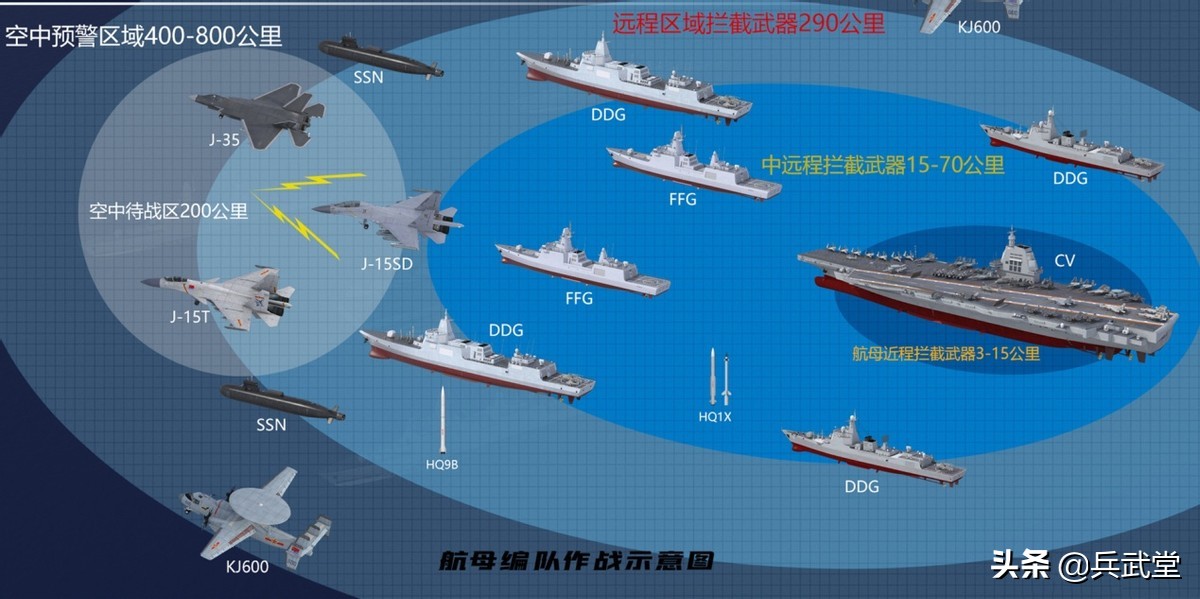
If the target fleet employs classic coverage of CAPs at 800 km as advertised.
2cb9bae385384b46b58e98b5a5900be3.jpg

and assuming their radars are as good as today's with a scanning range of 500 km and assuming F/A-XX can be detected at 30-40 km.
At latest they would need to release at a distance of 830 km. The F35 will be at risk.
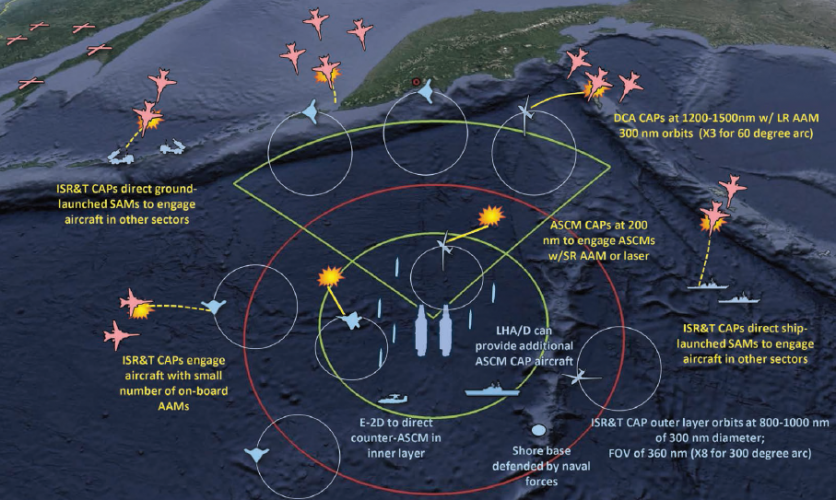
But if they use drones and employ the newer scheme placing CAP at 1200 NM with a radar range of 360 NM
outer-air-battle.png
the F/A-XX will need to penetrate 1060 NM. The B52 with AGM-183A ARRW won't do. The B21 would be needed assuming it can penetrate 360 NM without issue.
 

Similar threads

Back
Top Bottom