- Joined
- 3 June 2011
- Messages
- 20,030
- Reaction score
- 17,225
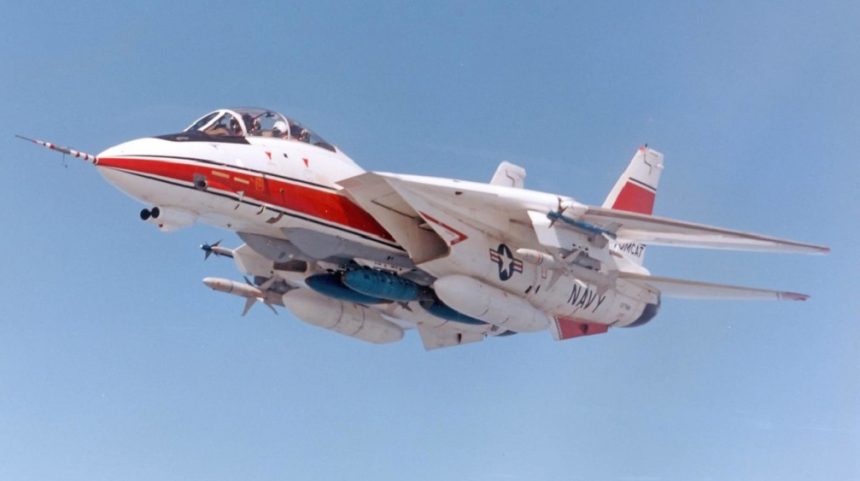
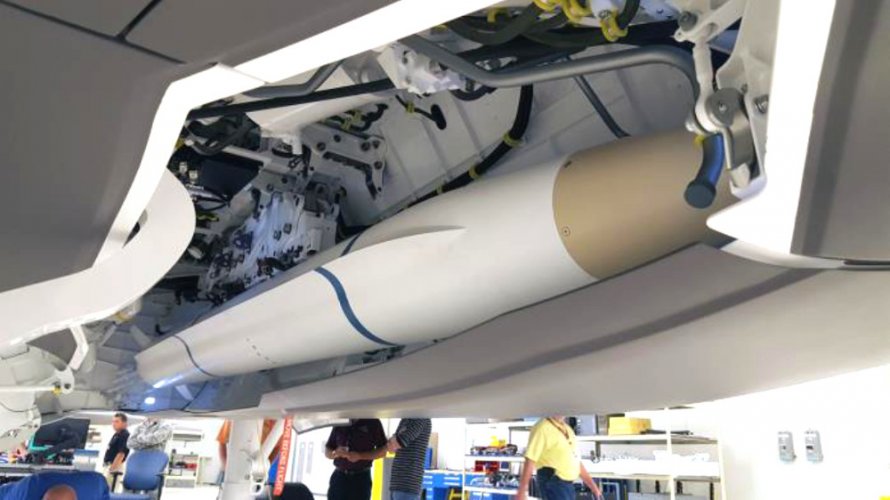
At mid - closer ranges there is a gap left to be filled for a fighter that can internal carry such a weapon vs internal carrying the SiAW.


At mid - closer ranges there is a gap left to be filled for a fighter that can internal carry such a weapon vs internal carrying the SiAW.

If we had the one on the left. . .I deleted my comment because I think I should frame this differently.
For cruise missiles of any range to be effective, how you carry them and how many you launch are all functions of the range to target.
Sure you can sling out a few hundred from the back of a few C-130s and 4th gen fighters from far far away, but that seems ill advised and not sustainable for regular attacks. You want to have a platform operating at near stand in ranges to perform timely, short reaction time attacks to take the best advantage of the munition.
- At the stated 500 nm range of the JASSM-ER and LRASM, your likely predators are aerial threats. You could make a case for 4th gen fighters slinging them at 500 - 1000 NMi (for the XR) provided that they have enough cover. At these ranges though, in order for them to make it through, you'd have to launch more.
- At 100-300 NMi, the enemy would have much less reaction time and necessarily the probability of intercept for cruise missiles drops a bit more so you necessarily would need to launch less. I would expect regular interdiction to be performed at this range with LRASMs and for anything sub 150NMi, then use SiAW carried internally. I find it doubtful that you could perform regular sorties and regular interdictions with bombers like the B-21 and the B-2. At least in my impression, having them loiter around for regular strikes at even 200 - 300 nmi is a bad idea. The only time you'd want them launching is to wipe out an amphibious landing. You'd want something maneuverable (compared to a bomber) that can internal carry a JASSM-ER. Currently that's the gap that exist
@Sferrin Yeah sure J-36s are the ideal thing to do the kind of job, but that only works for China because China doesn't have basing limitations, doesn't need to operate out of remote bases and the J-36 isn't flying itself off a carrier. This beckons the question of how many JASSMs or LRASMs to carry, how much range and loiter time F/A-XX would have while carrying them, which air to air munitions would be given up and where their A2A cover comes from.

I hate this photoshop, every article uses it and it artificially lengthens the weapons bay for what reason? The J-36 already has a 7m Center line bay, this makes it look like it’s 9m long. The Real J-36 bay ends at the end of the main gears. People need to stop spreading it around.

Bullshit Navy need a new fighter not a UCAV.Dumber than a sack of bowling balls.

If it comes it comes, if it doesn't...well it doesn't. Unfortunately the Americans are truly testing the patience of many observers.Still nothing about the FA/XX contract ?
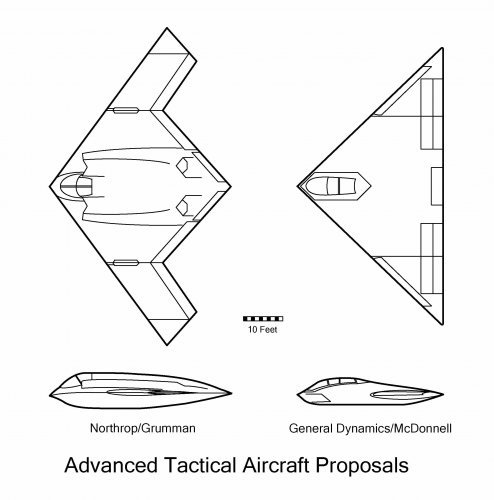
ATA, A/F-X, NATF...so many ambitious and in many cases promising USN programs have come and gone without results. It's quite unfortunate how poor the track record has recently been. Makes one wonder if the Navy would even have stealth aircraft nowadays if the USAF didn't back the F-35 as well.If we had the one on the left. . .
MQ-9Bs + E7/E2Ds + Satellite AMTI can be enough for multistatic AEW.I'd personally prefer to have a survivable early warning and air defense asset... strikes can come later, survival comes first.

ATA, A/F-X, NATF...so many ambitious and in many cases promising USN programs have come and gone without results. It's quite unfortunate how poor the track record has recently been. Makes one wonder if the Navy would even have stealth aircraft nowadays if the USAF didn't back the F-35 as well.
It'd be a pain to wrangle, but a conversion kit to stick the SM6 booster (Mk104?Mk72) onto the back end of a BLU-109 would be hilarious.
This is a pretty mediocre payload for naval strike? Though everyone in this thread seems to forget about JSM and the drag issues with external stores to long range. If you want to punch to 1000nmi then having external stores isn't great.The idea of carrying AGM-158s is stupid. It’s a weapon that exists in the hundreds that has a long range such that internal carriage is not necessary, and while width might be AARGM-ER, height/depth most certainly is not. I also would not assume AARGM is a prereq either.
Talk of 5000 lb penetrators is simply insane.
I would assume something like four 2000 lb class GP/penetrators, or alternatively 16 SDB as internal payload, since less than that does not improve much on F-35 (perhaps four mk83 as a fallback position). I also would assume a modestly sized cruise missile (say Baracuda 500) and/or a high speed direct attack missile (what ever equates to the ACME study) was also an option, though not necessarily AGM-88G given the width issues. I still think a healthy number of pylons would be present for light stand off weapons (MACE ish), ideally ejectable with low RCS penalty post jettison.
That I think would give you a well rounded strike fighter that still could extend range. Four largish weapons internally for direct attack, or 16 small diameter bombs, and maybe four pylons for four more 2000 lb class weapons or a pair of something smaller on a random ejector. About a dozen 1000 lb class bombs/cruise missiles on the heavy payload end.
This is a pretty mediocre payload for naval strike? Though everyone in this thread seems to forget about JSM and the drag issues with external stores to long range. If you want to punch to 1000nmi then having external stores isn't great.
Again, an aircraft with a ~40klb empty weight works out. 12,000lbs of ordnance and 28,000lbs of internal fuel. ~80,000lbs MTOW.FA-XX will not carry four large weapons or have double the payload volume of the F-35C. The heaviest aircraft to operate from a carrier is only 25% heavier than the F-35C.
Why would you want to go down to a ~14" deep bay? Most of the newer weapons are bigger than that. Crud, JSMs are 19" deep.Touching on internal stores again, it would not surprise me if there was one central bay with four mk83 sized pieces of ordnance and the length of the F-35 bay for cross compatibility of new weapon types. That should allow for a healthy sized internal direct attack, JSOW, SDB (x16), and whatever future small sized subsonic and supersonic cruise missiles are developed.
IIRC the AARGM-ER doesn't fit into F-35 bays, it's too wide.I do not think AGM-88G has a very long future (replaced with whatever fills the ACME concept) and in any case the F-35s can carry it.
? If the bay is the same length as the F-35 (and deep enough), it'll be able to carry 2000lb weapons.The main sticking point I see with the above is that the USN would not be able to carry 2000 lb class penetrators, though perhaps two could still be carried in place of four other weapons.
So do I, but I've been picturing the primary mission design as ~12klbs internal carriage, not external.I still see a heathy amount of external hard points with ejectable pylons) for heavy SOW loads, either as prep for penetration or along with the internal weapons, in place of penetration.
Why would you want to go down to a ~14" deep bay? Most of the newer weapons are bigger than that. Crud, JSMs are 19" deep.
So do I, but I've been picturing the primary mission design as ~12klbs internal carriage, not external.
least stealthy thing to take off from a carrier.

IIRC the AARGM-ER doesn't fit into F-35 bays, it's too wide.

Yeah that was around 50% of the point with AARGM-ER. Better than the AARGM and fitting F-35 internal baysIt does.

It fits in As and Cs but not Bs.IIRC the AARGM-ER doesn't fit into F-35 bays, it's too wide.

Range is mission profile dependent for both. F-47 officially has been described as having a combat radius of 1,000 nmi +. Combat radius targets with NGAP will probably exceed 1,000 nmi by some margin. FA-XX could have some supercruise requirement given its longer reach relative to both F-35C and F/A-18E and need to cover distance and generate sorties. An internal fuel only subsonic combat radius of 800 - 1,000 nmi for F/A-XX is probably a good estimate in some sort of air to air or a mix load of weapons.Range for FA-XX seems far more modest than F-47; I do not think a 1000 nmi is on the table based on previous statements and the fact adaptive engines are off the table.
It does.
It's also the ATA payload. The most stealthy thing to have been designed to launched off a carrier.Physically impossible. That’s the A-3 payload, the largest, least stealthy thing to take off from a carrier.
We know the design payloads, which is what I have been talking about.The ATA never made it into service Scott Kenny so we will never know how heavy it was supposed to be unfortunately.
It is interesting to see that the McDD/GD ATA example is much heavier than the NG variant Scott Kenny, did that have anything to do with the final decision that went McDD and General Dynamics way?
It's also the ATA payload. The most stealthy thing to have been designed to launched off a carrier.

So something that never existed.
So something that never existed.