The effect of RAN 1964 Carrier Replacement Plan going Ahead?

I was wrong still, during this time period you really need a Weapons Systems Officer to not overload the pilot with the AIM-7.
Really anyway you look at in 1964 there is only one option for the RAN for a supersonic jet with BVRM capability and its the F-4
I hear where you're coming from mate. But please keep in mind Australia/RAN wouldn't be facing complete Soviet Tu-16 Regiments attacking its carrier fleet. So, I think it's prudent that we keep the threat vs response within perspective.
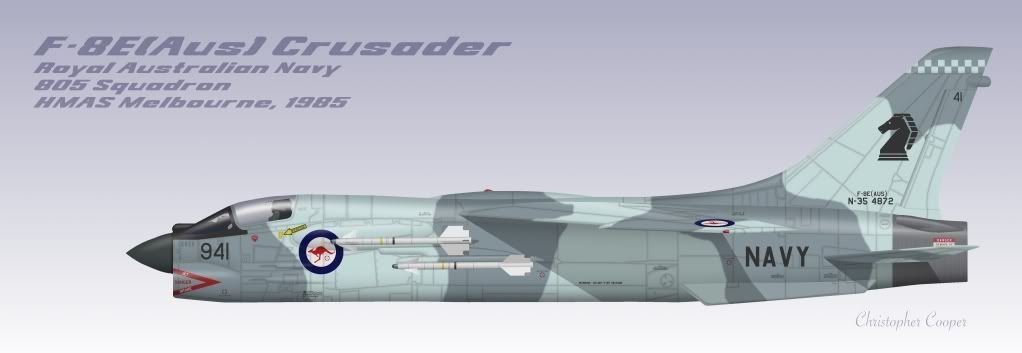
Hence a Crusader armed with two Sparrow's, two Sidewinder's and two 20mm cannon will provide a substantial leap in defence capability of the carrier task force substantial better than four Sidewinder-armed Skyhawk's.
I still think the expense and knock-on effect of obtaining Phantom II's for the RAN is excessive.

Come to think of it, if your
need a Weapons Systems Officer to not overload the pilot with the AIM-7.
is deemed a necessity, then perhaps Vought could devise an earlier derivative of the two-seat TF-8A Twosader
  • XF8U-1T – one XF8U-2NE used for evaluation as a two-seat trainer.
Or, come to think about, how about we go the full hog and go for the
  • F8U-1T (TF-8A) (V-408) – two-seat trainer version based on F8U-2NE, fuselage stretched 2 ft (0.61 m), internal armament reduced to two cannon, J57-P-20 engine, first flight 6 February 1962. The Royal Navy was initially interested in the Rolls-Royce Spey-powered version of TF-8A but chose the Phantom II instead. Only one TF-8A was built, although several retired F-8As were converted to similar two-seat trainers.

P.S. I'll keep searching for the specific designation of the Sparrow-armed Crusader proposed by Vought.......

Regards
Pioneer
 

Attachments

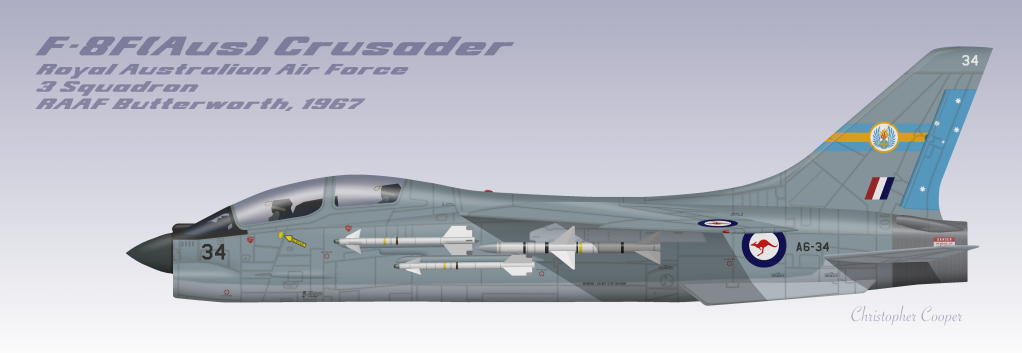
  • WhatIf RAN Vought F-8F(Aust) Crusader (Sparrow).png
    WhatIf RAN Vought F-8F(Aust) Crusader (Sparrow).png
    133.6 KB · Views: 31
Last edited:
I hear where you're coming from mate. But please keep in mind Australia/RAN wouldn't be facing complete Soviet Tu-16 Regiments attacking its carrier fleet. So, I think it's prudent that we keep the threat vs response within perspective.
Hence a Crusader armed with two Sparrow's, two Sidewinder's and two 20mm cannon will provide a substantial leap in defence capability of the carrier task force substantial better than four Sidewinder-armed Skyhawk's.
I still think the expense and knock-on effect of obtaining Phantom II's for the RAN is excessive.

Come to think of it, if your

is deemed a necessity, then perhaps Vought could devise an earlier derivative of the two-seat TF-8A Twosader

Or, come to think about, how about we go the full hog and go for the


P.S. I'll keep searching for the specific designation of the Sparrow-armed Crusader proposed by Vought.......

Regards
Pioneer
That is true mate its not facing soviet Tu-16 regiments.
Though the main reason i dont like the F-8 for the RAN is one its about to go out of production and be replaced by the F-4 in USN Service and two its very high attrition rate of the F-8 especially when compared to the A-4 & F-4
 
That is true mate its not facing soviet Tu-16 regiments.
Though the main reason i dont like the F-8 for the RAN is one its about to go out of production and be replaced by the F-4 in USN Service and two its very high attrition rate of the F-8 especially when compared to the A-4 & F-4
Good and valid points you make here Caryina2642!
But, if Australia is smart, it could incorporate this two-seater Twosader build and buy with Britian (and perhaps France), and in doing so, sharing the love.
As for the aspect of 'attrition rate', one should probably consider that if Australia/RAN was to buy the Spey-powered F-4M to operate from 'Hermes', we'd probably still suffer attrition, as a consequence of the power settings needed by the F-4's to operate off the smallish Hermes.
Add to this the demonstrated professionalism of the RAN FAA, I'm confident we'd minimise that attraction rate of the Crusader.;)

Regards
Pioneer
 

Attachments

  • WhatIf RAN Vought F-8E(Aust) Crusader.jpg
    WhatIf RAN Vought F-8E(Aust) Crusader.jpg
    28.9 KB · Views: 34
Good and valid points you make here Caryina2642!
But, if Australia is smart, it could incorporate this two-seater Twosader build and buy with Britian (and perhaps France), and in doing so, sharing the love.
As for the aspect of 'attrition rate', one should probably consider that if Australia/RAN was to buy the Spey-powered F-4M to operate from 'Hermes', we'd probably still suffer attrition, as a consequence of the power settings needed by the F-4's to operate off the smallish Hermes.
Add to this the demonstrated professionalism of the RAN FAA, I'm confident we'd minimise that attraction rate of the Crusader.;)

Regards
Pioneer
I dont see Britian buying a sprey powered F-8, They would want F-4s cause they would be facing Tu-16 regiments. I would expect the attrition rate to be lower with the F-4 than the F-8, Just from historical attrition rate of both aircraft in US Service
 
The numbers shown @NOMISYRRUC shown that the RAN was almost there in terms of required personal, that we could have manned her, if we made the decision to get an Essex in 64. (I would say recruitment would increase with an essex an the table).

In practice the RAN CN was dreaming, the economy was at full employment and booming. An inability to recruit to projected numbers was why the Army had to have conscription introduced. None of the other Service Chiefs believed the Navy could do it, after all they were trying to do similar things and failing.

Also the document states if in rember correctly that the F4s were to get longer nose gear like the F-4K to help them operate of the Carrier

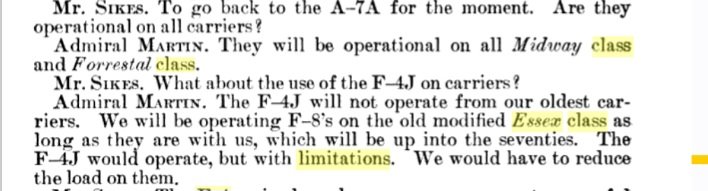
The document is grossly optimistic. This topic has been dissected at great length in other thread, bu basically a rebuilt Essex can only steam a 19 knots when launching aircraft and each cat shot consumes 10% of available steam, in contrast a Midway class can steam at 23 knots when launching aircraft and each cat shot consumes 7%. This makes the Essex inherently unsafe for the regular operation of Phantoms whereas a Midway was inherently safe. The extended nose oleo get the Phantom closer to an Essex, but it could be hemmed in by so many restrictions as to be not worthwhile.
 
Still doubting that slow speed. The RN calculated with 28 kts for Eagle and Ark launching Phantoms, so 19 for the faster essexes looks awfully low.

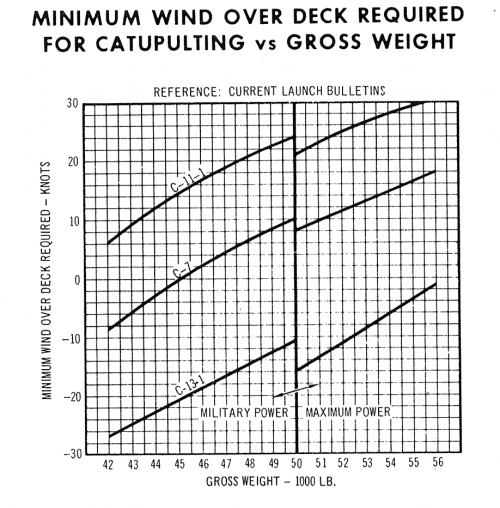
But even if: on the c-11, the Crusader needed 10 kts wod. A 48-50k lbs F-4 with the nose up is about 5-10 kts wod for minimum launch speed, so even with a bit safety extra it works out. As standard F-4s did on Coral Sea, even the supposed 4 kts difference in speed would be easily overcome by 10-12 kts gained from the nose strut.

The USN often claimed otherwise to get rid of the Essexes, but that was just as gor the F-18. And sometimes, they were honest....
 

Attachments

  • Screenshot_20251018_082708_Chrome.jpg
    Screenshot_20251018_082708_Chrome.jpg
    56.1 KB · Views: 34
Still doubting that slow speed. The RN calculated with 28 kts for Eagle and Ark launching Phantoms, so 19 for the faster essexes looks awfully low.

Yeah, I can see why. We've seen scanned docs about the Hermes doing 26kts while using the cats, so 19kts is very slow. Was that figure verified on some old documents?
 
The 28 kts are in the McD F-4K brochure. 25 Hermes and 28 Eagle is in the RN docs from 1963/4.
Not sure where the 19 for Essex come from. Maybe a worst case, max launch number? While the other numbers are for slower ops?
 
I think it was ~72m Australian pounds, just for the carrier, the CAG would cost the same again.
£A72 million for the ship only was exactly what I said. So was the £A58 million for an Oriskany. See Message 74.

Although some of the money for the air group was spent anyway with the Sea Kings, Skyhawks, Trackers and Wessexes that were purchased for Melbourne.
As much as I love that NAA Document, it's a pain to search through.
If it helps A4 and foolscap documents are easier to read if one has a big monitor that can be rotated from landscape to portrait. I know this because the huge monitor that I plugged my laptop into to make documents easier to read died six months ago and I replaced it with a smaller (but still rather large) monitor that is attached to its base by a pivot at the back which allows me to swivel it from landscape to portrait.
 
Still doubting that slow speed. The RN calculated with 28 kts for Eagle and Ark launching Phantoms, so 19 for the faster essexes looks awfully low.

But even if: on the c-11, the Crusader needed 10 kts wod. A 48-50k lbs F-4 with the nose up is about 5-10 kts wod for minimum launch speed, so even with a bit safety extra it works out. As standard F-4s did on Coral Sea, even the supposed 4 kts difference in speed would be easily overcome by 10-12 kts gained from the nose strut.

The USN often claimed otherwise to get rid of the Essexes, but that was just as gor the F-18. And sometimes, they were honest....
So the essex could operate a modified F4 with some limitations, how big would these limitations be?
So the only thing really holding this back is the cost and the to small number of aircraft stated to be brought for the air wing
 
£A72 million for the ship only was exactly what I said. So was the £A58 million for an Oriskany. See Message 74.
To be pedantic the estimated cost of a CVA.01 (ship only) was £A72.5 million in 1964 and which was £A14.5 million (25%) more than the estimated cost of a modernised Oriskany (ship only). The expected delivery of the Oriskany was 1968 and the expected delivery of a CVA.01 was 1972-74.

I reiterate that the the estimated costs were the estimated costs for the ships only, which, ipso facto, doesn't include the cost of the aircraft. But said aircraft would cost exactly the same regardless of which ship they were operating from. Furthermore, as I already wrote in an earlier post (albeit in a different way) the cost of the aircraft purchased for Melbourne IOTL has to be deducted from the costs of the aircraft required for a new ship or a modernised Oriskany. For that matter so does the cost of the refits that Melbourne had to enable her to operate Skyhawks and Trackers.

I've been wittering on about the compliments of Melbourne, Sydney, the Essex class and CVA.01 because it's clear to me that a CVA.01 and a modernised Oriskany would have the same size crew when operating the same number of aircraft and the same types of aircraft. Therefore, if Australia can find enough men for an Oriskany, it can find enough men for a CVA.01. Conversely, if Australia cant find enough men for a CVA.01, it can't find enough men for a modernised Oriskany.

If Her Majesty's Australian Government had decided to buy a CVA.01 in 1964, it's unlikely that they would have got it on time and at cost. However, getting a modernised Oriskany on time and at cost is rather unlikely too. E.g. Midway's SCB.101 refit took twice as long and cost nearly 2.5 times longer than estimated. I suspect that in practice the difference between the cost of a modernised Oriskany and a new CVA.01 would not have been less than 25%.

That's if any Oriskanys were for sale. This is not long before the full-scale US involvement in the Vietnam War when the USN suddenly needed every attack carrier it could get.

So they'd have to buy a SCB.27A Essex with hydraulic catapults or one of the surviving unmodernised Essexes, both of which would take longer and cost more to modernise to the required standard than an Oriskany.

Or they'd have to wait several years for one of the Oriskany's became available. Plus when it did become available the refit would cost more and take longer than estimated in 1964 because of the extra wear and tear due to its several years of service in the Vietnam War.

So if they're going to replace Melbourne, do it properly by buying a new ship. Either a CVA.01 from the British or a SCB.100 from the Americans.

Except, a SCB.100 was estimated to cost even more than a CVA.01. Plus if the first 3 Nimitz class are anything to go buy the time and cost overruns on a SCB.100 would be even worse than what I expect they would have been for a CVA.01 ITTL and were IOTL for the Invincible class.

 
F-4J or F-4B with drooped ailerons:


1760780206817.png

How this translates into actual essex class operations, my best guess: 50k lbs (fuel, droptank, missiles) 21 kts wod, with the longer nose strut about 10 kts wod. Even with a higher safety margin, tropical conditions and lower speed, this should work.
 
I'm very fond of the Spey Twosader concept. I think it may still need a full set of high-lift devices installed to fly off the postage stamps the rest of the world tries to pass off as Aircraft carriers, however. LE slat, fowler or slotted TE flaps, drooping ailerons, maybe even BLC blowing. On top of the variable-incidence wing.
 
To be pedantic the estimated cost of a CVA.01 (ship only) was £A72.5 million in 1964 and which was £A14.5 million (25%) more than the estimated cost of a modernised Oriskany (ship only). The expected delivery of the Oriskany was 1968 and the expected delivery of a CVA.01 was 1972-74.

I reiterate that the the estimated costs were the estimated costs for the ships only, which, ipso facto, doesn't include the cost of the aircraft. But said aircraft would cost exactly the same regardless of which ship they were operating from. Furthermore, as I already wrote in an earlier post (albeit in a different way) the cost of the aircraft purchased for Melbourne IOTL has to be deducted from the costs of the aircraft required for a new ship or a modernised Oriskany. For that matter so does the cost of the refits that Melbourne had to enable her to operate Skyhawks and Trackers.

I've been wittering on about the compliments of Melbourne, Sydney, the Essex class and CVA.01 because it's clear to me that a CVA.01 and a modernised Oriskany would have the same size crew when operating the same number of aircraft and the same types of aircraft. Therefore, if Australia can find enough men for an Oriskany, it can find enough men for a CVA.01. Conversely, if Australia cant find enough men for a CVA.01, it can't find enough men for a modernised Oriskany.

If Her Majesty's Australian Government had decided to buy a CVA.01 in 1964, it's unlikely that they would have got it on time and at cost. However, getting a modernised Oriskany on time and at cost is rather unlikely too. E.g. Midway's SCB.101 refit took twice as long and cost nearly 2.5 times longer than estimated. I suspect that in practice the difference between the cost of a modernised Oriskany and a new CVA.01 would not have been less than 25%.

That's if any Oriskanys were for sale. This is not long before the full-scale US involvement in the Vietnam War when the USN suddenly needed every attack carrier it could get.

So they'd have to buy a SCB.27A Essex with hydraulic catapults or one of the surviving unmodernised Essexes, both of which would take longer and cost more to modernise to the required standard than an Oriskany.

Or they'd have to wait several years for one of the Oriskany's became available. Plus when it did become available the refit would cost more and take longer than estimated in 1964 because of the extra wear and tear due to its several years of service in the Vietnam War.

So if they're going to replace Melbourne, do it properly by buying a new ship. Either a CVA.01 from the British or a SCB.100 from the Americans.

Except, a SCB.100 was estimated to cost even more than a CVA.01. Plus if the first 3 Nimitz class are anything to go buy the time and cost overruns on a SCB.100 would be even worse than what I expect they would have been for a CVA.01 ITTL and were IOTL for the Invincible class.
Going off paragraph 33 & 34 the RAN was going to get one of the preserved Essex in storage
SO the RAN can choose to go second hand and get it in say the 1968 - 1972 time period or a CVA-01 in the 1972
 
The berthing in Essex-class would make mixed crews challenging, to say the least. It's all large open bays!
I'm not being sarcastic, but how many open bays? Would it be feasible to have some for the female crew and the rest for the male crew? And as the ship has to be modernised anyway the accommodation can be modified as part of said modernisation at what I suspect would be negligible (if any) extra time and negligible extra cost.
Also, have you seen the heads/toilets? Just rows of seats, no stalls, no doors.
You've got me on that one. I've never visited any of the surviving Essex class or seen photographs of the heads/toilets.

But again (and again not sarcastically) how hard (and expensive) would it be to designate a few of these large open bays that the rows of seats were in for women and the rest for men? Similarly, as the ship has to be modernised anyway, some stalls and doors could be installed at little extra cost and little or no extra time.

Also, an Oriskany had a crew of 3,500 in USN service and the estimated crew of an Oriskany in RAN service was 2,291 so there's more accommodation (including the heads/toilets) to go around which may make it easier to provide female-only accommodation (including heads/toilets).
 
Last edited:
Going off paragraph 33 & 34 the RAN was going to get one of the preserved Essex in storage
SO the RAN can choose to go second hand and get it in say the 1968 - 1972 time period or a CVA-01 in the 1972
Which destroys half-a-morning's work in two sentences.

Despite of the above, I still think that if the Australian Government did decide to replace Melbourne in 1964 buying a new ship was the correct thing to do.

When the cost of the aircraft was included the difference in the cost would be a lot less than 25% difference in the cost of the ships alone.

Yes, they'd have to wait at least 4-6 years longer for it, but when they get it, it will last longer than a second-hand ship, probably be cheaper to maintain & have higher availability rates, plus have things like better accommodation and a modern torpedo defence system.

Also the larger cost of the new ship was spread over 8 to 10 years instead of 4 years for a new ship. Although the cost of keeping Melbourne in service for another 4 to 6 years may cancel that out.
 
Which destroys half-a-morning's work in two sentences.

Despite of the above, I still think that if the Australian Government did decide to replace Melbourne in 1964 buying a new ship was the correct thing to do.

When the cost of the aircraft was included the difference in the cost would be a lot less than 25% difference in the cost of the ships alone.

Yes, they'd have to wait at least 4-6 years longer for it, but when they get it, it will last longer than a second-hand ship, probably be cheaper to maintain & have higher availability rates, plus have things like better accommodation and a modern torpedo defence system.

Also the larger cost of the new ship was spread over 8 to 10 years instead of 4 years for a new ship. Although the cost of keeping Melbourne in service for another 4 to 6 years may cancel that out.
Whoops sorry mate.
I get what your saying and i do agree with a new ship will always be better and the RAN will be able to operate it longer. Plus if the RAN orders a CVA-01 i would say the RN would get one to cause otherwise it would look very bad if the cancel the order if the RAN is also getting one.
I agree the longer time period allows paying it off better, though i do fear having to keep melbourne in commision for longer may cancel it. Thats why i kinda prefer the essex it terms of you get it quicker leaving less likely for goverment to cancel it
 
Whoops sorry mate.
Thank you and no offence was taken.
I get what your saying and do agree with a new ship will always be better and the RAN will be able to operate it longer.
Fair enough.
Plus if the RAN orders a CVA-01 I would say the RN would get one to cause otherwise it would look very bad if the cancel the order if the RAN is also getting one.
What you said, plus the RAN buying a CVA.01 may make the the British ships cheaper to build and operate by spreading the fixed building and operating costs over a larger number of ships.

IIRC from the RAF's official history for the period the Wilson Government wanted to reduce defence spending in 1970 from £2.4 billion at 1964 prices to £2.0 billion at 1964 prices. The projected costs of HM Forces with strike carriers were over that target while the projected costs for the land-based maritime air force was less than the target.

It's unlikely, but Australia buying a CVA.01 might reduce difference between the cost of maintaining the RN's strike carrier force and the cost of a shore-based maritime air force operated by the RAF by enough to make the saving not worth it. Although, I think that when costs of the Tiger class helicopter cruisers and their replacements the Invincible class are included the saving in men and money was negligible anyway.
I agree the longer time period allows paying it off better, though I do fear having to keep Melbourne in commission for longer may cancel it. That's why I kinda prefer the Essex it terms of you get it quicker leaving less likely for government to cancel it.
The cost of the aircraft can be spread over a greater period too. However, in addition to the cost of keeping Melbourne in commission for longer there's inflation to consider.
 
I'm not being sarcastic, but how many open bays? Would it be feasible to have some for the female crew and the rest for the male crew? And as the ship has to be modernised anyway the accommodation can be modified as part of said modernisation at what I suspect would be negligible (if any) extra time and negligible extra cost.

You've got me on that one. I've never visited any of the surviving Essex class or seen photographs of the heads/toilets.

But again (and again not sarcastically) how hard (and expensive) would it be to designate a few of these large open bays that the rows of seats were in for women and the rest for men? Similarly, as the ship has to be modernised anyway, some stalls and doors could be installed at little extra cost and little or no extra time.

Also, an Oriskany had a crew of 3,500 in USN service and the estimated crew of an Oriskany in RAN service was 2,291 so there's more accommodation (including the heads/toilets) to go around which may make it easier to provide female-only accommodation (including heads/toilets).
Female crew wouldn't be an issue if the RAN had an Essex as the RAN didn't deploy women at sea until the 1990s.
 
You've got me on that one. I've never visited any of the surviving Essex class or seen photographs of the heads/toilets.

But again (and again not sarcastically) how hard (and expensive) would it be to designate a few of these large open bays that the rows of seats were in for women and the rest for men? Similarly, as the ship has to be modernised anyway, some stalls and doors could be installed at little extra cost and little or no extra time.

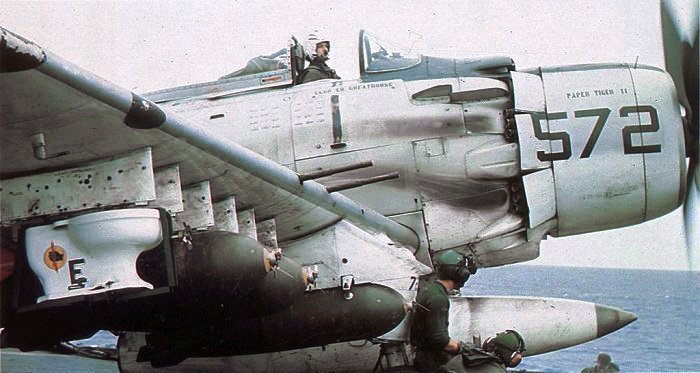
I'd have full trust in naval engineering when it comes to redesigning of dropping... ordnance.

1760811161474.jpeg
 
Female crew wouldn't be an issue if the RAN had an Essex as the RAN didn't deploy women at sea until the 1990s.
There's always one. As someone once said.
View: https://www.youtube.com/watch?v=z4uivPpzCGo

I've been deliberately using man, men and manning instead of crew and crewing, because the decision on what ship to buy would be taken shortly before the start of Women's Lib which would be in full swing when the ship entered service, so supplement the inadequate supply of men with women and allow them to serve at sea decades earlier than IOTL.
 
I'd have full trust in naval engineering when it comes to redesigning of dropping... ordnance.

View attachment 788602
Although you're joking, IIRC from "The World at War" episode about the strategic bombing of Germany, the crews of Allied bombers would drop their chemical toilets over Germany until the Red Cross had the practice banned.
 
So the essex could operate a modified F4 with some limitations, how big would these limitations be?

Big enough for the USN to keep flying the obsolescent F8 until 1976 rather than convert to the far more advanced F4. Its the difference between being able to fly from and being able to operate from. In practice this would mean:
  • Launching with not enough speed over the stall speed, eg 8kts over stall compared to the standard 15kt, leaving the aircraft vulnerable to stalling and dropping into the sea upon launch.
  • Having to launch with less fuel and weapons, this is a sliding scale which can get to zero on a hot day and you can guarantee that when you most need to launch will be the day when you can't.
  • Less landing on fuel margin, meaning the F4 would arrive back at the carrier with enough fuel for for 1 or 2 bolters as opposed to the standard 4 or 5. In the absence of diversion airfields this means ditching into the sea just because of a lack of fuel for a 3rd or 4th landing attempt.
All in all this would push the losses because of mishaps, ie accidents inherent in carrier flying, to the point where there wouldn't be enough F4s to fly after a few years. For example the RN lost 8 of its 28 F4s in 9 years of carrier flying and a RAN Essex would be worse than that.
 
While I have it open (Page 55 NAA documents), the estimated acquisition cost of the aircraft for the Essex are as follows, in Australian pounds which were USD $2.20.
  • 28 x F4B A£19,933,700
    • F4B test, support & 1-year spares A£12,031,522
  • 24 x S2E A£10,600,711
    • S2E support & 1-year spares A£4,601,974
  • 8 x E1B A£6,809,104 or A£3.942,117
    • E1B support & 1-year spares A£1,618,886
  • Air armament A£5,434,000
  • Oriskany class carrier A£58,101,449
    • carrier spares A£5,000,000
In addition pp 179-186 of the NAA documents provide the C-COSC's objections to the entire 'Essex with F4' proposal. While ACM Scherger was a RAAF officer and therefore not fully up to speed with ships he was well and truly familiar with what it takes to run an Air Force, regardless if it is on a land or a carrier.
 
Last edited:
Thank you and no offence was taken.

Fair enough.

What you said, plus the RAN buying a CVA.01 may make the the British ships cheaper to build and operate by spreading the fixed building and operating costs over a larger number of ships.

IIRC from the RAF's official history for the period the Wilson Government wanted to reduce defence spending in 1970 from £2.4 billion at 1964 prices to £2.0 billion at 1964 prices. The projected costs of HM Forces with strike carriers were over that target while the projected costs for the land-based maritime air force was less than the target.

It's unlikely, but Australia buying a CVA.01 might reduce difference between the cost of maintaining the RN's strike carrier force and the cost of a shore-based maritime air force operated by the RAF by enough to make the saving not worth it. Although, I think that when costs of the Tiger class helicopter cruisers and their replacements the Invincible class are included the saving in men and money was negligible anyway.

The cost of the aircraft can be spread over a greater period too. However, in addition to the cost of keeping Melbourne in commission for longer there's inflation to consider.
The more i have thought about it the more i agree with you about the CVA-01 being the better options. As you state it allows to pay for it and the air group over a longer period of time and also gives time to build up the RAN personal numbers.
To make the CVA-01 cheaper it would depend on how many the RN end u building if they build 4 and 1 for the RAN it should in theory make the chips cheaper due to the larger order, but if the RN only build 2 or 3 plus the RAN the coast would probably stay the same.
If the RAN buys 30 -40 F-4Ks it might bring the cost down just due to a larger order.
How many CVA-01 would the RN get in this scenario obviously 1 (Cause it would be embarrassing for the UK if Australian buys a CVA-01 and they cancel the CVA-01 for the RN)?
Say you buy enough A-4s and S-2s and refit Melbourne to last until CVA-01 enters service
  • You would probably have to buy more S-2s in the 70s to fill out the air group and swap the engine for a turbo prob so all the carrier fuel tanks are jet fuel
  • Keep the A-4s for training and advisory aircraft?
  • Could E-2s operate of a CVA-01?
How would a CVA-01 effect the RAN and Australia?
  • Would the DDL still be a Tartar/Standard armed ship or a seadart ship for commonality with the Carrier?
  • Intervention in Fiji 1987 after the coup?
  • Gulf War Deployment?
  • 1999 East Timor goes hot?
Additionally i know this is off topic but Australia had the chance to save 2 British defense programs of the 60s. The CVA-01 which we have talked about and if they had ordered the TSR.2 over the F-111. I wonder how this would effect Britain and Australia, if Australia had ordered a CVA-01 and 24-36 TSR.2 in the 60s?
 
Last edited:
The more I have thought about it the more I agree with you about the CVA-01 being the better options. As you state it allows to pay for it and the air group over a longer period of time and also gives time to build up the RAN personal numbers.
To make the CVA-01 cheaper it would depend on how many the RN end up building if they build 4 and 1 for the RAN it should in theory make the chips cheaper due to the larger order, but if the RN only build 2 or 3 plus the RAN the cost would probably stay the same.
If the RAN buys 30 -40 F-4Ks it might bring the cost down just due to a larger order.
How many CVA-01 would the RN get in this scenario obviously 1 (Cause it would be embarrassing for the UK if Australian buys a CVA-01 and they cancel the CVA-01 for the RN)?
Say you buy enough A-4s and S-2s and refit Melbourne to last until CVA-01 enters service
  • You would probably have to buy more S-2s in the 70s to fill out the air group and swap the engine for a turbo prob so all the carrier fuel tanks are jet fuel
  • Keep the A-4s for training and advisory aircraft?
  • Could E-2s operate of a CVA-01?
How would a CVA-01 effect the RAN and Australia?
  • Intervention in Fiji 1987 after the coup?
  • Gulf War Deployment?
  • 1999 East Timor goes hot?
Additionally I know this is off topic but Australia had the chance to save 2 British defense programs of the 60s. The CVA-01 which we have talked about and if they had ordered the TSR.2 over the F-111. I wonder how this would effect Britain and Australia, if Australia had ordered a CVA-01 and 24-36 TSR.2 in the 60s?
I usually say 3 CVA.01s built from circa 1966 to the middle 1980s using the money spent on Ark Royal's OTL Phantomisation refit, the OTL conversion of Hermes to a commando carrier, the conversion of Tiger & Blake to helicopter cruiser, building the OTL Invincible class and then some. One would be fully operational, one would be working up and the third would be in refit/reserve. There would be 2 operational air groups and one training group. In the event of war the operational groups would be brought to their war establishment by breaking up the training group. Some of the additional operating costs would be offset by the RAF having no maritime fighter squadrons, no maritime strike squadrons and no AEW squadron plus a corresponding reduction in the size of second line units like the Buccaneer OCU and the Phantom OCU.

Yes, E-2s could operate from a CVA.01.

I don't know about the rest.
 
I usually say 3 CVA.01s built from circa 1966 to the middle 1980s using the money spent on Ark Royal's OTL Phantomisation refit, the OTL conversion of Hermes to a commando carrier, the conversion of Tiger & Blake to helicopter cruiser, building the OTL Invincible class and then some. One would be fully operational, one would be working up and the third would be in refit/reserve. There would be 2 operational air groups and one training group. In the event of war the operational groups would be brought to their war establishment by breaking up the training group. Some of the additional operating costs would be offset by the RAF having no maritime fighter squadrons, no maritime strike squadrons and no AEW squadron plus a corresponding reduction in the size of second line units like the Buccaneer OCU and the Phantom OCU.

I don't know about the rest.
So the cost for the ships would stay the same most likely.
I wonder when the RAN CVA-01 would enter service would she be the 2nd or 3rd Carrier built?
 
I wonder when the RAN CVA-01 would enter service would she be the 2nd or 3rd Carrier built?
Never, probably, because of what @Rule of cool's been writing about how unrealistic it would have been to pay for it and raise the extra men.

If it was built, my guess is that it would probably be the second to be laid down, but the British Government may give it priority over CVA.01 for political and economic reasons, so it may have been completed first.
 
Never, probably, because of what @Rule of cool's been writing about how unrealistic it would have been to pay for it and raise the extra men.

If it was built, my guess is that it would probably be the second to be laid down, but the British Government may give it priority over CVA.01 for political and economic reasons, so it may have been completed first.
Agree it is a bet unrealistic, though the longer time period does make paying for it a bit more realistic than the 4 years for the Essex.
Copy when do you reckon it would be completed the document states 1972 - 1974, but i think 1976 - 1978 would have been more realistic
 
Would the DDL still be a Tartar/Standard armed ship or a Sea Dart ship for commonality with the Carrier?
My first guess is that none of the CVA.01s will be completed with the Type 988 radar to reduce the cost. The British ships will make do with the solid-state version of Type 965 with the AKE-2 aerial until Type 1022 is available. The Australian ship gets the Dutch LW-02 radar that other RAN ships of the era received or the American SPS-48.

The DDL would still be a Tatar/Standard armed ship, because the RAN already has 3 Adams class DDGs armed with Tatar/Standard. My guess is that they'd prefer to have their CVA.01 armed with a Mk 13 GMLS firing Tatar/Standard missiles to standardise with the Adams class too or even a Mk 26 launcher for longer range Terrier/Standard SAMs which could also fire ASROC.

However, my second guess is that the RAN's CVA.01 won't be built with any area defence SAM to reduce the cost. The British CVA.01s wouldn't for the same reason, except as they're built instead of the Invincible class in my timelines, they're built with Sea Dart because the Invincible class had Sea Dart.
 
Last edited:
If the RAN buys 30 -40 F-4Ks it might bring the cost down just due to a larger order.
Maybe, except that it's more likely that the RAN will buy the much cheaper F-4J which the CVA.01s with their 250ft stroke BS.6 steam catapults were more than capable of launching.
 
My first guess is that none of the CVA.01s will be completed with the Type 988 radar to reduce the cost. The British ships will make do with the solid-state version of Type 965 with the AKE-2 aerial until Type 1022 is available. The Australian ship gets the Dutch LW-02 radar that other RAN ships of the era received of the American SPS-48.

The DDL would still be a Tatar/Standard armed ship, because the RAN already has 3 Adams class DDGs armed with Tatar/Standard. My guess is that they'd prefer to have their CVA.01 armed with a Mk 13 GMLS firing Tatar/Standard missiles to standardise with the Adams class too or even a Mk 26 launcher for longer range Terrier/Standard SAMs which could also fire ASROC.

However, my second guess is that the RAN's CVA.01 won't be built with any area defence SAM to reduce the cost. The British CVA.01s wouldn't for the same reason, except as they're built instead of the Invincible class in my timelines, they're built with Sea Dart because the Invincible class had Sea Dart.
Fair enough. How much would a cheaper radar set and no GMLS on an Australian CVA-01 drop the costs.
Maybe, except that it's more likely that the RAN will buy the much cheaper F-4J which the CVA.01s with their 250ft stroke BS.6 steam catapults were more than capable of launching.
I agree the F-4J would probably be the one the chosen, i only said the F-4K to help drive the cost down for the RN
 
FWIW I suspect that the British could have built two CVA01s nearly simultaneously. IIUC Harland and John Brown were the preferred contractors and these 2 shipyards built the large and complex Fearless class almost simultaneously. Perhaps the RN's CVA01 & 02 could have been built sequentially in the first available yard and the RAN's CVA in the 2nd yard. Noting of course that I don't believe the RAN could get a CVA01.
 
FWIW I suspect that the British could have built two CVA01s nearly simultaneously. IIUC Harland and John Brown were the preferred contractors and these 2 shipyards built the large and complex Fearless class almost simultaneously. Perhaps the RN's CVA01 & 02 could have been built sequentially in the first available yard and the RAN's CVA in the 2nd yard. Noting of course that I don't believe the RAN could get a CVA01.
As a believer in the steel is cheap and air is free theory my guess is considerably.

I don't know about the Type 988.

However, late 1960s editions of Jane's the estimated costs in Sterling were £7-8 million for a Type 21 and £17 million for a Type 42.
  • They are listed as having exactly the same Olympus-Tyne COGAG machinery.
  • The only difference in the armament is that Type 21 has a Sea Cat SAM and Type 42 has a Sea Dart SAM with different fire control radars, i.e. Type 21 has a single Type 912 and Type 42 had a pair of Type 909s.
    • At this stage neither design had AS torpedo tubes.
    • At this stage Type 21 didn't have Exocet missiles.
  • Fire control radars aside Type 42 had all the radars, sonars & other electronic equipment planned for Type 21 except.
    • Type 42 also had a Type 965 radar.
    • Type 42 also had ADAWS and at this stage Type 21 didn't have CAAIS.
    • Sheffield and Birmingham weren't completed with the UAA-1 "Abbey Hill" ESM, they had it fitted during their first major refits in 1980 and 1982 respectively. Therefore, I think that isn't included in the estimated cost.
    • Amazon the first Type 21 wasn't completed with UAA-1 either and most or even all of them weren't completed with it, therefore I think it isn't included in the estimated cost.
Therefore Sea Dart v Sea Cat, the Type 965 radar and ADAWS appear to be the difference of £9-10 million Sterling in the estimated costs. However, the Australian CVA.01 would have ADAWS and a long-range air search radar, either the American SPS-48 or the Dutch LW-02. According to the NAA document, the estimated cost of CVA.01 in 1964 was £A72.5 million which in Pounds Sterling was £58 million. Therefore, if we delete the Sea Dart can we reduce the estimated cost to about £48 million in Sterling and about £60 million Australian?

Sheffield, the first Type 42 was completed in 1975 at a cost of £23.2 million and to the same standard outlined above (i.e. no torpedo tubes and no UAA-1) and Amazon the first Type 21 was completed in 1974 at a cost of £16.8 million to the same standard as outlined above (i.e. no torpedo tubes, no CAAIS and no UAA-1) but Antelope the second ship was completed in 1975 and only cost £14.4 million despite being built to the same standard as her sister, so the average cost of the first 2 ships was £15.6 million. So the first Type 42 as completed cost £7.2 million or about 1.5 times more than the first Type 21s instead of the £9-10 million or about 2 times more that was estimated in the late 1960s. It's also peculiar that the actual cost of the Type 21 was double the late 1960s estimate while the actual cost of the Type 42 was 36% more than the late 1960s estimate.

I think the Australian CVA.01 would be laid down in 1967 or 1968 and be completed in 1974 or 1975 which is concurrent with the first Type 21 and Type 42. Their actual costs was in the region of 1.5 to 2 times more than their estimated costs, which suggests that a CVA.01 laid down in the late 1960s and completed in the middle 1970s would cost 1.5 to 2 times the 1964 estimate of £A72.5 million.
 
FWIW I suspect that the British could have built two CVA01s nearly simultaneously. IIUC Harland and John Brown were the preferred contractors and these 2 shipyards built the large and complex Fearless class almost simultaneously. Perhaps the RN's CVA01 & 02 could have been built sequentially in the first available yard and the RAN's CVA in the 2nd yard. Noting of course that I don't believe the RAN could get a CVA01.
Fair enough. I think the RAN couldn't get one ether. That is short of spending the thick end of an extra one percent of GNP on defence or not buying F-111 and using the money saved to buy a CVA.01 and its aircraft.

Did the RAAF have an equivalent to the RAF's TASMO Force? AFAIK, no it didn't and the closest thing the RAAF had to one was the 2 F-111 squadrons. Is that correct?
 
Did the RAAF have an equivalent to the RAF's TASMO Force? AFAIK, no it didn't and the closest thing the RAAF had to one was the 2 F-111 squadrons. Is that correct?

No, the RAAF is too small to have something so specific. However Australia went Harpoon mad in the 80s; F111s and Oberons were boh fitted with Harpoons and of course the Hornets (and DDGs and FFGs) can fire Harpoons so virtually the entire RAAF can be TASMO if needed.
 
Fair enough. I think the RAN couldn't get one ether. That is short of spending the thick end of an extra one percent of GNP on defence or not buying F-111 and using the money saved to buy a CVA.01 and its aircraft.

Did the RAAF have an equivalent to the RAF's TASMO Force? AFAIK, no it didn't and the closest thing the RAAF had to one was the 2 F-111 squadrons. Is that correct?
I agree its extremely unlikely that the RAN would get CVA-01. though defence spending did skyrocket in the early 60s so getting an extra 1% of the GDP is not impossible but extremely unlikely.
The only way i could realisticly see this happening is if Australia decides to support Netherlands in West New Guinea in 62, by sending Melbourne to support Karel Doorman, and the Sea Venoms and Sea Hawks struggle to defend the carriers against a AShM attack from Tu-16s. Leading to either Melbourne or Karel Doorman being hit and either servilely damaged or sunk, sending alarm bells in Australia. This would probably lead to the carrier plan being made in 63. Though the essex class would be probably be chosen due to the time line but maybe like the decision to choose the F-111 they take the rest for a later deliver to get a new carrier
 
The more i have thought about it the more i agree with you about the CVA-01 being the better options. As you state it allows to pay for it and the air group over a longer period of time and also gives time to build up the RAN personal numbers.
To make the CVA-01 cheaper it would depend on how many the RN end u building if they build 4 and 1 for the RAN it should in theory make the chips cheaper due to the larger order, but if the RN only build 2 or 3 plus the RAN the coast would probably stay the same.
If the RAN buys 30 -40 F-4Ks it might bring the cost down just due to a larger order.
How many CVA-01 would the RN get in this scenario obviously 1 (Cause it would be embarrassing for the UK if Australian buys a CVA-01 and they cancel the CVA-01 for the RN)?
Say you buy enough A-4s and S-2s and refit Melbourne to last until CVA-01 enters service
  • You would probably have to buy more S-2s in the 70s to fill out the air group and swap the engine for a turbo prob so all the carrier fuel tanks are jet fuel
  • Keep the A-4s for training and advisory aircraft?
  • Could E-2s operate of a CVA-01?
How would a CVA-01 effect the RAN and Australia?
  • Would the DDL still be a Tartar/Standard armed ship or a seadart ship for commonality with the Carrier?
  • Intervention in Fiji 1987 after the coup?
  • Gulf War Deployment?
  • 1999 East Timor goes hot?
Additionally i know this is off topic but Australia had the chance to save 2 British defense programs of the 60s. The CVA-01 which we have talked about and if they had ordered the TSR.2 over the F-111. I wonder how this would effect Britain and Australia, if Australia had ordered a CVA-01 and 24-36 TSR.2 in the 60s?
The easiest way to keep the cost down on the CVA01 is to delete Seadart.

There should be no issue operating E-2, or S-3 for that matter. In fact, an interesting option could be RA-5 and even A-5, and it could even operate F-4J.
 
Big enough for the USN to keep flying the obsolescent F8 until 1976 rather than convert to the far more advanced F4. Its the difference between being able to fly from and being able to operate from. In practice this would mean:
  • Launching with not enough speed over the stall speed, eg 8kts over stall compared to the standard 15kt, leaving the aircraft vulnerable to stalling and dropping into the sea upon launch.
  • Having to launch with less fuel and weapons, this is a sliding scale which can get to zero on a hot day and you can guarantee that when you most need to launch will be the day when you can't.
  • Less landing on fuel margin, meaning the F4 would arrive back at the carrier with enough fuel for for 1 or 2 bolters as opposed to the standard 4 or 5. In the absence of diversion airfields this means ditching into the sea just because of a lack of fuel for a 3rd or 4th landing attempt.
All in all this would push the losses because of mishaps, ie accidents inherent in carrier flying, to the point where there wouldn't be enough F4s to fly after a few years. For example the RN lost 8 of its 28 F4s in 9 years of carrier flying and a RAN Essex would be worse than that.

True, but....
the c-11 is about 12 kts more powerful than the long bs5 on Ark,
the alternative would be the F-8 with a probably even worse record.
 
Last edited:

Similar threads

Back
Top Bottom