
US Navy WWII Destroyer Escort Bombardment Ship/Anti-Aircraft Ship

blackstar

ACCESS: Top Secret
Senior Member
Joined
26 September 2008
Messages
2,135
Reaction score
1,337
From Twitter:

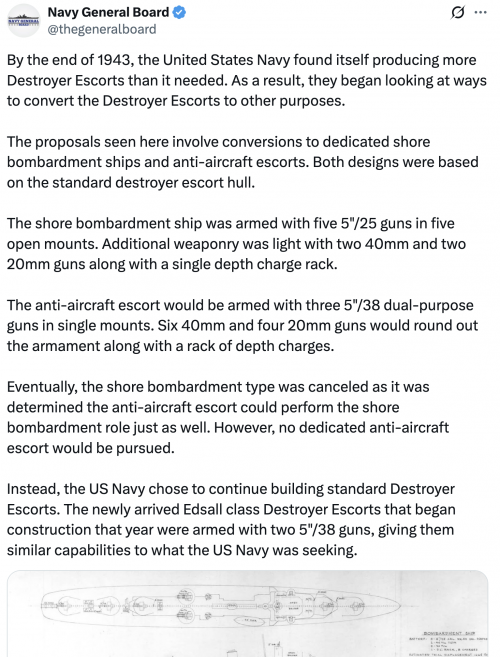
"By the end of 1943, the United States Navy found itself producing more Destroyer Escorts than it needed. As a result, they began looking at ways to convert the Destroyer Escorts to other purposes. The proposals seen here involve conversions to dedicated shore bombardment ships and anti-aircraft escorts. Both designs were based on the standard destroyer escort hull. The shore bombardment ship was armed with five 5"/25 guns in five open mounts. Additional weaponry was light with two 40mm and two 20mm guns along with a single depth charge rack.The anti-aircraft escort would be armed with three 5"/38 dual-purpose guns in single mounts. Six 40mm and four 20mm guns would round out the armament along with a rack of depth charges.Eventually, the shore bombardment type was canceled as it was determined the anti-aircraft escort could perform the shore bombardment role just as well. However, no dedicated anti-aircraft escort would be pursued. Instead, the US Navy chose to continue building standard Destroyer Escorts. The newly arrived Edsall class Destroyer Escorts that began construction that year were armed with two 5"/38 guns, giving them similar capabilities to what the US Navy was seeking."

View: https://x.com/thegeneralboard/status/1971298691723231418
 

Attachments

  • Screenshot 2025-09-25 at 10.29.37 PM.png
    Screenshot 2025-09-25 at 10.29.37 PM.png
    702 KB · Views: 69
  • G1t1tU9XwAAJMNY.jpg
    G1t1tU9XwAAJMNY.jpg
    120.5 KB · Views: 77
From Twitter:

"By the end of 1943, the United States Navy found itself producing more Destroyer Escorts than it needed. As a result, they began looking at ways to convert the Destroyer Escorts to other purposes. The proposals seen here involve conversions to dedicated shore bombardment ships and anti-aircraft escorts. Both designs were based on the standard destroyer escort hull. The shore bombardment ship was armed with five 5"/25 guns in five open mounts. Additional weaponry was light with two 40mm and two 20mm guns along with a single depth charge rack.The anti-aircraft escort would be armed with three 5"/38 dual-purpose guns in single mounts. Six 40mm and four 20mm guns would round out the armament along with a rack of depth charges.Eventually, the shore bombardment type was canceled as it was determined the anti-aircraft escort could perform the shore bombardment role just as well. However, no dedicated anti-aircraft escort would be pursued. Instead, the US Navy chose to continue building standard Destroyer Escorts. The newly arrived Edsall class Destroyer Escorts that began construction that year were armed with two 5"/38 guns, giving them similar capabilities to what the US Navy was seeking."

View: https://x.com/thegeneralboard/status/1971298691723231418

indeed, this is part of spring styles book 3, and is visible online here:

 
Trouble is the AA ship doesn't offer a lot more than the Rudderow (turbo electric) and John C Butler (geared turbine) classes of DE that were already planned.

AA ship - 3x5", 3 x twin 40mm & 4x20mm plus 1 DC rack. Not sure what the director was supposed to be but it doesn't look like a Mark 37.

Rudderow and JCB - 2x5", 2 x twin 40mm & 10 x20mm plus 1 x triple 21in TT, Hedgehog, 2 DC racks and 8 x DC throwers.

The first pair of Rudderows were laid down at the Philadelphia NY in July 1943, with the first JCBs following in Oct. Both types began to complete from March 1944.

These Springsharp designs were based on the Turbo-electric Buckley and Rudderow hull and machinery not that of the geared diesel Edsall class DE.

1945 saw the DEs having their AA armament upgraded, sacrificing the triple TT for more 40mm. Some Buckleys were also upgraded receiving 2x5" in place of the 3x3" with about 8 receiving radar picket conversions.
 
Trouble is the AA ship doesn't offer a lot more than the Rudderow (turbo electric) and John C Butler (geared turbine) classes of DE that were already planned.

AA ship - 3x5", 3 x twin 40mm & 4x20mm plus 1 DC rack. Not sure what the director was supposed to be but it doesn't look like a Mark 37.

Rudderow and JCB - 2x5", 2 x twin 40mm & 10 x20mm plus 1 x triple 21in TT, Hedgehog, 2 DC racks and 8 x DC throwers.

The first pair of Rudderows were laid down at the Philadelphia NY in July 1943, with the first JCBs following in Oct. Both types began to complete from March 1944.

These Springsharp designs were based on the Turbo-electric Buckley and Rudderow hull and machinery not that of the geared diesel Edsall class DE.

1945 saw the DEs having their AA armament upgraded, sacrificing the triple TT for more 40mm. Some Buckleys were also upgraded receiving 2x5" in place of the 3x3" with about 8 receiving radar picket conversions.
Weren't the twin 5 inch DEs already marginal stability wise?
 
Weren't the twin 5 inch DEs already marginal stability wise?
I don't recall reading anything to that effect. And the evidence from added topweight would suggest otherwise.

The final battery for these ships was 2 x 5"/38 (controlled by a Mk 52 director with Mk 26 radar on the bridge), 1 quad Bofors, 3 x twin Bofors & at least 8 (or 10) x 20mm with the full AS armament of Hedgehog, 2 DC rails and 8 throwers. All they seem to have lost is the triple TT. This is DE510 Heyliger in April 1945 shortly after completion.

In the summer of 1945 a programme was begun to upgun earlier DE construction to close to the above standard. It was focussed on the Buckley class (11 conversions carried out before programme cancelled) but one Edsall class (DE251 Camp) was also upgraded. Difference was that the Hedgehog was moved up and aft to replace the No 2 3" gun, instead of having a twin 40mm forward.

Then we have the APD high speed transport versions both as new builds and as conversions that had seen service as DE.

And the radar picket version (7 conversions and another 13 planned all from Buckley class ships) with 2 x 5"/38, 1 quad & 3 twin 40mm Bofors and 4 twin 20mm plus the larger heavier SC radar in place of the SA at the masthead and a new tripod mast with the SP radar and YE homing beacon aft. The sacrifice was the TT, Hedgehog, DC throwers and a few single 20mm.

All these added considerable topweight but the USN doesn't appear to have been backing off from making them until the war ended.
 
The RN did the same, the Loch Class ASW frigates becoming the Bay Class AA frigates, but that was a switch at build time. There were also proposals to switch frigates and corvettes over to other roles, including convoy rescue ships, weather ships, coastal forces command ships, and ISTR light bombardment ships, but it turned out the Landing Craft Guns could do it better.
 
The RN did the same, the Loch Class ASW frigates becoming the Bay Class AA frigates, but that was a switch at build time. There were also proposals to switch frigates and corvettes over to other roles, including convoy rescue ships,
Much more than proposals.

5 Castle class corvettes were completed as convoy rescue ships in 1944/45. Empires Comfort, Lifeguard, Peacemaker, Rest & Shelter.
weather ships,
Flower and Castle class conversions were post war merchant conversions.

USCG manned Tacoma class frigates were converted to this role in 1945 (deckhouse for launching weather balloons in place of the after 3" gun).

coastal forces command ships,
2 Lochs were converted while under construction to Coastal Forces Depot Ships. Derby Haven & Woodbridge Haven.

In 1944 /45 a number of RN DE / Captain class frigates were equipped as Coastal Forces Control Ships to control coastal force flotillas operating in the English Channel and North Sea. Changes to these were minimal, usually adding a 2pdr bowchaser and additional wireless equipment like "Headache" to allow them to listen in to German communications. Another batch of 5 were being prepared for service in the Far East when WW2 ended, these also being given an upgraded AA battery, but not to USN levels.

A number of River class frigates were converted to Landing Ship Headquarters (Small) aka LSH(S). Nith and Waveney saw service in WW2 as such from Normandy onwards. Another 4 were being planned in 1945 but IIRC only Meon was actually converted to see service post war. Also 3 RN Evarts class DE / Captain class frigates were converted for the role ahead of D-Day.

In 1945 the RN drew up plans to convert 5 RN Buckley DE / Captain class and 4 RN Colony / USN Tacoma class to fighter direction ships for use in the Pacific. Only one such conversion was completed, Caicos, which saw some service in the role in the North Sea in early 1945 combating the air launched V1 menace in conjunction with RAF nightfighters. Note the deckhouse aft with the Type 277 radar aerial on top.


and ISTR light bombardment ships, but it turned out the Landing Craft Guns could do it better.
That was about the only River class conversion project, along with a transport conversion for the BPF, that didn't come to fruition.

The other conversion not mentioned so far was the floating power station conversions of Buckley class DE by both the RN (Hotham) and the USN. This involved installation of large cable reels amidships. Hotham proved so useful in the role while in the Far East that she wasn't finally returned to USN control until 1956 (nominally returned under Lend Lease in 1952 but immediately reloaned under MDAP).
 

Similar threads

Back
Top Bottom