Development of Project 11442M Admiral Nakhimov - Kirov

Well, it's largest & most powerful surface combatant in the world. With enough cruise missiles to whipe out a small navy in one salvo, if in range.
80x Tsirkon mean ca. 80x disabled surface ships in a (conservative, anti-ship flight profile) 1000 km range. Only that ;)
 
It makes one wonder if refitting that comparatively cheaper air defense/surface strike asset and an Udaloy for asw might have been the better choice for hanging onto the blue water surface fleet,
Both her sisters - Varyag (from Pacific Fleet) and Marshal Ustinov (from Northern Fleet) - underwent several refits, including the much-required improvement in low-altitude detection capabilities.
 
Buying the 4th Slava and upgrading it and the Moskva would have given both blue water fleets 2 modern air defense cruisers without spending excessive amounts on another costly to refit/modernize/crew/power/arm Kirov, freeing needed funds for naval aviation and Udaloy modernization...
There were several attempts to buy "Ukraina" in 2000s, but sides could not agree on price. In 2011 Russia suggested that dealt could be made, that Ukraine would give cruiser to Russia in exchange for a major contract for the ship completion for Ukrainean industry. In 2013, the prelimitary agreement of buying the cruiser for circa 1 billion roubles was achieved. But Euromaidan stopped the further negotiations. By late 2010s Russia lost interest in cruiser, considering that it would cost too much to complete the obsolete ship.
 
"Moskva" was essentially 1980s warship. She never undergone any large-scale refit, even repairs were limited. In late 2010s she was nearly decommissioned, due to being in poor technical state and with little interest from Black Sea Fleet to maintain such unit. To put it simply, she was old ship, not refitted and in poor conditions.
Well, the Kirov-class battlecruisers are of the same flavor. Designed at the beginning of the seventies, beeing built starting with 1974, in service since 1980. Sensors and the defensive armament are quite similar. Both have analog Voshkod/Top Pair and Fregat MR-710 (Top Plate) air search radars, S-300, Osa-M and 30 mm CIWS air defense weapons. The Kirov class has supplementary close air defense in the form of the missiles of the Kortik system, but these 9M311 missiles are command guided from the ship, without their own sensor. So their effectiveness against fast moving stealth/supersonic antiship missile is quite dubious.
 
And close in defence with nuke tipped S-300s on surface to surface mode.
At the typical ranges at which the ship could detect a salvo of sea skimming antiship missiles the user of these variant of the S-300 missile would basically nuke itself. You could hope to detect them in ideal conditions at 20-30km distance and intercept them with your own missile at half that range. The engagement time from detection to destruction (of the incoming missile or of the ship receiving the hit) would be measured in several tens of seconds, less than one minute.
 
Last edited:
. So their effectiveness against fast moving stealth/supersonic antiship missile is quite dubious.
Erm, their effectivness against stealth targets likely more than of homing missiles, since they rely on ship's sensors - far more advanced and capable - not on their own seekers. For short-range weapons, autonomous homing isn't always advantageous.
 
At the typical ranges at which the ship could detect a salvo of sea skimming antiship missiles the user of these variant of the S-300 missile would basically nuke itself. You could hope to detect them in ideal conditions at 20-30km distance and intercept them with your own missile at half that range. The engagement time from detection to destruction (of the incoming missile or of the ship receiving the hit) would be measured in several tens of seconds, less than one minute.
Obviously those missiles are not intended for short range defence... not to mention that the nuclear tip (far fetched as it is) was meant in strike mode. The Nakhimov does possess a massive resource of strike missiles onboard and almost all of them are dual capable, so using the S-300 for that purpose is certainly besides the point. But still.

OTH, pointing out the presumed gaps in what is basically the best AD complex on board of any exiting ship, is... interesting. Specially when so little is known about the details of the modernization.
 
Obviously those missiles are not intended for short range defence... not to mention that the nuclear tip (far fetched as it is) was meant in strike mode.
As far as I know, the 48H6 family of missiles, used by Fort-M system (S-300FM) did not have nuclear version. I'm not sure Soviet Navy even operated any nuclear-tipped SAM's; they seems to be exclusive to PVO Strany SAM's.
 
By late 2010s Russia lost interest in cruiser, considering that it would cost too much to complete the obsolete ship.
They knew they could only complete 1 expensive, obsolete cruiser… what a shame. If either Kirov is sunk, only 1 other ship will be relevant regarding the entire experience of the type, whereas the Moskva sinking didn’t cripple the Slava class as a deployable force, and would have had even less impact with the Ukrainia commissioned (or been stopped by modernized AD on the Moskva)
 
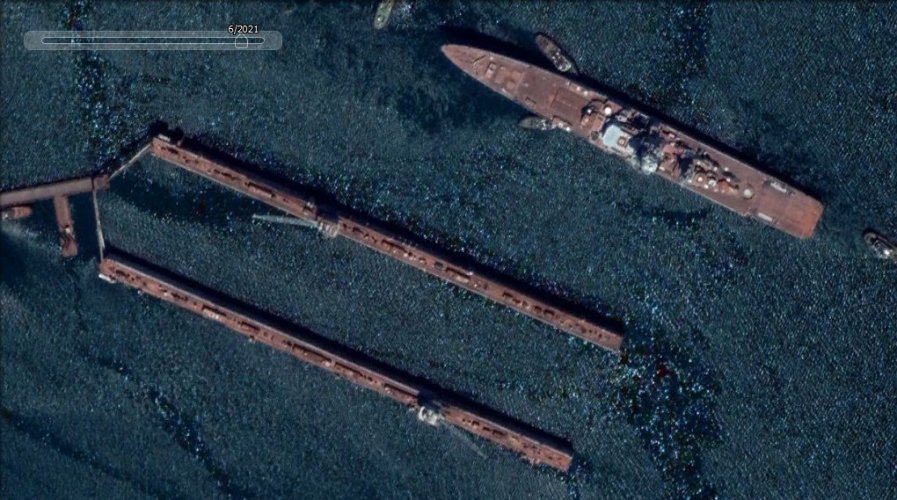
Anyway, this was Admiral Lazarev being scrapped.
I am trying to ascertain what the status of Admiral Ushakov is.

Images taken from Google Earth from 2021 and 2024 describing the final destination of Admiral Lazarev. Interestly, the first image shows the ship near the flooded dry dock.

2021-06.jpg 2022-03.jpg 2022-04.jpg 2022-06.jpg 2024-10.jpg
 
Anyway, this was Admiral Lazarev being scrapped.
I am trying to ascertain what the status of Admiral Ushakov is.

"Awaiting scrapping", since 2019, officially. Realistically, nothing's been done to her since sometime in the 2000s, she's been sitting at the same pier in Severodvinsk across from SEVMASH since at least 2003, and it does not appear that anything has been done since her name was changed back to "Kirov". Satellite images from July 2025 (the same shot that has the most recent top view of Nakhimov) show her in her usual place, still intact.

Judging by the quotes on Wikipedia, her reactors are still fueled, unlike Lazarev/Frunze which was defueled in the 2000s, which might be why they're reluctant to actually do anything.
 
"Awaiting scrapping", since 2019, officially. Realistically, nothing's been done to her since sometime in the 2000s, she's been sitting at the same pier in Severodvinsk across from SEVMASH since at least 2003

I suppose the ship is towed at regular intervals to the nearest convenient dry dock to have its' hull inspected and scrubbed of any marine growths such as barnacles?
 
I suppose the ship is towed at regular intervals to the nearest convenient dry dock to have its' hull inspected and scrubbed of any marine growths such as barnacles?
That would be the logical thing, but with the Submarine Admirals still pretty much having a death grip on the Russian Navy for the moment, logic is often in abeyance.
 
That would be the logical thing, but with the Submarine Admirals still pretty much having a death grip on the Russian Navy for the moment, logic is often in abeyance.

That doesn't seem to be the issue at the moment.

The ship has been moved several times - the evidence is in the satellite pictures, as she doesn't return to the exact same place after each move, but sits fifty meters up or down the pier depending. The major problem with her is that she was never defueled after her 1990 reactor incident, and now she's been sitting for 35 years with fueled reactors and "minimal maintenance", so they're scared of commencing defueling procedures.

Frunze, as mentioned, was defueled in 2004-ish when she was originally stricken from the Russian Navy, so she'd been cold for almost two decades when they started the scrapping.

Also... I think the submarine admirals would argue that Nakhimov has been eating all of their budget too. Rebuilding the cruiser has been something like six times as expensive as promised, and they could have built a whole squadron of Admiral Gorshkov frigates for what they paid for Nakhimov. Not to mention that she's been taking up the basin where they built the Typhoons and Oscars for a decade.
 
What exactly were the big bottlenecks in the process? I seem to recall the stripping of old equipment being done in 2015, the reactors seem fine, the surface armament was all developed for other ships anyway. What's the air defense suite truly capable of on this thing? The Slava refits, while lesser in scope, didn't take anywhere near that long or cost that much.
 
What exactly were the big bottlenecks in the process? I seem to recall the stripping of old equipment being done in 2015, the reactors seem fine, the surface armament was all developed for other ships anyway. What's the air defense suite truly capable of on this thing? The Slava refits, while lesser in scope, didn't take anywhere near that long or cost that much.
Sevmash has a much higher work standard and I've heard that the design bureau gundecked some of the stability calculations which is why they didn't rebuild the superstructure as fully.

But AIUI the biggest issue was rebuilding the interior and doing a huge amount of systems integration. I'll be very curious if they actually set up a decent CIC.
 
What exactly were the big bottlenecks in the process? I seem to recall the stripping of old equipment being done in 2015, the reactors seem fine, the surface armament was all developed for other ships anyway. What's the air defense suite truly capable of on this thing? The Slava refits, while lesser in scope, didn't take anywhere near that long or cost that much.
Unrealistic expectations and critical supply shortages because people stopped exporting certain things to Russia due to the Crimean annexation.

For the Murmansk repair yard, add in that they hadn't taken on any jobs that size before and had no idea what they were in for.
 
Unrealistic expectations and critical supply shortages because people stopped exporting certain things to Russia due to the Crimean annexation.

For the Murmansk repair yard, add in that they hadn't taken on any jobs that size before and had no idea what they were in for.
Sevmash made the Typhoons, which are larger (about the same size for surfaced displacement). But they're also used to submarine standards, which are somewhat higher than the rest of the surface fleet
 
Sevmash made the Typhoons, which are larger (about the same size for surfaced displacement). But they're also used to submarine standards, which are somewhat higher than the rest of the surface fleet

The Typhoons are at this point basically irrelevant, as they were built in 1980-1990, and not a whole lot of people who worked on them are still working anything like the same jobs anymore.

More relevant is that Sevmash's previous big project was the conversion of Admiral Gorshkov into Vikramadtiya, and that job was supposed to take four years, and ended up taking nine. So when Sevmash promised at the start of Nakhimov's modernization in 2008 (the year Vikramadtiya was supposed to be delivered) that Nakhimov would be delivered in 2012, that should have been a red flag...

Oh, and the Murmansk repair yard was the one handling the Chabanenko and Kuznetsov upgrades, which were "paused", presumably forever, earlier this summer. Murmansk has basically gotten a rep for being a place where ships go to die because none of the work they've taken on has been completed anywhere close to on time if it was completed at all.
 
Last edited:
The Typhoons are at this point basically irrelevant, as they were built in 1980-1990, and not a whole lot of people who worked on them are still working anything like the same jobs anymore.
I was speaking to the institutional culture, but yeah the delays have been real, and not helped by the fallout from the Georgia and Ukraine invasions
 
The ship first came to the attention of Western intelligence agencies in satellite photos taken more than 40 years ago, but then it posed a greater threat than it does today.
That may prove to be a rather premature assessment.
 
Also... I think the submarine admirals would argue that Nakhimov has been eating all of their budget too. Rebuilding the cruiser has been something like six times as expensive as promised, and they could have built a whole squadron of Admiral Gorshkov frigates for what they paid for Nakhimov. Not to mention that she's been taking up the basin where they built the Typhoons and Oscars for a decade.
A major factor in the cost overruns were said admirals themselves. Until very recently they had a pretty free hand with regards as to control of naval spending, and apparently regularly used that authority to divert monies budgeted for the refit program into various submarine related projects (doubtless as well into the occasional back pocket).

As it should be
The idea of the submarine being an all round capital ship that can replace major surface combatants except maybe aircraft carriers has taken quite a hammering indeed in the current conflict. SSNs & SSGNs just can't project power and hold territory the way that cruisers, battlecruisers, and battleships can, much less give robust support to land forces. Aircraft carriers may be having their own concurrent Götterdämmerung, for a lot of the same reasons.
 
The idea of the submarine being an all round capital ship that can replace major surface combatants except maybe aircraft carriers has taken quite a hammering indeed in the current conflict. SSNs & SSGNs just can't project power and hold territory the way that cruisers, battlecruisers, and battleships can, much less give robust support to land forces. Aircraft carriers may be having their own concurrent Götterdämmerung, for a lot of the same reasons.
The war in Ukraine, more precisely the skirmishes in the Black Sea (not even the appropriate term but I can't think about anything better tbh) obviously don't lend themselves to the powerful submarine components deployed by the Russian Navy. Mostly found in the Northern and Pacific Fleet anyway. The Black Sea theater is more suited for USVs, Corvettes, patrol boats and the likes. These large submarines would be of questionable usefulness, yes but that applies to large surface combatants and flat tops as well which would be cumbersome targets for USVs and missiles in a confined space.

The Russian Navy has the goal of controlling the sea lanes important to Russian trade and to cripple the US Navy in a conflict. And crippling the USN is done much more effectively by capable and numerous submarines than by surface combatants. It's just an assumption on my part here, maybe someone who served in the USN can give some insight, but I'd believe a US Navy sailor would be more anxious facing up against a Yasen or Akula SSN than against Gorshkov or even Admiral Nakhimov. Crippling the USN, their supply lines, the American shipping lanes is just much more important to the Russian concept of a war against the US and submarines are just the more suitable tool. Which is why I said it's rightfully deserved that they receive special attention as they're the most capable and important assets of the Russian Navy. Their Yasen-Ms, their Borei-As, Belgorod, the Khabarovsk etc. are the absolute crown jewels in their entire naval history up to this point.

And while something like Kuznetsov could have projected power in theory, we know how that would have looked in practice. And while an SSGN can't do that, it's presumed presence somewhere creates a landscape of caution for the other side.

It may be the German in me speaking, but I truly believe that submarines are just that more useful when shit hits the fan. So while this is all off topic with regards to Nakhimov, the submarine faction in the Russian Navy has all the reasons to be influential.

This makes the re-entry into service of Admiral Nakhimov all the more impressive though.

 
Last edited:
1 million+ dead might disagree with you
I forgot to clarify that I meant the skirmishes in the Black Sea, which isn't a proper battlefield like the Donbas where fighting is ongoing constantly at higher intensity for example, but rather sees sporadic attacks from both sides, be it missile launches against land targets in Ukraine, USVs attacking targets in Crimea etc.
 
@blackstar
The satellite photo reveals that Admiral Nakhimov’s original 20 vertical launchers for P-700 (SS-N-19) Granit anti-ship cruise missiles have been replaced by ten eight-cell modules for 80 modern cruise missiles. Forward of these are 12 eight-cell rotary launchers housing 96 S-300FM (SA-N-20) surface-to-air missiles. Additional photos—via satellites, or those taken by Western maritime surveillance aircraft, or released by the Russian government—will be necessary to determine other changes to the vessel.
The core of the modernization program was a plan to install no fewer than 176 vertical launch tubes. This would be more than any other surface combatant or submarine in the world. At least in terms of missiles, it would make Admiral Nakhimov the most powerful surface combatant at sea.

I have this suspicion that the return of Admiral Nakhimov in service is Russia answer to both Zumwalt class and the Chinese type 055. https://en.wikipedia.org/wiki/Type_055_destroyer

In the sense of : I have a bigger ship with a ton of VLS, too - mine is bigger.
 
@blackstar


I have this suspicion that the return of Admiral Nakhimov in service is Russia answer to both Zumwalt class and the Chinese type 055. https://en.wikipedia.org/wiki/Type_055_destroyer

In the sense of : I have a bigger ship with a ton of VLS, too - mine is bigger.
I rather doubt that; it was mostly about not wasting the capabilities when money became avaliable in 2010s. The initial plans were to restore at least three cruisers, after all (and even all four were considered at some point). It was only after Nakhimov restoration took much more time & resources that were initially projected, the plans were scaled down and then limited to basically only "Nakhimov".
 
@blackstar


I have this suspicion that the return of Admiral Nakhimov in service is Russia answer to both Zumwalt class and the Chinese type 055. https://en.wikipedia.org/wiki/Type_055_destroyer

In the sense of : I have a bigger ship with a ton of VLS, too - mine is bigger.

I'm not so sure that it was the way you characterize it. They clearly wanted to have a big ship in their fleet, even if they really don't have the navy that needs it. It's partly a status thing, for sure. It somewhat harkens back to the problem they had when they first started developing the Kirovs. They let their ego run too far when they needed to be more practical. Or, in the words of a famous sailor, "Your ego is writing checks your body can't cash."
 
I have this suspicion that the return of Admiral Nakhimov in service is Russia answer to both Zumwalt class and the Chinese type 055.
I kinda fail to see a relation given that each of these is fundamentally different in role and status.

The Type 055s are top of the line surface combatants produced in sizeable volume (8+8, so far) with their main focus being air warfare while also retaining a profound surface-to-surface capability. They are comparable to Ticonderogas, just more modern and not designed on a napkin (that Tico superstructure is the stuff of nightmares).

The Zumwalts on the other hand are white elephants which were seeking a mission and now might finally get it with the CPS implementation, giving them the ability to strike time sensitive land and surface targets. Downside is that they're costly and not the most reliable ships and undergoing major modifications. The fact that only 3 exist puts extensive logistical limitations on them.

The Admiral Nakhimov on the other hand is, as a Kirov class cruiser, a nuclear behemoth which was originally meant to hunt for US submarines and later ships. With the modernization completed surface-to-surface performance has been increased as well as the ability to perform anti-air roles.

However while the Type 055s are certainly key components of Chinese carrier battlegroups, they also contribute to the larger air access and denial bubble established by China. Meanwhile the Zumwalts are meant to deliver heavy hits either as parts of battlegroups or operating more independently and taking advantage of their radar, acoustic and emissions reducing measures. The Nakhimov is meant to operate more independently, thanks to its nuclear propulsion it's entirely within it's capabilities to act as such a hunter. Possibly accompanied by submarines or frigates.

The Admiral Nakhimov was put back into service because modernization was completed and this would give Pyotr Velekyi the opportunity to either receive similar upgrades or be decommissioned. Either way, the capability and symbolism provided by such a nuclear battle cruiser would be retained.
 
It somewhat harkens back to the problem they had when they first started developing the Kirovs. They let their ego run too far when they needed to be more practical.
This has little to do with ego and all with practicality. The nuclear powered Kirovs were meant to serve as powerful escorts for the projected nuclear aircraft carriers under development and construction by the USSR. And with both being nuclear powered independence was greatly increased, making fuel only a necessity for helicopters, aircraft and boats on board the ships of such a battlegroup. CVNs, CGNs and SSNs operating together in a flexible and highly autonomous battlegroup to respond to threats or shadow US assets and target the supplies in which their escorts depended more heavily.

The issue the Kirov faced ultimately was that the CVNs never came and that the USSR collapsed. Not some ego thing or anything of that sort. You don't create something like a nuclear powered guided missile cruiser because you think it's cool, but because you deem it necessary for a specific reason.

Do you think the construct and operate nuclear icebreakers for fun? No, they offer distinct advantages which have been valued as something that's well worth the cost.
 
The issue the Kirov faced ultimately was that the CVNs never came and that the USSR collapsed.

The USSR IIRC had a CVN under construction in a Ukrainian SSR shipyard but it was only ~60% complete when the USSR collapsed and so was scrapped in the early 1990s.
 
The issue the Kirov faced ultimately was that the CVNs never came and that the USSR collapsed. Not some ego thing or anything of that sort. You don't create something like a nuclear powered guided missile cruiser because you think it's cool, but because you deem it necessary for a specific reason.

They started as ASW cruisers, then got loaded up with all kinds of other missions. They were too big to keep operating when the USSR collapsed.
 

Similar threads

Back
Top Bottom