Colonization of Mars

How about a simpler and "faster" solution:
Send robots to borrow and build an underground deep enough for gravity to be higher. Since the core is no longer active this shouldn't be a problem. And with higher gravity the atmosphere don there could be kept better.
Only problem is you can't have large cavities without risking colapse and you kind of have to go as deep as ~889.5 km to get ~0.7g. :D
With the excavated material you can reshape the landscape for more ambitious endeavers later.
Actually, the way it's proposed right now is to put an orbiting satellite(s) in place between Mars and the Sun such that the satellite generates a magnetic field and directs the solar wind around the planet shielding it.

 
It is a serious problem. Solar wind was responsible for stripping Mars of a much denser atmosphere.
It’s a serious problem if you assume a Martian colony needs to be exposed to the atmosphere, and that industrial production will never be sufficient to evolve more gases than are lost by the solar wind. A conservative estimate is that Mars loses about 95,000 metric tons/year of atmospheric gases. San Marino, no industrial power by any means, emits far more than that (about a third more). If a Martian settlement is built, to thrive it will have to industrialize rapidly, so I think that within a few decades of the first factories being built, the Martians could (note: not would) be able to produce enough gases to begin thickening the atmosphere.
 
It’s a serious problem if you assume a Martian colony needs to be exposed to the atmosphere, and that industrial production will never be sufficient to evolve more gases than are lost by the solar wind. A conservative estimate is that Mars loses about 95,000 metric tons/year of atmospheric gases. San Marino, no industrial power by any means, emits far more than that (about a third more). If a Martian settlement is built, to thrive it will have to industrialize rapidly, so I think that within a few decades of the first factories being built, the Martians could (note: not would) be able to produce enough gases to begin thickening the atmosphere.
More is better. A solar wind shield that prevents it from striking the planet for the most part has other benefits. The amount of radiation hitting the planet is greatly reduced making outdoor activities safer along with helping life in general survive.
 
It is a serious problem. Solar wind was responsible for stripping Mars of a much denser atmosphere.


It's likely that Mars lost its magnetic field fairly early in its geologic history and that allowed the solar wind to rip away the atmosphere. Finding a way to shield the planet from the solar wind would allow the atmosphere to start to thicken and that could be helped along by various manmade means too.
There are two theories about the loss of the Martian magnetic field:

-Smaller planets cool quickly and their cores stop rotating when they lose their liquid state.

-The planetoid that produced the Hellas basin, the giant crustal fracture and the three volcanoes, also reached the planet's core by stopping its spin. Either by the direction of the collision or by stopping after reaching great depth, creating an asymmetrical formation that slows down the rotation of the nucleus.
 
More is better. A solar wind shield that prevents it from striking the planet for the most part has other benefits. The amount of radiation hitting the planet is greatly reduced making outdoor activities safer along with helping life in general survive.
All of that is stuff that would come many decades, if not centuries, into the life of Martian colonies. Radiation is mainly an issue at the zenith, and there are multiple simpler options than attempting to block the solar wind available to us. It would be a tertiary effort, rather than primary, as the Martians will have plenty of other work to tackle.
 
How about a simpler and "faster" solution:
Send robots to borrow and build an underground deep enough for gravity to be higher. Since the core is no longer active this shouldn't be a problem. And with higher gravity the atmosphere don there could be kept better.
Only problem is you can't have large cavities without risking colapse and you kind of have to go as deep as ~889.5 km to get ~0.7g. :D
With the excavated material you can reshape the landscape for more ambitious endeavers later.
Digging deeper into the ground does not increase felt gravity.
 
Burying the colony will not solve the problems of gravity, radiation, or Martian earthquakes, or the possible reactivation of lava tunnels by a Tunguska impact. It will only make the construction of the base and access more expensive to the detriment of transporting everything they will need to live: from hypodermic needles to excavators, from toilet paper to clothes, from soap to aspirin, from plastic bags to baby diapers.

For comparison, ask the Canadian government about the enormous logistical efforts that need to be made to supply Inuit settlements during the thaw season, some years aid does not arrive.

But living in tunnels is always a good cheap scenario for a horror series: to bring the defenseless colonists as close as possible to the monsters that inhabit the Martian underground, with nothing to eat for two hundred million years.
 
Tunnels would solve the radiation issue and I think mars quakes so slight as to be a non issue. Asteroid impacts probably also non issue given the near lack of atmosphere, lack of oceans, and other existing harsh conditions. There would not be a meaningful blast wave and there’s little to keep ejects suspended above the planet, plus food production would probably require artificial light anyway. Barring a direct hit, a tunnel system should be perfectly safe.

Although if we’re just digging tunnels, I see little advantage of Mars over the moon other than the gravity. If humans can live and reproduce at .38 but not at .17, then that would make all the difference. If instead both microgravity environments are just death sentences with different execution times, then that does not particularly matter.

I remain deeply skeptical that humans can reproduce or even survive normal life spans in low gravity, and it really seems like an area some experimentation should be done before anyone worries about permanent settlements anywhere. The moon at least allows for a vastly lower “commute” time to allow for manned bases to have personnel swapped out.
 
At the depth I've proposed an impact of an object of at least 40 km would only get halfway down at best. For reference the dino killer was 10-20 km in diameter. So this is at the very least 8x more energetic. The fall off for seismic effect likely demands far more energy. Only a true planet killer would be a threat.
 
I remain deeply skeptical that humans can reproduce or even survive normal life spans in low gravity, and it really seems like an area some experimentation should be done before anyone worries about permanent settlements anywhere. The moon at least allows for a vastly lower “commute” time to allow for manned bases to have personnel swapped out.
If nearness is an advantage for testing, then building a ring station in ELEO with multiple decks for different gravities is best of all. Far cheaper to reach than the lunar surface, and more convenient when testing variable gravity.

As for settlements, it would be simple enough for a Mars base to operate for years at small scale (hundreds of people or fewer) raising various animal species to test whether mammals can safely reproduce and bring their offspring to adulthood, and we may want based on Mars even if we don’t end up building a civilization on Mars.
 
All of that is stuff that would come many decades, if not centuries, into the life of Martian colonies. Radiation is mainly an issue at the zenith, and there are multiple simpler options than attempting to block the solar wind available to us. It would be a tertiary effort, rather than primary, as the Martians will have plenty of other work to tackle.
Actually, NASA predicts it would make a significant change in atmospheric thickness within a few years and then the process would accelerate as the polar ice caps of CO2 melt. All of that would warm the planet to a point where water in the current form of ice could melt and become surface water again. They predict just a few decades and all that would happen if Mars was shielded from the solar wind.

In turn, depositing various Mars friendly life transplanted from Earth there would start to green the planet and produce oxygen from the CO2 rich atmosphere. While that would take much longer, it's a good start. So, say in as little as 50 years Mars is far more habitable than it is now all because the solar wind has been blocked from ripping the atmosphere off the planet.
 
At the depth I've proposed an impact of an object of at least 40 km would only get halfway down at best. For reference the dino killer was 10-20 km in diameter. So this is at the very least 8x more energetic. The fall off for seismic effect likely demands far more energy. Only a true planet killer would be a threat.
The physics of asteroid impacts is somewhat more complex, what happens on the surface of the planet is that the shock waves are transmitted in a similar way to the waves produced by a stone in a pond and lose power as the diameter of the disturbance around the impact point becomes larger. But when the diameter reaches its maximum size when it reaches a maximum circle of the planet, it regains power as the diameter decreases when it reaches the opposite hemisphere, creating another cataclysm when all the energy is focused on the antipodes of the impact. The phenomenon repeats itself over and over again, losing energy in each cycle, until it is extinguished.

In the case of the meteorite that exterminated the dinosaurs, the worst damage did not occur at the point of impact but at the antipodes, at that time India was an island located northeast of Madagascar and the cataclysm resulting from the converging shock waves lifted the island to a certain extent by tearing it from the seabed and moving it over a sea of lava until it collided with Asia. There the Himalayas formed, and it still continues to move northwards making Everest grow several centimeters a year. The lava continued to flow for thousands of years to form a layer several kilometers thick known today as Deccan Traps.
 
No ‘Mars friendly life’ that is useful for humans exists. We’ll have to engineer it first. Radiation protection on Earth primarily comes from the density of the atmosphere, and is only tangentially related to the solar wind. My reading of the NASA proposal was that the authors admitted the idea was ‘fanciful’ (their wording), and that it would still take centuries to make a significant difference. How one defines significant is up for debate, but the Martians would not want to wait centuries for large-scale shirtsleeve environments, which we can achieve with current technologies on a decades timescale rather than on a century-length timescale. Paraterraforming early on, combined with building up the atmosphere and then protecting Mars from the solar wind over the mid term, and long term is when we can stop paraterraforming and having to emit so much in the way of gases from factories.
 
The physics of asteroid impacts is somewhat more complex, what happens on the surface of the planet is that the shock waves are transmitted in a similar way to the waves produced by a stone in a pond and lose power as the diameter of the disturbance around the impact point becomes larger. But when the diameter reaches its maximum size when it reaches a maximum circle of the planet, it regains power as the diameter decreases when it reaches the opposite hemisphere, creating another cataclysm when all the energy is focused on the antipodes of the impact. The phenomenon repeats itself over and over again, losing energy in each cycle, until it is extinguished.

In the case of the meteorite that exterminated the dinosaurs, the worst damage did not occur at the point of impact but at the antipodes, at that time India was an island located northeast of Madagascar and the cataclysm resulting from the converging shock waves lifted the island to a certain extent by tearing it from the seabed and moving it over a sea of lava until it collided with Asia. There the Himalayas formed, and it still continues to move northwards making Everest grow several centimeters a year. The lava continued to flow for thousands of years to form a layer several kilometers thick known today as Deccan Traps.
That only applies to Earth where most of the mass is molten with a thin solid sheet on top. Mars is solid although differences between laers could result in deformation near the surface. But most of the energy won't be tansmitted but absorbed locally. So it would look more like a bullet leaving a whole in a window.
 
That only applies to Earth where most of the mass is molten with a thin solid sheet on top. Mars is solid although differences between laers could result in deformation near the surface. But most of the energy won't be tansmitted but absorbed locally. So it would look more like a bullet leaving a whole in a window.
It doesn't work like a bullet; in fact the entire mass of the asteroid disintegrates while the planet is left vibrating like a bell until the excess energy is extinguished. As far as I know, only the upper layers transmit the shock wave at near-supersonic speeds, sweeping away caves, tunnels, underground rivers, and unstable geological formations in their path. Apocalyptic episodes of volcanism are also created, such as the one that occurred in Siberia, which usually last thousands of years. Only lightweight constructions located on the surface will be able to survive an earthquake capable of undulating the ground as if it were the sea. Ask a Japanese person.
 
If nearness is an advantage for testing, then building a ring station in ELEO with multiple decks for different gravities is best of all. Far cheaper to reach than the lunar surface, and more convenient when testing variable gravity.

As for settlements, it would be simple enough for a Mars base to operate for years at small scale (hundreds of people or fewer) raising various animal species to test whether mammals can safely reproduce and bring their offspring to adulthood, and we may want based on Mars even if we don’t end up building a civilization on Mars.

I think just establishing a mouse or rat colony on Mars would answer some basic questions. I don’t even think you would necessarily need human minders for that; you could just establish if they reproduced fairly normally or collapsed. The later would be a strong indicator that humans would if any fair worse.

You could perhaps achieve this with rotation sans gravity, but that also introduces an extra variable of coriolis force that might alter things. Though that would also be worth knowing and of itself, and if you could simulate 1g you could have a control for that situation.

I see no benefit to Mars occupation long term sans permanent settlement. There’s nothing there you can’t get somewhere else, and it’s too far away to have strategic value.
 
No ‘Mars friendly life’ that is useful for humans exists. We’ll have to engineer it first. Radiation protection on Earth primarily comes from the density of the atmosphere, and is only tangentially related to the solar wind. My reading of the NASA proposal was that the authors admitted the idea was ‘fanciful’ (their wording), and that it would still take centuries to make a significant difference. How one defines significant is up for debate, but the Martians would not want to wait centuries for large-scale shirtsleeve environments, which we can achieve with current technologies on a decades timescale rather than on a century-length timescale. Paraterraforming early on, combined with building up the atmosphere and then protecting Mars from the solar wind over the mid term, and long term is when we can stop paraterraforming and having to emit so much in the way of gases from factories.
Lichens are one that could with little or no adaptation


There are others that might work but in some cases take more adaptation

 
No ‘Mars friendly life’ that is useful for humans exists. We’ll have to engineer it first. Radiation protection on Earth primarily comes from the density of the atmosphere, and is only tangentially related to the solar wind. My reading of the NASA proposal was that the authors admitted the idea was ‘fanciful’ (their wording), and that it would still take centuries to make a significant difference. How one defines significant is up for debate, but the Martians would not want to wait centuries for large-scale shirtsleeve environments, which we can achieve with current technologies on a decades timescale rather than on a century-length timescale. Paraterraforming early on, combined with building up the atmosphere and then protecting Mars from the solar wind over the mid term, and long term is when we can stop paraterraforming and having to emit so much in the way of gases from factories.

It seems to me an alternative idea is sending as many varieties of earth bound bacteria as possible in as many locations as can practically/cost effectively be achieved and just seeing what happens. It seems likely we already sent bacteria that can survive a clean room to Mars; it’s not inconceivable that something anaerobic and oxygen producing might just get lucky and survive. The transportation costs would be minuscule compared to a manned effort.

Deflecting the solar wind on the other hand seems like a massive engineering project.
 
It seems to me an alternative idea is sending as many varieties of earth bound bacteria as possible in as many locations as can practically/cost effectively be achieved and just seeing what happens. It seems likely we already sent bacteria that can survive a clean room to Mars; it’s not inconceivable that something anaerobic and oxygen producing might just get lucky and survive. The transportation costs would be minuscule compared to a manned effort.

Deflecting the solar wind on the other hand seems like a massive engineering project.
Actually, it isn't that big a thing to do. You send one or more satellites and position them in geosynchronous orbits such that they remain between Mars and the Sun. These emit a powerful magnetic field generated by solar or nuclear (plutonium batteries etc.) power. The field deflects the solar wind, and Mars doesn't get its atmosphere stripped.

Add additional ones as practical orbiting the planet or set on its two moons, etc. These create the necessary magnetic field far enough out into space to block most or all of the solar wind.

As the atmosphere thickens, you send lifeforms that are likely to survive on the planet as is. All of that could be done in a matter of under a decade.
 
Actually, it isn't that big a thing to do. You send one or more satellites and position them in geosynchronous orbits such that they remain between Mars and the Sun. These emit a powerful magnetic field generated by solar or nuclear (plutonium batteries etc.) power. The field deflects the solar wind, and Mars doesn't get its atmosphere stripped.

Add additional ones as practical orbiting the planet or set on its two moons, etc. These create the necessary magnetic field far enough out into space to block most or all of the solar wind.
Or better yet at Sun-Mars Lagrange point 1. Using aereostationary orbit it requires more satellites while the requirement for the field size remains the same, hence, more costly investment. Although, this redundancy would be nice.

I want to note the fields will draw a fraction of charged particles onto those satellites as Earth does (see Aurora).
So leaving them alone seems wastefull. They might be better served to be collected for a fusion reactor a la Bussard collector.
Otherwise there would be a small plasma stream behind the satellite (see tail reconnection). So Mars will still be hit by a small concentrated stream of particles.

That said looking at the art of the proposal and comparing to Earth's field. It looks like the picture was beautified for convenience.
pls-use-this-image-not-image-1.jpg__1240x510_q85_subsampling-2.jpg

Mars Source
magnetic-reconnection-tail.jpg

Earth Source
 
Or better yet at Sun-Mars Lagrange point 1. Using aereostationary orbit it requires more satellites while the requirement for the field size remains the same, hence, more costly investment. Although, this redundancy would be nice.

I want to note the fields will draw a fraction of charged particles onto those satellites as Earth does (see Aurora).
So leaving them alone seems wastefull. They might be better served to be collected for a fusion reactor a la Bussard collector.
Otherwise there would be a small plasma stream behind the satellite (see tail reconnection). So Mars will still be hit by a small concentrated stream of particles.

That said looking at the art of the proposal and comparing to Earth's field. It looks like the picture was beautified for convenience.
pls-use-this-image-not-image-1.jpg__1240x510_q85_subsampling-2.jpg

Mars Source
magnetic-reconnection-tail.jpg

Earth Source
Exactly! One satellite, or a few, and you have the solar wind blocked. Add more later as a backup "just in case." Dump organic life that is suitable for a Mars environment as is on the planet and wait a year or two for results to start showing up.
 
I think just establishing a mouse or rat colony on Mars would answer some basic questions. I don’t even think you would necessarily need human minders for that; you could just establish if they reproduced fairly normally or collapsed. The later would be a strong indicator that humans would if any fair worse.

You could perhaps achieve this with rotation sans gravity, but that also introduces an extra variable of coriolis force that might alter things. Though that would also be worth knowing and of itself, and if you could simulate 1g you could have a control for that situation.
It would be massively cheaper to do those experiments in Earth orbit on a rotating space station.
 
Apparently, NASA has decided to buy a comms satellite for Mars
but detailed information especially technical are very sparse.
I'm wondering if it will feature laser comms, too, and how much traffic it would or should be able to manage.
 
Folks, this theme is ok and interesting, but please, stay with technical questions and details.
There are questions, of course, who could or should send people to Mars, and if perhaps the leader of the colony could change into a dictator like Adolf or Joseph, and if this dictator could even be a woman … but those aren‘t questions suitable for this forum here.
Cleaned up from OT, political or otherwise not compliant-to-rules posts.
 
If DARPA manages to develop a nuclear thermal engine, the travel time will be cut by half. The crew will need shielding.

Water ice is just below the surface in some places. In others, it is one mile down. Drilling equipment would have to be sealed and heated. Due to the low surface temperature, the water would need to stay in an underground reservoir. People would be housed in extinct lava tubes. The habitat would be a number of long, tear-proof tubes with air locks on both ends. These would need to be pressurized, heated and provided with electricity. Air might be extracted from the Martian atmosphere.

A greenhouse would have to be heated and pressurized. It would require artificial sunlight and a power source. This might be a small, modular reactor.
 
If DARPA manages to develop a nuclear thermal engine, the travel time will be cut by half. The crew will need shielding.
If the nuke-thermal rocket (NTR) can sustain a centigee, 10cm/s/s constant acceleration, that means you get to Mars in 35 days.

And you need shielding for the crew regardless of power source or rocket type.


Water ice is just below the surface in some places. In others, it is one mile down. Drilling equipment would have to be sealed and heated. Due to the low surface temperature, the water would need to stay in an underground reservoir. People would be housed in extinct lava tubes. The habitat would be a number of long, tear-proof tubes with air locks on both ends. These would need to be pressurized, heated and provided with electricity. Air might be extracted from the Martian atmosphere.
Correct. But you're still going to start with prefab cylinders on the surface until you can get the lava tubes etc.


A greenhouse would have to be heated and pressurized. It would require artificial sunlight and a power source. This might be a small, modular reactor.
You might be able to use mirrors and natural sunlight, but you'd need to also set up a 24hr day/night cycle with shade cloth et sim.
 
The mission would require two ships. One with astronauts, the other with supplies and other equipment.

But I don't think humans are going to go. Elon Musk could send robots to perform all tasks. The idea of living in a cylinder or tube is unappealing. The robots could build the domed cities from science fiction book covers.
 
The thing to start with, as I've stated is putting a satellite at the L1 position that gives Mars a shield from solar wind.


Such a shield is doable right now. We could likely have one in place in under 5 years. Within another 5, Mars' atmosphere would potentially thicken to roughly the same as Earths at about 5,000 meters. It wouldn't be breathable, but it would warm the planet enough to potentially support liquid water on the surface.
 
lol

good luck reducing atmospheric pressure to something less than "ocean abyss"
About the only way to do that is sequester all the CO2, or most of it, by combining it with Calcium and making it into limestone. Maybe carbolic acid instead. The big problem with Venus, and it's insolvable, is that it rotates once a Venusian year. That lets the sun bake it into a hell world indirectly.
 
good luck reducing atmospheric pressure to something less than "ocean abyss"

Not to mention a surface temperature hot enough to melt Lead and Zinc plus a highly corrosive atmosphere loaded with industrial-strength sulphuric-acid (With a dash of hydrofluoric-acid too).

About the only way to do that is sequester all the CO2, or most of it, by combining it with Calcium and making it into limestone.

Don't forget the trillions (If not quadrillions) of tons of water needed to allow this reaction to occur, in terms of water Venus is bone-dry.
 
Not to mention a surface temperature hot enough to melt Lead and Zinc plus a highly corrosive atmosphere loaded with industrial-strength sulphuric-acid (With a dash of hydrofluoric-acid too).

That requires a separate solution, one of which is below
Don't forget the trillions (If not quadrillions) of tons of water needed to allow this reaction to occur, in terms of water Venus is bone-dry.
That's because the water is bound up as HCO+ and H2SO4. You would have to unbind these and cool the atmosphere sufficiently to allow water vapor to form in it. It'd probably be easier to just crash a huge ice cored asteroid or comet into the planet... Like any of that is going to happen any time soon...
 
If the nuke-thermal rocket (NTR) can sustain a centigee, 10cm/s/s constant acceleration, that means you get to Mars in 35 days.
Nuclear thermal rockets generally do not have the isp to do that; however, they have the thrust to get you much better acceleration.
The isp limits have to do with the temperature limits of graphite and other materials used in nuclear thermal rockets, you can't expect to get much better than 1,000 seconds (10,000 m/s or so exhaust velocity) out of a solid-core NTR.
NASA's 1960s and 70s proposals ran on solid-core nuclear thermal rockets as well, and those did not envisage very short travel times.
Overall, if you have tankers (like we are likely to have, thanks to the Artemis architecture being tanker-heavy), solid core NTR does not necessarily offer a very large advantage in travel times or capability (there are marginal benefits, you need less tanker, but it's not transformative).

Liquid and gas core reactors are possible but not on the table in the near term.

Such a shield is doable right now.

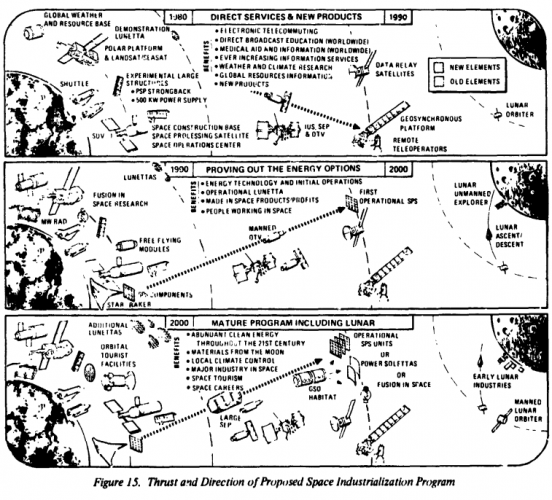
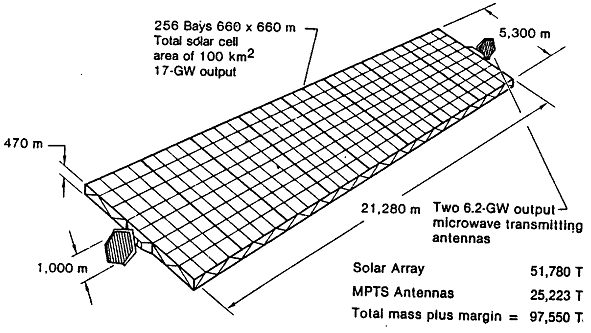
Only in the sense that space solar power stations were doable "by the Year 2000"; or Mars missions were doable "since the late 1970s or early 1980s".


1776926564975.png

1776926374761.png
 
Last edited:
I think we should first establish if a colony of rats can live and reproduce at 1/3 g before we worry about human population. I suspect reproduction in low g has a horrible failure rate and long term complications for anything that lives.
 
About the only way to do that is sequester all the CO2, or most of it, by combining it with Calcium and making it into limestone. Maybe carbolic acid instead. The big problem with Venus, and it's insolvable, is that it rotates once a Venusian year. That lets the sun bake it into a hell world indirectly.

You'd need solar shades to make Venus habitable anyway. It's rather more capable of supporting human life than Mars though.

The problem with Mars is more obvious and rather more intractable until we figure out how to make things have more gravity without adding mass. Humans likely cannot safely reproduce outside of an extremely narrow range of 1g, unless you want to speciate into a race that uses r-selection for females, like a spider or something. That would solve the "every birth is a life threatening pelvic fracture" issue but I'm not sure you can call it a success for the human race. Maybe a success for the Spider Monsters from Mars.

The good ending is the Mice Men from Mars, but you'd still need to speciate towards r-selection due to reproductive mortality rates, with all that entails. Even if offspring can survive with severely diminished bone masses (who knows), the mothers will have a better than even chance to die during birth, so you'd need litters rather than singletons or twins or triplets. You can only do so many C-sections and Mars will easily destroy skeletons.

Venus is far more forgiving and requires relatively modest investments in technology and capital.

The fact that Venus is diminished in popular culture doesn't make Mars more habitable. It just means people haven't thought about Mars.

Making a planet cooler is easy. You put it in the shade. Making Mars heavier is harder. We can't exactly slam a second or third Mars into it.

lol

good luck reducing atmospheric pressure to something less than "ocean abyss"

The atmosphere is free and you can export it to Mars. Venus has everything you need except plate tectonics and water. Just smack an ice moon into it and sequester the atmosphere with a combination of solar shades and calcium seeding I guess.

This is far less effort than would be required to fix Mars, but Mars is a potential planet, so people like thinking it's habitable. Any colonization effort will necessarily be a millennial project so it's not like a thousand years matters much for Venus or Mars. They'll both have water on them by the end. Only one will actually have humans on it though, while Mars might be a subspecies of Homo or a fully speciated genus, who can say.
 
Last edited:
Only one will actually have humans on it though
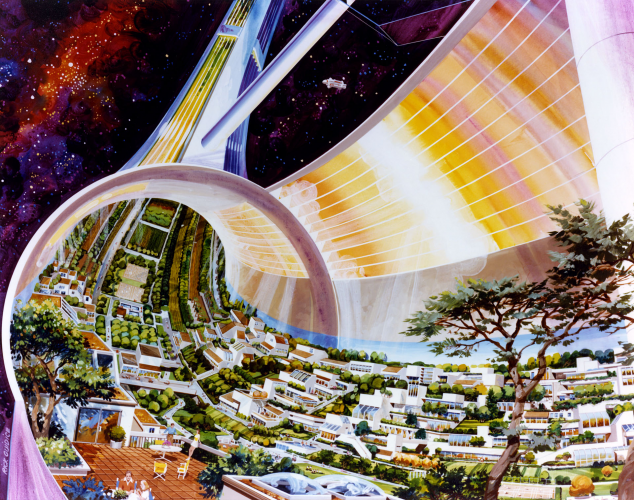
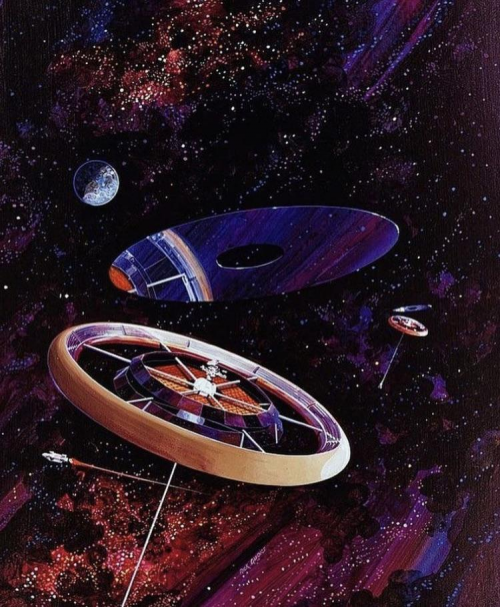
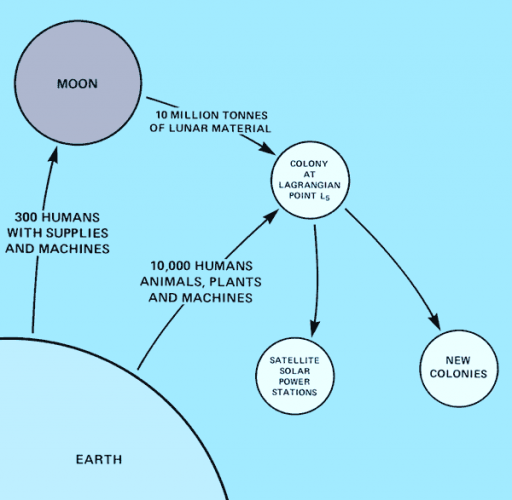
I mean if you're a 1g enjoyer you might as well go the Full O'Neill.

1776952469994.png 1776952574515.png 1776952613125.png

With a little Elbow Grease, we'll have this built no later than 1995! L5 by '95, baby!

And with a Little More Elbow Grease, assuming a habitat construction doubling time of 3 years, it will take no more than 56 years to build enough space colonies for the entire global population!


“An upper limit to the speed of growth of space colonization is estimated by assuming 3 years for the duplication of a habitat by a workforce equivalent to 12 percent of a habitat’s population. Only 56 years are required at this rate for the construction of communities in space adequate to house a population equal to that of the Earth today.”

A NASA report said this was feasible, therefore this must be so! We'll lick that Oil Crisis, solve crime, rid ourselves of Carter's loser attitude, and restore American industry while we're at it!

These studies are fifty years old, by the way. Half a century!
 
Last edited:

Similar threads

Back
Top Bottom