It's an option for the Moon, honestly. Robotic factories build stuff on the Moon before lofting it into L4 or L5. Beats a manned research station, since it won't expose anyone to deleterious osteoporosis that prevents them from returning to Earth, or worse.
Might take a while and cost a bit but it's still better than Evil Antarctica or Evil Antarctica 2: Mars Harder.
It's an option for the Moon, honestly. Robotic factories build stuff on the Moon before lofting it into L4 or L5. Beats a manned research station, since it won't expose anyone to deleterious osteoporosis that prevents them from returning to Earth, or worse.
Might take a while and cost a bit but it's still better than Evil Antarctica or Evil Antarctica 2: Mars Harder.
There is technically probably nothing stopping you from building a giant merry-go-round-shaped apartment building on the surface of the Moon or Mars, on a giant set of circular maglev tracks inside some sort of vacuum chamber. I would wager that it is probably "easier" to do that than to try to live in a giant blimp in the skies of Venus, or god forbid actually try to terraform either Venus or Mars, although I might estimate that genetically engineering humans to live on either the Moon or Mars might be of equivalent or intermediate difficulty.
There is technically probably nothing stopping you from building a giant merry-go-round-shaped apartment building on the surface of the Moon or Mars, on a giant set of circular maglev tracks inside some sort of vacuum chamber. I would wager that it is probably "easier" to do that than to try to live in a giant blimp in the skies of Venus, or god forbid actually try to terraform either Venus or Mars, although I might estimate that genetically engineering humans to live on either the Moon or Mars might be of equivalent or intermediate difficulty.
Genetically engineering a species would make them no longer human tbf.
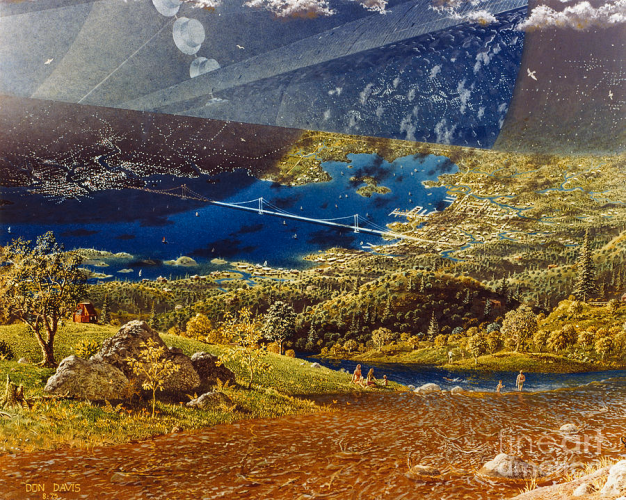
You could probably build a planet sized ring but that would be more urban area constructed on Moon or Mars than has been built on Earth since the dawn of cities. An L4/L5 O'Neill Cylinder would be a significantly smaller pressurized vessel. Unless you mean building an O'Neill Cylinder inside a lava tube or something. That's also practical but it would require people living on the Moon in some manner.
Robots building an O'Neill Cylinder that gets populated by humans in orbit gives you a work base for colonization that isn't Earth and helps people stay healthy. That's the most important thing for colonization because it's never not going to be a generational project.
More research needs to be done on reproduction in space for us to determine the limits of habitability. If we are hooked on 1g, then Venus is the only natural option, and if you are going to simply rotate a habitat, that’s a lot easier to do in space or on the moon than on mars. But we need to establish boundaries for what humans can live in generationally to have a good idea of the limitations. I suspect 1/3g is problematic. It would not surprise me if there were also limits to centrifugal gravity due to coriolis forces of higher angular velocities. Literally hundreds of millions of years of development has taken place to adapt mammals to their home planet; I think a lot of people over simply the complications of a complete human life cycle off earth.
As much as I agree that Martian gravity may be a problem, centrifuges on the Martian surface are dramatically easier to build than a solar shade large enough to cool Venus.
As much as I agree that Martian gravity may be a problem, centrifuges on the Martian surface are dramatically easier to build than a solar shade large enough to cool Venus.
True, but a spinning habitat in a volcanic tube can be built on the Moon, too. Not that much of a reason to go to Mars when the Moon has a smaller light speed lag, takes about as much delta-v, way less time, etc. I guess if there isn't a lot of water it would suck though. Still would be easier to ship essentials and evacuate sick people though regardless. An extraterrestrial jump off point for nuclear engines could be nice too, if anyone ever builds those.
True, but a spinning habitat in a volcanic tube can be built on the Moon, too. Not that much of a reason to go to Mars when the Moon has a smaller light speed lag, takes about as much delta-v, way less time, etc. I guess if there isn't a lot of water it would suck though. Still would be easier to ship essentials and evacuate sick people though regardless. An extraterrestrial jump off point for nuclear engines could be nice too, if anyone ever builds those.
That depends. The Moon is lacking in many useful raw materials, such as copper, sulfur, phosphorus, carbon, nitrogen, and hydrogen, and while there is water, there doesn’t seem to be a lot of it. If we want to build a new branch of industrial civilization beyond Earth, Mars is one of the better options we’ve got. Any stations such as you describe at the end are likely to be in free space rather than on a planetary surface, whether the Moon, Mars, or otherwise, outside of the asteroids where the gravity is very low indeed. The Moon seems better suited for factories, mines, and research/scientific/tourist facilities than as a second home for mankind.
You'd need solar shades to make Venus habitable anyway. It's rather more capable of supporting human life than Mars though.
The problem with Mars is more obvious and rather more intractable until we figure out how to make things have more gravity without adding mass. Humans likely cannot safely reproduce outside of an extremely narrow range of 1g, unless you want to speciate into a race that uses r-selection for females, like a spider or something. That would solve the "every birth is a life threatening pelvic fracture" issue but I'm not sure you can call it a success for the human race. Maybe a success for the Spider Monsters from Mars.
The good ending is the Mice Men from Mars, but you'd still need to speciate towards r-selection due to reproductive mortality rates, with all that entails. Even if offspring can survive with severely diminished bone masses (who knows), the mothers will have a better than even chance to die during birth, so you'd need litters rather than singletons or twins or triplets. You can only do so many C-sections and Mars will easily destroy skeletons.
Venus is far more forgiving and requires relatively modest investments in technology and capital.
The fact that Venus is diminished in popular culture doesn't make Mars more habitable. It just means people haven't thought about Mars.
Making a planet cooler is easy. You put it in the shade. Making Mars heavier is harder. We can't exactly slam a second or third Mars into it.
The atmosphere is free and you can export it to Mars. Venus has everything you need except plate tectonics and water. Just smack an ice moon into it and sequester the atmosphere with a combination of solar shades and calcium seeding I guess.
This is far less effort than would be required to fix Mars, but Mars is a potential planet, so people like thinking it's habitable. Any colonization effort will necessarily be a millennial project so it's not like a thousand years matters much for Venus or Mars. They'll both have water on them by the end. Only one will actually have humans on it though, while Mars might be a subspecies of Homo or a fully speciated genus, who can say.
No, Venus is a hell world that would take far more effort to fix. First, there's the rotation rate of once every 274 days. That's a huge problem. Then there's the temperature. In good part the slow rotation combined with the atmosphere raise the temperature to a point that could melt aluminum. That temperature, in turn, has eliminated any organic compounds on the planet. It is essentially sterile. Mars is not.
The slow rotation also means Venus doesn't have a magnetosphere. This would require an artificial one be created using satellites at the L1 point, like with Mars.
That Mars is like .6G of Earth is not a huge problem. People on Mars would likely grow taller than they do on Earth and be thinner and less muscular. This would only be a problem for 'Martians' to return to Earth who had evolved that way.
Cooling Venus and fixing the atmosphere is more than just shading the planet. You have to find molecular water or create it from molecules already present. Then you have to find a way to sequester the CO2. Getting the temperature down to a workable level is another issue. Even shaded to some degree, the planet is still going to likely be well above 100C and that remains a major problem. Water will still boil off and without getting the CO2 out of the atmosphere somehow--usually needing water to do that--you can't fix the problem.
The atmosphere is also far denser than Earth's at 90 bar surface pressure. This, again, means getting rid of the CO2 somehow to lower the pressure. All-in-all, Venus' atmosphere is a hot mess. It isn't easily fixed whatever you do. Fixing it is likely far beyond any current technology to accomplish.
No, Venus is a hell world that would take far more effort to fix. First, there's the rotation rate of once every 274 days. That's a huge problem. Then there's the temperature. In good part the slow rotation combined with the atmosphere raise the temperature to a point that could melt aluminum. That temperature, in turn, has eliminated any organic compounds on the planet. It is essentially sterile. Mars is not.
The slow rotation also means Venus doesn't have a magnetosphere. This would require an artificial one be created using satellites at the L1 point, like with Mars.
That Mars is like .6G of Earth is not a huge problem. People on Mars would likely grow taller than they do on Earth and be thinner and less muscular. This would only be a problem for 'Martians' to return to Earth who had evolved that way.
Cooling Venus and fixing the atmosphere is more than just shading the planet. You have to find molecular water or create it from molecules already present. Then you have to find a way to sequester the CO2. Getting the temperature down to a workable level is another issue. Even shaded to some degree, the planet is still going to likely be well above 100C and that remains a major problem. Water will still boil off and without getting the CO2 out of the atmosphere somehow--usually needing water to do that--you can't fix the problem.
The atmosphere is also far denser than Earth's at 90 bar surface pressure. This, again, means getting rid of the CO2 somehow to lower the pressure. All-in-all, Venus' atmosphere is a hot mess. It isn't easily fixed whatever you do. Fixing it is likely far beyond any current technology to accomplish.
I mean, deliberately slamming Venus with a pretty large watery comet (or a large number of them) would help with both blowing a lot of the atmosphere off and with getting water onto the planet.
After all, it's pretty much how Earth's atmosphere got so thin.
No, Venus is a hell world that would take far more effort to fix. First, there's the rotation rate of once every 274 days. That's a huge problem. Then there's the temperature. In good part the slow rotation combined with the atmosphere raise the temperature to a point that could melt aluminum. That temperature, in turn, has eliminated any organic compounds on the planet. It is essentially sterile. Mars is not.
'More' is a matter of opinion, it would take millennia for either to become truly Earthlike. The rotation rate is mainly a problem if we had no way of providing a day/night cycle, which may be possible with a well-designed shield (which we would need anyway to cool Venus down).
The slow rotation also means Venus doesn't have a magnetosphere. This would require an artificial one be created using satellites at the L1 point, like with Mars.
That Mars is like .6G of Earth is not a huge problem. People on Mars would likely grow taller than they do on Earth and be thinner and less muscular. This would only be a problem for 'Martians' to return to Earth who had evolved that way.
Cooling Venus and fixing the atmosphere is more than just shading the planet. You have to find molecular water or create it from molecules already present. Then you have to find a way to sequester the CO2. Getting the temperature down to a workable level is another issue. Even shaded to some degree, the planet is still going to likely be well above 100C and that remains a major problem. Water will still boil off and without getting the CO2 out of the atmosphere somehow--usually needing water to do that--you can't fix the problem.
Cooling the planet is the easiest part-it would take a couple centuries, and with a properly-designed sunshade, it would go well below zero, simultaneously cooling the planet, lowering atmospheric pressure, and turning the CO2 into ice. There are a few options for tackling the carbon dioxide after that, but all of them have downsides. The atmosphere would be mostly nitrogen by that point, and only somewhat higher pressure than Earth's. One would still need to provide water in mind-boggling quantities to make oceans and add oxygen to the atmosphere, certainly. In Blue Mars Kim Stanley Robinson postulates using Enceladus for this purpose.
The atmosphere is also far denser than Earth's at 90 bar surface pressure. This, again, means getting rid of the CO2 somehow to lower the pressure. All-in-all, Venus' atmosphere is a hot mess. It isn't easily fixed whatever you do. Fixing it is likely far beyond any current technology to accomplish.
I mean, deliberately slamming Venus with a pretty large watery comet (or a large number of them) would help with both blowing a lot of the atmosphere off and with getting water onto the planet.
After all, it's pretty much how Earth's atmosphere got so thin.
Actually, the science types say it wouldn't do much to the atmosphere after impact. You need the water, sure. A better bet is injecting lots of calcium and manganese into the atmosphere to react with the CO2 to form oxides.
This! Aside from a rotating space-station to induce artificial gravity if there are long-term crewed missions to Mars then they will need to bring some lab-mice and lab-rats to see if they reproduce normally in Martian gravity.
You'd still need to add a LOT of water too to enable this chemical reaction also where would you get the huge quantities of Calcium and Manganese from?
Cooling the planet is the easiest part-it would take a couple centuries, and with a properly-designed sunshade, it would go well below zero, simultaneously cooling the planet, lowering atmospheric pressure, and turning the CO2 into ice. There are a few options for tackling the carbon dioxide after that, but all of them have downsides. The atmosphere would be mostly nitrogen by that point, and only somewhat higher pressure than Earth's. One would still need to provide water in mind-boggling quantities to make oceans and add oxygen to the atmosphere, certainly. In Blue Mars Kim Stanley Robinson postulates using Enceladus for this purpose.
Nitrogen is the majority of our atmosphere, we don't need to get rid of all of it. But compared to the CO2, everything else in Venus's atmosphere is there in only minute amounts.
You'd still need to add a LOT of water too to enable this chemical reaction also where would you get the huge quantities of Calcium and Manganese from?
Nitrogen is the majority of our atmosphere, we don't need to get rid of all of it. But compared to the CO2, everything else in Venus's atmosphere is there in only minute amounts.
Another thing is that if one has added quadrillions of tons of water to Venus's surface it would quickly boil (Which should drop the surface temperature and pressure a bit) and that water vapour would react with the CO2 to form carbonic-acid along with forming hydrofluoric and sulphuric acids, all three when they rain out would react with Venusian rocks stripping them out of the air.
That depends. The Moon is lacking in many useful raw materials, such as copper, sulfur, phosphorus, carbon, nitrogen, and hydrogen, and while there is water, there doesn’t seem to be a lot of it. If we want to build a new branch of industrial civilization beyond Earth, Mars is one of the better options we’ve got. Any stations such as you describe at the end are likely to be in free space rather than on a planetary surface, whether the Moon, Mars, or otherwise, outside of the asteroids where the gravity is very low indeed. The Moon seems better suited for factories, mines, and research/scientific/tourist facilities than as a second home for mankind.
I mean yeah my expectation would be that the Moon, being a big ball of aluminum and whatever, is mostly going to be a factory with a token human presence to maintain mining and construction facilities outside of the gravity well. It's basically an oil for a few important metals. You can argue it would be better to put this in LEO but the less crowded we have Earth orbit with factories or whatever the better tbh. Leaves more room for stuff like nuclear engine tugs and gives a safe space to graveyard trash without adding to Earth's local clutter.
Venus is the only real second home we'd have unless you want to live in a spinny dome on Mars.
I mean, deliberately slamming Venus with a pretty large watery comet (or a large number of them) would help with both blowing a lot of the atmosphere off and with getting water onto the planet.
After all, it's pretty much how Earth's atmosphere got so thin.
Enceladus or Hyperion aren't busy. Everyone who thinks about Venus looks at Paul Birch's "terraforming Venus quickly" monograph.
Who knows what countries will exist in a thousand years, maybe China maybe England maybe France maybe Kiev maybe Japan as they all existed a thousand years ago, but they'll probably figure it out if they get there. Long term worries are that the planet isn't going to cool fast enough, or that there will be insufficient water and too much acid to form plate tectonics, and a mantle inversion happens in the hundreds of kiloyears. Not our problem to worry about though.
You can argue it would be better to put this in LEO but the less crowded we have Earth orbit with factories or whatever the better tbh. Leaves more room for stuff like nuclear engine tugs and gives a safe space to graveyard trash without adding to Earth's local clutter.
To take a bit of a detour, I don't think anyone is going to be igniting nuclear rockets in LEO, given how people would panic over potential disasters, and I also suspect that if we're colonizing other worlds, someone or many someones will start reducing our orbital debris, to protect their own assets if nothing else. Outside of sun-synchronous orbits, I expect most factories would be much higher up to take full advantage of solar energy. Being occulted by Earth every ninety minutes means more batteries and less mass devoted to profitable hardware.
To take a bit of a detour, I don't think anyone is going to be igniting nuclear rockets in LEO, given how people would panic over potential disasters, and I also suspect that if we're colonizing other worlds, someone or many someones will start reducing our orbital debris, to protect their own assets if nothing else. Outside of sun-synchronous orbits, I expect most factories would be much higher up to take full advantage of solar energy. Being occulted by Earth every ninety minutes means more batteries and less mass devoted to profitable hardware.
I meant more in the general vicinity of Earth orbit. The Moon is far enough away that even particularly powerful nuclear engines won't be an issue and it's a useful potential factory for raw material for skeletons of L4/L5 construction.
It's not a home but it's a decent enough industrial park for a place with no liquid water or real atmosphere.
It doesn't need to be planet sized, just a few hundred meters across (or less, depending on assumptions regarding tolerance of spinning). It's just a merry-go-round with a giant building on top; you cover the whole thing in sandbags. Space colonies are big spinning apartment buildings with decorative malls and a few potted plants, not necessarily megastructures.
(Edit: oops, didn't see your post; lava tubes are one option, surface installations with giant sandbags are another, they have their pros and cons)
Classical Stanford Tori are merely a kilometer or three across; Bernal spheres start from five hundred meters in diameter; and O'Neills go up to maybe ten kilometers tops (and honestly ten km is pushing it; the estimates for steel tensile strength do not give enough safety margin but you can do better with carbon fiber composite etc).
If genetically engineered people need to vote and pay taxes and follow human laws, they are basically humans for all intents and purposes.
It doesn't need to be planet sized, just a few hundred meters across (or less, depending on assumptions regarding tolerance of spinning). It's just a merry-go-round with a giant building on top; you cover the whole thing in sandbags. Space colonies are big spinning apartment buildings with decorative malls and a few potted plants, not necessarily megastructures.
(Edit: oops, didn't see your post; lava tubes are one option, surface installations with giant sandbags are another, they have their pros and cons)
Classical Stanford Tori are merely a kilometer or three across; Bernal spheres start from five hundred meters in diameter; and O'Neills go up to maybe ten kilometers tops (and honestly ten km is pushing it; the estimates for steel tensile strength do not give enough safety margin but you can do better with carbon fiber composite etc).
If genetically engineered people need to vote and pay taxes and follow human laws, they are basically humans for all intents and purposes.
I suspect GMO subspecies would be considered less than human if a corporation made them, like a very high performance piece of equipment, but I'm rather bullish on neo-medievalism as the prevailing economic trend of the XXI and that those trends will shape space rather than being shaped by space.
Classical Stanford Tori are merely a kilometer or three across; Bernal spheres start from five hundred meters in diameter; and O'Neills go up to maybe ten kilometers tops (and honestly ten km is pushing it; the estimates for steel tensile strength do not give enough safety margin but you can do better with carbon fiber composite etc).
It depends on the type of steel you’re using, and if there’s any structural reinforcement; one could go bigger than 10 km by a significant margin and still have a substantial safety factor. Using aluminum in the structure would let you get bigger still. Carbon fiber would be for continent-sized habitats.
I mean, deliberately slamming Venus with a pretty large watery comet (or a large number of them) would help with both blowing a lot of the atmosphere off and with getting water onto the planet.
Earth's hydrospere contains, roughly, a 690 km radius sized ball of water. That is not including whatever quantity is dissolved in Earth's mantle. Suffice to say that is quite a bit more than a few comets. I don't think smashing Ceres into Venus is particulary practical.
But then again, due to the harsh conditions of this hellish planet, we don't know much about what is hidden in it's crust.
Mars, for reference, is alleged to have oceans worth of water trapped below is's surface.
After all, it's pretty much how Earth's atmosphere got so thin.
Earth's hydrospere contains, roughly, a 690 km radius sized ball of water. That is not including whatever quantity is dissolved in Earth's mantle. Suffice to say that is quite a bit more than a few comets. I don't think smashing Ceres into Venus is particulary practical.
But then again, due to the harsh conditions of this hellish planet, we don't know much about what is hidden in it's crust.
Mars, for reference, is alleged to have oceans worth of water trapped below is's surface.
That seems unnecessary passive-agressive. I do understand what the word "theory" means pretty well. However, the wording of your reply might suggest that you do not. Evidence for LHB is pretty thin to begin with and there are alternative theories avaliable for peculiar chemical composition of Earth-Moon system and extensive cratering of Moon surface. Hense, "just a theory".
But, perhaps, calling it a "hypothesis" is more to your liking.
Yes, that would be a very big comet to slam in. We'd need to nudge a comet already on a relatively close pass.
Again, the amount of water required to form some semblance of an ocean on Venus surface does not correspond with a comet, big, small or otherwise. It corresponds with moderately sized planetoid. Which means thousands of comets, which means geo-engineering so complex, so prolonged, that by the time human civilization can actually pull it off, it might just as well skip the whole excersize and opt for orbital habitats or better suited celestial bodies, like Mars or gas giant's moons.
That seems unnecessary passive-agressive. I do understand what the word "theory" means pretty well. However, the wording of your reply might suggest that you do not. Evidence for LHB is pretty thin to begin with and there are alternative theories avaliable for peculiar chemical composition of Earth-Moon system and extensive cratering of Moon surface. Hense, "just a theory".
But, perhaps, calling it a "hypothesis" is more to your liking.
Again, the amount of water required to form some semblance of an ocean on Venus surface does not correspond with a comet, big, small or otherwise. It corresponds with moderately sized planetoid. Which means thousands of comets, which means geo-engineering so complex, so prolonged, that by the time human civilization can actually pull it off, it might just as well skip the whole excersize and opt for orbital habitats or better suited celestial bodies, like Mars or gas giant's moons.
If we are moving Ort cloud objects into a Venusian orbit, then we apparently have more or less unlimited energy.
I think the use case for Venus is basically only if human reproduction is extremely dependent not only on gravity but also coriolis forces. Otherwise you can just spin an object up for a fraction of the effort it would take to alter the hellscape on Venus.
Uhm, that implies that one can have a degree of superiority over the other. Which does not make a lick of sense, since not only idividual laws are encompassed by general theories and are their product, some laws were disproven/altered by supposedly somehow inferior theories (Newton's laws and General Relativity, for example). What does it have to do with LHB, again?
But I digress, this is far enough into off-topic.
No doubt. Voyager 1 has a couple more centuries to go, before it reaches it. By the time our civilization is advanced enough to either travel there in a reasonable time or can plan terraforming megaprojects thousands of years ahead, the need for planetary habitation is likely to disappear.
And what would be the point of that anyway, since Mars is much more suitable for habitation? The whole argument some users here are making about lower gravity somehow impeding reproduction holds no merit, since it is a bit too early to jump to that conclusion without any expiremental data to back that up. Hard to make jugement calls on the sample size of two.
If we are moving Ort cloud objects into a Venusian orbit, then we apparently have more or less unlimited energy.
I think the use case for Venus is basically only if human reproduction is extremely dependent not only on gravity but also coriolis forces. Otherwise you can just spin an object up for a fraction of the effort it would take to alter the hellscape on Venus.
The whole argument some users here are making about lower gravity somehow impeding reproduction holds no merit, since it is a bit too early to jump to that conclusion without any expiremental data to back that up. Hard to make jugement calls on the sample size of two.
I think the use case for Venus is basically only if human reproduction is extremely dependent not only on gravity but also coriolis forces. Otherwise you can just spin an object up for a fraction of the effort it would take to alter the hellscape on Venus.
If coriolis forces are an issue for pregnancy, Venus might have issues the other direction, since it rotates so slowly.
But I could see terraforming Venus to be a project several different groups of people might attempt. Including some that are going for the Golden Age Sci-Fi version of Venus as a giant jungle world. Solely because they can.
I fully expect terraforming to be a millennia-long project, while getting a working off-planet colony would only be a century-long project.
Actually that’s an interesting concept that I concede would also have to be tested, though I suspect the absence is not nearly as problematic as the extreme application of a higher threshold. 6 rotations per monument be survivable for astronauts but I suspect those people are at the ragged end of the motion sickness spectrum, even before we get to reproduction.
But I could see terraforming Venus to be a project several different groups of people might attempt. Including some that are going for the Golden Age Sci-Fi version of Venus as a giant jungle world. Solely because they can.
I fully expect terraforming to be a millennia-long project, while getting a working off-planet colony would only be a century-long project.
I think at some point, barring a major technological change that makes terraforming Venus more accessible, it just makes more sense to live on another object or, if we are talking about millennia, leave the solar system altogether.
Again, the only use case I see for Venus is if human reproduction is very dependent on a natural gravity field. If not, there are hundreds of possibilities inside our own system that would be easier, assuming a completely artificial object was less desirable. The only thing Venus brings to the table is a roughly equivalent gravity field.
That said, I think the Mars crowd is hopelessly jumping the gun as well. I don’t really see anything recommending it, outside what may be a fairly healthy amount of water. But terraforming would require a magnetic field and a very explicit technological single point of failure on a planetary scale.
Only if it is independently sustainable. I would argue digging some deeper holes here is a lot more efficient and effective over a shorter time frame than colonization.
Actually that’s an interesting concept that I concede would also have to be tested, though I suspect the absence is not nearly as problematic as the extreme application of a higher threshold. 6 rotations per monument be survivable for astronauts but I suspect those people are at the ragged end of the motion sickness spectrum, even before we get to reproduction.
Granted, and that is a big if. To start with, a minimum population of at least 100k would be necessary for human genetic diversity, and a million would be better.
Mars is modestly attractive, but the Moon is the obvious primary near-term exploration, industrialization and settlement target, simply because you can iterate rapidly on technology, equipment, techniques, and industrial supply chain.
Long term my bet is Jupiter being the most attractive and successful developmental target. The large number of small moonlets in distant orbits (the furthest moons are up to 0.2 AU away, which is a lot), with relatively low delta vee requirements to reach them (but somewhat protracted travel times), and the undifferentiated surface of Callisto seem to offer many opportunities for trade, commerce, and integrated development of a variety of industries, and Jupiter is not so far from the sun that solar power is unviable, and not far from the asteroid belt (potentially another developmental frontier). The inner moons are much more difficult to wrangle because of radiation belt issues, but drain those belts (various proposals have been floated for HiVOLT style high voltage tethers to drain the terrestrial radiation belts) and the vistas are even broader.
Preliminary results from mouse experiments on the space station suggest that Mars's gravity is likely to be insufficient for adequate health, so you're doing the O'Neill thing and building habitats anyway, either free-floating or mounted on a big carousel on the ground.
It depends on the type of steel you’re using, and if there’s any structural reinforcement; one could go bigger than 10 km by a significant margin and still have a substantial safety factor. Using aluminum in the structure would let you get bigger still. Carbon fiber would be for continent-sized habitats.
Yes, if you have reinforcing cables you can go higher; to my limited understanding, at the ten-kilometer mark, you need approximately >1-10 tonnes of steel structure to support 1 tonne of habitat interior decor (that is, lawns, swimming pools, barbeque pits, houses, infrastructure, cattle lots, farms, life support etc). Now since you need 10-20 tonnes of material per square meter of hull for rad protection anyway this is not a dealbreaker, but remember that merely 1 meter of soil or water will be 1 tonne of material (and concrete high-rise is like one or two tonnes per square meter per floor!), so you need quite a bit more steel unless, like the pictures fortell, we will be building American-style ultra-lightweight ranch houses out of sticks and wood in the habitat. Not coincidentally, lightweight construction was assumed for Stanford Tori in the summer study.
The bigger problem is resource storage and management, but if you have some kind of micro fission or fusion reactor, which is basically a pre requisite for almost all the colonization we are talking about, a lot of energy independent options on earth becomes possible for most any impact outside what hypothetically created the moon. A dinosaur ending bolide can be survived right here with some preparation and a lot less tech and resources than these colonization ideas, assuming that is the goal.
This isn't "overrated." On Mars the thin atmosphere offers nearly zero protection from solar radiation. You get fried by radioactive particles in nothing flat. Without a magnetosphere, the atmosphere can't easily thicken, which it would with one to the tune of being about equal to Earth's at roughly 15,000 feet, 5000 meters, in about a decade. That's a huge change. It eliminates alpha radiation entirely. It reduces bombardment by ionized atoms of various sorts. It especially takes care of free protons and neutrons that will kill you dead in nothing flat.
This site uses cookies to help personalise content, tailor your experience and to keep you logged in if you register.
By continuing to use this site, you are consenting to our use of cookies.