By comment, do you mean the comment from radar manufacturer or like comments from a random internet user?
Radar gain is affected by both aperture area and operating frequency, Zaslon has bigger aperture than Irbis-E, but it also operate at much lower frequency, so no, it does not neccesary have better gain. Besides, other factor like sensitivity is likely better on irbis-e as well.
Because of two reasons:
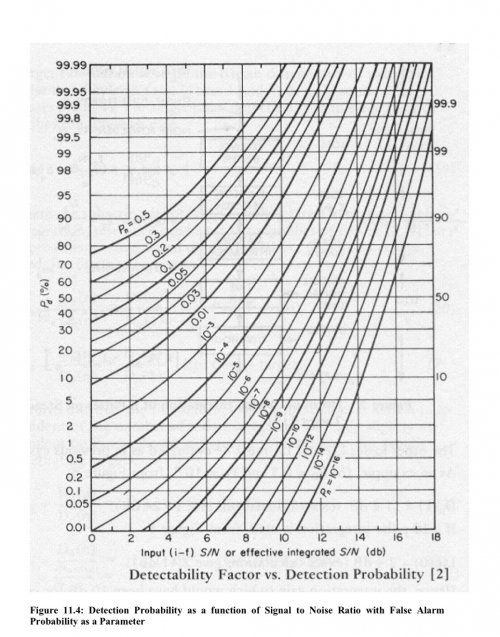
1- They don’t have the same backend, so the level of minimum detectable signal (S/N ratio) between the two radar are not the same. It is expected that the much newer Irbis-E will have better backend and therefore better sentitivity View attachment 779380
2- . If they both operate in X band then Zaslon-AM will have better gain than Irbis-e. However, Zaslon-AM operate in C band while Irbis-E operate in X band, and we know radar gain is heavily affected by operating frequency View attachment 779381
If you put the number in, you can see for your self that Irbis-e gain is actually 1.86 times better than Zaslon-AM.
Yeah that kind of obvious since it can track target with RCS of 3 m2 from 350-400 km, a bigger target can be seen from greater distance
Keep in mind that both N007AM and N035 were developed almost in the same time,after 2000.About that C- band ( f=6GHz, λ≈6cm) ,really don't know what to say/write. If that is right what once Yuriy Beliy said ,question is ,what happened with the reflector of the antenna ,what happened with the waveguide units?
About that detection distances,sorry but what we really know about even old N007 from 1980? We have many MiG-29 Flight and Technical Manuals and many books,also Su-27SK Flight Manual etc. What we really have about MiG-31 except that Book of the flight-technical characteristics from 1985? Books from Y.Gordon, D.Komissarov, A.Fomin and others? I mentioned earlier that old N007 was capable of lock-on incoming low-flying cruise missile (Kh-55) at almost 100km.
To be frank, just because someone on the internet claims to know something doesn't automatically make it credible. In this case, the user didn't present anything particularly insightful or that requires deep understanding of radar systems. What he said essentially boils down to: a large antenna aperture is important for radar performance which is widely known and rather basic, akin to saying “high thrust is important for a fighter jet” Well, duh.
Zaslon-AM is based on older architecture (the original Zaslon was the world's first PESA radar in a fighter, introduced in the early 1980s, it is essentially Zaslon-A with different processor, while Irbis-E is a more modern hybrid PESA. It like comparing F-35A and F-16V
About that C- band ( f=6GHz, λ≈6cm) ,really don't know what to say/write. If that is right what once Yuriy Beliy said ,question is ,what happened with the reflector of the antenna ,what happened with the waveguide units?
About that detection distances,sorry but what we really know about even old N007 from 1980? We have many MiG-29 Flight and Technical Manuals and many books,also Su-27SK Flight Manual etc. What we really have about MiG-31 except that Book of the flight-technical characteristics from 1985? Books from Y.Gordon, D.Komissarov, A.Fomin and others?
We don’t have a lot of data about Mig-31 because it is not a commercial success, it is not exported in great number, unlike Su-27 and Mig-29 because big interceptor has very niche use, so the chance that some classified document would be leaked is much lower. The reason who don’t see many manual of Mig-31 until recently is also the same reason we don’t see manual of Su-33.
Do you have a source for that?, as far as I know, this the only reference for Zaslon-AM range:
The Zaslon-AM retains the same angular coverage of its 1970s-vintage predecessor, scanning an area out to 70º on each side of the centreline and to 60º below and above the nose. However, with hugely increased processing power and refined software, the Zaslon-AM can now track up to 24 air targets simultaneously and provide data for engaging six of them with radar-guided AAMs such as the older-generation R-33S, as well as the new-generation R-37M and R-77-1. The lock-on range of the upgraded Zaslon-AM against low-flying cruise missiles, such as the BGM-109 Tomahawk, is claimed to have been extended to about 22nm (40km), representing a 30% improvement in detection/tracking performance.
It's important to understand that radar detection range in the real world doesn't work like in video games, where a target with a given RCS is always detected at a fixed distance. In reality, detection is probabilistic and depends heavily on the signal-to-noise ratio (SNR).
For example, you might achieve a 50% probability of detection with a 50% false alarm rate at an SNR of 0 dB. However, if you require a 99.9% detection probability and a false alarm rate as low as 10⁻¹⁶, the necessary SNR increases to around 18 dB. This difference in SNR translates to a significant change in detection range.
In short, is it possible for a radar to detect a target at a greater distance than the manufacturer's stated range under certain real-world conditions? Absolutely. However, the advertised detection range typically reflects the distance at which the signal-to-noise ratio (SNR) is sufficient to ensure reliable chance of detection with a low probability of false alarm.
To be frank, just because someone on the internet claims to know something doesn't automatically make it credible. In this case, the user didn't present anything particularly insightful or that requires deep understanding of radar systems. What he said essentially boils down to: a large antenna aperture is important for radar performance which is widely known and rather basic, akin to saying “high thrust is important for a fighter jet” Well, duh.
Zaslon-AM is based on older architecture (the original Zaslon was the world's first PESA radar in a fighter, introduced in the early 1980s, it is essentially Zaslon-A with different processor, while Irbis-E is a more modern hybrid PESA. It like comparing F-35A and F-16V
Well, may be Zaslon-A also operate around that band.
We don’t have a lot of data about Mig-31 because it is not a commercial success, it is not exported in great number, unlike Su-27 and Mig-29 because big interceptor has very niche use, so the chance that some classified document would be leaked is much lower. The reason who don’t see many manual of Mig-31 until recently is also the same reason we don’t see manual of Su-33.
Do you have a source for that?, as far as I know, this the only reference for Zaslon-AM range:
As I wrote earlier ,there is YT video about Pemboy test range exercise that happened on May 2013,must find
it.
I know about that A.Mladenov's article. Nothing special....
''The lock-on range of the upgraded Zaslon-AM against low-flying cruise missiles, such as the BGM-109 Tomahawk, is claimed to have been extended to about 22nm (40km), representing a 30% improvement in detection/tracking performance.''
Now let us see what Carlo Kopp wrote in its 2008 article :
''Rated at 2.5 kiloWatts average power, with a 25% duty cycle peak power rating of 10 kiloWatts, this immense radar is claimed to be capable of detecting a 0.3 m2 RCS cruise missile at 35 nautical miles range.''
https://ausairpower.net/APA-Flanker-Radars.html
So N007 could detect cruise missile at about 70km ( supose that lock on range was 70%-80% of the detect/track range) but modified N007AM can lock-on them at 40km.
Do not believe what Carlo or Alexander write/wrote.
What can I write about that ? On March 24 1999 one YuAF MiG-29B with its partially operative/usable N019EB detected/tracked BGM-109 at 30km in 'Vstrechya' combat mode.
We all know that one N019EB is only a little baby in comparison with mighty N007/A/AM.
P.S.
There is some details about that exercise from May 2013 on MiG-31 topic.
I know about that A.Mladenov's article. Nothing special....
''The lock-on range of the upgraded Zaslon-AM against low-flying cruise missiles, such as the BGM-109 Tomahawk, is claimed to have been extended to about 22nm (40km), representing a 30% improvement in detection/tracking performance.''
Now let us see what Carlo Kopp wrote in its 2008 article :
''Rated at 2.5 kiloWatts average power, with a 25% duty cycle peak power rating of 10 kiloWatts, this immense radar is claimed to be capable of detecting a 0.3 m2 RCS cruise missile at 35 nautical miles range.'' https://ausairpower.net/APA-Flanker-Radars.htmlSo N007 could detect cruise missile at about 70km ( supose that lock on range was 70%-80% of the detect/track range) but modified N007AM can lock-on them at 40km.
Do not believe what Carlo or Alexander write/wrote.
They can both be correct
Carlo Kopp could refer to lock up situation where there is little background clutter, whereas A.Mladenov could refer to look down situation where ground clutter significantly affect detection range.
Take for example: APG-66 can detect Mig-25 from 50 nm in look up situation but limited to 35 nm in look down situation. I would imagine a cruise missile at low altitude affected even more.
What can I write about that ? On March 24 1999 one YuAF MiG-29B with its partially operative/usable N019EB detected/tracked BGM-109 at 30km in 'Vstrechya' combat mode.
Do you have the source for it, I need to understand the context around it. Also, since it was a war and not an exercise between nation, how do we know for certain that the Mig-29B in that particular instance indeed detected a BGM-109 and not just a false alarm (since its radar is faulty) or a false target generated by F-16CJ ALQ-184?. The fog of war during that time period must be far greater than it is today.
Moreover, since it was a war, I would assume that destroyer didn't just launch a singular Tomahawk at target, they likely launched a dozen of them flying together, which probably make up much bigger RCS value
To be honest, it very hard to make judgment about having the source and seeing the related context
They can both be correct Carlo Kopp could refer to lock up situation where there is little background clutter, whereas A.Mladenov could refer to look down situation where ground clutter significantly affect detection range.
Take for example: APG-66 can detect Mig-25 from 50 nm in look up situation but limited to 35 nm in look down situation. I would imagine a cruise missile at low altitude affected even more. View attachment 779495
Do you have the source for it ,I need to understand the context around it. Also, since it was a war and not an exercise between nation, how do we know for certain that the Mig-29B in that particular instance indeed detected a BGM-109 and not just a false alarm (since its radar is faulty) or a false target generated by F-16CJ ALQ-184?. The fog of war during that time period must be far greater than it is today.
Moreover, since it was a war, I would assume that destroyer didn't just launch a singular Tomahawk at target, they likely launched a dozen of them flying together, which probably make up much bigger RCS value
Source is one Documentary called ''Nobody said no'' .
https://www.imdb.com/title/tt2807558/
It was Maj.Dragan Ilic in MiG-29B tactical number 106 ,sqn number 18106 who was guided twice by the GCI to intercept incoming cruise missiles. Btw ,his MiG-29 was engaged by the KLu F-16AM ( piloted by Capt. Piter Tankink) and was partially hit by AIM-120B in the front section but he wasn't shot down.He safely landed on the Nis airport. Flying Dutchman in fact did not shot down anybody,that's the true.
No matter what conclusion you reach, some assumptions are always required. Different conclusions simply reflect different underlying assumptions. For example, if you choose to believe that the Zaslon radar has a significantly greater detection range than officially reported, you would have to assume that both Carlo Kopp and A. Mladenov are incorrect, and that Zaslon-A was able to detect a cruise missile from 100 km during testing. To interpret that result as evidence of exceptionally long detection range, you'd also have to assume the missile wasn’t momentarily presenting a high-RCS spike to the radar, that it was detected with a very high signal-to-noise ratio (SNR), and that the detection wasn’t just a result of a low probability of detection (PD) setting and high false alarm tolerance.
Source is one Documentary called ''Nobody said no'' .
https://www.imdb.com/title/tt2807558/
It was Maj.Dragan Ilic in MiG-29B tactical number 106 ,sqn number 18106 who was guided twice by the GCI to intercept incoming cruise missiles. Btw ,his MiG-29 was engaged by the KLu F-16AM ( piloted by Capt. Piter Tankink) and was partially hit by AIM-120B in the front section but he wasn't shot down.He safely landed on the Nis airport. Flying Dutchman in fact did not shot down anybody,that's the true.
What can I write about that ? On March 24 1999 one YuAF MiG-29B with its partially operative/usable N019EB detected/tracked BGM-109 at 30km in 'Vstrechya' combat mode.
We all know that one N019EB is only a little baby in comparison with mighty N007/A/AM.
Source is one Documentary called ''Nobody said no'' . https://www.imdb.com/title/tt2807558/
It was Maj.Dragan Ilic in MiG-29B tactical number 106 ,sqn number 18106 who was guided twice by the GCI to intercept incoming cruise missiles. Btw ,his MiG-29 was engaged by the KLu F-16AM ( piloted by Capt. Piter Tankink) and was partially hit by AIM-120B in the front section but he wasn't shot down.He safely landed on the Nis airport. Flying Dutchman in fact did not shot down anybody,that's the true.
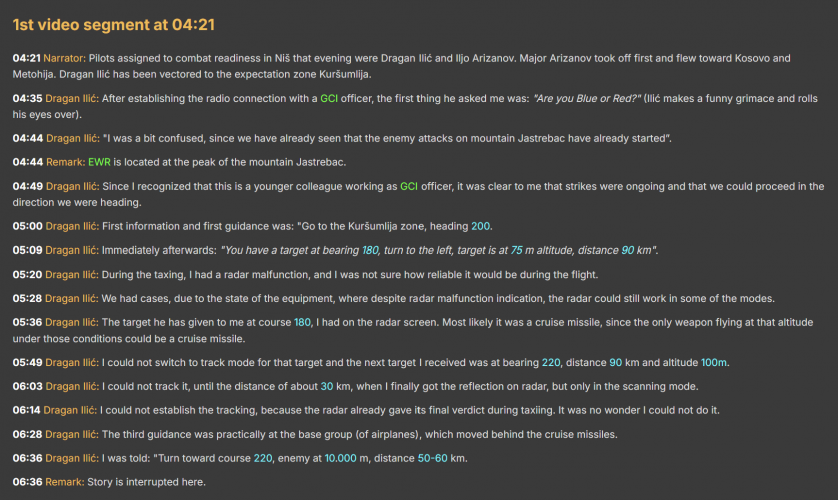
Alright, so lucky enough I actually found the subtitles
So it seem what I said is correct, Mig-29 didn't know for certain that the target he detected is a Tomahawk, he simply guess that the target is a cruise missile based on the flying altitude of around 100 meters. However, we should also note that Germany’s Tornado also join the NATO strike effort on the first night 24 March 1999, so it is entirely plausible that he did detect a Tornado which also often use low altitude for penetration https://forum.dcs.world/topic/365459-24031999-mig-29-combat-flight-dragan-ilic/
@Squirrel you are working from the flawed principal of cherrypicking data to suit your arguments.
35nm is 65km not 70km. So, you misrepresented the data, accidentally I am sure.
( supose that lock on range was 70%-80% of the detect/track range)
Range, headon, versus bomber: 180-200km search, 120-150km track (66 - 75% range when tracking)
Range, tailchase, versus bomber: 90km search, 70km track (77% detection range for tracking)
Using the radar range equation, and plugging in the known upper limit maximum detection range of 180-200km versus a 19 sq m bomber target, yields a detection range of 57-63 km versus a 0.3 sq m target. Tracking range would be 38–47km.
Close enough to 65km I won't dispute it, but this is maximum detection range in a headon engagement at a good closing rate. This is an idealised target for a high PRF radar where the target is unambiguously clear of clutter, so range is close to maximum.
If we consider the case where the target has a lower closure rate and a tailchase engagement is happening, range would be significantly reduced by clutter in the lookdown engagement.
Going from the tailchase figures for a bomber given above, a 0.3 sq m RCS target in tailchase would be detected at 28km and tracked at 22km.
Alexander Mladenov says Zaslon-AM has a lockon range of 40km vesus a Tomahawk, which is a 30% improvement over Zaslon. This implies the base Zaslon lockon range is in the ballpark of 30km.
Radar range calculations suggest tracking range would be between 22km and 47km. So if Mladenov's figure is actually pretty consistent with the figure stated by Mr Kopp.
Alright, so lucky enough I actually found the subtitles
So it seem what I said is correct, Mig-29 didn't know for certain that the target he detected is a Tomahawk, he simply guess that the target is a cruise missile based on the flying altitude of around 100 meters. However, we should also note that Germany’s Tornado also join the NATO strike effort on the first night 24 March 1999, so it is entirely plausible that he did detect a Tornado which also often use low altitude for penetration View attachment 779601 https://forum.dcs.world/topic/365459-24031999-mig-29-combat-flight-dragan-ilic/
@Squirrel you are working from the flawed principal of cherrypicking data to suit your arguments.
35nm is 65km not 70km. So, you misrepresented the data, accidentally I am sure.
( supose that lock on range was 70%-80% of the detect/track range)
Using the radar range equation, and plugging in the known upper limit maximum detection range of 180-200km versus a 19 sq m bomber target, yields a detection range of 57-63 km versus a 0.3 sq m target. Tracking range would be 38–47km.
Close enough to 65km I won't dispute it, but this is maximum detection range in a headon engagement at a good closing rate. This is an idealised target for a high PRF radar where the target is unambiguously clear of clutter, so range is close to maximum.
If we consider the case where the target has a lower closure rate and a tailchase engagement is happening, range would be significantly reduced by clutter in the lookdown engagement.
Going from the tailchase figures for a bomber given above, a 0.3 sq m RCS target in tailchase would be detected at 28km and tracked at 22km.
Alexander Mladenov says Zaslon-AM has a lockon range of 40km vesus a Tomahawk, which is a 30% improvement over Zaslon. This implies the base Zaslon lockon range is in the ballpark of 30km.
Radar range calculations suggest tracking range would be between 22km and 47km. So if Mladenov's figure is actually pretty consistent with the figure stated by Mr Kopp.
Sorry but there is no difference between detect and track ranges /distances .
Third aircraft ''X3'' was detected at 268 km and immediately after that it was automatically tracked.Automatic tracking begins right after aircraft is detected.
i dont know who ever started this thread but how are you supposed to compare strategic interceptor to a multirole fighter ?
sure Su-30 NOT Su-35 in some moment of delusion was to replace the MiG-31 as a strategic interceptor in the early-mid 90's (thats why Su-30 even exists in a first place ) but as we see that never happened since MiG-31 is a true interceptor and Su-30 is just another flanker variant
the 30% quote you mention @Squirrel isn't in a regular interview, its from the Zvezda from MiG-25 to MiG-31 the dual part documentary
Sorry but there is no difference between detect and track ranges /distances .
Third aircraft ''X3'' was detected at 268 km and immediately after that it was automatically tracked.Automatic tracking begins right after aircraft is detected.
Yes, his conclusion was based on the target's altitude. Additionally, it's important to note that the target appeared on his radar screen only briefly, which suggests it was likely presenting a momentary high-RCS spike. The MiG-29 was also exported to countries like Germany, if its radar had significantly outperformed expectations, we would likely have seen more reports or stories reflecting that instead of this singular instance where the kind of target can't even be fully confirmed
Yes, his conclusion was based on the target's altitude. Additionally, it's important to note that the target appeared on his radar screen only briefly, which suggests it was likely presenting a momentary high-RCS spike. The MiG-29 was also exported to countries like Germany, if its radar had significantly outperformed expectations, we would likely have seen more reports or stories reflecting that instead of this singular instance where the kind of target can't even be fully confirmed View attachment 779700
The mistake being made is that a single unqualified anecdote from a pilot trumps information from brochures and manuals. This is a particularly good example. The actual reference is a set of assumptions. The pilot assumes the target was a Tomahawk cruise missile, he doesn't know. The pilot got the target on radar at 30km, but we don't know the target aspect. We assume that a Tomahawk is 0.3-0.5 sq m RCS from the front, but there will be larger spikes from some other directions. He couldn't get a lock on.
Range figures for radar are statistical. Range is 200km, say, for 85% probability of detection for a target of 19 sq m RCS. If you detect the target at 230km one time, it doesn't invalidate the 200km range figure, any more than another time detecting it at 180km.
Yes, his conclusion was based on the target's altitude. Additionally, it's important to note that the target appeared on his radar screen only briefly, which suggests it was likely presenting a momentary high-RCS spike. The MiG-29 was also exported to countries like Germany, if its radar had significantly outperformed expectations, we would likely have seen more reports or stories reflecting that instead of this singular instance where the kind of target can't even be fully confirmed View attachment 779700
Serbian Airforce was in state of disrepair by the time of NATO bombing , given that radar was malfunctioning already before takeoff its hard to draw any conclusions from that report . The interesting part is that GCI was able to get radar on targets to vector the fighters given that NATO had like 600+ planes bombing and doing SEAD
i dont know who ever started this thread but how are you supposed to compare strategic interceptor to a multirole fighter ?
sure Su-30 NOT Su-35 in some moment of delusion was to replace the MiG-31 as a strategic interceptor in the early-mid 90's (thats why Su-30 even exists in a first place ) but as we see that never happened since MiG-31 is a true interceptor and Su-30 is just another flanker variant the 30% quote you mention @Squirrel isn't in a regular interview, its from the Zvezda from MiG-25 to MiG-31 the dual part documentary
..don't know for that but yes ,there was a interview with Yuriy Beliy from NIIP Tikhomirov where we he said that N007AM has 30% greater detection ranges than N007A. Hope I will find that interview.
''Using the radar range equation, and plugging in the known upper limit maximum detection range of 180-200km versus a 19 sq m bomber target, yields a detection range of 57-63 km versus a 0.3 sq m target. Tracking range would be 38–47km.''
My point with the video of testing N035 was to show that there is no difference between detect and track ranges. As I wrote,if aircraft is detected let say at 100km ,automatic tracking begins right from that moment.We can see exactly that in YT video of N035 Irbis live test.
I hope you will understand now what my point was.
Yes, his conclusion was based on the target's altitude. Additionally, it's important to note that the target appeared on his radar screen only briefly, which suggests it was likely presenting a momentary high-RCS spike. The MiG-29 was also exported to countries like Germany, if its radar had significantly outperformed expectations, we would likely have seen more reports or stories reflecting that instead of this singular instance where the kind of target can't even be fully confirmed View attachment 779700
I forgot to explain some details in my first comment about Maj. D.Ilic story. For the first aircraft ( heading 180°), he clearly said that he got him on its radar screen but he never said at what distance.In the meantime must explain some other details. Monitoring system 'Ekran' showed him during pre-flight checks that radar N019EB was mulfunctioning.In fact, lock-on mode could not work.Btw,in almost all ten ( only on paper operational and combat-ready) MiG-29B/L-18 radar N019EB's transmitters worked with degrading capabalities. His radar worked only in search modes ( V,D,AVT or SNP as the submode only of the V and D combat mode). Second aircraft ( heading 220°) his radar detected at a distance of 30km with stable tracking w/o possibility to lock him.
First command from the GCI officer to him after he took off from Nis airport was to fly to Kurshumlija zone ,after that he got that data about first target (heading 180 degrees) ,H=75m, D=90km.Second target was also low flying ( heading 220 degrees) ,H=100m D=90km. That first night ( 24 March 1999) ,Nis airport was hit by several cruise missiles BGM-109 launched from USN ships and one RN sub. You mentioned Luftwaffe Tornado's but must know that they didn't use RAF Tornado tactics from the First Gulf war with that low flying penetrating bombing missions.
Yes ,he mentioned cruise missiles as that was only logical and meaningful.That first night ,NATO launched so many cruise missiles like USN BGM-109 ( from the Adriatic sea) and AGM-86C from the Hungarian air space.There was no other NATO aircraft which flew at 75m or 100m.Of course, real target angle aspect at a moment of detecting we can't know but if we take a look on the vector from the city of Nis to the city of Kurshumlija,it seems that he flew right in the course of those CM's.
Now, whatever aircraft were on that night ,fact is that malfunctioned radar N019EB detected/tracked something that flew very low .Radar with degraded/weakened TWT which average power on HPRF mode is 1kW and max output pulse power is 8 kW when everything is OK.
That was the reason why I compared those real combat situations with given possibilities of much powerful old N007 Zaslon or newer N007AM Zaslon-AM.
@Mr. T
Yes, many MiG-29B had malfunctioning radars or RWR SPO-15LM.Even they all took off with R-27R1 as completely useless AAM's in that period 'cause they were not overhauled just like all 16 MiG-29B/UB . Btw, it was not Serbian but Yugoslav AF.
My point with the video of testing N035 was to show that there is no difference between detect and track ranges. As I wrote, if aircraft is detected let say at 100km ,automatic tracking begins right from that moment. We can see exactly that in YT video of N035 Irbis live test.
I hope you will understand now what my point was.
For most radars, tracking range is lower than detection range. For non TWS radars, tracking is a different mode you transition to where the radar operates differently. It normally takes a few cycles of stable detection of the target over successive search sweeps to switch to tracking, which might be 12 seconds apart with a mechanical scan radar depending on search volume.
TWS tracking modes are slightly different, as the radar stays in the search pattern the whole time, and electronically scanned radars obviously speed up the scan cycle, so successive detections occur quicker it is likely to be able to track a target quicker. Processor speed is relevant though. The more modern the radar, the quicker tracking will be possible,
So, the video of what Irbis does proves nothing about Zaslon.
Also, and once again you don't seem to grasp this, ranges are STATISTICAL. Lets say the detection range quoted is for an 85% probability of detection but the tracking range is given for 100% probability of establishing a track. The ranges will of course differ based on this.
Equally, a single event of moving from detection to tracking proves nothing about what will occur in 90% or 100% of cases.
if thats the cause @overscan (PaulMM) the R-37 record test that the MiG-31M did in the late 90s ( paralay somewhere shared excerpt on it i think here in the R-37 thread ) that means that it detected it's target on at least 400km with Zaslon-M
For most radars, tracking range is lower than detection range. For non TWS radars, tracking is a different mode you transition to where the radar operates differently. It normally takes a few cycles of stable detection of the target over successive search sweeps to switch to tracking, which might be 12 seconds apart with a mechanical scan radar depending on search volume.
TWS tracking modes are slightly different, as the radar stays in the search pattern the whole time, and electronically scanned radars obviously speed up the scan cycle, so successive detections occur quicker it is likely to be able to track a target quicker. Processor speed is relevant though. The more modern the radar, the quicker tracking will be possible,
So, the video of what Irbis does proves nothing about Zaslon.
Also, and once again you don't seem to grasp this, ranges are STATISTICAL. Lets say the detection range quoted is for an 85% probability of detection but the tracking range is given for 100% probability of establishing a track. The ranges will of course differ based on this.
Equally, a single event of moving from detection to tracking proves nothing about what will occur in 90% or 100% of cases.
Hm, why not..both are radars with PESA and very quick electronic scanning.Of course there is the difference between SOLO-35-1/2 and old Argon-15A comps ( if we count on old N007) but very small difference between them and new Baget-55-06 if we count on N007AM.
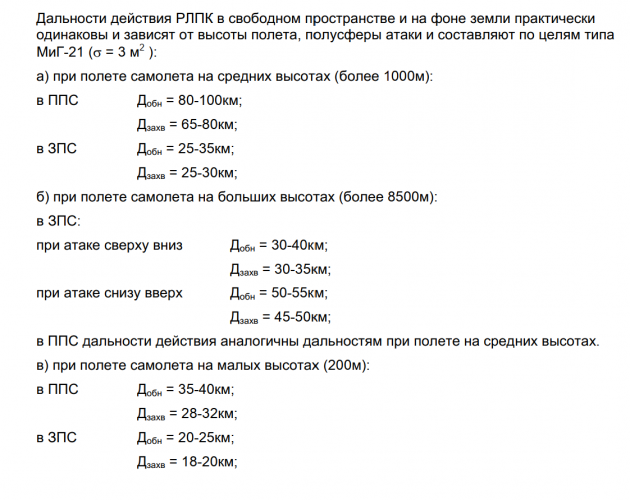
This is from the ''Su-27SK Flight Manual'' with N001E/ RLPK-27E ,old radar with mechanical scanning.
''Дальность действия РЛПК в свободном пространстве и на фоне земли практически одинакова и зависит от высоты полета самолета, полусферы атаки и составляет по истребителям (σ = 3 м2):
а) при полете самолета на больших высотах:
в ЗПС:
при атаке сверху вниз: Добн = 30 – 40 км;
Дзахв = 30 – 35 км;
при атаке снизу вверх: Доб= 50 – 55 км
Дзахв = 45 – 50 км;
в ППС: Добн = 80 – 100 км, Дзахв = 65 – 80 км;
б) при полете самолета на средних высотах (более 1000 м):
в ППС: Добн = 80 – 100 км, Дзахв = 65 – 80 км;
в ЗПС: Добн = 25 – 35 км, Дзахв = 25 – 30 км;
в) при полете самолета на малых высотах (200 м):
в ППС: Добн = 35 – 40 км, Дзахв = 28 – 32 км;
в ЗПС: Добн = 20 – 25 км, Дзахв = 18 – 20 км;''
''The range of the radar in free space and against the background of the earth is practically the same and depends on the altitude of the aircraft, the hemisphere of attack and is for fighters (σ = 3 m2):
a) when the aircraft flies at high altitudes:
It is easy to understand and there si data only about detection ranges and lock-on ranges. There is no data about tracking ranges.
''Добн'' is the detection distance , ''Дзахв'' is the lock-on distance.
Example, aircraft with 3sqm of RCS can be detected in front hemipshere( higher alt) at 80-100km and can be locked at 65-80 km .
Hm, why not..both are radars with PESA and very quick electronic scanning.Of course there is the difference between SOLO-35-1/2 and old Argon-15A comps ( if we count on old N007) but very small difference between them and new Baget-55-06 if we count on N007AM.
[....]
Example, aircraft with 3sqm of RCS can be detected in front hemipshere( higher alt) at 80-100km and can be locked at 65-80 km .
There are a whole slew of technical differences between Irbis and Zaslon implementation of PESA, aside from the infinite gulf in computing performance.
My point with the video of testing N035 was to show that there is no difference between detect and track ranges. As I wrote,if aircraft is detected let say at 100km ,automatic tracking begins right from that moment.We can see exactly that in YT video of N035 Irbis live test.
I hope you will understand now what my point was.
It is easy to understand and there si data only about detection ranges and lock-on ranges. There is no data about tracking ranges.
I want to offer my 2 cents here:
1- The maximum detection range of a pulse-Doppler radar is always longer than its tracking (or lock-on) range. Why? Because the absolute maximum detection range is achieved in velocity search mode, where the radar operates using high pulse repetition frequency (PRF). High PRF increases the average power on target, improving detection range especially for fast moving objects.
However, there's a trade-off: high PRF sacrifices range resolution. Since the radar sends out a new pulse before the previous one has time to return, it cannot reliably determine distance based on time delay. As a result, while targets can be detected, no precise range information is available in velocity search mode.
2- In tests involving the Irbis-E radar, range measurements are shown from the beginning of detection. This suggests it was likely operating in medium PRF mode, which allows both velocity and range information to be gathered, albeit at a slightly reduced detection range compared to high PRF.
3- The terms "tracking range" and "lock-on range" refer to the same concept: the distance at which the radar can continuously track and guide weapons to a target.
I forgot to explain some details in my first comment about Maj. D.Ilic story. For the first aircraft ( heading 180°), he clearly said that he got him on its radar screen but he never said at what distance.In the meantime must explain some other details. Monitoring system 'Ekran' showed him during pre-flight checks that radar N019EB was mulfunctioning.In fact, lock-on mode could not work.Btw,in almost all ten ( only on paper operational and combat-ready) MiG-29B/L-18 radar N019EB's transmitters worked with degrading capabalities. His radar worked only in search modes ( V,D,AVT or SNP as the submode only of the V and D combat mode). Second aircraft ( heading 220°) his radar detected at a distance of 30km with stable tracking w/o possibility to lock him.
First command from the GCI officer to him after he took off from Nis airport was to fly to Kurshumlija zone ,after that he got that data about first target (heading 180 degrees) ,H=75m, D=90km.Second target was also low flying ( heading 220 degrees) ,H=100m D=90km. That first night ( 24 March 1999) ,Nis airport was hit by several cruise missiles BGM-109 launched from USN ships and one RN sub. You mentioned Luftwaffe Tornado's but must know that they didn't use RAF Tornado tactics from the First Gulf war with that low flying penetrating bombing missions.
Yes ,he mentioned cruise missiles as that was only logical and meaningful.That first night ,NATO launched so many cruise missiles like USN BGM-109 ( from the Adriatic sea) and AGM-86C from the Hungarian air space.There was no other NATO aircraft which flew at 75m or 100m.Of course, real target angle aspect at a moment of detecting we can't know but if we take a look on the vector from the city of Nis to the city of Kurshumlija,it seems that he flew right in the course of those CM's.
Now, whatever aircraft were on that night ,fact is that malfunctioned radar N019EB detected/tracked something that flew very low .Radar with degraded/weakened TWT which average power on HPRF mode is 1kW and max output pulse power is 8 kW when everything is OK.
That was the reason why I compared those real combat situations with given possibilities of much powerful old N007 Zaslon or newer N007AM Zaslon-AM.
There are several issue with using that particular instant to deduce Mig-29 radar range:
1. Given the high number of NATO aircraft involved on the first night of the campaign (24 March 1999), it's plausible that the radar contact in question could have been a Tornado. In the absence of more detailed information, this possibility cannot be dismissed.
2. Cruise missiles typically don’t fly solo, they're often launched in salvos. In this case, it's likely that the ship launched multiple missiles simultaneously. If these missiles were flying in close formation within the same radar resolution cell, their combined radar cross section (RCS) would be significantly larger than that of a single missile.
The challenge is that we don’t know the number of missiles involved or their formation geometry, making it impossible to accurately estimate the effective RCS.
3. Radar cross section is not a fixed value, it varies with the aspect angle of the target. In this scenario, the targets appeared on radar only briefly, which suggests they were likely presenting a momentary high RCS spike as they briefly aligned in a way that reflected more radar energy.
4. As both Paul and I previously explained, radar detection range is statistical, not deterministic. It’s not like in a video game where a specific RCS equals a fixed detection distance. Instead, it's more like a game of Russian roulette:
The signal-to-noise ratio (SNR) is like the number of bullets in the chamber.
- Higher SNR gives you a greater chance of detecting the target and a lower chance of false alarm.
- But even with low SNR, detection is still possible, just less probable.
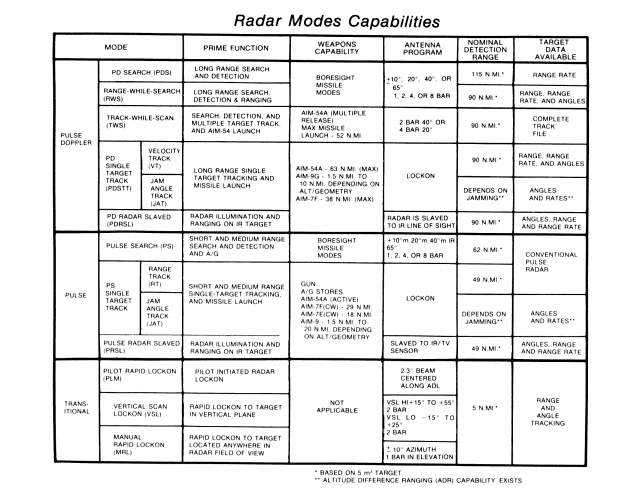
We also have detection range data for the N001VEP radar from official manuals. This information is reliable, as it is intended for operational use by pilots. According to the manual, the N001VEP can detect a MiG-21-sized target (with an RCS of approximately 3 m²) flying at an altitude of 200 meters from a distance of 40 km.
Given that the N001VEP has a larger antenna diameter (around 1 meter) compared to the N019EB (approximately 650 mm), and that both radars operate at roughly the same frequency band while the N019EB is also an older design, it is unreasonable to assume that the N019EB would have superior detection range.
if thats the cause @overscan (PaulMM) the R-37 record test that the MiG-31M did in the late 90s ( paralay somewhere shared excerpt on it i think here in the R-37 thread ) that means that it detected it's target on at least 400km with Zaslon-M
I vaguely recall that they positioned a Su-27 or Su-30 closer to the target to guide the missile
Nevertheless, Zaslon-M has bigger diameter compared to Zaslon-AM
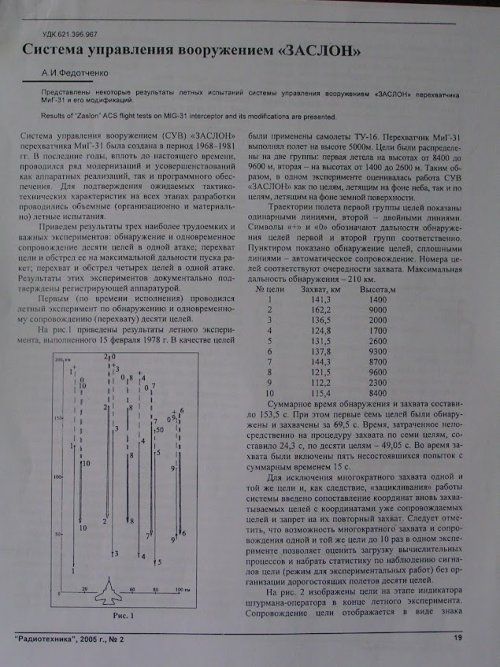
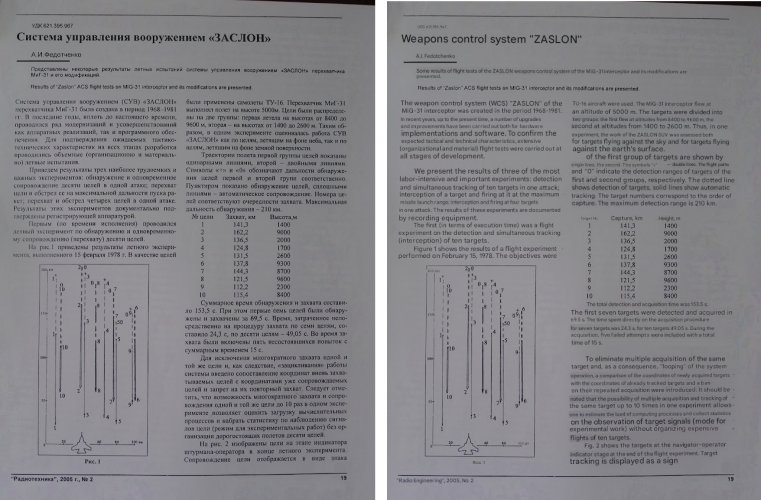
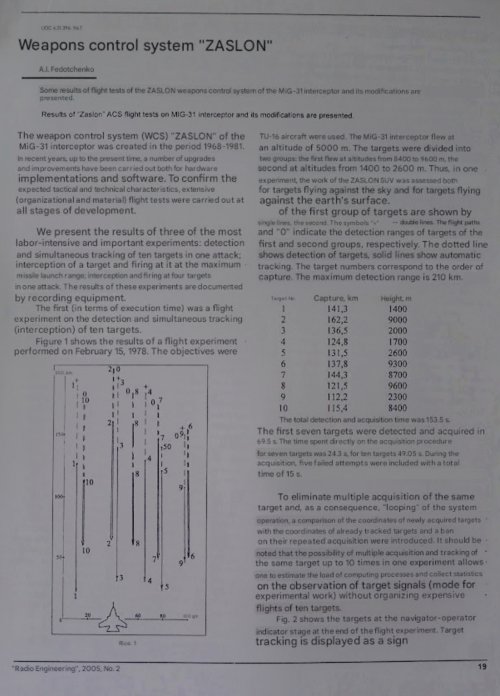
This test conducted on 15/2/1978, so I assume the radar being used here is Zaslon-A
Target used were Tu-16, maximum detection range is 210 km
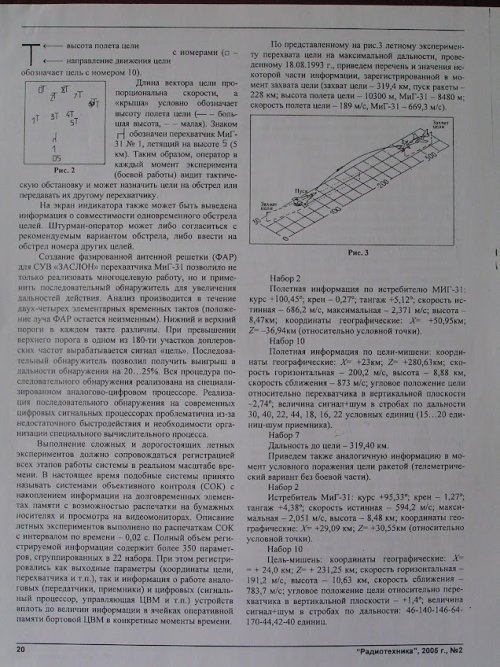
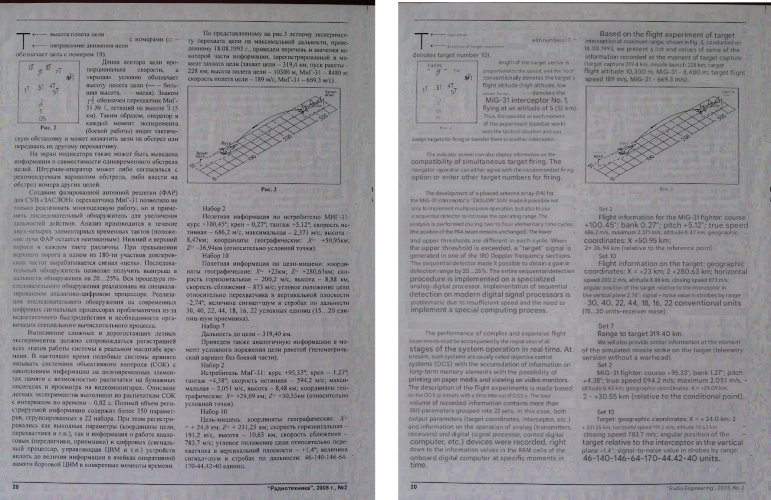
This test conducted on 18/8/1993, so I assume the radar being used here is Zaslon-M?
They didn't specified the exact kind of target in this test, however, given that the target speed is 189 m/s (680 km/h) at 10.3 km, I would assume that they also used a Tu-16 similar to previous test.
Maximum detection range is 319.4 km
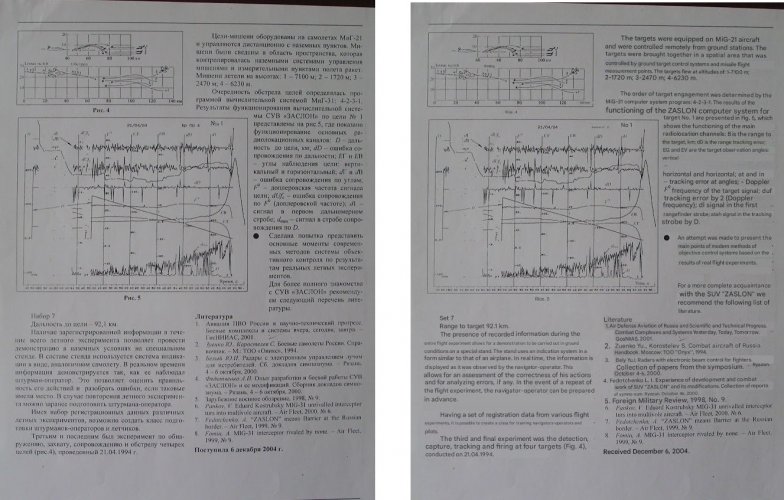
This is the test of detection/capture and firing on 4 targets at the same times
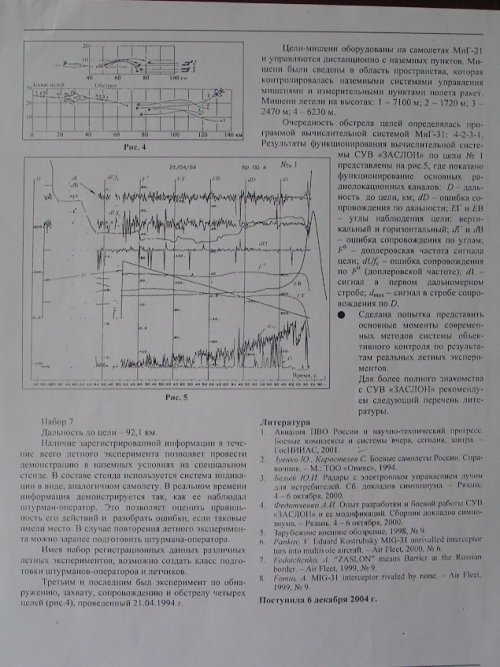
Test conducted on 21/04/1994 so I assume they use either Zaslon-AM or Zaslon-M
I'm not sure whether I understand the translation correctly or not, but the target are either equipped on Mig-21 or these Mig-21 themselves are the target? maybe someone who can read Russian better can help with translation
Anyway, it seem like these targets are detected at distance of 120 km
We also have detection range data for the N001VEP radar from official manuals. This information is reliable, as it is intended for operational use by pilots. According to the manual, the N001VEP can detect a MiG-21-sized target (with an RCS of approximately 3 m²) flying at an altitude of 200 meters from a distance of 40 km.
Given that the N001VEP has a larger antenna diameter (around 1 meter) compared to the N019EB (approximately 650 mm), and that both radars operate at roughly the same frequency band while the N019EB is also an older design, it is unreasonable to assume that the N019EB would have superior detection range. View attachment 779789
Wow, that's interesting. i think use of new processor on the N001VEP can increase the range even with the same antenna and transmitter power like N001 old.
this also adds new modes for surface detection capabilities like GMTI, DBS, etc
This test conducted on 15/2/1978, so I assume the radar being used here is Zaslon-A
Target used were Tu-16, maximum detection range is 210 km View attachment 779792
This test conducted on 18/8/1993, so I assume the radar being used here is Zaslon-M?
They didn't specified the exact kind of target in this test, however, given that the target speed is 189 m/s (680 km/h) at 10.3 km, I would assume that they also used a Tu-16 similar to previous test.
Maximum detection range is 319.4 km View attachment 779793
This is the test of detection/capture and firing on 4 targets at the same times
Test conducted on 21/04/1994 so I assume they use either Zaslon-AM or Zaslon-M
I'm not sure whether I understand the translation correctly or not, but the target are either equipped on Mig-21 or these Mig-21 themselves are the target? maybe someone who can read Russian better can help with translation
Anyway, it seem like these targets are detected at distance of 120 km View attachment 779794
Those are lock on ranges, not detection ranges, and yes, the targets were radio controlled Tu-16 and Mig-21.
It is worth mentioning that the Mig-21 were locked between 120-133 km, and in addition to the vertical and horizontal spacing between them, they were maneuvering during the engagement and were all destroyed at distances between 70-90 km.
Now, it is not very wise to extrapolate detection ranges from this data because we don't know the exact ROE.
If we watch the Irbis radar video, we can see that the targets were detected at around 270 km, but were locked at 100 km because these were the ROE (operator asked should they lock the targets at those ranges (268 km) and the leader said no, we will lock them at 100 km).
We can also see that Mig-31M was at very "conservative" altitude and speed, and if I remember correctly, in 1994 Mig-31M destroyed the target at 304 km distance which is the all time record in military aviation history.
That is also indication that the target was detected and locked at "significantly" longer range.
''2- In tests involving the Irbis-E radar, range measurements are shown from the beginning of detection. This suggests it was likely operating in medium PRF mode, which allows both velocity and range information to be gathered, albeit at a slightly reduced detection range compared to high PRF.''
During the test which we can see on the YT-video, N035 Irbis worked on High PRF mode. We can see as a title ''Режим ВЧП'' - ''Висока Частота Повторений'' meaning High PRF mode. On the left side of the vertical distance to target scale we can see : РЛ-радиолокатор оr radio-locator/radar, ИЗЛ-излучение or illumination, ППС-передняя полусфера or front hemisphere and ДО-дальнее обнаружение or further detection.
''3- The terms "tracking range" and "lock-on range" refer to the same concept: the distance at which the radar can continuously track and guide weapons to a target.''
It is not like that. First, you have automatic tracking during search mode ( e.g. TWS or track while scan/search is it ?) and where radars use so called quasi-continuous illumination regime.Then you have automatic tracking of given target in the lock-on mode or in Russian 'РНП-режим непрерывной пеленгации' where they used monopulse tracking regime.
When we speak about Irbis and Zaslon ,those two PESA radars have two TWT's. The main one always use quasi-continuous waveform during search mode which is not stopped during lock-on mode like in older N001 and N019 with one TWT only.For the lock-on mode and CWI mode ,those radars use secondary TWT.
N007AM can detect and automatically track max 24 aircraft in the given search zone.From max ( if possible) 24 tracked tnx to Baget-55-06 ,it can lock-on max 8 targets (as most dangerous) of them. On the other side, N035 can detect and automaticaly track max 30 differ aricraft in the given search zone and can lock-on max 8 of them tnx to SOLO-comps.
''This test conducted on 15/2/1978, so I assume the radar being used here is Zaslon-A.''
It was old N007 Zaslon, N007A Zaslon-A was in use on MiG-31B from 1991.
Those are lock on ranges, not detection ranges, and yes, the targets were radio controlled Tu-16 and Mig-21.
It is worth mentioning that the Mig-21 were locked between 120-133 km, and in addition to the vertical and horizontal spacing between them, they were maneuvering during the engagement and were all destroyed at distances between 70-90 km.
Now, it is not very wise to extrapolate detection ranges from this data because we don't know the exact ROE.
If we watch the Irbis radar video, we can see that the targets were detected at around 270 km, but were locked at 100 km because these were the ROE (operator asked should they lock the targets at those ranges (268 km) and the leader said no, we will lock them at 100 km).
We can also see that Mig-31M was at very "conservative" altitude and speed, and if I remember correctly, in 1994 Mig-31M destroyed the target at 304 km distance which is the all time record in military aviation history. That is also indication that the target was detected and locked at "significantly" longer range.
Hi, 304km was in fact the launch distance of one of the six K-37's launched from the prototype of the MiG-31M,number 057 blue .Yes, it happened on April 1994.
Of course, detection /automatic tracking distance in TWS was much greater .Lock-on range was of course greater than 300km. Note : old MiG-31 with N007 was capable of engaging 4 differ air targets within only 10 sec ( so launch of all four R-33 could be accomplished in less than 10 sec only ).
Hi, 304km was in fact the launch distance of one of the six K-37's launched from the prototype of the MiG-31M,number 057 blue .Yes, it happened on April 1994.
Of course, detection /automatic tracking distance in TWS was much greater .Lock-on range was of course greater than 300km. Note : old MiG-31 with N007 was capable of engaging 4 differ air targets within only 10 sec ( so launch of all four R-33 could be accomplished in less than 10 sec only ).
To be correct, the R-37 was limited by the testing range size, that's why it isn't over 304km
everything shoot over 160km is MiG-31M/R-37 if it's before 1998
they are two BM's the BM/E 1.0 - Multirole fighter - 1998 and BM/BSM 2.0 - pure interceptor with Zaslon-AM from the 2000s
I think you are correct about Zaslon-M test, but in Zaslon-A test, the 210 km distance against Tu-16 were detection range rather than lock on range. The lock on/capture range is 162 km.
Zaslon-M has much bigger antenna compared to Zaslon-A/Zaslon-AM. With diameter of 1.4 meters, the aperture area is 62% bigger than other Zaslon version. Unfortunately, it doesn’t go to full scale production
''2- In tests involving the Irbis-E radar, range measurements are shown from the beginning of detection. This suggests it was likely operating in medium PRF mode, which allows both velocity and range information to be gathered, albeit at a slightly reduced detection range compared to high PRF.''
During the test which we can see on the YT-video, N035 Irbis worked on High PRF mode. We can see as a title ''Режим ВЧП'' - ''Висока Частота Повторений'' meaning High PRF mode. On the left side of the vertical distance to target scale we can see : РЛ-радиолокатор оr radio-locator/radar, ИЗЛ-излучение or illumination, ППС-передняя полусфера or front hemisphere and ДО-дальнее обнаружение or further detection.
Fair enough, but since the radar still displays range information, it’s not operating at the maximum possible detection range associated with the highest PRF. If it were using VS mode which employs the highest pulse repetition frequency for maximum range , the range data wouldn’t be visible due to range ambiguity.
It is not like that. First, you have automatic tracking during search mode ( e.g. TWS or track while scan/search is it ?) and where radars use so called quasi-continuous illumination regime.Then you have automatic tracking of given target in the lock-on mode or in Russian 'РНП-режим непрерывной пеленгации' where they used monopulse tracking regime.
When we speak about Irbis and Zaslon ,those two PESA radars have two TWT's. The main one always use quasi-continuous waveform during search mode which is not stopped during lock-on mode like in older N001 and N019 with one TWT only.For the lock-on mode and CWI mode ,those radars use secondary TWT.
N007AM can detect and automatically track max 24 aircraft in the given search zone.From max ( if possible) 24 tracked tnx to Baget-55-06 ,it can lock-on max 8 targets (as most dangerous) of them. On the other side, N035 can detect and automaticaly track max 30 differ aricraft in the given search zone and can lock-on max 8 of them tnx to SOLO-comps.
This is what I’m trying to say:
Velocity search or PD search give you highest detection range but no accurate range measurement.
Tracking is when you can measure distance and therefore able to launch missile at target.
As far as I recall, Zaslon-A and Zaslon refer to the same radar. The original system was simply called Zaslon, and the 'A' designation was only added later to distinguish it from the upgraded Zaslon-M and Zaslon-AM variants.
A buddy of mine attended a briefing 20ish years ago and the original Zaslon was discussed.
Essentially it comes down to that Zaslon suffers from it's own success. Since it's on such a fast mover, it struggles with tracking fast movers in a head on aspect at high speeds
Do you have like a source for it?. There doesn't seem to be any source state any different in detection or tracking range between the supposed two different version
''Well, may be Zaslon-A also operate around that band.''
As we know, basic Zaslon or N007 , operational from 1980 on MiG-31 /Izdeliye 01 worked between 9-9.5GHz frequency range. Now when we talk about N007A Zaslon-A in MiG-31B ( Izdeliye 01B) from 1991 ,maybe it really worked in C- band ? N007A and R-33S on MiG-31B were Soviet answer to the USAF B-2A and its new strategic subsonic cruise missile type AGM-129A /ACM with frontal RCS in the centimetric band of only 0.01 sqm.
''This is what I’m trying to say:
Velocity search or PD search give you highest detection range but no accurate range measurement.
Tracking is when you can measure distance and therefore able to launch missile at target.''
You can have distance data even during automatic tracking in TWS/search mode. Do you remember that Maj. Dragan Ilic said that its radar detected incoming aircraft/CM flying at 100 m of alt from 30km in the search mode and lock-on mode did not work at all. During search mode, radar tracks aircraft by three angular coordinates in the space : distance ,azimuth and elevation. That is sometimes called ''rough tracking''.
This especially applies to older generation radars with mechanical scanning which get precise distance data only during lock-on mode.
Radars with fast electronic scanning (PESA/AESA) of course have much better capabilities in that domain ,'cause they can track one specific aircraft in the search zone many times more then radar with mechanical scanning .Thus they have much better distance data even during search.
About ADT :
ADT, in the context of radar and surveillance, typically refers to Automatic Detection and Tracking. It's a system that automatically identifies and follows targets (like aircraft or ships) using radar data. This allows for the tracking of multiple targets simultaneously, unlike older systems that required manual tracking.
Automatic Detection:
ADT systems use radar to detect targets within a scanned area.
Automatic Tracking:
Once a target is detected, the system automatically creates and maintains a track, predicting its future position based on past observations.
Track-While-Scan (TWS):
ADT systems are often associated with TWS, where the radar scans a volume and develops tracks on multiple targets as it scans.
''Well, may be Zaslon-A also operate around that band.''
As we know, basic Zaslon or N007 , operational from 1980 on MiG-31 /Izdeliye 01 worked between 9-9.5GHz frequency range. Now when we talk about N007A Zaslon-A in MiG-31B ( Izdeliye 01B) from 1991 ,maybe it really worked in C- band ? N007A and R-33S on MiG-31B were Soviet answer to the USAF B-2A and its new strategic subsonic cruise missile type AGM-129A /ACM with frontal RCS in the centimetric band of only 0.01 sqm.
In my opinion, that would be unlikely. If you changed frequency that much then the range of Zaslon-A will be shorter than Zaslon, and beside, changing the whole operating frequency seem to be a massive change. I can't find any relevant data regarding the supposed change between Zaslon and Zaslon-A
You can have distance data even during automatic tracking in TWS/search mode. Do you remember that Maj. Dragan Ilic said that its radar detected incoming aircraft/CM flying at 100 m of alt from 30km in the search mode and lock-on mode did not work at all. During search mode, radar tracks aircraft by three angular coordinates in the space : distance ,azimuth and elevation. That is sometimes called ''rough tracking''.
This especially applies to older generation radars with mechanical scanning which get precise distance data only during lock-on mode.
Radars with fast electronic scanning (PESA/AESA) of course have much better capabilities in that domain ,'cause they can track one specific aircraft in the search zone many times more then radar with mechanical scanning .Thus they have much better distance data even during search.
1- Target range is calculated based on the time delay between the emission of a radar pulse and the reception of its reflected signal.
2- Range While Scan (RWS) and Range While Search modes provide range data, but they do not represent the radar’s maximum detection potential, which is typically achieved in Velocity Search (VS) mode due to its use of higher PRF. Of course, the limitation of very high Pulse Repetition Frequency (PRF) is range ambiguity: new pulses are transmitted before echoes from previous pulses return, making it difficult to resolve true range. However, at shorter distances, the difference in detection performance between Range While Scan (RWS) and Velocity Search (VS) modes may be negligible.
In my opinion, that would be unlikely. If you changed frequency that much then the range of Zaslon-A will be shorter than Zaslon, and beside, changing the whole operating frequency seem to be a massive change. I can't find any relevant data regarding the supposed change between Zaslon and Zaslon-A
1- Target range is calculated based on the time delay between the emission of a radar pulse and the reception of its reflected signal.
2- Range While Scan (RWS) and Range While Search modes provide range data, but they do not represent the radar’s maximum detection potential, which is typically achieved in Velocity Search (VS) mode due to its use of higher PRF. Of course, the limitation of very high Pulse Repetition Frequency (PRF) is range ambiguity: new pulses are transmitted before echoes from previous pulses return, making it difficult to resolve true range. However, at shorter distances, the difference in detection performance between Range While Scan (RWS) and Velocity Search (VS) modes may be negligible.
Even after almost 35 years N007A ''Zaslon-A'' became operational ,we don't know its right working frequency.
That's why you can get distance data during search mode. With PRF in HPRF mode of 200kHz ( in Russian so called KNI mode or Quasi Continuos Illumination) ,RIO in the rear cockpit of the old MiG-31 had distance data.
This video shows us basics of ADT ( just like one of N035 Irbis live test from 2006 ) .
I vaguely recall that they positioned a Su-27 or Su-30 closer to the target to guide the missile
Nevertheless, Zaslon-M has bigger diameter compared to Zaslon-AM
I wrote about that earlier. It was fake story about Su-27/30 in that engaging of six differ air targets with six K-37 launched from MiG-31M number 057 blue that happened on April 1994. Su-27/30 radars could not be 'paired' with K-37 that had active/semi-active radar seeker type 9B-1388. During inertial phase of flight , RC-channel was used and that channel has max range of 100km from on-board radar. Yes ,N007M had 1.4m wide antenna vs 1.1m on N007/A/AM.
This site uses cookies to help personalise content, tailor your experience and to keep you logged in if you register.
By continuing to use this site, you are consenting to our use of cookies.